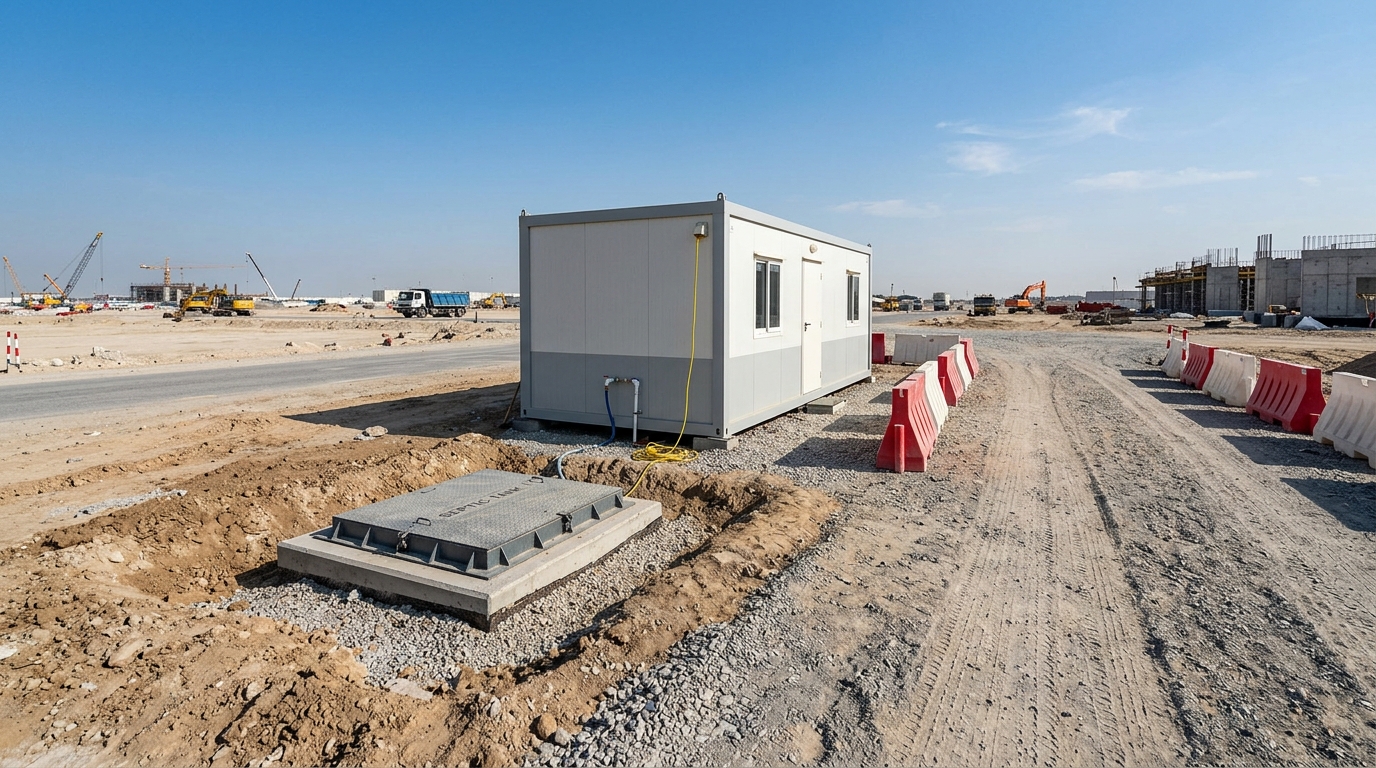

Anyone who has driven past a construction site in Dubai South, Dubai Investment Park, or one of the emirate’s fast-expanding logistics corridors in the last two years has probably noticed something different. Instead of scaffolding, mixers, and months of visible groundwork, flatbed trucks now deliver finished-looking box-like units that get lifted into place with a crane – and within days, a building starts to take shape.
That is modular construction, and it is quietly becoming one of the most important shifts in how Dubai builds.
Image Placement Suggestion #1 – Hero image, top of article Show a Dubai construction site with a crane lifting a finished modular unit into place, skyline visible in the background. ALT text: Crane lifting a modular construction unit on a Dubai building site
What Is Modular Construction, Exactly?
Modular construction is a building method where large sections of a structure – called modules – are manufactured off-site in a factory-controlled environment, then transported to the final location and assembled like building blocks.
It is less “building a building” and more “assembling pre-finished components.” Walls, floors, ceilings, electrical wiring, plumbing, insulation, and often even interior finishes are completed inside the factory. Only final assembly, service connections, and finishing touches happen on-site.
Key characteristics of modular construction:
- Off-site manufacturing – up to 80–90% of the work happens in a factory
- Parallel workflows – site groundwork (foundations, utilities) happens at the same time as module manufacturing, rather than after
- Standardized quality control – modules are built under consistent factory conditions, not variable weather
- Craned assembly – finished modules are lifted and connected on-site, often completing structural assembly in days or weeks rather than months
There are three related but distinct categories worth distinguishing:
- Volumetric modular – fully enclosed 3D units, similar in principle to how a porta cabin or prefab unit is manufactured, complete with walls, floor, and ceiling
- Panelized construction – flat panels (walls, floor cassettes) manufactured off-site and assembled into a 3D structure on-site
- Hybrid modular – a mix, where elements such as MEP-heavy bathroom pods are volumetric while the rest is panelized or conventional
Dubai’s market uses all three, depending on building type, though volumetric modular drives most of the attention because it is the fastest and most visually dramatic.
Image Placement Suggestion #2 – After the “Key characteristics” list Show a factory floor with a volumetric modular unit mid-assembly, walls and roof already framed. ALT text: Volumetric modular construction unit being built inside a factory
Why Dubai, and Why Now?
Modular construction is not new – it has existed for decades, especially in labor camps, temporary site offices, and school buildings. What is new is Dubai’s shift toward using it for permanent, high-quality, architecturally serious buildings: hotels, residential blocks, staff accommodation, retail kiosks, clinics, and even components of larger mixed-use towers.
Five forces are converging to make this the moment for modular in Dubai:
1. Dubai’s Construction Pipeline Is Enormous – and Time-Pressured
- Dubai’s construction market was valued at roughly USD 120.8 billion in 2025
- Dubai alone accounts for close to half of the entire UAE construction market by value
- Hospitality operators need rooms ready before a specific tourism season
- Logistics companies need warehouses operational before a lease or contract begins
- Developers are racing to deliver units before market conditions shift
Speed has become a competitive advantage, not just a nice-to-have.
2. Skilled Labor Is Harder to Scale Than Materials
- Every mega-project competes for the same pool of skilled tradespeople – electricians, MEP technicians, finishing carpenters
- Modular construction consolidates skilled labor into a small number of factories rather than spreading it across dozens of simultaneous job sites
- A single modular factory can run production lines with trained, permanent staff working under stable, repeatable conditions
This is a very different labor model than assembling a fresh crew for every new site.
3. Government Policy Is Actively Encouraging It
This point matters more than most generic articles admit: the regulator itself is pushing this forward.
Dubai Municipality’s Building Regulation and Permits Agency has been actively approving new modular building systems across the emirate, citing goals to:
- Accelerate project delivery
- Enhance construction efficiency
- Improve overall building quality
- Reduce material waste and environmental impact
This is regulator-led modernization, not a private-sector workaround.
4. Sustainability Targets Are Pushing Developers Toward Off-Site Methods
Off-site construction directly supports Dubai’s Clean Energy Strategy and the UAE Net Zero 2050 commitment because it:
- Generates significantly less material waste than on-site cutting and fitting
- Requires fewer vehicle trips to and from the site over the project lifecycle
- Enables higher-precision insulation and sealing, improving energy performance in Dubai’s cooling-dominated climate
- Makes it easier to consistently meet Al Sa’fat green building compliance benchmarks
5. The Market Numbers Back This Up
- The UAE’s prefabricated construction market reached roughly AED 24.49 billion in 2025, growing at around 8% annually
- The UAE modular construction market was valued at approximately USD 1.58 billion in 2025, projected to reach USD 2.76 billion by 2033
- Modular methods are expanding at a 6.54% CAGR, faster than the 5.64% CAGR of the overall construction market – meaning modular is taking market share, not simply riding the same wave
- Dubai represented roughly 47.2% of total UAE construction market share in 2025
The bottom line: this is not a fringe trend. It is a structural shift in how a meaningful share of Dubai’s building stock gets delivered, and it is a shift companies like Bait Al Maha have been building toward for years.
Image Placement Suggestion #3 – After “The Market Numbers Back This Up” Show an aerial or wide-angle view of the Dubai skyline with multiple active construction cranes visible. ALT text: Dubai skyline showing active modular construction and building cranes
How Modular Construction Actually Works, Step by Step
Here is what actually happens, phase by phase, when a modular building moves from concept to occupancy in Dubai.
Step 1: Design and Engineering
Because modules are manufactured in a factory to precise dimensions, the design phase locks in far more detail, far earlier, than conventional construction allows.
What happens at this stage:
- Architects and structural engineers design the building around a modular grid – dimensions aligned with efficient manufacturing and transport
- MEP engineers coordinate service runs so they connect cleanly between modules
- Structural engineers calculate loads for both transport (modules must survive being lifted, trucked, and craned) and in-service use (wind loads and Dubai’s specific climate stresses)
- 3D BIM modeling is used almost universally, since clash detection between modules is more critical than in traditional builds
A first-hand insight worth flagging: the single biggest risk in modular projects is not manufacturing – it is design freeze discipline. Once a module design is locked and production begins, late-stage changes are exponentially more expensive than in conventional construction, because an entire production line may need to change, not just a single wall on-site.
Step 2: Factory Manufacturing
Once designs are approved, production begins in a controlled factory environment. Inside the factory, modules typically go through:
- Steel or reinforced concrete frame fabrication – the structural skeleton of each module
- Insulation and cladding installation – critical for Dubai’s climate
- MEP rough-in – electrical wiring, plumbing lines, and HVAC ductwork installed inside walls and floors
- Interior finishing – flooring, wall finishes, fixtures, cabinetry, and sometimes furniture
- Quality control inspections – each module checked against specifications before leaving the factory floor
This phase delivers the biggest time compression, since it is completely unaffected by Dubai’s summer heat, sandstorms, or humidity – all of which routinely slow down conventional construction. Reported time savings from off-site manufacturing typically range from 30% to 50%, with fully modular buildings eventually reaching an average delivery time of around 5 months compared to roughly 12 months for equivalent conventional projects.
Image Placement Suggestion #4 – Inside “Step 2: Factory Manufacturing” Show workers on a factory production line installing MEP wiring or insulation inside a module frame. ALT text: Factory workers building modular construction units for Dubai projects
Step 3: Site Preparation (Happening in Parallel)
While modules are being built in the factory, the Dubai site is being prepared at the same time:
- Foundation work – footings, piling, or raft foundations depending on soil conditions
- Utility connections – DEWA power and water infrastructure, sewage connections, and telecom infrastructure
- Site access planning – crane positioning, delivery truck routes, and staging areas
This parallel-track approach is the real reason modular construction moves faster than conventional building. In a traditional build, foundation work and structural work happen sequentially. In modular, they happen simultaneously on two separate tracks that converge only at the assembly stage.
Step 4: Transport and Logistics
Modules travel from the factory to the site, often via flatbed trucks, sometimes requiring oversized load permits from Dubai’s Roads and Transport Authority (RTA).
Key logistics considerations specific to Dubai:
- Route planning around bridges, tunnels, and low-clearance infrastructure
- Timing around traffic restrictions, since oversized loads are often only permitted during specific night-time or off-peak windows
- Coordination with multiple authorities, including RTA, Dubai Municipality, and sometimes Dubai Police escort requirements
- Weather contingency built into schedules for rare sandstorms or high winds
Projects sourcing modules internationally must also add sea freight and customs clearance through Jebel Ali Port to the timeline.
Step 5: On-Site Assembly
This is the phase most associated with modular construction, since it is the most visually dramatic and fastest.
During assembly:
- Modules are lifted by crane and connected structurally, with joints sealed and reinforced per engineering specifications
- Inter-module utility connections are joined – often the most labor-intensive part of on-site work
- Weatherproofing and sealing is completed at all module junctions, critical in Dubai’s dusty climate
- Vertical circulation elements, such as stairwells and elevator shafts, are typically installed as separate structural cores
A building that might take months to frame conventionally can have its full structural shell assembled in days to a few weeks.
Image Placement Suggestion #5 – Inside “Step 5: On-Site Assembly” Show a crane lowering a finished modular unit onto a partially assembled building frame. ALT text: Modular construction assembly showing crane placing a prefab unit
Step 6: Final Finishing and Commissioning
Even though most interior finishing happens at the factory, a final on-site phase addresses:
- Exterior facade completion and architectural detailing
- Landscaping and external works
- Final MEP commissioning and testing, including fire alarm systems, HVAC balancing, and electrical load testing
- Dubai Civil Defence (DCD) fire and life-safety inspections
- Final Dubai Municipality building completion certificate inspection
Only after these approvals is the building cleared for occupancy – the same regulatory bar that applies to any conventional building in Dubai.
Regulatory Landscape: Is Modular Construction Fully Approved in Dubai?
The direct answer is: yes, but the details matter.
Dubai Municipality’s Building Regulation and Permits Agency actively reviews and approves specific modular building systems. This is not a blanket approval for “modular construction” as a generic category – it is system-specific approval.
What this means in practice:
- Not every modular manufacturer or system is automatically approved, so due diligence on a contractor’s specific approvals is essential
- Approved modular buildings go through the same core permitting pathway as conventional buildings, whether that is Dubai Municipality for most mainland areas or the relevant free zone authority, such as TRAKHEES or DDA
- Structural calculations, MEP layouts, and architectural drawings must be submitted through Dubai’s ePlan system and reviewed against the UAE Building Code, Dubai Building Code, and Al Sa’fat requirements
- Fire and life-safety compliance still requires Dubai Civil Defence approval, exactly as with a conventional structure
Typical permit-related costs and timelines:
| Item | Cost / Timeline |
| Major Works permits | AED 2,000–15,000 |
| Minor Works permits | AED 500–2,000 |
| Standard approval timeline | 15–30 days |
A practical note: the most common delay point is not the modular system itself. It is confirming, early, which authority governs the specific plot, since each has its own submission portal and review timeline. Working with an established manufacturer such as Bait Al Maha, which has an established track record with these approval pathways, tends to shorten this stage considerably.
Image Placement Suggestion #6 – Inside the Regulatory Landscape section Show a close-up of an approved building permit document, or an engineer reviewing structural drawings on-screen. ALT text: Dubai Municipality permit approval for modular construction project
Modular vs. Traditional Construction: A Direct Comparison
The two methods trade off differently across several dimensions:
- Speed – Modular can compress overall project timelines by roughly 30–50%, since site work and manufacturing happen in parallel. Traditional construction remains fully sequential.
- Cost predictability – Modular projects offer more predictable final costs, since most work is priced at the factory stage, insulated from on-site labor rate fluctuations or weather delays.
- Upfront cost – For small, simple, one-off structures, traditional construction can sometimes be cheaper, since modular manufacturing benefits from scale and repetition.
- Design flexibility – Traditional construction generally allows more late-stage flexibility and freeform architectural expression.
- Quality consistency – Modular has a structural advantage, since factory conditions allow tighter quality control and reduced exposure to weather-related defects.
- Site disruption – Modular dramatically reduces on-site activity duration, valuable for dense urban areas or sites near operating businesses.
- Waste and sustainability – Off-site manufacturing generates significantly less material waste than on-site cutting.
Where Modular Construction Is Being Used in Dubai Right Now
Modular construction is being deployed across a genuinely wide range of building types:
- Hospitality and hotel rooms – naturally repetitive units that make production most cost-effective
- Staff and labor accommodation – modern prefab accommodation units now deliver comfortable, code-compliant housing at scale
- Residential developments – villas, townhouses, and mid-rise blocks using modular or hybrid modular methods
- Healthcare facilities – clinics benefiting from speed and tightly controlled MEP-heavy spaces
- Retail kiosks and pop-up commercial spaces – fast deployment for seasonal or temporary retail
- Data centers and digital infrastructure – a newer, fast-growing niche tied to the UAE’s cloud computing sector
- Educational facilities – schools and training centers needing rapid expansion
- Site offices, security cabins, and labor camps – the traditional core of the prefab industry, an area covered in depth in Bait Al Maha’s service offering across UAE project sites
Image Placement Suggestion #7 – Inside “Where Modular Construction Is Being Used” Show a row of prefab staff accommodation units or a site office cluster on an active UAE project site. ALT text: Prefab staff accommodation units used in Dubai modular construction
Cost Considerations: What Actually Drives the Numbers
Factors that make modular construction more cost-competitive:
- High unit repetition – hotel rooms, staff accommodation, or standardized housing units compound factory efficiencies
- Tight timeline requirements – when the cost of delay outweighs any marginal cost difference
- Remote or difficult site conditions – sites with limited local labor benefit disproportionately from off-site work
- Standardized specifications – staying close to manufacturer-standard dimensions and finishes
Factors that reduce modular’s cost advantage:
- Highly bespoke, non-repeating architectural designs
- Complex site access with restricted crane access or difficult transport routing
- Very small overall project scale
A grounded rule of thumb: for fewer than roughly 10–15 repeated units, it is worth running the numbers both ways rather than assuming modular is automatically cheaper. The financial case strengthens sharply above that threshold.
Sustainability: The Environmental Case for Modular Construction in Dubai
Modular construction supports Dubai’s environmental commitments in several concrete ways:
- Reduced material waste – precise digital plans cut offcuts dramatically compared to a conventional site
- Lower embodied carbon from transport – fewer delivery trips needed over a project’s lifecycle
- Improved building envelope performance – factory-sealed insulation reduces air leakage, meaningful given Dubai’s cooling loads
- Easier Al Sa’fat compliance – factory-controlled manufacturing makes it easier to consistently meet insulation and efficiency benchmarks
- Reduced site disturbance – shorter on-site periods mean less dust and lower localized air quality impact
Challenges and Risks Worth Planning For
No construction method is without trade-offs. Understanding these risks in advance is what separates a smooth modular delivery from a frustrating one.
- Transport and route constraints can limit module size. Dubai’s road network includes bridges, tunnels, and interchanges with fixed clearance heights. Confirm transport routing and module size limits before finalizing architectural plans.
- Crane access and site staging need early planning. Dense urban sites or plots surrounded by existing buildings may have real constraints that need resolving during design, not on delivery day.
- Financing and valuation models sometimes lag behind the technology. Some lenders are still developing familiarity with modular methods, so it is worth checking with a specific lender early.
- Supply chain dependencies concentrate risk differently. A single supply disruption can affect an entire production batch. Experienced contractors build buffer stock and alternate supplier relationships into planning.
- Skilled MEP integration at joints is a genuine technical challenge. Poorly executed inter-module connections are a common source of post-occupancy defects such as water ingress or electrical faults.
None of these are reasons to avoid modular construction. They are the realistic planning considerations an experienced team accounts for from day one.
A Practical Example: How a Hospitality Project Might Unfold
Consider how a modular approach typically plays out for a mid-sized hotel project in Dubai:
- Conventional build: A 150-room hotel follows a linear sequence – foundations, then structural frame, then MEP rough-in floor by floor, then finishes floor by floor – often stretching to 18–24 months or more.
- Modular build: While the site team pours foundations and brings DEWA connections to the plot, the factory simultaneously produces dozens of identical, fully-finished guest room modules, complete with flooring, bathroom fixtures, wardrobes, and even wall-mounted televisions installed at the factory stage.
By the time foundations are cured, a significant share of guest room modules may already be complete and staged for delivery. Assembly then proceeds in a tight sequence:
- Cranes lift modules into position floor by floor
- The structural shell is often completed in weeks rather than months
- Vertical cores, such as elevators, stairwells, and corridors, are built conventionally in parallel
Net result: a project that can realistically compress its overall timeline by a third or more, turning a tight opening date from a scheduling risk into an achievable target.
Image Placement Suggestion #8 – Inside the Hospitality Example section Show the finished interior of a modular hotel guest room, fully furnished and ready for occupancy. ALT text: Finished interior of a modular hotel room built through modular construction
The Future of Modular Construction in Dubai
- Regulatory momentum is building, not slowing. As more systems earn Dubai Municipality approval, the pool of viable, code-compliant modular options keeps growing, typically driving down costs through competition.
- Technology integration is accelerating design and manufacturing precision, through wider BIM adoption and increasingly automated factory production lines.
- Market forecasts point to sustained, above-average growth – from roughly USD 1.58 billion in 2025 to approximately USD 2.76 billion by 2033.
- New use cases are emerging beyond traditional applications, including modular data center pods tied to the UAE’s expanding cloud computing sector.
- Affordable housing pressure will likely keep driving adoption, with demand for tens of thousands of new housing units projected across the UAE.
How to Choose a Modular Construction Partner in Dubai
- Confirm their specific modular system holds current Dubai Municipality (or relevant authority) approval. Do not assume general “modular experience” means regulatory clearance.
- Ask to see completed projects of comparable scale and building type. Bait Al Maha’s completed projects serve as one benchmark for what finished work should look like.
- Review their factory capacity and current production backlog.
- Clarify transport and logistics responsibility, including who manages RTA permits, route planning, and crane mobilization.
- Understand their design-freeze process and how late-stage changes are handled and priced.
- Check their MEP integration track record, since inter-module connections directly affect long-term building performance.
Is Modular Construction Right for Your Dubai Project?
Modular construction tends to make the strongest sense when:
- The project involves multiple repeated units, such as hotel rooms, staff housing, standardized residential units, or retail kiosks
- Speed to completion carries real financial value
- The site has logistical or labor access challenges
- Sustainability credentials matter to the developer or end client
- Consistent, factory-controlled quality across many identical units is a priority
It may be less compelling when:
- The project is a single, highly bespoke, architecturally unique structure
- The project is very small in scale
- The site has severe access constraints for crane-based delivery
Final Thoughts
Modular construction in Dubai is not a temporary trend or a workaround for labor shortages. It is a regulator-endorsed, market-validated shift in how a meaningful share of the emirate’s building stock is being delivered.
The key points to carry forward:
- Dubai Municipality is actively approving new modular systems, not merely tolerating them
- Market data shows modular growing faster than conventional construction overall
- Sustainability targets increasingly favor off-site manufacturing methods
- The fundamentals – design discipline, regulatory pathway, logistics planning, and honest cost modeling – apply regardless of project scale
Anyone ready to explore whether modular construction fits their next project can get in touch with Bait Al Maha or request a quote directly on WhatsApp to discuss requirements with the team.
Frequently Asked Questions
What is modular construction in Dubai? Modular construction in Dubai is a building method where large sections of a structure, called modules, are manufactured off-site in a factory-controlled environment and then transported to the final location for assembly. Dubai Municipality has formally approved specific modular building systems, allowing them to be used for permanent, code-compliant construction across the emirate.
Is modular construction cheaper than traditional construction in Dubai? It depends on the project. Modular construction tends to be more cost-effective for projects with a high number of repeated units, such as hotel rooms or staff accommodation, because factory production efficiencies compound with scale. For small, highly bespoke, one-off structures, traditional construction can sometimes be more cost-competitive.
How much faster is modular construction compared to conventional building methods? Modular construction can reduce overall project timelines by roughly 30% to 50% compared to traditional on-site construction, largely because site preparation and factory manufacturing happen simultaneously rather than sequentially.
Is modular construction legal and approved by Dubai Municipality? Yes. Dubai Municipality’s Building Regulation and Permits Agency actively reviews and approves specific modular construction systems for use across the emirate. Approval is system-specific, so it is important to confirm that the exact modular system being proposed for a project holds current regulatory approval.
What types of buildings use modular construction in Dubai? Modular construction is currently used across hotel rooms, staff and labor accommodation, residential villas and townhouses, healthcare clinics, retail kiosks, educational facilities, and data center pods, with hospitality and accommodation projects among the strongest current use cases due to their repetitive unit design.
Can modular buildings handle Dubai’s extreme heat and climate? Yes. Factory-controlled manufacturing allows for more precise insulation installation and tighter sealing against heat and dust infiltration than variable on-site construction conditions typically achieve, which can result in better building envelope performance in Dubai’s climate.
Does modular construction support Dubai’s sustainability goals? Yes. Modular construction generates significantly less material waste due to precision factory cutting, requires fewer delivery trips over a project’s lifecycle, and makes it easier to consistently meet Al Sa’fat green building compliance benchmarks across multiple units.
Who regulates modular construction projects in Dubai? Depending on the project location, modular construction is regulated by Dubai Municipality for most mainland areas, or by the relevant free zone authority, such as TRAKHEES or the Dubai Development Authority (DDA), for designated development zones. All modular projects must still comply with the UAE Building Code, Dubai Building Code, and receive Dubai Civil Defence approval for fire and life-safety compliance.
Image Placement Suggestions (Summary Table)
| # | Section / Location | Image Description | ALT Text |
| 1 | Hero, top of article | Crane lifting a finished modular unit into place on a Dubai site, skyline in background | Crane lifting a modular construction unit on a Dubai building site |
| 2 | After “Key characteristics of modular construction” list | Factory floor with a volumetric modular unit mid-assembly | Volumetric modular construction unit being built inside a factory |
| 3 | End of “Why Dubai, and Why Now?” | Wide/aerial shot of Dubai skyline with multiple active construction cranes | Dubai skyline showing active modular construction and building cranes |
| 4 | Step 2: Factory Manufacturing | Workers on a production line installing MEP wiring or insulation inside a module | Factory workers building modular construction units for Dubai projects |
| 5 | Step 5: On-Site Assembly | Crane lowering a finished module onto a partially assembled building frame | Modular construction assembly showing crane placing a prefab unit |
| 6 | Regulatory Landscape section | Close-up of an approved permit document or engineer reviewing structural drawings | Dubai Municipality permit approval for modular construction project |
| 7 | Where Modular Construction Is Used | Row of prefab staff accommodation units or a site office cluster on an active site | Prefab staff accommodation units used in Dubai modular construction |
| 8 | Hospitality Example section | Finished, furnished interior of a modular hotel guest room | Finished interior of a modular hotel room built through modular construction |