

Electrical & HVAC Setup for Site Office Cabins in Dubai: The Complete Guide
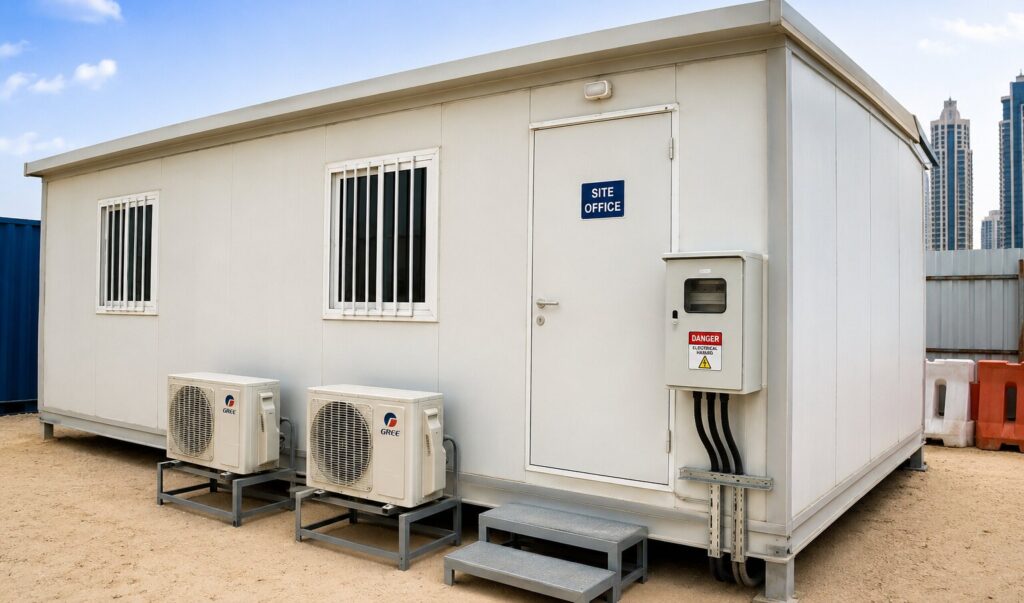
A correct electrical & HVAC setup for a site office cabin in Dubai means running power from DEWA mains or a generator into a weatherproof distribution board fitted with ELCB and MCB protection, earthing the cabin properly, and wiring it with fire-retardant, low-smoke cable that meets Dubai Civil Defence (DCD) standards. On the cooling side, a 20ft cabin generally needs 1.5 to 2 tons of refrigeration, and a 40ft cabin needs 3 tons or more, usually split across two units. Get the electrical & HVAC setup wrong, and the problem is not just discomfort in the heat. It becomes a failed inspection, a fire hazard, or a project delay that costs far more than doing it right the first time. This guide breaks the process down into every stage a project manager, facilities lead, or contractor in Dubai and across the wider UAE actually needs to plan for, with real sizing logic, cost ranges, compliance steps, and the mistakes that come up again and again on real portacabin and prefab office projects. For a broader look at portacabin types, sizing, and costs beyond electrical and HVAC alone, our complete guide to site offices in Dubai covers the full picture. Electrical & HVAC Setup Quick Reference: What a Compliant Setup Looks Like Before going into detail, here is the shorthand version most site managers want pinned to the cabin wall. Requirement Standard Practice for Dubai Site Office Cabins Power source DEWA mains where available, or a diesel generator for remote or interim phases. Distribution board Weatherproof, IP-rated, fitted with ELCB and MCB protection. Cabling Fire-retardant (FR) or low-smoke zero-halogen (LSZH), run through conduit. Earthing Mandatory on every cabin, tested and verified before handover. AC sizing – 20ft cabin (~15 sqm) 1.5–2 TR. AC sizing – 40ft cabin (~30 sqm) 3 TR, often split into two 1.5 TR units. Insulation PUF or EPS sandwich panel, 50–75mm thickness. Governing bodies DEWA, Dubai Civil Defence (DCD), and Dubai Municipality or Trakhees in free zones. Each row in this table gets a full explanation below, including why it is the standard and not just what the standard is. Why the Regulatory Side of Your Electrical & HVAC Setup Is Not Optional A site office cabin looks temporary, but Dubai treats the electrical and fire safety systems inside it with the same seriousness as a permanent building. Three separate authorities have a say in how the cabin gets powered and approved, and confusing their roles is one of the most common reasons a setup gets stuck in paperwork. The Three Authorities and What Each One Controls DEWA (Dubai Electricity and Water Authority) controls the power supply itself. This includes grid connections, temporary construction supply, and any request to increase load capacity mid-project. According to DEWA’s builder services documentation, a connection request needs a load schedule, a single-line diagram, and a site layout before an estimate is even issued. Dubai Civil Defence (DCD) governs what happens if something goes wrong. This covers fire-rated cabling, circuit protection, extinguisher placement, and emergency exit requirements. DCD’s fire and life safety code places heavy emphasis on electrical faults specifically, since they remain one of the most common causes of fire incidents on any site, temporary or permanent. Dubai Municipality or Trakhees (in free zones such as JAFZA) governs where the cabin physically sits. This includes its position relative to other structures and whether the plot itself is approved for temporary office use. Who Handles What, In Practice Your electrical contractor manages the DEWA-facing paperwork and connection application. Your fire safety contractor manages the DCD-facing cabling, extinguisher, and signage requirements. Your facilities or project team secures sign-off from whichever authority controls the plot itself. Skipping any one of these three steps is what turns a two-week cabin setup into a two-month one. Confirm all three approval paths at the very start of the project, not after the cabin has already arrived on site. Electrical Setup for Site Office Cabins: What Actually Goes Into the Cabin Choosing Your Power Source Most site offices in Dubai run on one of three setups. The right choice depends on where the project stands and how remote the site is. DEWA mains connection. The most stable, long-term option once the site has a confirmed supply point. Running costs are lower per month, there is no fuel logistics to manage, and this is generally the preferred option once it becomes available. Diesel generator. Necessary before DEWA supply is active, or on sites far from existing infrastructure. This option requires ongoing fuel delivery, routine servicing, and a plan for the noise and exhaust, since the cabin sits right next to the unit. Hybrid setup. DEWA as the primary source, with a generator kept as backup for critical loads such as server racks or security systems. This is more common on larger, longer-duration site offices where downtime is not acceptable. Option Best Suited For Advantages Trade-offs DEWA mains Sites with a confirmed connection. Stable supply, lower running cost, no fuel handling. Requires application lead time. Diesel generator Early-phase or remote sites. Immediate power, no waiting on approvals. Fuel cost, noise, and maintenance burden. Hybrid (DEWA + backup generator) Long-duration or critical-load offices. Redundancy, no single point of failure. Higher upfront setup cost. Working Out the Load You Actually Need This step is the one most articles skip, yet it is the step that determines the correct size for the distribution board and the cable. The method is simple: List every piece of equipment that will run in the cabin. Add up the wattage of each item. Convert the total to amps. Add a safety margin for future equipment. Example – a 20ft cabin. Lighting (LED, whole cabin): approximately 200W. Standard sockets (computers, printer, kettle, fridge): approximately 2,000W. 2 TR split AC unit: approximately 2,200W running load. Miscellaneous items (chargers, small appliances): approximately 500W. The total connected load comes to roughly 4,900W, or 4.9kW. On a standard single-phase 230V supply, that works out to around 21 amps