
Top 5 Advantages of Prefab Buildings for Dubai Developers in 2026
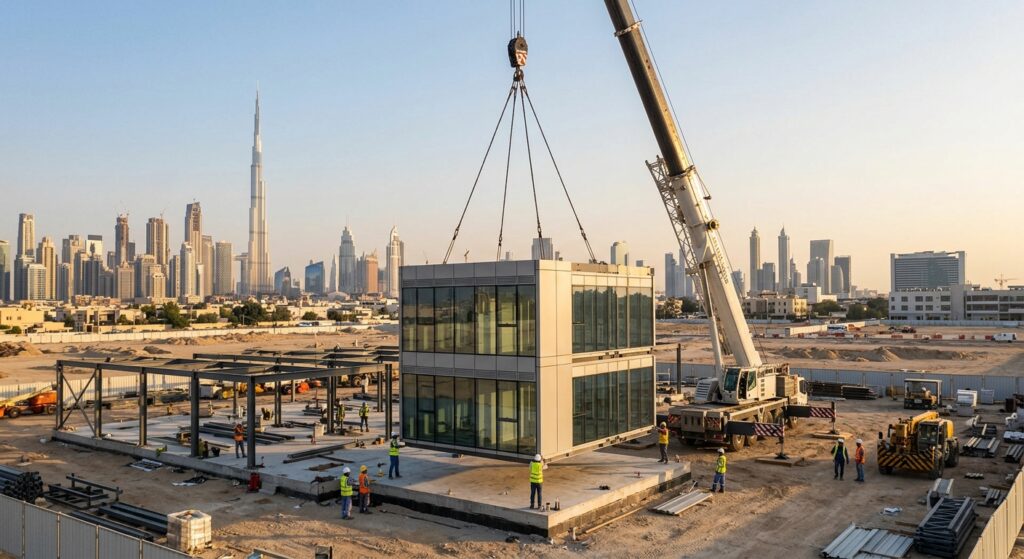
Dubai developers work under a demanding set of conditions. Land is expensive, skilled labour is tight, and handover dates rarely move. Investors expect income to start on schedule, tenants expect space that is ready when promised, and authorities expect safer, better documented and more sustainable buildings. On top of all this, the summer heat of the Gulf punishes every day spent on an open site, slowing work and raising risk. If you are asking whether there is a smarter way to build, the answer is yes, with some important conditions. The advantages of prefab buildings are now measurable, well documented and highly relevant to the way Dubai builds in 2026. This guide explains what those advantages really are, where the numbers come from, where the risks sit, and how to decide whether prefab suits your next project. The sections below take each advantage in turn and explain it in practical detail. If you are also planning workforce housing as part of your development, our prefab accommodation and labour camp solutions are a useful companion to this guide. What Are Prefab Buildings, and Why Do They Matter in Dubai? A prefab building, short for prefabricated building, is a structure whose main components are manufactured in a controlled factory and then transported to the site for assembly. Instead of building everything outdoors, exposed to heat, wind, dust and unpredictable labour availability, most of the work happens indoors under supervision. The site then becomes an assembly and finishing location rather than a full manufacturing site. That shift of work from the site to the factory is the source of nearly every advantage discussed in this article. It helps to understand that prefab is an umbrella term rather than a single product. Different formats suit different building types, and choosing the wrong format is one of the most common reasons a prefab project underperforms. Before comparing prefab with conventional construction, it is worth knowing the main formats and what each does best. The essentials to keep in mind before comparing methods: Prefab means factory-made components that are assembled on site, not a single product or style. Moving work indoors is the source of nearly every advantage in speed, quality and cost control. Dubai conditions, from heat to fast-moving markets, make the approach unusually relevant. Common Types of Prefab Construction Modular buildings are the most complete form of prefabrication. Entire three-dimensional units are built in the factory, often with electrical wiring, plumbing, internal finishes and even furniture installed before delivery. These units are transported to the site, lifted into position and connected to each other and to utilities. Modular construction is widely used for staff accommodation, offices, clinics, classrooms and hospitality units, because rooms repeat and interiors are labour intensive. Panelised systems take a different approach. Wall, floor and roof panels are manufactured off site, then delivered flat and assembled on site. Because flat panels are easier to transport than full modules, this approach works well where access is limited or where more design variety is needed. Pre-engineered steel buildings, often called PEB (see the steel structures and prefab buildings range), are among the most common prefab types in the UAE. Steel frames are designed and fabricated to exact specifications, then bolted together on site and clad with insulated panels. They dominate warehouses, factories, logistics hubs and showrooms because they offer large clear spans at a competitive cost. Portable and relocatable cabins are self-contained units designed to be moved. They serve as site offices, security posts, small accommodation units and temporary facilities. Finally, hybrid systems combine several methods, such as precast concrete floors, steel frames and modular bathroom pods inside a conventional structure. Hybrid thinking is increasingly popular among Dubai developers because it captures much of the speed advantage while keeping design freedom for the parts of a building that need it. The five formats developers meet most often: Modular buildings: complete three-dimensional units delivered with services and finishes installed. Panelised systems and pre-engineered steel (PEB): flat panels or steel frames assembled on site, common for warehouses and factories. Portable cabins and hybrid systems: relocatable units and mixed methods that combine precast, steel and modular elements. Why Dubai Is a Natural Fit Several features of the Dubai market make factory-based construction unusually attractive. The first is climate. Summer temperatures regularly pass 40°C, and coastal humidity adds further stress to workers, materials and equipment. Factory production protects both people and materials from these conditions, and it keeps working at a steady pace through the months when outdoor productivity drops. The second is the speed of the market itself. Master-planned communities, free zones and industrial clusters all reward fast delivery, and tenants in logistics, retail and accommodation often need space within months rather than years. The third is infrastructure. Jebel Ali Port, a dense road network and a strong regional fabrication base make it practical to produce, import and move components efficiently. Finally, public policy points in the same direction. Long-term strategies such as the Dubai 2040 Urban Master Plan and the Dubai Clean Energy Strategy 2050 favour innovation, efficiency and lower environmental impact, all of which align naturally with industrialised construction. Dubai offers several conditions that reward factory-based construction: Extreme climate: summer heat and humidity make controlled factory work safer and more productive. Fast-moving demand: free zones, master plans and industrial clusters reward speed to market. Strong logistics and policy support: Jebel Ali Port, regional fabrication and long-term strategies favour innovation and sustainability. Faster Project Delivery and Earlier Revenue Speed is the most cited of all the advantages of prefab buildings, and in Dubai it is also the most valuable. Rental yields, off-plan sales and operating contracts all depend on handover dates, and every month of delay carries a direct financial cost. When a project finishes earlier, income starts earlier, loans are repaid sooner and capital returns to the developer faster for use on the next project. Speed delivers value in three connected ways: Parallel workflows that overlap factory production with site preparation. Earlier occupancy,