

Porta Cabin Site Office for Government Projects in Dubai
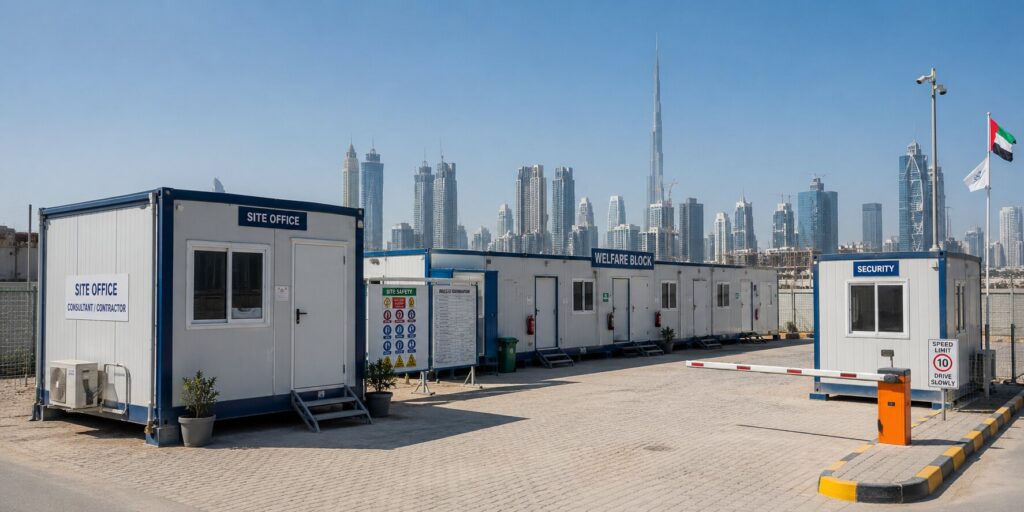
A porta cabin site office for government projects in Dubai requires a Temporary Building Permit (TBP) from Dubai Municipality before any structure is placed on site. The cabin must be built with fire-rated sandwich panels carrying a third-party Class A fire rating certificate, a hot-dip galvanised steel frame, inverter-type split AC units, and 220V/50Hz wiring with RCD protection, all of which are verified by UAE Civil Defense during a mandatory physical inspection. Welfare facilities must meet MOHRE standards, which require a minimum of one toilet for every 15 workers, a dedicated prayer room, and handwashing stations. If the project falls within a JAFZA or DP World territory, approvals must go through Trakhees EHS instead of, or in addition to, Dubai Municipality. The permit process takes between 25 and 55 working days depending on the project type and jurisdiction. Starting the approval process on the same day the cabin is ordered is the only way to avoid a stop-work notice on a Dubai government construction site. What Is a Porta Cabin Site Office for Government Project in Dubai? A porta cabin site office for government project is a prefabricated, relocatable modular structure that serves as the on-site administrative and operational headquarters for a construction project. It houses the project management team, site engineers, document controllers, QA/QC staff, and consultants. It is where permits are stored, where inspections begin, and where the day-to-day running of the project is coordinated. On a private development site in Dubai, a porta cabin is simply a practical convenience. On a UAE government project site, it is a regulated structure that must be engineered, documented, inspected, and approved by multiple authorities before a single worker can sit inside it. This distinction matters because many contractors treat the site office as an afterthought, something to sort out after the main contract is awarded. On a government construction site in Dubai, that approach routinely results in: Stop-work notices that halt the entire project, not just the site office. Re-inspection fees and mandatory remediation periods. Permit resubmissions that add weeks to the mobilisation timeline. Project delays that trigger contractual penalty clauses. Which Government Bodies Commission These Projects in Dubai? Government projects in Dubai are commissioned by public-sector entities, each with its own requirements for a compliant site office: Dubai Municipality (DM) for roads, drainage, public parks, and community infrastructure. Roads and Transport Authority (RTA) for highway expansions, Dubai Metro extensions, and bus depots. Dubai Electricity and Water Authority (DEWA) for power substations, water treatment plants, and pipeline works. Dubai South Authority for Expo City legacy infrastructure and Al Maktoum International Airport expansion. DP World and JAFZA entities for port, logistics corridor, and special economic zone infrastructure. Two Cabin Formats Used on Government Sites Across the UAE Sandwich panel modular cabins are the most common choice for contracts running up to three years, offering rapid fabrication and straightforward transport across Dubai and the wider UAE. ISO container conversions are increasingly preferred for long-duration infrastructure projects where structural permanence and resistance to impact damage outweigh the need for rapid mobilisation. Most contractors sourcing a compliant site office in Dubai end up comparing a handful of established UAE manufacturers, and the range of consultant cabins, contractor cabins, toilet blocks, security cabins, and container office conversions available locally gives a useful starting reference point for what a government-grade compound should include. Why Government Projects in Dubai Demand a Higher Standard of Site Office The easiest way to understand why a porta cabin site office for government projects is held to a different standard than a private-sector cabin is to look at what happens when that standard is not met. Contractors who have navigated government site inspections in Dubai know from experience that the site office is assessed before any structural work on the main contract is evaluated. Here is what typically happens when a site office fails to meet standard: An inspector from Dubai Municipality or UAE Civil Defense arrives and finds an uncleared cabin, one without a valid TBP displayed, or one built with non-fire-rated panels. The inspector does not move on to inspect the rest of the site. A stop-work notice is issued instead, halting every activity on the project, not just the site office. The contractor must resolve the non-compliance before any work can resume. On a contract with delay penalty clauses, the cost is disproportionate to what began as a simple procurement shortcut. It Is a Contractual Obligation, Not Just a Regulatory One Most Dubai government tender packages issued by DM, RTA, and DEWA include a site establishment clause within the contract documentation. This clause specifies: The minimum structural and material standards for all temporary structures. The welfare facility requirements that must be operational before work begins. The compliance documentation that must be available for inspection on demand. The permit sequence that must be completed before any cabin can be occupied. Failing to comply with this clause is not just a regulatory issue. It is a breach of the signed government contract. The Dubai Statistics Center reported that over 55,000 building permits were issued in 2024 alone, a 7.2% increase over the prior year, reflecting both the scale of construction activity and the increasingly competitive regulatory environment contractors now operate within. Multi-Authority Oversight Is the Norm on a Government Site Office in Dubai Private development sites typically deal with Dubai Municipality as their primary regulatory body. Government project sites simultaneously answer to several independent authorities: Dubai Municipality for building permits, site plan compliance, and structural standards. UAE Civil Defense for fire safety, panel ratings, detection systems, and evacuation provisions. MOHRE for worker welfare, toilet ratios, prayer facilities, and accommodation standards. Trakhees EHS for all of the above, independently, on sites within JAFZA and DP World zones. These bodies do not coordinate inspection schedules with one another. A pass from one authority offers no protection against a failure from another. Dubai’s Climate Turns Site Office Engineering Into a Genuine Safety Requirement Average temperatures on a Dubai