

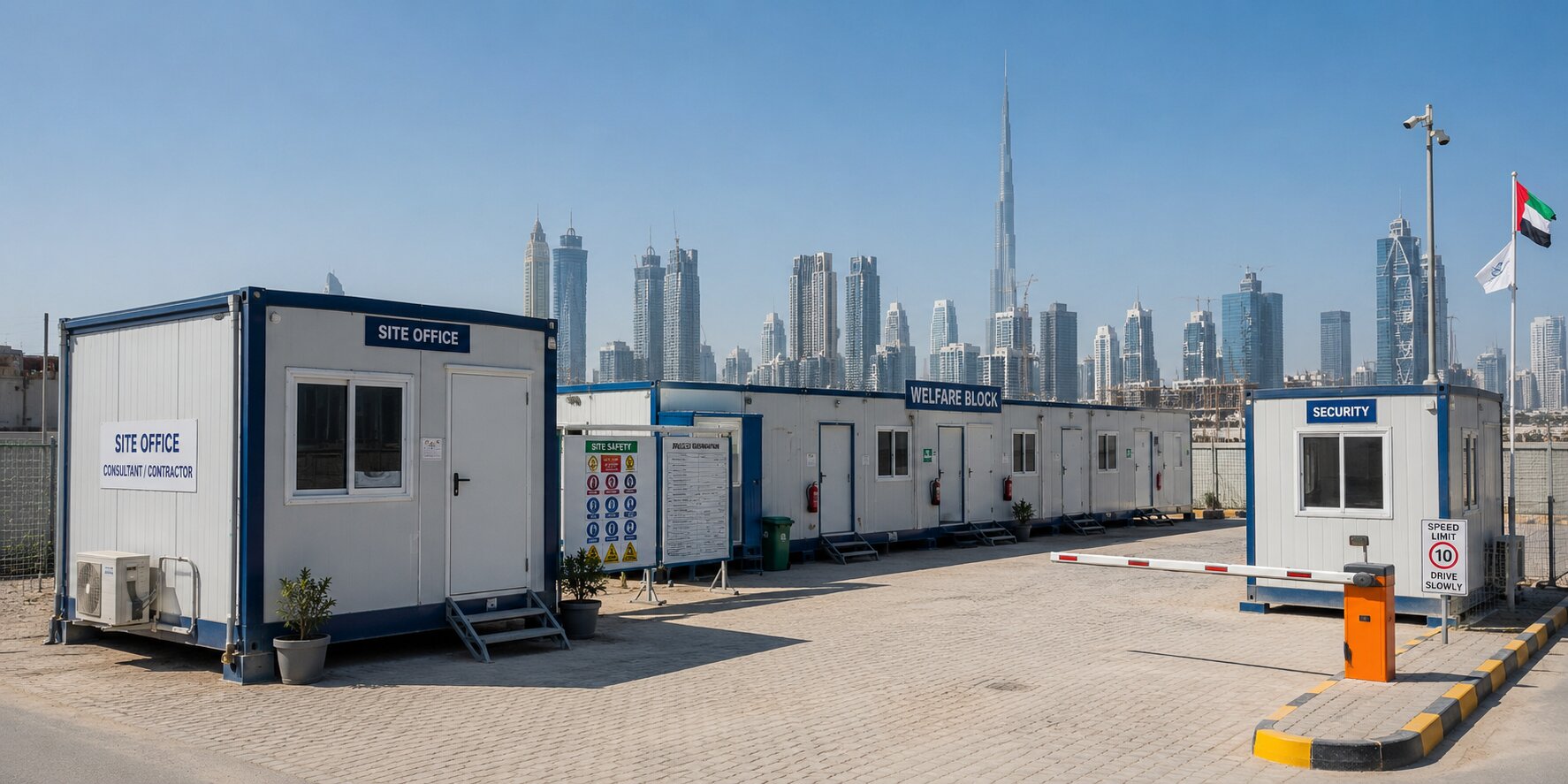
A porta cabin site office for government projects in Dubai requires a Temporary Building Permit (TBP) from Dubai Municipality before any structure is placed on site. The cabin must be built with fire-rated sandwich panels carrying a third-party Class A fire rating certificate, a hot-dip galvanised steel frame, inverter-type split AC units, and 220V/50Hz wiring with RCD protection, all of which are verified by UAE Civil Defense during a mandatory physical inspection.
Welfare facilities must meet MOHRE standards, which require a minimum of one toilet for every 15 workers, a dedicated prayer room, and handwashing stations. If the project falls within a JAFZA or DP World territory, approvals must go through Trakhees EHS instead of, or in addition to, Dubai Municipality. The permit process takes between 25 and 55 working days depending on the project type and jurisdiction. Starting the approval process on the same day the cabin is ordered is the only way to avoid a stop-work notice on a Dubai government construction site.
What Is a Porta Cabin Site Office for Government Project in Dubai?
A porta cabin site office for government project is a prefabricated, relocatable modular structure that serves as the on-site administrative and operational headquarters for a construction project. It houses the project management team, site engineers, document controllers, QA/QC staff, and consultants. It is where permits are stored, where inspections begin, and where the day-to-day running of the project is coordinated.
On a private development site in Dubai, a porta cabin is simply a practical convenience. On a UAE government project site, it is a regulated structure that must be engineered, documented, inspected, and approved by multiple authorities before a single worker can sit inside it.
This distinction matters because many contractors treat the site office as an afterthought, something to sort out after the main contract is awarded. On a government construction site in Dubai, that approach routinely results in:
- Stop-work notices that halt the entire project, not just the site office.
- Re-inspection fees and mandatory remediation periods.
- Permit resubmissions that add weeks to the mobilisation timeline.
- Project delays that trigger contractual penalty clauses.
Which Government Bodies Commission These Projects in Dubai?
Government projects in Dubai are commissioned by public-sector entities, each with its own requirements for a compliant site office:
- Dubai Municipality (DM) for roads, drainage, public parks, and community infrastructure.
- Roads and Transport Authority (RTA) for highway expansions, Dubai Metro extensions, and bus depots.
- Dubai Electricity and Water Authority (DEWA) for power substations, water treatment plants, and pipeline works.
- Dubai South Authority for Expo City legacy infrastructure and Al Maktoum International Airport expansion.
- DP World and JAFZA entities for port, logistics corridor, and special economic zone infrastructure.
Two Cabin Formats Used on Government Sites Across the UAE
- Sandwich panel modular cabins are the most common choice for contracts running up to three years, offering rapid fabrication and straightforward transport across Dubai and the wider UAE.
- ISO container conversions are increasingly preferred for long-duration infrastructure projects where structural permanence and resistance to impact damage outweigh the need for rapid mobilisation.
Most contractors sourcing a compliant site office in Dubai end up comparing a handful of established UAE manufacturers, and the range of consultant cabins, contractor cabins, toilet blocks, security cabins, and container office conversions available locally gives a useful starting reference point for what a government-grade compound should include.
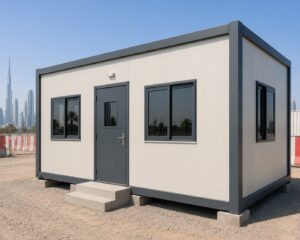
Why Government Projects in Dubai Demand a Higher Standard of Site Office
The easiest way to understand why a porta cabin site office for government projects is held to a different standard than a private-sector cabin is to look at what happens when that standard is not met.
Contractors who have navigated government site inspections in Dubai know from experience that the site office is assessed before any structural work on the main contract is evaluated. Here is what typically happens when a site office fails to meet standard:
- An inspector from Dubai Municipality or UAE Civil Defense arrives and finds an uncleared cabin, one without a valid TBP displayed, or one built with non-fire-rated panels.
- The inspector does not move on to inspect the rest of the site.
- A stop-work notice is issued instead, halting every activity on the project, not just the site office.
- The contractor must resolve the non-compliance before any work can resume.
- On a contract with delay penalty clauses, the cost is disproportionate to what began as a simple procurement shortcut.
It Is a Contractual Obligation, Not Just a Regulatory One
Most Dubai government tender packages issued by DM, RTA, and DEWA include a site establishment clause within the contract documentation. This clause specifies:
- The minimum structural and material standards for all temporary structures.
- The welfare facility requirements that must be operational before work begins.
- The compliance documentation that must be available for inspection on demand.
- The permit sequence that must be completed before any cabin can be occupied.
Failing to comply with this clause is not just a regulatory issue. It is a breach of the signed government contract. The Dubai Statistics Center reported that over 55,000 building permits were issued in 2024 alone, a 7.2% increase over the prior year, reflecting both the scale of construction activity and the increasingly competitive regulatory environment contractors now operate within.
Multi-Authority Oversight Is the Norm on a Government Site Office in Dubai
Private development sites typically deal with Dubai Municipality as their primary regulatory body. Government project sites simultaneously answer to several independent authorities:
- Dubai Municipality for building permits, site plan compliance, and structural standards.
- UAE Civil Defense for fire safety, panel ratings, detection systems, and evacuation provisions.
- MOHRE for worker welfare, toilet ratios, prayer facilities, and accommodation standards.
- Trakhees EHS for all of the above, independently, on sites within JAFZA and DP World zones.
These bodies do not coordinate inspection schedules with one another. A pass from one authority offers no protection against a failure from another.
Dubai’s Climate Turns Site Office Engineering Into a Genuine Safety Requirement
Average temperatures on a Dubai construction site in June, July, and August regularly exceed 45°C. Inside an uninsulated cabin, surface temperatures can push above 60°C during peak hours, creating a genuine occupational health risk that MOHRE monitors actively.
The structural threat is equally real. Dubai’s coastal humidity subjects steel frames to persistent salt-laden air. On sites near Dubai Creek, Dubai Harbour, Port Rashid, or any reclaimed land development:
- A painted steel frame shows surface rust within 12 to 18 months.
- A zinc spray-coated frame begins structural degradation within 3 to 4 years.
- A hot-dip galvanised frame with a minimum 60-micron zinc coat remains structurally sound for the full service life of a 5 to 7 year government contract.
MOHRE has been progressively strengthening welfare regulations across the UAE. Its April 2026 regulations now mandate free internet access, enhanced health facilities, and recreational provisions in worker accommodation. A cabin that barely passed inspection in 2022 may not pass one today.
The Commercial Risk of Non-Compliance Extends Beyond a Single Project
An inspection failure on a government project does not stay on that project alone. It generates a compliance record linked to the contractor’s regulatory profile, which can:
- Affect eligibility for future Dubai government tenders.
- Trigger additional scrutiny on all subsequent permit applications.
- Appear in the contractor’s digital compliance profile within Dubai’s Building Permit System, fully digitalised since 2024.
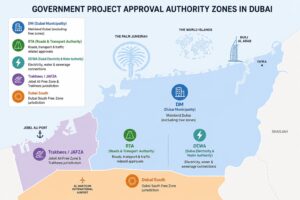
Which Government Authority Governs Your Site Office Approval in Dubai?
This is the question that most guidance on government site office cabins either skips entirely or answers with a one-size-fits-all response that does not reflect how Dubai’s construction regulation actually works. The governing authority depends on two factors:
- Which government entity commissioned the project.
- Where the project site is physically located.
Getting this wrong, most commonly by applying to Dubai Municipality for a site that falls partly within a Trakhees zone, is one of the most common and most costly mistakes in government project site establishment across the UAE. A DM permit will not cover the Trakhees portion of the site, and Trakhees can issue a stop order on that section independently of whatever DM has approved elsewhere.
Dubai Municipality: Standard Government Public Works
Covers: Public roads, drainage and stormwater networks, municipal buildings, public parks, waste management facilities, and most local authority infrastructure across mainland Dubai.
- Applications go through DM’s Building Control Department via the Dubai Building Permit System (BPS) and the Dubai REST platform.
- Inspection bodies are DM inspectors and UAE Civil Defense, who conduct separate, independent visits.
- Processing time is 5 to 10 working days for a clean, complete application.
- The original TBP must be physically displayed inside the site office at all times.
Roads and Transport Authority: Transport Infrastructure
Covers: Highway expansions and upgrades, interchange construction, Dubai Metro line extensions, bus depots and terminals, pedestrian bridges, and cycling infrastructure.
- RTA projects require an additional NOC from RTA’s own project department before DM will process the TBP.
- This multi-NOC requirement extends processing time to 15 to 25 working days.
- Inspection bodies are DM, UAE Civil Defense, and an RTA site engineer who provides separate sign-off.
DEWA: Utility Infrastructure
Covers: Power substations, high-voltage cable corridors, water treatment facilities, desalination plants, and pipeline expansion works.
- The site office TBP falls under Dubai Municipality’s jurisdiction, but DEWA adds specific electrical safety requirements to the cabin specification.
- Sites near live DEWA utility corridors require dedicated cable burial arrangements, additional isolation switches, and surge protection on distribution boards.
- The DEWA Building NOC runs parallel to the TBP application and typically takes three working days per service.
Trakhees EHS: Special Economic Zones and DP World Territories
Covers: JAFZA (Jebel Ali Free Zone), DP World port territories, Dubai Maritime City, Dubai World-managed land, and designated logistics corridors.
- Trakhees is a parallel regulatory authority, not a supplementary one, with its own portal, engineers, inspection team, and fee schedule.
- A Dubai Municipality TBP is legally void within Trakhees jurisdiction.
- If the site boundary straddles both DM and Trakhees zones, both permits are required simultaneously.
- In JAFZA specifically, a Modification Completion Certificate from Trakhees CED is required before EHS issues the operational permit.
- Allow 30 to 40 working days for full Trakhees approval on a government project.
Dubai South Authority: Expo City Legacy and Aerotropolis Projects
Covers: Projects within the Dubai South master development, Expo City legacy infrastructure, and Al Maktoum International Airport expansion works.
- Dubai South Authority adds a master developer oversight layer on top of DM and Civil Defense approvals.
- Site compound plans are reviewed and approved by Dubai South before DM processes the TBP.
Essential Government Regulations and Approvals for a Porta Cabin Site Office in Dubai
Temporary structures cannot simply be placed on a Dubai government construction site. They require formal approval from multiple authorities, each with its own documentation requirements, submission process, and physical inspection criteria, before the government project site office can legally be occupied.
Dubai Municipality Temporary Building Permit (TBP)
The Temporary Building Permit is the foundational legal document for any porta cabin or temporary structure placed on a construction site in Dubai. It is a distinct permit from the main construction permit, and it must be obtained before the cabin is positioned on site.
The TBP cannot be applied for without an active main construction permit already in place. Contractors who attempt to place a cabin on site while the main permit is still being processed will be in breach before the project has truly begun.
Required documents for TBP application:
- Copy of the active main construction permit number.
- Site plan showing the cabin footprint, setback distances from all boundaries (minimum 3 metres), access routes for emergency vehicles, fire assembly points, and the precise location of all welfare facilities.
- Material specification sheet for the cabin, including a numbered, third-party fire rating certificate for wall and roof panels.
- NOC from the plot owner. For government land, the commissioning entity (DM, RTA, DEWA) provides this NOC.
- HVAC load calculation signed and stamped by a UAE-licensed mechanical engineer.
- For double-storey configurations: structural drawings certified by a UAE-licensed civil engineer.
Processing and display:
- Standard DM projects: 5 to 10 working days with complete documentation.
- Multi-authority projects requiring RTA or DEWA NOCs: 15 to 25 working days.
- The original TBP must be displayed inside the site office, in a clearly visible location, at all times. A laminated copy fixed to the document control wall is the standard approach on professionally managed sites.
UAE Civil Defense: Fire Safety Compliance for Site Office Cabins
UAE Civil Defense does not grant approval through paper review alone. A physical site inspection is mandatory before the cabin is cleared for occupation, governed by the UAE Fire and Life Safety Code of Practice, published by the Directorate General of Civil Defence.
What Civil Defense checks during inspection:
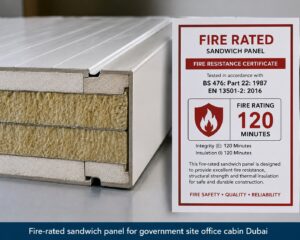
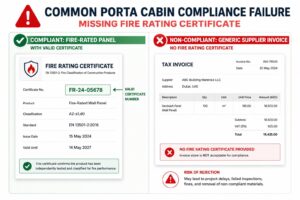
- Panel fire rating. Wall and roof panels must carry a numbered, traceable Class A fire rating certificate. A product label that simply says “insulated” or “sandwich panel” without a certificate number will fail. This is the most common reason for first-visit rejection.
- Smoke detectors in all enclosed cabin spaces, including the main office, meeting rooms, and any server room.
- Heat sensors in kitchen and pantry areas and near electrical distribution boards.
- Fire extinguishers, with a minimum of one CO₂ unit per cabin and dry powder units near fuel or electrical equipment.
- Emergency lighting above all exit routes, functional independently of the main power supply.
- Evacuation signage, including a printed route map at each exit point identifying the site’s primary fire muster point.
- Fire access route confirming emergency vehicles can reach the office and the wider compound.
If the inspection fails, a re-inspection fee applies and a minimum seven-day remediation period is required before re-inspection can be scheduled.
MOHRE: Worker Welfare and Labour Standards
MOHRE monitors welfare conditions on construction sites across the UAE and inspects unannounced. Non-compliance generates direct fines, a welfare flag on the contractor’s MOHRE Tawteen portal profile, and potential suspension of labour supply permits for the entire workforce.
Mandatory welfare standards for a government construction site office in Dubai:
- A minimum of one toilet for every 15 workers, calculated against peak headcount, not average attendance.
- Separate male and female toilet facilities where both genders are employed.
- Handwashing stations with running water and soap, positioned next to toilet blocks.
- A shaded prayer room with a qibla marker and an ablution tap immediately outside.
- Drinking water dispensers at accessible points across the compound.
- For sites with 50 or more workers: a covered rest area separate from the working zone.
- For long-duration or remote sites: on-site accommodation meeting 3.25 square metres per person, maximum four workers per room.
- Free internet access in worker accommodation, mandated under MOHRE’s April 2026 regulations.
Trakhees EHS Approval for JAFZA and DP World Zones
Within JAFZA, DP World territories, Dubai Maritime City, and other PCFC-governed zones, Trakhees operates as the sole construction regulatory authority, combining civil engineering, environmental compliance, and fire and life safety oversight into a single integrated approval.
- Submissions go through the PCFC Smart Portal and require drawings prepared to Trakhees-specific technical standards. DM-standard drawings are not directly transferable.
- A Trakhees-licensed consultant must manage the submission.
- Standard approval takes 2 to 6 weeks. In JAFZA, an additional Modification Completion Certificate from Trakhees CED is required.
- Allow 30 to 40 working days from submission to operational site office on a JAFZA government project.
Technical and Material Specifications for a Government-Grade Porta Cabin Site Office
Standard catalogue cabins from general suppliers in Dubai will fail government site inspections. The specifications below represent mandatory requirements, not optional upgrades, for any porta cabin site office for government projects in the UAE.
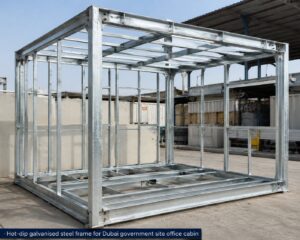
Structural Frame: Hot-Dip Galvanised Steel
The structural frame must use hot-dip galvanised (HDG) steel conforming to BS EN ISO 1461 or an equivalent standard. Painted steel and zinc spray-coated steel are not acceptable substitutes in Dubai’s coastal climate, where:
- Painted steel frames show surface rust within 12 to 18 months.
- Zinc spray-coated frames degrade structurally within 3 to 4 years.
- Hot-dip galvanised frames with a minimum 60-micron zinc coating remain structurally sound for a 5 to 7 year government contract, including the O&M phase.
Wall and Roof Insulation Panels
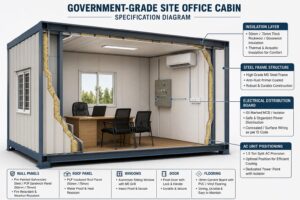
- Polyurethane (PU) foam sandwich panels for engineering offices, meeting rooms, and document control areas, with a minimum 75mm core, rising to 100mm where the cabin sees sustained peak summer occupation. Thicker PU cores reduce AC cooling load significantly, lowering energy consumption and keeping the interior within an acceptable occupied workspace temperature.
- Rockwool (mineral wool) sandwich panels for use near fuel storage, electrical switchrooms, generator sets, or hazardous material storage, carrying a Class A fire rating with a numbered third-party test certificate specifying panel brand, core material, and thickness.
- Aluminium Composite Panel (ACP) cladding for external faces on projects running two years or more, with a PVDF UV-resistant coating providing impact resistance and weatherproofing against Shamal dust storms.
| Application | Panel Type | Key Requirement |
| Engineering offices and meeting rooms | PU foam sandwich panel | 75–100mm core; optimised for 45°C+ loads |
| Fire-sensitive zones | Rockwool sandwich panel | Class A fire rating; numbered certificate |
| External faces, long-duration sites | ACP cladding | PVDF UV-resistant coating; impact-rated |
HVAC System
All government site office cabins must use inverter-type split AC units with a 5-star energy efficiency rating, aligned with DEWA’s Shams Dubai guidelines.
- Practical sizing rule: 1.5-ton capacity per 150 to 180 square feet of floor area, confirmed by a formal HVAC load calculation submitted with the TBP.
- AC compressors must sit on vibration-isolating pads.
- Condensate drainage must route to a collection point rather than discharge onto bare ground.
Electrical System
- UAE-standard 220V/50Hz supply, single-phase for individual cabins or three-phase for larger compound distributions.
- All cables run inside conduit. Civil Defense inspectors specifically check for open cable runs.
- A labelled distribution board with individual MCBs per circuit.
- Residual Current Device (RCD) protection on all socket circuits, a mandatory Civil Defense requirement.
- An earthing rod installed, connected, tested, and documented.
- For generator-supplied sites: an automatic transfer switch (ATS) and surge protection.
Data and IT Infrastructure
Government project site offices increasingly need real-time connectivity to Dubai REST, DM’s document management system, and the MOHRE Tawteen portal. The minimum pre-wired specification includes:
- CAT6 data cabling throughout.
- Wall-mounted data ports in the office and meeting room.
- A minimum 6U server rack with a dedicated UPS circuit.
- CCTV provision on RTA and DEWA projects.
| Feature | Required Standard |
| Structural frame | Hot-dip galvanised steel, 60-micron minimum zinc coat |
| Office panels | PU foam, 75–100mm core |
| Fire-sensitive panels | Rockwool, Class A fire rating |
| External cladding | ACP with PVDF coating |
| HVAC | Inverter split AC, 5-star rated |
| Electrical | 220V/50Hz, conduit wiring, RCD, earthing rod |
| Data and IT | CAT6, server rack, UPS, CCTV provision |
| Foundation | Concrete block or slab, no direct soil placement |
The Complete Government Site Office Compound: Beyond the Single Cabin
A compliant government project site office in Dubai is not one cabin. It is a coordinated modular compound in which every zone is subject to independent inspection by DM, Civil Defense, or MOHRE. An inspector who finds an impeccably specified engineering office alongside non-compliant toilet facilities or a missing security barrier has found a non-compliant site, regardless of how strong the office cabin is.
Zone 1: Engineering and Management Command Offices
On government projects above AED 50 million in contract value, the Project Management Consultant (PMC) team and the main contractor’s management team typically require separate, independently accessible workspaces.
- The consultant cabin houses the PMC representative, resident engineer, and QA/QC inspector.
- The contractor cabin houses the project manager, planning engineer, site engineer, and commercial team.
- Both require a dedicated entrance, lockable document storage, a workstation layout sized for the team, and independent AC circuits.
There are several established Dubai manufacturers fabricating consultant and contractor cabins to this specification, which is worth reviewing when finalising the compound layout for a government tender submission.
Zone 2: Meeting Room and Document Control
A dedicated meeting cabin, separate from the working offices, is explicitly specified in many RTA and DM government contract site establishment schedules. It needs:
- A projector or large display screen for drawing and progress reviews.
- A whiteboard for site coordination discussions.
- An A0-format drawing table for large-format print reviews.
- A fire-rated filing cabinet for original permit documents, since DM and Civil Defense inspectors routinely request to see these at the start of any site visit.
Meeting and document control cabins are typically specified alongside the consultant and contractor cabins as part of the same compound order.
Zone 3: Welfare Block
The zone MOHRE inspectors focus on most closely, and the zone most commonly under-specified by contractors trying to minimise site establishment costs.
- Toilet units in a quantity meeting the one-per-15-workers ratio, calculated against peak headcount.
- Separate male and female facilities with non-overlapping access routes.
- Handwashing stations adjacent to all toilet blocks.
- A shaded prayer room with qibla marking and an external ablution tap.
- Drinking water dispensers at multiple locations.
- A dedicated prefab mosque unit for sites with 100 or more workers.
Bait Al Maha manufactures toilet cabin units and prefab mosque cabins as standard products within its government site compound range.
Zone 4: Site Security and Access Control
A security cabin at the primary site entrance with a clear sightline to the access gate is a standard requirement, particularly on RTA highway and metro expansion projects.
- A barrier arm system, manual or electric depending on traffic volume.
- A visitor and vehicle log available for inspection.
- A CCTV monitoring position connected to the site’s main camera network.
- A second security cabin at any secondary access point on larger sites.
Bait Al Maha supplies and installs security cabins with optional integrated gate barrier systems as part of its site establishment package.
Zone 5: Labour Accommodation for Long-Duration and Remote Projects
For government projects exceeding 18 months, or sites where public transport is impractical, on-site accommodation is often specified within the tender. MOHRE requires:
- A minimum of 3.25 square metres per person.
- A maximum of four workers per room.
- Individual lockable storage, AC, and natural light in every room.
- Direct connection to the welfare block for toilet and shower access.
- For facilities housing 1,000 or more workers: 24-hour medical clinics and recreational areas.
Bait Al Maha produces abour residence cabins built to current MOHRE accommodation standards.
Zone 6: Mess, Canteen, and Kitchen Facility
On sites where no food vendor is available within 500 metres, a mess and canteen facility is effectively a welfare obligation. This requires:
- A kitchen cabin with commercial-grade equipment and mechanical exhaust ventilation.
- A dining cabin seating at least 30% of the workforce simultaneously, allowing for shift rotation.
- Hygienic waste disposal from all food preparation areas.
Bait Al Maha manufactures kitchen, mess, and dining cabins as part of its government site compound range.
Zone 7: Mosque and Prayer Hall
For sites with 100 or more workers, a dedicated prefab mosque serves both a welfare obligation and a practical need, given that prayer breaks occur five times daily. The unit needs:
- A carpeted prayer area with the qibla direction clearly marked.
- A designated space for the Imam.
- An ablution block positioned immediately outside the entrance.
Zone 8: Storage Containers
Separate locked containers for PPE, survey instruments, materials samples, and hazardous substances, positioned with a minimum 5 metre clearance from any occupied cabin. Hazardous material containers require HAZCHEM signage and a documented contents inventory, a Civil Defense requirement.
The complete compound layout, covering all eight zones, must be planned before any cabin is ordered, as it forms part of the TBP site plan submission.
Step-by-Step Permit Timeline for a Government Site Office in Dubai
The permit process must begin on the same day the contract is awarded, not after the site team is mobilised. Fabricating a compliant government-grade cabin takes 7 to 14 working days from order confirmation, while the permit process for a standard DM project takes 25 to 40 working days. If these run sequentially rather than in parallel, the cabin arrives before approvals are in place, and that triggers a stop-work notice.
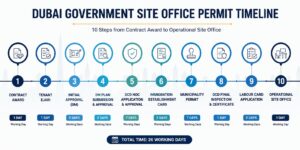
| Step | Action Required | Responsible Party | Realistic Timeline |
| 1 | Confirm main construction permit is active | Main contractor | Prerequisite |
| 2 | Engage cabin supplier; obtain fire rating certificates | Procurement team | 3–5 working days |
| 3 | Prepare site compound plan with engineer’s stamp | Engineering consultant | 5–7 working days |
| 4 | Submit TBP application via Dubai REST / BPS | Main contractor | On completion of Step 3 |
| 5 | DM processing and NOC coordination | Dubai Municipality | 5–25 working days |
| 6 | Schedule Civil Defense inspection | Main contractor | Within 3 days of TBP issue |
| 7 | Civil Defense site inspection | UACD inspector | 1–3 days after scheduling |
| 8 | Address remediation items if needed | Main contractor | 7 days minimum if re-inspection required |
| 9 | MOHRE welfare compliance | Main contractor | Ongoing from first occupation |
| 10 | Trakhees EHS approval (JAFZA/DP World only) | Main contractor | 10–20 additional working days |
| Operational | All inspections cleared and permits displayed | All parties | Day 25–40 (DM); Day 40–55 (Trakhees) |
MOHRE inspectors do not pre-announce visits, so the welfare block must be fully compliant from the day the first worker occupies the compound, not from the day an inspection is expected.
Seven Compliance Failures That Derail Government Site Offices in Dubai
1. Using Non-Fire-Rated Sandwich Panels
Cabins ordered from low-cost suppliers without a numbered fire rating certificate fail Civil Defense inspection on the first visit. Make the certificate number a mandatory field in the purchase order.
2. Delivering the Cabin Before the TBP Is Issued
DM inspectors photograph any structure without a displayed TBP and issue a stop-work notice. Start the permit application on the same day as the purchase order.
3. Under-Deploying Welfare Facilities
Toilet provision calculated against average rather than peak headcount fails MOHRE inspection during busy phases. Calculate against the project’s maximum anticipated workforce.
4. Electrical Systems Without RCD Protection or Earthing
Common on rental cabins without pre-delivery checks. Request a documented electrical compliance certificate before delivery.
5. No Evacuation Plan Posted
A specific, non-negotiable Civil Defense checklist item. Fix the evacuation map to the cabin wall during setup, not on inspection morning.
6. Incorrect Setback Distance from the Boundary
Cabins positioned without verifying the approved setback require costly relocation. Mark the approved footprint on the ground with pegs before delivery.
7. Assuming DM Approval Covers a Trakhees Zone
A DM permit does not extend into JAFZA or DP World territory. Check the site boundary against the Trakhees jurisdiction map before applying.
Buy vs. Rent: The Right Decision for a Government Contract
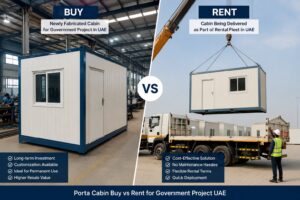
| Decision Factor | Buy | Rent |
| Contract duration | 24+ months, especially with O&M phase | 6–18 months |
| Material compliance control | Full specification control | Dependent on supplier’s fleet |
| Upfront capital | High one-time expenditure | Low monthly expenditure |
| Re-use across projects | Economical for repeat contractors | Not possible |
| Mobilisation speed | 3–5 weeks from order | 5–7 working days from fleet |
| Indicative cost | AED 18,000–35,000 purchased | AED 600–1,200 per month |
Many Dubai government tenders, particularly RTA road infrastructure and DM drainage systems, include a five to seven year Operation and Maintenance phase following construction. For these contracts:
- Purchasing the compound from day one and converting it into the O&M base at handover is almost always more economical than renting during construction and re-procuring afterward.
- The compliance documentation prepared for the original TBP remains valid through the O&M phase.
- The same supplier relationship can be carried forward for any refurbishment or reconfiguration needs.
If renting, the agreement should require the supplier to provide:
- Fire rating certificates for all panels, before delivery, not after.
- Structural drawings suitable for TBP submission.
- HVAC load calculations signed by a licensed mechanical engineer.
- A pre-delivery electrical compliance check confirming RCD and earthing.
A supplier who cannot produce these at the point of order is not suitable for a government project.
Sourcing a Compliant Government Site Office in Dubai
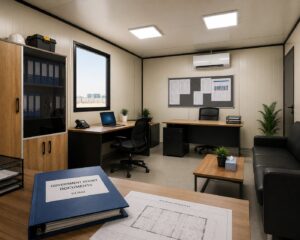
Finding the right supplier for a porta cabin site office for government projects comes down to documentation and compound coverage rather than price alone. A supplier worth shortlisting should be able to provide, as part of the standard order rather than a separate request afterward:
- A numbered, third-party fire rating certificate for all panels.
- Structural drawings suitable for direct TBP submission.
- An HVAC load calculation signed by a licensed mechanical engineer.
- A pre-delivery electrical compliance check confirming RCD and earthing.
Missing documentation is the single most common cause of TBP delays, so confirming this upfront saves weeks later in the process.
Coverage across the full eight-zone compound also matters. A government tender site plan is easier to manage, and easier for DM to approve, when the consultant cabin, contractor cabin, welfare block, security cabin, labour accommodation, and storage containers are specified to a consistent standard rather than sourced piecemeal from different vendors. Bait Al Maha, based in Dubai, manufactures across this full range:
- Consultant cabins and contractor cabins for the engineering and management offices.
- Toilet blocks, mosque units, and security cabins for the welfare and access control zones.
- Labour residence and kitchen/mess cabins for long-duration and remote sites.
- ISO container conversions for infrastructure contracts where structural permanence matters more than rapid mobilisation.
For long-duration government infrastructure work, an ISO container office carries its own structural certification, which simplifies the drawings package needed for the TBP submission and tends to outlast standard sandwich panel cabins on five to seven year contracts. For compounds with a constrained footprint, double-storey configurations with certified steel stair assemblies and proper foundation works are also worth factoring into the early site establishment plan, well before the tender submission deadline. The full products and civil works range covers these configurations alongside the standard cabin types.
At project handover, government contracts typically require full site clearance, so it is worth confirming a relocation and demobilisation service is available from whichever supplier is chosen. This should cover:
- Disconnection of all electrical, AC, and data connections.
- Crane lifting and loading of all units.
- Transport to the next project site or to secure storage.
- Refurbishment of units for reuse on the next contract.
This removes a significant logistical burden from the site team during a period when attention is focused on final contract deliverables.
Anyone scoping a government project site office in Dubai is welcome to browse completed government and infrastructure projects for reference, learn more about Bait Al Maha as a manufacturer, or get in touch to talk through compound layout and compliance documentation for a specific tender.
Frequently Asked Questions
Do I need a permit for a porta cabin on a government site in Dubai?
Yes. A Temporary Building Permit from Dubai Municipality is required for any porta cabin on a government construction site, even with an active main construction permit. Processing takes 5 to 25 working days.
What fire rating do porta cabins need in Dubai?
A Class A fire rating with a numbered, third-party test certificate. Standard “insulated panel” descriptions without a certificate number will fail Civil Defense inspection.
How many toilets are required on a UAE construction site?
One toilet per 15 workers, calculated against peak headcount, with separate male and female facilities where applicable.
What is Trakhees approval in Dubai?
The regulatory authority for JAFZA, DP World, and Dubai Maritime City zones. A DM permit does not apply within Trakhees jurisdiction, and approval typically takes 2 to 6 weeks.
How long does it take to get a site office approved in Dubai?
Between 25 and 40 working days for a standard DM project, and 40 to 55 working days for multi-authority or Trakhees zone projects.
Is it better to buy or rent a porta cabin for a government contract?
Buy for contracts of 24 months or more, especially with an O&M phase. Rent for shorter contracts of 6 to 18 months, provided the supplier can document full compliance before delivery.
Can a standard porta cabin pass a government site inspection in Dubai?
Rarely. Standard cabins typically lack a certified fire rating, use painted rather than galvanised steel, and have no RCD protection, all of which fail Civil Defense or DM inspection.
Why do porta cabin permits get rejected in Dubai?
Incomplete documentation is the leading cause, most often a missing fire rating certificate, HVAC load calculation, or NOC from the plot owner.
Compliance Starts Before the First Cabin Is Delivered
Everything on a government project site in Dubai is subject to inspection before the main contract works are assessed. The site office is evaluated before the piling rig, before the formwork, and before the first cubic metre of concrete. Getting the site compound right from day one is not a procedural formality. It is the foundation the rest of the project stands on.
Three things matter most for any government project site office in Dubai:
- The correct approval pathway for the specific commissioning authority and site jurisdiction, whether DM, RTA, DEWA, Trakhees, or Dubai South.
- Cabin materials and specifications that pass DM, Civil Defense, and MOHRE inspections on the first visit, avoiding re-inspection fees and stop-work notices.
- A complete compound plan covering all eight operational zones, not just the office cabin.
Contractors preparing a government tender submission in Dubai who want to talk through compound layout, compliance documentation, or material specification before finalising their site establishment plan can review the full product range or reach the Bait Al Maha team here.


