

How Many Site Offices Do I Need for a Large Construction Project?
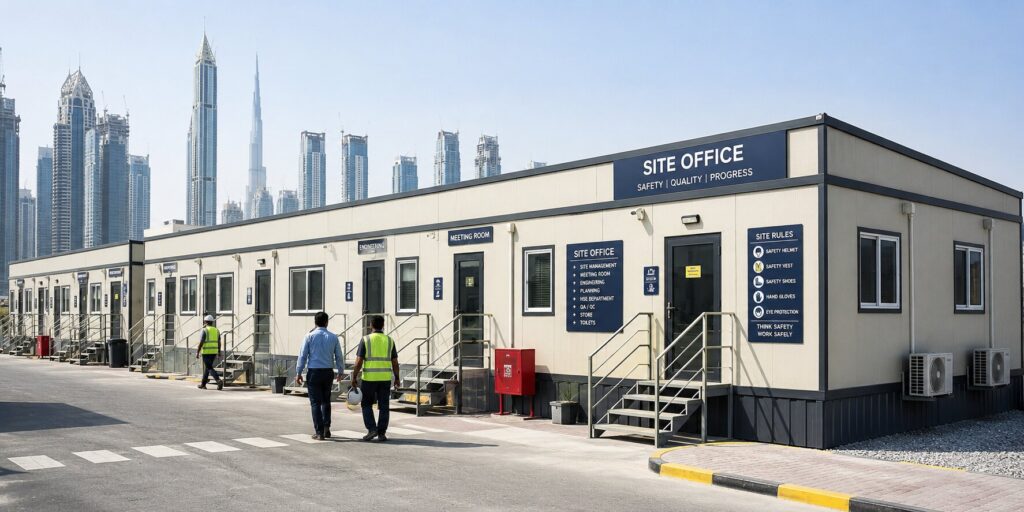
For a large construction project, instead of a single building, you often need one central command office complemented by smaller satellite units or welfare cabins. The exact number depends on your workforce size, site footprint, and trades. Most setups utilize multi-room configurations or modular complexes to separate administrative staff from operational teams Most large construction projects need a connected complex of 6 to 15 or more site offices, not one building. The exact number for your construction project comes from four things you can actually calculate: Your peak workforce headcount. How many distinct functions need their own space. How many subcontractors are active on site at once. The physical shape of your site. Get those four inputs right and the right number falls out almost on its own. Guess at them, and you will either run out of space in month four or pay for three empty cabins you never needed. I have spent years sourcing, configuring, and relocating site offices for contractors and developers across the UAE, on everything from a two-unit setup for a boutique villa project to a twelve-unit hub serving 30-plus engineers on a Business Bay tower. The question of how many site offices a construction project actually needs comes up on almost every single job, and almost nobody asks it correctly. They ask it as if there is one universal number. There is not. There is a formula instead, and that is what this guide walks through. How Many Site Offices a Construction Project Need? Before going further, it helps to define the thing we are actually counting. A site office is a connected group of modular or portable cabin units functioning as a temporary headquarters for a construction project. Rather than one freestanding building doing everything at once, it usually combines: Administration space for project management and engineering staff. Meeting rooms for coordination and client updates. Document control for plans, permits, and daily reports. Welfare facilities such as toilets and rest areas. A security or IT room for monitoring and server equipment. When this article refers to “units,” it means individual cabins, commonly 20-foot or 40-foot, that get connected, stacked, or distributed to form the complex. You can browse the actual range of site office cabins we configure these complexes from. If you want the fuller picture of how these units are built, sized, and permitted in the UAE, our complete guide to site offices covers the types, costs, and approvals in depth. That distinction matters because most generic advice on this topic answers a different question than the one people are actually asking. Articles that tell you to budget “15 to 20 square feet per person” are giving you a total area. They are not telling you: Whether that area should be one big cabin or nine small ones. Whether your subcontractors need their own desks. Whether your site’s shape means you need three separate clusters instead of one. Total square footage and unit count are related, but they are not the same decision. Unit count is usually the one that actually determines your budget, your permit applications, and your delivery schedule. Why “It Depends” Isn’t a Real Answer Ask five suppliers how many site offices a construction project needs and you will get five different vague answers, all true in their own way and useless in combination. The honest answer is that the right number comes from a calculation, not a lookup table. Here is the equation, in plain terms. Total units needed = (peak office headcount ÷ compliant occupancy per unit) + dedicated function units + subcontractor coordination units, adjusted for site layout. We call this the Four-Input Method, and it is the same sequence our team runs through with every client before quoting a single unit. Here is what each input means, in order: Peak office headcount. This is the busiest your administrative and engineering team will ever be. It is not your team size on day one, and it is not your average over the whole project. Compliant occupancy per unit. This is how many people can legally and comfortably work in a single cabin once local space regulations are applied. Dedicated function units. These are spaces that exist regardless of headcount, such as a meeting room, a document control room, an IT or server closet, and a first-aid station. You need these whether your team is 10 people or 80. Subcontractor coordination units. These account for the fact that subcontractor representatives need somewhere to sit and meet, even though they are not part of your core office headcount. Site layout. This is the adjustment factor. It can push your final number up or down by several units even when the headcount stays exactly the same. The rest of this guide walks through each of these five inputs one at a time, then puts the whole Four-Input Method together in two fully worked examples. Step 1: Size for Peak Headcount, Not Today’s Headcount The single biggest reason construction projects run out of office space midway through the build is that whoever ordered the units sized them for the team that existed at mobilization, often just five or six people setting up the site, rather than the team that will exist once the project hits full swing. Construction projects move through a predictable headcount curve, in three stages: Mobilization, roughly the first 1 to 3 months. A small core team, often just 3 to 5 people, including the project lead, a couple of engineers, and an admin assistant. Active construction, the bulk of the timeline. The full team mobilizes. Engineering, safety, quality control, and document control staff all come on board. Headcount often triples or quadruples from the mobilization phase. Finishing and handover. Headcount tapers off again as trades wind down, though snagging, inspection, and handover documentation can briefly bring specialist staff back in. If you order your site office complex based on the mobilization-phase headcount, you are sizing for the smallest team the project will