

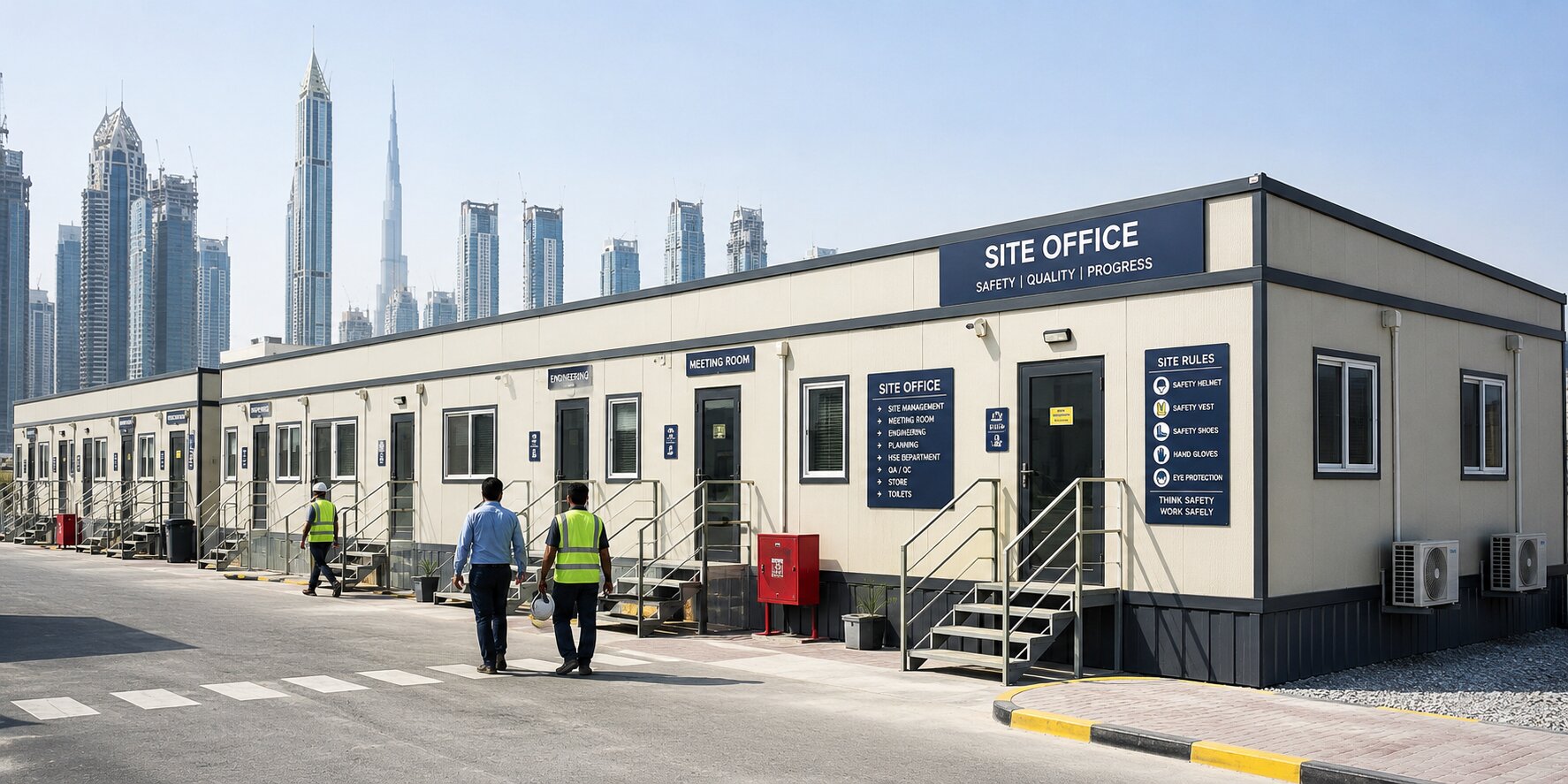
For a large construction project, instead of a single building, you often need one central command office complemented by smaller satellite units or welfare cabins. The exact number depends on your workforce size, site footprint, and trades. Most setups utilize multi-room configurations or modular complexes to separate administrative staff from operational teams
Most large construction projects need a connected complex of 6 to 15 or more site offices, not one building. The exact number for your construction project comes from four things you can actually calculate:
- Your peak workforce headcount.
- How many distinct functions need their own space.
- How many subcontractors are active on site at once.
- The physical shape of your site.
Get those four inputs right and the right number falls out almost on its own. Guess at them, and you will either run out of space in month four or pay for three empty cabins you never needed.
I have spent years sourcing, configuring, and relocating site offices for contractors and developers across the UAE, on everything from a two-unit setup for a boutique villa project to a twelve-unit hub serving 30-plus engineers on a Business Bay tower. The question of how many site offices a construction project actually needs comes up on almost every single job, and almost nobody asks it correctly. They ask it as if there is one universal number. There is not. There is a formula instead, and that is what this guide walks through.
How Many Site Offices a Construction Project Need?
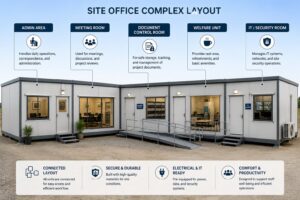
Before going further, it helps to define the thing we are actually counting. A site office is a connected group of modular or portable cabin units functioning as a temporary headquarters for a construction project. Rather than one freestanding building doing everything at once, it usually combines:
- Administration space for project management and engineering staff.
- Meeting rooms for coordination and client updates.
- Document control for plans, permits, and daily reports.
- Welfare facilities such as toilets and rest areas.
- A security or IT room for monitoring and server equipment.
When this article refers to “units,” it means individual cabins, commonly 20-foot or 40-foot, that get connected, stacked, or distributed to form the complex. You can browse the actual range of site office cabins we configure these complexes from. If you want the fuller picture of how these units are built, sized, and permitted in the UAE, our complete guide to site offices covers the types, costs, and approvals in depth.
That distinction matters because most generic advice on this topic answers a different question than the one people are actually asking. Articles that tell you to budget “15 to 20 square feet per person” are giving you a total area. They are not telling you:
- Whether that area should be one big cabin or nine small ones.
- Whether your subcontractors need their own desks.
- Whether your site’s shape means you need three separate clusters instead of one.
Total square footage and unit count are related, but they are not the same decision. Unit count is usually the one that actually determines your budget, your permit applications, and your delivery schedule.
Why “It Depends” Isn’t a Real Answer
Ask five suppliers how many site offices a construction project needs and you will get five different vague answers, all true in their own way and useless in combination. The honest answer is that the right number comes from a calculation, not a lookup table. Here is the equation, in plain terms.
Total units needed = (peak office headcount ÷ compliant occupancy per unit) + dedicated function units + subcontractor coordination units, adjusted for site layout.
We call this the Four-Input Method, and it is the same sequence our team runs through with every client before quoting a single unit. Here is what each input means, in order:
- Peak office headcount. This is the busiest your administrative and engineering team will ever be. It is not your team size on day one, and it is not your average over the whole project.
- Compliant occupancy per unit. This is how many people can legally and comfortably work in a single cabin once local space regulations are applied.
- Dedicated function units. These are spaces that exist regardless of headcount, such as a meeting room, a document control room, an IT or server closet, and a first-aid station. You need these whether your team is 10 people or 80.
- Subcontractor coordination units. These account for the fact that subcontractor representatives need somewhere to sit and meet, even though they are not part of your core office headcount.
- Site layout. This is the adjustment factor. It can push your final number up or down by several units even when the headcount stays exactly the same.
The rest of this guide walks through each of these five inputs one at a time, then puts the whole Four-Input Method together in two fully worked examples.
Step 1: Size for Peak Headcount, Not Today’s Headcount
The single biggest reason construction projects run out of office space midway through the build is that whoever ordered the units sized them for the team that existed at mobilization, often just five or six people setting up the site, rather than the team that will exist once the project hits full swing.
Construction projects move through a predictable headcount curve, in three stages:
- Mobilization, roughly the first 1 to 3 months. A small core team, often just 3 to 5 people, including the project lead, a couple of engineers, and an admin assistant.
- Active construction, the bulk of the timeline. The full team mobilizes. Engineering, safety, quality control, and document control staff all come on board. Headcount often triples or quadruples from the mobilization phase.
- Finishing and handover. Headcount tapers off again as trades wind down, though snagging, inspection, and handover documentation can briefly bring specialist staff back in.
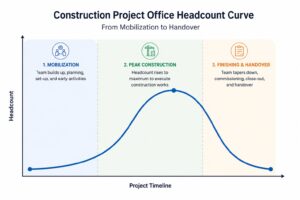
If you order your site office complex based on the mobilization-phase headcount, you are sizing for the smallest team the project will ever have. By the time peak construction arrives, which is also when budgets are tightest and schedules are least forgiving, you are left with two bad options:
- Cramming people into too few cabins, which hurts productivity and morale.
- Scrambling to add units mid-project, which almost always costs more and takes longer than planning for it upfront.
As a rough planning guide, here is how peak office headcount tends to scale with overall project value on the kind of projects we configure complexes for regularly across Dubai and the wider UAE. Treat these as planning bands to sanity-check your own numbers against, not as guarantees, since actual headcount depends heavily on project type and contractor structure.
Project Value Compare Table:
| Project value (AED) | Typical peak office headcount | Typical number of site offices needed |
| 20M–80M (single tower or mid-size villa cluster) | 8–15 | 2–4 units |
| 80M–300M (large tower or boutique community) | 15–35 | 4–7 units |
| 300M–800M (major mixed-use or large community) | 35–70 | 7–12 units |
| 800M+ (mega or giga project) | 70–150+ | 12–25+ units |
The practical takeaway is simple. Ask your project planner what the headcount looks like in the busiest month of the schedule, not what it looks like the week the gate goes up. Then size for that, with a small buffer on top. Most experienced project managers order current need plus roughly one extra unit of growth capacity, rather than guessing at the full final number from day one.
Step 2: Split Headcount by Function, Not Just by Total Number
Here is where a lot of planning goes wrong even after the headcount number is right. Treating your peak headcount as one undifferentiated pool of people, as in “we have 40 staff, so we need X square metres,” misses the fact that different roles need fundamentally different kinds of space, and some of them genuinely cannot share a room.
Break a typical large project’s office population into six actual functions:
- Main contractor PM and admin core. Needs secured, semi-private space for scheduling, budgeting, and client correspondence.
- Engineering, QA/QC, and document control. Needs large desks for plan review, strong lighting, and a climate-stable area for drawing and document storage, since paper and electronics both suffer in poor conditions.
- Safety officers. A relatively small footprint, but a non-negotiable one on any project past a certain size. They need somewhere to store PPE, log incidents, and run safety briefings.
- Subcontractor foremen and leads. Usually shared or hot-desk space rather than dedicated offices. There is more on this in the next section.
- Client or consultant teams. Sometimes need a slightly separate, more presentable unit, partly for confidentiality during approvals or disputes, and partly because client perception matters.
- Welfare-only labor population. This is the one people most often get wrong. Workers who only need rest, food, and sanitary facilities are a completely separate calculation from your office headcount, governed by different regulations entirely, which we cover in the regulatory section below. Mixing the two populations into one space-planning exercise is one of the most common, and most expensive, mistakes on this whole topic. If your project also needs to house the wider labor force, our labour camp cabin setups are built specifically around MOHRE’s accommodation standards rather than office occupancy rules.
Compare Table :
| Function | Typical share of peak office headcount | Space type needed | Can it share space? |
| PM / admin core | 15–20% | Semi-private admin unit | Limited sharing |
| Engineering / QA-QC / document control | 30–40% | Open workspace + document room | Can share open-plan |
| Safety / quality | 5–10% | Small dedicated unit | Rarely shares |
| Subcontractor coordination | Variable, scales with sub count | Shared meeting/coordination unit | Designed to share |
| Client / consultant team | 5–15% | Separate or branded unit | Usually separate |
Once you have headcount split by function, you will usually find that a single “office building” approach does not actually fit your project. You need a meeting unit, a document control unit, and an open admin unit as separate connected cabins, which is exactly why large projects end up with a complex of several site offices rather than one bigger box.
Step 3: Match Office Distribution to Site Layout
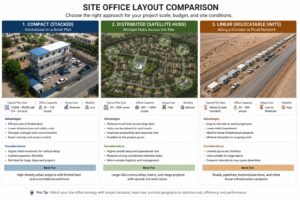
This is the factor almost every generic “how many offices” article skips entirely, and it is often the single biggest swing factor in your final number. Two construction projects with identical peak headcounts can need a very different number of site offices purely because of how their site is shaped. There are four common patterns.
-
Compact urban footprint.
Think of a tower project on a tight plot in an area like Business Bay or Downtown Dubai. Land is scarce, so the answer is usually fewer units stacked vertically rather than spread horizontally, often two or three storeys of connected cabins on a small footprint. Stacking requires more engineering, including load-bearing frames, external staircases, and more careful municipal review, but it solves the land problem directly. Our container site office range is built specifically with this kind of stacking in mind for tight Dubai plots.
-
Large horizontal footprint.
A sprawling villa community or master-planned development is the opposite problem. There is plenty of land, but it is spread over a wide area. Here, a single central complex often is not enough, because workers and engineers in the far corner of the site waste real time walking or driving back to a single welfare hub. The fix is usually a main administration complex plus one or more satellite welfare hubs positioned near active work zones, which increases total unit count even though headcount per zone might be modest.
-
Linear or dispersed sites.
Roads, pipelines, and rail corridors do not really have a “site” in the traditional sense. They have a moving front of active work that crawls along a route over months or years. A fixed, large complex at one end of a 20-kilometre corridor does nothing for the crew working 18 kilometres away. These projects typically use a small number of fixed hub units plus several smaller relocatable units that leapfrog forward as the work progresses, which is a fundamentally different unit-count model than a single static complex.
-
Multi-phase mega projects.
The largest projects often combine all three patterns above: one main administrative hub, several satellite units serving different phases or zones, and a hub-and-spoke structure that scales up or down as each phase moves through mobilization, peak, and handover.
How Many Site Offices Does Each Type of Construction Project Typically Need?
Putting headcount, function split, and layout together gives a usable planning benchmark by project type. These are based on configuration patterns we see repeatedly across completed construction projects in Dubai and across the UAE, not a rigid formula. Treat them as a starting range to refine with your own headcount and layout numbers.
| Project type | Typical peak headcount | Typical number of site offices | Sample composition |
| High-rise tower (constrained urban plot) | 15–45 | 4–9, often 2–3 storeys stacked | Admin units stacked, 1 meeting unit, 1 document control unit |
| Villa community / horizontal mega-residential | 20–60 | 6–14, distributed | Central admin hub + 2–3 satellite welfare hubs near active phases |
| Mall or large mixed-use retail development | 25–50 | 6–10, plus a tenant fit-out unit | Main complex + a coordination unit added during the tenant fit-out wave |
| Linear infrastructure (roads, pipelines, rail) | 10–30 (often spread thin) | 4–8, mostly relocatable | 1–2 fixed hubs + 2–4 mobile mini-units leapfrogging the corridor |
| Industrial / warehouse / logistics park | 10–25 | 4–7, fewer admin, more storage | Smaller admin footprint, larger document/security and storage units |
| Mega / giga project (multi-contractor, multi-billion AED) | 70–150+ | 15–25+, hub-and-spoke | Main complex per zone, satellite units per sub-contractor cluster |
A few patterns are worth calling out from this table:
- Retail and mall projects need an extra coordination unit specifically for the tenant fit-out period, which most generic guides never mention because it is a phase-specific need rather than a constant one.
- Industrial and logistics projects flip the usual ratio. They need comparatively less admin space and comparatively more document control and security space, because the work itself revolves more around inventory, permits, and equipment tracking than around desk-based coordination.
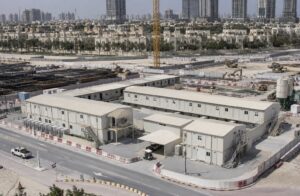
The Subcontractor Multiplier: Why 50 Subcontractors Does Not Mean 50 Offices
Large construction projects run on subcontractors, and people often assume that a high subcontractor count automatically means a high office unit count. It does not, and treating it that way would be wildly impractical. Even an average single-family home in the United States uses around 22 different subcontractors according to the National Association of Home Builders, and a large commercial or infrastructure project in the UAE will run well beyond that. You are obviously not building one office per subcontractor.
What you actually need is shared coordination capacity, not dedicated desks. A workable rule of thumb is roughly one shared coordination unit per 15 to 20 concurrently active subcontractors, used as rotating hot-desk and meeting space rather than permanent offices. Here is how that scales in practice:
- 10 to 20 active subcontractors: 1 shared coordination unit.
- 30 to 40 active subcontractors: 2 shared coordination units.
- 50 active subcontractors: roughly 3 shared coordination units, enough for toolbox talks, weekly progress meetings, and informal sit-downs between trades, not 50 separate rooms.
There is one exception worth planning for. One or two anchor subcontractors on very large projects, typically the main MEP contractor or the structural subcontractor, sometimes warrant their own dedicated unit, simply because the volume of daily coordination with them is high enough to justify it. Everyone else shares.
How Do Local Occupancy Rules Affect Your Number of Site Offices?
Regulations do not just describe best practice here. They set hard minimums that override your own preferences, and getting this wrong has real financial consequences, not just comfort consequences. The two standards that matter most are:
-
Office and shared space standard:
- 5.0 square metres of net usable space per person, the baseline figure in Dubai’s building code.
-
Worker accommodation standard:
- 3 square metres of personal space per person, the minimum set out by the UAE Government for labour accommodation.
In Dubai, the building code applies a baseline standard of 5.0 square metres of net usable space per person in residential and shared spaces, a figure confirmed by Al Tamimi & Co.’s real estate practice when discussing the emirate’s occupancy rules. Contractors and suppliers commonly apply this same baseline when planning site office occupancy. A few quick reference points:
- Schools: held to a tighter 1.9 square metres per student in standard classrooms, for comparison.
- A typical 40-foot cabin: offers around 20 to 23 square metres of net workspace after subtracting space for a toilet, HVAC equipment, and basic storage.
- Realistic capacity: that comfortably fits four people at the 5 sqm standard, not the eight or ten people many first-time buyers assume will fit based on the unit’s total footprint.
Here is how that plays out as a reverse calculation. Say your peak office headcount is 60 people. At a working occupancy of roughly 4 to 5 people per compliant 40-foot unit, you need a minimum of 12 to 15 site offices just to meet basic occupancy compliance, before you have added a single meeting room, document control unit, or subcontractor coordination space. That is the regulatory floor. Everything from Steps 2 and 3 above gets added on top of it, not instead of it.
Worked Example: Sizing Site Offices for a 500-Unit Residential Tower
Putting the whole Four-Input Method together is easier with a real number to follow. Here is how the math plays out for a mid-size residential tower project.
- Peak headcount. The project’s busiest month calls for roughly 45 people across project management, engineering, safety, and document control.
- Occupancy math. At 4 to 5 people per compliant 40-foot unit, 45 people need a baseline of 9 to 11 units just for office space.
- Function split. Add one dedicated meeting unit, one document control unit, and one combined IT and first-aid unit. That is three additional units that exist regardless of headcount.
- Subcontractor coordination. With roughly 35 active subcontractors at peak, that is one shared coordination unit at the 15-to-20-per-unit ratio, rounded up.
- Site layout adjustment. The plot is compact and urban, so the complex stacks two storeys rather than spreading across more ground-level units, which keeps the total count toward the lower end of the range rather than pushing it higher.
Result: A complex of around 9 to 10 connected site offices, configured as a two-storey stacked admin block plus a ground-level meeting, document control, and coordination cluster. That lines up closely with real project data. One infrastructure-scale complex we have configured used twelve connected units to house 30-plus engineers and planners, four private offices, two meeting rooms, document storage, an IT room, two toilet blocks, and reception, at a total installed cost of roughly AED 850,000, against an equivalent permanent structure that would have run past AED 3 million and taken six months longer to deliver. You can see the range of unit types this kind of complex draws from in our site office products lineup.
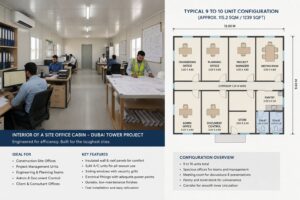
Worked Example: A 20-Kilometre Linear Infrastructure Corridor
Now apply the same Four-Input Method to a completely different shape of construction project, to show how layout changes the output even when the underlying math is identical.
- Peak headcount. Roughly 25 people across the project, but spread thin along a 20-kilometre active corridor rather than concentrated at one point.
- Occupancy math. 25 people at 4 to 5 per unit suggests a baseline of 5 to 6 units.
- Function split. One meeting and document control unit, plus one combined safety and first-aid unit.
- Subcontractor coordination. A smaller, more spread-out subcontractor base on this kind of project usually fits within the fixed hub units rather than needing a unit of its own.
- Site layout adjustment. Here is where it diverges sharply from the tower example. Instead of one static cluster, the project needs two fixed hub units positioned at logical anchor points along the route, plus three smaller relocatable units that move forward every few weeks or months as the active work front advances. This is the same approach used on the Sheikh Mohammed bin Zayed Road expansion project, where offices relocated repeatedly to stay close to the active work corridor and keep travel time down for engineers and supervisors.
Result: A total of roughly 5 fixed-plus-mobile site offices rather than one large complex. That is fewer total units than the tower example despite a comparable underlying headcount, because the layout factor pulled the number down rather than up. Same formula, genuinely different output. That is the whole point of treating site layout as a real input rather than an afterthought.
What Happens If You Order the Wrong Number of Site Offices?
Getting this calculation wrong costs real money in both directions, not just one. Here are the five mistakes we see most often on construction projects, in order of how frequently they show up.
-
Sizing for day-one headcount instead of peak headcount.
This is the most common mistake on the list. A project that orders three units for its five-person mobilization team and then grows to 25 people by month six ends up either cramming staff into inadequate space or scrambling for an emergency expansion, usually at a premium, since rush orders rarely get the best pricing or fastest delivery slots. Plan for peak demand with a small buffer, not for the smallest team the project will ever have.
-
Treating all headcount as one undifferentiated number.
Projects that skip the function-split step often end up with the wrong mix of units, too much open desk space and not enough meeting or document control capacity. This means people end up holding subcontractor coordination meetings at someone’s desk or storing drawings in a corner that floods every time it rains.
-
Ignoring subcontractor density entirely.
Skip the coordination-unit calculation and you end up with constant scheduling conflicts over the one meeting room nobody planned properly, or worse, with no neutral space for multi-trade coordination at all. Research on construction site amenities consistently links this kind of shortfall to lower workforce productivity and higher worker dissatisfaction, beyond just the obvious scheduling friction.
-
Conflating office occupancy with accommodation occupancy.
This is the costliest mistake on the list, because it is not just inefficient, it is a compliance violation. Housing workers in structures only approved for daytime office use, or vice versa, exposes a company to MOHRE inspection violations and fines, which industry compliance guides put in the range of AED 5,000 to AED 50,000 per violation depending on severity, on top of the disruption of a facility closure order. Keep the two calculations, and the two unit types, completely separate.
-
Over-ordering “just in case” on a site with no room to grow.
The flip side of under-ordering is locking up capital in units sitting idle on a fixed-footprint plot where there was never room to use them anyway. If your site genuinely has no room for future expansion, ordering speculative extra capacity just creates congestion and wasted spend. The phased “current need plus one buffer unit” approach described earlier almost always beats bulk ordering upfront, unless you have real cost-of-delay reasons not to.
Quick Self-Assessment Checklist
Run through this before you plan your site office order. It takes ten minutes and will save you from most of the mistakes above.
- What is your realistic peak office headcount, not your current or average headcount?
- How many distinct functions need separated space, such as PM, engineering, safety, client, and document control?
- How many subcontractors will be concurrently active at peak, not across the whole project lifetime?
- Is your site compact, sprawling, or linear, and does that change where units need to sit, not just how many?
- Does any part of your workforce need accommodation rather than office space? If yes, treat it as a fully separate calculation with its own permit.
- Have you built in a buffer for the schedule extension that is statistically likely to happen anyway? Large projects typically run about 20 percent longer than originally scheduled, according to McKinsey Global Institute research on construction project performance.
When Should You Add Another Site Office Mid-Project?
A few concrete signals tell you it is time to add capacity rather than push through with what you have.
- Your concurrently active subcontractor count crosses the next 15-to-20 threshold for your existing coordination units.
- Your headcount crosses the occupancy ceiling for your current unit count under local space rules. This is not about when it feels crowded, but when it is actually over the compliant limit.
- The project enters a new geographic zone or phase, particularly on linear or multi-phase sites where the active work front has physically moved away from your current setup.
- Your client or consultant team grows large enough that shared desk space stops being workable and they need dedicated space of their own.
Working Out Your Own Number
This is the exact worksheet I run through with project managers and developers before quoting anything: peak headcount, function split, subcontractor density, and site layout, in that order. It is a far better starting point than working off a generic price list and finding out the hard way, mid-project, that the order was wrong.
If you have a project coming up, here is where to go next:
- Talk through your numbers: Get in touch with your project details and I will help you work out the right count.
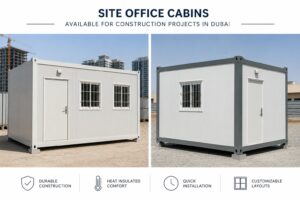
- Browse the cabins: Have a look through the available site office cabins once you have a rough sense of your number.
- Add the welfare side: Pair your office complex with modular toilet units and prefabricated buildings for a fully compliant setup.
- Housing the wider workforce: If your project also needs accommodation for laborers, our labour camp cabin range is built around MOHRE’s standards rather than office occupancy rules.
Frequently Asked Questions
What is a site office in a construction project?
A site office is a temporary cabin or group of cabins on or near a construction site that houses the project manager, engineers, and admin staff who run day-to-day operations, store documents, and hold site meetings.
How big should a site office be?
A standard 40-foot site office cabin offers around 20 to 23 square metres of usable space, comfortably fitting 4 to 5 people under Dubai’s office occupancy standard.
How many people can work in one site office cabin?
At Dubai’s space standard of roughly 5 square metres per person, a typical 40-foot cabin holds about 4 to 5 people, not the 8 to 10 some buyers expect from its total footprint.
How long does it take to set up a site office?
A modular site office is usually installed and ready for use within a few days to two weeks, compared to several months for a permanent structure.
Can a site office be a portable cabin?
Yes. Most site offices on large projects are portable or modular cabins rather than permanent buildings, since they install faster, cost less, and can be relocated or expanded as the project progresses.
What facilities should a construction site office have?
A well-equipped site office complex typically includes admin and meeting space, document control, welfare facilities such as toilets and a rest area, and a basic first-aid and security setup.
The Bottom Line
There is no flat number that applies to every large construction project, and any answer that gives you one is skipping the parts that actually matter. What does work is running your own numbers through the same four inputs every time: peak headcount, function split, subcontractor density, and site layout. Do that, and you will land on a number you can actually defend in a budget meeting, not a guess borrowed from someone else’s project that happened to look similar on paper.


