

How Many Site Offices Do I Need for a Large Construction Project?
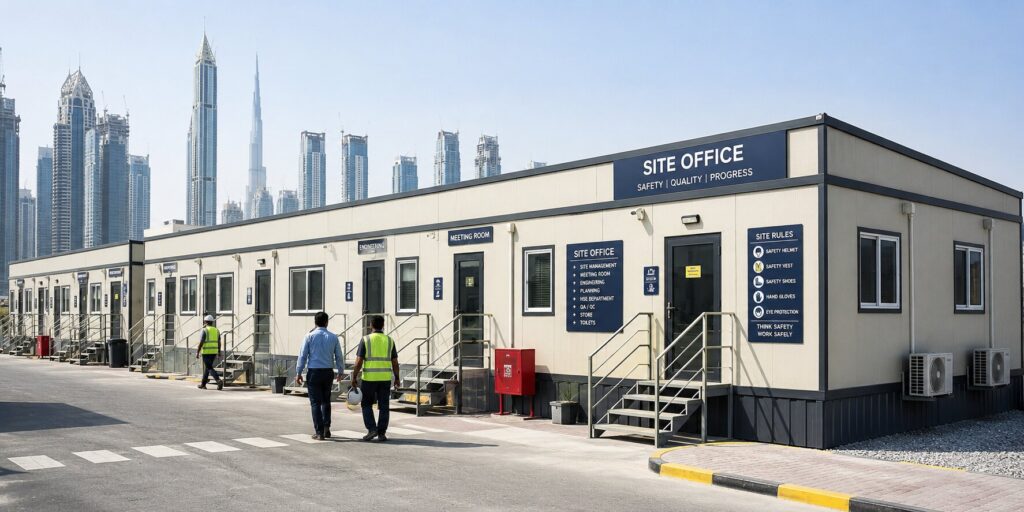
For a large construction project, instead of a single building, you often need one central command office complemented by smaller satellite units or welfare cabins. The exact number depends on your workforce size, site footprint, and trades. Most setups utilize multi-room configurations or modular complexes to separate administrative staff from operational teams Most large construction projects need a connected complex of 6 to 15 or more site offices, not one building. The exact number for your construction project comes from four things you can actually calculate: Your peak workforce headcount. How many distinct functions need their own space. How many subcontractors are active on site at once. The physical shape of your site. Get those four inputs right and the right number falls out almost on its own. Guess at them, and you will either run out of space in month four or pay for three empty cabins you never needed. I have spent years sourcing, configuring, and relocating site offices for contractors and developers across the UAE, on everything from a two-unit setup for a boutique villa project to a twelve-unit hub serving 30-plus engineers on a Business Bay tower. The question of how many site offices a construction project actually needs comes up on almost every single job, and almost nobody asks it correctly. They ask it as if there is one universal number. There is not. There is a formula instead, and that is what this guide walks through. How Many Site Offices a Construction Project Need? Before going further, it helps to define the thing we are actually counting. A site office is a connected group of modular or portable cabin units functioning as a temporary headquarters for a construction project. Rather than one freestanding building doing everything at once, it usually combines: Administration space for project management and engineering staff. Meeting rooms for coordination and client updates. Document control for plans, permits, and daily reports. Welfare facilities such as toilets and rest areas. A security or IT room for monitoring and server equipment. When this article refers to “units,” it means individual cabins, commonly 20-foot or 40-foot, that get connected, stacked, or distributed to form the complex. You can browse the actual range of site office cabins we configure these complexes from. If you want the fuller picture of how these units are built, sized, and permitted in the UAE, our complete guide to site offices covers the types, costs, and approvals in depth. That distinction matters because most generic advice on this topic answers a different question than the one people are actually asking. Articles that tell you to budget “15 to 20 square feet per person” are giving you a total area. They are not telling you: Whether that area should be one big cabin or nine small ones. Whether your subcontractors need their own desks. Whether your site’s shape means you need three separate clusters instead of one. Total square footage and unit count are related, but they are not the same decision. Unit count is usually the one that actually determines your budget, your permit applications, and your delivery schedule. Why “It Depends” Isn’t a Real Answer Ask five suppliers how many site offices a construction project needs and you will get five different vague answers, all true in their own way and useless in combination. The honest answer is that the right number comes from a calculation, not a lookup table. Here is the equation, in plain terms. Total units needed = (peak office headcount ÷ compliant occupancy per unit) + dedicated function units + subcontractor coordination units, adjusted for site layout. We call this the Four-Input Method, and it is the same sequence our team runs through with every client before quoting a single unit. Here is what each input means, in order: Peak office headcount. This is the busiest your administrative and engineering team will ever be. It is not your team size on day one, and it is not your average over the whole project. Compliant occupancy per unit. This is how many people can legally and comfortably work in a single cabin once local space regulations are applied. Dedicated function units. These are spaces that exist regardless of headcount, such as a meeting room, a document control room, an IT or server closet, and a first-aid station. You need these whether your team is 10 people or 80. Subcontractor coordination units. These account for the fact that subcontractor representatives need somewhere to sit and meet, even though they are not part of your core office headcount. Site layout. This is the adjustment factor. It can push your final number up or down by several units even when the headcount stays exactly the same. The rest of this guide walks through each of these five inputs one at a time, then puts the whole Four-Input Method together in two fully worked examples. Step 1: Size for Peak Headcount, Not Today’s Headcount The single biggest reason construction projects run out of office space midway through the build is that whoever ordered the units sized them for the team that existed at mobilization, often just five or six people setting up the site, rather than the team that will exist once the project hits full swing. Construction projects move through a predictable headcount curve, in three stages: Mobilization, roughly the first 1 to 3 months. A small core team, often just 3 to 5 people, including the project lead, a couple of engineers, and an admin assistant. Active construction, the bulk of the timeline. The full team mobilizes. Engineering, safety, quality control, and document control staff all come on board. Headcount often triples or quadruples from the mobilization phase. Finishing and handover. Headcount tapers off again as trades wind down, though snagging, inspection, and handover documentation can briefly bring specialist staff back in. If you order your site office complex based on the mobilization-phase headcount, you are sizing for the smallest team the project will
Porta Cabin Site Office for Government Projects in Dubai
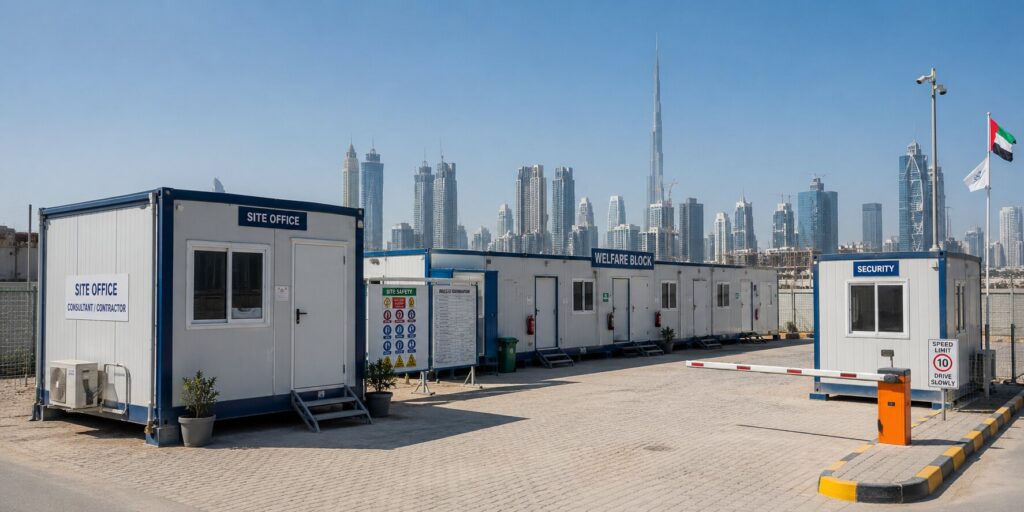
A porta cabin site office for government projects in Dubai requires a Temporary Building Permit (TBP) from Dubai Municipality before any structure is placed on site. The cabin must be built with fire-rated sandwich panels carrying a third-party Class A fire rating certificate, a hot-dip galvanised steel frame, inverter-type split AC units, and 220V/50Hz wiring with RCD protection, all of which are verified by UAE Civil Defense during a mandatory physical inspection. Welfare facilities must meet MOHRE standards, which require a minimum of one toilet for every 15 workers, a dedicated prayer room, and handwashing stations. If the project falls within a JAFZA or DP World territory, approvals must go through Trakhees EHS instead of, or in addition to, Dubai Municipality. The permit process takes between 25 and 55 working days depending on the project type and jurisdiction. Starting the approval process on the same day the cabin is ordered is the only way to avoid a stop-work notice on a Dubai government construction site. What Is a Porta Cabin Site Office for Government Project in Dubai? A porta cabin site office for government project is a prefabricated, relocatable modular structure that serves as the on-site administrative and operational headquarters for a construction project. It houses the project management team, site engineers, document controllers, QA/QC staff, and consultants. It is where permits are stored, where inspections begin, and where the day-to-day running of the project is coordinated. On a private development site in Dubai, a porta cabin is simply a practical convenience. On a UAE government project site, it is a regulated structure that must be engineered, documented, inspected, and approved by multiple authorities before a single worker can sit inside it. This distinction matters because many contractors treat the site office as an afterthought, something to sort out after the main contract is awarded. On a government construction site in Dubai, that approach routinely results in: Stop-work notices that halt the entire project, not just the site office. Re-inspection fees and mandatory remediation periods. Permit resubmissions that add weeks to the mobilisation timeline. Project delays that trigger contractual penalty clauses. Which Government Bodies Commission These Projects in Dubai? Government projects in Dubai are commissioned by public-sector entities, each with its own requirements for a compliant site office: Dubai Municipality (DM) for roads, drainage, public parks, and community infrastructure. Roads and Transport Authority (RTA) for highway expansions, Dubai Metro extensions, and bus depots. Dubai Electricity and Water Authority (DEWA) for power substations, water treatment plants, and pipeline works. Dubai South Authority for Expo City legacy infrastructure and Al Maktoum International Airport expansion. DP World and JAFZA entities for port, logistics corridor, and special economic zone infrastructure. Two Cabin Formats Used on Government Sites Across the UAE Sandwich panel modular cabins are the most common choice for contracts running up to three years, offering rapid fabrication and straightforward transport across Dubai and the wider UAE. ISO container conversions are increasingly preferred for long-duration infrastructure projects where structural permanence and resistance to impact damage outweigh the need for rapid mobilisation. Most contractors sourcing a compliant site office in Dubai end up comparing a handful of established UAE manufacturers, and the range of consultant cabins, contractor cabins, toilet blocks, security cabins, and container office conversions available locally gives a useful starting reference point for what a government-grade compound should include. Why Government Projects in Dubai Demand a Higher Standard of Site Office The easiest way to understand why a porta cabin site office for government projects is held to a different standard than a private-sector cabin is to look at what happens when that standard is not met. Contractors who have navigated government site inspections in Dubai know from experience that the site office is assessed before any structural work on the main contract is evaluated. Here is what typically happens when a site office fails to meet standard: An inspector from Dubai Municipality or UAE Civil Defense arrives and finds an uncleared cabin, one without a valid TBP displayed, or one built with non-fire-rated panels. The inspector does not move on to inspect the rest of the site. A stop-work notice is issued instead, halting every activity on the project, not just the site office. The contractor must resolve the non-compliance before any work can resume. On a contract with delay penalty clauses, the cost is disproportionate to what began as a simple procurement shortcut. It Is a Contractual Obligation, Not Just a Regulatory One Most Dubai government tender packages issued by DM, RTA, and DEWA include a site establishment clause within the contract documentation. This clause specifies: The minimum structural and material standards for all temporary structures. The welfare facility requirements that must be operational before work begins. The compliance documentation that must be available for inspection on demand. The permit sequence that must be completed before any cabin can be occupied. Failing to comply with this clause is not just a regulatory issue. It is a breach of the signed government contract. The Dubai Statistics Center reported that over 55,000 building permits were issued in 2024 alone, a 7.2% increase over the prior year, reflecting both the scale of construction activity and the increasingly competitive regulatory environment contractors now operate within. Multi-Authority Oversight Is the Norm on a Government Site Office in Dubai Private development sites typically deal with Dubai Municipality as their primary regulatory body. Government project sites simultaneously answer to several independent authorities: Dubai Municipality for building permits, site plan compliance, and structural standards. UAE Civil Defense for fire safety, panel ratings, detection systems, and evacuation provisions. MOHRE for worker welfare, toilet ratios, prayer facilities, and accommodation standards. Trakhees EHS for all of the above, independently, on sites within JAFZA and DP World zones. These bodies do not coordinate inspection schedules with one another. A pass from one authority offers no protection against a failure from another. Dubai’s Climate Turns Site Office Engineering Into a Genuine Safety Requirement Average temperatures on a Dubai