
Construction Site Cabin Dubai: All Types Available from One Supplier
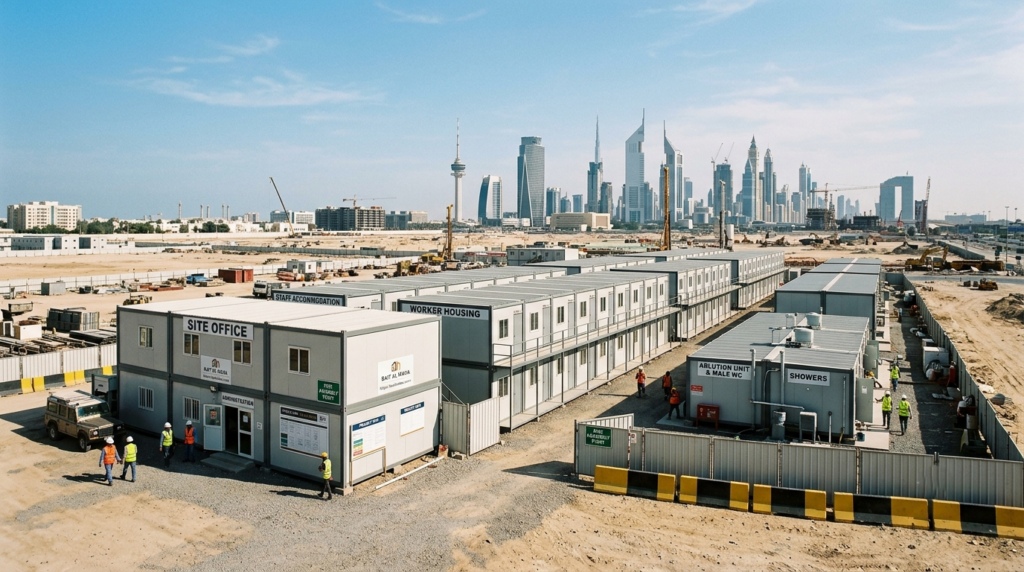
Construction site cabins in Dubai can be sourced comprehensively from a single, turnkey supplier to handle all temporary infrastructure needs. Leading UAE manufacturers like Bait Al Maha Prefab, Al Bait Al Hadi, and TASS Group provide end-to-end solutions, eliminating the hassle of coordinating with multiple vendors. They manage everything from engineering design and factory fabrication to heavy-duty transport, on-site installation, and full utility integration (water, power, and drainage). Construction Site Cabin Dubai: Types, Sizes, and Lead Times at a Glance Cabin Type Common Size Range Starting Price (AED) Typical Lead Time Best For Site Office 3m × 6m to 3m × 12m 8,000 – 25,000 1–3 weeks Project management, engineering teams Labor Accommodation (per unit) 3m × 6m, 8–10 person rooms 8,000 – 20,000 1–3 weeks Worker housing on long-term projects Ablution / Toilet Block 3m × 6m, 4–6 fixture units 6,000 – 50,000 1–2 weeks Sanitation for any site size Dining & Kitchen Cabin 3m × 9m to 3m × 12m 15,000 – 60,000 2–4 weeks Catering and staff meal breaks Security Guard House 1.2m × 2m to 2.4m × 4m 7,000 – 25,000 3–10 days Site entry points and access control Storage / Workshop Container 20ft or 40ft modified container 10,000 – 40,000 1–2 weeks Tools, equipment, and material storage Full Turnkey Labor Camp Multi-unit, custom layout 200,000 – 600,000+ 4–6 weeks Large-scale, long-duration projects Prices vary depending on insulation grade, electrical fit-out, and customization. Steel and raw material costs also shift throughout the year, so treat this table as a planning reference rather than a fixed quote. The full range of available cabins and configurations goes beyond what fits in a single table, so it is worth browsing the complete product line before finalizing a list. What Is a Construction Site Cabin in Dubai? A construction site cabin in Dubai is a prefabricated steel-framed unit built off-site in a factory and transported to the project location, ready to function as an office, sleeping quarters, toilet block, kitchen, or storage space within days of arrival. Unlike permanent buildings, these units sit on a leveled surface or simple foundation blocks rather than deep footings. Here is what separates a site cabin from a conventional building, and why that distinction matters on a Dubai project. It is built in a factory, not on-site. Manufacturing happens under controlled conditions, which keeps quality consistent and avoids weather-related construction delays. It does not need a permanent foundation. A flat, compacted surface is usually enough, which means installation takes days rather than months. It can be relocated. Once a project finishes, the same cabin can move to the next site instead of being demolished. It can be resold, rented, or refurbished. Unlike a permanent structure, a used cabin still holds resale or rental value. It is modular. Units can be linked side by side or stacked to create larger configurations, from a single guard house to a multi-story office block. This combination of speed, flexibility, and reusability is exactly why prefab cabins remain the standard solution for almost every active construction site across Dubai, regardless of project size. Why Source Every Construction Site Cabin in Dubai from One Supplier Anyone who has managed a site mobilization knows the friction that comes from dealing with separate vendors for offices, labor housing, toilets, and security cabins. One truck shows up two weeks early. Another shows up two weeks late. The insulation grade on the sleeping cabins does not match the site office because they came from two different factories. Sourcing every construction site cabin Dubai project needs from a single supplier removes that friction in several specific ways. Single Supplier vs. Multiple Suppliers, Side by Side Factor One Supplier Multiple Suppliers Delivery schedule One coordinated date for every unit. Staggered arrivals that are hard to align. Build quality Matching panels, insulation, and electrical fit-out across the camp. Quality and finish vary from cabin to cabin. Warranty and repairs One company to call, no disputes over fault. Vendors often argue over whose unit or installation failed. Pricing Bundle pricing on one combined order. Full price on each separate small order. Procurement paperwork One contract and one invoice trail. Multiple contracts and invoices to track and reconcile. Compliance consistency Every unit built to the same MOHRE and Civil Defence standard. One non-compliant unit can fail the whole camp’s inspection. The table above captures the headline differences. The points below explain why each one matters in practice. One delivery schedule instead of four or five. When offices, accommodation, ablution units, and a guard house all come from the same manufacturer, they can be fabricated and dispatched together, which matters when a project has a fixed mobilization date tied to a contractual milestone. Consistent build quality across the entire camp. Matching panel thickness, insulation type, and electrical fit-out across every unit avoids the patchwork appearance that often raises questions during a client walkthrough or a Civil Defence inspection. A single point of contact for warranty and repairs. If a door hinge fails on a labor cabin or an AC unit in the site office stops cooling, there is no back-and-forth between two companies arguing over whose responsibility it is. Most established suppliers cover this through an ongoing maintenance and repair service rather than a one-time delivery and goodbye. Better pricing on bundled orders. Suppliers typically offer stronger per-unit rates when a client places one mixed order covering offices, accommodation, ablution, and security, rather than five small separate purchase orders. Simpler procurement paperwork. One contract and one invoice trail is easier for a project accountant to track than five separate vendor agreements, particularly on projects where every cost line gets reconciled against the original bill of quantities. Construction Site Cabin Dubai: Available Types and Specifications Site Offices Site offices are usually the first units to land on a new project and the last to leave. They give project managers, engineers, and administrative staff a functional workspace from day one of mobilization through to final handover. Common sizes and configurations: 3m
Consultant Cabin vs Contractor Cabin: Key Differences

A consultant cabin is a professional-grade, temporary site office used by project consultants, engineers, architects, and quality inspectors for planning, compliance oversight, and client-facing work. A contractor cabin is a functional, operations-grade temporary structure used by the contractor’s site team for daily execution management, labor coordination, and on-site workflow control. The real difference between a consultant cabin and a contractor cabin comes down to two things: The consultant cabin supports the people who plan and oversee the project. The contractor cabin supports the people who build and deliver it. Two Cabins, Two Worlds on the Same Site Walk onto any mid-to-large construction project in the UAE and you will typically find two distinct types of temporary cabins before you even reach the actual building work. One sits near the entrance, looks professionally fitted out, and carries a quiet, controlled atmosphere where people review drawings, take calls with clients, and manage documentation. The other is positioned closer to the action – busier, louder, filled with shift registers, notice boards, and the organized rhythm of daily site operations. These are the consultant cabin and the contractor cabin. Despite being physically similar structures made from the same basic materials, they serve completely different purposes and represent two entirely different positions in the construction project hierarchy. Yet procurement teams, junior engineers, and even experienced project managers regularly confuse the two. Common mistakes that happen when the two cabins are confused: Specifying the wrong fitout for the wrong team. Placing the cabin in the wrong location on the site plan. Expecting one structure to serve both functions on a project that genuinely needs both. Misallocating the procurement budget between the two cabin types. The result is predictable: Misallocated budgets spent on the wrong cabin specification. Operational friction between consulting and contracting teams sharing inadequate space. A breakdown in the professional separation that keeps large projects running with clarity. Contractual complications when the consultant’s accommodation does not meet the agreed standard. This guide breaks down every meaningful difference between a consultant cabin vs contractor cabin – what each one is, why they exist the way they do, what goes inside them, where they sit on a project site, who pays for them, and how they work together throughout the project lifecycle. Whether you are mobilizing a residential site in Sharjah or a large infrastructure project in Dubai, getting this decision right at the procurement stage saves time, money, and a great deal of friction later on. If you are still finalizing your site cabin requirements, the team at Bait Al Maha regularly helps project managers across the UAE work through exactly this kind of decision before mobilization begins. What Is a Consultant Cabin? A consultant cabin is a portable, prefabricated, professional-grade temporary office structure deployed on construction or infrastructure project sites for use by consultants, Project Management Consultants (PMCs), quality engineers, architects, and client representatives. It serves as the strategic command center of the project, where: Planning decisions are made. Compliance is monitored. Client communications are managed. Quality standards are enforced. Think of it as the brain room of the project. Everything that determines whether the project is being built correctly either happens inside this cabin or passes through it. Who Uses a Consultant Cabin? The consultant cabin is not a shared facility for everyone on site. It is a dedicated workspace for a specific group of professionals, each of whom represents either the client’s interests or an independent oversight function. The primary occupants of a consultant cabin include: Project Management Consultants (PMC) – the firm engaged by the client to manage, supervise, and coordinate the overall project, advising on every matter from design intent to final compliance. Resident Engineers and Site Engineers – the technical professionals from the consulting firm who physically visit the site, conduct inspections, and approve or reject construction activities. Architects and Structural Design Reviewers – responsible for ensuring the physical construction matches the approved design intent. Quality Assurance and Quality Control (QA/QC) Inspectors – independent professionals who verify workmanship and material quality. Client Representatives and Owner’s Project Managers – the client’s own eyes on the project. Third-party Safety and Compliance Auditors – visiting professionals who assess HSE compliance. When Is a Consultant Cabin Set Up on Site? The consultant cabin is typically deployed in the pre-construction or early mobilization phase, and this timing is one of its most distinctive characteristics. Pre-construction tasks that require the consultant cabin to be ready early: Reviewing and issuing the Approved-for-Construction (AFC) drawing set. Finalizing Inspection and Test Plans (ITPs) for all major construction activities. Conducting the pre-construction baseline survey and photographic record. Hosting the pre-construction meeting with the contractor and client. Setting up the document management system and correspondence register. Approving the contractor’s Method Statements before any work begins. Once established, the consultant cabin remains operational throughout the entire project lifecycle: Pre-construction phase. Active construction phase. Practical Completion Certificate issuance. Defects Liability Period, on many formally contracted projects. Key Physical Features of a Consultant Cabin Understanding what a consultant cabin looks like inside and out matters because these specifications directly affect how the cabin performs through a long, hot UAE construction season. Size and footprint: Small teams (2–4 professionals): 10×20 ft unit, around 18–20 sq. m. Medium PMC operations (5–8 professionals): 20×30 ft unit or two linked cabin modules. Large infrastructure projects (10+ professionals): 20×40 ft complex or a multi-room cabin compound. Structure and materials: Prefabricated galvanized steel or aluminum structural frame. Insulated sandwich panel walls and roof, using EPS or PUF core for thermal performance against UAE summer heat. Corrosion-resistant exterior cladding suitable for coastal and desert site conditions. Leveling pedestals or a concrete plinth base for a stable, level installation. Interior specifications: Vinyl or ceramic tile flooring, cleanable and professionally presentable. Suspended false ceiling for a finished, formal appearance. Internal partition walls creating distinct zones. Individual workstations with ergonomic chairs. A dedicated drawing review table with adequate lighting. Lockable steel document storage cabinets. A presentation screen or projector and whiteboard
Labour Camp Cabin Supplier in Dubai: Setup, Rules & Costs

A trusted labour camp cabin supplier in Dubai provides MOHRE-compliant, heat-engineered prefabricated portacabins starting from AED 8,000 for a single sleeping unit and rising to AED 600,000+ for a fully operational 100-worker turnkey camp. Monthly costs run AED 500 to AED 1,500 per worker. Every cabin must meet a minimum of 3 sq.m of sleeping space per worker, mandatory air conditioning, fire safety systems, and registered sanitation under MOHRE Ministerial Resolution No. 44 of 2022. Setup takes 1 to 6 weeks depending on camp size. This guide covers every step – rules, costs, setup, and supplier selection. Why Finding the Right Labour Camp Cabin Supplier in Dubai Matters More Than You Think Your company wins a major construction tender in Dubai. Contracts are signed on a Thursday. By Sunday morning, the question lands on the project manager’s desk that nobody properly planned for: “Where do we legally house 300 workers before the first load of rebar arrives on site?” This scenario plays out across Dubai every single week – and it catches even experienced contractors off guard. Unlike other GCC markets where temporary worker accommodation is a relatively simple procurement step, finding the right labour camp cabin supplier in Dubai means navigating a three-layer compliance structure that carries real financial penalties if you get it wrong. Those three compliance layers are: MOHRE – the Ministry of Human Resources and Emiratisation, setting federal worker welfare and accommodation standards across the UAE. Dubai Municipality – enforcing structural safety, building permits, fire compliance, electrical standards, and sewage regulations at the emirate level. Free zone authorities – JAFZA, Trakhees, or TECOM, each adding project-specific approval requirements on top of both MOHRE and DM. Layer in Dubai’s extreme summer climate – outdoor temperatures regularly exceeding 48°C between June and September – and the full picture becomes clear. A labour camp cabin in Dubai is not a metal box. It is a thermally managed, legally registered, government-inspected structure that must pass multi-authority scrutiny while keeping your workforce healthy, productive, and legally housed. What this guide covers: What a labour camp cabin actually is – and the three distinct product types available in Dubai. Who needs one and how to make the buy-versus-rent decision correctly. Complete MOHRE, Dubai Municipality, and free zone compliance rules explained in full. Engineering and climate specifications every Dubai cabin must physically meet. A step-by-step setup process from site survey to MOHRE inspection sign-off. Real 2025–2026 cost tables – purchase prices, rental rates, and the hidden costs most projects miss. Zone-by-zone location guide covering Sonapur, DIP, Jebel Ali, Al Quoz, and Ras Al Khor. The eight costliest mistakes Dubai contractors make – and how to avoid every one of them. The 2025–2030 trend shift already reshaping the Dubai prefab accommodation market. What Is a Labour Camp Cabin? Three Types Every Dubai Contractor Should Know A labour camp cabin in Dubai is a prefabricated, modular accommodation unit manufactured off-site and installed on a designated plot to house construction, industrial, or logistics workers. These units are built with galvanized or mild steel frames and insulated sandwich panels, connected to DEWA power, municipal water, and sewage on-site, then configured into camp layouts covering sleeping quarters, bathroom blocks, kitchens, dining halls, and support facilities. The Dubai market offers three distinct product types. Understanding which one fits your project is a decision that must happen before you contact a single portacabin supplier in Dubai. Portacabins (Modular and Fully Relocatable) Portacabins are the workhorse of the Dubai labour camp market. These are steel-framed, sandwich panel-insulated units designed to be craned onto flatbed trucks and redeployed across multiple project sites over their working life. Standard available sizes and their primary uses: 3m × 6m – most common for small sleeping bays, security rooms, and site supervisor offices. 3m × 9m – mid-range units used for bathroom blocks and compact dining areas. 3m × 12m – larger sleeping quarters capable of housing 16 to 20 workers per unit. Key advantages of portacabins for Dubai projects: Fully relocatable – crane on, truck off, and redeploy to the next project site. Fast installation – most standard units can be placed and connected within days. Scalable – additional units are added as headcount grows without major ground work. Widely available for both purchase and short-term rental across Dubai. When relocatability creates real value: When your Al Quoz project finishes, the cabins are craned onto flatbeds and move directly to your Jebel Ali project. For contractors running sequential or simultaneous projects, this is a genuine financial asset. For single-project buyers with no confirmed second deployment, the purchase economics need careful evaluation against the rental alternative. Prefabricated Permanent Structures These are bolted or welded semi-permanent buildings constructed on concrete foundations and not intended to be moved once installed. They cost more upfront, require a full Dubai Municipality building permit, and are typically specified for camps running two or more years on a fixed site. Key characteristics of prefabricated permanent structures: Higher construction quality and thicker insulation as standard. Better natural alignment with MOHRE space and ventilation standards due to larger room dimensions. Requires DM building permit submission before any ground work begins. Offers a higher quality of living environment, which supports worker retention on long projects. Best suited for mega project operators and main contractors with a confirmed multi-year project pipeline on a single site. Container Conversions ISO shipping container repurposing is a growing trend in Dubai’s southern industrial zones – particularly Dubai Investment Park (DIP), Jebel Ali, and Ras Al Khor. Containers are structurally robust, stackable into two- and three-storey configurations, and comparatively cost-effective to source. Advantages of container conversions: Structurally strong – ISO containers are built to carry 25+ tonnes of stacked load. Stackable – can be configured into multi-storey camp layouts on compact sites. Cost-effective to acquire compared to purpose-built cabin structures. Suitable for remote or rugged industrial sites where durability is the priority. The critical compliance point every buyer must understand: A converted container must meet exactly the same
Toilet Cabin Supplier in Dubai: Types, Sizes and Pricing Guide (2026)

Finding a reliable toilet cabin supplier in Dubai means choosing between GRP portables, prefab sandwich panel units, container toilet blocks, VIP cabins, and combo welfare units. Prices range from AED 3,000 for a basic portable unit to AED 200,000+ for a fully fitted 40ft container toilet complex. All toilet cabins on Dubai construction sites and UAE labor camps must comply with MOHRE Ministerial Resolution No. 44 of 2022 and Dubai Municipality temporary structure guidelines. At a Glance: Toilet Cabin Types and Starting Prices in Dubai Why Choosing the Right Toilet Cabin Supplier in Dubai Matters Dubai’s construction sector never stops. Behind every rising tower, every infrastructure project, and every large outdoor event, thousands of workers and visitors need clean, safe, and legally compliant sanitation. The UAE’s construction market consistently ranks among the most active in the GCC – and proper site sanitation is not an optional extra. It is a legal obligation enforced by MOHRE, Dubai Municipality, Trakhees, and free zone authorities across all seven emirates. Getting this wrong is expensive. Companies that fail to provide compliant portable toilet cabins in Dubai face: Inspection shutdowns that halt all active site work. MOHRE fines that can run into tens of thousands of dirhams. Labor camp deregistration – one of the most damaging outcomes for any contractor. Project delays that cascade across the entire programme timeline. Equally, the UAE’s booming events sector drives enormous demand for portable sanitation solutions in Dubai. From Abu Dhabi Grand Prix corporate hospitality zones to high-end desert weddings and Dubai outdoor festivals, clean and well-designed sanitation is a commercial and logistical priority that organisers cannot afford to get wrong. This guide is written for: Procurement officers managing labor camps and multi-site construction operations. Construction contractors needing compliant site sanitation on fast-moving Dubai projects. Event organisers sourcing temporary toilet solutions for outdoor venues. Facility managers overseeing industrial site welfare for large workforces. What this guide covers: Every toilet cabin type available from toilet cabin suppliers in Dubai and the UAE. Exact sizes and technical specifications for each category. Current 2026 pricing for both purchase and rental. UAE legal compliance requirements that protect your project from risk. How to evaluate and shortlist a verified portable toilet supplier in Dubai. Hidden costs that experienced buyers plan for from day one. UAE Compliance and Legal Requirements for Toilet Cabins in Dubai Before reviewing any supplier catalog, understand what UAE law actually requires. This is the section most buyers skip – and the one that protects your project from surprise shutdowns and regulatory fines. MOHRE Ministerial Resolution No. 44 of 2022 – The Legal Baseline The primary legal framework governing worker sanitation in the UAE is MOHRE Ministerial Resolution No. 44 of 2022 Regarding Occupational Health and Safety and Labour Accommodation, reinforced by Administrative Decision No. 19 of 2023. This resolution applies to all establishments employing 50 or more workers earning AED 1,500 or less per month. Mandatory sanitation ratios under UAE law: 1 toilet per 8 persons in all shared bathroom facilities. A minimum of 2 toilets in every shared bathroom, regardless of occupancy count. 1 urinal per 25 persons with a continuous and adequate flushing water supply. 1 shower and 1 washbasin per 8 persons in all labor accommodation. Hot and cold water must be available in every bathroom facility without exception. Cleaning at least once per day using certified sterilization products is required by law. These are not recommendations. They are enforceable legal requirements. MOHRE confirmed that private sector companies registered and compliant in the Labour Accommodation System grew by over 1,000% between February 2022 and the end of 2023 – driven by intensified inspection campaigns and legal enforcement actions against non-compliant employers. Additional regulations that may apply depending on project scale: Cabinet Resolution No. 13 of 2009 – General Standards for Collective Labour Housing. Ministerial Decree No. 212 of 2014 – Standards for accommodations housing under 500 laborers. Administrative Decision No. 19 of 2023 – Updated occupational safety and accommodation standards. Jurisdiction by Project Location in the UAE The approving authority changes depending on where your project is located. Getting this wrong means delays in the permit process and non-compliant installations. Project Location Approving Authority Standard Dubai construction site Dubai Municipality – Technical Department JAFZA, DAFZA, TECOM, Dubai Silicon Oasis Respective free zone authority Palm Jumeirah, Dubai Maritime City Trakhees (PCFC) Abu Dhabi projects Abu Dhabi DMT ADNOC oil and gas sites ADNOC HSE Department ISO Certifications to Verify Before Ordering For government, semi-government, or Tier 1 contractor supply chain procurement in Dubai, two ISO certifications form the non-negotiable baseline. ISO 9001:2015 – Quality Management System: Confirms the supplier maintains an audited, documented production process. Without it, the supplier fails pre-qualification on most government tenders. ISO 14001:2015 – Environmental Management System: Increasingly required for projects with sustainability specifications or waste management obligations. Before signing any supply agreement, check three things on every certificate: The issuing certification body – must be accredited by UKAS, DAkkS, or JAS-ANZ. The scope of certification – must explicitly cover the product category you are purchasing. The expiry date – an expired certificate is not evidence of quality; it is evidence the supplier stopped maintaining their quality system. Types of Toilet Cabins Available from Suppliers in Dubai Dubai’s market offers six distinct toilet cabin categories. Choosing the wrong type for your project results in non-compliance, unnecessary operational costs, or poor user conditions – all of which are avoidable with the right information before you order. GRP (Glass Reinforced Plastic) Portable Toilet Cabins GRP portable toilets are the most widely used temporary sanitation units across Dubai and the UAE. Made from glass-reinforced plastic – a composite of woven glass fibers and polyester resin – these units are lightweight, UV-resistant, corrosion-proof, and moveable by two workers without mechanical lifting equipment. For a country where summer temperatures regularly exceed 45°C and the UV index reaches 10 to 12, material choice matters enormously. Steel rusts. Wood warps. Standard plastic degrades under sustained UV exposure.
Office Cabin in Dubai: Your Complete Solution with Bait Al Maha

In today’s fast-paced world, businesses in the UAE are constantly seeking innovative solutions to enhance productivity, optimize space, and reduce costs. Enter the prefab office cabin, a game-changing option that combines functionality, sustainability, and aesthetic appeal. At Bait Al Maha, we specialize in delivering high-quality prefabricated office cabins tailored to meet the diverse needs of businesses across the UAE. This article explores why prefab office cabins are becoming the go-to choice for modern workspaces and how they align with the region’s dynamic business landscape. What is a Prefab Office Cabin? A prefab office cabin is a modular, pre-constructed workspace designed to be easily assembled on-site. Unlike traditional construction, these cabins are manufactured off-site in controlled environments, ensuring precision, durability, and efficiency. Once completed, they are transported and installed at the desired location, offering a fully functional office space in a fraction of the time required for conventional builds. At Bait Al Maha, our prefab office cabins are crafted with cutting-edge technology and premium materials, ensuring they meet the highest standards of quality and comfort. Whether you need a compact workspace for a small team or a larger office for collaborative projects, our customizable solutions cater to businesses of all sizes. Why Choose a Prefab Office Cabin in the UAE? The UAE’s business environment is characterized by rapid growth, innovation, and a focus on sustainability. Prefab office cabins align perfectly with these priorities, offering a range of benefits that make them an ideal choice for modern workplaces. 1. Speedy Installation for Fast-Paced Businesses In a bustling market like the UAE, time is money. Traditional office construction can take months, disrupting operations and delaying productivity. Prefab office cabins, however, can be installed in as little as a few days. At Bait Al Maha, our streamlined manufacturing and assembly processes ensure your workspace is ready when you need it, minimizing downtime and keeping your business on track. 2. Cost-Effective Without Compromising Quality Budget constraints are a reality for many businesses, especially startups and SMEs. Prefab office cabins offer a cost-effective alternative to traditional construction, with lower labor and material costs. Despite their affordability, Bait Al Maha’s cabins are built to last, featuring durable materials like insulated panels, high-quality glass, and sustainable finishes that ensure long-term value. 3. Customizable Designs for Unique Needs Every business is unique, and so are its workspace requirements. Our prefab office cabins at Bait Al Maha are fully customizable, allowing you to choose from a variety of layouts, sizes, and finishes. Want floor-to-ceiling glass for a bright, open feel? Need soundproofing for focused work? Or perhaps an outdoor deck for informal meetings? We can tailor your cabin to reflect your brand’s identity and operational needs. 4. Sustainability at Its Core The UAE is a global leader in sustainability, with initiatives like Dubai’s Vision 2021 emphasizing eco-friendly development. Prefab office cabins are inherently sustainable, as they generate less waste during manufacturing and require fewer resources than traditional builds. At Bait Al Maha, we use eco-conscious materials and energy-efficient designs, ensuring your office cabin aligns with the UAE’s green goals. 5. Versatility for Any Environment Whether you’re setting up a workspace in the heart of Dubai, a remote construction site, or a suburban backyard, prefab office cabins are designed to adapt. Their modular nature allows for easy relocation, making them ideal for businesses with dynamic needs. Plus, with features like advanced insulation and climate control, our cabins provide comfort in the UAE’s harsh climate, from scorching summers to cooler winters. Applications of Prefab Office Cabins The versatility of prefab office cabins makes them suitable for a wide range of applications. Here are just a few ways businesses in the UAE are using them: Home Office Solutions: With remote work on the rise, many professionals are opting for backyard prefab office cabins to create a dedicated workspace separate from home distractions. These cabins offer a serene environment for focused work, as noted by industry experts who highlight their ability to blend functionality with tranquility. Construction Site Offices: For project managers and contractors, prefab office cabins provide a convenient on-site workspace, complete with desks, storage, and climate control. Pop-Up Workspaces: Retail businesses, startups, and event organizers use prefab cabins as temporary offices or creative hubs, thanks to their quick setup and stylish designs. Guest Suites or Meeting Rooms: Larger cabins can double as meeting spaces or even guest accommodations, offering flexibility for businesses with diverse needs. Why Bait Al Maha for Your Prefab Office Cabin? At Bait Al Maha, we pride ourselves on being a leading provider of prefabricated solutions in the UAE. Our commitment to quality, innovation, and customer satisfaction sets us apart. Here’s what you can expect when you choose us: Expert Craftsmanship: Our prefab office cabins are manufactured with precision, using high-quality materials that meet international standards. Tailored Solutions: From standard designs to fully customized cabins, we work closely with you to create a workspace that fits your vision. End-to-End Service: From design and manufacturing to delivery and installation, we handle every step to ensure a seamless experience. Local Expertise: Operating in the UAE, we understand the region’s unique climate, regulations, and business needs, ensuring your cabin is built to thrive. The Future of Workspaces in the UAE As businesses continue to evolve, the demand for flexible, efficient, and sustainable workspaces is growing. Prefab office cabins are at the forefront of this transformation, offering a smart solution for companies looking to stay ahead. Whether you’re a startup seeking an affordable office, a corporation expanding your footprint, or an entrepreneur creating a home-based workspace, Bait Al Maha’s prefab office cabins deliver unmatched value and versatility. Ready to revolutionize your workspace? Contact Bait Al Maha today to explore our range of prefab office cabins and discover how we can bring your vision to life. Visit baitalmaha.com for more information and start building your dream office today.