

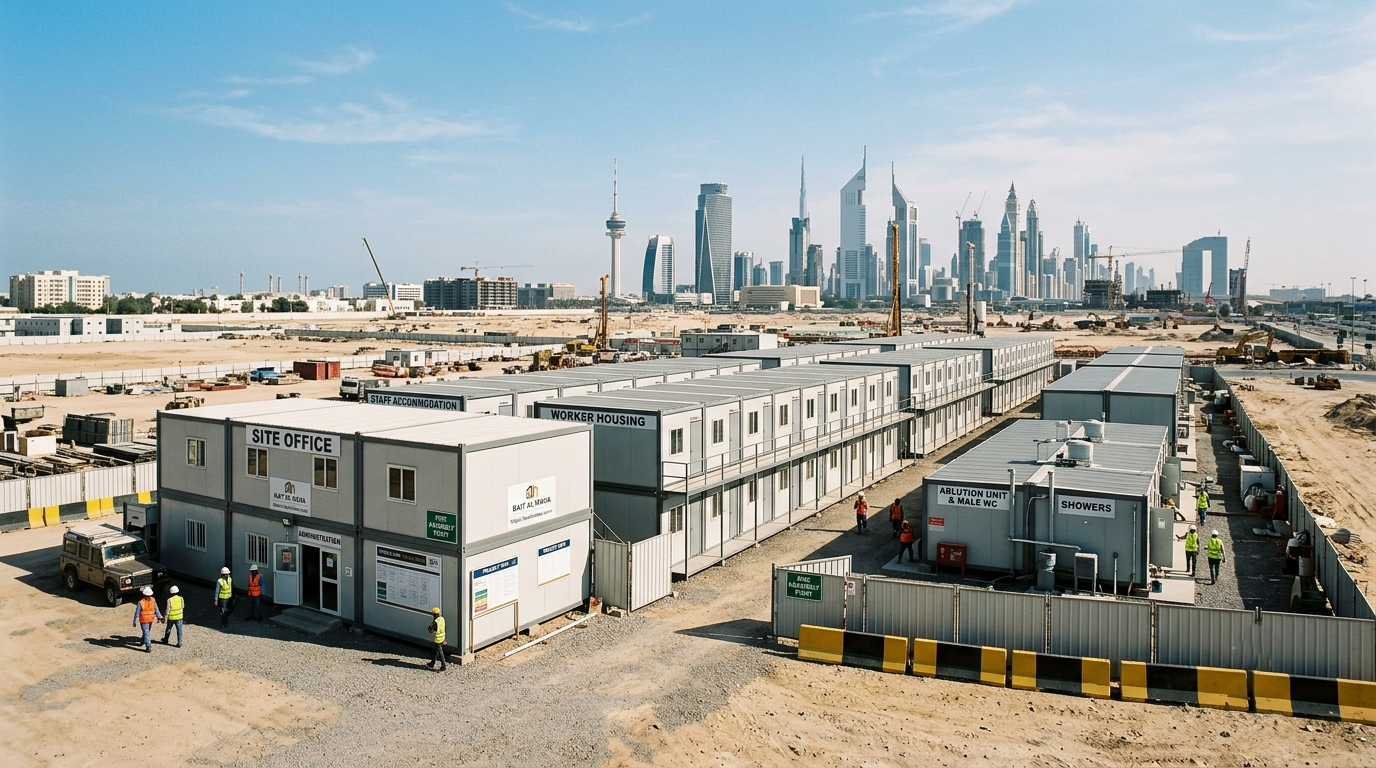
Construction site cabins in Dubai can be sourced comprehensively from a single, turnkey supplier to handle all temporary infrastructure needs. Leading UAE manufacturers like Bait Al Maha Prefab, Al Bait Al Hadi, and TASS Group provide end-to-end solutions, eliminating the hassle of coordinating with multiple vendors. They manage everything from engineering design and factory fabrication to heavy-duty transport, on-site installation, and full utility integration (water, power, and drainage).
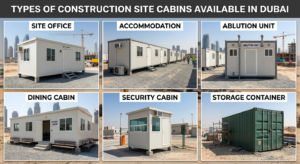
Construction Site Cabin Dubai: Types, Sizes, and Lead Times at a Glance
| Cabin Type | Common Size Range | Starting Price (AED) | Typical Lead Time | Best For |
| Site Office | 3m × 6m to 3m × 12m | 8,000 – 25,000 | 1–3 weeks | Project management, engineering teams |
| Labor Accommodation (per unit) | 3m × 6m, 8–10 person rooms | 8,000 – 20,000 | 1–3 weeks | Worker housing on long-term projects |
| Ablution / Toilet Block | 3m × 6m, 4–6 fixture units | 6,000 – 50,000 | 1–2 weeks | Sanitation for any site size |
| Dining & Kitchen Cabin | 3m × 9m to 3m × 12m | 15,000 – 60,000 | 2–4 weeks | Catering and staff meal breaks |
| Security Guard House | 1.2m × 2m to 2.4m × 4m | 7,000 – 25,000 | 3–10 days | Site entry points and access control |
| Storage / Workshop Container | 20ft or 40ft modified container | 10,000 – 40,000 | 1–2 weeks | Tools, equipment, and material storage |
| Full Turnkey Labor Camp | Multi-unit, custom layout | 200,000 – 600,000+ | 4–6 weeks | Large-scale, long-duration projects |
Prices vary depending on insulation grade, electrical fit-out, and customization. Steel and raw material costs also shift throughout the year, so treat this table as a planning reference rather than a fixed quote. The full range of available cabins and configurations goes beyond what fits in a single table, so it is worth browsing the complete product line before finalizing a list.
What Is a Construction Site Cabin in Dubai?
A construction site cabin in Dubai is a prefabricated steel-framed unit built off-site in a factory and transported to the project location, ready to function as an office, sleeping quarters, toilet block, kitchen, or storage space within days of arrival. Unlike permanent buildings, these units sit on a leveled surface or simple foundation blocks rather than deep footings.
Here is what separates a site cabin from a conventional building, and why that distinction matters on a Dubai project.
- It is built in a factory, not on-site. Manufacturing happens under controlled conditions, which keeps quality consistent and avoids weather-related construction delays.
- It does not need a permanent foundation. A flat, compacted surface is usually enough, which means installation takes days rather than months.
- It can be relocated. Once a project finishes, the same cabin can move to the next site instead of being demolished.
- It can be resold, rented, or refurbished. Unlike a permanent structure, a used cabin still holds resale or rental value.
- It is modular. Units can be linked side by side or stacked to create larger configurations, from a single guard house to a multi-story office block.
This combination of speed, flexibility, and reusability is exactly why prefab cabins remain the standard solution for almost every active construction site across Dubai, regardless of project size.
Why Source Every Construction Site Cabin in Dubai from One Supplier
Anyone who has managed a site mobilization knows the friction that comes from dealing with separate vendors for offices, labor housing, toilets, and security cabins. One truck shows up two weeks early. Another shows up two weeks late. The insulation grade on the sleeping cabins does not match the site office because they came from two different factories. Sourcing every construction site cabin Dubai project needs from a single supplier removes that friction in several specific ways.
Single Supplier vs. Multiple Suppliers, Side by Side
| Factor | One Supplier | Multiple Suppliers |
| Delivery schedule | One coordinated date for every unit. | Staggered arrivals that are hard to align. |
| Build quality | Matching panels, insulation, and electrical fit-out across the camp. | Quality and finish vary from cabin to cabin. |
| Warranty and repairs | One company to call, no disputes over fault. | Vendors often argue over whose unit or installation failed. |
| Pricing | Bundle pricing on one combined order. | Full price on each separate small order. |
| Procurement paperwork | One contract and one invoice trail. | Multiple contracts and invoices to track and reconcile. |
| Compliance consistency | Every unit built to the same MOHRE and Civil Defence standard. | One non-compliant unit can fail the whole camp’s inspection. |
The table above captures the headline differences. The points below explain why each one matters in practice.
- One delivery schedule instead of four or five. When offices, accommodation, ablution units, and a guard house all come from the same manufacturer, they can be fabricated and dispatched together, which matters when a project has a fixed mobilization date tied to a contractual milestone.
- Consistent build quality across the entire camp. Matching panel thickness, insulation type, and electrical fit-out across every unit avoids the patchwork appearance that often raises questions during a client walkthrough or a Civil Defence inspection.
- A single point of contact for warranty and repairs. If a door hinge fails on a labor cabin or an AC unit in the site office stops cooling, there is no back-and-forth between two companies arguing over whose responsibility it is. Most established suppliers cover this through an ongoing maintenance and repair service rather than a one-time delivery and goodbye.
- Better pricing on bundled orders. Suppliers typically offer stronger per-unit rates when a client places one mixed order covering offices, accommodation, ablution, and security, rather than five small separate purchase orders.
- Simpler procurement paperwork. One contract and one invoice trail is easier for a project accountant to track than five separate vendor agreements, particularly on projects where every cost line gets reconciled against the original bill of quantities.
Construction Site Cabin Dubai: Available Types and Specifications
Site Offices
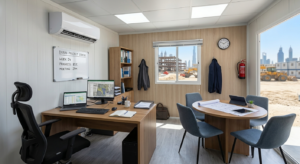
Site offices are usually the first units to land on a new project and the last to leave. They give project managers, engineers, and administrative staff a functional workspace from day one of mobilization through to final handover.
Common sizes and configurations:
- 3m × 6m single module, suited to a small site team of two to four people.
- 3m × 9m, suited to a slightly larger team with a small meeting space.
- 3m × 12m, often linked from two or three smaller modules end to end.
- Two-story stacked configurations, used on larger projects to house separate teams without expanding the footprint.
Key features to look for:
- Integrated power points and concealed wiring, compatible with either a generator or a single-phase DEWA connection.
- Data cabling for site network and internet access.
- Air conditioning sized correctly for the cabin’s floor area, not a generic one-size-fits-all unit.
- Insulated sandwich panel walls, since an uninsulated steel box becomes unusable by mid-morning in summer.
- Reception areas, private offices, and meeting rooms, depending on project scale.
Best for: Site management teams, engineering staff, document storage, and client or consultant meetings held on-site.
A more detailed breakdown of layouts, electrical specifications, and stacked configurations is covered in this guide to site offices in Dubai. On projects running a separate consulting team alongside the contractor’s own staff, it is also worth understanding the difference between a consultant cabin and a contractor cabin before finalizing the office layout, since the two serve different functions on site.
Labor and Staff Accommodation
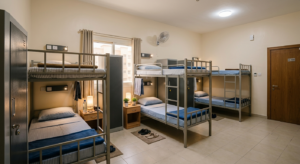
This is the most heavily regulated cabin type on this list, and for good reason. Under UAE labour accommodation rules, employers with 50 or more workers earning AED 1,500 or less per month are required to provide compliant housing, and that housing must meet specific space and safety standards set by the Ministry of Human Resources and Emiratisation.
Mandatory space and layout standards include:
- A minimum of 3 square metres of floor space allocated per worker.
- A maximum of 8 to 10 persons per bedroom, while maintaining that per-person space requirement.
- A minimum bedroom ceiling height of 7 feet.
- A bed, side table, and a lockable cupboard provided for every worker.
- A minimum clearance of 36 inches between standard beds on all sides.
- For bunk beds, a minimum of 48 inches clearance on all sides, with at least 27 inches between the upper and lower bunk.
- Shoe racks fixed at the entrance of each room, since shoes are not permitted inside sleeping areas.
- No stoves or washing machines allowed inside bedrooms.
Additional welfare requirements under current MOHRE guidance:
- Free internet access in worker accommodation.
- Designated recreational areas with seating and a television.
- A first-aid room equipped with basic medical supplies and a dedicated quarantine room.
- For accommodations housing 1,000 workers or more, an on-site 24-hour medical clinic with qualified staff and ambulance access.
- Laundry services provided either in-house on a fixed schedule or outsourced to an external company.
None of these requirements are arbitrary. They exist to prevent overcrowding, which remains one of the most common violations found during routine labour accommodation inspections across the UAE. A supplier who understands these rules in detail, rather than just selling a generic cabin shell, makes the difference between a compliant camp and one that fails inspection on day one.
Best for: Construction workforce housing, remote project sites, and long-duration developments where workers stay on-site for months at a time.
For a full walkthrough of labour camp setup rules, costs, and supplier selection, this guide to labour camp cabin suppliers in Dubai covers the subject in more depth.
Sanitation and Ablution Units
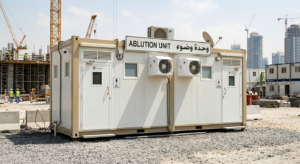
Ablution cabins combine toilets, urinals, and shower stalls into a single weatherproof unit, fitted with exhaust fans and either a connection to site drainage or a sealed wastewater tank.
Fixture ratios required under UAE labour housing standards:
- One toilet for every 8 workers.
- A minimum of two toilets in any shared bathroom, regardless of headcount.
- One urinal for every 25 workers.
- One shower and one wash basin for every 8 workers.
- Hot and cold water available in every bathroom.
- Daily cleaning, with sterilisers used as part of the sanitation routine.
Practical build features:
- Cement board or PVC flooring designed to handle constant moisture without warping.
- Powder-coated aluminium doors and windows for corrosion resistance.
- Built-in or supplementary water heaters, since the UAE sun does not provide reliable hot water on demand.
- Easy access without needing to pass through any bedroom, which is a specific MOHRE requirement.
Best for: Any site with a workforce on-site for more than a few hours a day, from small teams to full labor camps.
Fixture counts, finish options, and current pricing for this category are covered in more depth in this toilet cabin supplier guide for Dubai.
Dining and Kitchen Cabins
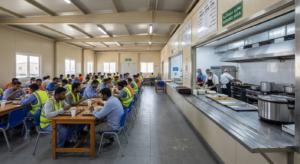
Dining cabins need to be sized for roughly a third of total site staff at any one time, since workers eat in shifts rather than all together. The regulatory benchmark allocates 1.4 square metres per person in the dining area.
Specifications to plan around:
- Food-safe wall and floor cladding throughout the kitchen section.
- Proper ventilation and extraction above all cooking equipment.
- Sufficient bench and prep space to handle catering for the full site headcount without bottlenecking during meal times.
- Posted meal-time notices at the dining room entrance, as required under UAE labour housing standards.
- Daily cleaning schedule, since dining areas are inspected as closely as sleeping quarters.
Cooking inside sleeping cabins is explicitly prohibited under UAE labour housing rules. That single regulation is exactly why a dedicated, properly ventilated kitchen and dining cabin becomes non-negotiable once a labor camp passes a certain size, rather than something to add later if budget allows.
Best for: Labor camps and larger site setups where staff need a structured meal schedule and proper food handling facilities.
Configuration options for this category sit alongside the rest of the kitchen and dining cabin range, which is worth checking together with accommodation units since both are usually ordered as part of the same camp setup.
Security Guard Houses
Guard houses sit at the small end of the size spectrum, but their placement matters more than their footprint.
Common sizes:
- 1.2m × 2m, suited to a single-person post at a minor access point.
- 1.5m × 2m, with slightly more room for equipment or a small desk.
- 2m × 2m, allowing for a chair, desk, and basic monitoring equipment.
- 2.4m × 4m, large enough for shift changeovers or two guards at once.
Features that matter on a real site:
- Clear sightlines in both directions along the access road.
- Pre-wiring for CCTV monitors and an intercom system.
- Compatibility with manual or electric boom barriers at the gate.
- Sufficient insulation to keep a guard comfortable through a full shift in summer heat.
- An optional attached toilet or pantry for extended shift coverage.
Best for: Site entry points, perimeter checkpoints, and parking control areas requiring continuous visibility.
Sizes and fit-out options across the full security cabin range can be browsed alongside the rest of a supplier’s product line, which is worth checking if the same order also needs to cover toilets, dining, or storage units.
Storage and Workshops
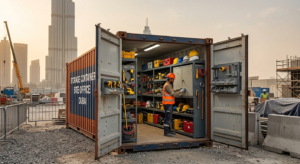
Storage units are typically built from modified shipping containers rather than standard cabin panels, since tools, materials, and equipment need a higher load capacity and tougher weatherproofing than a sleeping cabin or office.
Configuration options:
- 20ft containers, suited to smaller tool and equipment storage.
- 40ft containers, suited to bulkier materials or larger equipment fleets.
- Modified units with built-in shelving, lockable compartments, or workshop benches.
- Insulated and ventilated versions, used where stored materials are sensitive to heat.
Best for: Tool and equipment storage, material staging, and on-site workshop space that needs to be secure and weatherproof.
For sites that need more than a single storage unit, this guide to container storage solutions in Dubai covers configuration options, sizing, and security features in more depth.
How Many Cabins Does Your Site Actually Need?
This is the question almost no supplier website answers directly, and it is usually the first thing a project manager needs to know before requesting a quote. Using the official UAE labour accommodation ratios as a baseline, here is a rough planning guide by workforce size.
| Workforce Size | Site Offices | Sleeping Cabins | Ablution Units | Dining/Kitchen Cabins | Security Cabins |
| 25 workers | 1 | 2–3 | 1 | 1 | 1 |
| 50 workers | 1–2 | 5–6 | 2 | 1 | 1 |
| 100 workers | 2 | 10–12 | 3–4 | 2 | 1 |
| 200+ workers | 3+ | 20+ | 6–8 | 2–3 | 1–2 |
These figures assume standard 8–10 person sleeping cabins and 4–6 fixture ablution units. Storage and workshop units are not included in this table, since they scale with equipment volume rather than headcount.
To calculate your own requirement, follow these steps.
- Confirm your total workforce headcount, separating site management staff from labor workers, since they are usually housed separately.
- Divide the worker headcount by 8 to estimate the minimum number of toilets required, then divide by 25 to estimate the minimum number of urinals.
- Divide the worker headcount by the chosen room occupancy, typically 8 to 10 persons per sleeping cabin, to estimate the number of accommodation units.
- Calculate dining area requirements using 1.4 square metres per person, applied to roughly one-third of total headcount at any given meal time.
- Add one site office per management function, such as a separate cabin for engineering, commercial, and site administration teams on larger projects.
- Confirm final numbers with your supplier through an on-site survey, since slope, access, and utility availability can all affect the final layout.
Worked Example: Sizing and Costing a 75-Worker Site Camp
The steps above are easier to picture with real numbers attached. Here is how a mid-sized labor camp for 75 workers comes together once the official ratios are applied.
- Sleeping cabins. 75 workers divided by 9 per room, rounded up, equals 9 sleeping cabins.
- Toilets. 75 divided by 8 equals 10 toilets, split across 2 to 3 ablution units.
- Urinals. 75 divided by 25 equals 3 urinals.
- Showers and wash basins. 75 divided by 8 equals 10 of each, distributed across the same ablution units.
- Dining capacity. One-third of 75 is 25 people at a time. At 1.4 square metres per person, that is roughly 35 square metres, which fits comfortably into one 3m × 12m dining cabin.
- Site offices. 1 to 2 units, depending on whether engineering and site administration share a cabin or need separate space.
- Security cabin. 1 unit positioned at the main site entrance.
Estimated total cost. Using the benchmark pricing covered later in this guide, a purchased setup at this scale typically falls somewhere between AED 190,000 and AED 290,000, depending on insulation grade and finish level. The same setup on a rental arrangement would cost considerably less per month, with no large upfront outlay.
Step-by-Step: How the Ordering and Mobilization Process Works
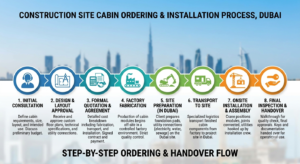
Knowing what happens between placing an order and taking occupancy helps a project team plan realistic mobilization dates rather than guessing.
- Initial consultation and site requirement review. The supplier confirms workforce size, cabin types needed, site location, and any access restrictions for delivery vehicles or cranes. This step usually starts with a direct consultation request rather than a generic online quote form.
- Design and quotation. A layout proposal and itemized quote are prepared, covering each cabin type, size, specification, and total project cost.
- Order confirmation and design sign-off. Final dimensions, electrical layout, and any customization are agreed upon and confirmed in writing, typically within 1 to 3 days.
- Fabrication. Cabins are built in the factory rather than on-site, which usually takes 1 to 3 weeks depending on the number of units and complexity involved.
- Transport to site. Units are moved by flatbed truck, taking anywhere from same-day to a few days depending on location within the UAE.
- Crane lifting and on-site assembly. Standard camps are typically assembled within 1 to 3 days, while multi-story linked offices take longer.
- Utility connection. Power, water, and drainage hookups follow, which can take a few days to two weeks depending on whether a temporary DEWA connection or generator setup is involved.
- Final walkthrough and handover. Every unit is checked against the agreed specification before the client takes occupancy.
For a small setup, the full process from order to handover often wraps up within 1 to 2 weeks. A full turnkey labor camp for a large workforce can take 4 to 6 weeks, mostly driven by the number of units that need fabricating and the scale of the utility connection work involved.
Dubai Compliance and Approvals for Site Cabins
Does labor accommodation need MOHRE approval?
Yes. Any company providing housing for its workforce is required to register that accommodation in MOHRE’s Labour Accommodation System. The facility itself must comply with the space, sanitation, and safety standards set out in the relevant cabinet and ministerial resolutions covering group labour housing.
What the registration process typically covers:
- The camp’s full design layout, including room counts and occupancy figures.
- The sanitation system, including fixture ratios and wastewater handling.
- Fire safety provisions and emergency evacuation planning.
- Ongoing compliance, confirmed through unannounced MOHRE inspections after approval is granted.
Is Civil Defence approval required for temporary cabins?
Generally, yes, particularly once a site cabin setup includes labor accommodation, a kitchen, or any meaningful occupant load. Dubai Civil Defence issues a No-Objection Certificate confirming that a structure, whether permanent or temporary, meets the UAE Fire and Life Safety Code.
Standard fire safety requirements include:
- Functioning fire extinguishers positioned throughout the camp.
- Smoke detectors and an audible alarm system.
- Clearly marked emergency exits and evacuation routes.
- A documented evacuation plan, communicated to workers in a language they understand.
- Regular fire drills, especially for larger labor accommodation sites.
Temporary structure approvals are typically valid for a defined period and need renewal if the underlying project timeline shifts. This is worth building into your mobilization schedule rather than treating it as an afterthought once cabins are already on site.
Do requirements differ inside free zones?
They can. Authorities such as JAFZA, DIP, and other free zone operators sometimes run their own permitting workflow alongside, or instead of, standard Dubai Municipality approval.
What this means in practice:
- A site cabin setup inside a free zone may need sign-off from that specific free zone authority in addition to the usual civil approvals.
- The approving body changes depending on the project’s exact location, not just the emirate.
- Confirming this directly with the free zone authority before finalizing a cabin layout avoids a costly redesign after delivery.
What about power connections?
Site cabins generally run on either a temporary DEWA connection or a generator, and the wiring inside each unit needs to match whichever supply is actually available on-site.
What a supplier with real project experience typically does:
- Pre-wires cabins for both generator and DEWA scenarios before they leave the factory.
- Confirms load requirements with the client ahead of delivery, not after.
- Avoids the common problem of a cabin arriving wired for three-phase power when the site only has a temporary single-phase connection.
Built for Dubai’s Climate
A site cabin that performs well in a milder climate often is not built to handle a Dubai summer, where ambient temperatures regularly clear 45°C and direct sun exposure on an uninsulated steel roof can push internal temperatures far higher within hours.
Insulation considerations:
- Rockwool, EPS, or PUF sandwich panels are standard, typically in the 50mm to 100mm range.
- Thicker panels are generally justified for accommodation units, which need to stay livable overnight without running AC at full capacity around the clock.
- Roof insulation matters as much as wall insulation, since direct overhead sun exposure is the primary source of heat gain.
AC sizing guidelines:
- AC tonnage should scale with cabin size rather than using a flat unit across every cabin type.
- A 3m × 6m office typically needs different cooling capacity than a 3m × 12m linked office.
- Undersized units run constantly without ever bringing the room to a comfortable temperature, which increases both electricity costs and equipment wear.
Exterior cladding considerations:
- UV-resistant finishes hold their color and structural integrity far longer than standard paint under constant sun exposure.
- Aluminium composite panels are a common upgrade for offices and labor accommodation that need to look presentable for several years of continuous use.
- Proper sealing around windows and doors prevents both heat infiltration and sand or dust intrusion during shamal wind events.
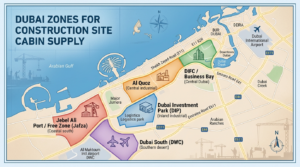
Where Construction Site Cabins Are Needed Most Across Dubai
Demand for a construction site cabin in Dubai is not limited to one part of the city. Industrial and infrastructure activity keeps cabin demand steady across several zones, each with slightly different practical requirements.
- Al Quoz, where light industrial and warehouse projects are common and ground access for delivery trucks is usually straightforward.
- Dubai Investment Park (DIP), home to large logistics and manufacturing developments that often need multi-unit labor camps rather than a single cabin.
- Jebel Ali, close to the port and free zone, where industrial and marine projects typically need stronger corrosion resistance due to coastal salt exposure.
- Business Bay and DIFC, where high-rise developments need compact, professional site offices that fit into a tight urban footprint, sometimes stacked two stories high to save ground space.
- Dubai South, where ongoing infrastructure and aviation-linked projects continue to expand and frequently need phased camp setups as headcount grows.
A supplier familiar with these zone-specific differences tends to get the layout right on the first attempt rather than after a costly resubmission. Reviewing a gallery of completed projects across these areas is one practical way to judge whether a supplier actually has the relevant experience before placing an order.
Seasonal Planning: The UAE Midday Break and Your Site Camp
This is a detail almost no competitor article connects to cabin planning, but it directly affects how a site camp should be laid out. Every year, from 15 June to 15 September, the UAE enforces a mandatory midday work break for any work performed under direct sunlight, including construction. Outdoor work is prohibited daily between 12:30 PM and 3:00 PM during this period, and employers found in violation face fines of AED 5,000 per worker, up to a maximum of AED 50,000 per company.
What this means for your cabin setup:
- Employers are legally required to provide shaded, cooled rest areas for the entire workforce during the ban hours, which means dining and rest cabins need enough capacity to hold the full on-site headcount at once, not just a third of it as during normal meal shifts.
- Air conditioning capacity in rest and dining cabins becomes critical during these three months, since the entire workforce will be indoors simultaneously rather than spread across shifts.
- Hydration stations and first-aid provisions, often housed in or near the site office, need to be easily accessible from the rest cabins during this window.
- Projects mobilizing a new camp between June and September should factor in slightly larger dining and rest cabin capacity than the standard sizing table suggests, since the midday rule effectively concentrates the entire workforce indoors for two and a half hours every day.
Planning for this seasonal requirement in advance, rather than scrambling to add capacity once summer arrives, is one of the simplest ways to avoid both compliance fines and a miserable workforce.
Construction Site Cabin Dubai: Typical Pricing and Setup Timeline
Pricing for any cabin depends on three factors: the base size, the insulation and electrical specification, and any custom fit-out requested, such as built-in furniture, branded signage, or upgraded flooring.
General pricing benchmarks:
- A basic single sleeping cabin or small site office can start around AED 8,000.
- Security cabins generally range from AED 7,000 to AED 25,000 for a standard build, with premium insulated and air-conditioned versions going higher.
- Ablution and toilet cabins typically range from AED 6,000 to AED 50,000, depending on fixture count and finish quality.
- A fully turnkey, multi-room labor camp combining offices, accommodation, ablution, dining, and security can run past AED 600,000 depending on scale.
These figures shift with steel and material costs throughout the year, so the fastest way to confirm current rates for a specific project is to request a quote directly rather than budgeting from last year’s pricing.
Rent or Buy: Which Makes Sense for Your Project?
This is one of the first questions worth answering before requesting any quote, because it changes the entire conversation with a supplier.
Rental tends to make sense when:
- The project duration is short, typically under six months.
- The exact site lifespan is uncertain, such as on a tender-dependent or phased project.
- Capital needs to stay available for other parts of the project rather than being tied up in cabin assets.
- The cabin requirement is temporary or event-related rather than tied to a long construction program.
Purchase tends to make sense when:
- The project timeline stretches past a year.
- The contractor regularly mobilizes new sites and can reuse the same cabins across multiple projects.
- Long-term cost control matters more than short-term cash flow flexibility.
- The cabins need heavy customization, such as branded signage or a specific internal layout, which is easier to justify on an owned asset.
A rough breakeven guide:
- Security cabin rentals in the UAE typically run between AED 300 and AED 1,500 a month, depending on size and specification.
- A basic cabin purchase costs somewhere around AED 8,000 to AED 15,000.
- Comparing the two, the breakeven point typically falls somewhere between six and eighteen months.
- Beyond that point, ownership is usually the cheaper path, since every additional month is rental cost with nothing to show for it afterward.
Every project is different, so it is worth running the actual numbers against your specific timeline rather than relying on a general rule.
Common Mistakes Contractors Make When Setting Up a Site Camp
These mistakes show up repeatedly across real projects, and almost all of them are avoidable with proper planning before the first cabin is even ordered.
- Underestimating ablution capacity. Many contractors size toilets and showers for the office staff headcount and forget to scale up for the full labor workforce, leading to non-compliant ratios that fail inspection.
- Ordering cabins before confirming the site survey. Ground conditions, slope, and access for delivery trucks or cranes can all change the final layout, and skipping this step often leads to costly rework after delivery.
- Ignoring electrical load planning. A cabin wired for the wrong power supply, whether generator or DEWA, can sit unusable on-site until rewiring is completed.
- Treating compliance as an afterthought. Waiting until after cabins arrive to check MOHRE or Civil Defence requirements almost always costs more time and money than confirming requirements during the design stage.
- Choosing the cheapest cabin without checking insulation quality. A cabin that looks identical on paper can perform very differently in Dubai’s summer heat depending on panel thickness and AC sizing.
- Splitting the order across multiple suppliers to save a small amount per unit. The delivery and quality inconsistencies this creates usually cost more in lost time than the original savings.
- Forgetting seasonal capacity during the midday work ban months. Camps mobilized without accounting for the June to September rest requirement often need emergency capacity additions once summer arrives.
- Skipping a maintenance plan. Cabins left unmaintained for a year or more often need far more expensive repairs than a basic annual service would have prevented.
Maintenance and Lifespan of Site Cabins
A well-built, properly maintained site cabin can remain in active use for many years across multiple projects, but only with consistent upkeep.
Routine maintenance tasks to schedule:
- Roof sealant inspection, particularly before and after the summer heat and the winter rain season.
- AC servicing every three to six months, depending on usage intensity.
- Pest control checks, which are also a specific requirement under UAE labour accommodation standards.
- Steel frame and panel inspection for rust or corrosion, especially in coastal or high-humidity areas.
- Electrical safety checks, including wiring, distribution boards, and isolator switches.
- Door, window, and seal inspections to maintain insulation performance over time.
Factors that affect a cabin’s working lifespan:
- Frequency of relocation, since repeated transport and reassembly adds wear over time.
- Climate exposure, with coastal and high-humidity sites generally seeing faster wear than inland locations.
- Quality of the original build, particularly steel gauge and panel insulation grade.
- Consistency of maintenance, since a cabin serviced on schedule will outlast one that is neglected.
Suppliers offering refurbishment services can often extend a cabin’s usable life significantly beyond its original condition, which is a cost-effective alternative to replacing units outright between projects.
Sustainability and Energy Efficiency Considerations
Sustainability is becoming a bigger part of procurement conversations on UAE construction projects, and site cabins are no exception.
- Reusability reduces waste. Unlike permanent structures, cabins can be relocated and reused across multiple projects instead of being demolished, which significantly reduces construction waste over a contractor’s project history.
- Better insulation directly reduces energy consumption. Higher-grade insulation lowers AC running time and electricity costs across the full project duration, not just worker comfort.
- Water-saving fixtures in ablution units reduce overall site water consumption. This matters on projects where water is trucked in rather than connected to a permanent supply.
- Solar power options exist for remote or off-grid sites. This works well for security cabins and smaller units where a full generator connection is not cost-effective.
- Refurbishing existing cabins instead of manufacturing new ones reduces the material footprint. This matters most for contractors running multiple sites per year, where reused units replace newly manufactured ones from one project to the next.
What to Check Before Choosing a Site Cabin Supplier in Dubai
- Can they supply every cabin type your site needs? A supplier who covers offices but not labor accommodation, or accommodation but not ablution units, defeats the purpose of single-sourcing in the first place.
- Do they offer after-delivery maintenance or an annual maintenance contract? Cabins that sit on a busy site for a year or more need occasional servicing, and it helps to know upfront who handles that.
- Can they show completed projects of a similar scale in the UAE? A gallery of finished labor camps and office setups tells you more about real capability than a product catalogue ever will.
- Do they handle transport and on-site assembly, or is that left to you? Some suppliers quote ex-factory pricing only, which can add unexpected cost once delivery and crane work get factored in separately.
- Are their materials actually specified for UAE conditions? Ask directly about insulation thickness and AC sizing rather than assuming every cabin on the market is built the same way.
- Do they understand MOHRE and Civil Defence requirements in detail? A supplier who can speak specifically about bed spacing, fixture ratios, and fire safety provisions is far more likely to deliver a compliant camp on the first attempt.
- Can they support both rental and purchase arrangements? Flexibility here means you are not locked into one commercial model before you have confirmed your project’s actual duration.
- Do they offer relocation or refurbishment services? This matters if your company runs multiple projects per year and wants to reuse cabins rather than buying new units each time.
Quick Glossary: Site Cabin Terms Explained
Procurement and compliance documents for site cabins are full of abbreviations that are not always explained anywhere. Here is a plain-English reference for the terms used throughout this guide.
- Ablution Unit. A combined toilet, shower, and washbasin cabin built as a single weatherproof module.
- BOQ (Bill of Quantities). The itemized cost breakdown used to track every project expense, including cabin procurement.
- DEWA. Dubai Electricity and Water Authority, the utility provider responsible for both permanent and temporary power connections.
- MOHRE. The Ministry of Human Resources and Emiratisation, the federal authority that regulates labor accommodation standards across the UAE.
- NOC (No-Objection Certificate). An approval issued by Dubai Civil Defence confirming that a structure meets fire and life safety requirements.
- Sandwich Panel. An insulated wall or roof panel made of two outer steel layers with an insulating core, such as rockwool, EPS, or PUF.
- Single-Phase and Three-Phase Power. Two types of electrical supply. Single-phase usually suits smaller cabins, while three-phase is typically needed for larger AC loads or multiple linked units.
- Turnkey. A fully completed setup handed over ready for immediate use, with no further work required from the client.
Bait Al Maha manufactures its full cabin range, including site offices, accommodation units, ablution blocks, dining and kitchen cabins, security cabins, and storage containers, from its production facility in Sharjah, with delivery, crane installation, and relocation services covering Dubai and the wider UAE. More on the company’s background and manufacturing capability is available on the About Bait Al Maha page.
Frequently Asked Questions
How much does a construction site cabin cost in Dubai?
Basic units start around AED 8,000. A full turnkey labor camp can run from roughly AED 200,000 to AED 600,000 or more, depending on workforce size.
Can one supplier provide all types of site cabins in Dubai?
Yes. Most established prefab manufacturers in the UAE build offices, accommodation, ablution units, and security cabins in-house from the same factory.
Are portacabins legal for construction sites in Dubai?
Yes, provided the unit is registered where required and meets MOHRE and Dubai Civil Defence standards for space, sanitation, and fire safety.
How long does it take to set up a site cabin in Dubai?
A small setup typically takes 1 to 2 weeks from order to handover. A full labor camp usually takes 4 to 6 weeks.
Is it better to rent or buy a construction site cabin in Dubai?
Rental suits projects under about six months. Purchase tends to cost less over a year or longer, since the cabin becomes a reusable asset.
Do construction site cabins in Dubai need MOHRE approval?
Labor accommodation does. It must be registered in MOHRE’s Labour Accommodation System and meet space, bed-spacing, and sanitation ratios.
What is the standard size of a site office cabin in Dubai?
Common sizes run from 3m × 6m for a small team up to 3m × 12m for linked units housing a full site management team.
Can construction site cabins be relocated after the project ends?
Yes. A purchased cabin can be craned onto a flatbed truck and reinstalled at a new site, which most suppliers offer as a relocation service.
Ready to Scope Your Construction Site Cabin in Dubai?
Every project’s cabin requirement looks different once you factor in workforce size, project duration, and site-specific approvals. The fastest way to get an accurate quote for a construction site cabin in Dubai is to share three details with your supplier.
- Which cabin types you need right now, whether offices, accommodation, ablution, dining, security, or storage.
- Your estimated number of staff or workers to be housed or accommodated on site.
- Whether you are looking for short-term rental or permanent purchase.
Get in touch with Bait Al Maha with those three answers, and a full site cabin proposal, covering sizes, pricing, and a realistic delivery timeline, can be put together from there.


