Tag: PortacabinDubai

  • Types of Portacabins Available in Dubai: A Complete Guide (2026)

    The main types of portacabins available in Dubai are site office cabins, labor accommodation cabins, security guard cabins, portable toilet and ablution units, storage and workshop containers, commercial and retail cabins, specialised functional units (clinics, mosques, canteens, generator rooms), and stackable multi-storey modular complexes. Every type is engineered for Dubai’s extreme climate – with insulated sandwich panels, high-ambient AC units, and UV-resistant materials as standard. Prices range from AED 9,000 for a mini security cabin to AED 120,000+ for custom commercial units, with short-term and long-term rental available for all types across Dubai and the wider UAE.

    What Is a Portacabin and Why Is Dubai One of Its Biggest Markets?

    A portacabin – also written as porta cabin or portable cabin – is a factory-manufactured, steel-framed modular structure. It is built off-site under controlled conditions, delivered to your location on a flatbed truck, and ready to use within hours of arrival.

    Three things that make portacabins the ideal choice for Dubai projects:

    • No concrete foundation required – units sit on levelled ground or concrete blocks.
    • No lengthy construction programme – delivery and setup in days, not months.
    • No permanent land commitment – units can be relocated, reconfigured, or returned when the project ends.

    That combination of speed, flexibility, and cost control is exactly why Dubai runs on portacabins.

    Dubai’s Construction Economy Drives Non-Stop Portacabin Demand

    The numbers tell the story clearly:

    • Dubai accounts for approximately 41.6% of total UAE construction activity, according to Mordor Intelligence’s UAE Construction Market Report.
    • The UAE construction sector reached AED 178.49 billion in 2024 and is projected to grow to AED 242.33 billion by 2029 (ResearchAndMarkets, Q4 2026).
    • Prefabricated construction methods – of which portacabins are the core component – are advancing at a 6.87% CAGR through 2030, outpacing conventional construction growth.

    Every major project in that pipeline – residential towers, metro expansions, highway networks, hospitality developments, industrial zones – requires temporary site infrastructure from its very first day on site. That infrastructure is built almost entirely from portacabins.

    The Practical Reality of a Dubai Project Mobilisation

    When a main contractor wins a large project in Dubai, the clock starts immediately. Before a single shovel touches the ground on the permanent works, the following must all be in place and operational:

    1. A functioning site office complex with partitioned workspaces, data cabling, and air conditioning.
    2. MOHRE-compliant accommodation for potentially hundreds of workers.
    3. Sanitation blocks meeting Dubai Municipality toilet-to-worker ratio requirements.
    4. A canteen and kitchen facility for workforce feeding.
    5. A prayer room or mosque cabin for the predominantly Muslim workforce.
    6. A first aid point or portable clinic appropriate to the workforce size.
    7. A security cabin at the compound entrance for access control.

    Portacabins make every item on that list operational within weeks – not the months that conventional construction would require.

    Beyond Construction – Other Dubai Sectors Driving Portacabin Use

    Portacabins are not exclusive to construction sites. Demand comes from every corner of Dubai’s economy:

    • Events and exhibitions: Dubai Shopping Festival, Dubai Airshow, Art Dubai, GITEX Technology Week, and Ramadan Night Markets all deploy portable commercial cabins seasonally.
    • Oil, gas, and industrial: Operators in Dubai Industrial City and Jebel Ali Free Zone need self-contained welfare units for isolated workforces far from permanent infrastructure.
    • Retail and F&B: Brands test new Dubai locations with pop-up kiosk cabins before committing to permanent leases and full fit-out costs.
    • Healthcare and welfare: Portable clinic cabins serve rapidly growing communities in new Dubai districts where permanent medical facilities are still in development.
    • Real estate sales: Developers install temporary on-site sales offices at new project launches – branded, professional, and operational within days.

    branded retail kiosk cabin at a Dubai outdoor market

    How Dubai’s Climate Changes Everything About Portacabin Design

    A portacabin made for the UK or Europe will fail in Dubai within one summer. This is not an exaggeration – it is an engineering reality that every buyer in the Dubai market must understand before specifying or procuring any unit.

    Dubai’s environment imposes four specific design challenges that simply do not exist in most other markets. Every UAE-spec portacabin must be engineered to address all four simultaneously.

    Extreme Heat

    • Sustained ambient temperatures of 45°C to 52°C from June through September.
    • Standard residential AC units rated to 43°C ambient will trip repeatedly on thermal protection during Dubai summer peaks – making them unsuitable for portacabin use.
    • High-ambient inverter AC models rated for 52°C continuous operation (brands: Midea, Gree, Carrier) are the only acceptable specification.
    • Panel walls must carry a minimum 50mm insulation thickness.
    • 75mm to 100mm rock wool or polyurethane (PU) core panels are strongly recommended for any direct sun exposure application.
    • Double-skin insulated roofs with a reflective exterior coating reduce internal cabin temperatures by 8°C to 12°C compared to single-skin roofing.

    UV Radiation

    • Dubai’s UV intensity will degrade low-grade panel coatings within 12 to 18 months of installation.
    • All exterior surfaces must use either UV-stabilised pre-painted galvanised steel or aluminium composite panels (ACP) to maintain surface integrity across the cabin’s full operational lifespan.
    • Standard paint finishes applied over untreated steel begin to crack, fade, and chalk within two to three Dubai summers.

    Coastal Humidity and Salt Air

    • Sites near Dubai’s coastline – including Dubai Marina, Jumeirah Beach, Jebel Ali port, and Palm Jumeirah – face accelerated steel corrosion from salt-laden air.
    • Frames in these locations should specify powder-coated galvanised steel at minimum.
    • For maximum long-term protection, aluminium frame sections at joints and connection points are recommended – aluminium does not corrode in salt-air environments.

    Sand and Dust Infiltration

    • Dubai’s desert environment and seasonal shamal winds drive fine particulate sand through every unsealed gap in a cabin’s structure.
    • Properly specified Dubai portacabins use dust-resistant louvre designs, fitted door gaskets, and sealed panel joints throughout.
    • Site office cabins in particularly dusty zones – desert periphery sites, demolition-adjacent projects – benefit from filtered AC intake systems to protect cooling coils from premature fouling and performance loss.

    standard portacabin cross-section with single-skin roof, no insulation, and a basic AC unit

    Rent or Buy in Dubai – Settle This Before Choosing a Type

    Before selecting a portacabin type, decide whether to rent or purchase. This single decision shapes your cost structure, customisation options, and total project expenditure.

    Renting makes financial sense when:

    • Your project runs for under 12 months.
    • You need flexibility to scale unit numbers up or down as the project evolves.
    • The use is seasonal or events-based (October to April is Dubai’s peak outdoor commercial season).
    • You want maintenance and logistics managed by the supplier without adding to your site management workload.
    • You need immediate availability from standard supplier stock without a fabrication lead time.

    Buying makes financial sense when:

    • Your project runs for 18 months or longer.
    • You need a fully custom-specified unit that standard rental stock cannot provide.
    • You plan to redeploy the same cabin across multiple projects over several years.
    • You are establishing a semi-permanent labor camp or long-term operational facility.
    • The 18 to 24-month purchase break-even calculation is favourable against the total rental cost.

    For a full view of what is available for both purchase and rent across all cabin types – including site offices, accommodation units, security cabins, and toilet blocks – the rental and service options at Bait Al Maha are a practical starting point for understanding what the Dubai and Sharjah market currently offers.

    The 8 Main Types of Portacabins Available in Dubai – Full Breakdown

    listing all 8 portacabin types with a small icon representing each one (e.g., a desk for site office, a bed for accommodation, a shield for security cabin)

    Site Office Cabins in Dubai

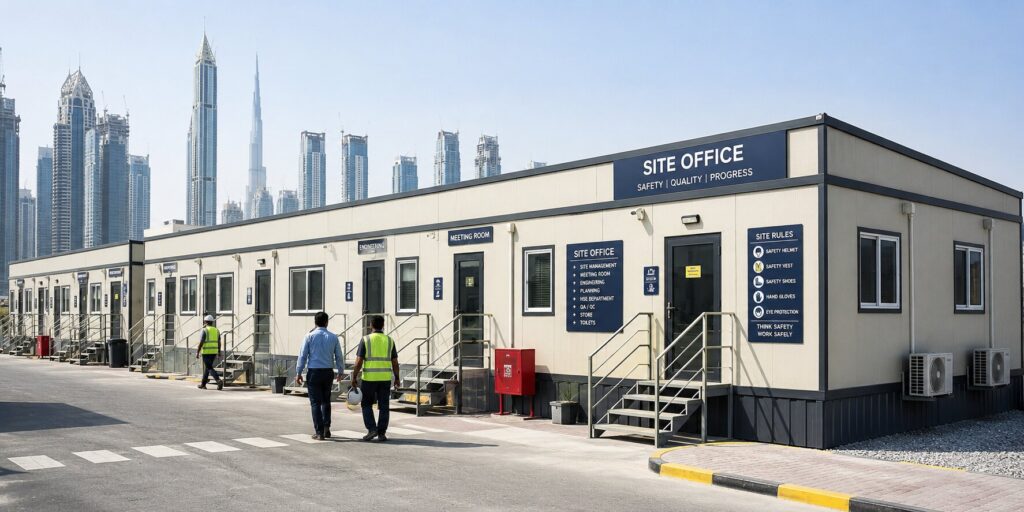
    Definition: A site office cabin is a fully fitted, air-conditioned administrative portacabin used as the on-site command centre for project management, engineering coordination, and contractor operations. It is the most commonly deployed portacabin type on Dubai construction sites.

    Who Uses Site Office Cabins in Dubai:

    • Main contractors and civil works teams managing day-to-day construction operations.
    • PMC consultants and client representatives overseeing project delivery on behalf of owners.
    • Engineering consultants requiring on-site drawing, coordination, and review space.
    • Sub-contractors needing a dedicated presence on large multi-contractor sites.
    • Government project supervisors on Dubai infrastructure and public works programmes.

    Standard Specifications:

    Feature Specification
    Available sizes 3m x 3m / 6m x 3m / 12m x 3.2m
    Electrical fitout 220V wiring, distribution board, multiple sockets, LED lighting
    Air conditioning Min. 1.5-ton inverter split AC; 2-ton recommended for Dubai summer
    Partitioning Open plan or divided offices via gypsum or steel stud partitions
    Data and comms Pre-installed conduit for CAT6 network cabling and telephone line
    Doors Galvanised steel lockable door with multi-point locking
    Windows Tinted aluminium casement windows with insect mesh
    Flooring options Vinyl sheet, ceramic tile, or anti-static tile for technical offices

    UAE-Specific Design Requirements for Dubai Site Offices:

    • Minimum 50mm insulated sandwich panel walls – EPS at entry level; rock wool or PU for better thermal performance.
    • Double-skin insulated roof with reflective exterior coating – reduces internal temperature under direct Dubai sun.
    • High-ambient inverter AC rated for 52°C ambient operation – non-negotiable for any cabin running through a Dubai summer.
    • Elevated floor base – prevents sand and dust ingress from site ground surfaces.

    Available Upgrades in the Dubai Market:

    1. Executive specification – False ceiling tiles, carpet flooring, glass partition walls, Venetian blinds, and an executive furniture package.
    2. Compound configuration – Multiple cabins interconnected via covered walkway corridors, creating a full management complex with drawing offices, meeting rooms, and senior management suites.
    3. Double-storey stacking – Two-storey site office blocks with external staircases, widely used on large Dubai infrastructure projects with limited ground footprint.
    4. Solar panel integration – Roof-mounted solar panels for remote sites where generator power consumption needs to be minimised.

    Real-World Example: A Tier 1 contractor on a major road expansion in Dubai sets up a 10-unit site office compound – standard contractor offices, an executive client representative unit, a drawing room, a conference cabin, and a server room – all connected by a shaded walkway corridor. The full compound is mobilised and operational within four weeks of contract award.

    Labor Accommodation Cabins in Dubai

    properly organised, clean labor accommodation compound

    Definition: A labor accommodation cabin is a residential portacabin providing sleeping quarters and basic living facilities for construction and industrial workers on or near Dubai project sites.

    In Dubai, these cabins are not optional for qualifying employers. They are a legal obligation under UAE labor law, and the standards governing them are actively enforced through regular MOHRE and municipality inspection visits.

    The Legal Requirement in Plain Terms:

    Under UAE labor regulations, employers must provide accommodation when all three of the following conditions are met:

    1. The organisation employs more than 50 workers.
    2. Workers earn a monthly wage below AED 2,000.
    3. The accommodation does not already meet prescribed standards.

    Non-compliance consequences:

    • Fines of AED 5,000 to AED 50,000 per violation.
    • Work permit suspensions – halting all new employee processing for the offending organisation.
    • Risk of project stoppages following Civil Defense or MOHRE inspection failures.

    Who Uses Labor Accommodation Cabins in Dubai:

    • Main contractors housing workforces on large Dubai construction and infrastructure projects.
    • Labor supply companies and manpower agencies managing housed workforces.
    • Industrial facility operators in Dubai Industrial City and Jebel Ali Free Zone.
    • Large hospitality and retail development contractors during fit-out phases.

    Standard Specifications:

    Feature Specification
    Available sizes 6m x 3m (6-person), 12m x 3m (10–12 persons with partitioning)
    Sleeping arrangements Built-in 2-tier steel bunk beds, individual personal steel lockers
    Cooling Minimum 2 high-ambient inverter split AC units per 6-person cabin
    Ventilation Mechanical exhaust ventilation in addition to AC cooling
    Fire safety 30-minute fire-rated door, smoke detector, fire extinguisher point
    Utilities 220V wiring, LED lighting, external water connection point

    MOHRE Compliance Standards – What the Law Requires:

    • Minimum 3.0 to 4.0 square metres of floor space per worker.
    • Mandatory separation of sleeping and living areas where space permits.
    • Functioning air conditioning and mechanical ventilation in every sleeping unit.
    • Hot and cold running water accessible within the compound.
    • Separate male and female accommodation where applicable.
    • Access to a canteen and recreation area for all camps with more than 50 workers.
    • Full registration in the MOHRE Labour Accommodation System before workers occupy the facility.

    The Compound Approach – Why Accommodation Cabins Never Stand Alone:

    This is the most important planning insight for any contractor building a labor camp in Dubai. A dormitory cabin on its own is not a compliant facility. UAE regulations and practical worker welfare requirements mean that accommodation cabins must operate as part of a fully integrated compound system.

    A complete, compliant compound for 300 workers includes:

    1. Dormitory cabins – sleeping quarters with bunk beds and personal lockers.
    2. Ablution blocks – combined toilets, showers, and wudu wash areas.
    3. Kitchen and canteen cabins – food preparation and dining facilities.
    4. Recreation area or cabin – mandatory for camps with more than 50 workers.
    5. Security cabin – compound entrance access management and control.

    Civil Defense approval is mandatory for compounds housing 50 or more workers – covering fire safety plans, emergency egress routes, fire suppression systems, and emergency lighting installation.

    For a comprehensive view of accommodation cabin options – from single dormitory units through to full turnkey camp configurations – the labor accommodation and prefab building range available in the current UAE market covers every scale of requirement.

    Real-World Example: A civil contractor builds a 300-worker labor camp in Dubai’s outer industrial zone – 50 dormitory cabins, 10 ablution blocks, 2 canteen cabins, and a mosque cabin – achieving full Civil Defense approval and MOHRE registration within six weeks of mobilisation.

    Security Guard Cabins in Dubai

    showing the tinted safety glass panels, the roof overhang, and an access barrier in the background

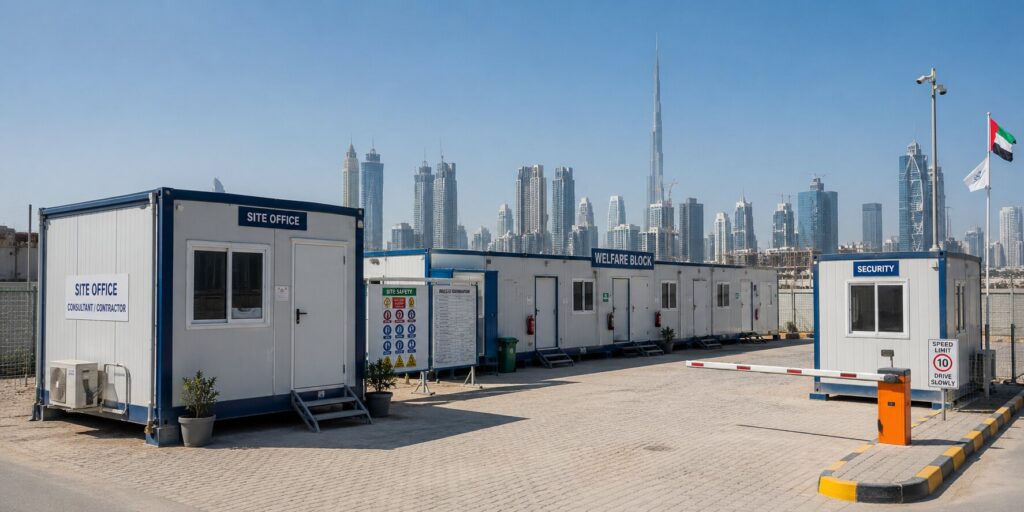
    Definition: A security guard cabin – also called a guardhouse or security booth – is a compact, standalone portacabin positioned at the entry and exit points of sites, compounds, and facilities. It provides a climate-controlled, high-visibility station for security personnel.

    Every gated community in Dubai, every logistics hub in Jebel Ali, every construction site in Downtown Dubai, and every industrial facility in Dubai Industrial City has at least one. They are the most universally used portacabin type across every sector of the Dubai economy.

    Who Uses Security Cabins in Dubai:

    • Security companies managing access at construction sites and industrial facilities.
    • Residential developers protecting gated communities throughout Dubai.
    • Facility management firms overseeing commercial, mixed-use, and retail compounds.
    • Port and logistics operators controlling access at Jebel Ali and similar facilities.
    • Schools, hospitals, government buildings, and public sector facilities across the emirate.

    Standard Specifications:

    Feature Specification
    Standard sizes 2m x 2m / 2.4m x 2.4m / 3m x 2.4m
    Glazing 3-sided or 360° tinted safety glass (20–30% VLT)
    Air conditioning 0.75-ton to 1-ton high-ambient inverter split AC
    Power Single-phase 220V, 2–4 sockets, LED lighting throughout
    Optional features Intercom panel housing, CCTV conduit, access control panel, barrier connection point, telephone line

    Dubai-Specific Design Features That Make the Difference:

    • Extended roof overhang – A minimum 300mm galvanised steel overhang on all sides is essential. Without it, direct overhead sun drives interior temperatures to unworkable levels even with AC running continuously.
    • Tinted safety glazing at 20–30% VLT – Reduces glare and solar heat gain for the guard while maintaining full visibility of the access point and surrounding area.
    • Elevated floor at 100mm to 150mm – Prevents sand, dust, and rain water from infiltrating the cabin, maintaining cleanliness and protecting internal surfaces over the cabin’s operational life.
    • Bullet-resistant glass upgrade – Available from select UAE manufacturers for banking facilities, embassy compounds, government buildings, and high-value logistics centres.

    Real-World Example: A Dubai-based security company deploys 30 standard 2.4m x 2.4m guard cabins across the entry points and internal checkpoints of a new residential master development in Dubai South – each fitted with tinted glazing, a 1-ton high-ambient AC, integrated CCTV conduit, and an elevated anti-dust floor.

    Portable Toilet and Ablution Cabins in Dubai

    the exterior with the wudu wash area visible

    Definition: Portable toilet and ablution cabins in Dubai range from single standalone chemical units to fully plumbed, multi-stall container blocks serving large workforces and public events. Understanding which sub-type is right for your situation requires knowing the key differences between them.

    The 5 Sub-Types of Portable Toilet and Ablution Cabins:

    Single Mobile Portable Toilet

    • Self-contained chemical holding tank – no plumbing connection needed.
    • Standard footprint: approximately 1m x 1m.
    • Serviced by waste management contractors through regular pump-out visits.
    • Best for: Small construction sites, short-duration outdoor events, and remote locations without sewerage access.

    Toilet Container Block (6 to 10 Stalls)

    • Plumbed multi-stall unit connected to site sewerage or a holding tank.
    • Individual cubicles, handwashing sinks, and external water inlet connections.
    • Available in 6-stall and 10-stall configurations from most UAE suppliers.
    • Best for: Medium to large Dubai construction sites where a permanent sanitation solution is needed for an extended project duration.

    Executive or VIP Toilet Unit

    • Air-conditioned interior with ceramic tile finishes, vanity mirrors, quality sanitary ware, and full LED lighting.
    • Best for: Exhibitions, high-end outdoor events, VIP areas of Dubai festivals, and prestige corporate venues.
    • In Dubai’s premium events market, this specification is a genuine operational requirement – not a luxury option.

    Combined Ablution Block – The GCC-Specific Unit

    • Combines toilet cubicles, shower stalls, and a dedicated wudu washing area with running water and a layout designed for Islamic ritual washing.
    • This unit type is unique to the GCC market and one of the most consistently requested units for Dubai labor camp compounds.
    • Found on virtually every major construction welfare compound in Dubai, yet rarely discussed in portacabin articles outside the region.
    • Best for: Labor camps, large construction sites, and any facility housing a predominantly Muslim workforce.

    Shower-Only Block

    • Individual shower cubicles with hot and cold water connections.
    • Best for: Remote welfare facilities where separate shower and toilet blocks make operational and maintenance sense.

    Compliance Requirements for Portable Toilets on Dubai Sites:

    • Dubai Municipality requires a minimum of one toilet per 15 to 20 workers on construction sites.
    • Separate male and female facilities are required on mixed-gender sites.
    • Food preparation areas must have separate, dedicated handwashing facilities directly adjacent to the food zone under UAE food safety regulations.
    • Portable toilet units must be serviced on a schedule to meet MOHRE hygiene standards for worker welfare.

    Real-World Example: An event management company deploys 8 executive VIP toilet units and 4 standard 6-stall toilet container blocks at a 3-day outdoor festival at Dubai Creek Harbour – with clearly separated male, female, and VIP zones, and a contracted waste management team on-site throughout.

    Storage Containers and Workshop Cabins in Dubai

    Storage Container and Workshop Cabin Photo

    Definition: Storage and workshop portacabins are reinforced, secure structures used to house tools, materials, spare parts, and light industrial operations on Dubai project sites. They are the least visible portacabin type on any site – and among the most practically essential.

    Who Uses Storage and Workshop Cabins in Dubai:

    • MEP contractors storing cables, conduit, instruments, and installation equipment.
    • Civil contractors managing bulk materials, formwork, and hand tools.
    • Fit-out contractors requiring workspace for assembly, testing, and calibration.
    • Logistics companies managing overflow stock during warehouse transition periods.
    • Industrial facility managers storing maintenance tools, chemical consumables, and spare parts.

    The 4 Main Sub-Types:

    Dry Storage Cabin

    • Ventilated, lockable steel unit for hand tools, consumables, documents, and office supplies.
    • Standard stock at most Dubai-area suppliers.
    • Best for: Any project needing a secure, weatherproof storage solution quickly and economically.

    Heavy Equipment Store

    • Reinforced floor loading for generator parts, large power tools, and machinery components.
    • Heavy-duty roller shutter or wide-swing steel doors for trolley and pallet truck access.
    • Best for: Large civil and mechanical projects where heavy components need structured secure storage.

    Workshop Cabin

    • Fitted with a steel worktop workbench, industrial power sockets (32A and 16A), exhaust ventilation fan, and LED task lighting.
    • Best for: MEP and fit-out contractors performing cable termination, instrument calibration, and technical assembly that cannot safely be done in open air during Dubai’s summer months.

    Converted ISO Container (20ft or 40ft)

    • Standard shipping containers modified with shelving, access doors, louvres, and basic lighting.
    • Best for: Bulk materials storage on large sites with crane access; economical solution for high-volume storage requirements.

    Converted Container vs. Purpose-Built Storage Cabin – Key Differences:

    Feature Converted ISO Container Purpose-Built Storage Cabin
    Structural strength Very high – stackable without modification Moderate – suitable for single-storey use
    Insulation Limited – steel skin conducts heat rapidly Good – sandwich panel walls reduce interior heat
    Dimensions Fixed at ISO standard sizes only Fully customisable to project requirements
    Weight Heavy – crane or forklift required for positioning Lighter – truck-mounted crane is sufficient
    Access options Limited to end doors or roller shutter cuts Flexible – doors and windows positioned as required
    Best for Bulk materials storage on crane-accessible sites Tool storage, workshop use, temperature-sensitive items

    For workshop use in Dubai’s summer heat, a purpose-built unit with insulated sandwich panel walls is almost always the better operational choice. It keeps tools, materials, and workers at functional temperatures throughout the workday – which a converted ISO container with its bare steel walls simply cannot achieve from June through September.

    Commercial and Retail Portacabins in Dubai

    Branded Commercial Kiosk Cabin A high-quality exterior photograph of a fully branded commercial portacabin

    Definition: Commercial and retail portacabins are architecturally customised modular units designed for consumer-facing business operations. These cabins carry a brand identity, serve the public directly, and must communicate professionalism and quality through their appearance as much as their function.

    Who Uses Commercial Portacabins in Dubai:

    • Specialty coffee and F&B brands at Dubai’s winter outdoor markets and events.
    • Pop-up retailers testing Dubai locations before committing to permanent leases.
    • Banks and fintech companies deploying ATM and service kiosks across the emirate.
    • Real estate developers setting up on-site project sales and marketing offices.
    • Medical and wellness providers running community outreach programmes.
    • Petrol station operators housing convenience retail and vehicle service points.

    The 6 Commercial Cabin Sub-Types Available in Dubai:

    Specialty Coffee and Food Kiosk Cabin

    • The most visible commercial cabin in Dubai between October and April.
    • Combines full structural portability with retail-grade interior fitout and branded exterior ACP cladding.
    • Best for: F&B brands operating the Dubai outdoor market circuit seasonally.

    ATM and Banking Kiosk

    • Security-rated enclosures housing ATM machines and basic banking services.
    • Climate-controlled to protect sensitive electronics from Dubai’s heat.
    • Structurally reinforced to deter forced entry and meet banking security standards.
    • Best for: Banks and financial institutions requiring fast ATM deployment at new locations.

    Retail Pop-Up Shop Cabin

    • Full exterior branding, display shelving, and retail-standard lighting included.
    • Best for: Fashion, electronics, and specialty goods retailers testing a Dubai location before signing a permanent lease.

    Drive-Through Service Window Cabin

    • Single or double-window service counter configurations with roll-up service windows.
    • Refrigeration power circuits and full brand identity included.
    • Best for: Coffee and food operators where a drive-through format suits the site plan.

    Real Estate Developer Sales Office Cabin

    • Often the most highly specified commercial cabin in the Dubai market.
    • Premium finishes, brand colour schemes, digital presentation screens, and reception counters.
    • Best for: Developers launching new residential or mixed-use projects in Dubai who need an immediate professional presence on site.

    Medical and Wellness Kiosk

    • Pharmacy dispensing points, community health screening stations, and outreach cabins.
    • Best for: Healthcare providers running community programmes across Dubai residential districts and industrial zones.

    Dubai’s Events Economy – A Seasonal Commercial Cabin Market in Its Own Right:

    Dubai’s annual calendar creates a predictable, large-scale seasonal demand for commercial portacabins unlike anything seen in most other markets. Key events driving this demand include:

    • Dubai Shopping Festival – January to February.
    • Dubai Airshow – November (biennial).
    • Ramadan Night Markets – Ramadan season (varies annually by Islamic calendar).
    • Art Dubai – March.
    • GITEX Technology Week – October.
    • Eid and National Day outdoor activations – multiple times per year.

    Many Dubai F&B operators now maintain a permanent fleet of commercial portacabins specifically for this seasonal circuit – stored during summer months and redeployed each October as the outdoor season opens.

    Customisation Options Available in the Dubai Market:

    • Exterior cladding: ACP panels in any RAL brand colour with UV-resistant, Dubai-rated surface finishes.
    • Integrated signage: Backlit signage frames built into the facade at the fabrication stage.
    • Canopies and awnings: Shaded customer service and queuing areas extending from the cabin face.
    • Interior fitout: Polished tile flooring, concealed LED lighting, display shelving, refrigeration power circuits, and POS counter integration.

    Real-World Example: A specialty coffee brand deploys 5 fully branded kiosk cabins across the Dubai outdoor market circuit from November to March – each in brand-matched ACP cladding, with backlit menu boards, a roll-up service window, built-in refrigeration power, and a 1-ton high-ambient inverter AC unit.

    Specialised Functional Cabins in Dubai

    This is the most underreported category in the Dubai portacabin market. Most published articles treat these units as footnotes or miss them entirely. In practice, they represent some of the most compliance-critical and technically demanding structures deployed on large Dubai projects – and overlooking them in the planning stage creates serious and expensive problems later.

    Portable Site Clinic / First Aid Cabin

    professional interior photograph of a portacabin site clinic

    Definition: A portable site clinic is a purpose-fitted medical portacabin providing primary healthcare and emergency first aid on large Dubai construction and industrial sites.

    When a Site Clinic Is Required in Dubai:

    • The Dubai Health Authority (DHA) mandates on-site medical facilities for large construction sites exceeding applicable workforce thresholds.
    • OSHAD-SF in Abu Dhabi carries the same requirement for projects with 500 or more workers.
    • Dubai construction sites operating in extreme summer heat, with machinery operation and work at height, generate consistent occupational health demand that requires a proper clinical response capability.

    Standard Fitout for a Compliant Dubai Site Clinic:

    1. Adjustable examination bed or table.
    2. Lockable medical storage cabinet for medicines and controlled substances.
    3. Handwashing sink with hot and cold running water.
    4. Medical-grade non-slip vinyl flooring – easy to clean and disinfect after clinical use.
    5. Eyewash station for sites where chemical handling is part of operations.
    6. Clinical LED lighting at a minimum of 300 lux at the examination surface.
    7. Separate patient entry point to maintain clinical zone integrity.
    8. Clearly marked emergency exit with unobstructed egress.
    9. Independently controllable AC for temperature maintenance.

    Mosque and Prayer Room Cabins in Dubai

    Mosque Cabin Interior A respectful interior photograph of a portacabin mosque or prayer room-AZ2rMnYqNQT04hod9eoUoQ

    Definition: A portable mosque cabin is a dedicated religious facility providing a correctly oriented prayer space for Muslim workers on Dubai construction sites and labor camps.

    This cabin type is entirely unique to the GCC market. It does not appear in portacabin catalogues in Europe or North America. Yet in Dubai – where the construction workforce is overwhelmingly Muslim – the portable mosque cabin is a standard welfare requirement on every large project.

    Why This Cabin Type Exists in Dubai:

    • UAE labor regulations and the broader cultural and religious framework of the country create a clear expectation that employers provide accessible prayer facilities for their workforce.
    • The five daily prayers are a religious obligation – on large Dubai construction sites miles from the nearest mosque, a dedicated prayer cabin is the compliant and operationally sensible solution.
    • During Ramadan, portable mosque cabins also serve outdoor events, community gatherings, and temporary festival sites across the emirate.

    Standard Fitout for a Dubai Mosque Cabin:

    • Qibla direction marking – compass-oriented indicator showing the direction of Mecca, built into the structural orientation or prominently marked inside.
    • Full carpet flooring throughout the prayer space.
    • Integrated wudu washing area with running water, or a connected external ablution unit adjacent to the cabin entry.
    • Speaker system for adhan (call to prayer) broadcast.
    • Air conditioning for comfort across all five daily prayer times, including peak summer months.
    • Shoe storage rack or recessed shelving at the cabin entry.

    Capacity Planning:

    • A standard 6m x 3m mosque cabin accommodates approximately 25 to 30 simultaneous worshippers in two prayer rows.
    • Larger Dubai projects with 500 or more workers typically install two or three mosque cabins to accommodate staggered prayer windows without queuing.

    Both purchase units and Ramadan rental options are available for mosque cabins in the UAE market – for a view of what is currently offered, the prefab and modular product range includes mosque and prayer room cabin configurations for sites and events of all sizes.

    Kitchen and Canteen / Dining Hall Cabin

    Canteen and Kitchen Cabin Photos

    Definition: A kitchen and canteen portacabin is a modular food preparation and dining facility deployed in Dubai labor camps and large construction sites to provide organised, compliant catering for site workforces.

    Standard Configuration – How the Compound Works:

    A kitchen cabin handles all food preparation:

    • Stainless steel worktops and preparation surfaces throughout.
    • Commercial range or LPG burner sets sized to the workforce.
    • Exhaust hood with duct terminating outside the cabin structure.
    • Commercial washing-up sink and separately designated handwashing sink.
    • Food-safe ceramic tile flooring and walls throughout.

    A connected dining hall cabin provides the eating space:

    • Fixed or folding tables and benches.
    • Multiple high-ambient AC units for a high-occupancy environment.
    • Mechanical exhaust ventilation to manage heat and cooking odour carryover.
    • Easy-clean vinyl or tile flooring with LED lighting throughout.

    Capacity Planning for Dubai Labor Camps:

    • A standard 12m x 3m dining cabin seats approximately 30 to 40 workers per sitting.
    • A 300-worker camp running two meal sittings needs 4 to 5 dining cabins operating simultaneously or in rotation.
    • Staggered meal schedules of 20 to 30 minutes per group are standard practice on large Dubai camps.

    UAE Food Safety Compliance – What Is Required:

    1. Compliance with UAE Food Safety Law (Federal Decree-Law No. 8 of 2022).
    2. Registration and inspection approval from the Dubai Municipality Food Safety Department.
    3. Proper temperature maintenance of all refrigerated and dry food storage.
    4. Food handler certification for all kitchen staff from a Dubai-recognised programme.
    5. Documented pest control programme with regular inspection records on site.

    Electrical Room and Generator Room Cabins

    Generator Room Cabin Exterior An exterior photograph of a purpose-built generator room cabin on a large construction site

    Definition: An electrical or generator room cabin is a fire-rated, ventilated portacabin purpose-built to house generator sets, main distribution boards, UPS systems, and site electrical infrastructure safely and compliantly.

    Why Purpose-Built Is Essential – Not Optional:

    • Generator sets produce carbon monoxide exhaust gases that are lethal in enclosed, poorly ventilated spaces.
    • They generate significant heat under load that standard EPS panel walls cannot safely contain or dissipate.
    • Placing a generator in a standard portacabin directly violates Civil Defense fire safety requirements – standard EPS panels carry no fire rating.
    • The CO2 concentrations that build up in an improperly ventilated generator enclosure represent a genuine and serious life-safety risk.

    Standard Features of a Purpose-Built Dubai Generator Room Cabin:

    • Minimum 60-minute fire-rated panel walls – rock wool core panels with steel skins on both faces.
    • Mechanical louvered ventilation – natural draft louvres and forced-draft extraction fans sized for the generator’s cooling air volume requirements.
    • Anti-static or concrete-screed flooring appropriate for high-voltage electrical environments.
    • Cable entry glands at floor and wall level for power cable ingress.
    • CO2 fire extinguisher housing – water-based extinguishers must never be used in generator rooms.
    • Acoustic insulation option for cabins positioned near occupied accommodation or office areas.

    Common Dubai Generator Cabin Configurations:

    • 3m x 3m: Single generator enclosure for sets up to 200kVA.
    • 6m x 3m: Dual generators or a combined generator and main distribution board configuration for larger site power systems.

    Stackable Multi-Storey Modular Complexes in Dubai

    Double or Triple-Storey Modular Complex

    Definition: Stackable modular complexes are engineered multi-floor portacabin systems where individual cabin units are structurally stacked 2 to 4 storeys high and interconnected via external staircases, covered corridors, and shared utility risers to form complete temporary or semi-permanent buildings.

    This is the most ambitious portacabin application in the Dubai market – and in a city where project timelines are among the most compressed in the world, it is also one of the most commercially important and widely used.

    Who Uses Stackable Modular Complexes in Dubai:

    • Main contractors needing large fast-track site office complexes before permanent buildings are completed.
    • Labor camp operators maximising accommodation capacity within a restricted land footprint.
    • Event infrastructure companies building multi-function temporary venue complexes.
    • Government project offices in developing Dubai districts where permanent buildings are still being planned and permitted.

    How the Structural System Works:

    1. Individual cabin units are built on reinforced heavy-gauge structural steel chassis (rectangular hollow section – RHS steel) rather than the lighter C-section frames used in standard single-storey cabins.
    2. Engineered corner connection points accept bolted inter-unit connectors binding cabins together horizontally and vertically.
    3. External powder-coated steel staircases connect the floors.
    4. Covered walkway corridors run along the face of each floor level, providing sheltered circulation between cabins.
    5. Shared vertical utility risers carry electrical cabling, water supply, and drainage through the full height of the stack.
    6. All structural loads transfer through the steel chassis – the sandwich panels carry no structural load at any level.

    Stacking Configuration and Permit Requirements in Dubai:

    Configuration                  Engineering Requirement Dubai Municipality Permit
    2 storeys                  Standard chassis – no special certification needed Recommended before installation
    3 storeys                  Standard chassis with connection system verification Required before installation
    4 storeys                   Full structural engineer certification and calculation package Required before installation
    5+ storeys                 Full building permit process – not standard practice in the Dubai portacabin market Required – full process

    Allow 3 to 6 weeks of permit processing time with Dubai Municipality for any multi-storey configuration. Submit structural engineer drawings and certification well before the planned delivery date to avoid mobilisation delays.

    The Dubai Fast-Track Advantage – Why Stackable Systems Matter:

    • A 3-storey, 60-room modular complex can be fabricated, transported, and operational in approximately 7 to 8 weeks from order confirmation.
    • An equivalent permanent building in Dubai requires a minimum of 12 to 18 months through design, permitting, and construction.

    For buyers exploring what is achievable with multi-storey and compound configurations – including real examples of completed portacabin installations across Dubai and the UAE – the completed projects gallery provides a practical reference point for scope, scale, and finish standards across different project types.

    Real-World Example: A main contractor on a large infrastructure project in Dubai mobilises a 3-storey modular site office complex housing 180 project staff – contractor administration on the ground floor, project engineering on the second floor, and client representative offices on the third – fully operational 7 weeks after contract award.

    Portacabin Materials and Panel Standards Used in Dubai

    Panel Materials Comparison Visual A close-up photograph

    Understanding what a portacabin is actually made of is not simply background information – it directly determines how the cabin performs in Dubai’s climate, how long it lasts, and what the real cost of ownership is over the project lifecycle.

    Structural Frame Options

    Frame Type Material Best Application Dubai Suitability
    Light Steel Frame (LSF) Galvanised C-section steel Standard offices, accommodation,
    single-storey cabins
    Most common – excellent for single-storey
    Dubai applications
    Heavy Steel Chassis Structural RHS steel Stackable units, heavy
    storage containers
    Required for 2-storey stacking and above
    Aluminium Frame Extruded aluminium sections Coastal salt-air environments,
    Dubai waterfront sites
    Premium corrosion resistance –
    recommended for coastal locations
    Timber Frame Engineered timber Temperate climates only Not recommended – poor performance in
    sustained Dubai heat

    Key guidance on frame selection:

    • For standard single-storey cabins across most Dubai sites – light steel frame with galvanised finish is the correct and most economical choice.
    • For coastal sites near Dubai Marina, Jumeirah, or Jebel Ali port – aluminium frame sections at joints and connections add meaningful long-term protection against salt-air corrosion.
    • For multi-storey stacked structures – heavy steel RHS chassis is mandatory and non-negotiable.

    Sandwich Panel Comparison for Dubai Conditions

    Panel Type Core Insulation Performance    Fire Rating Dubai Assessment
    EPS Sandwich Panel   Expanded Polystyrene   Moderate    Not fire-rated  Entry-level – acceptable for standard,
    non-fire-sensitive office applications
    Rock Wool Sandwich Panel   Mineral Wool   High    30 to 120 minutes  Strongly recommended for accommodation,
    labor camps, and all fire-sensitive buildings
    PU Foam Sandwich Panel   Polyurethane   Highest insulation value    Limited   Best thermal performance for Dubai heat –
    ideal for premium offices and executive cabins
    PIR Panel  Polyisocyanurate   Very high    Better than PU  Premium choice when both thermal performance
    and fire resistance are required simultaneously
    ACP Cladding   Aluminium Composite   Minimal (exterior skin only)    Depends on core  Aesthetic and branding applications only –
    not a structural insulation panel

    Key panel selection guidance for Dubai buyers:

    • For labor accommodation cabins where Civil Defense fire compliance is mandatory – rock wool panels are the correct specification.
    • For site offices and executive cabins where thermal comfort is the priority – PU or PIR panels deliver the best available performance for Dubai’s sustained heat.
    • Minimum panel thickness for any Dubai application: 50mm. Recommended for direct sun exposure: 75mm. Best practice for premium applications: 100mm.

    Roofing Systems for Dubai

    Roof System Heat Performance in Dubai Recommendation
    Single-skin galvanised steel Very poor – extreme heat conduction through uninsulated metal Avoid entirely
    Double-skin with internal air gap Moderate improvement over single-skin Minimum acceptable standard for Dubai
    Insulated sandwich panel roof Good thermal performance Recommended for most Dubai applications
    Insulated panel with reflective coating Excellent – maximum solar heat rejection Best practice – specify for all direct sun exposure cabins

    Flooring Options by Cabin Type

    Cabin Type Recommended Flooring Key Reason
    Site office Vinyl sheet or carpet tiles Comfort and easy daily maintenance
    Labor accommodation Vinyl or ceramic tile Durability and ease of thorough cleaning
    Toilet and ablution unit Non-slip ceramic tile Mandatory safety requirement in wet areas
    Electrical or generator room Anti-static or concrete screed Electrical safety compliance
    Site clinic Medical-grade vinyl Hygiene and infection control requirement
    Commercial or retail cabin Polished tile or luxury vinyl Aesthetics and brand presentation
    Mosque or prayer room Fitted carpet Religious requirement for the prayer space
    Kitchen cabin Food-safe ceramic tile Hygiene, durability, and slip resistance in wet conditions

    Portacabin Prices in Dubai 2026 – Buy and Rental Rates

    Portacabin pricing in Dubai is one of the most frequently searched topics in this market, yet accurate and consolidated current data is rarely available in one place. The figures below reflect the 2026 Dubai and UAE market based on available supplier data. Use them as planning benchmarks – actual quotes will vary based on specification level, supplier, delivery location, and market conditions at the time of enquiry.

    2026 Purchase Price Guide (AED)

    Cabin Type Standard Size Price Range (AED) Key Notes
    Mini security cabin 1.5m x 1.5m 9,000 – 13,000 Basic fitout, small AC unit
    Standard security cabin 2.4m x 2.4m 13,000 – 18,000 Tinted safety glass, 1-ton AC
    Standard site office 3m x 6m 18,000 – 28,000 Fitted interior, partitioned
    Worker accommodation unit 6m x 3m (6-bunk) 22,000 – 35,000 Steel bunks, lockers, 2 AC units
    Executive office cabin 6m x 3m (full fitout) 30,000 – 55,000 False ceiling, carpet, glass partitions
    Portable toilet block (6-stall) Standard container 35,000 – 60,000 Fully plumbed and tiled
    Commercial retail cabin Custom specification 40,000 – 120,000+ Full brand fitout with ACP cladding
    Portable site clinic 6m x 3m (clinical spec) 45,000 – 80,000 Medical-grade fitout
    Mosque or prayer room cabin 6m x 3m 25,000 – 45,000 Qibla orientation, carpet, ablution point
    Generator or electrical room 3m x 3m to 6m x 3m 20,000 – 50,000 Fire-rated panels, mechanical ventilation
    Stackable modular unit (per module) 12m x 3m single module 55,000 – 120,000 Structural chassis with connection system

    2026 Monthly Rental Price Guide (AED)

    Cabin Type Monthly Rental Range (AED) Minimum Rental Period
    Standard site office 800 – 1,800 3 months
    Executive office cabin 1,500 – 3,000 3 months
    Worker accommodation unit 600 – 1,200 3 months
    Security guard cabin 400 – 700 1 month
    Portable toilet block 700 – 1,500 1 month
    Commercial retail cabin 2,000 – 5,000 1 month
    Portable site clinic 1,200 – 2,500 3 months

    7 Factors That Drive Portacabin Price Variation in Dubai

    1. Panel and insulation specification – Rock wool or PU panels cost 20% to 35% more than EPS at the same thickness, but deliver superior thermal performance and mandatory fire resistance. The price premium is routinely recovered through lower AC energy bills over the cabin’s operational life.
    2. Customisation level – Moving from standard to full executive specification can double the base unit price. The biggest individual cost drivers are false ceiling systems, glass partition walls, quality flooring upgrades, and integrated executive furniture packages.
    3. Interior fitout package – Many UAE suppliers quote a cabin shell price and the fitout separately. Always confirm precisely what is and is not included before signing any purchase or rental agreement.
    4. Transport and installation costs – Delivery within Dubai typically costs AED 500 to AED 1,500 for a standard cabin from a Sharjah-area manufacturer. Remote or difficult-access sites attract delivery surcharges. Installation labor – crane positioning, structural bolting, AC commissioning – typically runs AED 500 to AED 1,500 per unit.
    5. Emirate of delivery – Most UAE portacabin fabrication takes place in Sharjah’s industrial zones, making Dubai one of the most economically served delivery markets in the UAE due to proximity.
    6. Rental duration – A 12-month rental agreement typically attracts a 15% to 25% lower monthly rate than a 3-month agreement for the same cabin type and specification.
    7. Market timing – October to April is Dubai’s peak construction and events season. Rental availability tightens during this period. Planning procurement 6 to 8 weeks before your mobilisation date avoids both pricing pressure and stock availability constraints.

    How to Choose the Right Portacabin Type for Your Dubai Project

    showing the key portacabin types in a visual list format with their price ranges clearly displayed

    Work through these five steps in order. Each answer narrows the decision until the right cabin type and specification become clear.

    Match Your Function to the Correct Cabin Type

    Primary Function Correct Portacabin Type
    Project administration and site management Site office cabin
    Worker sleeping and living quarters Labor accommodation cabin
    Site entry and access control Security guard cabin
    Site sanitation for the workforce Portable toilet or ablution unit
    Tool, material, and equipment storage Storage container or workshop cabin
    Consumer-facing commercial or retail use Commercial or retail cabin
    Worker healthcare and emergency first aid Portable clinic cabin
    Worker prayer and religious facility Mosque or prayer room cabin
    Worker dining and food preparation Kitchen and canteen cabin compound
    Generator and electrical equipment housing Electrical or generator room cabin
    Fast-track multi-floor office or accommodation Stackable multi-storey modular complex

    Decide Between Renting and Buying

    Under 12 months – Rent:

    • Lower capital outlay with no large upfront purchase cost.
    • Maintenance and logistics managed by the supplier.
    • Full flexibility to increase or decrease unit numbers as the project changes.

    12 to 24 months – Compare Carefully:

    • Total rental cost over the full duration versus the purchase price minus estimated resale value.
    • Purchase typically becomes the more financially sensible option at around 18 months of rental equivalence for most standard cabin types.

    Over 24 months – Buy:

    • The cabin recovers its cost relative to renting within 18 to 24 months.
    • Retain a productive asset with remaining useful life – redeployable on the next project or sold on the secondary market to recover further capital.

    Assess Your Dubai Site Conditions

    Remote desert site with no utility connections:

    • Specify self-contained units with independent generator connection points.
    • Specify integrated water tanks where applicable.
    • Include site sewerage or septic connections for all sanitation units.
    • Specify dust-sealed panel joints and filtered AC intake systems for sandy environments.

    Urban Dubai site with mains utility connections:

    • Standard units with mains power, water, and sewerage tie-in points are the appropriate specification.
    • Utility connections significantly simplify the overall cabin specification and reduce ongoing running costs.

    Coastal site near Dubai’s waterfront, marina, or port areas:

    • Specify galvanised or aluminium frame construction with powder-coated connections.
    • Specify UV-stabilised and salt-air-resistant exterior panel finishes throughout.
    • Avoid unprotected steel-to-steel bolted joints at connection points without proper corrosion treatment.

    Verify Compliance Requirements Before Ordering

    This step is critical. Regulatory requirements in Dubai are specific, actively enforced, and must be confirmed before a purchase order is placed – not after delivery.

    • Labor accommodation: Confirm the proposed cabin size and configuration meets MOHRE space standards (minimum 3.0 to 4.0 sq m per worker). Register the facility in the MOHRE Labour Accommodation System before workers occupy it.
    • Site clinic: Confirm current DHA requirements for your project’s workforce size and type of work before specifying the clinical fitout package.
    • Kitchen and canteen: Contact the Dubai Municipality Food Safety Department. Registration and inspection are required before commercial food service begins.
    • Multi-storey structures: Submit structural engineer drawings to Dubai Municipality and allow 3 to 6 weeks for permit processing before your planned delivery date.
    • Electrical and generator rooms: Confirm Civil Defense fire safety documentation requirements for your specific installation.

    Build the Full Cost Picture Before Approaching Suppliers

    Do not budget from the unit price alone. Your complete project cost includes:

    • Unit purchase price or agreed monthly rental rate.
    • Site-specific delivery charge – always get a direct quote for your Dubai location.
    • Installation labor and any crane hire required for positioning.
    • AC servicing every 3 months in Dubai conditions (approximately AED 100 to AED 300 per unit per visit).
    • Municipality permit fees or Civil Defense approval process costs.
    • Maintenance budget for the full project duration.

    When you are ready to move from planning to action – with your cabin type, site details, workforce size, and project duration confirmed – the most efficient next step is to send your project details and request a quote directly. A supplier with genuine Dubai market experience will turn that brief into an accurate specification and a competitive price.

    Portacabin Permits and Regulations in Dubai

    properly organised and permitted portacabin installation on a Dubai construction site

    This section is the one most Dubai portacabin buyers wish they had read before the delivery date – not after it.

    Permit Authorities in Dubai

    Location Relevant Authority Approval Required
    Dubai mainland sites Dubai Municipality (DM) NOC and temporary structure approval
    JAFZA, TECOM, DIFC, and other free zones TRAKHEES or relevant free zone authority Zone-specific approval – varies per free zone
    Dubai offshore and port areas Port authority plus Dubai Municipality Combined approvals required

    Regulatory Requirements by Cabin Use Case

    Cabin Use Regulatory Body Key Requirement
    Labor accommodation MOHRE Space standards, welfare facilities,
    Labour Accommodation System registration
    Accommodation (50+ workers) Civil Defense Fire safety approval, emergency plan,
    suppression and detection systems
    Site medical facility Dubai Health Authority (DHA) Staffing qualification and clinical
    equipment specification
    Commercial food preparation Dubai Municipality Food Safety Dept. Registration, inspection, and food
    handler certification
    Multi-storey stacked structure Dubai Municipality + structural engineer Structural certification and building permit
    Electrical or generator room Civil Defense Fire safety compliance documentation

    Key UAE Legislation Governing Dubai Portacabin Use

    • Cabinet Resolution No. 13 of 2009 – General standards for collective labor housing accommodating 500 or more workers.
    • Ministerial Decree No. 212 of 2014 – Standards for labor accommodation housing fewer than 500 workers.
    • Administrative Decision No. 19 of 2023 – Updated occupational safety, health, and accommodation requirements – the most recent major regulatory revision.
    • Ministerial Resolution No. 44 of 2022 and No. 516 of 2024 – Further guidance on employer accommodation compliance and MOHRE registration obligations.
    • Federal Decree-Law No. 8 of 2022 – UAE Food Safety Law, applicable to all commercial food preparation in portacabin kitchen and canteen units.

    Important Note for All Readers: Permit requirements, processing timelines, and specific technical standards in Dubai are subject to change and vary between project types and site classifications. The information above provides a general regulatory framework only. Always confirm current requirements with the relevant Dubai authority or a qualified UAE construction consultant before proceeding with installation.

    Frequently Asked Questions About Portacabins in Dubai

    frequently asked questions answered

    What types of portacabins are available in Dubai?

    The main types are site office cabins, labor accommodation cabins, security guard cabins, portable toilet and ablution units, storage and workshop containers, commercial and retail cabins, specialised functional units (clinics, mosques, canteens, and generator rooms), and stackable multi-storey modular complexes. All are available for purchase and rental across Dubai and the UAE.

    What is the price of a portacabin in Dubai?

    Prices range from AED 9,000 for a basic mini security cabin to AED 120,000+ for a fully custom commercial or executive unit. Standard site office cabins cost AED 18,000 to AED 28,000 to buy and AED 800 to AED 1,800 per month to rent. Price depends on size, insulation specification, and fitout level.

    Do you need a permit to place a portacabin in Dubai?

    Yes. Portacabin installation in Dubai typically requires a NOC and temporary structure approval from Dubai Municipality. Free zone sites need approval from TRAKHEES or the relevant free zone authority. Labor accommodation compounds with 50 or more workers additionally require Civil Defense fire safety approval.

    What is the difference between a portacabin and a container?

    A portacabin is purpose-built with a structural steel frame and insulated sandwich panel walls – optimised for thermal comfort and habitability. A container is a converted ISO shipping container – structurally stronger and cheaper for bulk storage, but with limited insulation and fixed dimensions. Portacabins are generally the better choice for offices and accommodation in Dubai’s climate.

    How long does a portacabin last in Dubai?

    A well-specified portacabin – with insulated panels, a galvanised steel frame, UV-resistant exterior finishes, and regular AC servicing every 3 months – typically lasts 15 to 25 years in Dubai conditions. Low-spec single-skin units with basic EPS panels can degrade noticeably within 5 to 8 years under direct Dubai sun.

    Can portacabins be stacked in Dubai?

    Yes. Stackable systems can reach 3 to 4 storeys using reinforced steel chassis with bolted connections. Any multi-storey configuration requires a structural engineer’s certification and a Dubai Municipality building permit. Allow 3 to 6 weeks for the permit process.

    Are portacabins suitable for Dubai’s summer heat?

    Yes – when properly specified. UAE-grade portacabins with 50mm+ insulated panels, double-skin insulated roofs with reflective coating, and high-ambient inverter AC units rated to 52°C operate comfortably through Dubai summers. Standard European or Asian-spec cabins are not suitable for Dubai’s peak summer conditions without significant modification.

    What is the minimum space per worker in a Dubai labor accommodation cabin?

    A minimum of 3.0 to 3.5 square metres of floor space per worker is required under UAE regulations, with some guidelines citing up to 4.0 square metres depending on facility type. Overcrowding violations carry fines of AED 5,000 to AED 50,000 per violation.

    Can portacabins be branded for retail use in Dubai?

    Yes. Commercial portacabins in Dubai can be fully customised with ACP cladding in brand-matched RAL colours, backlit signage frames, canopy extensions, and retail-standard interior fitout. Lead time for fully custom builds is typically 3 to 6 weeks from order confirmation.

    What portacabin sizes are available in Dubai?

    Standard sizes range from 1.5m x 1.5m (mini security pod) to 12m x 3.2m (large executive office or dormitory unit). Custom dimensions are available from most UAE manufacturers. Multi-storey stacked complexes extend available floor area significantly through horizontal and vertical module combinations.

    Conclusion – The Right Portacabin for the Right Dubai Project

    Dubai’s portacabin market is one of the most technically advanced and commercially diverse in the entire GCC region. Whether you need a 1.5m security pod for a single site gate or a 4-storey modular office complex for 200 staff, the Dubai market has a solution available, specified, and deliverable within weeks.

    The Three Decisions That Determine Your Outcome

    Getting portacabin selection right in Dubai comes down to three decisions – made in the right order, with the right information:

    1. Define the function first. Every type in this guide exists for a specific operational purpose. Matching function to type before considering price prevents the most common and costly procurement mistakes.
    2. Decide rent or buy based on your project duration. The 18 to 24-month break-even point is the financial turning point for almost every standard cabin type in the Dubai market.
    3. Verify compliance requirements before placing an order. MOHRE, Civil Defense, Dubai Municipality, and DHA requirements are specific, actively enforced, and non-negotiable. Building compliance verification into your planning schedule from the start avoids expensive delays and fines.

    Why Specification Matters More in Dubai Than Almost Anywhere Else

    A poorly specified portacabin in Dubai is not simply uncomfortable – it fails on multiple dimensions simultaneously:

    • It degrades faster under UV radiation and sustained heat.
    • It consumes more energy because the AC system is working against inadequate insulation.
    • It fails compliance inspections, creating regulatory risk and potential project stoppages.
    • It costs more over its full operational life than a properly specified unit would have at a marginally higher initial price.

    Getting the specification right from the start is the single highest-leverage decision in any Dubai portacabin procurement.

    Before You Approach a Supplier – Have These Details Ready

    • The cabin type required and its primary operational function.
    • Your site location in Dubai – specific district, access conditions, and utility availability.
    • Workforce size or user numbers the cabin must serve.
    • Project duration – determines whether renting or buying is the correct financial decision.
    • Known compliance requirements – MOHRE, Civil Defense, DHA, or municipality-specific approvals that apply to your project type.

    A supplier with genuine Dubai market knowledge will take that brief and deliver an accurate specification alongside a competitive, realistic quote. A vague brief produces a generic quote that rarely matches what the project actually needs – and the gap typically only becomes visible after delivery.

    Where to Go From Here

    For buyers ready to move from research to action:

    • The full portacabin and prefab product range covers every cabin type discussed in this guide – from standard security cabins and site offices through to labor accommodation compounds, mosque cabins, toilet blocks, containerised units, and double-storey configurations.
    • The rental, relocation, refurbishment, and logistics services are available for buyers who need more than just a delivered cabin – including portable toilet rental for events, site office rental for short-duration projects, and full camp relocation services.
    • The completed project gallery provides a practical reference for scope, scale, and finish standards across real Dubai and UAE portacabin installations.
    • For a site-specific quote, reach the team directly via the project enquiry page . 

    The portacabin specifications and price ranges in this guide reflect the 2026 Dubai and UAE market and serve as a planning baseline. Always verify current pricing, stock availability, permit requirements, and regulatory standards directly with your chosen supplier and the relevant Dubai authorities before finalising any procurement decision.

  • Porta Cabin Manufacturers in Dubai: How to Choose the Right One

    Porta Cabin Manufacturers in Dubai: How to Choose the Right One

    Choosing the right porta cabin manufacturer in Dubai means verifying three things before anything else:

    • The steel grade used in the structural frame.
    • The thermal insulation specification of the wall and roof panels.
    • Whether the supplier delivers a genuine turnkey service – from fabrication through to on-site installation.

    Dubai’s extreme summer heat, layered regulatory requirements, and the scale of its active infrastructure projects make this decision far more important than most buyers initially appreciate. Get these three factors right, and you have a cabin that performs for years. Get them wrong, and you are looking at warped panels, compliance penalties, and costs you never planned for – all before the first UAE summer ends.

    Whether you are sourcing a single security guard cabin or planning a full labour camp deployment, this guide gives you the clarity to make the right call.

    Why Choosing a Porta Cabin Manufacturer in Dubai Requires a Different Approach

    Most buyers treat sourcing a porta cabin the same way they would buy office furniture: check the price, look at a few photos, and place the order. That approach works in moderate climates. In Dubai, it regularly leads to expensive and entirely avoidable mistakes.

    Three reasons Dubai is fundamentally different:

    1. The climate is among the harshest on earth for any metal structure.
    2. The regulatory environment is specific, layered, and actively enforced.
    3. Project scale demands logistics capability most small suppliers cannot provide.

    The Dubai Climate Is the Toughest Test Any Porta Cabin Manufacturer Faces

    Porta cabin insulation requirements for Dubai summer heat

    Dubai summers run from May through September, and the conditions during those months are genuinely extreme:

    • Average daytime temperatures: 38–45°C across the city.
    • Heatwave peaks: 48–50°C in urban zones, higher inland.
    • “Feels like” record: 62°C recorded in Dubai in July 2024.
    • UV index: Peaks at 12 in May, remains 10–11 throughout summer – classified as “extreme” internationally.
    • Annual humidity: Averages above 47%, with sharp spikes in coastal zones.

    What this level of UV radiation does to a poorly specified porta cabin:

    • Degrades low-grade steel coatings and protective paint finishes within one to two seasons.
    • Breaks down inferior insulation materials, causing internal temperatures to become unsafe for occupancy.
    • Causes joint and panel seal failure on cabins not engineered for thermal expansion and contraction cycles.
    • Accelerates structural corrosion in coastal Dubai zones – Dubai Marina, Port Saeed, Jebel Ali, and JBR – where heat meets persistent salt-laden humidity.

    The critical number most buyers do not know:

    The interior of a non-insulated cabin in a Dubai summer can reach 65–70°C. That is far beyond what any worker can safely occupy – and it creates direct welfare and legal liability for the site operator under UAE law.

    The bottom line: A porta cabin built to standard European or Asian specifications, without UAE-specific climate engineering, can become structurally compromised and unsafe within 18 months of deployment in Dubai.

    UAE Regulations That Every Porta Cabin Buyer in Dubai Must Know

    Beyond climate, Dubai operates a structured regulatory environment for portable structures that surprises many first-time buyers. Before sourcing any cabin, understand which authority governs each aspect of its use:

    Regulatory Body What They Govern Why It Matters
    Dubai Civil Defence (DCD) Fire safety for all occupied portable structures Inspection required before any occupied cabin goes into service
    Dubai Municipality Structural placement permits and site approvals Permit needed before cabin is installed on site
    DEWA All electrical connections to the Dubai grid Non-compliant wiring = disconnection + voided insurance
    MOHRE Worker accommodation minimum standards Labour inspections – non-compliance stops projects

    What non-compliance actually means on an active Dubai site:

    • Cabin confiscation by Civil Defence.
    • Monetary fines issued to the site operator.
    • Refusal of site access for non-permitted structures.
    • Work stoppages triggered by MOHRE labour inspections.

    A manufacturer who cannot advise you on these requirements is not equipped for the Dubai market. These are documented occurrences – not theoretical risks.

    The Scale of Dubai’s Projects Demands Suppliers With Real Logistics Infrastructure

    Dubai’s construction activity creates logistical demands most porta cabin buyers significantly underestimate. The market context matters here:

    • UAE construction market: USD 42.75 billion in 2026, growing to USD 52.66 billion by 2030.
    • Dubai’s share: 41.6% of all UAE construction activity.
    • UAE prefabricated construction segment: AED 24.49 billion in 2026, growing at 8% annually.
    • Active mega-project zones: Dubai Industrial City, Jebel Ali Free Zone, Dubai South, Business Bay, DIFC, Mohammed Bin Rashid City.

    What large-scale projects actually require from a porta cabin supplier:

    • Simultaneous delivery and placement of 50 to 200+ cabin units.
    • Dedicated flatbed transport logistics with oversized load routing.
    • Crane coordination for every unit that cannot be manually positioned.
    • A trained, supervised installation team – not a subcontracted crew.
    • Post-installation electrical, plumbing, and commissioning support.

    A manufacturer without this infrastructure cannot serve these projects reliably – regardless of how competitive their unit price appears on a quotation.

    Types of Porta Cabins Available From Dubai Manufacturers

    Types of porta cabins available from manufacturers in Dubai UAE

    Understanding which cabin type your project requires before approaching any supplier is the most effective way to avoid being sold a standard product when your situation demands something specific. Reputable porta cabin manufacturers in Dubai offer seven main categories, each engineered for distinct use conditions and occupancy requirements.

    The seven main porta cabin types available in Dubai:

    1. Site Office and Project Management Cabins.
    2. Worker Accommodation and Labour Camp Cabins.
    3. Security Guard Cabins.
    4. Portable Toilet and Sanitation Units.
    5. Storage and Equipment Cabins.
    6. Executive and VIP Portable Offices.
    7. Stackable and Multi-Storey Cabin Complexes.

    Site Office and Project Management Cabins

    The most commonly ordered cabin type across Dubai’s construction sector – serving project managers, engineering teams, and site administration.

    Size range: 3m × 6m (single-manager) to 12m × 3.5m (full project management suite).

    Standard features to specify:

    • Interior partitioning for separate work areas and meeting rooms.
    • Integrated AC ducting built into the structure – not cut into panels after delivery.
    • Full electrical fittings, LED lighting, and data communication points.
    • Anti-slip, high-traffic flooring rated for daily heavy use.
    • Options for attached restroom or kitchenette modules.

    Quality indicators that separate good manufacturers from poor ones:

    • Double-skin sandwich panels – not single-skin with added insulation.
    • HVAC integration point engineered into the structure at fabrication, not retrofitted.
    • Flooring that withstands years of daily traffic without warping or edge-lifting.

    Explore the full range of site office and prefab cabin products available for Dubai and UAE projects.

    Worker Accommodation and Labour Camp Cabins

    This category carries the heaviest regulatory obligation of all cabin types. Worker accommodation must comply with MOHRE’s minimum habitability standards – failure to meet them during a labour inspection results in penalties, work stoppages, and reputational damage for both the supplier and site operator.

    Size range: 6m × 3m (single-room) to 15m × 3.5m (multi-occupancy blocks), frequently configured in stackable two-storey layouts.

    Non-negotiable specification requirements:

    • Polyurethane (PU) foam or rock wool insulation – not EPS – for year-round occupancy in UAE summer conditions.
    • Integrated mechanical ventilation systems – not just window openings.
    • Bunk bed configurations with clearance meeting MOHRE occupant spacing standards.
    • Bathroom and sanitation units at municipality-required ratios per occupant count.
    • Dining and kitchen modules for larger camp configurations.

    The test: Any manufacturer who cannot tell you the thermal resistance value (R-value or U-value) of their insulation panels is not equipped to deliver compliant worker accommodation in Dubai.

    Security Guard Cabins in Dubai

    Security guard cabins are compact, fast to deploy – and far too often specified at the lowest possible quality by buyers who overlook occupant welfare. A guard working a 12-hour shift in a cabin reaching 50°C internally is a welfare violation and an increasing legal liability under UAE labour law.

    Standard available sizes:

    • 2m × 1.2m – smallest standard security post.
    • 2m × 2m – standard single-guard configuration.
    • 3m × 2m – extended with small storage or pantry.
    • 4m × 2.4m – supervisor or dual-guard configuration.

    Essential features for any security cabin specification:

    • 360-degree visibility through appropriately positioned and sized windows.
    • A correctly sized split AC unit – not an undersized unit installed as a cost-saving measure.
    • Secure, lockable door with communication port or intercom provision.
    • Basic electrical points for lighting, communication equipment, and device charging.
    • Optional toilet or pantry attachment for extended shift use on large sites.

    Portable Toilet and Sanitation Units

    Sanitation cabins are a regulatory requirement on active Dubai construction sites – not an optional addition. Dubai Municipality specifies minimum toilet facility ratios per worker population on site, and non-compliance during an inspection carries immediate financial penalties and potential work stoppages.

    Available configurations:

    • Single-cubicle portable toilet units.
    • Multi-bay toilet blocks with shared handwashing facilities.
    • VIP bathroom units for executive or client-facing site areas.
    • Combined toilet and shower blocks for labour camp configurations.

    Specification essentials:

    • Hygiene-grade PVC or GRP (glass-reinforced plastic) interior lining – moisture-resistant and easy to clean.
    • Proper through-ventilation to prevent odour accumulation in Dubai’s heat.
    • Holding tank or direct plumbing connection options depending on site infrastructure.
    • Exhaust fans, WC, washbasin, and urinals as standard fittings.

    Storage and Equipment Cabins

    Storage cabins prioritise function over insulation and serve across Dubai’s construction, logistics, oil and gas, and facilities management sectors.

    Size range: 3m × 6m (tools and consumables) to 6m × 6m (heavy equipment and materials).

    Key features to specify:

    • Reinforced steel flooring rated for concentrated point loads from palletised or heavy materials.
    • Roller shutter or full-width swing doors sized for equipment or forklift access.
    • Heavy-duty locking systems appropriate for high-value inventory on active sites.
    • Basic ventilation to prevent heat build-up that damages temperature-sensitive stored materials.
    • No interior insulation required – reduces cost for pure storage applications.

    Executive and VIP Portable Offices

    Dubai’s real estate development and high-end construction sectors generate consistent demand for executive-grade portable offices – used as client-facing sales offices, VIP inspection facilities, and branded on-site reception spaces.

    Features that distinguish this category:

    • Premium interior finishes: tiled or vinyl flooring, smooth-plastered or panelled walls, suspended ceilings.
    • Glass façade panels and custom branded exterior cladding systems.
    • Concealed split AC ducting with individual thermostat controls.
    • Conference room layouts with AV and presentation infrastructure.
    • External signage and branded graphics integration.

    Who needs this: Real estate developers, main contractors with client visits, government-funded infrastructure project offices, and hospitality sector operators.

    Only manufacturers with an in-house design and fabrication team can deliver this category reliably. Suppliers who outsource finishing work cannot maintain the quality control these projects demand.

    Stackable and Multi-Storey Cabin Complexes

    Stackable multi-storey porta cabin complex Dubai UAE

    As Dubai’s construction sites become increasingly space-constrained, multi-storey porta cabin configurations are growing rapidly in specification frequency across large infrastructure and real estate projects.

    Structural requirements – all mandatory:

    • Reinforced base frames with load ratings certified for the additional weight of upper cabin units.
    • Certified inter-unit structural connection hardware – not improvised on-site solutions.
    • Internal or external staircase access with compliant handrails and anti-slip surfaces.
    • Dubai Civil Defence compliance certification for multi-storey temporary occupied structures.
    • Structural engineering sign-off documentation confirming load calculations.

    Who uses this configuration: Large construction contractors, government infrastructure projects, developer-run labour camp complexes, and industrial facilities across Jebel Ali, Dubai South, and Al Quoz.

    Not every porta cabin manufacturer in Dubai has the engineering capability to deliver verified multi-storey configurations safely. Confirm structural certification specifically before placing any order.

    Porta Cabin Types: Quick Reference Table

    Cabin Type Typical Size Key Requirement Best Application
    Site Office 3m×6m – 12m×3.5m HVAC integration, data points Construction management
    Worker Accommodation 6m×3m – 15m×3.5m MOHRE-compliant insulation Labour housing
    Security Guard Cabin 2m×2m – 4m×2.4m 360° visibility, climate control Checkpoints, site entrances
    Sanitation Unit Varies Hygiene lining, Municipality ratio Active worksites, events
    Storage Cabin 3m×6m – 6m×6m Reinforced floor, heavy access Tools, materials, equipment
    Executive Office Custom Premium finishes, branded exterior Client-facing, VIP sites
    Multi-Storey Complex Stackable DCD-compliant structural frame Large infrastructure projects

    How to Choose the Right Porta Cabin Manufacturer in Dubai: 7 Proven Criteria

    How to evaluate porta cabin manufacturers in Dubai

    This section separates experienced procurement decisions from costly first-time mistakes. Evaluate every supplier – including the ones with the most polished websites – against these seven criteria before signing anything.

    The seven criteria in order of evaluation priority:

    1. Define your project requirements before making contact.
    2. Verify steel grade and panel thickness.
    3. Evaluate thermal insulation specification in detail.
    4. Assess the real depth of customisation capability.
    5. Confirm UAE regulatory compliance and approvals.
    6. Evaluate what the turnkey service actually includes – line by line.
    7. Verify track record, references, and after-sales commitment.

    Define Your Project Requirements Before Contacting Any Manufacturer

    A supplier who can sell you anything will sell you anything if you approach them without a clear brief. Before making any enquiry, be specific on the following:

    Define your use type:

    • Site office – single room or multi-room management suite?
    • Worker accommodation – how many occupants, what MOHRE compliance tier?
    • Security cabin – standard post or extended supervisor configuration?
    • Sanitation – how many toilet units at what Municipality ratio?
    • Storage – what floor load capacity and access door type?
    • Executive office – what finish standard and branded elements?

    Define your project parameters:

    • Occupancy: How many people, for how many hours per shift?
    • Unit count: One cabin or a multi-unit phased deployment?
    • Duration: Six months or five years? This single question determines whether renting or buying is the better financial decision.
    • Site conditions: Crane access available? Concrete pad, gravel, or unprepared ground?
    • Timeline: When do the cabins need to be operational? Work backwards from that date.

    The rule to follow: A manufacturer who asks all of these questions before quoting is a more reliable partner than one who immediately offers a price.

    Verify Steel Grade and Panel Thickness

    The structural frame is the primary defence against Dubai’s climate. The accepted industry standard for UAE-deployed porta cabins is non-negotiable:

    Minimum material standards to accept:

    • High-grade galvanised steel frame: minimum 1.5mm to 2mm thickness.
    • Hot-dip galvanisation – not spray-applied zinc coating – for genuine corrosion resistance.
    • Written material specification documentation provided without hesitation.

    Red flags that tell you a supplier is cutting corners:

    • Describing material only as “premium steel” or “good quality” without citing specific grades or measurements.
    • Reluctance or inability to provide a written material specification sheet.
    • A price significantly below the market average without a clear explanation of where quality has been reduced.
    • Offering only a verbal assurance on material standards – not a documented spec.

    Evaluate Thermal Insulation: The Most Critical Factor for Dubai Use

    No single specification matters more for an occupied porta cabin in Dubai than insulation quality. This is where the performance gap between suppliers is widest and the consequences of getting it wrong are most serious.

    Three insulation types used in UAE-grade porta cabins:

    Polyurethane (PU) foam

    • Highest thermal resistance of all three types.
    • Excellent moisture resistance and structural bonding to panel skins.
    • Maintains a temperature differential of 15–20°C against external temperature.
    • The only insulation type fully appropriate for human occupancy in UAE summers.

    Rock wool (mineral wool)

    • Strong fire resistance credentials.
    • Solid thermal performance – marginally below PU foam.
    • Best specified when fire rating matters as much as thermal performance.

    EPS (expanded polystyrene)

    • Budget-oriented option.
    • Not recommended for any occupied cabin in UAE summer conditions.
    • Appropriate only for storage or non-occupied equipment cabins.

    Panel construction – equally important as insulation type:

    • Double-skin sandwich panels outperform single-skin on every measure: thermal resistance, structural rigidity, acoustic performance, and long-term durability.
    • Single-skin construction for an occupied workspace in Dubai is not an acceptable specification.

    The question to ask every supplier: “What internal temperature does your cabin maintain when the external temperature is 45°C?” A manufacturer who engineers for UAE conditions answers this with a specific figure. One who cannot is telling you something important.

    Assess Customisation Depth: Surface vs. Structural

    There is a meaningful gap between a manufacturer who can repaint your cabin and one who can engineer a structure around your specific operational requirements.

    Surface-level customisation

    • Exterior colour selection from a standard palette.
    • Window position and size adjustments within standard panel configurations.
    • Door swing direction and basic hardware choices.
    • Standard interior wall panel finish options.

    Structural customisation

    • Interior partitioning engineered to meet fire egress clearance requirements.
    • Integrated HVAC ducting designed into the wall and ceiling structure before fabrication begins.
    • Custom electrical load capacity with a rated distribution board for specific equipment.
    • Branded exterior cladding systems and bespoke façade treatments.
    • Specialist flooring for laboratory, medical, food preparation, or industrial use.
    • VIP and executive interior layouts with concealed services and premium finishes.

    The defining question: Does the manufacturer have an in-house design and fabrication team, or do they outsource modifications to third parties?

    • In-house: Faster turnaround, consistent quality, direct accountability.
    • Outsourced: More variables, longer timelines, unclear accountability when something fails specification.

    View the complete range of customisation options and modular products to understand what is achievable within standard and bespoke porta cabin specifications.

    Confirm UAE Regulatory Compliance and Approvals

    Regulatory compliance is a genuine operational risk in Dubai – not a formality. Non-compliant cabins have been confiscated and sites have been shut down across the UAE.

    Dubai Civil Defence (DCD) – Fire Safety

    Requirements that must be met before an occupied cabin goes into service:

    • Fire-rated insulated panels achieving 30 to 120-minute fire resistance ratings.
    • Emergency exit placement meeting minimum clearance and accessibility dimensions.
    • NFPA-standard fire extinguishers sized for cabin occupancy type.
    • Smoke and fire alarm systems where occupancy levels require them.
    • Pre-occupancy DCD inspection and written approval.

    Dubai Municipality – Placement Permits

    Requirements that must be satisfied before the cabin is installed on site:

    • Written placement permit for any semi-permanent or permanent installation.
    • Structural adequacy documentation confirming the cabin can withstand placement conditions.
    • Minimum setback distance compliance from adjacent structures.
    • Sanitation provision review for larger deployments, particularly labour camps.

    DEWA – Electrical Compliance

    Requirements that apply to any cabin connected to the Dubai electricity grid:

    • All electrical wiring must meet DEWA technical standards.
    • Installation must be performed exclusively by a DEWA-approved contractor.
    • Non-compliant electrical work voids insurance, creates fire risk, and triggers disconnection orders.

    MOHRE – Worker Accommodation Standards

    Requirements enforced through periodic labour inspections:

    • Defined minimum floor area per occupant.
    • Specific ventilation rates for sleeping and living areas.
    • Toilet and shower facility ratios per number of resident workers.
    • Adequate cooking and meal preparation facilities.
    • Non-compliance results in penalties and potential project work stoppages.

    The standard to hold any manufacturer to: A credible porta cabin manufacturer in Dubai confirms – without hesitation – which of their products carry Civil Defence fire approval, Municipality structural acceptance, and DEWA-compliant electrical systems as standard features. If a supplier cannot answer this question directly, walk away.

    Understand the full scope of porta cabin services and compliance support available for Dubai and UAE projects.

    Evaluate Turnkey Services: What Is Actually Included in the Quote

    “Turnkey” is one of the most overused and under-delivered promises in the porta cabin industry. Many suppliers use the term to mean delivery to your site gate. What it must mean is a fully managed process from fabrication to a functional, occupied, compliant space.

    What genuine turnkey service includes – line by line:

    1. Transport logistics – flatbed truck coordination, route planning for oversized loads, road permit management where required for large units on Dubai roads.
    2. Crane hire and placement – a critical cost frequently excluded from base quotations and disclosed only at delivery.
    3. On-site assembly and installation by a trained, supervised team.
    4. Electrical connection from the site’s main distribution board to the cabin’s internal system.
    5. Plumbing connection for sanitation and kitchen modules.
    6. Post-installation inspection and client sign-off before project handover.
    7. Commissioning support for AC systems, electrical testing, and plumbing verification.

    The rule that protects your budget: Always request a fully itemised, all-inclusive written quotation covering every service above before signing. A reputable manufacturer provides this without hesitation. One who resists is protecting room to add charges later. The cumulative impact of these hidden costs can exceed the original quote by 30–40%.

    Verify Track Record, References, and After-Sales Commitment

    The UAE’s AED 24.49 billion prefabricated construction market in 2026 has attracted many new entrants into the porta cabin supply space. Not all have the engineering depth, regulatory knowledge, or logistics capability to deliver reliably. Verified track record is the most reliable filter available.

    What to request and verify before committing to any supplier:

    • A portfolio of completed projects in Dubai in your specific sector – with project descriptions and client names where possible.
    • Two to three contactable client references who will speak openly about their experience.
    • Written warranty terms – one to two years structural warranty is the market standard minimum. Understand what voids it.
    • Confirmation of a dedicated after-sales support team with a defined SLA response time for maintenance calls.
    • Clarity on whether the manufacturer can relocate and reassemble the cabin if your project site changes – and the confirmed cost to do so.
    • Documentation of any ISO certification or quality management system in place.

    Review completed projects across Dubai and the UAE to understand the standard of finished work before making any sourcing decision.

    Top Porta Cabin Manufacturers in Dubai: An Honest Structured Comparison

    Porta cabin manufacturer facility Dubai UAE - Bait Al Maha

    Rather than a generic alphabetical list, this comparison is structured around what each supplier genuinely does well and which project types they are best suited to serve.

    Bait Al Maha – Custom Turnkey Porta Cabin Solutions in Dubai and the UAE

    Best for: Commercial, industrial, and infrastructure clients requiring fully customised, climate-compliant porta cabins with complete end-to-end delivery.

    What sets Bait Al Maha apart:

    • Porta cabins engineered specifically for UAE climate conditions – designed around Dubai’s heat, UV index, and humidity, not adapted from a temperate-market product range.
    • Full product coverage: site offices, worker accommodation, security cabins, executive offices, sanitation units, container conversions, and double-storey complexes – all built to Dubai’s regulatory environment.
    • In-house design and fabrication team – structural customisation is done internally, not outsourced.
    • Genuine turnkey delivery: fabrication, transport, crane placement, on-site installation, and post-delivery support managed under one roof.
    • Rental and relocation services available for short-term requirements or projects that change location mid-construction.
    • Experience across construction, real estate development, oil and gas, government infrastructure, and commercial operations across Dubai and the UAE.

    Explore their work: The project portfolio demonstrates completed site offices, labour camp complexes, security cabin deployments, and executive portable offices – a direct reference point for buyers evaluating quality before placing an order.

    Get in touch: Request a no-obligation quotation for your specific project requirements in Dubai or across the UAE.

    Website: baitalmaha.com

    Espectro General Trading – Broad Product Range

    Best for: Procurement teams sourcing multiple cabin types from a single supplier with consistent base material standards.

    Key strengths:

    • Wide product catalogue spanning offices, toilet units, kitchen cabins, and custom configurations.
    • Galvanised steel construction stated as standard across all unit types.
    • Suitable for buyers managing diverse cabin requirements across a large project.

    Consideration: Strength is breadth rather than specialisation – less suited to projects requiring deep structural customisation or climate-specific engineering.

    Al Bait Al Hadi – Structural Integrity Focus

    Best for: Mid-to-large construction projects in Dubai where structural verification and documented quality assurance are the primary evaluation criteria.

    Key strengths:

    • Established UAE market track record with emphasis on structural durability.
    • Custom design capability for varied project scales.
    • Experience with construction-sector clients requiring cabins built to verified specification.

    Hidden Costs When Buying or Renting a Porta Cabin in Dubai

    Hidden costs of buying or renting a porta cabin in Dubai

    The most commonly missed costs when sourcing a porta cabin in Dubai are the ones that never appear in a base quotation. Understanding them before you receive any quote is the difference between a project budget that holds and one that surprises you at every stage.

    The eight hidden costs Dubai buyers consistently miss:

    Crane Hire

    • Required for elevated platform placement, constrained site access, or multi-storey stacking.
    • Typical cost: AED 800 to AED 2,500 per lift, depending on crane capacity, duration, and site access.
    • Almost never included in a base delivery quote unless explicitly negotiated and confirmed in writing.
    • Protect yourself: Ask specifically: “Is crane placement included in this quotation?”

    Dubai Municipality Placement Permits

    • Required before a porta cabin can be installed on designated site types in Dubai.
    • Fees, processing timelines, and documentation requirements vary by zone, project type, and cabin size.
    • Your supplier must advise on permit requirements for your specific location and use case.
    • Protect yourself: Ask: “Will you coordinate the Municipality permit, or is that our responsibility?”

    Dubai Civil Defence Inspection Fees

    • Required before any occupied cabin is put into active service.
    • Scheduling, coordination, and fee payment are the buyer’s responsibility in most supply contracts.
    • A failed inspection adds rectification cost and delays your mobilisation schedule.
    • Protect yourself: Budget for inspection fees and factor the lead time into your project timeline.

    Foundation and Base Preparation

    • Porta cabins require prepared ground before placement: compacted gravel beds, concrete pads, or raised platforms.
    • Foundation preparation is almost never included in a manufacturer’s supply contract.
    • This is the buyer’s or main contractor’s responsibility in virtually all UAE porta cabin transactions.
    • Protect yourself: Confirm your site preparation requirements with the manufacturer before delivery.

    AC Unit – “AC-Ready” Does Not Mean AC Included

    • Many cabins described as “AC-ready” include the bracket, wall opening, and fitting point – but not the actual AC unit.
    • A quality split AC unit for a standard site office cabin adds AED 800 to AED 2,500 depending on capacity.
    • Protect yourself: Ask directly: “Is the air conditioning unit included in this quotation, or is the cabin AC-ready only?”

    DEWA-Compliant Electrical Connection

    • Cabling from the site’s main power board to the cabin must be installed by a DEWA-approved contractor only.
    • This is the buyer’s responsibility in most supply contracts – it adds both cost and scheduling coordination.
    • Protect yourself: Ask whether DEWA-compliant connection is included or whether you must arrange it separately.

    Relocation Costs

    • Moving a cabin to a new site means transport, crane hire, and reinstallation costs – all over again.
    • Protect yourself: Request a written relocation cost scenario before your first placement is confirmed.

    End-of-Rental Dismantling Fees

    • Rental agreements almost always include a dismantling and collection fee at contract end.
    • This charge is frequently not highlighted during the sales process.
    • Protect yourself: Read the complete rental agreement – not just the monthly rate – before signing.

    The one rule that protects your budget across all eight points:

    Always request a fully itemised, all-inclusive written quotation before committing to any supplier. Reputable porta cabin manufacturers in Dubai provide this without being asked twice. A supplier who resists providing full cost transparency is either inexperienced or deliberately protecting room to add charges later.

    For transparent, all-inclusive quotations covering full project requirements, get in touch with the Bait Al Maha team.

    Renting vs. Buying a Porta Cabin in Dubai: Which Makes More Sense?

    Whether to rent or buy comes down to two factors: how long you need the cabin and how specific your requirements are. Projects under 12 months typically benefit from rental. Projects running longer – or organisations that use porta cabins regularly across multiple sites – find that purchasing delivers a significantly better long-term return.

    Rent a Porta Cabin in Dubai if:

    • Your project duration is under 12 months.
    • You need deployment within days – rental stock units are typically available in 3 to 7 working days.
    • A standard configuration meets your requirements – customisation is not a priority.
    • You want maintenance responsibility to remain with the supplier throughout the project.
    • Upfront capital expenditure needs to stay low due to cash flow or budget constraints.
    • Your project timeline is uncertain or subject to change.
    • The cabin is needed for a one-off event, temporary event setup, or short-duration contract.

    Why renting makes financial sense for short-term projects: Modular rental solutions can reduce project mobilisation costs by up to 30% compared to building temporary permanent structures. This is why renting remains the default choice for fast-turnaround projects across Dubai’s construction and events sectors.

    Buy a Porta Cabin in Dubai if:

    • Your project duration exceeds 12 months.
    • Full structural customisation – specific layout, integrated HVAC, branded exterior, specialist finishes – is required and cannot be achieved with standard rental stock.
    • You operate multiple sites across Dubai or the UAE and need a consistent, owned cabin standard that follows your projects.
    • Long-term ROI and resale value are part of your financial planning model.
    • You want full control over maintenance scheduling, modification, and relocation decisions.
    • The cabin will serve multiple consecutive projects – making long-term ownership far cheaper than accumulating rental costs.
    • You need MOHRE-compliant worker accommodation that must meet specific specification standards a rental unit cannot satisfy.

    Why purchasing delivers better value on long-term projects: In Dubai’s construction market, purchasing is increasingly the preferred approach for infrastructure projects running 18 months or longer. The cumulative cost of rental fees over a multi-year project almost always exceeds the purchase cost of a well-specified cabin. Quality cabins retain meaningful resale value at project completion – making the net ownership cost considerably lower than the headline purchase price suggests.

    Rent vs. Buy Decision Matrix

    Factor Renting Buying
    Upfront Cost Low Higher
    Total Cost Over 12+ Months Higher Lower
    Customisation Available Limited Full
    Maintenance Responsibility Supplier Owner
    Resale Value at End None Moderate
    Deployment Speed 3–7 days (from stock) 2–6 weeks (custom build)
    Relocation Flexibility Yes, with additional fees Fully owner-controlled
    Compliance Specification Control Limited Full
    Ideal Project Duration Under 12 months 12 months and above

    Explore rental and purchase options for porta cabins in Dubai to find the right model for your project type and budget.

    Porta Cabin Compliance in Dubai: Regulations Every Buyer Must Know

    UAE porta cabin compliance regulations

    Regulatory compliance is not a formality in Dubai – a non-compliant cabin on an active project site can halt all operations.

    Dubai Civil Defence (DCD) – Fire Safety

    What DCD requires for all occupied portable structures:

    • Fire-rated insulated panels achieving 30 to 120-minute fire resistance ratings.
    • Emergency exit placement meeting minimum clearance and accessibility standards.
    • NFPA-standard fire extinguishers sized and positioned for the cabin occupancy type.
    • Smoke and fire alarm systems where occupancy levels and cabin category require them.
    • Pre-occupancy inspection and written DCD approval – mandatory before any occupied cabin goes into service.

    Why this matters: Choosing a properly fire-rated cabin from a qualified manufacturer reduces fire damage risk materially and protects the site operator from direct liability in the event of an incident.

    Dubai Municipality – Placement Permits

    What Municipality requires before installation:

    • A written placement permit for any semi-permanent or permanent cabin installation on a Dubai site.
    • Structural adequacy documentation confirming the cabin meets placement conditions.
    • Minimum setback distance compliance from adjacent structures, confirmed in writing.
    • Sanitation provision documentation for larger deployments – particularly labour camps and multi-unit site office complexes.

    The timeline risk: For large multi-unit deployments, Municipality coordination must begin significantly in advance of the planned installation date. Leaving permit applications until the week of delivery creates avoidable project delays.

    DEWA (Dubai Electricity and Water Authority) – Electrical Standards

    DEWA requirements for any grid-connected cabin:

    • All wiring inside the cabin must meet DEWA technical standards.
    • Installation must be performed exclusively by a DEWA-approved contractor.
    • Non-compliant electrical work voids insurance coverage and results in immediate disconnection orders during any routine site inspection.
    • This compliance requirement applies whether the cabin is purchased outright or rented.

    MOHRE (Ministry of Human Resources and Emiratisation) – Accommodation Standards

    MOHRE standards enforced through periodic labour inspections:

    • Minimum floor area per occupant – defined in square metres.
    • Ventilation rates for sleeping areas and common living spaces.
    • Toilet and shower facility ratios calculated per number of resident workers.
    • Adequate cooking and meal preparation facilities for the camp population.
    • Non-compliance results in financial penalties and potential project work stoppages – affecting not just the cabin supplier but the main contractor and developer above them in the supply chain.

    The benchmark to apply to every manufacturer: A credible porta cabin manufacturer in Dubai confirms – without hesitation – which products carry Civil Defence fire approval, Municipality structural acceptance, and DEWA-compliant electrical fittings as standard features. If a supplier cannot answer this question directly, that is a significant and actionable warning sign.

    Questions to Ask a Porta Cabin Manufacturer in Dubai Before You Sign Anything

    questions to ask porta cabin manufacturers in Dubai before signing

    Before committing to any supplier, use this checklist in every manufacturer conversation. Save it, print it, and bring it to every meeting. Each question has a right type of answer – and a wrong one.

    The pre-contract questions every Dubai porta cabin buyer must ask:

    1. What steel grade and frame thickness do you use? – Minimum acceptable: high-grade galvanised steel at 1.5mm–2mm frame thickness. Vague answers are a red flag.
    2. What insulation type and thermal rating do your panels carry? – PU foam, rock wool, or EPS? What is the R-value or U-value? Can this be provided in a written specification document?
    3. Is transport, crane placement, and on-site installation included in the quoted price? – Confirm this in a written, itemised quotation – not a verbal assurance.
    4. Which UAE regulatory approvals do your cabins carry? – Civil Defence fire rating, Municipality structural approval, and DEWA-compliant electrical systems should all be answerable with supporting documentation.
    5. Can you provide contactable references from similar Dubai projects? – Actual contact names at client organisations – not just company logos on a website.
    6. What are the full terms for relocation and dismantling? – Request a written cost scenario for relocation before your first placement is confirmed.
    7. Is the AC unit included in the quoted price, or is the cabin “AC-ready” only? – Get this confirmed in writing to avoid the most common post-order budget surprise in the Dubai porta cabin market.
    8. What is your after-sales support process? – Who do you contact after delivery? How quickly do they respond? What does a maintenance visit cost outside the warranty period?

    Contact the Bait Al Maha team with your project requirements – and receive answers to all twelve questions before any commitment is required.

    Frequently Asked Questions About Porta Cabin Manufacturers in Dubai

    What is the price of a porta cabin in Dubai?

    Porta cabin prices in Dubai fall into three clear tiers:

    • AED 3,000 – AED 8,000 – basic security guard cabins and compact single-use units.
    • AED 8,000 – AED 25,000 – standard site office configurations with AC and electrics.
    • AED 25,000 – AED 80,000+ – large custom accommodation blocks, executive offices, or multi-room modular complexes.

    Final cost depends on size, insulation grade, customisation level, and whether delivery, crane placement, and installation are included in the package. Always compare all-inclusive quotations – not base unit prices alone.

    Which is the best porta cabin manufacturer in Dubai?

    There is no single universal answer – the right manufacturer depends on your project type. Key considerations:

    • For fully customised, climate-compliant, turnkey solutions, Bait Al Maha is a well-regarded option serving commercial, industrial, and infrastructure projects.
    • For long-term site deployment in harsh UAE conditions, Greenfab’s climate-engineered range is strong.
    • For wide product variety, Espectro General Trading suits multi-type procurement.
    • For systems-ready, fast-mobilisation units, Porta Cabins UAE performs well.

    Evaluate any supplier against the seven criteria in this guide before deciding.

    Are porta cabins suitable for Dubai’s summer heat?

    Yes – when correctly specified:

    • A cabin with polyurethane foam double-skin sandwich panels maintains a safe internal temperature even when external temperatures exceed 45°C, provided a correctly sized AC unit is operating.
    • Cabins without proper insulation are not safe for human occupancy during UAE summer months.
    • Placing workers in improperly insulated cabins creates direct legal liability for the site operator under UAE welfare regulations.

    How long does porta cabin delivery take in Dubai?

    • In-stock standard units: 3 to 7 working days from a Dubai or Sharjah-based supplier.
    • Custom-built units: 2 to 6 weeks depending on specification complexity and current manufacturer capacity.

    Factor the correct lead time into your mobilisation schedule before confirming any order – particularly for large multi-unit deployments.

    Do porta cabins require a municipality permit in Dubai?

    Yes. Any porta cabin used as a permanent or semi-permanent occupied structure requires:

    • A Dubai Municipality placement permit before installation.
    • Dubai Civil Defence approval for any cabin used as an occupied workspace.
    • DEWA-compliant electrical installation by an approved contractor for any grid-connected unit.

    Ask your manufacturer which specific permits apply to your use case and site location.

    What materials are porta cabins made of?

    Quality porta cabins in Dubai are constructed using:

    • Galvanised steel frames at minimum 1.5mm–2mm thickness.
    • Double-skin sandwich panels with PU foam or rock wool insulation.
    • Anti-corrosion exterior coatings rated for UAE UV intensity and coastal humidity.
    • Interior finishes in vinyl, plasterboard, GRP, or specialist materials depending on application type.

    Can porta cabins be relocated after installation?

    Yes – relocation is one of their primary advantages over permanent structures. However, in Dubai this involves:

    • Transport logistics for the relocated unit.
    • Crane hire for removal and re-placement at the new location.
    • Potential re-permitting at the new site if Municipality approval is required.

    Confirm relocation terms and confirm the cost before the initial placement – not when you first need to move.

    Can porta cabins be stacked into multi-storey buildings?

    Yes – but only when:

    • Cabins are structurally rated for stacking loads.
    • The configuration carries Dubai Civil Defence compliance certification for multi-storey temporary occupied structures.
    • Certified inter-unit structural connections are used – not improvised on-site solutions.

    Confirm structural certification explicitly before ordering any stackable configuration.

    Why Dubai’s Construction Sector Relies on Experienced Porta Cabin Manufacturers

    Porta cabin site offices on a large Dubai construction project

    Dubai’s construction market does not slow down. Consider what is actively underway:

    Active major construction zones across Dubai in 2026:

    • Mohammed Bin Rashid City – large-scale residential and mixed-use development.
    • Dubai South and Al Maktoum Airport expansion – USD 35 billion airport development.
    • Jebel Ali Free Zone – ongoing industrial and logistics infrastructure.
    • Business Bay and DIFC – commercial and high-rise development.
    • Al Quoz and Dubai Industrial City – manufacturing and warehousing expansion.

    The market numbers that explain the demand:

    • Over 41% of the UAE’s USD 42.75 billion construction spend in 2026 occurred in Dubai alone.
    • The demand for portable cabin manufacturers in Dubai and the UAE is growing at 8% annually in the prefab segment.
    • Every active project across these zones needs portable infrastructure – site offices, worker accommodation, security posts, sanitation units, and storage cabins.

    What this growth means for buyers:

    • More suppliers have entered the market – not all are equipped to serve it properly.
    • The difference between reliable and unreliable suppliers is visible in material specifications, regulatory knowledge, logistics capability, and after-sales accountability.
    • Buyers who evaluate suppliers on those criteria – rather than headline price alone – consistently report fewer compliance surprises, fewer hidden costs, and cabin performance that holds through Dubai’s summers.

    Where to start your evaluation:

    • Browse the full product range covering every cabin type available for Dubai and UAE projects.
    • Review the services that support project delivery – transport, crane, installation, rental, relocation, and refurbishment.
    • See real delivery standards in the completed project portfolio across Dubai and the broader UAE.
    • Contact the team for a direct, no-obligation conversation about your specific project requirements.

    Key Takeaways: How to Choose the Right Porta Cabin Manufacturer in Dubai

    The right decision starts with three non-negotiables – in this order:

    1. Material quality – verified galvanised steel grade and frame thickness, confirmed in writing before any deposit is paid. Not a verbal assurance.
    2. Climate-rated insulation – a measurable thermal specification that genuinely performs at 45°C+ external temperatures, confirmed with R-value or U-value documentation. Not a marketing claim.
    3. UAE regulatory compliance – Civil Defence, Municipality, DEWA, and MOHRE requirements met as standard, confirmed with documentation. Not a future assurance after signing.

    The four decisions this guide equips you to make confidently:

    • Which cabin type your project actually requires – and what to specify for each.
    • Which manufacturer in Dubai has the capability to deliver what your project demands.
    • What hidden costs to identify and eliminate from any quotation before signing.
    • Whether renting or buying gives you the better long-term financial outcome.

    The one rule that applies to every sourcing decision:

    Price is the last filter – not the first. Selecting the wrong manufacturer to save money on day one creates compliance exposure, operational disruptions, and cost overruns that far exceed any initial saving. The suppliers worth choosing are the ones who can answer the twelve questions in this guide clearly, in writing, and without hesitation.

    The best porta cabin decision is always the informed one.


  • Toilet Cabin Supplier in Dubai: Types, Sizes and Pricing Guide (2026)

    Toilet Cabin Supplier in Dubai: Types, Sizes and Pricing Guide (2026)

    Finding a reliable toilet cabin supplier in Dubai means choosing between GRP portables, prefab sandwich panel units, container toilet blocks, VIP cabins, and combo welfare units. Prices range from AED 3,000 for a basic portable unit to AED 200,000+ for a fully fitted 40ft container toilet complex. All toilet cabins on Dubai construction sites and UAE labor camps must comply with MOHRE Ministerial Resolution No. 44 of 2022 and Dubai Municipality temporary structure guidelines.


    At a Glance: Toilet Cabin Types and Starting Prices in Dubai

    Toilet Cabin Types and Starting Prices in Dubai

    Why Choosing the Right Toilet Cabin Supplier in Dubai Matters

    Dubai’s construction sector never stops. Behind every rising tower, every infrastructure project, and every large outdoor event, thousands of workers and visitors need clean, safe, and legally compliant sanitation. The UAE’s construction market consistently ranks among the most active in the GCC – and proper site sanitation is not an optional extra. It is a legal obligation enforced by MOHRE, Dubai Municipality, Trakhees, and free zone authorities across all seven emirates.

    Getting this wrong is expensive. Companies that fail to provide compliant portable toilet cabins in Dubai face:

    • Inspection shutdowns that halt all active site work.
    • MOHRE fines that can run into tens of thousands of dirhams.
    • Labor camp deregistration – one of the most damaging outcomes for any contractor.
    • Project delays that cascade across the entire programme timeline.

    Equally, the UAE’s booming events sector drives enormous demand for portable sanitation solutions in Dubai. From Abu Dhabi Grand Prix corporate hospitality zones to high-end desert weddings and Dubai outdoor festivals, clean and well-designed sanitation is a commercial and logistical priority that organisers cannot afford to get wrong.

    This guide is written for:

    • Procurement officers managing labor camps and multi-site construction operations.
    • Construction contractors needing compliant site sanitation on fast-moving Dubai projects.
    • Event organisers sourcing temporary toilet solutions for outdoor venues.
    • Facility managers overseeing industrial site welfare for large workforces.

    What this guide covers:

    • Every toilet cabin type available from toilet cabin suppliers in Dubai and the UAE.
    • Exact sizes and technical specifications for each category.
    • Current 2026 pricing for both purchase and rental.
    • UAE legal compliance requirements that protect your project from risk.
    • How to evaluate and shortlist a verified portable toilet supplier in Dubai.
    • Hidden costs that experienced buyers plan for from day one.

    UAE Compliance and Legal Requirements for Toilet Cabins in Dubai

    MOHRE toilet ratio requirements UAE construction sites 2026

    Before reviewing any supplier catalog, understand what UAE law actually requires. This is the section most buyers skip – and the one that protects your project from surprise shutdowns and regulatory fines.

    MOHRE Ministerial Resolution No. 44 of 2022 – The Legal Baseline

    The primary legal framework governing worker sanitation in the UAE is MOHRE Ministerial Resolution No. 44 of 2022 Regarding Occupational Health and Safety and Labour Accommodation, reinforced by Administrative Decision No. 19 of 2023. This resolution applies to all establishments employing 50 or more workers earning AED 1,500 or less per month.

    Mandatory sanitation ratios under UAE law:

    • 1 toilet per 8 persons in all shared bathroom facilities.
    • A minimum of 2 toilets in every shared bathroom, regardless of occupancy count.
    • 1 urinal per 25 persons with a continuous and adequate flushing water supply.
    • 1 shower and 1 washbasin per 8 persons in all labor accommodation.
    • Hot and cold water must be available in every bathroom facility without exception.
    • Cleaning at least once per day using certified sterilization products is required by law.

    These are not recommendations. They are enforceable legal requirements. MOHRE confirmed that private sector companies registered and compliant in the Labour Accommodation System grew by over 1,000% between February 2022 and the end of 2023 – driven by intensified inspection campaigns and legal enforcement actions against non-compliant employers.

    Additional regulations that may apply depending on project scale:

    • Cabinet Resolution No. 13 of 2009 – General Standards for Collective Labour Housing.
    • Ministerial Decree No. 212 of 2014 – Standards for accommodations housing under 500 laborers.
    • Administrative Decision No. 19 of 2023 – Updated occupational safety and accommodation standards.

    Jurisdiction by Project Location in the UAE

    The approving authority changes depending on where your project is located. Getting this wrong means delays in the permit process and non-compliant installations.

    Project Location Approving Authority
    Standard Dubai construction site Dubai Municipality – Technical Department
    JAFZA, DAFZA, TECOM, Dubai Silicon Oasis Respective free zone authority
    Palm Jumeirah, Dubai Maritime City Trakhees (PCFC)
    Abu Dhabi projects Abu Dhabi DMT
    ADNOC oil and gas sites ADNOC HSE Department

    ISO Certifications to Verify Before Ordering

    For government, semi-government, or Tier 1 contractor supply chain procurement in Dubai, two ISO certifications form the non-negotiable baseline.

    • ISO 9001:2015 – Quality Management System: Confirms the supplier maintains an audited, documented production process. Without it, the supplier fails pre-qualification on most government tenders.
    • ISO 14001:2015 – Environmental Management System: Increasingly required for projects with sustainability specifications or waste management obligations.

    Before signing any supply agreement, check three things on every certificate:

    1. The issuing certification body – must be accredited by UKAS, DAkkS, or JAS-ANZ.
    2. The scope of certification – must explicitly cover the product category you are purchasing.
    3. The expiry date – an expired certificate is not evidence of quality; it is evidence the supplier stopped maintaining their quality system.

    Types of Toilet Cabins Available from Suppliers in Dubai

    Types of toilet cabins available in Dubai  - GRP, prefab, container, VIP

    Dubai’s market offers six distinct toilet cabin categories. Choosing the wrong type for your project results in non-compliance, unnecessary operational costs, or poor user conditions – all of which are avoidable with the right information before you order.

    GRP (Glass Reinforced Plastic) Portable Toilet Cabins

    GRP portable toilet cabin supplier Dubai  - fiberglass portable unit

    GRP portable toilets are the most widely used temporary sanitation units across Dubai and the UAE. Made from glass-reinforced plastic – a composite of woven glass fibers and polyester resin – these units are lightweight, UV-resistant, corrosion-proof, and moveable by two workers without mechanical lifting equipment.

    For a country where summer temperatures regularly exceed 45°C and the UV index reaches 10 to 12, material choice matters enormously. Steel rusts. Wood warps. Standard plastic degrades under sustained UV exposure. GRP does none of these – its UV-stabilised resin holds structural integrity and surface quality for five to eight years of UAE outdoor use with regular maintenance.

    Standard features inside every GRP portable toilet:

    • Built-in waste tank of 200–250 litres capacity.
    • Moulded anti-slip floor.
    • Ventilation louvres near the roofline.
    • Door latch with an occupied indicator.
    • Hand sanitiser dispenser holder.
    • Optional small washbasin with a separate fresh water tank in higher-specification models.

    GRP portable toilets are the right choice when:

    • Project duration is under six months.
    • The site is remote and crane access is not available.
    • Units need to be repositioned quickly between different site locations.
    • Budget is the primary constraint and specifications are basic.
    • The application is a one-off outdoor event, festival, or temporary survey camp.
    • Desert locations, oil field survey camps, or seasonal event venues are involved.

    Prefabricated Sandwich Panel Toilet Cabins

    Prefab sandwich panel toilet cabin Dubai construction site UAE

    Prefabricated sandwich panel toilet cabins are the standard specification for long-term construction sites across Dubai and the UAE. They cost more than GRP units, weigh significantly more, and require a forklift or crane to move. What they deliver in exchange is genuine thermal insulation, structural rigidity, split A/C compatibility, and the level of interior comfort that MOHRE welfare inspectors are actually looking for on site visits.

    The sandwich panel construction explained:

    • A rigid foam core – either EPS (expanded polystyrene) or PU (polyurethane foam) – is bonded between two metal skins of ACP or GI.
    • A 75mm PU-core panel is the minimum recommended specification for UAE outdoor installations running through summer.
    • It reduces interior temperatures by 15 to 20°C below outdoor ambient when paired with a correctly sized split A/C unit.

    Panel specification comparison for UAE conditions:

    • 50mm EPS core: Basic insulation. Suitable for indoor use, winter months, or units with frequent A/C cycling. Not recommended for direct UAE summer sun.
    • 75mm PU core: Superior thermal performance. The correct outdoor summer specification. Reduces A/C running costs through better heat retention throughout the unit’s service life.

    The structural chassis matters as much as the panel:

    • Hot-dip galvanised steel (85+ micron zinc coating): Essential for all UAE coastal and long-term outdoor placements. Provides cathodic protection even if the surface is scratched or abraded.
    • Epoxy-coated or painted chassis: Develops visible surface rust within 18 to 24 months in Abu Dhabi and Fujairah coastal environments. Not recommended for any unit with a planned service life beyond one year outdoors.

    Prefab sandwich panel units are the correct choice when:

    • Project duration is 12 months or longer.
    • MOHRE welfare compliance is being actively audited.
    • Workers use the facilities multiple times per shift.
    • The site has access to mains water supply and a reliable electrical connection.
    • Worker welfare standards are formally specified in the main contract documents.

    Prefab Sandwich Panel Unit – Key Specifications:

    Specification Detail
    Dimensions (L × W × H) Approx. 2.4m × 1.8m × 2.5m
    Floor Area Approx. 4.32 m²
    Weight 450–600 kg
    Wall Panel 50mm EPS or 75mm PU core (75mm recommended)
    Air Conditioning 1-ton split (12,000 BTU) standard
    Water Inlet ¾” BSP connection
    Waste Outlet 4″ (110mm) uPVC soil pipe
    Electrical 220V/50Hz, ELCB protected
    Mobility 3-tonne forklift or mobile crane
    Purchase Price Range AED 9,000 – AED 22,000

    Container Toilet Blocks (Modified Shipping Containers)

    Container toilet block supplier Dubai - 40ft modified container welfare unit UAE

    For large labor camps, industrial megaprojects, and permanent or semi-permanent sanitation infrastructure in Dubai and across the UAE, container toilet blocks are the industrial-grade solution. These are standard ISO shipping containers – 20ft (6.0m) or 40ft (12.0m) – fully stripped, reinforced where required, and fitted out as multi-compartment sanitation facilities with complete MEP (mechanical, electrical, and plumbing) installations.

    The structural shell is corten steel – an alloy that forms a stable, adherent surface layer actively protecting the steel underneath from further corrosion. This structural integrity means these units can be:

    • Crane-lifted to upper floors of Dubai high-rise construction buildings.
    • Stacked three-high in JAFZA or KIZAD industrial zones to maximise site footprint.
    • Transported anywhere in the UAE by standard flatbed truck.
    • Connected to municipal DEWA supply or operated as a self-contained tank system on remote sites.

    If you are managing a large construction project or labour camp accommodation across multiple UAE locations, container toilet blocks offer the most scalable and robust sanitation solution available.

    Configuration options by compartment count:

    • 4-unit (20ft): Four toilets, or two toilets and two showers.
    • 6-unit (20ft extended or 40ft): Four toilets, two showers, plus a urinal bay.
    • 8-unit (40ft): Four toilets, four showers, urinals, and a handwash bank.
    • 10 to 12-unit (40ft, full welfare): Toilets, showers, urinals, handwash stations, and a changing area with lockers.

    Water supply options for container blocks:

    • Municipal DEWA tie-in: For sites with established mains water supply infrastructure.
    • Self-contained tank system: 1,000–5,000 litre supply tank plus a matching waste holding tank – for remote desert sites, offshore locations, or temporary project phases without DEWA access.

    Container Toilet Block – Key Specifications:

    Container Toilet Block - Key Specifications:

    Executive and VIP Toilet Cabins in Dubai

    Executive VIP toilet cabin Dubai  - luxury portable toilet for events

    Not every toilet cabin serves a dusty construction site. For the Abu Dhabi Grand Prix, corporate product launches, luxury desert weddings, and high-profile outdoor festivals, the executive VIP toilet cabin is an entirely different product. It uses the same structural base as a standard prefab unit – but everything the user sees and touches is specified to a hospitality standard, not a site standard.

    Interior specifications of a properly fitted VIP toilet cabin:

    • Porcelain WC pan and cistern with quiet-close seat.
    • Ceramic or stone-finish vanity washbasin with chrome mixer tap.
    • Full-length or backlit vanity mirror.
    • High-quality vinyl or ceramic tile flooring.
    • Recessed LED lighting at 300+ lux – the difference between feeling like a hotel bathroom and a construction office.
    • Automatic air freshener dispenser on a timed-release cycle.
    • Individual split A/C unit with a separate thermostat control.
    • Coat hooks, stainless steel toilet roll holder, and paper towel dispenser.
    • Exterior in powder-coated aluminium cladding or premium composite panel.
    • Optional branded exterior with vinyl wrap or digitally printed panels for corporate events.

    The rental model dominates this category for good reason:

    • Most organisations in Dubai rent rather than purchase VIP toilet cabins.
    • Daily rental rates run from AED 800 to AED 3,000 per unit depending on specification and service package.
    • Full-service rental packages typically include fresh water delivery, waste removal, and an on-site attendant option.
    • For organisations running multiple events per year, purchase becomes financially justified after two to three years of regular use.

    Executive VIP Toilet Cabin – Key Specifications:

    Executive VIP Toilet Cabin - Key Specifications:

    Combo Cabin Units – Toilet, Shower, Washbasin, and Changing Room

    Combo toilet shower welfare cabin UAE - MOHRE compliant sanitation unit Dubai

    The combo cabin is the most complete single-structure sanitation solution available in Dubai and the UAE. Rather than separate toilet blocks, shower units, and changing facilities, a combo unit integrates all functions into one modular structure on a single base chassis. This simplifies site logistics, reduces the number of units to install and maintain, and meets MOHRE’s multi-function welfare requirements within a single deliverable.

    Standard configurations available from Dubai suppliers:

    1. T+S – Toilet and Shower: Entry-level welfare unit. Two compartments in one structure. Suitable for smaller sites with lower daily worker counts.
    2. T+S+W – Toilet, Shower, and Washbasin: The standard MOHRE-compliant configuration. Three functions in one structure. This is the baseline specification for labor camp procurement across the UAE.
    3. T+S+W+C – Full Welfare Unit with Changing Room: Complete package including toilet, shower, washbasin, and a separate changing area with bench seating and lockers. Commonly specified on ALDAR, EMAAR, and DEWA contractor camp projects.

    Accessibility requirements – a detail most buyers overlook:

    Federal Law No. 29 of 2006 (UAE legislation for People of Determination) requires accessible facilities in public and semi-public spaces. For government-specified projects, toilet cabin units must meet:

    • Minimum 0.9m clear door width for wheelchair access.
    • Horizontal grab rails at the WC and shower positions.
    • Slip-resistant floor finish throughout.
    • Lower basin height for seated users.
    • Level or ramped entry with no threshold step.

    Partition material options – quality differences that matter:

    • PVC honeycomb partitions: Lowest cost. Degrade in UAE heat and sustained moisture. Not recommended for service life beyond 12 months.
    • Aluminium-frame with GRP or HPL infill: The industry standard for construction site welfare use. Resistant to heat, moisture, and cleaning chemicals.
    • Full GRP moulded partitions: Maximum durability and hygiene. Easiest to clean. Best option for high-use facilities serving 30 or more people per day.

    Combo Cabin (T+S+W) – Key Specifications:

    Specification Detail
    Dimensions (L × W × H) Approx. 2.4m × 3.6m × 2.5m
    Air Conditioning Split unit per compartment zone
    Hot Water Supply 10L or 20L electric in-line heater
    Waste Outlet 4″ (110mm) uPVC soil pipe
    Partition Standard Aluminium frame with GRP or HPL infill
    Purchase Price Range AED 14,000 – AED 45,000

    Standalone Urinal Blocks

    Standalone urinal blocks are the most cost-effective supplement to any toilet cabin in Dubai for high-traffic, male-dominated construction sites and industrial projects. The operational case is straightforward.

    During peak-hour breaks on a large construction site, the majority of male workers need urinal access only. Directing that traffic to a dedicated urinal unit achieves three practical outcomes simultaneously:

    1. It reduces queuing and congestion at full toilet cabin entrances during break periods.
    2. It keeps toilet compartments cleaner for longer by reducing unnecessary use.
    3. It effectively increases total sanitation capacity without the cost of additional full toilet units.

    The waterless urinal option is gaining real traction in the UAE for two reasons:

    • It eliminates the water supply connection requirement entirely – ideal for remote sites without DEWA access.
    • For Abu Dhabi projects targeting Estidama Pearl credits under the Water Use Reduction category (W-1), specifying waterless urinals is a verified and documented credit contribution pathway.

    Urinal Block – Key Specifications:

    Specification Detail
    Available Configurations 2-bay, 4-bay, 6-bay
    Construction Material GRP or sandwich panel
    Flushing Options Manual flush or waterless cartridge seal
    Purchase Price Range AED 2,500 – AED 12,000

    Complete Toilet Cabin Type Comparison – Dubai

    Type A/C Best Use Case Price Range (AED) Mobility
    GRP Portable No Short-term sites, events 3,000 – 8,000 High (manual)
    Prefab Sandwich Panel Yes Long-term projects 9,000 – 22,000 Medium (forklift)
    Container Toilet Block Ducted Labor camps, mega-sites 30,000 – 200,000+ Low (crane)
    Executive VIP Yes Events, corporate 18,000 – 55,000 Medium
    Combo Cabin (T+S+W) Yes MOHRE welfare compliance 14,000 – 45,000 Medium
    Urinal Block No High-traffic male sites 2,500 – 12,000 High

    Standard Toilet Cabin Sizes and Technical Specifications

    Toilet cabin sizes Dubai  - dimension guide GRP prefab container

    Knowing the type you need is half the job. Having the exact dimensions, weights, and technical specifications before you contact a toilet cabin supplier in Dubai prevents delivery-day surprises, incorrect crane bookings, and permit application rejections.

    Dimension Reference by Unit Type

    Unit Type L × W × H (metres) Floor Area Weight A/C
    Single GRP Portable 1.2 × 1.2 × 2.3 1.44 m² 90–120 kg None
    Compact Prefab Single 2.4 × 1.8 × 2.5 4.32 m² 450–600 kg 1T split
    Twin Modular Unit 3.6 × 2.4 × 2.5 8.64 m² 900–1,200 kg 1.5T split
    4-Room Prefab Block 6.0 × 2.4 × 2.6 14.4 m² 2,000–2,500 kg Ducted 2T
    20ft Container Block 6.0 × 2.4 × 2.6 14.4 m² 3,500–4,500 kg Ducted 2T
    40ft Container Block 12.0 × 2.4 × 2.6 28.8 m² 6,000–8,500 kg Ducted 3–5T

    Material Specifications and UAE Climate Suitability

    Wall Panels – The Most Commonly Mis-Specified Component

    The wrong panel specification is one of the most common and costly procurement mistakes for prefab toilet cabins in Dubai. Three options dominate the UAE market:

    • 50mm EPS core panel: Basic insulation. Acceptable for indoor use, winter months, or units with frequent A/C cycling. Not recommended for direct UAE summer outdoor exposure.
    • 75mm PU-core sandwich panel: The minimum recommended specification for any outdoor installation running through UAE summer (May–September). Delivers 15–20°C interior temperature reduction below outdoor ambient when paired with a correctly sized A/C unit.
    • ACP (Aluminium Composite Panel) alone: Lightweight and clean-looking but has poor standalone thermal resistance. Only suitable as a cladding layer over a separately insulated structure – not as a primary wall for an A/C unit in direct Dubai sun.

    Steel Base Chassis – Why Galvanising Grade Matters

    • Hot-dip galvanised (85+ micron zinc coating): The correct specification for all UAE coastal and long-term outdoor placements. Provides cathodic protection – even scratched or abraded surfaces continue to be protected.
    • Epoxy-coated or painted chassis: Develops visible surface rust within 18 to 24 months in Abu Dhabi and Fujairah coastal environments. Not recommended for units with a planned service life beyond one year outdoors.

    Flooring – Practical vs. Premium

    • Anti-slip FRP grating: Best practical choice for construction site toilet cabins. Water drains through, mould growth is minimal, and cleaning is straightforward with a pressure washer.
    • Ceramic tile: Specified for VIP units and higher-specification welfare blocks. Requires more maintenance and can crack if the base chassis flexes during transport.

    Plumbing and Electrical Compliance Standards

    Plumbing (UAE Standard Specification):

    • Water inlet: ¾” BSP male thread – compatible with standard UAE site supply fittings. Always add an inline ball valve and pressure regulator (maximum 3 bar).
    • Hot water supply: 10L or 20L electric in-line heater. Hot and cold water in all bathrooms is a legal MOHRE requirement, not an optional upgrade.
    • Cold water pipe: uPVC, rated for operating pressure.
    • Hot water pipe: CPVC (chlorinated PVC), rated to 93°C for continuous service.
    • Waste outlet: 4″ (110mm) uPVC push-fit soil pipe with a minimum 1:80 fall on all horizontal runs.

    Electrical (UAE Compliance):

    • Supply voltage: 220V/50Hz single phase – standard UAE residential and light commercial grid.
    • Protection: ELCB (Earth Leakage Circuit Breaker) – mandatory for all wet-area electrical installations under DEWA wiring regulations.
    • Lighting: LED, minimum 200 lux at work surface height – the Dubai Municipality minimum for enclosed occupied spaces.
    • Ventilation: 6-inch axial exhaust fan, minimum 100 CFM extraction rate for effective odour control.
    • A/C unit: For government and semi-government projects, only DEWA-approved energy-rated units (minimum 2-star rating) are accepted during inspections.

    Toilet Cabin Prices in Dubai: Full 2026 Pricing Guide

    Toilet cabin price guide Dubai  2026 - AED pricing for portable and prefab units

    The price range for toilet cabins in Dubai is wide enough to cover both a basic construction site requirement and a luxury event installation. Understanding what moves prices within each category protects you from overpaying and helps you build an accurate budget from project day one.

    Purchase Price Guide by Unit Type (2026)

    Toilet Cabin Type Unit Description Price Range (AED) Primary Cost Driver
    Basic GRP Single No A/C, built-in tank 3,000 – 8,000 Material grade, tank size
    Standard Prefab Single 2.4×1.8m, split A/C 9,000 – 13,000 Panel type, A/C brand
    Prefab Twin Unit 2-room, A/C 14,000 – 22,000 Configuration, finish
    Executive VIP Single Premium interiors, A/C 18,000 – 55,000 Fixture quality, cladding
    Combo Cabin (T+S+W) 3-function welfare unit 20,000 – 45,000 Configuration, spec
    20ft Container Block 4–6 compartments 30,000 – 85,000 Compartment count, water system
    40ft Container Block 8–12 compartments 70,000 – 200,000 MEP, compartment count, finish
    Custom Multi-Container Bespoke welfare complex 200,000+ Fully project-specific

    Rental Price Guide for Toilet Cabins in Dubai (2026)

    Type Daily Rate (AED) Monthly Rate (AED) Typically Includes
    Basic GRP Portable 80–150 300–600 Delivery, scheduled pump-out
    Standard Prefab + A/C 200–400 2,000–4,500 Delivery and installation
    Executive VIP Cabin 800–3,000 Event-based pricing Full service, attendant option
    Container Block (20ft) 500–1,200 5,000–15,000 Delivery, site setup
    Container Block (40ft) 1,000–2,500 10,000–25,000 Delivery, MEP connection

    💡 Pro Tip: Bulk rental discounts of 10 to 20% are standard from most established Dubai suppliers for orders of 10 or more units, or for agreements of six months or longer. This is a negotiable line item – always ask before accepting the opening quoted rate.

    7 Factors That Drive Toilet Cabin Prices Up in Dubai

    1. Customisation level: Custom RAL colour, vinyl logo wrap, or digitally printed panels add AED 500–AED 3,000 per unit plus one to two weeks of additional production time.
    2. Panel and insulation grade: Upgrading from 50mm EPS to 75mm PU core adds 15–25% to the base unit price – a worthwhile investment for any UAE summer outdoor placement.
    3. Delivery location surcharge: Remote sites in Fujairah, Hatta, Ras Al Khaimah mountains, or offshore locations add AED 1,000–AED 5,000 above standard Dubai delivery rates.
    4. Water system type: A self-contained tank system adds AED 2,000–AED 8,000 versus a simple mains connection stub. Essential for remote sites – unnecessary for sites with established DEWA water supply.
    5. Urgency premium: Orders needed within two weeks typically carry a 10–15% price premium over standard three-to-six-week production lead times.
    6. Import vs. local manufacture: Locally manufactured units from UAE-based producers are typically 15–25% less expensive than equivalent imported units due to the absence of customs duty and shorter lead times.
    7. Container fit-out level: The gap between a basic 20ft container shell (AED 30,000) and a fully MEP-fitted, tiled welfare block (AED 85,000) is entirely the fit-out specification. Always request itemised quotes.

    Hidden Costs That First-Time Buyers Consistently Miss

    Every experienced procurement manager in the UAE’s construction sector has encountered these costs unexpectedly. Budget for all of them from project day one.

    Hidden Cost Item Estimated Cost (AED) Key Detail
    Dubai Municipality Temporary Structure Permit 500 – 2,000 Required for installations over 6 months or 20 m². Allow 2–4 weeks.
    DEWA Temporary Water Meter Connection 1,000 – 3,500 Apply minimum 3 weeks in advance. Not flexible.
    Ground preparation / concrete pad 800 – 8,000 Varies by unit type. Even GRP gravel beds carry a real cost.
    Septic tank pump-out contract (annual) 7,800 – 20,800 per unit AED 150–400 per weekly visit for a GRP unit serving 15–20 workers.
    Summer A/C servicing 150 – 300 per service call Required every 4–6 weeks in UAE summer for outdoor units.
    End-of-project removal and transport 3,000 – 10,000 Crane hire plus transport for container blocks. Factor in before buying.
    Warranty activation Varies Some suppliers require written registration within 30 days of delivery.

    How to Choose a Toilet Cabin Supplier in Dubai

    How to choose toilet cabin supplier Dubai - procurement checklist UAE

    Choosing the right toilet cabin supplier in Dubai is as important as choosing the right unit type. A supplier with wrong certifications, no local service capability, or no verified track record creates problems that surface months into a project – not on the day the order is placed.

    Step Supplier Evaluation Process

    Verify the UAE Trade License.

    • Every legitimate business in Dubai must hold a current trade license issued by Dubai Economy and Tourism (DET) or the relevant free zone authority (JAFZA, DMCC, DAFZA, etc.).
    • Verification takes under five minutes on the DED Smart App or the Dubai REST platform.
    • Any supplier reluctant to provide their trade license number should be removed from your shortlist immediately.

    Confirm Local Manufacturing or Import Capability.

    • Ask directly: do you manufacture locally in the UAE, or import units?
    • Local manufacturers can show a physical production facility and maintain local spare parts inventory.
    • Import-only suppliers can still be reputable, but you need documented confirmation of UAE-based after-sales support – not a contact number that redirects internationally.

    Authenticate ISO Certificates.

    • Request the certificate physically or digitally.
    • Check the issuing certification body (must be UKAS, DAkkS, or JAS-ANZ accredited).
    • Confirm the scope of certification explicitly covers your product category.
    • Check the expiry date – an expired certificate is not quality evidence.

    Request and Contact Project References.

    • Ask for a minimum of three reference contacts from comparable UAE projects.
    • Contact at least one by phone – a three-minute conversation reveals more than any written testimonial.
    • Ask references specifically about after-sales response, maintenance reliability, and delivery accuracy.

    Confirm After-Sales Geographic Coverage.

    • Ask which emirates the supplier’s service technicians are based in.
    • Ask the guaranteed response time for emergency breakdown calls.
    • A team based exclusively in Sharjah’s industrial area is not positioned to respond quickly to a breakdown in a Fujairah labor camp or an Al Ain project.

    Supplier Pre-Qualification Checklist

    Use this checklist before placing any order with a portable toilet supplier in Dubai:

    • UAE trade license verified on the DET portal, JAFZA, or the relevant free zone platform.
    • Physical production facility or established import documentation confirmed.
    • ISO 9001:2015 certificate verified – issuing body, scope, and expiry date checked.
    • Minimum three UAE project references provided, and at least one contacted by phone.
    • After-sales service network confirmed for your project’s specific emirate.
    • Local spare parts stock confirmed – A/C units, wall panels, plumbing components.
    • Warranty terms documented – coverage scope, duration, and transport responsibility for claims.
    • Municipality-compliant technical drawings available for permit submission.
    • Payment terms negotiated – milestone-based payments available for large orders.
    • Emergency breakdown response time documented in writing for any service contract.

    10 Questions to Ask Your Supplier Before Ordering

    1. Can you provide your UAE trade license number and current ISO certificates for verification?
    2. Do you manufacture locally in the UAE, or are units imported – and what is the confirmed lead time?
    3. Can you produce municipality-compliant technical drawings (plan and elevation) for our permit application?
    4. What exactly does your warranty cover – structural integrity, mechanical components, A/C – and what are the terms and duration?
    5. Do you have service technicians based in our project’s emirate, and what is your documented response time for emergency breakdowns?
    6. Are spare parts – A/C units, wall panels, plumbing fittings – stocked locally and available for immediate dispatch?
    7. What volume discount applies to our order quantity, and what is the qualifying threshold?
    8. Can you provide three UAE project references from comparable projects completed in the past 24 months?
    9. Is waste pump-out included in rental packages, and is it carried out by a Dubai Municipality-licensed waste carrier?
    10. Who arranges and bears the full cost of unit removal and transport at the end of the rental or project period?

    Buy vs. Rent: The Financial Decision Framework for Dubai

    Buy or rent toilet cabin Dubai  - cost comparison guide 2026

    The buy-versus-rent decision for toilet cabins in Dubai has no universal answer. It depends entirely on project duration, available capital, the number of units required, site access, and what happens to the units when the project ends.

    When Buying Makes More Financial Sense

    The core calculation is direct. If the total rental cost over the project duration exceeds the purchase price, buying is the better financial decision – provided you have a productive use for the unit afterwards, or can resell it into the UAE used cabin market.

    Break-Even Analysis: Purchase vs. Monthly Rental

    Unit Type Purchase Price (AED) Monthly Rental (AED) Break-Even Point
    GRP Portable Single 5,000 450 Approx. 11 months
    Prefab Single (with A/C) 11,000 2,500 Approx. 4.4 months
    Container Block (20ft) 55,000 8,000 Approx. 6.9 months

    For a standard prefab sandwich panel unit – the most common purchase in the UAE market – the break-even against monthly rental is under five months. Any project running longer favours buying.

    Additional reasons to purchase rather than rent:

    • Your organisation manages multiple simultaneous project sites – owned units transfer between sites at zero additional supply cost.
    • Multi-year labor camp contracts make ownership the obvious financial choice.
    • Well-maintained prefab toilet cabins retain 40 to 60% of purchase value after three years in the UAE used cabin market.
    • UAE Corporate Tax (effective June 2023) treats capital asset purchases differently from operational rental expenditure – confirm the most favourable treatment with your finance team.

    When Renting Is the Smarter Choice

    Renting wins clearly in three specific scenarios:

    • Short project duration: Any project under 12 months, or a one-time event. The break-even table above makes this unambiguous.
    • Remote site with high transport cost: If end-of-project removal and transport costs rival the rental premium paid over the project duration, renting eliminates the exit cost problem entirely.
    • Working capital constraints: For smaller contractors, preserving AED 11,000 in capital versus paying AED 2,500 monthly is a real operational decision – renting frees cash for materials, plant, and direct site costs.

    Lease-to-Own: A Growing Option in Dubai

    A growing number of UAE toilet cabin suppliers now offer lease-to-own arrangements – structured monthly payments over 24 to 36 months, with full ownership transferring at the end of the payment period. This suits SME contractors who cannot absorb a large upfront capital purchase but recognise that indefinite renting beyond a certain project duration is economically wasteful.

    Key points to negotiate in any lease-to-own agreement:

    • Maintenance responsibility during the lease period – insist this stays with the supplier until ownership formally transfers.
    • Early buyout option – ask what the price is relative to the remaining payment balance.
    • Warranty transfer – confirm the manufacturer’s warranty transfers in full to the buyer on completion of the lease.
    • Damage liability – clarify how repair costs during the lease period are shared between parties.

    Installation, Maintenance, and Waste Management in the UAE

    Toilet cabin installation Dubai  - crane placement on construction site

    Sourcing the right unit at the right price is the first part of the task. How you install it, maintain it through UAE’s extreme climate, and manage the resulting waste determines whether the investment delivers real compliance and functionality across the entire project.

    Step-by-Step Toilet Cabin Installation Guide

    Site Survey and Ground Preparation

    Identify the optimal placement location before ordering – not on delivery day.

    Location selection criteria:

    • Within 100 metres of the primary work area, per MOHRE site welfare guidance.
    • Accessible to pump-out trucks without obstructing active site operations or traffic.
    • Shaded or covered where possible – shade placement alone reduces interior A/C load by 20–30% in UAE summer.
    • On ground that can be properly prepared to the correct specification for the unit type.

    Ground preparation requirements by unit type:

    • GRP units: 100mm compacted gravel bed using 20mm aggregate, levelled to ±20mm.
    • Prefab sandwich panel units: 150mm reinforced concrete pad (C25 mix) is ideal. Compacted hardcore with a steel distribution frame is acceptable for placements under 12 months.
    • Container toilet blocks: Engineered reinforced concrete pad required. Corner loads on a loaded 40ft block can exceed 5 tonnes per corner – do not place on unverified or uncompacted ground.

    Utility Connection Planning

    • Map the water supply route before the unit arrives on site.
    • Submit the DEWA temporary water meter application at least three weeks in advance – this timeline cannot be expedited.
    • Determine whether you are connecting to the site sewage network or operating with a holding tank – this drives all soil pipe routing and pump-out logistics.

    Unit Placement

    • GRP units: Two workers or a small site telehandler.
    • Prefab units: 3-tonne rated forklift using the base chassis forklift pockets, or a mobile crane for upper-floor placement.
    • Container blocks: Mobile crane – minimum 25-tonne capacity for 20ft units; 50-tonne capacity for fully fitted 40ft blocks.

    Connection and Commissioning

    Follow this sequence on every toilet cabin installation:

    1. Connect water inlet with ball valve stopcock and pressure regulator. Check all joints for leaks before proceeding.
    2. Connect waste outlet to the soil stack or holding tank. Confirm minimum 1:80 fall on all horizontal pipe runs.
    3. Install and commission the A/C unit. Check refrigerant charge, test thermostat, and confirm condensate drainage clears the unit exterior.
    4. Test ELCB by pressing the trip button – it must cut power immediately. Reset and retest before energising any other circuit.
    5. Run water through all basins and flush all WC pans a minimum of three times before handing the unit over to users.

    Compliance Documentation

    • Submit the as-built drawing to Dubai Municipality or the relevant authority for any installation requiring a permit.
    • Keep the pump-out contractor’s current Dubai Municipality waste carrier license on site at all times.
    • MOHRE inspectors and municipality auditors request this documentation during unannounced site visits.

    UAE Maintenance Schedule for Toilet Cabins

    UAE conditions impose maintenance demands significantly more intensive than any temperate climate. Dust, sand, extreme heat, UV radiation, and coastal humidity age equipment faster than standard manufacturer guidance assumes.

    Maintenance Task Frequency Why Critical in UAE
    A/C filter cleaning Every 4–6 weeks (May–Sept); every 6–8 weeks (Oct–Apr) Construction dust clogs filters within weeks, reducing cooling efficiency by 30–40%.
    GRP waste tank pump-out Weekly (for units serving 15–20 workers) 45°C summer heat dramatically accelerates bacterial growth and odour development.
    Panel and roof joint inspection Quarterly UAE thermal cycling causes sealant cracking at panel joints, roof edges, and penetrations.
    Plumbing joint inspection Monthly Repeated temperature swings cause expansion and contraction at all pipe joints.
    Anti-slip floor surface check Every 6 months Sand and water traffic erodes non-slip texture – a slip hazard and a legal liability.
    ELCB trip test Monthly Moisture ingress in coastal UAE locations degrades ELCB sensitivity over time.
    Pest control treatment Quarterly UAE climate and waste proximity attract insects – quarterly treatment maintains hygiene compliance.
    Chassis and panel rust inspection Annually Even galvanised frames develop rust at cut edges. Treat with zinc-rich primer immediately.

    Waste Management Compliance in Dubai

    Waste disposal from toilet cabins in Dubai is a legally regulated activity – not a matter of site discretion or convenience.

    What UAE environmental law requires:

    • Illegal discharge penalty: Discharging waste onto site ground, into drainage channels, or any watercourse carries fines of AED 5,000 to AED 50,000 – plus potential criminal liability for the responsible site manager.
    • Licensed waste carriers only: Your pump-out contractor must hold a current Dubai Municipality waste carrier license. Verify this on the Dubai REST platform before engagement.
    • Pump-out manifests: Every visit must be documented with a service receipt recording volume collected, date, and disposal facility used. Keep all manifests on site for the duration of the project.
    • Pump-out frequency: A single GRP unit serving 15–20 workers requires a pump-out approximately once per week. Adjust frequency with your contractor based on actual usage data.
    • Hot water mandatory: MOHRE standards require hot and cold water in all bathroom facilities. Install an electric in-line water heater at installation – not after the first inspection flags its absence.

    Sustainable and Eco-Friendly Toilet Cabin Options in Dubai

    Solar powered toilet cabin Dubai  - eco-friendly portable sanitation

    Sustainability is no longer a peripheral item on UAE project agendas. The country’s Net Zero by 2050 Strategic Initiative, Abu Dhabi’s Estidama Pearl Rating System, and growing LEED requirements are pushing the entire construction supply chain – including temporary welfare facilities – toward measurable, environmentally responsible choices.

    Solar-Powered Toilet Cabins

    Solar-powered toilet cabin units are gaining real operational traction on remote construction sites, eco-tourism developments, and projects in the Emirates’ outer regions where generator connection is the only conventional alternative.

    How a solar toilet cabin system works:

    • A 200–400W rooftop solar panel array collects energy during daylight hours.
    • A 100–150Ah lithium or AGM battery bank stores energy for nighttime and overcast conditions.
    • The system powers LED lighting, a 6-inch exhaust fan, a USB charging point, and a small water circulation pump.
    • Generator fuel costs for basic cabin functions are eliminated entirely.

    Why the UAE is ideal for solar cabin installations:

    • Dubai averages over 300 sunny days per year.
    • UAE Global Horizontal Irradiance (GHI): 2,100–2,300 kWh/m² annually – among the highest in the world.
    • Payback period on a solar fit-out (AED 3,000–AED 8,000 additional cost) against generator fuel savings: typically 12 to 18 months under UAE operating conditions.

    Waterless Toilet Systems

    Waterless urinals use a cartridge-based oil-trap seal to prevent odours without any flushing water. Each cartridge handles approximately 7,000 uses before replacement at AED 40–AED 80.

    The water saving case for a 10-bay urinal block over 12 months:

    • Daily water saving vs. 3L low-flush urinal: 600 litres per bay per day.
    • Monthly saving per bay: approx. 18,000 litres.
    • Annual saving for a 10-bay block: approximately 2.16 million litres.

    For Abu Dhabi projects targeting Estidama Pearl credits under the Water Use Reduction category (W-1), specifying waterless urinals is a verified and accepted credit contribution pathway.

    Practical Sustainability Steps for UAE Projects

    • Specify 3L/6L dual-flush cisterns instead of 9L single-flush – reduces water consumption without affecting user experience.
    • Specify solar lighting and ventilation on any unit within cable distance of a panel installation.
    • Specify waterless urinals for all male welfare units where water is metered or supply is constrained.
    • Select the highest available energy star rating on all A/C units – mandatory for government projects, best practice for all others.
    • Maintain pump-out manifests as part of project waste documentation – this data feeds into Environmental Management Plans submitted to Dubai Municipality or Abu Dhabi DMT.

    Frequently Asked Questions About Toilet Cabins in Dubai

    Toilet cabin supplier Dubai FAQ - frequently asked questions portable toilet UAE

    What is a toilet cabin?

    A toilet cabin is a prefabricated, self-contained sanitation unit designed for temporary or semi-permanent installation on construction sites, labor camps, events, and remote locations. In Dubai and the UAE, toilet cabins range from basic GRP portable units to fully fitted prefab welfare blocks and executive VIP cabins – all built to withstand extreme UAE climate conditions and meet MOHRE hygiene standards.

    How much does a portable toilet cabin cost in Dubai?

    Portable toilet cabin prices in Dubai range from AED 3,000 for a basic GRP single unit to AED 200,000 or more for a fully fitted 40ft container toilet block. Standard prefab single units with A/C cost between AED 9,000 and AED 13,000. Monthly rental rates start from AED 300–AED 600 for basic units and reach AED 10,000–AED 25,000 per month for large container blocks.

    What are the types of portable toilets available in Dubai?

    The main types of portable toilet cabins in Dubai are:

    • GRP portable toilets – lightweight, self-contained, ideal for short-term use and events.
    • Prefab sandwich panel cabins – insulated, A/C-equipped, for long-term construction sites.
    • Container toilet blocks – multi-compartment units for labor camps and mega-projects.
    • Executive VIP cabins – premium interiors for corporate events and weddings.
    • Combo welfare units – toilet, shower, and washbasin in one structure for MOHRE compliance.
    • Standalone urinal blocks – cost-effective supplement for high-traffic male sites.

    How many toilets are required per worker on UAE construction sites?

    Under MOHRE Ministerial Resolution No. 44 of 2022, the required ratios for shared labor accommodation are:

    • 1 toilet per 8 persons (minimum 2 toilets per shared bathroom).
    • 1 urinal per 25 persons.
    • 1 shower and 1 washbasin per 8 persons.
    • Hot and cold water in all facilities without exception.

    These ratios are legally enforceable and are checked during MOHRE inspections.

    Can I rent a toilet cabin in Dubai?

    Yes. Toilet cabin rental in Dubai is widely available for construction sites, events, and short-term projects. Monthly rental rates range from AED 300–AED 600 for basic GRP units to AED 10,000–AED 25,000 per month for large container toilet blocks. Most suppliers offer volume discounts of 10–20% for orders of 10 or more units or agreements of six months or longer.

    What permits do I need to install a toilet cabin in Dubai?

    • Installations under 6 months and under 20 m² floor area: Usually covered under the main site permit.
    • Installations over 6 months or over 20 m²: A temporary structure NOC from Dubai Municipality is required.
    • Mains water connection: A DEWA temporary water meter permit is required – allow at least three weeks for processing.
    • Free zone projects (JAFZA, DAFZA, TECOM): Free zone authority approval replaces Dubai Municipality clearance.

    What is the difference between a GRP and a prefab sandwich panel toilet cabin?

    GRP toilet cabin:

    • Moulded fiberglass unit, weighing 80–120 kg.
    • Built-in 200–250 litre waste tank – no external plumbing required.
    • Can be moved manually. No A/C connection.
    • Designed for short-term, temporary use.

    Prefab sandwich panel toilet cabin:

    • Steel-framed, insulated structure with external plumbing and split A/C.
    • Weighs 450–600 kg – requires a forklift or crane to reposition.
    • Designed for long-term, climate-controlled, MOHRE-compliant use.

    In short: GRP is portable and budget-appropriate. Prefab sandwich panel is compliance-grade and built for the long haul.

    Is it better to buy or rent a toilet cabin in Dubai?

    • Buy if your project runs longer than five months – the break-even for a standard A/C prefab unit is approximately 4.4 months at typical Dubai rental rates.
    • Rent for events, projects under 12 months, or remote sites with high end-of-project transport costs.
    • Consider a lease-to-own arrangement if capital expenditure is constrained but long-term ownership makes financial sense.

    Conclusion: Choosing the Right Toilet Cabin Supplier in Dubai

    The right toilet cabin supplier in Dubai decision comes down to matching four variables: project duration, daily user count, site location and utility access, and compliance requirements. Get those four variables right, and the product type follows logically.

    A practical summary of when to use each type:

    • GRP portables → Short-term sites and events. Economical, flexible, fast to deploy.
    • Prefab sandwich panel units with A/C → Any project running beyond six months in UAE outdoor conditions. Compliance-grade, comfortable, financially justified within five months against the rental alternative.
    • Container toilet blocks → Large labor camps, industrial zones, and megaprojects. The right solution when sanitation infrastructure needs to scale to hundreds or thousands of daily users.
    • Executive VIP units → Events and corporate settings where user experience matters. Almost always better rented than purchased.
    • Combo welfare units → MOHRE-compliant multi-function delivery within a single, relocatable structure.
    • Standalone urinal blocks → High-traffic sites where congestion management and sustainability metrics both matter.

    <b>Before committing to any purchase or rental agreement:

    • Get the MOHRE and Dubai Municipality compliance requirements confirmed in writing from your HSE manager.
    • Budget for all hidden costs – permits, ground preparation, water meter connections, pump-out contracts, and summer A/C servicing – from day one.
    • Request fully itemised quotes from a minimum of three verified suppliers.
    • Complete the supplier pre-qualification checklist in this guide before signing any agreement.

    For procurement teams managing large-scale projects in the UAE, toilet cabins rarely exist in isolation. Many sites need an integrated approach across multiple infrastructure requirements. If you are exploring prefab modular toilet solutions alongside broader site welfare planning – including full labour camp accommodation setups and double-storey container structures – working with a supplier who understands the full scope of modular site infrastructure makes procurement significantly more efficient. You can explore the full range of prefab cabin products or get in touch directly to discuss your project requirements.

    Toilet cabins are not an afterthought on any UAE project. In a market where MOHRE compliance is actively enforced, worker welfare is a legal priority, and project managers are held directly accountable for sanitation failures, getting this right from the start matters as much as any other piece of site infrastructure – and the cost of getting it wrong is always higher than the cost of getting it right.


  • Best Portacabin Suppliers for ADNOC Projects in Dubai | 2026 Buyer’s Guide

    Each of these companies supplies ADNOC-compliant, high-durability portacabin units built for oilfield, industrial, and construction site environments across Dubai and the wider UAE. They meet ADNOC’s strict HSE framework requirements, deliver within demanding project timelines, and carry the compliance documentation that procurement teams and site managers need before a single unit crosses the site gate.

    ADNOC Portacabin

    Picture this. It is 47 degrees Celsius on a remote oilfield site outside Abu Dhabi. Your ADNOC subcontract was confirmed three days ago. The site mobilization checklist is sitting on your desk, and at the very top — before manpower, before equipment, before anything else — is a fully compliant, operational site office. You have 72 hours to deploy.

    You call a portacabin supplier found through a quick internet search. They promise everything. The unit arrives. It fails your ADNOC HSE site inspection on day one.

    This scenario is not a worst-case hypothetical. It plays out on UAE project sites with uncomfortable regularity. The portacabin market in Dubai is crowded with vendors. But suppliers who genuinely understand what ADNOC compliance requires — and who back that up with verified documentation — represent a much smaller group.

    Why Choosing the Wrong Supplier is Costly

    A non-compliant portacabin on an ADNOC project site can trigger all of the following:

    • Immediate HSE inspection failure and compulsory unit removal from site.
    • Project mobilization delays that cascade directly into contract milestone penalties.
    • Financial penalties for non-compliance with ADNOC’s site safety standards.
    • Reputational damage with the prime contractor and with ADNOC directly.
    • In serious cases, full suspension of subcontractor site access.

    The numbers reinforce the stakes. The UAE construction market is forecast to reach AED 189.59 billion in 2026 — a year-on-year growth of 6.2%. ADNOC’s oil and gas infrastructure pipeline alone includes the USD 15 billion Hail and Ghasha Sour Gas Development project. The pressure on procurement teams to make the right supplier decision has never been greater.

    WHAT IS AN ADNOC-COMPLIANT PORTACABIN?

    ADNOC Portacabin

    An ADNOC-compliant portacabin is a prefabricated, modular temporary structure that meets the Abu Dhabi National Oil Company’s technical, safety, and environmental standards for deployment on active oilfield, construction, or industrial project sites across the UAE. These units must satisfy ADNOC’s HSE framework requirements across five core areas:

    • Fire resistance ratings.
    • Extreme heat insulation performance.
    • Structural load tolerances.
    • Certified electrical installations.
    • Anti-corrosion specifications for coastal and desert environments.

    That sounds straightforward. In practice, the UAE portacabin market is filled with suppliers who use terms like “ADNOC-grade” or “ADNOC-standard” as marketing language rather than as a reflection of any verified compliance standing. Understanding what the standards actually demand — and the critical difference between a genuinely compliant supplier and one who simply claims to be — is the single most important thing a procurement officer must establish before shortlisting any vendor.

    ADNOC’s Five Core Technical Requirements Explained

    ADNOC’s site requirements for portacabins are tied to its broader HSE framework, which governs structural integrity, electrical safety, thermal performance, and environmental resistance. For a portacabin unit, these requirements translate into five critical specification areas:

    Fire Resistance.

    • Cabin panels must carry a minimum fire rating that complies with ADNOC’s site safety code.
    • Standard commercial portacabins do not automatically meet this threshold.
    • Suppliers must use fire-rated panel systems — typically mineral wool or rock wool core construction.
    • The overall unit must demonstrate a certified fire resistance period before receiving site entry clearance.

    Thermal Insulation.

    • UAE summer ambient temperatures regularly exceed 45 degrees Celsius.
    • Desert ground radiant heat pushes actual site temperatures even higher on remote oilfield locations.
    • ADNOC requires portacabins to maintain safe and workable internal temperatures for workers throughout the working day.
    • Roof insulation thickness, wall panel specification, and HVAC unit capacity are all evaluated during compliance assessments.

    Structural Integrity.

    • Units deployed on remote or semi-permanent ADNOC sites must carry a certified load-bearing capacity.
    • Multi-storey configurations require formal structural engineering certification for the stacking connection system.
    • Wind load resistance is a specific specification factor for coastal and offshore-adjacent project sites.

    Electrical Standards.

    • All internal wiring must comply with ADNOC’s HSE electrical safety framework without exception.
    • Requirements cover cable routing, distribution board ratings, and earthing standards.
    • Flame-retardant fittings are mandatory in applicable zone classifications on oilfield and gas processing sites.

    Environmental Resistance.

    • Desert sites require sand-sealed door and window joints and UV-resistant external coatings.
    • Coastal ADNOC sites require anti-corrosion treatment on all structural steel elements — not as an optional upgrade, but as a mandatory specification.
    • Sea air accelerates steel corrosion significantly faster than inland desert conditions, making this a critical long-term durability factor.

    ADNOC-Approved vs ADNOC-Compatible | The Distinction That Actually Matters

    This is a point that almost no published article in this space addresses directly, yet it carries serious operational and legal consequences for procurement teams.

    What “ADNOC-Approved” Actually Means

    An ADNOC-approved supplier is a company formally registered and prequalified through ADNOC’s Supplier Hub — the SAP Ariba platform that manages the entire ADNOC vendor registry. Formal registration requires completing ALL of the following steps:

    • Submitting audited financial statements for the previous one to two years.
    • Providing valid ISO certifications covering quality, environment, and occupational safety management.
    • Signing and submitting a formal HSE policy.
    • Completing ADNOC’s Integrity Due Diligence review successfully.
    • Holding a Mainland Abu Dhabi DED trade licence — either as an LLC or a Foreign Branch — with trade activities correctly aligned to the products or services being supplied.
    • Obtaining Supreme Petroleum Council (SPC) approval on the company’s trade licence. This is a legally required prerequisite for any company working directly with ADNOC or any of its 15+ subsidiary group companies.

    What “ADNOC-Compatible” Actually Means

    ADNOC-compatible is a term suppliers use to indicate that their products are designed and constructed to meet ADNOC’s published technical specifications. Critically:

    • A portacabin unit can be constructed to ADNOC-compatible standards without the supplying company itself holding formal ADNOC vendor registration.
    • The term carries no legal verification weight — it is a product claim, not a regulatory status.
    • Any supplier can use this language. Always request documentation to verify what the claim is actually based on.

    What This Means for Your Procurement Decision

    • If you are a prime contractor working directly on an ADNOC project, your portacabin supplier may need to hold formal ADNOC vendor registration.
    • If you are a subcontractor a layer removed from direct ADNOC procurement, an ADNOC-compatible supplier may be acceptable — but only if your contract terms explicitly permit this.
    • Never assume either way. Request documented compliance certificates and verify the supplier’s registration status against your contract’s procurement clauses before any vendor is shortlisted.

    The Three Non-Negotiable Compliance Pillars

    Regardless of project type, site location, or contract size, every portacabin deployed on an ADNOC project must meet three core requirements without exception:

    Safety (HSE-Certified Construction).

    • The unit must meet ADNOC’s Health, Safety and Environment standards.
    • This is mandatory for site entry approval.
    • It cannot be substituted with a general commercial compliance certificate, regardless of how it is described.

    Durability (Climate Resistance).

    • The structure must withstand the UAE’s environmental extremes for the full project duration.
    • A unit that degrades, warps, or fails structurally within six months is both a site safety liability and a financial one.
    • Desert and coastal conditions are not equivalent — verify that the unit’s durability specification matches your specific site environment.

    Speed of Deployment (Rapid Mobilization).

    • ADNOC project timelines are among the most demanding in the region.
    • Suppliers who cannot deliver and install a compliant unit within agreed timelines — often 24 to 72 hours for standard rental fleet units — are not viable ADNOC project partners.
    • Deployment speed must be a contractual commitment, not a verbal assurance.

    TYPES OF PORTACABINS USED ON ADNOC PROJECTS

    ADNOC Portacabin

    ADNOC projects across Dubai and the UAE use six primary portacabin types. The correct type for your project is determined by three variables:

    • The current phase of the project — mobilization, construction, or operational.
    • The size of the on-site workforce.
    • The specific functions that need to be supported on the site.

    Many procurement teams make the common mistake of ordering a generic site office cabin when the project actually requires a welfare unit, a medical cabin, or a multi-storey modular structure. Getting the type right from day one saves budget, prevents mid-project replacements, and avoids failed HSE inspections.

    The Six Primary Portacabin Types: A Full Breakdown

    1. Site Office Cabin.

    What it is used for:

    • Administrative work and document control.
    • Project management and coordination meetings.
    • Engineering and commercial office functions.

    Key features required:

    • Air conditioning system rated for UAE summer heat conditions.
    • LAN networking infrastructure for site communications.
    • Adequate desk space, seating, and secure document storage.
    • Sufficient electrical outlets and lighting for sustained office use.

    Typical ADNOC phase: Construction and operational phases.

    1. Guard and Security Cabin.

    What it is used for:

    • Site entry checkpoints and visitor registration.
    • Access control and workforce gate management.
    • Perimeter security monitoring.

    Key features required:

    • Compact footprint with reinforced structural construction.
    • 360-degree visibility windows for perimeter line-of-sight.
    • 24-hour operational readiness in extreme heat conditions.
    • Sufficient space for guard seating, telephone, and access control equipment.

    Typical ADNOC phase: All phases  deployed from the first day of site mobilization and removed on the last.

    Important note: Guard cabins face unbroken direct sun exposure throughout the working day. Thermal performance and structural robustness are particularly critical for this cabin type and must not be treated as secondary specifications.

    1. Labor Accommodation Cabin.

    What it is used for:

    • Workforce housing on remote sites where daily commuting is not feasible.
    • Overnight accommodation for site workforce during project construction.

    Key features required:

    • Multi-bunk sleeping configurations at appropriate occupancy ratios.
    • Mechanical ventilation and adequate air circulation.
    • Ablution facilities that meet current UAE labor welfare standards.
    • Secure personal storage for workers.

    Typical ADNOC phase: Construction phase – peak workforce deployment periods.

    Important note: UAE labor welfare accommodation standards for oilfield sites have tightened significantly in recent years, with enhanced health insurance rules and stricter accommodation requirements increasing employer costs for blue-collar workers by an estimated 15% between 2024 and 2025. Any supplier providing accommodation cabins must be current on these updated standards.

    1. First Aid and Medical Cabin.

    What it is used for:

    • On-site emergency first aid and injury assessment.
    • Worker welfare assessment and medical observation.
    • Storage and management of on-site medical supplies.

    Key features required:

    • Sterile interior surfaces and medical-grade fittings throughout.
    • Clear site access routes for emergency vehicle entry.
    • Adequate internal lighting suitable for clinical assessment.
    • Compliant ventilation and temperature control.

    Typical ADNOC phase: All phases – mandatory above a threshold workforce size.

    Important note: A standard portacabin with a first aid kit placed inside does not satisfy ADNOC’s HSE site requirements. Purpose-built medical units with appropriate fittings are required and will be assessed during HSE inspections.

    1. Welfare and Canteen Cabin.

    What it is used for:

    • Worker rest periods and scheduled break times.
    • Meal preparation and canteen service.
    • Break-room functions for rotating shift workers.

    Key features required:

    • Hygienic food-safe surface materials throughout the interior.
    • Adequate ventilation and air circulation for food preparation.
    • Seating capacity proportionate to peak shift size.
    • Potable water supply provision and appropriate drainage.

    Typical ADNOC phase: Construction phase.

    Important note: ADNOC HSE inspectors assess welfare cabins thoroughly — both for structural compliance and food safety hygiene standards. Underestimating the specification requirements for this cabin type is one of the most common and costly procurement oversights on UAE construction sites.

    1. Multi-Storey Modular Unit.

    What it is used for:

    • Large project headquarters requiring multiple departments on one site.
    • Multi-level labor accommodation camps for large workforces.
    • Permanent-style project management facilities on major ADNOC contracts.

    Key features required:

    • Structural stacking certification with engineered inter-floor connection systems.
    • Staircase access and safety barriers meeting current UAE standards.
    • Full MEP — mechanical, electrical, and plumbing — integration across all floor levels.
    • Formal structural engineering certification for the complete assembly.
    • In some cases, a formal building permit from the relevant local authority.

    Typical ADNOC phase: Large-scale operational projects with extended duration and significant workforce numbers.

    Important note: Not every portacabin supplier in the UAE who markets “multi-storey capability” has invested in the engineering infrastructure to deliver it safely and compliantly. This is one of the most significant real-world differentiators among the suppliers reviewed in this guide.

    Single Unit vs. Modular Camp Setup — Which Do You Need?

    Choosing between a single-unit order and a full modular camp depends on three key variables: workforce size, project duration, and site remoteness.

    Choose single-unit procurement when:

    • The on-site workforce is under 50 personnel.
    • The project scope requires only two to four cabin types.
    • The project duration is defined and under 12 months.
    • The site is accessible and cabins can be added or returned as the project evolves.

    Choose a modular camp setup when:

    • The workforce on site exceeds 100 personnel.
    • The project duration runs beyond 18 months.
    • The site is remote enough that daily commuting is impractical.
    • The scope requires multiple accommodation blocks, a canteen complex, a project management building, and medical and welfare facilities operating simultaneously.
    • The project is a large EPC contract where the site facility must reflect the scale and profile of the overall contract.

    Only a handful of the suppliers reviewed in this guide operate at full modular camp scale. Identifying this requirement early is critical before the shortlisting process begins.

    HOW THESE SUPPLIERS WERE SELECTED – EDITORIAL CRITERIA

    ADNOC Portacabin

    Every supplier in this guide was evaluated against six objective criteria. These are not arbitrary categories. They reflect exactly what experienced procurement officers, project managers, and HSE teams prioritize when sourcing portacabins for ADNOC project environments in Dubai and the wider UAE.

    The Six Selection Criteria Applied

    1. Verified ADNOC Compliance Track Record.

    • Documented compliance through certifications and verifiable project history on ADNOC-adjacent or oilfield sites.
    • Ability to produce technical compliance documentation on request.
    • No supplier was included based solely on verbal assurances or website marketing claims.
    1. Active UAE Operational Presence.

    • The supplier must be actively operating in Dubai and/or Abu Dhabi with the physical logistics infrastructure to service oilfield and industrial project sites.
    • Holding a UAE address on a company website is not the same as having the logistics capability to deliver a compliant unit to a remote desert site within 72 hours.
    1. Product Range Depth.

    • The ability to supply multiple cabin types across different project needs, rather than being limited to a single product category.
    • Suppliers who can grow with a project’s requirements as it scales through phases were rated higher than single-product vendors.
    1. Deployment Capability.

    • Demonstrated rapid mobilization capacity.
    • For rental fleet suppliers, this means a maintained, compliant fleet available for same-week deployment.
    • For manufacturers, this means a defined production and delivery timeline committed in writing.
    1. Client Reputation.

    • Verified references from ADNOC project environments or equivalent oilfield and industrial deployments in the UAE.
    • References from general commercial or events work were not treated as equivalent to oilfield project references.
    1. After-Sales Support Quality.

    • A defined on-site maintenance SLA with a specific response time commitment.
    • A stated emergency cabin replacement policy.
    • Accessible post-installation support with documented contact procedures.

    This guide was compiled through research into UAE construction procurement records, supplier documentation, industry feedback, and publicly available supplier track records. No supplier paid for inclusion or for their position in this guide.

    HOW TO CHOOSE THE RIGHT SUPPLIER FOR YOUR ADNOC PROJECT

    ADNOC Portacabin

    To choose the right ADNOC portacabin supplier in Dubai, work through the following six-step decision framework before any shortlisting begins. Skipping steps is where costly procurement mistakes happen.

    Define Your Project Phase.

    The cabin type you need is directly tied to the current lifecycle stage of your project.

    Is this an exploration or early mobilization phase?

    • Priority: Guard cabin, small site office, basic welfare unit.
    • Requirement: Fast deployment and compliant units on site immediately.
    • Best supplier match: Bait Al Maha.

    During the construction phase, requirements change.

    • Priority: Labor accommodation, canteen, welfare, and multi-department offices.
    • Requirement: Multiple cabin types across a phased delivery schedule.
    • Best supplier match: Al Bait Al Maha

    Finally, is this an operational phase?

    • Priority: Semi-permanent modular structures and premium-specification facilities.
    • Requirement: Multi-storey capability and long-term durability.

    Calculate Your Deployment Timeline.

    Your timeline filters your shortlist faster than almost any other factor.

    Under 72 hours required:

    • Use only suppliers with a ready rental fleet.
    • Bait Al Maha operate at this speed for standard unit types.

    Two to six weeks of lead time available:

    • Custom-fabricated units from Golden Falcon become viable.
    • The additional lead time buys a unit built precisely to your specification.

    Three to twelve months of planning time:

    • Lead time is less critical than engineering and camp setup capability.
    • Smart Space Prefab and Mister Shade ME are appropriate for this planning horizon.

    Assess Your Site Environment.

    Many procurement teams underweight this until they are sitting in a cabin that is losing structural integrity to coastal corrosion six months into a two-year project.

    Remote desert interior site:

    • Thermal insulation is the priority specification.
    • Smart Space Prefab’s climate engineering is the clearest competitive advantage in this specific context.

    Coastal oilfield or offshore-adjacent site:

    • Anti-corrosion specification is critical.
    • Verify that supplier units carry appropriate marine environment treatment ratings.

    Urban or semi-urban Dubai site:

    • Standard compliance specifications are typically sufficient.
    • Bait Al Maha will satisfy requirements at a more cost-effective price point.

    Verify Compliance Documentation.

    This step cannot be skipped. It cannot be satisfied by a verbal assurance or a website claim. Request the following documents from every supplier before signing:

    • ADNOC Technical Compliance Certificate or documented ADNOC-standard manufacturing evidence.
    • UAE HSE framework compliance evidence.
    • Dubai Civil Defence fire safety compliance certificate.
    • ISO 9001 — quality management — a baseline expectation for any serious ADNOC-focused supplier.
    • ISO 14001 — environmental management.
    • ISO 45001 — occupational health and safety.
    • Verified references from a minimum of two previous ADNOC or oilfield project deployments in the UAE.

    If a supplier cannot produce these documents promptly, that is a significant red flag regardless of how competitive their pricing appears.

    Calculate Your Total Cost of Ownership.

    Beyond the basic monthly rental rate, consider the following cost factors:

    • Delivery and installation cost — is this included in the quoted price or charged additionally?
    • End-of-project dismantling and return cost.
    • Ongoing maintenance cost over the full project duration.
    • Compliance upgrade cost if ADNOC or UAE HSE standards are updated during the project.
    • Residual value if purchasing — UAE construction market activity supports a secondary portacabin market.

    RENTAL VS PURCHASE | WHICH IS RIGHT FOR YOUR ADNOC PROJECT?

    ADNOC Portacabin

    For ADNOC projects under 12 months, renting is the more cost-effective and operationally flexible approach. For projects exceeding 12 months — particularly those involving a large on-site workforce — purchasing typically delivers better total cost of ownership and greater compliance control.

    The Rental vs. Purchase Decision Breakdown

    • Project Duration Rent: Under 12 months. Buy: 12 months or longer.
    • Upfront Investment Rent: Low. Buy: High.
    • Customization Control Rent: Limited to available stock options. Buy: Full specification control.
    • Maintenance Responsibility Rent: Primarily the supplier’s responsibility. Buy: The buyer’s full responsibility.
    • Compliance Update Obligation Rent: Often the supplier’s responsibility. Buy: The buyer’s responsibility.
    • Flexibility Rent: High — units returned when project ends. Buy: Low — capital asset commitment.
    • Best Suited For Rent: Subcontractors and phased project work. Buy: Prime contractors and long-term operational sites.

    When Renting Makes Clear Financial Sense

    • The project is a defined subcontract with a fixed completion date under 12 months.
    • Your company has no storage or asset management capacity for owned portacabins between projects.
    • The project is a first engagement in a new UAE geography and future cabin requirements in the area are uncertain.
    • Rapid mobilization within 24 to 72 hours is required, making a rental fleet the only practical supply model.
    • Maintaining compliance with potential future UAE HSE standard updates is more manageable when the compliance obligation rests with the supplier.

    When Purchasing Delivers Better Value

    • The ADNOC project runs beyond 12 months with a stable, defined workforce.
    • More than 50 workers are deployed on site, making unit count and cumulative rental cost significant over the project duration.
    • The project has specific compliance or layout requirements best met through owned, fully customized units.
    • Your company has ongoing UAE project commitments where the cabins will be redeployed after the current contract ends.
    • The UAE secondary portacabin market makes residual asset value a meaningful factor in the overall cost calculation.

    The practical rule: if your ADNOC project runs beyond 12 months and involves more than 50 on-site workers, run the full purchase calculation before defaulting to a long-term rental arrangement. At that scale and duration, the numbers frequently favor ownership.

    8 QUESTIONS TO ASK EVERY ADNOC PORTACABIN SUPPLIER BEFORE SIGNING

    ADNOC Portacabin

    Before signing with any ADNOC portacabin supplier in Dubai, procurement managers must verify compliance certification, deployment timelines, climate specifications, fire safety compliance, maintenance terms, and after-sales support commitments. The eight questions below separate genuinely reliable suppliers from those who sound reliable until something goes wrong on an active ADNOC project site.

    1. Are your units certified to ADNOC HSE technical standards | and can you provide that documentation today?

    What to look for:

    • Complete compliance documentation produced immediately on request.
    • Certificates that specifically reference ADNOC or UAE oilfield HSE standards — not generic international certifications only.
    • A supplier who needs days to “locate” their certificates is indicating exactly how seriously they manage their compliance standing.

    Red flag: Any hesitation or delay in producing compliance documents.

    1. What is your confirmed deployment timeline from signed order to completed on-site installation?

    What to look for:

    • A specific, written commitment — not a verbal promise or general assurance.
    • Separate timelines for delivery, installation, and commissioning stages.
    • A contingency plan if the committed timeline is not met.

    Red flag: “We deliver fast” without a specific timeframe confirmed in writing.

    1. Do you provide complete on-site installation, commissioning, and end-of-project dismantling services?

    What to look for:

    • Explicit confirmation that installation, MEP connections, leveling, commissioning, and end-of-project removal are all included.
    • A clear statement of what is included in the quoted price versus what is charged additionally.

    Red flag: A supplier who considers delivery to the site boundary as job complete.

    1. What thermal insulation rating do your units carry, and how does that rating perform under UAE summer desert conditions?

    What to look for:

    • A specific insulation specification — panel type, thickness, and thermal resistance coefficient.
    • Evidence that the specification has been tested or validated for UAE desert temperature conditions specifically.

    Red flag: A supplier who cannot answer this technical question with specific figures.

    1. Can you provide verified references from at least two previous ADNOC or oilfield project deployments in the UAE?

    What to look for:

    • References from oilfield or ADNOC-adjacent deployments specifically — not general construction sites or event supply.
    • Contact details for references that can be followed up directly before shortlisting.
    • A minimum of two UAE-based references with a clear project description.

    Red flag: References from general commercial projects presented as equivalent to oilfield deployment experience.

    1. What is your emergency cabin replacement protocol if a unit is damaged or fails on an active project site?

    What to look for:

    • A specific, documented emergency replacement procedure.
    • A committed response time for emergency replacement requests, stated in hours.
    • Evidence that emergency replacement has been delivered to previous oilfield clients successfully.

    Red flag: A supplier who pauses before answering or gives a vague “we will sort it out” response.

    1. Do your units comply with Dubai Civil Defence fire safety regulations?

    What to look for:

    • Documented compliance with Dubai Civil Defence requirements specifically.
    • Confirmation that both Dubai Civil Defence and ADNOC HSE fire safety standards are addressed — they are not identical requirements.
    • A specific fire resistance rating for the panel system used in the unit.

    Red flag: A supplier who conflates general fire safety compliance with Dubai Civil Defence-specific certification.

    1. What warranty period and maintenance SLA do you offer post-installation — and is the SLA response time a specific number of hours or a general statement?

    What to look for:

    • A specific warranty period stated in months, confirmed in writing.
    • An SLA with response and resolution timeframes stated in hours — not in vague terms like “promptly” or “as soon as possible.”
    • Clarity on what is covered under the warranty versus what requires an additional maintenance charge.

    Red flag: “We offer full support” without any specific time commitment attached.

    Save this checklist and use it in every supplier qualification process. It will protect your project from supplier claims that do not survive direct scrutiny.

    CONCLUSION

    ADNOC Portacabin

    Not every portacabin supplier in Dubai is built for ADNOC project work. The UAE market has hundreds of cabin vendors. The companies combining verified compliance documentation, demonstrated oilfield deployment experience, climate-engineered products, and reliable after-sales support form a significantly smaller group. The six suppliers in this guide represent the strongest options available across the full spectrum of ADNOC project requirements in 2026.

    Quick Summary – Matching Supplier to Your Scenario

    • Most ADNOC subcontractors in Dubai needing reliable compliant units fast:  Bait Al Maha Over 12 years of UAE worksite experience, 1,875+ completed deployments, and a product range covering the most common project requirements make them the most practical starting point.
    • ADNOC subcontractors looking specifically for a rental model: . Bait Al Maha  decades of UAE oilfield rental experience and a dedicated ADNOC subcontractor focus make them the most dependable rental partner on this list.
    • Projects on remote desert or coastal sites where climate engineering is non-negotiable: Bait Al Maha . Purpose-built environmental resistance credentials put them in a category of their own for extreme environment deployments.
    • Large-scale projects requiring certified multi-storey facilities: Bait Al Maha. The most capable supplier in the multi-storey and premium modular segment with no close competitor for complex configurations.
    • Bespoke compliance-engineered builds where standard units cannot meet project specification: Bait Al Maha . Custom fabrication from the ground up to the precise ADNOC project parameters.
    • The UAE construction industry is operating at full scale. With the market growing at 6.2% in 2026 to reach AED 189.59 billion, and with ADNOC’s infrastructure projects driving sustained demand for compliant site facilities, the requirement for properly sourced portacabins on ADNOC project sites is not softening anytime soon.


    FREQUENTLY ASKED QUESTIONS

    ADNOC Portacabin

    Q: What is an ADNOC-compliant portacabin?

    An ADNOC-compliant portacabin is a prefabricated modular unit that meets the Abu Dhabi National Oil Company’s HSE, structural, thermal, and fire safety standards for deployment on active oilfield and industrial sites across the UAE. The unit must satisfy the following requirements:

    • Fire resistance ratings using certified panel systems.
    • Thermal insulation performance for temperatures exceeding 45 degrees Celsius.
    • Structural load tolerances with stacking certification for multi-storey configurations.
    • HSE-framework compliant electrical installations throughout.
    • Anti-corrosion specifications for coastal site environments.

    Q: Which company is the best portacabin supplier for ADNOC projects in Dubai?

    Bait Al Maha is widely recognized as the top overall specialized supplier for ADNOC-standard portacabins in Dubai, backed by:

    • 12+ years of UAE oilfield-grade modular construction experience.
    • A completed project portfolio exceeding 1,875 UAE deployments.
    • A full product range covering the most common ADNOC project cabin types.

    Actively operating in the UAE since 2004 which is the leading choice among ADNOC subcontractors, with a dedicated oilfield rental line and over 20 years of proven deployment experience.

    Q: How much does it cost to rent a portacabin in Dubai for an ADNOC project?

    Portacabin rental prices in Dubai for ADNOC-standard units typically range from:

    • AED 800 to AED 1,500 per month for basic guard and welfare cabins.
    • AED 1,500 to AED 2,500 per month for standard site office units.
    • AED 2,500 to AED 3,500 or more per month for fully fitted, ADNOC-compliant accommodation and large office units.
    • Custom and multi-storey configurations carry additional costs beyond these ranges.

    Always request itemized pricing that includes delivery, on-site installation, and end-of-project dismantling separately from the monthly cabin rental rate.

    Q: What are the key ADNOC portacabin technical requirements?

    The key technical requirements include:

    • Fire resistance certification using rated panel systems — typically mineral wool or rock wool core construction.
    • Thermal insulation engineered for UAE temperatures exceeding 45 degrees Celsius.
    • Structural load-bearing compliance with stacking certification for multi-storey units.
    • Electrical installations meeting ADNOC’s HSE framework specifications.
    • Anti-corrosion coatings on all structural steel for coastal ADNOC sites.
    • ISO certifications — typically ISO 9001, ISO 14001, and ISO 45001 — for suppliers seeking formal ADNOC registration.

    Q: Is it better to rent or buy a portacabin for an ADNOC project?

    The decision depends on four key factors:

    • Project duration — under or over 12 months.
    • Workforce size — under or over 50 on-site personnel.
    • Customization requirements — standard versus bespoke specification.
    • Future UAE project pipeline — will the cabins be redeployed after this contract?

    For projects under 12 months, renting is more cost-effective. For projects over 12 months with 50 or more workers on site, purchasing typically delivers better total cost of ownership and compliance control.

    Q: How quickly can a portacabin be delivered to an ADNOC site in Dubai?

    Delivery timelines by supplier type:

    • Rental fleet suppliers such as Bait Al Maha : 24 to 72 hours for standard unit types from signed order confirmation.
    • Standard manufactured units from  Bait Al Maha: 3 to 7 business days depending on unit specification.
    • Custom-fabricated units from Golden Falcon: 2 to 6 weeks depending on specification complexity and order volume.
    • Multi-storey modular configurations from Bait Al Maha: Project-specific timeline confirmed at contract stage.

    Q: What is the difference between ADNOC-approved and ADNOC-compatible portacabins?

    ADNOC-approved means the supplier is formally registered on ADNOC’s vendor list through the SAP Ariba Supplier Hub. Registration requires completing ADNOC’s prequalification process, obtaining Supreme Petroleum Council trade licence approval, passing Integrity Due Diligence review, and providing audited financial statements and ISO certifications.

    ADNOC-compatible means the supplier claims their units are built to ADNOC’s technical specifications, without holding formal vendor registration. This is a product claim, not a regulatory status.

    For direct ADNOC prime contracts, approved registration status may be mandatory. For subcontractor procurement, contract terms dictate the specific requirement. Always verify which applies to your project before shortlisting any vendor.

    Q: What certifications should I request from an ADNOC portacabin supplier?

    Request the following certifications as a minimum before signing any contract:

    • ADNOC HSE Technical Compliance documentation.
    • ISO 9001 — quality management systems.
    • ISO 14001 — environmental management systems.
    • ISO 45001 — occupational health and safety management.
    • Dubai Civil Defence fire safety compliance certificate.
    • UAE HSE framework electrical installation certification.
    • Anti-corrosion treatment certification for coastal ADNOC sites.
    • Structural engineering certification for any multi-storey configurations.

    Q: Can a subcontractor use a non-ADNOC-registered portacabin supplier?

    In many cases, yes | but the following conditions always apply:

    • It depends entirely on your specific subcontract terms and your prime contractor’s procurement requirements.
    • Not all ADNOC subcontracts require the portacabin supplier to hold formal ADNOC vendor registration.
    • What is always required, regardless of the supplier’s registration status, is that the unit itself meets ADNOC’s technical and HSE specifications for the site type and zone classification.
    • Read your contract carefully, ask your prime contractor explicitly, and never assume that an ADNOC-compatible unit from an unregistered supplier will satisfy all site access and compliance requirements without prior written confirmation.