
Construction Site Cabin Dubai: All Types Available from One Supplier
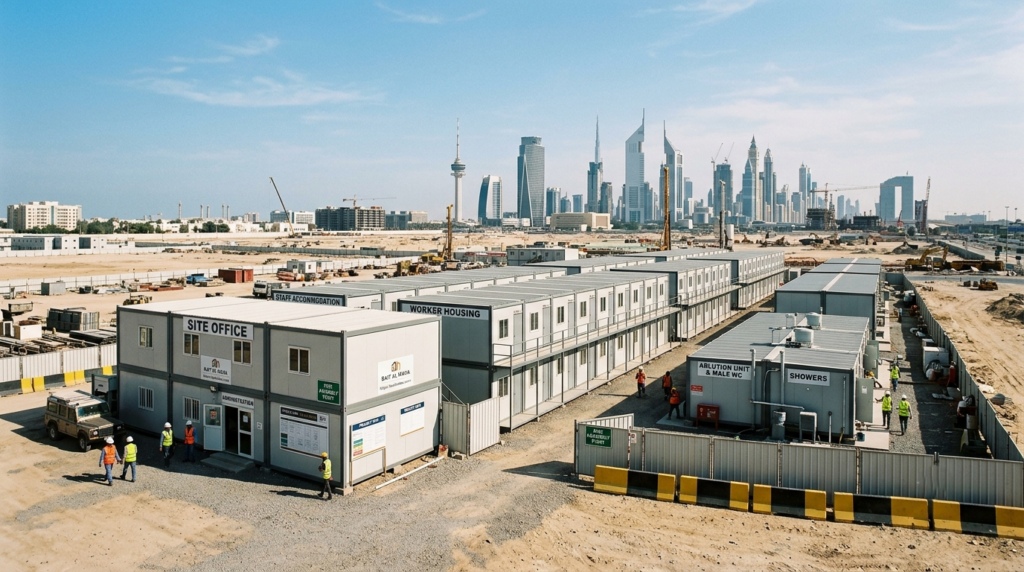
Construction site cabins in Dubai can be sourced comprehensively from a single, turnkey supplier to handle all temporary infrastructure needs. Leading UAE manufacturers like Bait Al Maha Prefab, Al Bait Al Hadi, and TASS Group provide end-to-end solutions, eliminating the hassle of coordinating with multiple vendors. They manage everything from engineering design and factory fabrication to heavy-duty transport, on-site installation, and full utility integration (water, power, and drainage). Construction Site Cabin Dubai: Types, Sizes, and Lead Times at a Glance Cabin Type Common Size Range Starting Price (AED) Typical Lead Time Best For Site Office 3m × 6m to 3m × 12m 8,000 – 25,000 1–3 weeks Project management, engineering teams Labor Accommodation (per unit) 3m × 6m, 8–10 person rooms 8,000 – 20,000 1–3 weeks Worker housing on long-term projects Ablution / Toilet Block 3m × 6m, 4–6 fixture units 6,000 – 50,000 1–2 weeks Sanitation for any site size Dining & Kitchen Cabin 3m × 9m to 3m × 12m 15,000 – 60,000 2–4 weeks Catering and staff meal breaks Security Guard House 1.2m × 2m to 2.4m × 4m 7,000 – 25,000 3–10 days Site entry points and access control Storage / Workshop Container 20ft or 40ft modified container 10,000 – 40,000 1–2 weeks Tools, equipment, and material storage Full Turnkey Labor Camp Multi-unit, custom layout 200,000 – 600,000+ 4–6 weeks Large-scale, long-duration projects Prices vary depending on insulation grade, electrical fit-out, and customization. Steel and raw material costs also shift throughout the year, so treat this table as a planning reference rather than a fixed quote. The full range of available cabins and configurations goes beyond what fits in a single table, so it is worth browsing the complete product line before finalizing a list. What Is a Construction Site Cabin in Dubai? A construction site cabin in Dubai is a prefabricated steel-framed unit built off-site in a factory and transported to the project location, ready to function as an office, sleeping quarters, toilet block, kitchen, or storage space within days of arrival. Unlike permanent buildings, these units sit on a leveled surface or simple foundation blocks rather than deep footings. Here is what separates a site cabin from a conventional building, and why that distinction matters on a Dubai project. It is built in a factory, not on-site. Manufacturing happens under controlled conditions, which keeps quality consistent and avoids weather-related construction delays. It does not need a permanent foundation. A flat, compacted surface is usually enough, which means installation takes days rather than months. It can be relocated. Once a project finishes, the same cabin can move to the next site instead of being demolished. It can be resold, rented, or refurbished. Unlike a permanent structure, a used cabin still holds resale or rental value. It is modular. Units can be linked side by side or stacked to create larger configurations, from a single guard house to a multi-story office block. This combination of speed, flexibility, and reusability is exactly why prefab cabins remain the standard solution for almost every active construction site across Dubai, regardless of project size. Why Source Every Construction Site Cabin in Dubai from One Supplier Anyone who has managed a site mobilization knows the friction that comes from dealing with separate vendors for offices, labor housing, toilets, and security cabins. One truck shows up two weeks early. Another shows up two weeks late. The insulation grade on the sleeping cabins does not match the site office because they came from two different factories. Sourcing every construction site cabin Dubai project needs from a single supplier removes that friction in several specific ways. Single Supplier vs. Multiple Suppliers, Side by Side Factor One Supplier Multiple Suppliers Delivery schedule One coordinated date for every unit. Staggered arrivals that are hard to align. Build quality Matching panels, insulation, and electrical fit-out across the camp. Quality and finish vary from cabin to cabin. Warranty and repairs One company to call, no disputes over fault. Vendors often argue over whose unit or installation failed. Pricing Bundle pricing on one combined order. Full price on each separate small order. Procurement paperwork One contract and one invoice trail. Multiple contracts and invoices to track and reconcile. Compliance consistency Every unit built to the same MOHRE and Civil Defence standard. One non-compliant unit can fail the whole camp’s inspection. The table above captures the headline differences. The points below explain why each one matters in practice. One delivery schedule instead of four or five. When offices, accommodation, ablution units, and a guard house all come from the same manufacturer, they can be fabricated and dispatched together, which matters when a project has a fixed mobilization date tied to a contractual milestone. Consistent build quality across the entire camp. Matching panel thickness, insulation type, and electrical fit-out across every unit avoids the patchwork appearance that often raises questions during a client walkthrough or a Civil Defence inspection. A single point of contact for warranty and repairs. If a door hinge fails on a labor cabin or an AC unit in the site office stops cooling, there is no back-and-forth between two companies arguing over whose responsibility it is. Most established suppliers cover this through an ongoing maintenance and repair service rather than a one-time delivery and goodbye. Better pricing on bundled orders. Suppliers typically offer stronger per-unit rates when a client places one mixed order covering offices, accommodation, ablution, and security, rather than five small separate purchase orders. Simpler procurement paperwork. One contract and one invoice trail is easier for a project accountant to track than five separate vendor agreements, particularly on projects where every cost line gets reconciled against the original bill of quantities. Construction Site Cabin Dubai: Available Types and Specifications Site Offices Site offices are usually the first units to land on a new project and the last to leave. They give project managers, engineers, and administrative staff a functional workspace from day one of mobilization through to final handover. Common sizes and configurations: 3m
Labour Camp Cabin Supplier in Dubai: Setup, Rules & Costs

A trusted labour camp cabin supplier in Dubai provides MOHRE-compliant, heat-engineered prefabricated portacabins starting from AED 8,000 for a single sleeping unit and rising to AED 600,000+ for a fully operational 100-worker turnkey camp. Monthly costs run AED 500 to AED 1,500 per worker. Every cabin must meet a minimum of 3 sq.m of sleeping space per worker, mandatory air conditioning, fire safety systems, and registered sanitation under MOHRE Ministerial Resolution No. 44 of 2022. Setup takes 1 to 6 weeks depending on camp size. This guide covers every step – rules, costs, setup, and supplier selection. Why Finding the Right Labour Camp Cabin Supplier in Dubai Matters More Than You Think Your company wins a major construction tender in Dubai. Contracts are signed on a Thursday. By Sunday morning, the question lands on the project manager’s desk that nobody properly planned for: “Where do we legally house 300 workers before the first load of rebar arrives on site?” This scenario plays out across Dubai every single week – and it catches even experienced contractors off guard. Unlike other GCC markets where temporary worker accommodation is a relatively simple procurement step, finding the right labour camp cabin supplier in Dubai means navigating a three-layer compliance structure that carries real financial penalties if you get it wrong. Those three compliance layers are: MOHRE – the Ministry of Human Resources and Emiratisation, setting federal worker welfare and accommodation standards across the UAE. Dubai Municipality – enforcing structural safety, building permits, fire compliance, electrical standards, and sewage regulations at the emirate level. Free zone authorities – JAFZA, Trakhees, or TECOM, each adding project-specific approval requirements on top of both MOHRE and DM. Layer in Dubai’s extreme summer climate – outdoor temperatures regularly exceeding 48°C between June and September – and the full picture becomes clear. A labour camp cabin in Dubai is not a metal box. It is a thermally managed, legally registered, government-inspected structure that must pass multi-authority scrutiny while keeping your workforce healthy, productive, and legally housed. What this guide covers: What a labour camp cabin actually is – and the three distinct product types available in Dubai. Who needs one and how to make the buy-versus-rent decision correctly. Complete MOHRE, Dubai Municipality, and free zone compliance rules explained in full. Engineering and climate specifications every Dubai cabin must physically meet. A step-by-step setup process from site survey to MOHRE inspection sign-off. Real 2025–2026 cost tables – purchase prices, rental rates, and the hidden costs most projects miss. Zone-by-zone location guide covering Sonapur, DIP, Jebel Ali, Al Quoz, and Ras Al Khor. The eight costliest mistakes Dubai contractors make – and how to avoid every one of them. The 2025–2030 trend shift already reshaping the Dubai prefab accommodation market. What Is a Labour Camp Cabin? Three Types Every Dubai Contractor Should Know A labour camp cabin in Dubai is a prefabricated, modular accommodation unit manufactured off-site and installed on a designated plot to house construction, industrial, or logistics workers. These units are built with galvanized or mild steel frames and insulated sandwich panels, connected to DEWA power, municipal water, and sewage on-site, then configured into camp layouts covering sleeping quarters, bathroom blocks, kitchens, dining halls, and support facilities. The Dubai market offers three distinct product types. Understanding which one fits your project is a decision that must happen before you contact a single portacabin supplier in Dubai. Portacabins (Modular and Fully Relocatable) Portacabins are the workhorse of the Dubai labour camp market. These are steel-framed, sandwich panel-insulated units designed to be craned onto flatbed trucks and redeployed across multiple project sites over their working life. Standard available sizes and their primary uses: 3m × 6m – most common for small sleeping bays, security rooms, and site supervisor offices. 3m × 9m – mid-range units used for bathroom blocks and compact dining areas. 3m × 12m – larger sleeping quarters capable of housing 16 to 20 workers per unit. Key advantages of portacabins for Dubai projects: Fully relocatable – crane on, truck off, and redeploy to the next project site. Fast installation – most standard units can be placed and connected within days. Scalable – additional units are added as headcount grows without major ground work. Widely available for both purchase and short-term rental across Dubai. When relocatability creates real value: When your Al Quoz project finishes, the cabins are craned onto flatbeds and move directly to your Jebel Ali project. For contractors running sequential or simultaneous projects, this is a genuine financial asset. For single-project buyers with no confirmed second deployment, the purchase economics need careful evaluation against the rental alternative. Prefabricated Permanent Structures These are bolted or welded semi-permanent buildings constructed on concrete foundations and not intended to be moved once installed. They cost more upfront, require a full Dubai Municipality building permit, and are typically specified for camps running two or more years on a fixed site. Key characteristics of prefabricated permanent structures: Higher construction quality and thicker insulation as standard. Better natural alignment with MOHRE space and ventilation standards due to larger room dimensions. Requires DM building permit submission before any ground work begins. Offers a higher quality of living environment, which supports worker retention on long projects. Best suited for mega project operators and main contractors with a confirmed multi-year project pipeline on a single site. Container Conversions ISO shipping container repurposing is a growing trend in Dubai’s southern industrial zones – particularly Dubai Investment Park (DIP), Jebel Ali, and Ras Al Khor. Containers are structurally robust, stackable into two- and three-storey configurations, and comparatively cost-effective to source. Advantages of container conversions: Structurally strong – ISO containers are built to carry 25+ tonnes of stacked load. Stackable – can be configured into multi-storey camp layouts on compact sites. Cost-effective to acquire compared to purpose-built cabin structures. Suitable for remote or rugged industrial sites where durability is the priority. The critical compliance point every buyer must understand: A converted container must meet exactly the same