Author: admin

  • Modular Homes in Dubai: Comprehensive Buyer’s Guide of 2026

    Modular Homes in Dubai: Comprehensive Buyer’s Guide of 2026

    To buy a modular home in Dubai, start by consulting with an experienced manufacturer like Bait Al Maha (058 127 0978), finalize your design and budget, prepare your site and secure permits while your home is factory-built (4-8 weeks), then have it delivered and installed on your foundation. The entire process takes 3-5 months versus 10-14 months for traditional construction, with costs typically 30-40% lower and superior quality control through factory production.

    Dubai’s housing landscape is changing. Families and investors across the UAE are discovering what international markets have known for decades: modular homes deliver better value, faster completion, and often superior quality compared to traditional construction.

    If you’re reading this, you’re likely considering a modular home for your Dubai plot—or you’re simply curious whether this construction method makes sense for your situation. Either way, you’re in the right place.

    At Bait Al Maha, we’ve guided hundreds of clients through this exact journey. We’ve seen firsthand how modular construction solves real problems: the family needing to move in before the school year starts, the investor wanting rental income within months instead of years, the environmentally conscious buyer seeking sustainable construction, and the budget-minded homeowner who refuses to compromise on quality.

    This guide walks you through everything you need to know about buying a modular home in Dubai. No sales pressure, no technical jargon you need a degree to understand—just practical, honest information from people who build these homes every day.

    By the end, you’ll understand exactly what modular homes are, why they’re gaining popularity in Dubai, what the buying process actually looks like, and whether this construction method aligns with your goals. You’ll also know the questions to ask any manufacturer you’re considering and the red flags to watch for.

    Whether you ultimately choose Bait Al Maha or another provider, you’ll be equipped to make a confident, informed decision.

    Let’s start with the basics.

    Ready to discuss your specific situation? Call our team at 058 127 0978 for a free, no-obligation consultation.

    Understanding Modular Homes in Dubai

    What Are Modular Homes?

    Think of modular homes as the marriage between advanced manufacturing and residential construction.

    Here’s how it works: Instead of building your entire home on your plot exposed to Dubai’s 45°C summers, sandstorms, and labor coordination challenges, the majority of construction happens in a climate-controlled factory. Your home is built in sections called “modules”—complete with walls, floors, ceilings, electrical wiring, plumbing, insulation, and interior finishes.

    These modules are then transported to your site and assembled on a prepared foundation. The on-site work focuses primarily on joining the modules, connecting utilities, and completing exterior finishing touches.

    The result looks, feels, and functions exactly like a traditionally-built home. Walk through a completed modular home and you won’t spot the difference—unless someone points out the superior insulation consistency or the precision of the construction.

    This isn’t new technology. The global modular construction market is projected to reach USD 64.16 billion by 2033, growing at 6.2% annually, driven by demand for faster, more efficient construction methods.

    What makes modular homes different from other building types you might have heard about?

    Modular vs. Mobile Homes: Mobile homes (also called manufactured homes in some markets) are built to different standards, designed for potential relocation, and typically sit on a chassis. Modular homes are permanent structures built to the same Dubai Municipality codes as traditional homes and placed on permanent foundations.

    Modular vs. Prefabricated: “Prefabricated” is actually a broader term. All modular homes are prefabricated, but not all prefab construction is modular. Prefab simply means components are built off-site. Modular specifically refers to complete room-sized sections built in factories.

    Modular vs. Traditional Construction: Traditional construction happens entirely on-site, exposed to weather, with multiple trades coordinating in sequence. Modular construction completes 85-90% of the work in controlled factory conditions, with on-site work limited to assembly and finishing.

    Types of Modular Solutions Available in Dubai

    The modular construction method accommodates diverse needs:

    Residential Villas: Complete family homes ranging from compact 2-bedroom designs to spacious 5-bedroom villas with multiple floors, covering 1,200-4,000+ square feet.

    Custom Architectural Designs: Fully personalized homes reflecting your aesthetic preferences, from modern minimalist to traditional Arabic-inspired architecture with majlis rooms, courtyards, and cultural design elements.

    Expandable Homes: Starter homes designed with future expansion in mind. Build a 2-bedroom home now, add a bedroom module in three years when your budget or family grows.

    Investment Properties: Rental-optimized designs with layouts proven to attract tenants, durable finishes that minimize maintenance, and energy efficiency that appeals to cost-conscious renters.

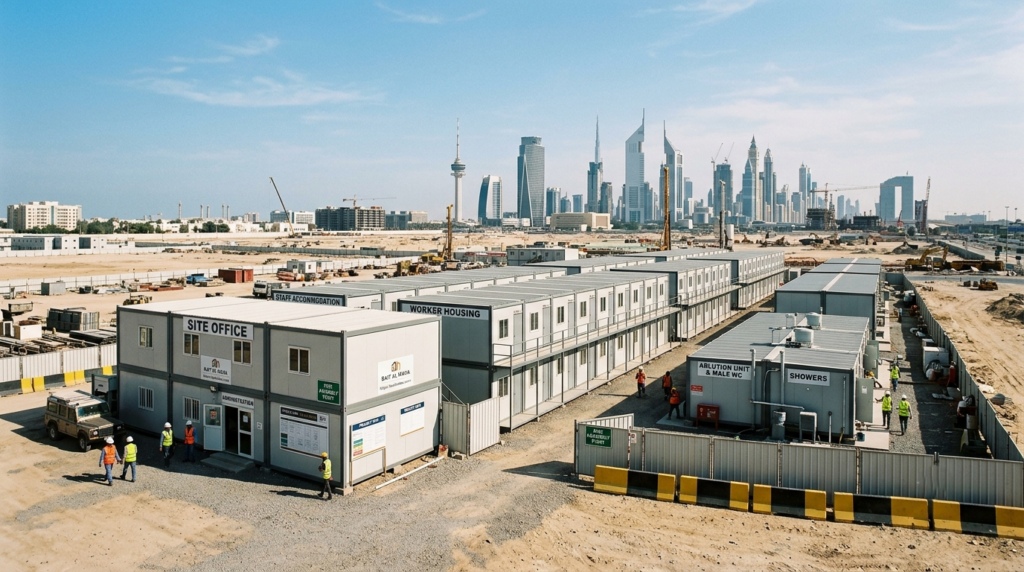
    Porta Cabins and Site Offices: Temporary or semi-permanent structures for construction sites, events, or commercial applications—Bait Al Maha’s specialty extends beyond residential into commercial modular solutions.

    Labor Accommodation: Large-scale housing for workforce accommodation, meeting Dubai Municipality standards for worker housing while maintaining cost efficiency.

    Why Dubai Is Embracing Modular Construction

    Several factors are driving modular adoption across the UAE, and they’re not abstract market forces—they’re practical advantages addressing real challenges.

    The Speed Advantage

    Time matters in Dubai’s real estate market.

    Traditional villa construction in Dubai averages 10-14 months from groundbreaking to occupancy certificate. Modular construction compresses this to 3-5 months.

    For investors, this speed translates directly to returns. A rental property generating AED 150,000 annually that’s ready 8 months earlier produces an additional AED 100,000 in rental income while the traditional construction project is still ongoing.

    For families, speed means children don’t change schools mid-year, elderly parents aren’t displaced longer than necessary, or you simply stop paying expensive Dubai rent sooner.

    The speed comes from simultaneity: while your foundation is being prepared on-site, your home is being built in the factory. Traditional construction follows a sequential process—foundation must cure before framing begins, framing must complete before electrical work starts. Modular construction parallelizes these activities.

    The Cost Reality

    Let’s address pricing directly since it matters to everyone.

    Modular construction typically costs 30-40% less than comparable traditional construction in Dubai. A traditional 2,500 square foot villa might cost AED 1.2-1.5 million all-in. A modular equivalent with similar finishes often comes in at AED 850,000-1.1 million.

    Where do the savings come from?

    Factory efficiency reduces material waste. Traditional construction wastes 15-20% of materials through cutting errors, weather damage, theft, and poor planning. Factory construction operates with precision cutting, protected storage, and optimized material ordering—waste drops to 4-6%.

    Labor costs decrease significantly. Factory workers are more productive in climate-controlled environments with proper tools and ergonomic workflows compared to on-site construction in Dubai’s extreme heat. The UAE’s construction labor market also faces periodic shortages and wage inflation—factory construction provides more predictable labor costs.

    Reduced financing costs matter more than many first-time builders realize. If you’re financing construction with a loan at 4.5% interest, completing construction 8 months faster saves thousands in interest charges. On a AED 800,000 construction loan, 8 months of interest is approximately AED 24,000 saved.

    Fewer change orders and delays prevent budget overruns. Traditional construction frequently exceeds budgets by 15-30% due to unforeseen complications, design changes, material price increases, or weather delays. Modular construction’s fixed factory timeline and clear specifications minimize these overruns.

    Quality Control You Can Actually Verify

    Here’s something most construction guides won’t tell you: quality control in traditional Dubai construction is inconsistent at best.

    We’ve seen it repeatedly. Traditional construction in Dubai battles extreme heat affecting concrete curing, sandstorms contaminating fresh work, varying skill levels among rotating labor crews, and supervision challenges across large sites. The result is unpredictable quality—some parts of your home might be excellent while others are barely acceptable.

    Factory construction flips this equation.

    Every wall is built using the same jigs and tools. Every electrical circuit is installed by trained technicians following standardized procedures. Every plumbing connection is pressure-tested before the module leaves the facility. Every insulation cavity is filled to specification because inspectors can actually access and verify it before drywall installation.

    Dubai Municipality inspections are simpler for modular homes because inspectors can verify factory processes and certifications rather than inspecting every individual construction detail on-site. This often accelerates approval processes.

    The climate-controlled environment matters enormously in Dubai. Concrete doesn’t cure properly when poured in 48°C heat. Adhesives fail when applied in temperature extremes. Paint doesn’t flow correctly in high humidity. Workers make errors when exhausted from heat. Factory construction eliminates all these variables.

    Multiple quality checkpoints occur throughout production: post-framing inspection, post-MEP rough-in inspection, pre-drywall inspection, post-finishing inspection, and pre-delivery final inspection. Traditional construction might have 2-3 inspections total.

    Sustainability Alignment

    Dubai’s Clean Energy Strategy 2050 targets 75% clean energy by 2050. Vision 2031 emphasizes sustainable urban development. Green building certifications are becoming mandatory for certain property sizes.

    Modular construction naturally aligns with these initiatives.

    Material waste reduction directly cuts environmental impact. The construction industry generates approximately 30% of global waste—modular construction’s 70% waste reduction versus traditional methods makes a measurable difference.

    Energy efficiency is engineered in from day one. Factory construction enables consistent insulation installation without gaps or compression—critical for Dubai’s cooling demands. Many clients report 40-50% lower DEWA bills compared to traditional villas of similar size, translating to both cost savings and reduced carbon footprint.

    Transportation emissions are actually lower despite the apparent inefficiency of transporting completed modules. Traditional construction requires hundreds of individual deliveries—cement trucks, lumber deliveries, tile shipments, fixture deliveries, equipment transport. Modular construction consolidates this into a single (or few) large deliveries of completed modules.

    Solar panel integration is simpler because electrical systems are designed with this capacity from the start rather than retrofitted later.

    Green building certifications like Estidama Pearl rating or LEED become more attainable because factory processes are documented and consistent, making certification verification straightforward.

    Design Flexibility

    A common misconception is that modular homes mean cookie-cutter designs.

    The reality is more nuanced. Pre-designed modular homes do exist—they’re faster and more economical, ideal for buyers prioritizing speed and budget. But customization is entirely possible.

    Architectural flexibility within modular construction includes:

    Floor plan modifications—move walls, enlarge rooms, add or remove spaces, create open concepts or defined rooms.

    Exterior aesthetics—choose cladding materials, colors, rooflines, window styles, entry designs, and architectural details reflecting your taste.

    Interior finishes—select flooring, cabinetry, countertops, fixtures, appliances, paint colors, and hardware across wide price and style ranges.

    Smart home integration—wire for automation systems, security, lighting control, energy monitoring, and entertainment systems.

    Sustainable features—solar panel systems, greywater recycling, high-efficiency HVAC, LED lighting, and energy management systems.

    Cultural and lifestyle elements—majlis rooms, prayer rooms, multiple kitchens, separate guest entrances, home offices, gym spaces, or home theaters.

    The limitation is structural: modules are constrained by transport dimensions (typically maximum 14 feet wide, 12 feet high, 60 feet long for road transport). Creative design works within these constraints by combining multiple modules.

    At Bait Al Maha, roughly 60% of our clients choose semi-custom designs—starting with proven layouts and personalizing finishes and details. About 30% select pre-designed models with minor modifications. The remaining 10% pursue fully custom architectural designs.

    Want to explore design possibilities for your specific vision? Schedule a consultation with our design team: 058 127 0978.


    The Complete Modular Home Buying Process

    Understanding what to expect removes uncertainty—the biggest source of stress in any major purchase.

    We’ve broken the process into five distinct phases. Some overlap (manufacturing happens while site preparation occurs), but this structure helps you understand the journey from first conversation to move-in day.

    Phase 1: Planning and Design

    Initial Consultation and Needs Assessment

    Your journey begins with conversation, not commitment.

    During your initial consultation (free at Bait Al Maha, and it should be free anywhere reputable), expect to discuss:

    Purpose and Priority: Are you building a family home prioritizing comfort and space? An investment property maximizing rental appeal and ROI? A vacation home for occasional use? Your purpose shapes design recommendations.

    Household Requirements: How many bedrooms and bathrooms? Do you need a home office? Playroom for children? Space for elderly parents? Guest accommodation? Storage for hobbies or equipment?

    Location and Land: Do you own land or are you still searching? Where in Dubai or UAE are you building? Is it a gated community with design restrictions or an independent plot with full creative freedom?

    Budget Parameters: What’s your comfortable investment range? Are you paying cash or financing? What’s your urgency—must you move by a specific date?

    Lifestyle Preferences: Do you entertain frequently? Need indoor-outdoor living space? Want traditional Arabic design elements or contemporary minimalism? Prioritize energy efficiency?

    This conversation isn’t a sales pitch. Reputable manufacturers like Bait Al Maha use this time to understand whether they can actually meet your needs—and to be honest if they can’t. We’ve turned away projects that didn’t align with our capabilities or timeline, referring clients elsewhere. It’s better for everyone.

    If you’ve already purchased land, mention it. If not, the manufacturer can provide guidance on suitable areas, minimum plot sizes, and zoning considerations—though land acquisition itself remains your responsibility.

    Site Visit and Assessment

    If you own land, the manufacturer should visit the site before providing detailed quotations.

    Site assessment examines:

    Access: Can delivery trucks reach the site? Some Dubai villa communities have narrow lanes. Multi-story homes might need crane access—is there space?

    Soil Conditions: Foundation requirements depend on soil type. Sandy soil common in Dubai often requires specific foundation engineering. Rocky soil might need different approaches.

    Utilities: Where are DEWA connection points? Sewer or septic system? Existing or required? Distance affects connection costs.

    Topography: Sloped plots require additional site work. Level plots simplify foundation construction.

    Community Restrictions: If building in a gated community, what are the architectural guidelines? Height restrictions? Setback requirements? Color limitations?

    This site visit enables accurate quotations rather than rough estimates. Surprises discovered during site assessment are better than surprises discovered during construction.

    Design Selection and Customization

    Now the exciting part begins—designing your actual home.

    You’ll typically choose between three approaches:

    Pre-Designed Models: The manufacturer has proven floor plans and designs ready to build. You select one, choose finish levels (economy, standard, or premium), pick colors, and proceed. This is the fastest and most economical approach. Lead time: 3-4 months total.

    Semi-Custom: Start with an existing design but modify it—add a room, enlarge the master bedroom, change the kitchen layout, upgrade specific finishes. This balances customization with efficiency. Lead time: 4-5 months total.

    Fully Custom: Work with architects to design from scratch. This maximizes personalization but increases cost (typically 20-30% premium) and timeline (5-6 months total).

    At Bait Al Maha, we guide you through this decision based on your priorities. Clients with tight timelines typically prefer pre-designed or semi-custom. Those with specific architectural visions pursue full customization.

    Dubai Climate Design Considerations

    Any competent Dubai modular home manufacturer must design specifically for local climate. If they’re not discussing these elements, walk away:

    Insulation: Dubai requires aggressive insulation. Walls should have minimum R-30 insulation, roofs R-50 or higher. This isn’t negotiable—inadequate insulation means unbearably hot homes and astronomical cooling costs.

    Windows: Double-glazed, Low-E coated, UV-blocking glass is standard for Dubai. Single-pane windows are unacceptable. Proper window specification can reduce cooling costs by 25-30%.

    HVAC Sizing: AC systems must be sized for Dubai’s reality, not temperate climate assumptions. Expect 1 ton of cooling per 350-400 square feet, not the 600 square feet used in moderate climates. Undersized AC systems run constantly, fail prematurely, and never achieve comfortable temperatures.

    Roof Design: Light-colored, reflective roofing materials reduce heat absorption. Proper ventilation prevents attic heat buildup. These details matter enormously in a city where roof surfaces can exceed 70°C on summer afternoons.

    Exterior Materials: UV-resistant finishes prevent fading. Sand-resistant smooth surfaces don’t trap abrasive dust. Durable materials withstand temperature extremes (10°C winter nights to 50°C summer days).

    Ventilation: Even with AC, proper ventilation prevents humidity buildup, kitchen odors, and bathroom moisture. Mechanical ventilation with heat recovery preserves energy efficiency while maintaining air quality.

    Cultural and Lifestyle Design Elements

    Dubai’s diverse population means diverse design preferences. Common requests at Bait Al Maha include:

    Traditional Elements: Majlis room (formal reception area) separated from family spaces, often with separate entrance. Prayer room oriented toward Mecca. Gender-separated spaces for traditional families. Courtyard designs for privacy and outdoor living.

    Modern Lifestyle: Open-concept living for contemporary families. Large kitchens as social hubs. Home office space (essential post-COVID). Media rooms or home theaters. Home gym facilities. Oversized master suites with sitting areas.

    Outdoor Living: Covered terraces extending living space outdoors. Some clients add misting systems or outdoor AC for year-round usability. Outdoor kitchens for entertaining. Swimming pools (separate site work, not part of modular home itself).

    Multi-Generational: Separate living suites for extended family. Multiple kitchens in some cases. Accessibility features for elderly relatives. Ground-floor bedroom suites avoiding stairs.

    Investment Property Features: Proven layouts with mass appeal. Durable, maintenance-friendly finishes. Energy efficiency reducing tenant utility costs (attractive selling point). Flexible spaces working for various tenant types.

    Visualization and Approval

    Before manufacturing begins, you should see exactly what you’re getting.

    Expect:

    3D Renderings: Exterior and interior visualizations showing your home from multiple angles. This isn’t a rough sketch—it’s photorealistic representation of your finished home.

    Virtual Walkthroughs: Some manufacturers offer virtual reality tours of your design. Walking through your home before construction builds confidence in spatial layouts.

    Material Samples: Physical samples of flooring, countertops, tiles, paint colors, and fixtures. Screens distort colors—samples show true appearance.

    Detailed Plans: Architectural drawings showing dimensions, room layouts, door/window placement, and structural details. MEP (mechanical, electrical, plumbing) plans showing system layouts.

    Review everything carefully. Changes after manufacturing begins range from expensive to impossible depending on the timing and scope. This is your opportunity to request modifications.

    At Bait Al Maha, we iterate designs until you’re completely satisfied. Some clients approve the first design, others go through 3-4 revisions—both are completely normal. Your satisfaction matters more than our timeline.

    Code Compliance and Zoning Verification

    Dubai has specific building regulations. Your manufacturer should ensure compliance, but understanding the basics helps you ask informed questions.

    Zoning Considerations:

    Dubai divides into zones with different regulations. Residential zones have requirements like:

    • Minimum plot size (often 2,000-3,000 square feet for detached villas)

    • Maximum building coverage (percentage of plot you can build on)

    • Setback requirements (distance from property boundaries)

    • Height restrictions (ground plus one floor, ground plus two floors, etc.)

    • Parking requirements (usually 2 spaces minimum)

    Freehold vs. Leasehold: Expatriates can own property outright in designated freehold areas (Dubai Marina, Palm Jumeirah, Arabian Ranches, Downtown Dubai, and many others). Other areas are leasehold only, typically 99-year terms. This affects financing and resale.

    Community Restrictions: Gated communities often impose additional rules beyond Dubai Municipality requirements—approved color palettes, architectural style consistency, landscaping standards, or even outright prohibition of modular construction in some exclusive communities.

    Building Code Requirements:

    Dubai Municipality updated building codes in 2024, emphasizing:

    • Green building requirements for properties over certain sizes

    • Fire safety standards including sprinklers, fire-resistant materials, and escape routes

    • Structural standards for wind loads and seismic activity (minimal in UAE but still specified)

    • Energy efficiency mandates including solar panel requirements for larger homes

    • Accessibility provisions

    Reputable manufacturers have pre-approved designs that meet Dubai Municipality standards, expediting approval. Custom designs require full engineering review, adding 4-6 weeks to timeline.

    Bait Al Maha handles compliance entirely—it’s part of our service. You shouldn’t navigate building codes yourself.

    Looking for design inspiration? Visit our Sharjah showroom to see materials, sample modules, and completed projects. Call 058 127 0978 to schedule your visit.

    Phase 2: Site Preparation and Permits

    While design finalization occurs, site preparation and permitting run concurrently. This parallelization accelerates the overall timeline.

    Land Preparation

    Your land must be ready before module delivery. Foundation must be cured, utilities roughed in, and access clear.

    Soil Testing

    Dubai’s soil varies dramatically—coastal areas have sandy soil with high water tables, inland areas may have harder, rocky soil, and some areas have expansive clay soils.

    Soil testing determines:

    • Bearing capacity (how much weight soil can support)

    • Soil type and composition

    • Water table depth

    • Recommendations for foundation type

    Cost: AED 5,000-10,000 typically. Timeline: 1-2 weeks from test to report.

    Skip soil testing and you risk foundation failure, settling, or cracking—repairs cost orders of magnitude more than the test itself.

    Foundation Options

    Based on soil conditions and home design, foundation options include:

    Slab Foundation: Most common in Dubai. Concrete poured directly on prepared ground, reinforced with steel. Advantages: cost-effective, suitable for level plots, good for Dubai’s stable climate. Disadvantages: no underfloor access for utilities, difficult to repair foundation issues later. Cost: AED 150-250 per square meter typically.

    Pier and Beam: Elevated foundation with concrete piers supporting beams. Advantages: allows underfloor access, better for slightly uneven plots, easier utility access. Disadvantages: higher cost, requires more site work. Cost: AED 200-300 per square meter.

    Basement Foundation: Rare in Dubai due to high water tables in many areas, but possible in inland locations. Advantages: maximum space, storage, potential for additional living area. Disadvantages: expensive, requires extensive waterproofing, longer construction time. Cost: AED 800-1,200 per square meter.

    Foundation timeline: 3-6 weeks depending on type and size. Concrete requires 28 days curing before placing heavy modular loads.

    Utility Rough-Ins

    Before modules arrive, utilities must be roughed in:

    DEWA Connections: Electricity and water connection points must be established. This involves application to DEWA, site inspection, connection installation, and temporary service during construction.

    Application process: Submit approved building permit, title deed, and application form. DEWA inspects site and confirms connection feasibility. Connection fee: AED 5,000-10,000 plus capacity deposit refundable later. Timeline: 2-4 weeks from application to connection.

    Sewage: Connection to municipal sewer system (if available) or septic system installation (if required). Septic systems are less common in developed Dubai areas but necessary in some locations. Costs vary widely: AED 10,000-30,000 depending on system size and location.

    Telecommunications: Conduits for internet, telephone, and television services. Du and Etisalat are the primary providers. Pre-wiring during foundation phase simplifies later activation.

    Gas: Rare in modern Dubai homes (most use all-electric systems), but some areas have gas available for cooking or water heating.

    Site Access and Preparation

    Access Road: If your plot doesn’t have established road access, temporary or permanent access construction might be necessary. Delivery trucks are large—they need clear, stable roads to reach your site.

    Site Clearance: Remove vegetation, debris, rocks, and level the building area. In some cases, excavation or fill is required to achieve proper grade.

    Drainage: Dubai experiences rare but intense rainfall. Proper drainage prevents water accumulation around your foundation. Grading should direct water away from the home.

    Temporary Fencing: Secure your site during construction to prevent theft, vandalism, or liability if someone wanders onto the construction site.

    Temporary Utilities: Construction requires electricity and water. Temporary connections from DEWA serve this purpose.

    Bait Al Maha coordinates all site preparation, either performing the work ourselves or managing qualified subcontractors. You’re not coordinating multiple contractors yourself.

    Obtaining Construction Permits

    Dubai requires multiple permits before construction begins. The manufacturer should handle this entirely, but understanding the process helps you appreciate timeline requirements.

    Required Approvals:

    Building Permit: Primary approval from Dubai Municipality authorizing construction. Requires architectural plans, structural engineering calculations, MEP designs, soil report, title deed, and manufacturer credentials.

    Architectural Approval: Ensures design complies with zoning, setbacks, height restrictions, and aesthetic guidelines (in regulated communities).

    Structural Engineering Approval: Verifies structural calculations meet safety standards and load requirements.

    MEP Approval: Confirms electrical, plumbing, and mechanical systems meet code requirements, particularly fire safety and energy efficiency standards.

    Civil Defense Approval: Fire safety compliance including sprinkler requirements (if applicable), fire-resistant materials, escape routes, and alarm systems.

    DEWA Approval: Utility company must approve electrical capacity and connection plans.

    Developer NOC: If building in a master-planned community, the developer must issue a No Objection Certificate confirming your design complies with community standards.

    Environmental Impact Assessment: Required for larger projects or environmentally sensitive locations. Most single-family homes don’t require this.

    Timeline: Complete permit package typically takes 6-10 weeks. Pre-approved modular designs can reduce this to 4-6 weeks because much of the technical documentation is standardized.

    Costs: Total permit and approval fees range from AED 15,000-50,000 depending on home size and complexity. This includes government fees, document preparation, and submission coordination.

    Documents Required:

    • Title deed showing ownership or lease

    • Plot survey showing boundaries and dimensions

    • Architectural drawings and elevations

    • Structural calculations and specifications

    • MEP engineering plans

    • Soil test report

    • Manufacturer’s trade license and credentials

    • Proof of Dubai Municipality pre-approval (if applicable)

    • Developer NOC (if in gated community)

    Missing or incorrect documentation extends timeline. Work with experienced manufacturers who submit complete, accurate applications the first time.

    At Bait Al Maha, permit management is part of our comprehensive service. We prepare documentation, submit applications, respond to authority questions, coordinate revisions if needed, and keep you updated on progress. You receive regular status updates but don’t personally navigate the bureaucracy.

    Concerned about the complexity? Don’t be. Our team has processed hundreds of permits across Dubai and UAE—we handle this entirely. Focus on exciting decisions like finishes and features. Call 058 127 0978 to discuss your project.

    Phase 3: Manufacturing and Construction

    This is where the magic happens—your home is being built while you go about your daily life.

    Factory Production

    While your site is being prepared and permits processed, manufacturing begins in Bait Al Maha’s Sharjah facility (or whichever manufacturer you choose).

    Engineering and Material Procurement

    Before physical construction starts:

    Detailed Engineering: Convert architectural designs into fabrication drawings showing every cut, connection, and component. This level of detail is what enables factory efficiency.

    Material Ordering: Lumber or steel framing, insulation, windows, doors, electrical components, plumbing fixtures, HVAC equipment, interior finishes, appliances—everything specified in your design is ordered from certified suppliers.

    Quality Verification: Incoming materials are inspected. Substandard materials don’t make it into your home.

    Timeline: 1-2 weeks typically.

    Module Construction Process

    Factory construction follows a systematic process:

    Floor System: The module starts with floor framing (steel or engineered lumber), subfloor installation, and insulation. This creates the platform for the rest of the module.

    Wall Framing: Walls are built on framing tables using jigs ensuring perfect square and dimensions. This consistency is impossible to achieve in field construction. Walls include rough openings for windows and doors.

    Structural Connections: Wall-to-floor connections use engineered fasteners and adhesives. These connections must be strong enough to withstand transportation stresses.

    Roof System: Roof trusses or rafters are installed, sheathing applied, and weatherproofing added. For designs requiring it, roof sections might be split for transportation and rejoined on-site.

    MEP Rough-In: With walls and roof framed but still accessible:

    • Electrical wiring run through walls, junction boxes installed, circuits tested

    • Plumbing supply lines and drain pipes installed, pressure tested for leaks

    • HVAC ductwork installed, units positioned

    • Smart home wiring (if specified)

    Insulation Installation: This is where factory construction truly shines. Insulation is installed before drywall, allowing inspection and verification of complete coverage. Spray foam, blown insulation, or batt insulation fills every cavity without gaps or compression—achieving the specified R-values actually delivers the energy performance you’re paying for.

    In traditional construction, insulation is often incomplete, compressed, or incorrectly installed because it’s difficult to inspect after drywall installation. This is a primary reason traditionally-built homes underperform their theoretical energy ratings.

    Interior Finishes: Drywall installation, taping, sanding, and painting. Flooring installation (tile, hardwood, luxury vinyl). Kitchen cabinet installation and countertop mounting. Bathroom fixtures and tiling. Interior doors and trim. Hardware installation (handles, hinges, locks).

    Exterior Finishing: Exterior cladding (fiber cement, metal panels, vinyl, or specified material). Window and door installation with weather sealing. Exterior trim and architectural details. Paint or finish coatings.

    Systems Installation: HVAC equipment installation and testing. Electrical panel installation, outlet and switch installation, lighting fixtures. Plumbing fixtures (sinks, toilets, showers, faucets). Appliances (if included).

    Timeline: Module construction takes 4-8 weeks depending on size and complexity. A simple single-module 1,200 square foot home might complete in 4 weeks. A complex 3,500 square foot multi-module home with extensive customization might require 8 weeks.

    Quality Control Checkpoints

    Unlike traditional construction with minimal oversight, factory production includes multiple inspections:

    Post-Framing Inspection: Verify structural integrity, proper fastening, square and level construction. Catch and correct issues before they’re hidden.

    Post-MEP Rough-In Inspection: Test electrical circuits, pressure-test plumbing for leaks, verify HVAC airflow. Systems must function perfectly before walls are closed.

    Pre-Drywall Inspection: Final verification of insulation, wiring, plumbing before covering with drywall. Once drywall is installed, access becomes difficult.

    Post-Finish Inspection: Quality check of paint, flooring, cabinets, fixtures. Identify and correct cosmetic defects before delivery.

    Pre-Delivery Final Inspection: Comprehensive inspection of completed module before transport. Functionality testing of all systems. Cosmetic inspection for any damage or defects.

    Each checkpoint includes documented findings and corrections. This documentation becomes part of your permanent home record.

    Material Selection Deep Dive

    Since materials determine long-term performance, let’s discuss what actually goes into quality modular homes for Dubai:

    Framing Materials:

    Steel Framing: Increasingly common in UAE due to termite resistance (termites are active in Gulf region). Steel doesn’t warp, shrink, or burn. Disadvantage: higher cost, requires skilled installation, conducts heat (requiring thermal breaks).

    Engineered Lumber: Wood I-joists and laminated beams provide strength with less material than solid lumber. Less prone to warping than traditional lumber. Disadvantage: requires termite protection in UAE.

    For Dubai, steel framing is generally recommended despite higher initial cost. Long-term maintenance savings and durability justify the premium.

    Insulation (Most Critical for Dubai):

    Spray Foam Insulation: Highest R-value per inch, creates air seal eliminating drafts, moisture resistant. Expensive but delivers best performance in Dubai’s extreme climate. R-40 to R-50 achievable in roof cavities.

    Rigid Foam Boards: High R-value, moisture resistant, good for continuous insulation applications. Often used in combination with other insulation types.

    Mineral Wool (Rockwool): Fire resistant, sound dampening, good R-value, moisture resistant. More affordable than spray foam while delivering good performance.

    Don’t accept generic “insulation included” specifications. Demand specific R-values: minimum R-30 walls, R-50 roof for Dubai climate. Verify this in your contract.

    Windows and Doors:

    Glass: Double-glazed Low-E (low emissivity) coated glass reflects heat while allowing visible light. UV-blocking prevents furniture and fabric fading. Tinted glass further reduces heat gain. Single-pane glass is unacceptable in Dubai.

    Frame Material: Aluminum (durable, low maintenance, conducts heat unless thermally broken), uPVC (good insulation, affordable, less durable in extreme UV), or fiberglass (best performance, expensive).

    Seals: Multi-point locking systems, weather stripping, and proper installation prevent Dubai’s dust infiltration and maintain insulation performance.

    Exterior Materials:

    Fiber Cement Board: Durable, fire-resistant, termite-proof, UV-resistant, available in various textures and colors. Excellent choice for Dubai. Requires painting but holds paint well.

    Metal Panels: Very durable, reflective finishes reduce heat absorption, low maintenance, modern aesthetic. Can dent from impact.

    Vinyl Siding: Affordable, low maintenance, fade-resistant modern formulations. Less common in UAE luxury market.

    Stucco/Render: Traditional appearance, can be textured or smooth, requires proper application to prevent cracking. Common in Dubai architecture.

    Roofing:

    Metal Roofing: Reflective finishes, extremely durable, can withstand Dubai’s temperature extremes, low maintenance. Light colors (white, light gray) reflect heat best.

    Concrete Tiles: Very durable, fire-resistant, good heat resistance, traditional appearance. Heavy—requires structural support.

    Membrane Roofing: For flat or low-slope roofs common in modern architecture. Requires proper installation and maintenance to prevent leaks.

    Light-colored roofing can reduce attic temperatures by 15-20°C compared to dark roofing—this matters enormously in Dubai.

    Interior Finishes:

    Flooring: Porcelain tile (most common in UAE, durable, cool underfoot, easy cleaning), engineered hardwood (appearance of wood with better dimensional stability), luxury vinyl tile (affordable, comfortable, durable), or natural stone (premium, beautiful, expensive).

    Cabinetry: Moisture-resistant materials for UAE humidity. Plywood construction superior to particleboard. Soft-close hinges and drawer slides indicate quality. Finish durability in high-use areas (kitchen, bathrooms).

    Countertops: Quartz (durable, non-porous, low maintenance, wide color range), granite (natural stone, durable, requires sealing), or solid surface (Corian-type, seamless installation, repairable).

    Paint: Low-VOC paints for indoor air quality. Moisture-resistant formulations for bathrooms. UV-resistant exterior paints to prevent fading.

    At Bait Al Maha, we explain how each material choice affects performance, maintenance, cost, and longevity. We present options at different price points, but we never compromise on structural integrity or systems that affect safety and fundamental performance.

    Client Involvement During Manufacturing

    Your involvement during manufacturing can be as extensive or minimal as you prefer.

    Progress Updates: Regular photo or video updates showing your home’s construction progress. At Bait Al Maha, clients receive weekly update photos and can request specific angles or details.

    Factory Visits: We encourage clients to visit the factory during construction. Typical visit points:

    • 50% Completion: Framing and MEP rough-ins complete, allowing you to see structural quality and systems layout before they’re covered.

    • 90% Completion: Finishes installed, systems functional, nearly ready for delivery. Final opportunity to identify any concerns before transport.

    Factory visits build confidence. Seeing your home being built with precision and care provides peace of mind impossible to achieve with traditional construction where work is scattered and rushed.

    Material Selection Confirmation: For semi-custom and custom homes, you’ll confirm specific finishes, colors, and fixtures during manufacturing. We provide samples and options, you make final selections.

    Minor Modifications: Early in manufacturing, minor changes are still possible—different paint color, upgrade a fixture, add outlets. Later in manufacturing, changes become difficult or impossible. We communicate clearly about modification windows.

    What Happens to Your Module During Transport

    Completed modules must travel from factory to site intact. This requires:

    Structural Reinforcement: Temporary bracing and reinforcement prevents damage during transport. This is removed after installation.

    Weatherproofing: Modules are wrapped or protected from road debris, weather, and dust during transport.

    Transport Engineering: Route planning ensures modules can navigate turns, overhead clearances, and road conditions. Oversized loads may require special permits and police escort.

    Insurance: Modules are insured during transport against damage or accidents.

    Delivery is scheduled when your foundation is ready, site is accessible, and installation crew is available. Coordinating all these elements is part of the manufacturer’s project management.

    Curious about how your home is built? Schedule a factory tour at our Sharjah facility. See the precision, quality control, and craftsmanship that goes into every Bait Al Maha home. Call 058 127 0978 to arrange your visit.

    Phase 4: Financing and Investment Planning

    Let’s discuss money honestly—because pretending it’s not a major consideration helps nobody.

    Understanding Your Total Investment

    Many first-time modular home buyers focus exclusively on the module price—a mistake leading to budget surprises.

    Your total investment includes:

    The Modular Home Itself: The primary cost, varying based on size, finishes, and customization. This is what manufacturers quote prominently.

    Land Cost: If you don’t already own land, this can be your largest expense. Dubai land prices vary dramatically: AED 150-500+ per square foot depending on location. A 3,000 square foot plot in Arabian Ranches might cost AED 800,000-1,200,000. In emerging areas like Dubai South, the same size plot might cost AED 300,000-600,000.

    Site Preparation and Foundation: AED 50,000-150,000 for typical single-family homes, varying based on:

    • Soil conditions (poor soil requires more extensive foundation)

    • Foundation type (slab cheapest, basement most expensive)

    • Site accessibility (difficult access increases costs)

    • Existing utilities vs. new installations

    Permits and Government Fees: AED 15,000-50,000 covering:

    • Dubai Municipality building permit

    • Various technical approvals

    • DEWA connection fees

    • Developer NOC (if applicable)

    • Document preparation

    Utility Connections: AED 10,000-20,000 for:

    • DEWA electrical and water connections

    • Sewage connection or septic system

    • Telecommunications infrastructure

    Delivery and Installation: AED 30,000-150,000 depending on:

    • Distance from manufacturing facility

    • Home size and complexity

    • Crane requirements (multi-story homes)

    • Site access challenges

    External Works: Often underestimated, this includes:

    • Landscaping: AED 50-150 per square meter

    • Boundary walls and fencing: AED 200-400 per linear meter

    • Driveway and parking: AED 80-150 per square meter

    • Outdoor lighting and irrigation

    • Pool (if desired): AED 100,000-300,000

    Professional Services: AED 10,000-30,000 for:

    • Legal review of contracts

    • Independent inspections

    • Consulting if needed

    Contingency: Add 10-15% for unexpected costs. Construction always surfaces surprises—proper planning means they don’t derail your project.

    Example Total Investment Scenarios:

    Economy 2-Bedroom (1,200 sq ft):

    • Land (already owned or separate purchase): Variable

    • Modular home: AED 350,000-450,000

    • Foundation & site prep: AED 60,000-80,000

    • Permits & fees: AED 18,000-25,000

    • Utilities: AED 12,000-15,000

    • Delivery & installation: AED 35,000-50,000

    • External works: AED 60,000-100,000

    • Professional fees: AED 10,000-15,000

    • Contingency (12%): AED 60,000-80,000

    • Total (excluding land): AED 605,000-815,000

    Mid-Range 3-Bedroom (2,000 sq ft):

    • Land: Variable

    • Modular home: AED 650,000-850,000

    • Foundation & site prep: AED 90,000-120,000

    • Permits & fees: AED 25,000-35,000

    • Utilities: AED 15,000-20,000

    • Delivery & installation: AED 60,000-90,000

    • External works: AED 100,000-180,000

    • Professional fees: AED 15,000-25,000

    • Contingency (12%): AED 115,000-160,000

    • Total (excluding land): AED 1,070,000-1,480,000

    Luxury 4-Bedroom (3,500 sq ft):

    • Land: Variable

    • Modular home: AED 1,400,000-2,200,000

    • Foundation & site prep: AED 150,000-220,000

    • Permits & fees: AED 40,000-50,000

    • Utilities: AED 20,000-30,000

    • Delivery & installation: AED 100,000-150,000

    • External works: AED 250,000-500,000

    • Professional fees: AED 25,000-40,000

    • Contingency (12%): AED 240,000-380,000

    • Total (excluding land): AED 2,225,000-3,570,000

    These ranges reflect real-world costs across Dubai. Your specific project might fall outside these ranges based on unique factors.

    At Bait Al Maha, we provide detailed quotations breaking down every cost category, so you budget accurately from day one. No hidden fees, no surprise charges—complete transparency.

    Comparing Investment: Modular vs. Traditional

    How does modular investment compare to traditional construction for equivalent quality?

    Cost Comparison:

    A traditionally-built 2,000 square foot villa in Dubai with mid-range finishes costs approximately AED 1,400,000-1,900,000 all-in (excluding land). The equivalent modular home costs AED 1,070,000-1,480,000—savings of 20-30%.

    These savings come from:

    • Reduced material waste (factory efficiency)

    • Lower labor costs (productive factory environment vs. outdoor Dubai heat)

    • Shorter timeline (less financing cost)

    • Fewer change orders and delays

    Timeline Comparison:

    Traditional construction: 10-14 months from permit to occupancy
    Modular construction: 3-5 months from permit to occupancy

    For investors, this 6-9 month time advantage translates directly to returns. If a property generates AED 120,000 annual rental income (AED 10,000 monthly), being ready 8 months earlier produces an additional AED 80,000 in rental income while the traditional construction project is still ongoing.

    For owner-occupants, time savings means months less paying expensive Dubai rent while your home is built.

    Quality Comparison:

    This is harder to quantify but equally important. Traditional construction quality in Dubai is variable—some builders deliver excellent work, others deliver barely acceptable results. The difference often isn’t apparent until you’ve lived in the home for months or years.

    Modular construction’s factory quality control delivers more consistent results. The insulation is installed properly. The electrical connections are secure. The plumbing doesn’t leak. The finishes are applied correctly.

    This consistency means fewer warranty claims, lower maintenance costs, better energy performance, and higher satisfaction.

    Financing Your Modular Home

    Several financing paths exist for modular home purchases in Dubai.

    Bank Mortgage Financing

    UAE banks increasingly recognize modular homes for financing, though not all banks are equally comfortable yet.

    Loan Terms:

    • Loan-to-Value (LTV): Typically 75-80% for expatriates, 80-85% for UAE nationals

    • Interest Rates: Currently 3.5-5.5% (variable depending on bank, your profile, and market conditions)

    • Loan Terms: Up to 25 years

    • Down Payment: 20-25% typically

    Requirements:

    • Valid UAE residency visa

    • Steady employment with minimum salary requirements (usually AED 15,000-20,000 monthly)

    • Good credit history

    • Title deed or purchase agreement for land

    • Approved building permit

    • Manufacturer contract and specifications

    • Proof of down payment and closing costs

    Modular-Friendly Banks:

    Not all UAE banks have equal experience with modular construction. Banks with more positive track records include:

    • Emirates NBD (largest bank, experienced with various property types)

    • Abu Dhabi Commercial Bank (ADCB)

    • Mashreq Bank

    • RAK Bank

    When applying, explicitly mention “modular construction” or “prefabricated home” during pre-qualification. Some loan officers unfamiliar with modular construction might incorrectly classify your application as “mobile home” (different lending standards). Providing manufacturer documentation showing Dubai Municipality compliance and permanent foundation typically resolves concerns.

    Construction Loans

    Construction loans are designed specifically for home-building projects. Funds are released in stages as construction progresses rather than lump sum at closing.

    Typical disbursement schedule:

    • 20-30% at foundation completion

    • 30-40% at module delivery and installation

    • 20-30% at completion of finishing work

    • 10-20% at final occupancy certificate

    Upon completion, the construction loan typically converts to a standard mortgage with refinanced terms.

    Advantages: Pay interest only on disbursed funds, reducing costs during construction period.

    Disadvantages: More complex application process, typically higher interest rates during construction phase.

    Payment Plans Directly with Manufacturer

    Some modular manufacturers offer payment plans aligned with project milestones, reducing or eliminating bank financing requirements.

    Typical structure:

    • 15-25% deposit on contract signing

    • 25-35% on manufacturing start

    • 30-40% on delivery and installation

    • 10-20% on completion and handover

    At Bait Al Maha, we work with clients’ financial situations to create feasible payment structures. We prefer building long-term relationships over losing good clients due to inflexible payment terms.

    Advantages over bank financing:

    • Simpler process (no bank bureaucracy)

    • Potentially better terms for buyers with strong cash position

    • Faster approval and project initiation

    Disadvantages:

    • Requires significant liquid assets

    • No tax benefits (if any) from mortgage interest

    Cash Purchase

    Paying cash offers several advantages:

    • No financing costs (save thousands in interest)

    • Simpler process (no bank approval delays)

    • Stronger negotiating position (many manufacturers offer 5-10% discount for full cash payment)

    • Faster project initiation

    Obviously, cash purchase requires substantial liquid assets. For clients with the means, it’s often the most economical approach.

    Investment Property Financial Considerations

    If building an investment property for rental income, additional financial analysis is warranted:

    Rental Yield Analysis:

    Dubai rental yields typically range 5-8% gross annually (rental income divided by total investment).

    Example: AED 1,200,000 total investment (including land). Expected annual rent: AED 80,000. Gross yield: 6.7%.

    Modular construction’s lower cost and faster completion can increase effective yields. If you achieve the same rental income (AED 80,000 annually) with lower investment (AED 1,000,000 for modular vs. AED 1,200,000 for traditional), your yield increases to 8%.

    Additionally, being ready 8 months earlier means 8 months of rental income traditional construction doesn’t generate. In this example, that’s an additional AED 53,000.

    Operating Expenses:

    Factor in:

    • Property management fees (if using management company): 5-8% of rent

    • Maintenance and repairs: Budget 1-2% of property value annually

    • Service charges (if in managed community): Variable

    • Property tax: Currently zero in Dubai, but budget for potential future taxation

    • Insurance: AED 2,000-5,000 annually typically

    • Vacancy periods: Budget for 1-2 months vacancy between tenants

    ROI Calculation:

    Net Operating Income (NOI) = Rental Income – Operating Expenses
    Return on Investment (ROI) = NOI / Total Investment

    Example using numbers above:

    • Rental Income: AED 80,000

    • Operating Expenses: AED 15,000 (management, maintenance, insurance)

    • NOI: AED 65,000

    • Total Investment: AED 1,000,000

    • ROI: 6.5%

    This exceeds many other investment options in UAE, particularly when combined with potential property appreciation.

    First-Time Home Buyer Program

    UAE nationals earning below AED 20,000 monthly may qualify for Dubai’s First-Time Home Buyer Program, offering:

    • Reduced registration fees

    • Potential down payment assistance

    • Favorable loan terms through participating banks

    Modular homes in freehold areas qualify equally to traditional construction. The application process goes through Dubai Land Department.

    Eligibility requirements:

    • UAE national

    • First-time homebuyer (no previous property ownership)

    • Income below threshold

    • Property value within program limits

    • Property in Dubai

    Details and applications: dubailand.gov.ae

    Need help navigating financing options? Our team can guide you through approaches that have worked for other clients and provide documentation for bank applications. Call 058 127 0978 to discuss your financial situation confidentially.

    Contract and Agreement

    Your contract with the manufacturer is the most important document in this entire process. It defines expectations, protects both parties, and provides recourse if issues arise.

    Don’t sign until you understand and agree with every provision.

    Essential Contract Elements:

    Scope of Work:

    The contract must specify exactly what you’re buying. Vague descriptions create disputes later.

    Detailed specifications should include:

    • Home dimensions (exact square footage, module count and sizes)

    • Floor plan with room dimensions

    • Structural materials (steel vs. wood framing, foundation type)

    • Insulation specifications with R-values

    • Window and door specifications (brands, models, glass type)

    • Roofing materials and colors

    • Exterior finishes and colors

    • Interior finishes room-by-room (flooring types, tile specifications, paint colors)

    • Kitchen specifications (cabinet style, countertop material, appliances included)

    • Bathroom specifications (fixtures, tile, vanities)

    • HVAC system (brand, size, tonnage)

    • Electrical specifications (panel size, outlet count, lighting fixtures)

    • Plumbing fixtures (brands and models)

    • Smart home systems (if included)

    • Solar panels (if included, with capacity specifications)

    If the contract says “standard finishes” or “builder’s choice materials,” push back. Demand specific brands, models, and specifications. “Standard” means different things to different people.

    Inclusions and Exclusions:

    Equally important is what’s NOT included. The contract should clearly state:

    What the manufacturer provides:

    • Design services

    • Engineering and permitting assistance

    • Manufacturing

    • Delivery to site

    • Installation and assembly

    • System connections and testing

    • Warranty

    What’s your responsibility (or separate cost):

    • Land acquisition

    • Site preparation and foundation (or specify if manufacturer handles this)

    • Utility connections

    • Landscaping

    • Boundary walls and fencing

    • Driveway and parking areas

    • Pool (if desired)

    • Furniture and appliances (if not included)

    Assumptions kill budgets. If you assume landscaping is included and it’s not, you face unexpected costs. If you assume the manufacturer is handling foundation work and they’re not, your project stalls.

    Pricing and Payment Terms:

    Total Contract Price: The complete amount you’ll pay for the scope of work defined above. This should be fixed, not “estimated” or “approximate.”

    Payment Schedule: When payments are due, typically tied to milestones:

    • Deposit on contract signing (10-25% typically)

    • Payment on manufacturing start (20-30%)

    • Payment on delivery (30-40%)

    • Final payment on completion (15-25%)

    • Retention (5-10% held for 30-90 days post-completion)

    Payment timing should align with value delivered. Avoid contracts demanding 50%+ upfront before work begins—this creates risk if the manufacturer faces financial trouble or doesn’t perform.

    Payment Methods: Bank transfer, certified check, etc. Escrow arrangements provide additional protection for large payments.

    Price Variation Clauses: Some contracts include provisions for price increases due to material cost changes. These are problematic—they shift risk entirely to you. Negotiate fixed pricing or narrow variation clauses (e.g., “price fixed unless material costs increase more than 15%”).

    Change Orders: Process for design changes after contract signing. Changes should require written approval with price impact clearly stated before work proceeds.

    Timeline and Delivery:

    Start Date: When manufacturing begins.

    Manufacturing Duration: How long factory production will take (e.g., “6-8 weeks from manufacturing start”).

    Delivery Date: When modules will be delivered to site. This should account for your foundation being ready.

    Installation Duration: How long site installation will take (e.g., “3-5 days for installation and assembly”).

    Completion Date: When the home will be fully complete and ready for occupancy certificate application.

    Contingencies: What circumstances excuse delays? Weather is reasonable for installation days. Material supply chain disruptions might be reasonable (though less so if materials are common). Vague “unforeseen circumstances” clauses are too broad.

    Delay Penalties: Does the contract include penalties if the manufacturer misses deadlines? This provides recourse and motivation for on-time completion. Typical penalty clauses specify AED amount per day past the agreed completion date (with reasonable exceptions for legitimate force majeure events).

    Warranties and Guarantees:

    Warranties protect you after completion. Understand exactly what’s covered and for how long.

    Structural Warranty: Coverage for foundation, framing, and load-bearing elements. Industry standard: 10 years minimum. Some manufacturers offer 15-25 years. This should cover structural defects, not normal wear.

    Weatherproofing Warranty: Coverage for roof leaks, window leaks, exterior seal failures. Standard: 5-10 years.

    Workmanship Warranty: Coverage for defects in construction, finishing, and installation. Standard: 1-2 years.

    Systems and Components: HVAC, electrical, plumbing systems typically carry manufacturer warranties (1-5 years depending on component) in addition to installation warranties.

    Appliances: If appliances are included, manufacturer warranties apply (typically 1-2 years).

    What Warranties Should Cover:

    • Repair or replacement of defective work or materials

    • Labor costs for repairs

    • Consequential damage from defects (e.g., water damage from roof leak)

    What Warranties Don’t Cover:

    • Normal wear and tear

    • Damage from misuse or lack of maintenance

    • Modifications by others

    • Acts of God beyond design parameters

    Warranty Claim Process:

    • How to submit claims (written notice, photos, description)

    • Response timeframe (manufacturer should respond within 7-14 days)

    • Repair timeframe (reasonable time to complete repairs after approval)

    • Dispute resolution if claim is denied

    Warranty Transferability: Can warranty transfer to future owners if you sell? This adds value and makes resale easier.

    Warranty Insurance Backing: Some manufacturers carry warranty insurance, providing protection if the manufacturer goes out of business during warranty period. This is a strong positive indicator.

    Quality Standards and Inspections:

    Building Code Compliance: Contract should explicitly state compliance with Dubai Municipality building codes and all applicable regulations.

    Inspection Points: Contract should specify when inspections occur and who conducts them:

    • Factory inspections during production

    • Pre-delivery final inspection

    • Post-installation inspection

    • Pre-occupancy final inspection

    Your Inspection Rights: Can you (or your hired inspector) inspect the work at various stages? This should be explicitly permitted.

    Acceptance Criteria: What constitutes acceptable work? Industry-standard workmanship is typical language, but more specific standards are better.

    Punch-List Process: How are minor deficiencies handled? Typical process:

    • Comprehensive walk-through before final payment

    • Document all deficiencies (the “punch list”)

    • Manufacturer corrects items within specified timeframe

    • Re-inspection to confirm corrections

    • Final payment release after corrections

    Don’t release final payment until punch-list items are corrected. Once the manufacturer has full payment, motivation to complete minor items decreases dramatically.

    Responsibilities of Each Party:

    Manufacturer Responsibilities:

    • Design services

    • Engineering

    • Permit application preparation and submission

    • Manufacturing to specifications

    • Quality control

    • Delivery logistics

    • Installation and assembly

    • System testing

    • Punch-list correction

    • Warranty service

    Your Responsibilities:

    • Provide accurate information (plot details, preferences, decision-making)

    • Timely approvals and decisions

    • Payment per schedule

    • Site access

    • Cooperation with inspections

    • Maintenance after handover

    Third-Party Coordination:

    • Who coordinates foundation contractors?

    • Who handles DEWA applications?

    • Who manages landscaping contractors?

    These details prevent finger-pointing when coordination issues arise.

    Dispute Resolution:

    Hopefully never needed, but important if problems arise.

    Governing Law: UAE law and Dubai courts typically for Dubai projects.

    Dispute Process:

    1. Good-faith negotiation between parties

    2. Mediation (neutral third party facilitates resolution)

    3. Arbitration or litigation

    Arbitration is typically faster and less expensive than litigation. Many construction contracts specify arbitration through the Dubai International Arbitration Centre.

    Legal Costs: Who pays legal costs if disputes arise? Typically, prevailing party recovers costs from the losing party.

    What to Negotiate:

    Contracts are negotiable. Don’t assume printed contracts are take-it-or-leave-it.

    Items Worth Negotiating:

    Extended Warranties: Can you get longer warranty periods, particularly for structural elements?

    Performance Guarantees: Can the manufacturer guarantee specific performance metrics (e.g., “home will achieve thermal efficiency of R-30 walls, verified by testing”)?

    Delay Penalties: Add teeth to timeline commitments through penalty clauses.

    Price Protection: Lock in pricing to prevent mid-project increases.

    Inspection Rights: Ensure you can visit factory and conduct independent inspections.

    Payment Schedule: Adjust milestone payments to align with value delivered and your cash flow.

    Scope Additions: Add items you want that aren’t in the standard contract.

    Red Flags in Contracts:

    Walk away from contracts with these characteristics:

    Vague Specifications: “Standard materials,” “builder’s choice,” “similar to” without specifics.

    Large Upfront Payments: Demanding 40-50%+ before manufacturing begins creates risk.

    No Warranties or Very Short Warranties: Reputable manufacturers stand behind their work. One-year-only warranties or no structural warranty indicates lack of confidence.

    No Recourse for Delays: If the contract provides no remedy for manufacturer delays, your timeline is at their mercy.

    Manufacturer Can Substitute Materials: Language allowing substitution of “equivalent” materials without your approval is problematic—”equivalent” is subjective.

    No Inspection Rights: If you can’t verify work quality, you’re buying blind.

    All Risk on Buyer: Contracts shifting all risk to you (price variations, timeline flexibility, limited warranties) are one-sided.

    Contract Review Recommendation:

    For contracts over AED 500,000, invest AED 3,000-5,000 in legal review by a UAE-licensed construction lawyer. They catch issues you’ll miss and negotiate improvements.

    For contracts over AED 1 million, legal review is essential, not optional.

    At Bait Al Maha, we provide clear, fair contracts because we want long-term relationships, not one-time transactions. We welcome contract review and questions—it demonstrates you’re a serious, informed buyer, which we respect.

    Questions to ask before signing:

    1. Can I visit factory during production? When?

    2. What happens if you miss the completion deadline?

    3. What specific brands and models of materials are you using?

    4. Are warranties backed by insurance?

    5. What’s your warranty claim response time?

    6. Can I hire independent inspectors at key milestones?

    7. How do change orders work and what’s the pricing process?

    8. What happens if I’m unsatisfied with some aspect of the work?

    9. Can you provide references from recent clients?

    10. What’s included in the price and what’s my separate responsibility?

    A reputable manufacturer answers these questions confidently and transparently. Evasive or defensive responses are warning signs.

    Ready to discuss contract terms and receive a detailed proposal for your project? Contact Bait Al Maha at 058 127 0978 for transparent, comprehensive contracting.

    Phase 5: Installation, Delivery, and Final Handover

    The culmination of months of planning—your home arrives and becomes reality.

    Pre-Delivery Preparations

    The week before delivery is critical for ensuring smooth installation.

    Final Site Verification:

    Your site must be 100% ready:

    • Foundation fully cured (minimum 28 days for concrete)

    • Foundation inspection completed and approved by Dubai Municipality

    • Utility rough-ins completed and inspected

    • Site cleared of debris and obstacles

    • Access route confirmed passable for delivery trucks

    • Crane pad prepared (if multi-story home requiring crane)

    • Temporary power and water available for installation work

    • Site security arranged (modules may remain on-site overnight)

    The manufacturer should conduct a pre-delivery site inspection 1-2 weeks before scheduled delivery, confirming readiness and identifying any issues requiring correction.

    If the site isn’t ready on delivery day, you face expensive delays—modules may need to return to factory or be stored, rescheduling costs apply, and your timeline extends.

    Delivery Logistics Coordination:

    Route Planning: Large modules require careful route planning. Oversized loads face restrictions:

    • Maximum width typically 4.2 meters

    • Maximum height typically 4.5 meters

    • Maximum length typically 20 meters

    Routes avoiding narrow roads, low bridges, overhead cables, or sharp turns are necessary.

    Permits and Escorts: Oversized loads may require:

    • Dubai Police permits for oversized transport

    • Police escort for route (particularly on major highways)

    • Coordination with Dubai Municipality for temporary traffic management

    • Timing restrictions (often overnight or early morning to minimize traffic disruption)

    Bait Al Maha handles all logistics coordination—you don’t personally navigate these requirements.

    Weather Considerations: Installation requires suitable weather:

    • Wind below 40 km/h for safe crane operation

    • No rain (rare in Dubai but possible in winter months)

    • Reasonable temperatures for worker safety and material performance

    Delivery is rescheduled if weather is unsuitable. In Dubai, weather delays are rare compared to other climates.

    Delivery Day:

    Delivery day is exciting—watching your completed home arrive.

    What to Expect:

    Morning Arrival: Delivery trucks typically arrive early morning to maximize working hours.

    Multiple Trucks: Large homes require multiple trucks, arriving in sequence. A 3-module home might require 3 separate deliveries coordinated within hours.

    Crane Setup: For multi-story or large modules, cranes position and set up (1-2 hours typically).

    Module Placement: Each module is carefully lifted and positioned on the foundation with precision (within 5mm tolerances). This is where craftsmanship shows—proper alignment prevents problems later.

    Temporary Support: Modules are temporarily supported and braced until permanently secured.

    Duration: Single module placement: 2-4 hours. Multi-module home: full day or two days depending on complexity.

    Your Presence: You’re welcome to be on-site (maintaining safe distance from active work). Many clients consider this a memorable milestone worth witnessing.

    Installation Process:

    After modules are positioned, installation work connects everything into a unified home.

    Module-to-Module Connections:

    For multi-module homes:

    • Structural connections join modules together (bolts, brackets, adhesives)

    • Roof sections joined and sealed

    • Flooring aligned and connected at module joints

    • Wall finishes matched at seams

    • MEP connections run between modules (electrical conduits, plumbing pipes, HVAC ducts)

    Quality installation is critical. Poor connections create air leaks (losing insulation performance), water leaks (during rare rains), and structural issues. This is where manufacturer experience matters.

    Foundation Securing:

    Modules are permanently secured to foundation:

    • Anchor bolts embedded in foundation bolt modules down

    • Hurricane straps and clips provide additional securing (Dubai doesn’t face hurricanes, but wind events do occur)

    • Shims level modules perfectly

    • Gaps sealed between module bottom and foundation

    Weatherproofing and Sealing:

    • All roof joints sealed against water infiltration

    • Module-to-module joints sealed

    • Windows and doors sealed to exterior

    • Penetrations (vents, pipes, electrical) sealed

    • Exterior cladding joints sealed

    Dubai’s rare but intense rain events require thorough weatherproofing. Quality manufacturers don’t shortcut this crucial work.

    MEP Final Connections:

    • Electrical: Main panel connection to DEWA supply, circuit verification, testing all outlets and switches

    • Plumbing: Water supply connection to DEWA, drain connection to sewer/septic, pressure testing for leaks, fixture testing

    • HVAC: Ductwork final connections, refrigerant line connections, system startup and testing, airflow balancing

    Exterior Finishing:

    • Trim installation at module joints

    • Paint or finish touch-ups where modules connect

    • Exterior stairs or entry features installation

    • Gutters and downspouts (if specified)

    Timeline: Installation typically takes:

    • Single-module small home: 1-2 days

    • Multi-module single-story: 3-5 days

    • Multi-story complex home: 5-7 days

    Your Role During Installation:

    Daily Site Visits: Many clients visit daily to monitor progress. This is encouraged—it’s your home.

    Questions Welcome: Ask installation crew questions. Reputable manufacturers ensure crews are professional and communicative.

    Concerns Addressed Immediately: If you notice something concerning, mention it immediately. Issues are easier to correct during installation than after.

    Photo Documentation: Document each stage with photos. This creates a record and can be useful for future reference or if issues arise later.

    Respect Work Zone: Maintain safe distance from active work areas. Construction sites have inherent hazards.

    Systems Testing and Commissioning:

    Before handover, comprehensive testing verifies everything functions correctly.

    Electrical System Testing:

    • All circuits tested for proper voltage and grounding

    • GFCI outlets tested

    • All switches and outlets functional

    • Lighting fixtures operational

    • Main panel properly labeled

    • Solar system operational (if included)

    • Smart home systems functional (if included)

    Plumbing System Testing:

    • Water pressure test throughout home (typically 2-3 hours maintaining pressure without drops)

    • Drain testing (running water through all drains confirming proper flow)

    • Hot water system operation and temperature verification

    • All fixtures tested (faucets, showers, toilets, appliances if included)

    • No visible leaks anywhere in system

    HVAC System Testing:

    • System startup and refrigerant charge verification

    • Airflow measurement at all vents

    • Temperature differential verification (supply air vs. return air)

    • Thermostat responsiveness

    • Even cooling/heating throughout home

    • Filter installation and air quality

    Structural Verification:

    • Level check throughout home (floors shouldn’t have noticeable slope)

    • Windows and doors operate smoothly

    • No gaps at module connections

    • Roof water-tight (difficult to test without rain, but visual inspection for proper sealing)

    Final Walk-Through and Punch-List:

    Before final payment, conduct comprehensive inspection with the manufacturer.

    Room-by-Room Inspection:

    Systematically inspect every room:

    Walls and Ceilings:

    • Paint quality (even coverage, no drips or thin spots)

    • No cracks or drywall defects

    • Trim properly installed and joined

    • Electrical outlets and switches properly installed and covered

    Floors:

    • Tile properly installed, even grout lines, no cracks

    • Wood or vinyl flooring even and secure

    • Transitions between rooms properly finished

    • No visible damage or defects

    Kitchen:

    • Cabinets properly installed, doors align and close properly

    • Countertops level, no chips or cracks, seams minimal and even

    • Appliances functional (if included), doors operate properly

    • Sink and faucet functional, no leaks

    • Backsplash properly installed

    Bathrooms:

    • Tile work quality (showers, floors, walls)

    • Grout even and complete

    • Fixtures functional, no leaks

    • Vanity properly installed

    • Mirrors and accessories properly mounted

    • Proper drainage, no standing water

    Doors and Windows:

    • All operate smoothly

    • Lock properly

    • Weather seals intact

    • Screens (if included) properly fitted

    • No glass cracks or defects

    Exterior:

    • Cladding properly installed

    • Paint or finishes even and complete

    • Trim and details properly finished

    • Module connections not visible or properly concealed

    • Roof appearance (from ground level)

    Creating the Punch-List:

    Document every deficiency, no matter how minor:

    • Photograph each issue

    • Note exact location (e.g., “master bedroom north wall, 2 feet from window, paint drip”)

    • Describe issue clearly

    • Assign severity: Critical (prevents use), Major (noticeable defect), Minor (cosmetic)

    Critical items must be corrected before occupancy. Major items should be corrected within 7-14 days. Minor items within 30 days.

    Both you and manufacturer representative sign the punch-list, acknowledging agreement on items requiring correction.

    Don’t Accept “We’ll Fix It Later” for Critical Items:

    Once you’ve paid in full and moved in, leverage to ensure corrections evaporates. Reputable manufacturers correct issues before handover, but protect yourself by withholding final payment (or appropriate retention amount) until major items are corrected.

    What to Absolutely Inspect Before Accepting:

    These aren’t cosmetic—they affect safety, functionality, or long-term performance:

    • All electrical systems functional and safe

    • All plumbing systems functional without leaks

    • HVAC system properly cooling/heating entire home

    • Windows and doors properly sealed (check by feeling for air leaks)

    • No structural issues (level floors, no significant cracks, stable structure)

    • Roof properly weatherproofed

    • No water damage anywhere

    Hiring Independent Inspector:

    For added confidence, hire a professional home inspector (AED 2,000-5,000 for comprehensive inspection).

    Independent inspectors find issues you might miss. They have no relationship with the manufacturer, providing objective assessment.

    Schedule inspection before final walk-through with manufacturer. Use inspector findings to inform your punch-list.

    In Dubai, snagging companies (specialized in finding defects in new construction) are common. They’re experienced with Dubai construction standards and common issues.

    Official Handover:

    After final inspection and punch-list creation (with critical items corrected), official handover occurs.

    Documentation You Receive:

    Construction and Technical Documents:

    • As-built architectural drawings (showing final configuration)

    • Structural engineering documentation

    • MEP system layouts and specifications

    • Foundation engineering reports and soil testing

    • Material specifications and sources

    • Dubai Municipality approvals and permits

    • DEWA connection certificates and account information

    • Civil Defense approval

    • Occupancy certificate (or documentation to apply for it)

    Warranty and Service Information:

    • Comprehensive warranty certificate from Bait Al Maha

    • Component warranties (HVAC, appliances, windows, etc.)

    • Warranty claim procedures and contacts

    • Emergency service contacts

    Operation and Maintenance:

    • Homeowner’s manual covering all systems

    • HVAC operation and maintenance guide

    • Solar system operation (if applicable)

    • Smart home system instructions and passwords

    • Appliance manuals

    • Paint colors, flooring types, and material specifications (for future matching)

    • Recommended maintenance schedule

    Financial Documents:

    • Final invoice showing all payments

    • Receipts for all payments made

    • Lien releases (confirming all subcontractors and suppliers paid)

    • Warranty insurance certificate (if applicable)

    Keys and Access:

    • All door keys

    • Window keys (if lockable windows)

    • Gate or fence keys

    • Access codes (garage, smart locks, security system)

    • Utility meter access

    Keep all documentation in organized, accessible location. You’ll reference it for maintenance, warranty claims, future sales, or renovations.

    Orientation Session:

    Bait Al Maha (or your chosen manufacturer) should spend time orienting you to your new home:

    System Operation:

    • How to operate thermostat and HVAC system

    • Where circuit breaker panel is located and how to reset breakers

    • Water main shutoff location (critical in emergencies)

    • How to operate any smart home features

    • Solar system monitoring (if applicable)

    • Water heater operation and temperature adjustment

    Maintenance Requirements:

    • HVAC filter change schedule and procedure (monthly in Dubai)

    • Recommended professional service schedule (quarterly HVAC service recommended)

    • Exterior maintenance needs

    • Seasonal considerations (sandstorm cleanup, etc.)

    Warranty Coverage:

    • What’s covered under warranty

    • How to submit warranty claims

    • Response timeframes to expect

    • What’s not covered (maintenance, wear and tear)

    Questions Answered:

    • Ask anything about your home’s systems or operation

    • No question is too simple—better to ask than damage something through improper operation

    Post-Handover Support:

    Reputable manufacturers don’t disappear after handover.

    Follow-Up Inspections:

    At Bait Al Maha, we schedule:

    • 30-day post-occupancy inspection: Check how home is performing, address any issues that emerged during first month

    • 90-day inspection: Systems check, address punch-list completion, answer questions

    • 12-month pre-warranty-expiration inspection: Comprehensive check before workmanship warranty expires, document any issues for correction

    Warranty Service:

    If issues arise during warranty period:

    1. Contact manufacturer immediately with:

      • Photo or video of issue

      • Clear description

      • Impact on home use

    2. Manufacturer responds within specified time (7-14 days typical)

    3. Legitimate warranty issues are corrected at no cost

    4. Non-warranty issues (maintenance, damage, wear) are your responsibility

    Ongoing Relationship:

    Your satisfaction determines our reputation. We maintain relationships with homeowners long after warranty expires because:

    • Satisfied clients refer friends and family

    • Satisfied clients may build additional properties

    • Satisfied clients provide testimonials and references

    • It’s the right way to do business

    Municipality Final Approvals:

    One critical post-installation task remains: obtaining the occupancy certificate.

    Occupancy Certificate (Tasheel):

    This official document from Dubai Municipality authorizes legal occupancy of your home. Without it:

    • You can’t legally occupy the property

    • You can’t transfer DEWA to permanent account

    • You can’t sell the property

    • Insurance may be invalidated

    • You face potential fines

    Application Process:

    1. Submit application to Dubai Municipality with:

      • Building permit and all approvals

      • As-built drawings

      • Final inspection completion confirmations

      • DEWA connection certificate

      • Civil Defense final approval

      • Photos of completed home

    2. Dubai Municipality schedules final inspection (typically 1-2 weeks after application)

    3. Inspector verifies:

      • Construction matches approved plans

      • All systems functional and code-compliant

      • Safety systems operational

      • No unauthorized modifications

    4. If approved, occupancy certificate issued (1-2 weeks after inspection)

    5. If deficiencies found, corrections required before re-inspection

    Timeline: 3-5 weeks typically from application to certificate issuance

    Cost: AED 5,000-15,000 depending on home size

    Bait Al Maha typically assists with occupancy certificate application, ensuring complete and accurate submission.

    DEWA Permanent Connection:

    Convert temporary construction account to permanent residential account:

    • Submit occupancy certificate to DEWA

    • Provide ownership documentation

    • Transfer account to your name

    • Establish billing

    Move-In Readiness:

    With occupancy certificate obtained, utilities transferred, and punch-list corrected, your home is ready:

    • Deep cleaning (remove construction dust)

    • Final walkthrough confirming cleanliness

    • Furniture delivery and setup

    • Utility accounts active

    • Welcome home

    The journey from consultation to move-in is complete. Ready to begin yours? Contact Bait Al Maha at 058 127 0978 to schedule your consultation and start your modular home project.


    Important Considerations for Your Modular Home Project

    Beyond the step-by-step process, several factors deserve careful thought during planning.

    Community, Location, and Lifestyle Alignment

    Where you build shapes daily life as much as the home design itself.

    Location Selection Priorities:

    For Families:

    Proximity to quality schools is often the primary concern. Dubai’s top schools have wait lists—living nearby improves admission chances and simplifies daily logistics.

    Healthcare access matters, particularly for families with young children or elderly relatives. Major hospitals and clinics in your area provide peace of mind.

    Parks, playgrounds, and family-friendly amenities contribute to quality of life. Communities like Arabian Ranches, Dubai Hills Estate, or Town Square offer extensive family amenities.

    Safety and security, either through gated community access control or generally safe neighborhoods.

    Community atmosphere—some areas attract young families creating built-in social networks for children and parents.

    For Investors:

    Rental demand in the area. Research vacancy rates, average rents, and tenant demographics. Areas near business districts, universities, or tourist attractions typically have strong rental demand.

    Appreciation potential based on planned development. Dubai areas undergoing development (metro extensions, new commercial centers, infrastructure improvements) often appreciate faster.

    Tenant profile alignment with home design. Luxury villas attract different tenants than compact homes. Ensure your design matches the market.

    Ease of property management. Some communities have established management companies and services. Remote or independent plots require more hands-on management.

    For Everyone:

    Commute to work, particularly in traffic-heavy Dubai. A home 45 minutes from work in off-peak traffic might be 90 minutes during rush hour.

    Access to services you use frequently: worship facilities, grocery stores, restaurants, entertainment, gyms.

    Future development plans. Check Dubai municipality master plans. Areas slated for commercial or industrial development nearby might not be ideal for residential living.

    Gated Communities vs. Independent Plots:

    Gated Community Advantages:

    • Security and access control

    • Shared amenities (pools, gyms, parks, clubhouses)

    • Maintenance often included in service charges

    • Established infrastructure and utilities

    • Built-in community and social opportunities

    • Often better resale value and rental demand

    Gated Community Disadvantages:

    • Service charges (AED 10-50 per square foot annually in Dubai)

    • Design restrictions and architectural guidelines

    • Some communities prohibit or restrict modular homes

    • Less privacy than independent plot

    • Rules and regulations governing usage

    Independent Plot Advantages:

    • Complete design freedom

    • More privacy

    • No service charges

    • No community rules restricting usage

    • Typically more land for same price

    Independent Plot Disadvantages:

    • All maintenance your responsibility

    • Security your responsibility

    • Amenities must be built yourself (pool, landscaping)

    • Potentially longer utility connections and higher costs

    • May have lower resale liquidity than established communities

    For modular construction specifically, verify the community’s position on prefabricated homes before purchasing land. Some exclusive communities explicitly prohibit modular construction or require case-by-case approval. Discovering this after land purchase creates expensive problems.

    Freehold Areas for Expatriates:

    Expatriate property ownership is limited to designated freehold areas in Dubai. Popular freehold areas include:

    • Dubai Marina

    • Downtown Dubai

    • Palm Jumeirah

    • Arabian Ranches

    • Dubai Hills Estate

    • Jumeirah Village Circle/Triangle

    • Dubai South

    • Town Square

    • IMPZ (International Media Production Zone)

    • Sports City

    • Motor City

    • Jumeirah Lakes Towers (JLT)

    • Business Bay

    • Dubai Land

    Each area has different characteristics, price points, and demographics. Research thoroughly before committing.

    Not sure which Dubai area suits your lifestyle and budget? Our team’s experience across Dubai helps clients identify suitable locations. Discuss your priorities with us: 058 127 0978.

    Privacy, Security, and Lifestyle Design

    Your home should support how you actually live, not just look attractive in photos.

    Privacy Considerations:

    Plot Layout:

    Maximize privacy through thoughtful design:

    • Position bedrooms away from street noise and neighbor windows

    • Orient living spaces toward private backyard rather than street

    • Use landscaping strategically (trees, shrubs, walls) to block sight lines

    • Covered terraces and courtyards create private outdoor spaces

    • Window placement considering neighbor proximity

    Cultural Privacy Needs:

    Traditional families often require:

    • Separate guest entrance for visitors

    • Majlis room separated from family areas

    • Gender-separated spaces

    • Privacy screening for outdoor areas

    • Window placement preventing neighbors’ views into family spaces

    Modern designs can incorporate traditional privacy concepts elegantly.

    Security Features:

    Dubai is generally very safe, but security features provide peace of mind:

    Community Level:

    • Gated access with security guards

    • CCTV coverage of common areas

    • Controlled vehicle and pedestrian access

    Individual Home Level:

    • Perimeter fencing or walls (typical in Dubai residential)

    • Security system with door/window sensors and motion detection

    • CCTV cameras covering entry points

    • Smart locks allowing remote access control and monitoring

    • Video doorbell systems

    • Adequate outdoor lighting deterring unwanted approach

    • Safe room (for high-security needs)

    Lifestyle Alignment:

    Design should reflect how you live, not generic assumptions:

    Indoor-Outdoor Living:

    Dubai’s climate allows outdoor living most of the year with proper design:

    • Covered terraces with ceiling fans or misting systems extending usability

    • Some clients install outdoor AC for year-round outdoor dining

    • Outdoor kitchens for entertaining

    • Lounge areas overlooking pools or gardens

    • Courtyards providing private outdoor space even in urban areas

    Work-From-Home:

    Post-COVID, home offices became essential rather than luxury:

    • Dedicated office space separated from family areas (reducing distractions)

    • Proper lighting, electrical outlets, and internet connectivity

    • Quiet location away from household noise

    • Storage for work materials

    • Some clients desire separate entrance for client visits

    Multi-Generational Living:

    Many Dubai families include extended family:

    • Ground-floor bedroom suite for elderly parents (avoiding stairs)

    • Separate living areas providing independence while staying connected

    • Multiple kitchens in some cases

    • Accessibility features (wider doorways, walk-in showers, grab bars)

    Hobbies and Interests:

    Design for your actual life:

    • Home gym space (very popular in Dubai)

    • Media room or home theater

    • Workshop or studio for creative pursuits

    • Library or reading room

    • Music room (with sound insulation)

    • Game room for children or adults

    • Collection display areas

    Entertainment:

    If you entertain frequently:

    • Open-concept living flowing from kitchen to dining to living room

    • Large kitchen accommodating multiple cooks

    • Outdoor entertainment areas

    • Guest bedroom and bathroom

    • Ample seating areas

    Resale Value and Investment Protection

    Even if planning long-term occupancy, protecting resale value makes financial sense.

    Market-Friendly Design Choices:

    Certain features have broad appeal, others are niche:

    High Broad Appeal:

    • 3-4 bedrooms (most common buyer/renter search parameters)

    • 2.5-3.5 bathrooms

    • Open kitchen-living layouts

    • Master bedroom en-suite

    • Covered outdoor living space

    • Energy-efficient features

    • Quality finishes (not necessarily luxury, but good quality)

    • Adequate storage throughout

    Niche Appeal (Proceed Carefully):

    • Highly specific color schemes or themes

    • Very personalized layouts serving specific needs

    • Unconventional room configurations

    • Extreme minimalism or maximalism

    • Features requiring expensive maintenance

    • Design choices limiting functionality for different users

    This doesn’t mean avoid personalization—it means balance personal preferences with eventual marketability.

    Example: Paint colors are easily changed, so choose favorites. Room configuration is expensive to change, so lean toward proven layouts unless you have specific needs.

    Factors Supporting Strong Resale Value:

    Location: The old real estate axiom remains true. Prime locations maintain value through market cycles.

    Condition: Well-maintained homes command premiums. Deferred maintenance depresses values significantly.

    Documentation: Complete records of construction, maintenance, repairs, and upgrades reassure buyers. Lack of documentation creates uncertainty and lower offers.

    Energy Efficiency: Increasingly important to buyers. Homes with lower DEWA bills have measurable selling advantages.

    Modern Amenities: Smart home features, quality fixtures, and updated systems appeal to contemporary buyers.

    Quality Construction: Reputation of builder/manufacturer matters. Homes from established, reputable manufacturers sell better than unknown sources.

    Curb Appeal: First impressions matter enormously. Attractive exterior, quality landscaping, and maintained appearance significantly impact buyer interest.

    Market Timing: Dubai real estate experiences cycles. Selling during strong markets yields better prices than during downturns.

    Modular Home Market Perception:

    Current reality: Some buyers remain unfamiliar or skeptical about modular construction, potentially affecting resale.

    Improving trends: As quality modular homes become more common and buyers become educated, this gap narrows.

    Strategies to maximize modular home resale value:

    Build with Reputable Manufacturer: Established manufacturers with strong reputations (like Bait Al Maha) provide buyer confidence.

    Maintain Meticulously: Prove through condition that quality equals or exceeds traditional construction.

    Document Everything: Show buyers the construction quality through factory photos, inspections, and certifications.

    Emphasize Benefits: Energy efficiency, quality control, modern construction techniques.

    Competitive Pricing: Price competitively acknowledging market perception, but don’t drastically undersell—quality homes hold value.

    Professional Presentation: Stage, photograph professionally, present like any quality home.

    Early adopters of modular construction may face some resale discount, but as the market matures and acceptance grows, this gap should narrow. Quality construction from reputable manufacturers minimizes this effect.

    Investment Property ROI:

    For rental properties, calculate returns before proceeding:

    Gross Rental Yield:
    Annual Rent / Total Investment = Gross Yield

    Dubai residential yields typically 5-8% gross. Calculate your specific scenario:

    Example: AED 1,200,000 total investment, AED 85,000 annual rent = 7.1% gross yield

    Net Rental Yield:
    (Annual Rent – Operating Expenses) / Total Investment = Net Yield

    Operating expenses include:

    • Property management (5-8% of rent if using management company)

    • Maintenance (1-2% of property value annually)

    • Service charges (if in community)

    • Insurance

    • Dubai Municipality housing fees

    • Vacancy periods

    Example: AED 85,000 rent – AED 18,000 expenses = AED 67,000 net / AED 1,200,000 = 5.6% net yield

    Compare to other investment options (bank deposits, stocks, bonds) considering risk and liquidity.

    Capital Appreciation:

    Historical Dubai property appreciation varies by area and time period. Past performance doesn’t guarantee future results, but Dubai long-term trends have shown appreciation in established areas.

    Total Return:
    Rental Income + Property Appreciation = Total Return

    This is the complete picture of investment property performance.

    Modular Advantage for Investors:

    Lower initial investment with same rental income improves yield percentage.

    Faster completion means earlier income generation (months of rent traditional construction can’t collect).

    Energy efficiency reduces tenant utility costs, making property more attractive and potentially commanding slight rent premium.

    Lower maintenance costs (if quality construction) improve net operating income.

    Thinking of your modular home as an investment? We’ll help you design for strong rental appeal and long-term value. Discuss your investment goals with Bait Al Maha: 058 127 0978.

    First-Time Home Buyer Guidance

    Building your first home is exciting and overwhelming. That’s normal.

    First-Time Buyer Advantages of Modular Construction:

    Lower Entry Cost: Compared to traditional construction, modular homes’ 30-40% cost savings make homeownership more accessible.

    Faster Move-In: Stop paying rent sooner—modular completion in 3-5 months vs. 10-14 months for traditional means substantial rent savings.

    Predictable Budget: Factory construction’s fixed pricing and shorter timeline reduce the budget overruns that plague first-time builders.

    Quality Assurance: Factory quality control provides consistency that’s harder to achieve with traditional construction management.

    Energy Efficiency: Lower ongoing costs (DEWA bills) improve affordability long-term.

    First-Time Buyer Common Mistakes:

    Underestimating Total Costs: Focusing only on home price while forgetting land, permits, site work, external works, and carrying costs.

    Overextending Budget: Borrowing maximum amount banks approve without buffer for life’s surprises. Financial advisors typically recommend keeping housing costs below 30-35% of gross income.

    Skipping Inspections: Trying to save a few thousand by skipping independent inspections, potentially missing issues costing tens of thousands later.

    Emotional Decisions Over Financial Logic: Falling in love with features you can’t afford or don’t need, stretching budget unsustainably.

    Ignoring Resale Considerations: Designing so specifically to personal taste that future sale becomes difficult.

    Not Reading Contracts: Signing without understanding, then facing surprises later.

    Accepting Verbal Promises: Trusting “we’ll handle that” without written confirmation in contracts.

    UAE First-Time Home Buyer Program:

    UAE nationals with annual income below AED 240,000 may qualify for benefits:

    Program Benefits:

    • Reduced registration fees with Dubai Land Department

    • Potential down payment assistance

    • Favorable loan terms through participating banks

    • Support navigating the home buying process

    Eligibility Requirements:

    • UAE national

    • First-time property buyer

    • Income below program threshold

    • Property value within program limits

    • Property located in Dubai

    Application Process:

    • Apply through Dubai Land Department

    • Provide income documentation

    • Demonstrate first-time buyer status

    • Show property purchase intent

    Details: dubailand.gov.ae or visit Dubai Land Department offices

    First-Time Buyer Roadmap:

    Step 1: Education

    • Learn about the process (this guide is great start)

    • Understand costs beyond just home price

    • Research Dubai areas and markets

    • Learn about modular construction specifically

    Step 2: Financial Preparation

    • Calculate realistic budget including all costs

    • Check credit history and improve if needed

    • Save for down payment (20-25% typical)

    • Get mortgage pre-qualification from banks

    • Establish contingency fund (10-15% of project cost)

    Step 3: Clarify Priorities

    • List must-haves vs. nice-to-haves

    • Define non-negotiables

    • Identify areas you’re flexible

    • Establish timeline requirements

    Step 4: Partner Selection

    • Research manufacturers thoroughly

    • Visit completed projects

    • Check references

    • Compare proposals from 2-3 manufacturers

    • Select based on total value, not just price

    Step 5: Contract Carefully

    • Read every word of contract

    • Ask questions about anything unclear

    • Get legal review

    • Ensure everything verbally promised is in writing

    • Understand payment schedule and implications

    Step 6: Stay Involved

    • Maintain communication with manufacturer

    • Visit factory during production

    • Inspect work at key milestones

    • Make decisions promptly when required

    • Document everything

    Step 7: Plan for Handover

    • Hire independent inspector for final check

    • Create comprehensive punch-list

    • Don’t accept deficiencies

    • Ensure all documentation received

    • Understand warranty coverage and procedures

    Step 8: Long-Term Success

    • Maintain your home proactively

    • Keep all documentation organized

    • Service systems on schedule

    • Address small issues before becoming big ones

    • Build relationship with reliable contractors for future needs

    First-time homebuyer feeling overwhelmed? That’s why Bait Al Maha provides patient, educational guidance through every step. We’ve helped hundreds of first-time buyers successfully navigate this journey. Start with a no-pressure consultation: 058 127 0978.


    Why Choose Bait Al Maha for Your Modular Home

    Choosing a manufacturer is as important as choosing your home design. You’re selecting a partner for a multi-month journey and ongoing relationship.

    Here’s what sets Bait Al Maha apart in Dubai’s modular construction market.

    Our Experience and Expertise

    Years in the UAE Market:

    We’ve been building modular and prefabricated structures across UAE for years, accumulating deep knowledge of local conditions, regulations, and client needs.

    This isn’t our first project in Dubai—it’s one of hundreds. We’ve navigated Dubai Municipality approvals countless times. We’ve built in Dubai’s climate extensively. We’ve learned from past projects what works and what doesn’t.

    Diverse Project Portfolio:

    Our experience spans:

    • Residential villas of all sizes

    • Labor accommodation projects

    • Commercial offices and facilities

    • Porta cabins for construction sites

    • Custom architectural designs

    • Standard production models

    This diversity means we’ve solved varied challenges and can apply lessons across projects.

    Local Knowledge:

    We understand:

    • Dubai Municipality requirements and approval processes

    • Climate-specific construction needs

    • Cultural design preferences

    • Community regulations across Dubai areas

    • Local contractor and supplier networks

    • UAE real estate market dynamics

    Technical Expertise:

    Our team includes:

    • Experienced architects familiar with both modern and traditional design

    • Structural engineers licensed in UAE

    • MEP engineers specializing in climate-appropriate systems

    • Project managers with extensive UAE construction experience

    • Skilled factory production staff

    • Professional installation crews

    Our Comprehensive End-to-End Service

    Unlike companies focusing only on manufacturing or only installation, Bait Al Maha handles everything:

    Design Services:

    • Initial consultation and needs assessment

    • Architectural design and 3D visualization

    • Structural and MEP engineering

    • Material and finish selection guidance

    • Customization within your budget

    • Code compliance verification

    Manufacturing Excellence:

    • Modern production facility in Sharjah

    • Quality materials from certified suppliers

    • Climate-appropriate construction specifications

    • Rigorous quality control at multiple checkpoints

    • Factory inspections welcome

    Project Management:

    • Permit application preparation and submission

    • Authority coordination and follow-up

    • Site preparation management

    • Timeline coordination

    • Contractor liaison

    • Budget oversight and cost control

    Installation and Completion:

    • Professional delivery logistics

    • Experienced installation crews

    • Systems testing and commissioning

    • Punch-list management

    • Municipality final approval assistance

    After-Sales Support:

    • Comprehensive warranty coverage

    • Follow-up inspections (30-day, 90-day, 12-month)

    • Responsive warranty service

    • Maintenance guidance

    • Ongoing consultation

    Single Point of Responsibility:

    One team, one contact, unified accountability. No finger-pointing between separate design, manufacturing, and installation companies.

    If issues arise, you call us—we solve them. No “that’s not our responsibility” or “talk to the other contractor.”

    This integrated approach delivers:

    • Seamless communication

    • Coordinated timeline

    • Consistent quality

    • Efficient problem-solving

    • Better client experience

    Our Commitment to Quality and Sustainability

    Quality Standards:

    We compete on value, not just price. That means:

    Never Compromising Safety or Structural Integrity: We won’t cut corners on foundation engineering, structural connections, or safety systems to save money.

    Dubai Municipality Code Compliance: Every home meets or exceeds required standards.

    ISO-Quality Manufacturing: Documented processes, standardized procedures, and quality verification.

    Multiple Inspection Points: We inspect our own work throughout production, catching and correcting issues proactively.

    Climate-Appropriate Specifications: Insulation, windows, and systems designed for Dubai’s reality, not temperate climate assumptions.

    Proven Materials: We source from established, certified suppliers—not the cheapest option from unknown sources.

    Skilled Workforce: Factory staff and installation crews with training and experience.

    Structural Warranties: We back our work with comprehensive warranties because we’re confident in our construction quality.

    Sustainability Focus:

    Bait Al Maha aligns with UAE Vision 2031 and Dubai’s sustainability initiatives:

    Energy-Efficient Design: Superior insulation, efficient systems, and smart design reducing energy consumption 40%+ compared to poorly-built traditional homes.

    Waste Reduction: Factory construction generates 70% less waste than traditional on-site construction.

    Solar-Ready Designs: Electrical systems sized for solar panel addition, making renewable energy integration straightforward.

    Green Building Capability: We can design and build to Estidama Pearl or LEED standards when required.

    Durable Construction: Quality materials and construction mean longer home lifespans, reducing replacement frequency and resource consumption.

    Local Manufacturing: Our Sharjah facility reduces transportation distances compared to importing modules.

    Customer-Centric Approach

    You’re Not a Project Number:

    We limit concurrent projects to ensure personalized attention. You receive:

    • Dedicated project coordinator

    • Direct access to decision-makers

    • Responsive communication (phone, WhatsApp, email, in-person meetings)

    • Regular progress updates

    • Honest recommendations, even when not most profitable for us

    Transparent Pricing:

    No hidden fees, no surprise charges. Our quotations break down costs clearly:

    • What’s included in the price

    • What’s your separate responsibility

    • Optional items with clear pricing

    • Payment schedule aligned with value delivered

    If costs change (due to your design changes), we communicate pricing impact before proceeding.

    Flexible and Collaborative:

    We work with your situation:

    • Budget constraints: We’ll help identify cost-saving options that don’t compromise essentials

    • Timeline needs: We prioritize schedules when possible

    • Design preferences: Your home should reflect your vision within budget reality

    • Financing arrangements: Payment structures accommodating your cash flow

    • Family circumstances: We’ve worked around work schedules, travel, family events

    Cultural Sensitivity:

    Our diverse team and extensive UAE experience means understanding various cultural preferences:

    • Traditional Arabic design elements

    • Modern Western aesthetics

    • Asian design influences

    • Privacy requirements

    • Religious considerations

    • Family structure accommodation

    We respect and accommodate cultural needs without judgment or confusion.

    Long-Term Relationship Focus:

    We measure success by:

    • Your satisfaction and happiness in your home

    • Referrals to friends and family (our best marketing)

    • Return clients for additional projects

    • Positive reviews and testimonials

    • Our reputation in the market

    This means we’re invested in your long-term happiness, not just completing the transaction and moving on.

    Proven Results

    Client Satisfaction:

    Our reputation comes from hundreds of satisfied clients across UAE who:

    • Live comfortably in energy-efficient homes

    • Achieved rental income goals through investment properties

    • Completed projects on-time and within budget

    • Refer family and friends to us

    • Return for additional projects

    • Provide positive testimonials

    Portfolio Highlights:

    We’ve successfully delivered:

    • 2-bedroom starter homes for young families

    • Luxury 5-bedroom villas with custom architecture

    • Multi-unit investment properties

    • Labor camps housing hundreds

    • Commercial facilities and offices

    • Porta cabins for various applications

    This range demonstrates capability across budget levels, design complexity, and project types.

    Visit Our Work:

    We encourage prospective clients to:

    • Visit our Sharjah showroom and production facility

    • Tour completed homes (with homeowner permission)

    • Speak with past clients about their experience

    • Review our portfolio of diverse projects

    • Seeing is believing—and we’re proud to show our work.


    Competitive Advantages

    Why clients consistently choose Bait Al Maha:

    Comprehensive Service Under One Roof: From initial consultation through warranty service, one partner manages everything. No coordination headaches between multiple companies.

    Local Manufacturing: Our Sharjah facility means faster delivery, responsive support, and no import complications. We’re accessible when you need us.

    Flexibility Across Budget Levels: Whether economy, mid-range, or luxury, we deliver appropriate quality at each price point without compromising safety or integrity.

    Proven UAE Experience: Hundreds of successful projects across Dubai and UAE. We’ve solved the challenges you’ll face.

    Quality Over Price Competition: We compete on total value—quality construction, reliable service, long-term support—not racing to offer the lowest price by cutting corners.

    Transparent Communication: Clear quotations, honest timelines, and upfront about challenges. No surprises, no hidden agendas.

    Accessibility and Responsiveness: Reach us easily by phone, WhatsApp, email, or in-person. Receive timely responses and updates.

    Innovation and Technology: Modern construction techniques, smart home integration, sustainable practices, and BIM technology where appropriate.

    Comprehensive Warranties: We stand behind our work with robust warranties because we’re confident in our quality.

    Cultural Sensitivity: Experience serving diverse clients means understanding and respecting varied preferences and requirements.

    Experience the Bait Al Maha difference yourself. Visit our Sharjah showroom, tour our manufacturing facility, see completed projects, and meet the team committed to making your modular home dream a reality. Call 058 127 0978 or visit baitalmaha.com to schedule your visit.


    Frequently Asked Questions

    Based on hundreds of client consultations, these are the questions we hear most frequently about modular homes in Dubai.

    Process and Timeline Questions

    How long does the complete process take from first consultation to move-in?

    Typically 3-5 months total for most projects:

    • Design finalization and permitting: 2-4 weeks

    • Manufacturing (concurrent with site preparation): 4-8 weeks

    • Site preparation and foundation: 4-6 weeks (overlaps with manufacturing)

    • Delivery and installation: 1 week

    • Final connections and approvals: 2-3 weeks

    Compare this to traditional construction: 10-14 months on average.

    Your specific timeline depends on design complexity, site conditions, permitting speed, and any customization scope.

    Can I visit the factory while my home is being built?

    Absolutely, and we encourage it! Factory visits build confidence and allow you to see quality firsthand.

    We typically recommend visits at:

    • 50% completion: See framing and systems before they’re covered

    • 90% completion: Nearly finished home, chance to identify any concerns

    Schedule visits in advance with your project coordinator. Our Sharjah facility welcomes clients.

    What happens if there are delays?

    We build realistic timelines with some buffer. Most delays are weather-related (rare in Dubai) or permit processing.

    We communicate proactively about any timeline changes and work to minimize impact. Our contracts outline how various delay scenarios are handled and what remedies exist.

    Our experience and relationships with Dubai authorities help us navigate approvals efficiently, minimizing permit delays.

    Cost and Value Questions

    How do I get accurate pricing for my specific project?

    Schedule a consultation where we discuss your requirements in detail:

    • Home size and layout

    • Design preferences and customization level

    • Site location and conditions

    • Finish quality and materials

    • Timeline and any special requirements

    After understanding your needs, we provide a comprehensive quotation breaking down all costs. No obligation—just clear information helping your decision.

    Contact us at 058 127 0978 to receive your detailed, transparent quotation.

    Are there hidden costs I should know about?

    We believe in complete transparency. Our quotations clearly outline:

    What’s included in our price:

    • Design services and engineering

    • Permit application preparation

    • Manufacturing with specified materials

    • Delivery to your site

    • Installation and assembly

    • Systems testing

    • Warranty coverage

    What’s typically your separate responsibility (or quoted separately):

    • Land acquisition (if you don’t own land)

    • Site preparation and foundation (we can coordinate, but it’s separate cost)

    • DEWA connection fees

    • Landscaping and external works

    • Pool installation (if desired)

    We provide a complete checklist of all potential costs so you budget accurately. No surprises mid-project.

    Can I get a payment plan?

    Yes! We understand that flexible payment structures help make homeownership attainable.

    We offer milestone-based payment schedules aligned with project progress:

    • Deposit on contract signing

    • Payment on manufacturing start

    • Payment on delivery

    • Final payment on completion

    During consultation, we’ll discuss payment arrangements that work with your financial situation.

    Call 058 127 0978 to explore payment options suitable for your circumstances.

    How much can I save compared to traditional construction?

    Most clients experience 30-40% total cost savings with modular construction compared to equivalent traditional construction.

    Savings come from:

    • Factory efficiency reducing material waste

    • Lower labor costs in controlled environment

    • Shorter timeline reducing financing costs

    • Predictable budgets with fewer overruns

    • Energy-efficient design lowering long-term utility bills

    Your specific savings depend on your project details, but modular consistently delivers better value.

    Will my modular home hold its value?

    Quality modular homes hold value well, particularly as market understanding improves. Key factors:

    Supporting strong value:

    • Location (prime areas maintain value)

    • Condition (maintenance matters)

    • Quality construction from reputable manufacturer

    • Energy efficiency (increasingly important to buyers)

    • Modern amenities and features

    • Complete documentation

    Current reality: Some buyers remain unfamiliar with modular construction, potentially affecting resale slightly.

    Improving trend: As quality modular homes become more common and buyers become educated, this perception gap narrows.

    We design with resale value in mind, balancing your personal preferences with market-friendly features.

    Design and Customization Questions

    How much can I customize my modular home?

    Customization ranges from minor finish selections to completely custom architectural designs.

    Standard Models: Choose from proven designs, select finish levels and colors. Fastest and most economical.

    Semi-Custom: Modify existing designs—add rooms, change layouts, upgrade specific finishes. Balances customization with efficiency.

    Fully Custom: Work with architects to create unique design. Maximum personalization, higher cost (20-30% premium), longer timeline.

    We discuss your vision and show design examples during consultation. The level of customization affects price and timeline, which we explain clearly.

    Can you design a home that reflects traditional Arabic architecture?

    Absolutely! We’ve designed homes incorporating traditional elements:

    • Majlis rooms for formal hospitality

    • Separate guest and family entrances

    • Privacy-focused layouts

    • Courtyards and outdoor spaces

    • Arabic architectural details and aesthetics

    Our team understands both modern and traditional design and can blend them beautifully.

    We respect diverse architectural preferences and work to realize your cultural and aesthetic vision.

    Can I see examples of your previous projects?

    Yes! We welcome you to:

    • Visit our Sharjah showroom

    • Tour completed homes (with homeowner permission)

    • Review our portfolio of diverse designs

    • Speak with past clients about their experience

    Seeing our work in person gives you the best sense of quality and possibilities. Schedule your showroom visit: 058 127 0978.

    What if I want to expand my home in the future?

    Excellent planning! We can design your initial home with future expansion in mind:

    • Foundation engineered to support additional modules

    • Structural connections prepared for additions

    • Electrical panel sized for expansion

    • Plumbing rough-ins positioned for future bathrooms/kitchens

    • Architectural design accommodating logical additions

    Modular construction makes expansion easier than traditional building—we add modules rather than extensive reconstruction.

    Discuss long-term plans during initial design so we prepare accordingly.

    Quality and Performance Questions

    How do modular homes perform in Dubai’s extreme heat?

    Our modular homes are specifically engineered for Dubai’s climate:

    Insulation: R-30+ walls, R-50+ roofs—far exceeding minimum requirements. This keeps heat out and cool air in.

    Windows: Double-glazed Low-E glass blocks heat while allowing light. UV-blocking prevents furniture fading.

    HVAC: Properly sized systems for Dubai reality (not temperate climate assumptions). 1 ton per 350-400 square feet.

    Materials: UV-resistant finishes, heat-reflective roofing, sand-resistant exteriors.

    Factory Advantage: Controlled environment ensures consistent insulation installation—no gaps or compression that plague on-site construction.

    Many clients report 40-50% lower DEWA bills compared to traditional villas of similar size. We never compromise on climate specifications.

    Are modular homes as strong as traditional construction?

    Yes—often stronger! Modular homes are engineered to withstand transport stresses far exceeding typical building loads.

    They must meet the same Dubai Municipality building codes as traditional construction. Factory-controlled construction ensures proper installation of all structural components.

    With proper maintenance, modular homes last 50+ years—the same as traditional homes. Longevity depends on quality and maintenance, not construction method.

    What about sandstorms—will my home be protected?

    Our Dubai-appropriate designs incorporate sandstorm protection:

    • Superior window and door sealing preventing dust infiltration

    • Smooth exterior surfaces that don’t trap sand

    • Advanced HVAC filtration capturing fine particles

    • Quality weatherstripping throughout

    Dubai specifications are standard in our builds, not optional upgrades. We’ve been building in UAE’s climate for years—we know what works.

    How energy-efficient are your modular homes?

    Very efficient when properly specified! Features include:

    • Superior insulation (40-60% better than poorly-insulated traditional homes)

    • Efficient HVAC systems properly sized and installed

    • Double-glazed Low-E windows

    • LED lighting throughout

    • Smart home energy management (optional)

    • Solar panel readiness or installation (optional)

    Typical energy savings: 40-50% reduction in DEWA bills compared to traditional villas of similar size.

    Example: Standard 2,500 sq ft villa: AED 2,500-3,000/month DEWA bill. Efficient modular equivalent: AED 1,200-1,800/month.

    These savings compound annually, providing significant long-term value.

    Location and Land Questions

    I don’t own land yet—can you help?

    While we focus on modular home construction rather than real estate sales, we provide guidance:

    • Suitable Dubai areas for modular construction

    • Considerations when evaluating plots

    • Minimum plot sizes and zoning requirements

    • Community restrictions to watch for

    We can review potential plots to assess suitability for your planned home. Our UAE experience provides valuable insights.

    Can expatriates own modular homes in Dubai?

    Yes! Expatriates can own property in designated freehold areas of Dubai. Modular homes have the same ownership rights as traditional construction.

    Popular freehold areas include:

    • Dubai Marina

    • Downtown Dubai

    • Palm Jumeirah

    • Arabian Ranches

    • Dubai Hills Estate

    • Dubai South

    • Business Bay

    • Jumeirah Lake Towers (JLT)

    • And many others

    We guide you regarding location considerations and freehold area verification.

    What if my community has design restrictions?

    We’re experienced working within community guidelines and HOA rules.

    Share any design standards or restrictions during consultation. We ensure your home complies while meeting your preferences.

    Our pre-approved designs often align well with community standards. For communities with strict requirements, we work within parameters to create your ideal home.

    Verify community rules before land purchase—some communities restrict modular construction.

    How far from your facility can you deliver?

    We serve all of Dubai, Abu Dhabi, Sharjah, and throughout UAE.

    Distance affects delivery logistics and costs, which we factor into your quotation. Our Sharjah location provides convenient access to most UAE locations.

    We’ve successfully delivered projects across UAE—distance doesn’t limit us.

    Permits and Legal Questions

    Will you handle all the permits and approvals?

    Yes! Managing permits and municipality approvals is part of our comprehensive service.

    We:

    • Prepare all technical documentation

    • Submit applications to Dubai Municipality and relevant authorities

    • Coordinate with officials

    • Respond to questions or revision requests

    • Keep you informed of progress

    • Obtain all required approvals

    You receive regular updates but don’t personally navigate the bureaucracy. This is included in our service—not an extra charge.

    How long do permits take?

    Typically 6-10 weeks for complete approval package from Dubai Municipality.

    Timeline varies based on:

    • Project complexity

    • Design (pre-approved designs faster than custom)

    • Current authority workloads

    • Completeness of initial application

    Our experience and relationships with authorities help expedite the process. We submit complete, accurate applications minimizing delays.

    We begin permit applications early to avoid delaying your project.

    Do I need special insurance for a modular home?

    Standard homeowner’s insurance covers modular homes just like traditional homes.

    Some insurers may be less familiar with modular construction initially. Providing our structural certifications and warranty documentation typically resolves concerns.

    We can provide documentation supporting your insurance application. Expect similar insurance costs to traditional homes: AED 2,000-5,000 annually for typical villa.

    Maintenance and Longevity Questions

    How much maintenance do modular homes require?

    Modular homes require similar maintenance to traditional homes, with some advantages due to factory quality control.

    Dubai’s climate requires attention for all homes:

    Monthly:

    • AC filter changes (critical in Dubai’s dusty environment)

    • Basic cleaning and inspection

    Quarterly:

    • Professional AC service and duct cleaning

    • Systems check (plumbing, electrical)

    Annually:

    • Comprehensive home inspection

    • Exterior maintenance (paint touch-ups, seal checks)

    • Deep AC system service

    Budget approximately AED 15,000-25,000 annually for comprehensive maintenance of typical villa.​

    We provide detailed maintenance guidance at handover. Proper maintenance ensures decades of comfortable, efficient living.​

    What’s covered under warranty?

    Our warranties typically cover:

    Structural Warranty: Foundation, framing, load-bearing elements. Typically 10+ years.

    Weatherproofing: Roof leaks, window leaks, exterior seals. Typically 5-10 years.

    Workmanship: Defects in construction, finishing, installation. Typically 12 months.

    Systems: HVAC, electrical, plumbing carry installation warranties plus manufacturer warranties.

    Exact warranty terms are detailed in your contract. We stand behind our work and respond promptly to legitimate warranty concerns.

    What warranties don’t cover:

    • Normal wear and tear

    • Damage from lack of maintenance

    • Modifications by others

    • Misuse or accidents

    What if I have issues after move-in?

    Contact us immediately if issues arise. We conduct follow-up inspections:

    • 30 days post-occupancy

    • 90 days

    • Before warranty expiration (12 months)

    We’re committed to your long-term satisfaction and address concerns professionally and promptly.

    Our reputation depends on happy homeowners—your satisfaction matters beyond just the sale.

    Emergency contact: 058 127 0978

    How long will my modular home last?

    With proper maintenance: 50-100+ years—the same as traditional construction.

    Lifespan depends on:

    • Material quality

    • Construction standards

    • Maintenance consistency

    • Climate protection

    We build for longevity using durable, climate-appropriate materials and proven engineering. Quality modular construction doesn’t have shorter lifespan than traditional—it’s a myth based on older manufactured home standards.​

    Experience Questions

    I’ve never built a home before—will you guide me?

    Absolutely! Many of our clients are first-time homeowners.

    We:

    • Explain everything in clear language (no confusing jargon)

    • Answer questions patiently

    • Provide guidance at each decision point

    • Keep you informed throughout

    • Help you make confident choices

    You’re never alone in this process—our team partners with you from consultation through long-term support and beyond.

    First-time homebuyers are our specialty. We make the process straightforward and stress-free.

    How involved do I need to be during construction?

    As much or as little as you prefer!

    Minimum involvement:

    • Approve final design

    • Select finishes and materials

    • Conduct final walk-through

    • Make payment per schedule

    Maximum involvement:

    • Factory visits during production

    • Weekly progress updates

    • Frequent communication

    • Site visits during installation

    We adapt to your preference while keeping you informed of important decisions and progress.

    What makes Bait Al Maha different from other modular home companies?

    Our comprehensive approach:

    • Complete service from design through warranty (one partner, one responsibility)

    • Local Sharjah manufacturing (responsive, accessible support)

    • Years of UAE experience (hundreds of successful projects)

    • Quality focus over price competition

    • Transparent communication (no hidden fees or surprises)

    • Customer-first philosophy (long-term relationships, not just transactions)

    • Cultural sensitivity and diverse experience

    Experience the difference yourself—visit us to see quality, meet our team, and judge for yourself. Call 058 127 0978.

    Can I speak with previous clients?

    With client permission, yes!

    We’re proud of our satisfied customers and happy to connect you with homeowners who’ve experienced our process.

    Hearing firsthand experiences builds confidence in your decision. We have nothing to hide—our work speaks for itself.


    Maintenance and Long-Term Care

    Your investment doesn’t end at handover—proper maintenance protects your home and investment value for decades.

    Dubai-Specific Maintenance Requirements

    Dubai’s harsh climate demands more attention than temperate climates, but proactive maintenance prevents expensive problems.​

    Monthly Maintenance (Essential in Dubai):

    AC Filters:

    Change or clean monthly—non-negotiable in Dubai’s dusty environment.​

    Dirty filters:

    • Reduce efficiency (increasing DEWA bills 15-25%)

    • Strain system (causing premature failure)

    • Decrease air quality (health concerns)

    • Reduce cooling effectiveness

    Cost: AED 50-150/month for quality filters. Small investment preventing large expenses.

    Visual Inspection:

    Walk through home monthly checking:

    • No visible leaks (plumbing, roof, windows)

    • Windows and doors sealing properly

    • No cracks in walls or ceilings

    • Exterior condition (paint, seals, surfaces)

    • HVAC system running smoothly

    Early detection prevents small issues becoming big problems.

    Quarterly Maintenance:

    Professional AC Service:

    Comprehensive service every 3 months:​

    • Deep coil cleaning

    • Refrigerant level check

    • Airflow measurement and balancing

    • Duct inspection

    • System performance testing

    Cost: AED 300-500 per visit

    Dubai’s AC systems work harder than anywhere—quarterly service prevents mid-summer breakdowns when you need cooling most.

    AC Duct Cleaning:

    Professional duct cleaning quarterly removes accumulated dust:​

    • Improves air quality

    • Increases efficiency (15-20% improvement possible)

    • Reduces respiratory issues

    • Extends system life

    Cost: AED 800-1,500 for villa

    Many Dubai residents underestimate duct dust accumulation—quarterly cleaning is worthwhile investment.

    Plumbing Check:

    Inspect for:

    • Leaks under sinks, around toilets, behind appliances

    • Water pressure (low pressure indicates problems)

    • Drainage speed (slow drains need attention)

    • Hot water system performance

    Address small leaks immediately—water damage is expensive.

    Exterior Inspection:

    Check exterior quarterly:

    • Seal condition around windows and doors

    • Paint condition (fading, cracking, peeling)

    • Exterior surfaces (damage from sandstorms, UV)

    • Drainage (ensure water flows away from foundation)

    Dubai sun and sand are harsh—exterior requires attention.​

    Annual Maintenance:

    Comprehensive Home Inspection:

    Professional inspection annually covering:

    • Structural condition

    • All systems (electrical, plumbing, HVAC comprehensive)

    • Roof condition

    • Foundation (cracks, settling, moisture)

    • Windows and doors

    • Interior and exterior finishes

    Cost: AED 2,000-5,000 for thorough inspection

    Annual inspections catch issues early when repairs are simpler and cheaper.​

    Deep AC System Service:

    Beyond quarterly service, annual deep service includes:

    • Complete system diagnostic

    • Duct deep cleaning and sealing

    • Refrigerant complete service

    • Electrical connections inspection

    • Thermostat calibration

    • Performance optimization

    Cost: AED 800-1,500

    Paint and Exterior:

    Dubai UV degrades paint faster than moderate climates. Plan exterior repainting every 4-5 years (vs. 7-10 years elsewhere).​

    Use UV-resistant paint formulations designed for Gulf climate.

    Touch up small areas annually preventing larger problems.

    Pest Control:

    Annual termite inspection even with steel-framed homes—wood components exist in cabinets, trim, doors.

    General pest control quarterly or annually depending on location and pest pressure.

    Solar Panels (if installed):

    Clean quarterly—Dubai dust reduces efficiency 15-25% when dirty.

    Annual professional inspection and maintenance.

    Maintenance Cost Budget:

    Realistic annual maintenance budget for typical Dubai villa:

    • Monthly: AED 200-400 (filters, minor items)

    • Quarterly: AED 1,000-2,000 (professional services)

    • Annual: AED 5,000-10,000 (comprehensive maintenance)

    • Total: AED 15,000-25,000 annually

    This seems expensive but prevents much costlier repairs and maintains home value.

    Deferred maintenance costs 3-5 times more when problems become serious.

    Bait Al Maha provides detailed maintenance schedules and guidance at handover. We’re available for questions and recommendations long after warranty expires.

    Warranty Management

    Protect your investment through effective warranty management.

    Documentation System:

    Create organized records:

    • Digital folder with all warranty certificates

    • Spreadsheet tracking each component:

      • What’s covered

      • Warranty provider contact

      • Start and expiration dates

      • Claim process

      • Service history

    Pre-Expiration Strategy:

    90 days before warranty expiration:

    • Schedule comprehensive inspection

    • Document ALL issues (even minor)

    • Submit warranty claims before expiration

    • Don’t assume “I’ll deal with it later”—once expired, coverage ends

    Common Warranty Issues:

    Within first year, common claims:

    • Minor paint touch-ups

    • Door or window adjustments

    • Plumbing minor leaks

    • Electrical outlet issues

    • AC system tuning

    • Small finish defects

    Report immediately—don’t wait until warranty expires.

    Claim Documentation:

    For any warranty issue:

    • Photograph/video clearly showing problem

    • Written description with location

    • Date when problem first noticed

    • Impact on home use

    • Maintain all correspondence

    Follow up weekly if no response—be persistent but professional.

    Long-Term Upgrades

    Strategic upgrades enhance value, comfort, and efficiency.

    High-ROI Upgrades (70%+ return):

    Solar Panels:

    Dubai sun makes solar extremely attractive:

    • Payback period: 5-7 years typically

    • Reduces DEWA bills 50-70%

    • Increases home value 3-5%

    • Environmental benefits

    Cost: AED 25,000-50,000 for typical villa system

    Smart Home Systems:

    Energy management, security, convenience:

    • Automated lighting and climate control

    • Remote monitoring and control

    • Energy optimization (15-20% additional savings)

    • Security systems

    • Convenience features

    Cost: AED 5,000-20,000 depending on scope

    Energy Efficiency:

    Additional insulation, window treatments, efficient appliances:

    • Reduces ongoing costs

    • Increases comfort

    • Appeals to buyers

    Cost varies by specific upgrades

    Outdoor Living:

    Covered terrace with AC or misting:

    • Extends usable living space

    • High value in Dubai climate

    • Strong ROI for resale

    Cost: AED 30,000-80,000

    Kitchen and Bathroom Updates:

    High-traffic areas with strong ROI:

    • Modern finishes and fixtures

    • Quality materials

    • Functional improvements

    Cost: AED 30,000-80,000 for comprehensive kitchen

    Upgrades to Avoid (Low ROI):

    • Overly personal design (limits buyer appeal)

    • Cutting-edge technology (obsolete before ROI)

    • Luxury upgrades in economy neighborhoods (won’t recoup investment)

    • Pool in small yard (maintenance exceeds value)

    Upgrade Timeline:

    • Years 1-2: Warranty items only, essential maintenance

    • Years 3-5: Strategic value-adding (solar, smart home basics)

    • Years 5-10: Major renovations if planning long-term ownership

    • Pre-sale: Cosmetic updates (paint, landscaping, cleaning)


    Taking the Next Step

    You’ve learned about modular homes, understood the process, explored considerations, and discovered what sets Bait Al Maha apart.

    Now it’s time to begin your journey.

    How to Get Started

    Schedule Your Free Consultation

    No obligation—just a friendly conversation about your vision, needs, and questions.

    Contact Bait Al Maha:

    📞 Call or WhatsApp: 058 127 0978
    🌐 Visit: baitalmaha.com
    📍 Location: Sharjah, UAE (serving all Dubai and UAE)

    What to Bring:

    • Your ideas and inspiration (photos, sketches, Pinterest boards)

    • Budget range

    • Timeline expectations

    • Land details if owned (plot number, location, title deed)

    • Questions or concerns

    What Happens Next:

    Step 1: Free consultation discussing your vision and requirements

    Step 2: Site visit (if land owned) assessing conditions and feasibility

    Step 3: Design exploration showing options and possibilities

    Step 4: Detailed quotation with transparent breakdown of costs, timeline, and specifications

    Step 5: Your decision—no pressure, take time you need

    Step 6: When ready, finalize design, sign agreements, begin your project

    From that point, our experienced team manages details while keeping you informed and involved.

    Why Wait?

    Dubai’s Real Estate Market:

    Demand continues growing. Starting now means faster completion and earlier occupancy or rental income.

    Rising Construction Costs:

    Material and labor costs trend upward. Locking in your project now provides cost certainty.

    Your Life Goals:

    Whether growing family, planning retirement, building rental income, or pursuing homeownership—delays mean delayed fulfillment.

    Your ideal home can be ready in months, not years.

    Special Invitation

    Visit Our Sharjah Facility:

    See modular construction in action:

    • Tour manufacturing facility

    • Examine materials and quality

    • Meet our team

    • View completed modules

    • Ask questions in person

    Seeing is believing. We welcome visits—call ahead to schedule: 058 127 0978

    Final Thoughts

    Modular homes with Bait Al Maha means choosing:

    Speed without sacrificing quality (3-5 months vs. 10-14 months)
    Value without hidden costs (30-40% savings, transparent pricing)
    Customization aligned with your vision and budget
    Expertise from UAE’s experienced specialists
    Partnership with a team committed to your satisfaction
    Innovation in construction technology and sustainability
    Peace of mind from consultation through decades of homeownership

    Your journey to a beautiful, efficient, comfortable modular home in Dubai starts with a simple conversation.

    📞 Call us now: 058 127 0978
    🌐 Visit: baitalmaha.com
    📍 Showroom: Sharjah, UAE


    Conclusion

    Modular homes with Bait Al Maha combine speed, quality, and value in ways traditional construction can’t match. Complete your project in 3-5 months instead of years, save 30-40% on costs, and enjoy superior factory-built quality. Whether you’re building your first home, investing in rental property, or seeking sustainable construction, modular homes in Dubai offer proven advantages. Your ideal home is months away—not years. Start your journey today: Call 058 127 0978 or visit baitalmaha.com. Transform your vision into reality with Dubai’s trusted modular home specialist.

    Your dream home in Dubai is closer than you think—just months away instead of years. The process is straightforward when you partner with experienced professionals committed to your success.

    Take the first step today. Your future home awaits.

    Start your modular home journey now: 058 127 0978 | baitalmaha.com

    Bait Al Maha—Building Your Vision, Exceeding Your Expectations

  • Why a Portacabin Container Restaurant in Dubai is the Smartest Startup Idea in 2026

    Why a Portacabin Container Restaurant in Dubai is the Smartest Startup Idea in 2026

    A portacabin container restaurant is the smartest startup idea in Dubai for 2026 because it slashes initial investment by 60% (AED 200K-400K vs. AED 500K-2M for traditional), launches in 6-8 weeks instead of 12 months, offers complete location flexibility to capture high-traffic areas, and aligns perfectly with the UAE’s Net Zero 2050 sustainability goals. With Dubai’s F&B market projected to reach $43.98 billion by 2029 and container restaurants generating revenue from week one, this model turns the biggest barriers to entry, cost, time, and risk into competitive advantages.

    Think about this for a moment. While traditional restaurant owners spend a year negotiating leases, managing construction delays, and burning through half a million dirhams before serving their first customer, container restaurant operators are already six months into profitable operations.

    This isn’t theory. It’s happening right now across Dubai.

    The food and beverage industry in Dubai has always been highly competitive. High rents. Expensive fit-outs. Long setup times. And then there’s the risk that 60% of traditional restaurants don’t make it past three years. For years, these barriers kept talented chefs and ambitious entrepreneurs on the sidelines, watching from the outside as established players dominated the scene.

    But 2026 is different.

    The portacabin container restaurant model is rewriting the rules. It’s not just another trend or a budget-friendly compromise. It’s a fundamental rethinking of how restaurants can operate in one of the world’s most dynamic cities. And the timing couldn’t be better.


    What is a Portacabin Container Restaurant?

    A portacabin container restaurant is a fully functional food and beverage establishment built inside repurposed shipping containers, transforming industrial cargo boxes into modern, mobile dining spaces. Unlike traditional brick-and-mortar restaurants that require months of construction and massive capital investment, these prefabricated structures arrive ready for customization and can be operational in weeks rather than months.​

    Think of it as a complete restaurant compressed into a standardized shipping container. The same steel boxes that once transported goods across oceans now house commercial kitchens, customer seating areas, storage facilities, and all the equipment necessary to run a thriving food business.


    The Dubai Opportunity That’s Too Big to Ignore Portacabin Container Restaurant

    Let’s talk numbers that matter.

    Dubai’s foodservice market was valued at $23.21 billion in 2025, and the UAE’s food and beverage (F&B) sector is expected to expand to $43.98 billion by 2029, with a compound annual growth rate (CAGR) of 17.09%. That’s not slow, steady growth. That’s explosive expansion driven by forces that show no signs of slowing down.

    Dubai attracted 14.36 million international overnight visitors in 2022, compared to 7.28 million in 2021. Tourism has roared back, and with it, an insatiable appetite for dining experiences. But tourists aren’t the only ones eating out.

    The expatriate community comprises approximately 80% of the UAE’s population in 2024, creating a multicultural dining ecosystem where authenticity meets adventure. Pakistani food one night, Peruvian the next, then perhaps some proper Nashville hot chicken. This diversity isn’t just cultural richness; it’s a market opportunity.

    Here’s where it gets interesting for container restaurant entrepreneurs. In 2022, approximately 55% of the UAE population consumed fast food one to three times per week, and 42% of UAE residents consumed two cups of coffee daily. People aren’t just eating out occasionally. They’re making it part of their weekly rhythm.

    But here’s the problem most aspiring restaurateurs face.

    The Traditional Restaurant Trap

    Want to open a traditional restaurant in Dubai? Here’s what you’re signing up for:

    The Money Pit: Opening a traditional restaurant in Dubai typically requires an initial investment of between AED 790,000 and AED 800,000 for mid-range ventures, with costs ranging from AED 500,000 to AED 1.5 million, depending on the concept, location, and scale.

    That’s just to open the doors. Before you’ve served a single customer, before you know if your concept works, before you’ve earned back a single dirham.

    The Waiting Game: From concept to opening day, you’re looking at a minimum of 8-12 months. That’s a year of paying rent with zero revenue. A year of watching your capital drain while construction delays pile up. A year of hoping the market doesn’t shift before you launch.

    The Lock-In: Most commercial leases in Dubai run 3-5 years with annual rent increases built in. Pick the wrong location? Too bad. Neighborhood foot traffic dies down? You’re stuck. Better concept opportunity elsewhere? Sorry, you’re committed.

    The Risk: With such massive upfront investment and long timelines, the margin for error is razor-thin. One slow season, one unexpected expense, one shift in consumer preferences—and suddenly you’re fighting for survival instead of building success.

    This traditional model made sense when it was the only option. But it’s 2026, and there’s a better way.


    Four Game-Changing Advantages That Make Container Restaurants Unstoppable

    Advantage #1: Invest Smart, Profit Fast

    Here’s the reality that changes everything.

    A complete, portacabin container restaurant from Bait Al Maha runs between AED 200,000 and AED 400,000. That includes the container, full modification and customization, kitchen equipment installation, HVAC systems optimized for Dubai’s climate, interior fit-out, branding, and all structural certifications.

    Do the math. That’s 50-60% less than the bare minimum for a traditional setup.

    But the savings don’t stop at the initial investment. The whole financial structure works in your favor.

    Lower Monthly Burn Rate: Invest Smart, Profit Fast in portable restaurant

    Traditional restaurants in Dubai face crushing monthly costs. Rent alone can run AED 30,000 to AED 80,000 in decent locations. Add utilities (AED 5,000-10,000), service charges (AED 3,000-8,000), and you’re bleeding cash before accounting for food costs or staff.

    Container restaurants flip this equation. Your land lease might run AED 8,000-20,000, depending on the area. Utilities? Thanks to a smaller footprint and energy-efficient design, you’re looking at AED 2,000-4,000. The efficient layout means you can operate with a leaner team AED 12,000-20,000 instead of AED 25,000-50,000.

    Total fixed costs: roughly AED 25,000-48,000 per month versus AED 65,000-153,000 for traditional operations.

    Faster Path to Profitability:

    With lower costs across the board, your break-even point drops dramatically. A traditional restaurant might need AED 6,000-10,000 in daily revenue just to stay afloat. Your container restaurant? Around AED 2,500-3,500.

    That difference is massive. It’s the difference between serving 50-70 customers daily versus 130-220. It’s the difference between reaching profitability in 6-12 months versus waiting 18-24 months.

    And here’s what nobody talks about: those extra months of profitability compound. While traditional restaurant owners are still recovering from their initial investment, container restaurant operators are already generating profits, testing menu innovations, and planning their second location.

    Scale Without Breaking the Bank:

    Perhaps the most powerful advantage: replicability.

    Once you’ve proven your concept works and with lower risk, you can prove it faster; expanding doesn’t require another massive capital raise. Your second location follows the same model with predictable costs. Third location? Same thing.

    You’re not building an empire one expensive restaurant at a time. You’re multiplying a proven formula.

    Would you like to see exact projections for your specific concept and location? Bait Al Maha offers free consultation sessions where we break down the numbers based on your cuisine type, target area, and revenue goals. Book your strategy session here


    Advantage #2: From Idea to Open in 6-8 Weeks

    Speed is everything in the restaurant business. Not just because every day without revenue hurts, but because speed gives you options.

    The traditional restaurant timeline is painful:

    Months 1-3: Hunt for the perfect location. Negotiate lease terms. Wait for approvals. Sign contracts. Pay deposits. Start hemorrhaging rent without any revenue.

    Months 4-6: Design finalization. Permits and approvals. More waiting. Some construction begins, but slowly.

    Months 7-10: Full construction and fit-out. Equipment delays. Inspection failures. Redo work that doesn’t meet codes.

    Months 11-12: Equipment installation. Staff hiring and training. Soft opening. Finally, revenue starts trickling in.

    Total time: A full year. Total revenue during that year: Zero.

    container restaurant timeline

    Compare that to the container restaurant timeline:

    Week 1-2: Concept finalized. Location secured with short-term commitment option. Bait Al Maha consultation completed. Design selected from proven templates, with customization options tailored to your brand.

    Week 3-4: Container customization underway. While construction happens, licensing applications are submitted simultaneously. No waiting for one before starting the other.

    Week 5-6: Container delivered and positioned. Utility connections completed. Equipment installed. Interior finished.

    Week 7-8: Final inspections. Staff training. Soft launch to build buzz. Grand opening.

    Total time: 6-8 weeks. Revenue starting: Week 7.

    The difference isn’t just about patience. It’s about capturing opportunity.


    Why Speed Creates Unfair Advantages

    Capture Seasonal Momentum:

    Dubai’s peak dining season runs from October through April. The weather’s perfect, tourists flood in, and residents eat outdoors constantly. This is when restaurants make their real money.

    Launching a traditional restaurant in January means you won’t be operational until the following year’s peak season. That’s not just a 12-month delay; it’s missing an entire revenue cycle.

    Launch a container restaurant in September, and you’re capturing the full October-April rush just weeks later. You’re making money while competitors are still in construction.

    Test and Iterate Fast:

    Maybe your Vietnamese concept absolutely crushes it. Perhaps it doesn’t quite land right, but with some menu adjustments, you’ll find your groove. Perhaps you’ll discover that the real opportunity lies in your coffee program, not your pho.

    With a 6-8 week launch timeline, you can test, learn, and pivot while traditional restaurant owners are still picking paint colors. You receive genuine market feedback while they’re making informed decisions.

    Ride the Wave of New Developments:

    Dubai’s constantly evolving. New neighborhoods emerge. New office parks open. New residential communities fill up. These areas represent gold mines for the food service industry, but only for those who can move quickly.

    By the time traditional restaurants can set up in newly developed areas, the window may have closed. Container restaurants can be there from day one, capturing the entire community before competition arrives.

    Bait Al Maha has streamlined every step of the launch process. We’ve established relationships with the Dubai Municipality for faster approvals. Our team manages permitting and construction simultaneously, eliminating the sequential delays that kill traditional timelines. Equipment is sourced and staged before your container even arrives.

    You don’t just save time. You compress time.

    Ready to fast-track your restaurant dream? Explore Bait Al Maha’s solutions and discover exactly how we help you achieve operational status in 6-8 weeks. View our process timeline

    Location Freedom Changes in Container restaurant

    Advantage #3: Location Freedom Changes Everything

    This might be the most underrated advantage of the container restaurant model.

    Traditional restaurants thrive or falter based on their location. Pick wrong, and you’re trapped. The neighborhood changes? You’re stuck. Better opportunity across town? Locked in by your lease.

    Container restaurants operate by different rules.

    Test Before You Commit:

    Instead of signing a 3-5 year lease based on foot traffic projections and hopeful thinking, you can secure a location with a 6-12 month agreement. Actually, see if it works. Watch the numbers. Experience the reality, not the promise.

    If it performs? Great, extend your commitment or negotiate better terms from a position of strength. If it underperforms? You haven’t anchored yourself to a sinking ship. You relocate to an opportunity.

    Follow the Demand:

    Dubai’s not static. Areas rise and fall. Events create temporary gold mines. Seasonal patterns shift crowds around the city.

    Container restaurants can follow the opportunity.

    Consider the annual rhythm: from October through April, beach areas and outdoor locations come alive with activity. May through September? Indoor malls and climate-controlled areas experience higher traffic as people seek refuge from the heat.

    What if you could serve both markets with the same unit? Morning coffee near business districts during the week, evening dining near entertainment zones on weekends?

    The mobility isn’t just about avoiding bad locations. It’s about optimizing for the best ones.


    Dubai’s High-Potential Zones for Container Restaurants Dubai's High-Potential Zones for Container Restaurants

    Emerging Neighborhoods:

    Areas like Dubai South (near Al Maktoum Airport expansion), Motor City, Sports City, and Studio City represent massive opportunity. These communities have grown rapidly, filled with residents and workers, but remain underserved by quality dining options.

    Traditional restaurants hesitate because the areas haven’t “proven” themselves yet. Container restaurants can be first movers, capturing loyal customers before competition floods in. And if the area doesn’t develop as hoped? You can relocate before burning years of rent.

    Event and Entertainment Districts:

    Near Dubai Arena, Coca-Cola Arena, La Mer, and Bluewaters, crowds surge before and after events. But these aren’t all-day, every-day opportunities. They’re peak-time scenarios that reward flexibility.

    A container restaurant can position itself near these venues during event seasons, then shift to different locations during quiet periods. Try doing that with a traditional lease.

    Business and Industrial Zones:

    Dubai Investment Park, Business Bay, and Al Quoz employ thousands of workers looking for quality lunch options. The morning coffee rush and midday meal service create predictable, high-volume opportunities.

    Many of these areas have available land at reasonable rates because traditional restaurants can’t economically justify the fit-out costs for lunch-only service. Container restaurants can profitably serve these markets thanks to lower overhead.

    Temporary and Seasonal Opportunities:

    Dubai’s calendar bursts with festivals, events, and seasonal markets. Ramadan night markets. Winter outdoor festivals. Corporate events. Private functions.

    These represent pure profit opportunities for container restaurants. You can commit to a festival location for a month, generate concentrated revenue, then return to your primary spot. Or cycle through multiple seasonal opportunities throughout the year.

    Traditional restaurants often overlook these opportunities. They can’t relocate for a month. Container restaurants bank the extra revenue.

    The Multi-Location Strategy

    Here’s where it gets really interesting.

    Start with one unit. Perfect your concept. Build your brand. Prove your unit economics. Once that’s humming, you have options traditional operators don’t.

    You could add a second container in a completely different area. Same concept, new market. Or test a different concept in an optimal location. Breakfast and coffee in Business Bay. Gourmet burgers near Dubai Marina. Healthy bowls in a gym district.

    Each location can be individually optimized without requiring massive capital for each expansion. You’re not trying to replicate one restaurant. You’re deploying a proven model across multiple opportunities.

    Bait Al Maha designs containers with relocation in mind. Foundation systems simplify site changes. We can assist with permitting when you move. And because we’ve built containers for various locations across Dubai, we understand the specific requirements of different zones.

    Interested in exploring location strategies for your concept? Schedule a consultation with Bait Al Maha to explore specific areas, land lease rates, and positioning opportunities. Book your location planning session


    Advantage #4: Sustainability That Drives Profits

    Most people think sustainability is about doing good. That’s true, but incomplete.

    In Dubai’s market, sustainability is a key driver of profit.

    The UAE isn’t casually interested in environmental responsibility. The country has committed to its Net Zero 2050 Strategy, with the government investing heavily in green initiatives. The UAE Energy Strategy 2050 targets net-zero emissions in the energy and water sectors by 2050.

    This isn’t just policy. It’s creating real market conditions that reward sustainable businesses.

    As part of the UAE’s commitment to sustainability, Expo City Dubai launched the country’s first Green License aimed at attracting entities committed to environmental and social sustainability. Government incentives, favorable regulations, and public recognition are increasingly flowing toward businesses that demonstrate genuine environmental commitment.

    But here’s the business case that matters: Dubai consumers care, and they’re willing to pay for it.

    Studies show that UAE consumers are increasingly favoring eco-friendly brands, with many willing to pay premium prices for sustainable options. For restaurants, that means green credentials translate directly to higher menu prices and stronger customer loyalty.

    Sustainability Features of porta restaurant

    Built-In Sustainability Features That Save Money

    Solar Power Integration:

    Dubai receives intense sunshine nearly year-round. That’s not just hot weather—it’s free energy waiting to be captured.

    Bait Al Maha’s premium container packages include rooftop solar panels that can reduce electricity bills by 40-60%. In a city where cooling costs dominate restaurant utilities, that’s substantial monthly savings.

    The math is straightforward. Solar installation may cost AED 15,000-30,000 upfront, but monthly DEWA savings of AED 1,500-3,000 mean a payback period of 12-18 months. After that? Pure savings, month after month, year after year.

    Energy-Efficient Climate Control:

    Dubai’s summer sees temperatures regularly hitting 50°C (122°F). Maintaining a comfortable space requires significant cooling power.

    Container restaurants face this challenge head-on with advanced insulation (spray foam plus reflective coating), high-efficiency HVAC systems, and smart ventilation design that manages kitchen heat without overtaxing the cooling system.

    The result: comfortable interiors that don’t destroy your utility budget. While traditional restaurants may see summer cooling costs spike to AED 8,000-12,000 per month, well-designed container restaurants maintain comfortable temperatures at AED 3,000-5,000.

    Water Conservation:

    Dubai takes water seriously for good reason. With limited natural water resources, conservation isn’t just an environmental issue—it’s a practical necessity.

    Container restaurants can integrate low-flow fixtures, greywater recycling where permitted, and condensate recovery from AC units. These features reduce water consumption by up to 40%, cutting costs while meeting regulatory expectations.

    Sustainable Materials and Repurposing:

    The fundamental concept—converting shipping containers into functional spaces—is itself a sustainable act. You’re taking industrial materials that served their primary purpose and giving them new life.

    That narrative resonates. It’s authentic. And in a city where stories matter almost as much as food, it gives you a marketing angle that traditional restaurants can’t match.

    Marketing Gold: Your Sustainability Story

    Think about your social media presence. Your website. Your conversations with customers.

    “We built this restaurant from a repurposed shipping container” immediately differentiates you. It’s visual. It’s interesting. It’s shareable.

    Add solar panels, water conservation, and energy efficiency, and you have a complete story. Behind-the-scenes content showing your solar array generating power. Monthly updates on environmental impact. Partnership opportunities with eco-conscious brands.

    This isn’t greenwashing. Authentic sustainability is what attracts customers, qualifies you for green certifications, and positions your brand as forward-thinking.

    And here’s the kicker: while delivering all these benefits, you’re actually spending less on utilities than traditional restaurants. You’re not choosing between profits and principles. You’re achieving both.

    Bait Al Maha specializes in eco-optimized container designs. Solar integration is standard in our premium packages. We source sustainable interior materials. We design for energy efficiency from the ground up.

    Interested in maximizing the sustainability features of your container restaurant? Discover Bait Al Maha’s eco-optimized packages and learn how its green credentials translate into a competitive advantage. View sustainability options

    Creating Instagram-Worthy Spaces That Drive Traffic

    Let’s address the elephant in the room.

    When most people hear “container restaurant,” they might picture something basic. Industrial. Temporary-looking.

    That’s the amateur version. The professional version, the version that succeeds, is something entirely different.

    Container restaurants aren’t constrained by traditional architecture. They’re not pretending to be something they’re not. They’re bold, modern, and inherently visual in a way that Dubai’s Instagram-obsessed dining scene craves.

    From Industrial to Incredible

    The container’s industrial aesthetic isn’t a limitation. It’s a design language.

    Exposed metal and corrugation become architectural features. Strategic wood accents add warmth. Strategic lighting creates ambiance. Greenery vertical gardens and potted plants soften edges while reinforcing sustainability credentials.

    The result: spaces that photograph beautifully because they’re designed with visual impact in mind.

    Current Dubai design trends favor exactly what containers naturally provide: modern, uncluttered spaces with strong visual identity. Industrial-chic isn’t a budget compromise. It’s on-trend authenticity.

    Customization Capabilities in Container Restaurant

    Bait Al Maha’s Customization Capabilities in Container Restaurant

    Exterior Transformation:

    Your container’s exterior is your billboard. Custom paint and branding make you instantly recognizable. Window configurations flood the interior with natural light while showcasing your operation to passersby.

    Awnings and shade structures extend your usable space, creating comfortable outdoor seating that capitalizes on Dubai’s excellent weather most of the year. Green walls and vertical gardens add color and life while demonstrating a commitment to the environment.

    LED lighting and signage ensure you’re visible and attractive from morning coffee service through evening dinner rush.

    Interior Design:

    Inside, every square foot works hard.

    Open kitchen designs create theater—customers watch their food being prepared, building trust and engagement. Counter seating maximizes efficiency for solo diners and quick service. Booth configurations provide intimacy for groups. Communal tables encourage community and optimize space.

    Custom lighting sets the mood while ensuring your space photographs well in customer social media posts. Brand-specific color schemes and materials create a cohesive identity. Smart storage solutions keep the space functional without visual clutter.

    This isn’t generic. It’s custom-designed for your concept, your brand, and your target customers.

    Technology Integration:

    Modern diners expect modern conveniences.

    QR code menu systems reduce labor while meeting post-COVID preferences. Instagram-worthy neon signs create photo opportunities that customers share voluntarily, making them a valuable marketing tool. Charging stations at seats keep customers comfortable during longer visits. Quality music and AV systems set the atmosphere.

    These aren’t expensive luxuries. They’re expected features that Bait Al Maha builds into thoughtful container designs.


    Cuisine-Specific Solutions

    Different food concepts have different requirements. Bait Al Maha has designed containers for: container Coffee Shop

    Coffee Shop Concepts: Espresso bar layouts with equipment staging that seamlessly integrates into the performance. Display cases showing pastries. Bean roasting space for serious operations. Customer flow is designed around the ritual of coffee ordering.

    Quick-Service Restaurants: Efficient order-to-fulfillment flow that keeps customers moving. Pickup windows for takeaway. Kitchen visibility that builds trust. Space optimization for high-volume throughput.

    Specialty Cuisine: Kitchen equipment and layout specific to your menu requirements. Whether you need tandoor ovens, wok stations, pizza ovens, or specialty grills, the container is configured around your culinary needs.

    Dessert and Sweet Shops: Display-focused layouts that showcase products. Photo-ready presentation areas. Evening lighting that attracts after-dinner crowds.

    Healthy Bowl Concepts: Fresh ingredients showcasing. Prep visibility demonstrating quality. Clean, bright aesthetics that match your health positioning.

    You’re not forcing your concept into a generic box. You’re creating a purpose-built space that enhances your unique offering.

    The Organic Marketing Multiplier

    Here’s what smart container restaurant operators understand: every design element should work double duty.

    Functional AND marketable.

    Photo-worthy murals and branded walls provide customers with compelling reasons to share. Unique angles and interesting textures make every angle Instagram-ready. Outdoor spaces invite lingering and socializing. Lighting designed specifically for phone photography ensures customer photos look great.

    When customers share their experience, they’re creating content for your brand. They’re telling their followers, “This place is worth visiting.” That’s advertising you don’t pay for.

    The container itself becomes part of your brand identity. While traditional restaurants compete solely on food, container restaurants compete on the total experience—encompassing food, space, values, and aesthetics.

    Want to see portfolio examples of Bait Al Maha’s container designs? Book a design consultation to explore how we can bring your specific vision to life. Schedule design review


    Real Concepts That Win in Dubai’s Container Restaurant Market

    Theory is interesting. Practical application is valuable.

    Let’s talk about concepts that actually work in Dubai’s container restaurant ecosystem.

    High-Potential Ideas for 2026

    Specialty Coffee + Artisan Pastries:

    In 2022, 42% of UAE residents consumed two cups of coffee daily, and the specialty coffee culture continues to grow. A well-positioned coffee container captures morning commuters, mid-morning breaks, and afternoon pick-me-ups.

    Margins on coffee are excellent—70%+ on espresso drinks. Add artisan pastries or light breakfast items, and you have a sustainable business model that requires minimal kitchen equipment and can operate with a small team.

    Location flexibility lets you test different areas. Near business districts for weekday traffic. Near residential areas for weekend community gathering. The container’s small footprint makes prime locations accessible.

    Authentic Ethnic Street Food: portable Street Food restaurant

    Dubai’s multicultural population craves authentic flavors from their home countries, while adventurous eaters seek experiences they can’t find elsewhere.

    Southeast Asian, Latin American, or African cuisine concepts remain underrepresented in Dubai’s food and beverage (F&B) scene. The gap represents opportunity.

    Street food formats—designed for quick service and high turnover—complement container restaurant efficiency perfectly. Ingredient costs stay manageable while quality and authenticity command premium pricing.

    The visual appeal of unfamiliar cuisines drives social media sharing. Customers don’t just eat—they document and share the experience, creating organic marketing.

    Health-Conscious Bowl Concepts:

    Dubai’s fitness culture continues to grow stronger every year. Gyms multiply. Fitness influencers proliferate. Health-conscious consumers actively seek out nutritious and convenient options.

    Bowl concepts—whether açaí, poke, Mediterranean, or macro-balanced meals—meet this demand perfectly. Fresh ingredients displayed prominently demonstrate quality. Customization empowers customers. Preparation happens quickly.

    Premium pricing is justified by the use of high-quality ingredients and the health benefits they offer. Corporate lunch catering to nearby offices creates additional revenue streams.

    Gourmet Burgers or Specialty Sandwiches:

    Universal appeal across demographics. Everyone understands burgers and sandwiches, but there’s always room for quality execution.

    Simple kitchen requirements—such as a grill, fryer, and prep space—keep equipment costs manageable. Strong delivery performance means revenue extends beyond foot traffic. The format scales easily to multiple locations.

    Franchise potential exists once you’ve proven the concept and systematized operations.

    Dessert and Sweet Concepts:

    Evening and weekend traffic targets a different crowd than lunch service. Dessert containers capture after-dinner wanderers, families seeking treats, and date-night crowds.

    High social media shareability drives organic discovery. The visual nature of desserts—colorful, creative, photogenic—encourages customer content creation.

    Event catering opportunities add revenue diversity. Weddings, corporate functions, and private parties often need dessert service. Your mobile container can serve these markets.

    Kitchen requirements are simpler than those of a full restaurant service, reducing equipment investment and operational complexity.


    Success Scenario with Container Restaurant: Your First Year

    Let’s walk through a realistic progression.

    Months 1-2: Launch with soft opening buzz. Initial traffic typically originates from curiosity and early marketing efforts. Menu refinement based on real customer feedback. Staff settles into efficient workflows. You’re learning fast.

    Months 3-6: Word-of-mouth grows. Social media presence expands organically as customers share their experiences. Local food bloggers and influencers discover you. Regular customers emerge. You’re refining operations, optimizing the menu, and building a reputation.

    Months 6-9: Profitability achieved. Revenue consistently exceeds costs. You’ve proven the concept works. Now you’re optimizing—testing new menu items, improving margins, and enhancing efficiency. Cash flow turns positive.

    Months 9-12: Scale planning begins. Would you consider adding a second location in a different area? Expand the menu? Extend operating hours? Focus on catering opportunities? You have options because you’re operating from a position of strength, not desperation.

    From concept to profitable business in under a year. That’s not fantasy. That’s the typical trajectory for well-executed container restaurant concepts.

    Expansion Possibilities of Container Restaurant

    Expansion Possibilities of Container Restaurant

    Multi-Location Rollout:

    Once you’ve proven the model, replication becomes straightforward. The second location follows the same playbook with predictable costs and timelines. Same concept, new market. Or adapt slightly for local preferences while maintaining core identity.

    Franchise Opportunities:

    A proven container restaurant concept becomes franchiseable faster than traditional restaurants. Lower investment barriers attract franchisees. Standardized build-out and operations manuals can be easily transferred. Container mobility means franchisees aren’t locked into make-or-break location decisions.

    Ghost Kitchen Network:

    Containers positioned in delivery-optimized locations can serve online ordering exclusively. No customer seating required. Pure production focus. Service multiple delivery brands from one physical location.

    Event and Catering Revenue:

    Your mobile nature enables event presence. Weddings. Corporate functions. Festival booths. These add revenue without requiring full-time commitment to event locations.

    The container restaurant model isn’t just about starting. It’s about scaling sustainably.

    Which concept speaks to your vision? Schedule a consultation with Bait Al Maha to explore solutions tailored to your specific food and beverage concept. Book a free concept consultation


    The Bait Al Maha Difference: True Portable Container Restaurant Solutions

    Here’s where the rubber meets the road.

    Container restaurants offer incredible advantages, but only if executed properly. Amateur conversions waste money, fail inspections, and create operational nightmares.

    Professional container restaurant solutions, such as those delivered by Bait Al Maha, transform containers into revenue-generating assets.

    Why Bait Al Maha Is Your Ideal Partner Portable Container Restaurant Solutions

    10+ Years of Container Expertise:

    We’re not restaurant operators trying to sell containers. We’re container specialists who’ve mastered restaurant applications. That distinction matters.

    We are familiar with Dubai’s building codes, Municipality requirements, and inspection processes. We’ve navigated every regulatory hurdle. We know which shortcuts create problems and which optimizations actually work.

    End-to-End Service:

    From initial concept discussion through grand opening, you have one point of contact. One team coordinating every element. No finger-pointing between designers, builders, equipment suppliers, and permit coordinators.

    You focus on your menu, your brand, and your marketing. We handle everything else.

    Complete Packages

    Container Selection and Modification:

    We source quality 20ft, 40ft, or custom-configured containers. Complete structural modifications, including window and door installations. Waterproofing and weatherization are specifically engineered for Dubai’s climate extremes.

    This isn’t cosmetic. This is structural integrity that lasts.

    Climate Control Systems:

    Industrial-grade HVAC systems designed for Dubai’s 50°C summers. Advanced insulation (spray foam plus reflective coating) that actually keeps heat out. Kitchen ventilation that manages cooking heat without overwhelming the cooling system.

    Optional solar panel integration that pays for itself while cutting your ongoing costs.

    You’ll stay comfortable year-round, and your utility bills will reflect the benefits of smart design.

    Complete Kitchen Setup:

    Commercial-grade equipment sourced for reliability and efficiency. Custom kitchen layout designed around your specific menu and workflow. All plumbing and gas installations to code. Exhaust and fire suppression systems meeting Dubai Municipality and Civil Defense requirements.

    Food safety compliance is built into the design from day one. You’ll pass inspections because we build to pass inspections.

    Interior Fit-Out:

    Flooring, walls, and ceiling finishing to your brand specifications. Electrical installations and lighting designed for ambiance and functionality. Furniture and fixtures installed and secured. Custom branding and décor that make the space yours.

    POS system is set up and ready to use. When we hand you the keys, you’re ready to operate.

    Regulatory Compliance and Support:

    All work meets Dubai Municipality requirements. Civil Defense safety standards satisfied. DEWA connection assistance. Documentation is organized and ready for licensing processes.

    We don’t just build compliant containers. We provide the documentation that proves compliance.

    Exterior and Branding:

    Custom paint and graphics that make your brand stand out and remain memorable. Signage installation that meets local regulations. Outdoor seating structures that extend your space. Landscaping coordination that softens the space and adds appeal.

    Curb appeal that stops traffic and drives walk-in business.


    Flexible Container Restaurant Packages for Every Budget

    Starter Package (AED 180K-250K):

    Basic conversion with essential equipment. Standard finishes and fixtures that are clean, functional, and professional.

    Perfect for first-time entrepreneurs testing concepts or entering the market conservatively.

    Premium Package (AED 250K-350K):

    Upgraded equipment and appliances. Custom interior design that reflects your unique brand. Solar panel integration for ongoing cost savings. Enhanced branding elements and exterior treatments.

    Everything you need for a competitive, professional operation that matches established restaurants in quality.

    Luxury Package (AED 350K-500K+):

    Top-tier equipment and premium finishes. Fully custom design reflecting your unique vision. Complete solar power system. Smart technology integration. Elaborate outdoor dining structures.

    Create a flagship destination experience that becomes a landmark in its location.

    Customization Options: Customization Options in container portable restaurant

    Don’t need everything in a package? Mix and match features. Begin with the essential package and add specific upgrades as needed. Plan phased improvements as revenue grows.

    Build the solution that fits your vision and your budget.

    Ongoing Support and Services

    Beyond Installation:

    Our relationship doesn’t end at the grand opening. Maintenance packages are available for ongoing peace of mind. Relocation services when you scale or optimize locations. Equipment upgrade paths as your concept evolves. Design refresh services to keep your space current.

    A partnership that grows with your business.

    Consultation and Planning:

    Free initial concept consultation. Location strategy advice based on our experience across Dubai. ROI projections specific to your concept and chosen area. Menu equipment that matches your kitchen to ensure your culinary vision is supported.

    Expert guidance from industry veterans who’ve seen what works and what doesn’t.

    Ready to transform your restaurant dream into reality? Contact Bait Al Maha today for a complimentary consultation and a customized quote for your container restaurant project.

    Call/WhatsApp: +971-58-127-0978

    Email: info@baitalmaha.com Or Book Instant Consultation: Schedule here

    Getting Started: Your Clear Path Forward

    You’ve seen the opportunity. You understand the advantages. You know the model works.

    Now what?


    The Simple 3-Step Process

    Step 1: Free Consultation (This Week)

    Schedule a 30-minute call with a Bait Al Maha expert. We’ll discuss your concept, location ideas, and budget parameters. You’ll get preliminary timeline estimates and package recommendations tailored to your vision.

    No obligation. No pressure. Just solid information to help you make an informed decision.

    Step 2: Custom Proposal (Week 2)

    Based on our consultation, you’ll receive a detailed proposal that includes 3D renderings of your container design, exact pricing for your chosen package and customizations, a timeline with key milestones, and financing options if needed.

    You’ll see exactly what your container restaurant will look like before committing a single dirham.

    Step 3: Launch Your Restaurant (6-8 Weeks)

    Sign the agreement, and we will begin immediately. You’ll receive regular updates as your container takes shape. We handle permits, construction, equipment installation, and final inspections. You prepare your menu, hire staff, and plan your marketing.

    Grand opening support included. From a signed agreement to serving customers in under two months.

    2026 Early Bird Advantage 2026 trends in prefab restaurant

    Timing matters. Book in Q1 2026 for several advantages:

    Prime location opportunities before they’re claimed. Current pricing before annual increases. Installation slots secured for peak season opening (October-April). First-mover advantage in emerging Dubai neighborhoods.

    Early action creates a competitive advantage. While others hesitate, you’re already building your customer base.

    Special Considerations:

    Free design consultation (valued at AED 5,000) for projects booked this quarter. Flexible payment terms available for qualified clients. Trade-in options if you’re upgrading from a food truck or kiosk operation.

    Added value for entrepreneurs ready to take decisive action.

    Addressing Common Hesitations

    “I’m not ready to commit yet”

    That’s perfectly fine. Start with the free consultation to gather information. No pressure tactics. No hard sell. Just an honest conversation about whether this model fits your goals and situation.

    We’re here when you’re ready.

    “I need to secure funding first.”

    We provide detailed proposals that banks and investors need to evaluate your project. Financing partner referrals available. Phased payment schedules are possible for qualified clients.

    We’ll help you make the business case that secures funding.

    “I want to see examples first.”

    Absolutely. Visit our showroom to see container quality and finishes firsthand. Tour completed projects currently operating. Virtual walkthroughs available for those outside Dubai. Reference calls with past clients who’ve launched successful container restaurants.

    See the quality before deciding. We’re confident that once you see the work, you’ll understand the difference.

    Don’t Let Another Year Pass

    2026 marks a pivotal turning point in Dubai’s food and beverage (F&B) landscape. Container restaurants are transitioning from trend to standard, from experimental to proven.

    The question isn’t whether this model works; the question is whether it works. Market data, global success stories, and local implementations confirm it works beautifully.

    The question is whether you’ll be among the early movers who capture the best opportunities—or a late-comer fighting for scraps in an already crowded market.

    The barrier to entry has never been lower. The support infrastructure has never been stronger. The market opportunity has never been clearer.

    Don’t spend another year dreaming about your restaurant while watching others build theirs. Make 2026 the year you become a Dubai restaurateur.

    Start Your Container Restaurant Journey Today

    Building Dubai’s Restaurant Future, One Container at a Time


    Frequently Asked Questions

    How much does a container restaurant cost with Bait Al Maha?

    Investment ranges from AED 180,000 to AED 500,000, depending on the selected package and customization level. Our Starter Package (AED 180K-250K) provides all essentials for operation. Premium Package (AED 250K-350K) includes upgraded equipment, custom design, and solar integration. The Luxury Package (AED 350K-500K+) offers flagship-quality finishes and comprehensive sustainability features.

    All packages include the container, complete modification, kitchen equipment, HVAC systems, interior fit-out, exterior branding, and regulatory compliance support. Flexible payment terms available for qualified clients.

    How quickly can Bait Al Maha have my container restaurant operational?

    6-8 weeks from contract signing to grand opening. We manage permitting and construction simultaneously rather than sequentially. Our established relationships with the Dubai Municipality accelerate approvals. Equipment is sourced and staged before container delivery to minimize waiting time.

    Compare this to 8-12 months for a traditional restaurant setup. You’re generating revenue while traditional restaurants are still in construction.

    What’s included in the package?

    Everything required for operations, including container sourcing and complete structural modification. Commercial kitchen equipment is installed and ready. HVAC and climate control systems. Complete interior fit-out including flooring, walls, lighting, and furniture. Exterior painting and branding. All plumbing, electrical, and gas connections. Fire suppression and safety systems. Documentation for regulatory compliance.

    You receive keys to a fully operational restaurant ready to serve customers.

    Do you help with Dubai Municipality permits and licensing?

    Yes, we provide comprehensive support throughout the regulatory process. Our containers are designed to meet all Dubai Municipality, Civil Defense, and DEWA requirements from day one. We provide organized documentation for your licensing applications.

    While we don’t obtain licenses on your behalf (legal requirements vary by business structure), we ensure your container satisfies all physical requirements for successful inspections. Our experience with Dubai’s system helps you avoid common pitfalls that delay traditional restaurants.

    Can I customize the design to match my brand?

    Absolutely. Every Bait Al Maha container is fully customizable. Exterior paint, branding, and graphics reflect your identity. Interior layout configured for your specific workflow. Equipment selection matches your menu requirements. Color schemes, materials, and finishes align with your brand aesthetic.

    We offer unlimited design revisions during the planning phase until you’re completely satisfied with the vision. Your container should feel authentically yours, not generic.

    What happens if I want to relocate my container restaurant?

    Bait Al Maha containers are engineered for mobility. Our foundation systems simplify disconnection and relocation. We offer professional relocation services, including transport, site preparation at the new location, reinstallation, and utility connections.

    We also assist with permit requirements for new locations. Moving your container restaurant is straightforward and cost-effective compared to opening a new traditional restaurant. This mobility is a strategic advantage, not a complication.

    How do Bait Al Maha containers handle Dubai’s extreme summer heat?

    Through multiple engineering strategies working together: Advanced insulation, including spray foam and reflective coating that blocks heat transfer. Industrial-grade HVAC systems sized for Dubai’s climate, not standard conditions. Intelligent ventilation design that manages kitchen heat separately from dining areas. Optional solar panels that offset cooling costs.

    The result: comfortable interior temperatures year-round without destroying your utility budget. Our containers incur monthly cooling costs of AED 3,000-5,000, compared to AED 8,000-12,000 for many traditional restaurants.

    Can I see examples of completed container restaurants?

    Yes, we encourage it. Visit our showroom in Dubai to see container quality and finish options. Schedule tours of completed projects that are currently operating (with the owner’s permission). Virtual walkthroughs available for those outside Dubai. Portfolio showing various concepts, layouts, and customization levels.

    We’re also happy to connect you with current container restaurant owners for candid conversations about their experience. We’re confident in our work and our clients’ success.

    Do you offer financing or payment plans?

    We offer flexible payment terms structured around project milestones. We can also refer you to financing partners familiar with container restaurant projects and comfortable with the business model.

    For qualified clients, we can structure payment schedules that align with your cash flow situation. Our goal is to make the project financially workable, not create barriers.

    What’s your warranty and ongoing support?

    All Bait Al Maha containers come with a comprehensive warranty that covers the structure and systems. Specific terms vary by package and components, as detailed in your proposal. Beyond warranty, we offer maintenance packages for ongoing peace of mind.

    We’re available for future upgrades, expansions, or relocations as your business grows. Our relationship doesn’t end at the grand opening. We’re invested in your long-term success because your success is our best marketing.

    How is a container restaurant different from a food truck?

    Container restaurants offer permanent infrastructure, not mobile operation. Full utility connections, including water, sewage, and electricity—not generators and tanks. Larger capacity and proper dine-in space, not just walk-up windows. Treated as establishments with corresponding credibility, not transient vendors.

    Food trucks serve a role, but container restaurants offer the permanence and capacity required for serious food and beverage operations. You’re building an asset and a brand, not operating a vehicle.

    Can I start small and expand later?

    Definitely, and we recommend it. Start with one container to prove your concept and build operations. Once profitable, consider adding a second location or expanding your existing setup. Many successful operators began with a single unit and now run multiple locations.

    Our modular approach supports phased growth. You’re not betting everything on one massive investment. You’re scaling methodically based on proven results.

    What types of cuisine work best in container restaurants?

    Almost any concept can work with proper planning. We’ve successfully designed containers for specialty coffee shops, quick-service restaurants, ethnic street food, gourmet burgers, healthy bowls, dessert concepts, and more.

    The key is matching your kitchen equipment and layout to your specific menu. During consultation, we discuss your concept and ensure the container design supports your culinary vision. Some complex cuisines, requiring extensive equipment, may necessitate larger containers or creative solutions, but most concepts adapt beautifully.

    Do container restaurants qualify for business licenses like traditional restaurants?

    Yes, container restaurants are subject to the same business licenses as traditional restaurants. You’ll obtain a trade license from Dubai Economic Development (DED), a food permit from Dubai Municipality, Civil Defense approval, and DEWA connection.

    The structure type doesn’t affect licensing. What matters is meeting health, safety, and operational requirements, which properly built container restaurants satisfy completely.

    What are the monthly operating costs?

    Variable depending on location, concept, and operating hours, but generally lower than those of traditional restaurants. Typical breakdown: Land lease AED 8,000-20,000 depending on area. Utilities AED 2,000-4,000 thanks to efficient design. Staff costs range from AED 12,000 to AED 20,000 for a lean operation. Food costs remain percentage-based, accounting for approximately 28-35% of revenue.

    Total fixed costs typically run AED 25,000-48,000 monthly versus AED 65,000-153,000 for traditional restaurants. This lower overhead dramatically improves profitability and reduces break-even thresholds.

    Can I install a container restaurant anywhere in Dubai?

    Location must meet zoning requirements, just like traditional restaurants. Commercial zones, free zones, designated tourist areas, and some mixed-use areas permit food service operations. Purely residential zones typically don’t.

    During location selection, we help verify zoning compliance to ensure you make an informed decision. Our experience across Dubai means we know which areas work and which create obstacles. Smart location selection is part of our consultation process.

    What’s the lifespan of a container restaurant?

    With proper maintenance, a vehicle can have a productive life of 15-25 years. The steel structure is incredibly durable. Interior finishes, equipment, and systems may require updates over time, just like those in traditional restaurants, but the core structure typically lasts for decades.

    Container restaurants aren’t temporary or disposable. They’re long-term business assets with excellent durability in Dubai’s climate, provided they are properly maintained.

    How do container restaurants perform in terms of profitability?

    Strong performance when executed properly. Lower overhead means lower break-even points. Faster launch means quicker revenue generation. Location flexibility enables optimization over time.

    Typical profitable container restaurants reach positive cash flow within 6-12 months. Well-positioned operations with strong concepts can see 20-30% profit margins after stabilization. These numbers surpass those of many traditional restaurants struggling with high overhead.

    Success depends on concept execution, location selection, operations quality, and marketing—the same factors affecting any restaurant. But the container model’s lower costs and flexibility create more margin for error and faster paths to profitability.

    What maintenance do container restaurants require?

    Regular HVAC servicing (every 3-6 months in Dubai’s climate). Periodic inspection of seals, doors, and windows. Equipment maintenance following manufacturer schedules. Exterior touch-ups to maintain appearance. Standard restaurant cleaning and upkeep.

    Maintenance requirements are no higher than those of traditional restaurants. In some ways, they’re simpler due to smaller space and newer systems. Bait Al Maha offers maintenance packages for those who prefer professional handling, or you can manage it independently with standard contractors.

    Can container restaurants get insurance?

    Yes, standard commercial insurance covers container restaurants just as it does traditional establishments. General liability, property, equipment, and workers’ compensation insurance are all available through standard providers.

    Some insurers, particularly familiar with Dubai’s F&B sector, understand container restaurants well. We can refer you to insurance partners if helpful. Insurance costs are typically comparable to or lower than those of traditional restaurants, due to the use of newer equipment and lower replacement values.

    Best Prefabricated restaurant

    The Bottom Line: Why This Works

    The portacabin container restaurant model succeeds because it solves real problems with practical solutions.

    High costs? Slashed by 50-60% compared to traditional setups.

    Long timelines? Compressed from 12 months to 6-8 weeks.

    Location risk? Eliminated through mobility and flexible commitments.

    Market uncertainty? Reduced through lower investment and faster testing.

    Sustainability requirements? Built-in through solar power and efficient design.

    Competition for unique concepts? Addressed through customizable, Instagram-worthy spaces.

    Every barrier that keeps talented entrepreneurs out of Dubai’s F&B market, the container model removes it or dramatically reduces it.

    This isn’t theory. Global success stories prove the model. Local implementations demonstrate Dubai viability. Market conditions create perfect timing.

    The container restaurant opportunity in 2026 isn’t about compromising or settling for less. It’s about working smarter, moving faster, and building more sustainably than traditional approaches allow.

    You can spend the next 12 months planning a traditional restaurant, burning through capital, hoping everything goes right, praying you picked the right location.

    Alternatively, you can launch a container restaurant within the next 8 weeks, start generating revenue, test and learn in real-time, and adapt based on actual market responses rather than hopeful projections.

    One approach treats restaurants as massive, irreversible commitments. The other treats them as flexible, scalable businesses that evolve with market opportunities.

    Which approach sounds smarter for 2026?

    Bait Al Maha has spent 10+ years perfecting container conversions. We’ve learned what works in Dubai’s unique environment. We’ve navigated every regulatory requirement. We’ve designed for every type of cuisine. We’ve seen what succeeds and what struggles.

    That expertise is yours to leverage. One conversation could save you months of research and tens of thousands of dirhams in costly mistakes.

    The question isn’t whether container restaurants work in Dubai. They do. The question is whether you’ll take action while the opportunity is clear—or wait until everyone else has already captured the best locations and customers.

    2026 is your year. Make it count.

    Ready to begin? Contact Bait Al Maha today.

    📞 +971-58-127-0978| 💬 WhatsApp | 📧 info@baitalmaha.com

    Bait Al Maha: Your partner in building Dubai’s most innovative F&B concepts.

  • Best Car Parking Shade Manufacturer in Dubai: Your Guide to Quality and Durability

    Best Car Parking Shade Manufacturer in Dubai: Your Guide to Quality and Durability

    Dubai’s extreme heat turns unshaded vehicles into furnaces, with interior temperatures reaching 70-80°C on typical summer days, hot enough to damage dashboards, fade upholstery, and strain air conditioning systems. A quality car parking shade from a reliable manufacturer reduces these temperatures by 20-25°C, protects your vehicle’s interior from costly UV damage (repairs can exceed AED 10,000), and extends your vehicle’s lifespan by years. Bait Al Maha specializes in premium car parking shade solutions, utilizing hot-dip galvanized steel structures and certified UV-resistant materials (HDPE, PVC, PTFE) with warranties of up to 15 years. This ensures your investment delivers decades of protection in Dubai’s challenging climate.


    Why Car Parking Shades Are Essential in Dubai’s Climate

    Dubai’s climate presents one of the harshest environments for vehicles anywhere in the world. Summer temperatures regularly exceed 45°C, and the combination of intense UV radiation, occasional sandstorms, and humidity creates conditions that systematically damage unprotected vehicles.

    The Science Behind Vehicle Damage

    The science behind vehicle damage is straightforward but devastating. When sunlight penetrates your car’s windows, it creates a greenhouse effect where heat becomes trapped inside the cabin. Research shows that an unshaded vehicle parked in Dubai’s summer sun experiences interior temperatures between 70 °C and 80°C—substantially hotter than the outside air temperature. Within just 15 minutes of parking, your dashboard can become hot enough to cause burns, and leather seats reach temperatures that accelerate cracking and fading.

    This extreme heat affects:

    • Dashboard and steering wheel: Vinyl and plastic components begin deteriorating under sustained heat exposure, causing warping and cracking
    • Seats and upholstery: Leather and fabric fade noticeably, losing original color and texture
    • Electronic systems: Batteries experience reduced lifespan and performance under constant heat stress
    • Air conditioning: Systems work harder and wear faster cooling superheated interiors

    UV Radiation Impact

    UV radiation compounds these problems significantly. The UAE experiences UV index levels between 11 and 12 during the summer months—classified as “extreme” by international standards. This intense UV exposure causes:

    • Paint oxidation, where your car’s exterior finish gradually loses shine and protective qualities
    • Interior materials are suffering dramatically with dashboards cracking
    • Plastics are becoming brittle and degrading rapidly
    • Upholstery is fading to the point where replacement becomes necessary

    Financial Impact

    The financial impact of this damage adds up quickly:

    • Cracked dashboard repair: AED 2,900-7,300
    • Complete interior reupholstering: AED 9,000-14,500
    • Paint restoration: AED 1,800-5,500
    • Recurring damage: Without protection, repairs become necessary every 2-3 years

    How Quality Shades Protect

    Quality car parking shades address these challenges directly:

    • Temperature reduction: Shades reduce interior temperatures by 20-25°C
    • UV blocking: 95-99% of harmful UV radiation is blocked
    • AC efficiency: Air conditioning systems work 40% less hard when starting cooled vehicles
    • Fuel savings: Reduced AC usage decreases fuel consumption
    • Resale value: Protected vehicles maintain value significantly better than exposed vehicles

    At Bait Al  Maha, we’ve seen these benefits firsthand across hundreds of installations throughout Dubai. Property owners consistently report:

    • Lower vehicle maintenance costs
    • Improved comfort when entering vehicles
    • Enhanced property appeal
    • Investment payback within five to seven years through preserved vehicle value and avoided repair costs

    Understanding Car Parking Shade

    Understanding Car Parking Shade Materials: The Foundation of Durability

    The material you select determines whether your car parking shade serves you reliably for 15 years or disappoints you within three. Dubai’s climate demands materials specifically engineered to withstand extreme heat, intense UV radiation, occasional heavy rain, and the abrasive effects of sandstorms.

    At Bait Al Maha, the quality of materials forms the foundation of every installation we complete. We work exclusively with certified, premium-grade materials that meet or exceed international standards for Gulf climate conditions.

    HDPE: High-Density Polyethylene Fabric

    HDPE fabric represents the most widely used material for car parking shades in Dubai, combining effectiveness, durability, and cost-efficiency in a package that performs reliably year after year.

    Technical Specifications:

    • Density rating: 320-340 GSM (Bait Al  Maha premium grade) vs. 240-280 GSM (economy alternatives)
    • UV protection: 95-98% blocking with integrated UV stabilizers
    • Lifespan: 10-12 years in Dubai conditions
    • Structure: Breathable mesh allowing air circulation

    Key Advantages:

    • Prevents heat buildup beneath the shade through breathable design
    • Wind passes through mesh reducing structural stress during storms
    • Resists mildew growth and doesn’t absorb water
    • Maintains consistent performance throughout service life
    • Colors remain vibrant due to solution-dyed manufacturing
    • Relatively lightweight allowing larger coverage areas

    Color Options:

    • Sand
    • Green
    • White
    • Blue
    • Custom options available

    Best For:

    • Residential villas seeking practical protection
    • Budget-conscious commercial projects
    • Large coverage areas requiring cost efficiency
    • Properties prioritizing function over premium aesthetics

    Bait Al  Maha Difference:

    We use exclusively 320-340 GSM HDPE with integrated UV stabilizers, at a density of 40-60 grams per square meter, which is denser than our competitors. This translates to:

    • Stronger, more tear-resistant fabric
    • Better tension maintenance
    • 2-3 years longer lifespan
    • Consistent appearance throughout service life

    PVC: Polyvinyl Chloride Coated Fabric

    PVC-coated fabric occupies the premium segment, offering superior aesthetics, enhanced durability, and complete waterproofing in a package that transforms parking areas into architectural features.

    Technical Specifications:

    • Density rating: 850-1,050 GSM (substantially heavier than HDPE)
    • Construction: High-strength polyester base with PVC coating on both sides
    • UV protection: 98-99% blocking
    • Waterproofing: 100% waterproof with welded seams
    • Lifespan: 12-15 years in Dubai conditions

    Key Advantages:

    • Smooth, refined surface presenting a professional appearance
    • Complete barrier against rain, vehicles stay dry
    • Exceptional tensile strength resisting tearing under stress
    • Fire-retardant additives meeting B1/M2 certifications
    • Anti-fungal treatment preventing mildew in humid conditions
    • Easy cleaning, dust washes away with simple water rinsing

    Color Options:

    • Extensive standard colors
    • Custom color matching available
    • Metallic finishes
    • Translucent variations
    • Accepts printing for branding (commercial applications)

    Best For:

    • Luxury residential properties
    • Premium commercial developments
    • Properties prioritizing aesthetics alongside performance
    • Locations requiring complete waterproofing
    • Clients seeking maximum longevity

    Considerations:

    • Premium pricing (50-80% higher than equivalent HDPE)
    • Requires more robust structural support due to weight
    • Installation demands greater precision

    PTFE: Polytetrafluoroethylene Tensile Membrane PTFE car parking shade

    PTFE represents the pinnacle of car parking shade materials, a space-age fabric delivering unmatched longevity, minimal maintenance, and striking aesthetics.

    Technical Specifications:

    • Construction: Woven fiberglass coated with polytetrafluoroethylene
    • Tensile strength: 4,000-6,000 Newtons per 5cm width
    • UV protection: 99%+ blocking
    • Light transmission: 8-18% filtered natural light
    • Lifespan: 18-25 years in Dubai conditions

    Key Advantages:

    • Self-cleaning surface,rain naturally washes away accumulated dust
    • Filtered natural lighting creates a softly illuminated space beneath
    • Brilliant white surface with dramatic curves
    • Inherently non-flammable without chemical treatments
    • Resists temperature extremes from -40°C to +120°C
    • Maintains structural properties throughout the entire service life

    Best For:

    • Luxury commercial developments
    • Corporate headquarters
    • High-end residential compounds
    • Landmark projects where design excellence matters
    • Properties seeking ultimate durability and aesthetics

    Considerations:

    • Premium investment (2-3 times higher than PVC)
    • Requires specialized expertise in tensile membrane structures
    • Installation demands precision engineering and tension calculations

    Polycarbonate Panels

    Polycarbonate represents a distinct approach to rigid panels rather than fabric structures, which are suited for modern architectural styles.

    Technical Specifications:

    • Type: Twin-wall (hollow channel) thermoplastic polymer sheets
    • Thickness: 6-10mm
    • UV protection: 99% through co-extruded coatings
    • Impact resistance: 200 times stronger than glass
    • Lifespan: 10-12 years

    Key Advantages:

    • Allows filtered natural light while blocking UV radiation
    • Virtually unbreakable protection against hail and impacts
    • Clean lines and modern, minimalist appearance
    • Multiple tints available (clear, bronze, white, gray)
    • Creates bright, welcoming parking spaces

    Maintenance:

    • Requires regular cleaning to maintain clarity
    • Mild detergent and water (avoid abrasives)
    • More maintenance-intensive than fabric options

    Best For:

    • Modern villa designs
    • Contemporary commercial properties
    • Covered walkways connecting buildings
    • Applications where natural lighting matters

    Consideration:

    Allows more heat transmission than fabric materials—vehicles remain cooler than fully exposed but warmer than under fabric shades.


    Material Selection Decision Guide

    Choose HDPE if you prioritize:

    • Cost-effective protection
    • Proven performance
    • Breathable design
    • Large coverage areas
    • Value-oriented investment

    Choose PVC if you prioritize:

    • Premium aesthetics
    • Complete waterproofing
    • Maximum longevity
    • Refined appearance
    • Property value enhancement

    Choose PTFE if you prioritize:

    • Ultimate durability (20+ years)
    • Minimal maintenance
    • Architectural statement
    • Self-cleaning properties
    • Premium positioning

    Choose Polycarbonate if you prioritize:

    • Modern design
    • Natural light transmission
    • Impact resistance
    • Contemporary aesthetics
    • Rigid structure

    Popular Car Parking Shade Design Types in Dubai

    Popular Car Parking Shade Design Types in Dubai

    The design of your car parking shade affects coverage efficiency, structural stability, aesthetic impact, and long-term performance. Dubai’s property owners select from several proven design types, each offering distinct advantages.

    Cantilever Shades

    Cantilever design represents modern engineering applied to car parking protection, featuring offset support columns positioned to one side with shade structures extending outward.

    Design Features:

    • Column-free parking area beneath
    • Support columns positioned in landscaped areas or on sidewalks
    • An extended overhang creates fa loating appearance
    • Robust engineering resisting rotational forces

    Coverage Capacity:

    • 6-10 vehicles per structure
    • Multiple units are arranged in rows for extensive coverage

    Key Advantages:

    • Maximizes usable space: Vehicles park without navigating around columns
    • Increases efficiency: 15-20% more parking capacity compared to column-in-parking designs
    • Modern aesthetics: Floating appearance projects sophistication
    • Easy maneuvering: Loading and unloading proceed without obstruction
    • Zero collision risk: No columns in pthe arking area

    Installation Timeline: 10-14 days

    Best For:

    • Commercial parking facilities
    • Modern residential compounds
    • Office buildings and medical clinics
    • Properties with limited space
    • Contemporary architectural styles

    Sail Shades (Tensile Structures)

    Sail shades transform car parking protection into artistic expression through elegant, flowing curves.

    Design Features:

    • High-strength fabric stretched between multiple anchor points
    • Precisely calculated tension creating curved surfaces
    • Single or overlapping multiple sails
    • Customizable shapes and configurations

    Coverage Capacity:

    • 2-4 vehicles per individual sail
    • 2-8 vehicles with multi-sail configurations

    Key Advantages:

    • Unlimited design flexibility: No two installations need to look identical
    • Architectural elegance: Flowing curves create visual focal points
    • Efficient water drainage: Curved surfaces prevent pooling
    • Wind performance: Flexibility allows movement rather than rigid resistance
    • Customizable aesthetics: Reflects the property character and the owner’s vision

    Installation Timeline: 8-12 days

    Best For:

    • Villa owners prioritizing aesthetics
    • Boutique commercial properties
    • Restaurants and hospitality venues
    • Properties with irregular layouts
    • Design-focused projects

    Pyramid Shades

    Pyramid shades offer proven engineering and efficient coverage through multi-peaked designs, providing superior stability.

    Design Features:

    • Multiple sloped surfaces radiating from support columns
    • Symmetrical peaked configuration
    • Aerodynamic profile for wind resistance
    • Modular, repetitive design

    Coverage Capacity:

    • 10-15 vehicles per structure
    • Multiple pyramids create extensive coverage

    Key Advantages:

    • Superior wind resistance: Aerodynamic profile performs excellently in storms
    • Efficient drainage: Multiple slopes shed rain quickly
    • Cost-effective: Highest coverage per dirham for large areas
    • Proven stability: Balanced loading simplifies engineering
    • Quick installation: Repetitive design allows efficient work

    Installation Timeline: 12-18 days for substantial projects

    Best For:

    • Large commercial parking facilities
    • Schools and universities
    • Places of worship
    • Industrial and warehouse complexes
    • Community centers
    • Applications prioritizing coverage efficiency over aesthetics

    Cone Shades (Single Pole) Cone Shades car parking

    Cone shades represent the most straightforward, economical approach to car parking protection.

    Design Features:

    • Single central support pole
    • Conical fabric cover radiating outward
    • Minimal engineering complexity
    • Modular independent units

    Coverage Capacity:

    • 1-2 vehicles per unit
    • Multiple units for multiple cars

    Key Advantages:

    • Most economical: Lowest price point in car parking shades
    • Fastest installation: 3-4 days per unit, including foundation
    • Minimal disruption: Limited ground disturbance suits established landscaping
    • Phased investment: Add units as budget allows
    • Independent operation: Each unit functions separately

    Installation Timeline: 3-4 days per unit

    Best For:

    • Single-family homes with 1-3 vehicles
    • Budget-conscious property owners
    • Properties with space/access constraints
    • Interim solutions
    • Heritage-style properties

    Arched and Curved Designs

    Arched designs bring architectural elegance through graceful curves, transforming parking areas into designed environments.

    Design Features:

    • Precisely fabricated curved steel members
    • Flowing wave-like forms
    • Smooth, continuous surfaces
    • Complex stress pattern engineering

    Coverage Capacity:

    • 6-12 vehicles per structure

    Key Advantages:

    • Architectural sophistication: Dramatic visual interest
    • Excellent drainage: Curved surfaces channel water efficiently
    • Spacious feel: Curves create impressions of openness
    • Photography-worthy: Enhances property marketing materials
    • Premium positioning: Demonstrates design excellence

    Installation Timeline: 12-16 days

    Best For:

    • Luxury residential properties
    • Premium commercial developments
    • Corporate headquarters
    • Hospitality properties
    • High-end retail locations

    Design Selection Guide

    Choose Cantilever if you need:

    • Maximum parking efficiency
    • Column-free parking areas
    • Modern aesthetic
    • Commercial-scale coverage

    Choose Sail Shades if you want:

    • Artistic visual impact
    • Design flexibility
    • Residential elegance
    • Unique customization

    Choose Pyramid if you prioritize:

    • Cost-effective large coverage
    • Wind resistance
    • Practical performance
    • Proven reliability

    Choose Cone Shades if you need:

    • Most economical option
    • Small-scale protection
    • Quick installation
    • Budget-conscious solution

    Choose Arched if you desire:

    • Architectural statement
    • Premium aesthetics
    • Luxury positioning
    • Sophisticated elegance

    Top Features to Look for When Buying Car Parking Shades

    Top Features to Look for When Buying Car Parking Shades

    The difference between car parking shades that disappoint within years and those that serve reliably for decades lies in specific quality features. Understanding what indicates quality helps you evaluate suppliers and make informed decisions.

    Feature 1: Premium UV-Resistant Materials with Certification

    What to Look For:

    • Materials with certified UV protection ratings (95%+ minimum)
    • UV stabilizers integrated during manufacturing (not surface coating)
    • Material grade specifications (GSM ratings for fabric, thickness for panels)
    • Manufacturer warranties on UV protection performance

    Why It Matters:

    • Dubai’s intense UV radiation degrades inferior materials within 3-5 years
    • Certified materials maintain color and structural integrity throughout lifespan
    • Protects your vehicles effectively from sun damage

    Bait Al  Maha Standard:

    • Complete material documentation with every quote
    • Manufacturer certification documenting UV protection levels
    • Physical samples for inspection
    • Material specification sheets and warranty documents provided

    Red Flags to Avoid:

    • Suppliers unable to provide material certification
    • Vague descriptions like “high-quality” without specific ratings
    • No manufacturer documentation
    • Refusal to specify material brand or origin

    Feature 2: Hot-Dip Galvanized Steel Structure

    What to Look For:

    • Hot-dip galvanized steel framework (not just powder coating)
    • Minimum steel grade: ASTM A36 or equivalent
    • Structural steel thickness: Minimum 3-4mm for posts, 2-3mm for beams
    • Minimum 80-micron zinc coating
    • Additional powder coating over galvanization

    Why It Matters:

    • Dubai’s humidity causes rapid rust in inadequately protected steel
    • Hot-dip galvanizing provides 15-20 years of corrosion protection
    • Powder coating alone fails within 2-3 years in Gulf conditions
    • Structural integrity depends on rust-free steel framework

    Bait Al  Maha Standard:

    • Exclusively hot-dip galvanized steel with minimum 80-micron zinc coating
    • Polyester powder coating over galvanization for dual protection
    • Certified by steel suppliers with documentation
    • Steel specifications exceed minimum requirements

    Red Flags to Avoid:

    • “Galvanized steel” without specifying hot-dip process
    • Unable to provide galvanizing certificates
    • Rust appearing within first year
    • Powder coating only without galvanization

    Feature 3: Engineered Foundation System with Soil Analysis

    What to Look For:

    • Pre-installation soil testing and analysis
    • Foundation depth minimum 1.2-1.5m in Dubai
    • Concrete specifications (minimum M25/C20 grade)
    • Steel reinforcement (rebar) in foundations
    • Proper anchor bolt specifications
    • Minimum 7-day curing period

    Why It Matters:

    • Dubai’s sandy soil requires specific foundation engineering
    • Inadequate foundations cause tilting, settling, or collapse
    • Wind loads demand robust anchoring
    • Proper foundations ensure safety and longevity

    Bait Al  Maha Standard:

    • Soil analysis at every site
    • Foundations engineered specifically for local conditions
    • High-grade concrete with proper reinforcement
    • Full curing periods respected regardless of schedule

    Red Flags to Avoid:

    • “Standard” foundations without site assessment
    • Foundation depth less than 1 meter
    • Rushing construction on freshly poured concrete
    • No reinforcement bars specified
    • Unable to provide foundation specifications

    Feature 4: Professional Tensioning System (For Fabric Shades)

    What to Look For:

    • Engineered tensioning mechanism (not improvised tie-downs)
    • Stainless steel or galvanized tension hardware
    • Adjustable tension points for future re-tensioning
    • Reinforced fabric attachment (welded sleeves, reinforced edges)
    • Anti-flapping design features

    Why It Matters:

    • Incorrect tension causes sagging, water pooling, and premature wear
    • Loose fabric flaps in wind, accelerating deterioration
    • Proper tension maximizes fabric lifespan
    • Allows for thermal expansion/contraction

    Bait Al  Maha Standard:

    • Engineered tension calculations for each design
    • Corrosion-resistant hardware properly sized
    • Reinforced edges and welded sleeves
    • Complimentary re-tensioning service after 6 months

    Red Flags to Avoid:

    • Fabric appears loose or saggy after installation
    • Visible wrinkles or waves
    • Simple grommets without reinforcement
    • Suppliers unable to explain tensioning methodology

    Feature 5: Comprehensive Warranty Coverage Comprehensive Warranty Coverage

    What to Look For:

    Structure Warranty:

    • Minimum 10 years (premium: 15+ years)
    • Covers corrosion, structural failures, foundation settling

    Material Warranty:

    • 5-10 years depending on material grade
    • Covers premature UV degradation, tearing (excluding accidents), color fading

    Workmanship Warranty:

    • Minimum 2-3 years
    • Covers installation quality issues

    Documentation:

    • Clear written warranty terms
    • Specific coverage criteria
    • Claim process and contact information
    • Warranty transferability to new owners

    Why It Matters:

    • Comprehensive warranties indicate manufacturer confidence
    • Protects investment against defects and premature failure
    • Provides recourse if issues arise
    • Separates professionals from fly-by-night operators

    Bait Al  Maha Standard:

    • 15-year structural warranty
    • 10-year material warranty (premium fabrics)
    • 5-year workmanship warranty
    • 24-hour emergency response for structural concerns
    • Warranties transfer to subsequent owners

    Red Flags to Avoid:

    • Verbal warranties without written documentation
    • Vague coverage terms
    • Short warranty periods (1-2 years)
    • Exclusions eliminating coverage for common issues
    • Suppliers avoiding warranty discussion

    Feature 6: Compliance with Dubai Municipality Regulations

    What to Look For:

    • Experience with Dubai Municipality permit processes
    • Licensed engineers stamping structural designs
    • All required engineering drawings and calculations provided
    • Adherence to UAE building codes
    • Insurance coverage (public liability, worker’s compensation)

    Why It Matters:

    • Non-compliant installations may require costly removal
    • Permits ensure structural safety standards are met
    • Protects from legal liability
    • Required for property insurance validity

    Bait Al  Maha Standard:

    • Complete permit processing included as standard service
    • Work with licensed engineers for structural certification
    • Installation begins only after approvals received
    • Comprehensive insurance protects you throughout
    • Copies of all permits and engineering documents provided

    Red Flags to Avoid:

    • Suggesting “permits aren’t necessary”
    • Asking you to handle permit applications
    • Unable to provide insurance certificates
    • Willing to begin work before approvals

    Feature 7: Customization Capability and Design Flexibility

    What to Look For:

    • Custom dimensions matching your exact space
    • Multiple color options or custom color matching
    • Ability to work with non-standard layouts
    • 3D design previews or renderings
    • Integration with existing structures
    • Unlimited design revisions

    Why It Matters:

    • Off-the-shelf solutions rarely optimize specific spaces
    • Custom solutions maximize coverage and aesthetic appeal
    • Proper integration creates cohesive appearance
    • Addresses unique challenges and requirements

    Bait Al  Maha Standard:

    Every Project Includes:

    • Complimentary site visit and measurement
    • Custom design proposal with 3D visualization
    • Multiple design options
    • Unlimited revisions until satisfied
    • Color matching to existing palette

    Red Flags to Avoid:

    • Pushing standard products without discussing needs
    • Limited customization options
    • Substantial upcharges for basic modifications
    • Inability to provide design visualizations
    • Resistance to design feedback

    Feature 8: Professional Installation with Safety Protocols

    What to Look For:

    Team Qualifications:

    • Trained, experienced installation teams
    • Car parking shade installation expertise
    • Comprehensive safety protocols

    Site Practices:

    • Safety equipment (harnesses, barriers, proper tools)
    • Site protection measures
    • Daily cleanup and waste removal
    • Project manager assigned
    • Clear timeline with milestones

    Why It Matters:

    • Premium materials fail if installation is substandard
    • Safety incidents cause injuries and property damage
    • Professional installation ensures optimal performance
    • Protects property from installation-related damage

    Bait Al  Maha Standard:

    • Trained, certified installation professionals
    • Comprehensive insurance coverage
    • Strict safety protocols followed
    • Site protection throughout installation
    • Daily cleanup maintaining presentable property
    • Thorough final inspection before project completion

    Red Flags to Avoid:

    • Untrained laborers
    • Lack of safety equipment
    • Damage to property during installation
    • Messy work areas with debris accumulation
    • No project management or coordination

    Common Mistakes to Avoid When Choosing Car Parking Shades

    Common Mistakes to Avoid When Choosing Car Parking Shades

    After hundreds of installations and conversations with property owners, we’ve identified mistakes that consistently lead to disappointment, wasted money, and regret.

    Mistake 1: Choosing Based Exclusively on Price

    The Mistake:
    Selecting the cheapest quote without evaluating quality, materials, or warranty

    Why It’s Costly:

    False Economy Mathematics:

    • Economy shade: AED 8,000 lasting 3 years = AED 2,667/year
    • Quality shade: AED 15,000 lasting 15 years = AED 1,000/year
    • Actual savings with quality: AED 1,667 annually

    Over 15 Years:

    • Cheap option × 5 replacements = AED 40,000
    • Quality option × 1 installation = AED 15,000
    • Choosing cheap costs AED 25,000 extra

    Additional Costs:

    • Inferior materials provide less UV protection
    • Vehicles still suffer damage despite being “shaded”
    • Thousands in repair costs the shade should have prevented

    What to Do Instead:

    1. Compare quotes on equal footing (same materials, warranties, service)
    2. Request detailed specifications from all suppliers
    3. Evaluate what each option actually delivers
    4. Focus on value, not lowest price

    Bait Al  Maha Approach:
    We compete on value with transparent specifications, comprehensive warranties, and proven quality—encouraging fair comparison rather than price-only decisions.

    Mistake 2: Ignoring Material Specifications and Certifications

    The Mistake:
    Accepting vague assurances like “high-quality HDPE” without demanding documentation

    Why It’s Costly:

    The Risk:

    • Generic descriptions carry no specific meaning
    • Unable to verify or compare actual quality
    • May receive unmarked materials without warranties
    • Substitution of inferior alternatives after contract signing

    What to Demand:

    ✓ Material manufacturer names and product designations
    ✓ GSM ratings or thickness specifications
    ✓ Certified UV protection percentages with test documentation
    ✓ Manufacturer warranty documentation
    ✓ Physical material samples for inspection

    Bait Al  Maha Approach:

    Complete Material Transparency:

    • Exact material grades specified in every proposal
    • Manufacturer names and certifications provided
    • Physical samples included with proposals
    • All documentation delivered upon installation completion

    Mistake 3: Skipping Site Assessment and Professional Measurement

    The Mistake:
    Accepting “standard size” solutions or providing measurements yourself without professional evaluation

    Why It’s Costly:

    Problems Created:

    • Inadequate coverage leaving vehicles partially exposed
    • Wasted space with oversized or poorly positioned structures
    • Missed opportunities for optimal design
    • Foundation issues if soil conditions aren’t evaluated
    • Structural problems from unassessed wind exposure

    What Site Assessment Should Include:

    1. Precise measurements of parking area
    2. Soil assessment for foundation planning
    3. Sun path analysis (where shadows fall at different times)
    4. Wind exposure evaluation
    5. Access assessment for installation equipment
    6. Integration planning with existing structures

    Bait Al  Maha Approach:
    Comprehensive site assessment conducted by experienced engineers at every location—complimentary with no obligation. Assessment feeds into engineering and design ensuring optimal results.

    Red Flags:

    • Quotes based on dimensions you provide over phone/email
    • “Standard designs” without seeing your property
    • Resistance to conducting site visits
    • Rushed visits skipping systematic documentation

    Mistake 4: Overlooking Foundation Quality Overlooking Foundation Quality of car parking shade

    The Mistake:
    Assuming all foundations are adequate or allowing contractors to cut corners on foundation work

    Why It’s Costly:

    Foundation Failures Are:

    • Most catastrophic installation problems
    • Most expensive to repair
    • Preventable through proper initial work

    Dubai-Specific Challenges:

    • Sandy soil requires deeper foundations (1.2-1.5m minimum)
    • Surface sand shifts easily with minimal load-bearing capacity
    • Proper foundations extend through surface layers to stable substrate

    Critical Foundation Elements:

    Depth Requirements:

    • Minimum 1.2-1.5m in Dubai conditions
    • Extends through surface sand to stable substrate

    Concrete Quality:

    • Minimum M25/C20 grade
    • Proper mixture proportions
    • Adequate cement content
    • Controlled water addition

    Steel Reinforcement:

    • Rebar grids resist cracking
    • Proper placement within concrete
    • Prevents temperature-related failures

    Curing Time:

    • Minimum 7 days before loading
    • Allows concrete to develop strength
    • Rushing risks long-term stability

    Bait Al  Maha Approach:

    Foundation Excellence:
    ✓ Soil analysis at every site
    ✓ Foundations engineered for local conditions
    ✓ High-grade concrete with proper reinforcement
    ✓ Full curing periods respected regardless of schedule
    ✓ Sizing exceeds minimum requirements

    Red Flags:

    • Unable to provide foundation specifications
    • “Standard” foundations without site assessment
    • Building on inadequately cured concrete
    • Foundation depth less than 1.2 meters
    • No reinforcement bars specified

    Mistake 5: Neglecting Permit Requirements

    The Mistake:
    Proceeding without checking Dubai Municipality requirements, or hiring contractors suggesting permits are unnecessary

    Why It’s Costly:

    Consequences:

    • Non-compliant structures may be ordered removed
    • Property insurance may be voided
    • Difficulty selling property with unpermitted structures
    • Fines and legal complications
    • Structural safety risks

    Reality:
    Most car parking shade installations in Dubai require approval, especially:

    • Structures in residential communities
    • Commercial properties
    • Structures over certain dimensions
    • Installations near property boundaries

    What to Do Instead:

    1. Ask specifically about permit requirements for your location
    2. Choose contractor experienced with Dubai Municipality processes
    3. Ensure engineering drawings and calculations are provided
    4. Confirm permits obtained before installation begins
    5. Receive copies of all approval documentation

    Bait Al  Maha Approach:

    Complete Permit Handling:

    • Entire permit process included as standard service
    • Experienced with Dubai Municipality requirements
    • All necessary approvals secured before beginning work
    • Copies of all permits and engineering documents provided

    Red Flags:

    • “You don’t need permits” suggestions
    • Asking you to handle applications yourself
    • Willing to begin work before approvals received

    Mistake 6: Accepting Inadequate or Unclear Warranties

    The Mistake:
    Proceeding with verbal warranties or vague written warranties without specific coverage details

    Why It’s Costly:

    Problems:

    • No recourse when problems arise
    • Disputes over coverage
    • Contractor becomes unresponsive
    • Out-of-pocket costs for warranty-covered repairs

    Warning Signs:

    ❌ “We guarantee our work” without written documentation
    ❌ Warranty excludes most common issues
    ❌ Short periods (1-2 years) suggesting lack of confidence
    ❌ No clear claim process
    ❌ Warranty from manufacturer but not installer

    What Comprehensive Warranties Should Cover:

    Steel Structure:

    • 10-15 years against corrosion and structural failures

    Fabric/Panels:

    • 5-10 years against premature UV degradation and manufacturing defects

    Workmanship:

    • 2-5 years against installation quality issues

    Documentation Must Include:

    • Exact coverage terms
    • What triggers warranty service
    • Exclusions (reasonable ones)
    • Clear claim process with response times
    • Multiple contact methods
    • Warranty transferability

    Bait Al  Maha Approach:

    Industry-Leading Warranties:

    • 15-year structural warranty
    • 10-year material warranty (premium fabrics)
    • 5-year workmanship warranty
    • Simple claim process with 24-hour response commitment
    • Warranties transfer to new owners

    Mistake 7: Failing to Plan for Maintenance

    The Mistake:
    Assuming car parking shades are “install and forget” without considering maintenance requirements

    Why It’s Costly:

    Neglected Shades:

    • Deteriorate prematurely
    • Small issues become major problems
    • Warranty may be voided by lack of maintenance
    • Replacement needed years earlier than expected

    Common Issues from Poor Maintenance:

    • Fabric tears from accumulated dirt and stress
    • Rust forming on unprotected steel areas
    • Loose connections from thermal expansion/contraction
    • Drainage problems from debris buildup
    • Faded appearance reducing property appeal

    What to Do Instead:

    Maintenance Requirements:

    Monthly (5-10 minutes):

    • Visual inspection for tears, loose connections, rust
    • Quick hose-down removing dust
    • Check for standing water

    Quarterly (15-20 minutes):

    • More thorough cleaning with mild soap
    • Inspect fabric tension
    • Check all visible bolts
    • Clean drainage channels
    • Trim overhanging branches

    Annual (Professional Service):

    • Comprehensive structural assessment
    • Fabric UV degradation evaluation
    • Steel coating inspection and touch-ups
    • Connection tightening and lubrication
    • Professional cleaning
    • Documentation for warranty compliance

    Bait Al  Maha Approach:

    Comprehensive Support:

    • Maintenance guidelines with every installation
    • DIY instructions for simple tasks
    • Annual professional inspection packages available (AED 400-1,200)
    • Priority service for maintenance customers
    • Maintenance log system for warranty compliance

    Mistake 8: Not Researching Company Track Record

    The Mistake:
    Hiring contractors based on websites or advertising without verifying experience, reputation, and completed work quality

    Why It’s Costly:

    Risks:

    • Inexperienced installers make costly errors
    • New companies may not exist to honor long-term warranties
    • Poor workmanship requires expensive corrections
    • No proven track record to verify claims

    Due Diligence Steps:

    Verify:

    1. Years in business: Minimum 5+ years indicates stability
    2. Portfolio: Completed projects you can potentially visit
    3. Customer references: Speak directly with previous customers
    4. Licensing and insurance: Request certificates and verify
    5. Physical presence: Office/showroom location in Dubai
    6. Communication quality: Professional documentation and responsiveness

    Questions to Ask References:

    • Communication quality throughout project
    • Timeline adherence
    • Cleanup standards
    • Warranty responsiveness
    • Would they hire this company again?

    Bait Al  Maha Approach:

    Proven Track Record:
    ✓ Years serving Dubai’s property owners
    ✓ Hundreds of successful installations
    ✓ Comprehensive portfolio available for review
    ✓ Customer references provided willingly
    ✓ Physical office location in Dubai
    ✓ Complete licensing and insurance documentation
    ✓ Professional communication from first contact

    Red Flags:

    • New companies with limited track records
    • Reluctance to provide portfolio access or references
    • Unable to produce insurance/licensing documentation
    • No physical office or showroom
    • Unprofessional communication during initial interactions

    bait al maha car parking metarial solution

    Understanding Bait Al Maha’s Material Excellence

    Material selection separates adequate car parking shades from exceptional ones. At Bait Al Maha, we’ve built our reputation on using exclusively premium materials that perform flawlessly in Dubai’s extreme climate.

    Our Premium HDPE Fabric Solutions

    Specifications:

    Feature Bait Al Maha HDPE Typical Market HDPE
    Density (GSM) 320-340 240-280
    UV Protection 98% 95%
    UV Stabilizers Integrated Surface coating
    Expected Lifespan 10-12 years 6-8 years
    Warranty 10 years 3-5 years

    Why Bait Al  Maha HDPE Is Superior:

    Higher density: 40-60 grams per square meter more material
    Better UV blocking: 98% vs. 95% standard
    Integrated stabilizers: Protect throughout fabric lifespan
    Anti-bacterial treatment: Prevents mildew in humid conditions
    Reinforced edges: Double-stitching prevents tearing
    Solution-dyed colors: Maintain vibrancy for entire service life

    Available Colors:

    • Sand
    • Green
    • White
    • Blue
    • Red
    • Custom colors available

    Best For:

    • Residential villas
    • Community parking areas
    • Budget-conscious commercial projects requiring proven reliability

    Our Premium PVC Coated Fabric Solutions

    Specifications:

    Feature Bait Al  Maha PVC Typical Market PVC
    Density (GSM) 850-1,050 650-750
    UV Protection 99% 97-98%
    Waterproofing 100% (welded seams) Variable (sewn seams)
    Fire Rating B1/M2 certified Often uncertified
    Expected Lifespan 12-15 years 8-10 years
    Warranty 10 years 5-7 years

    Why Bait Al  Maha PVC Is Superior:

    Premium polyester base: Superior tensile strength
    Advanced coating formulation: Resists Dubai’s heat extremes
    Anti-fungal treatment: Prevents deterioration in humidity
    Color-fast pigments: Maintain appearance for years
    Cleanable surface: Easy maintenance with water rinsing
    Welded seams: 100% waterproof vs. sewn seams that leak

    Available Options:

    • Extensive standard colors
    • Custom color matching
    • Metallic finishes
    • Translucent variations
    • Printable for branding

    Best For:

    • Premium residential properties
    • Luxury commercial developments
    • Properties prioritizing aesthetics alongside performance

    Our Structural Steel Standards

    Specifications:

    Component Bait Al  Maha Standard Typical Market Standard
    Steel Grade ASTM A36 (250 MPa minimum) Often uncertified
    Post Dimensions 100mm × 100mm to 150mm × 150mm 80mm × 80mm to 100mm × 100mm
    Wall Thickness 3-4mm (posts), 2-3mm (beams) 2mm (standard)
    Galvanization Hot-dip (80+ micron zinc) Spray or powder coating
    Finish Powder coating over galvanization Powder coating only
    Warranty 15 years 5-7 years

    Why Bait Al  Maha Steel Is Superior:

    Hot-Dip Galvanization:

    • 80+ micron zinc coating (not spray or electroplating)
    • Provides 15-20 years corrosion protection
    • Sacrificial protection even when damaged
    • Certified by steel fabricators

    Thicker Dimensions:

    • Exceeds minimum requirements for enhanced stability
    • Better weld quality
    • Greater long-term durability

    Dual Protection:

    • Galvanization provides fundamental corrosion resistance
    • Powder coating adds color and additional barrier
    • Combination ensures decades of rust-free performance

    Our Foundation Engineering

    Specifications:

    Element Bait Al  Maha Standard Common Market Practice
    Site Analysis Soil testing every site Often skipped
    Depth 1.2-1.5m (based on analysis) 0.8-1.0m (standard)
    Concrete Grade M25/C20 minimum Often M20 or unspecified
    Reinforcement Steel rebar per engineering Sometimes omitted
    Anchor Bolts Hot-dip galvanized, properly sized Plain steel
    Curing Period Minimum 7 days Often rushed (3-5 days)

    Why Bait Al  Maha Foundations Are Superior:

    Engineering Approach:
    ✓ Soil analysis determines optimal design
    ✓ Foundations engineered for worst-case wind loads
    ✓ Safety factors ensure long-term stability
    ✓ Oversized design provides extra protection

    Material Quality:
    ✓ M25/C20 minimum concrete grade
    ✓ Proper mixture and curing ensures maximum strength
    ✓ Steel reinforcement prevents cracking
    ✓ Hot-dip galvanized anchor bolts resist corrosion

    Installation Discipline:
    ✓ Full 7-day curing respected regardless of schedule
    ✓ Quality verification before structural loading
    ✓ Documentation provided for your records


    Bait Al  Maha’s Design Portfolio

    Bait Al  Maha’s design capability spans residential, commercial, and institutional applications. Our experience across hundreds of installations informs design recommendations optimized for your specific requirements.

    Residential Villa Solutions

    Typical Projects:

    • Single-family homes (2-4 cars)
    • Luxury villa compounds (5-10 cars)
    • Townhouse communities

    Popular Designs:

    Design Type Best For Material Preference
    Sail Shades Contemporary villas, aesthetic focus PVC
    Cantilever Modern properties, space efficiency HDPE or PVC
    Arched Luxury homes PVC
    Cone Heritage-style, budget-conscious HDPE

    Recent Installations:

    • Contemporary sail shades in Arabian Ranches (4 vehicles)
    • Cantilever installations in Dubai Hills Estate
    • Traditional pyramid structures in heritage communities

    Commercial Property Solutions

    Typical Projects:

    • Office building parking (20-50+ spaces)
    • Retail shopping centers
    • Restaurants and hospitality
    • Medical clinics
    • Showrooms

    Popular Designs:

    Design Type Best For Coverage Capacity Typical Application
    Cantilever Maximum parking efficiency 6-10 cars/structure Office buildings, clinics
    Pyramid Large parking lots 10-15 cars/structure Retail centers, institutions
    Sail Boutique properties 4-8 cars/structure Restaurants, hospitality

    Material Preferences:

    • PVC or PTFE for professional appearance
    • Enhanced longevity justifying premium investment
    • Reduced maintenance requirements

    Recent Installations:

    • Medical clinic cantilever shades (20 spaces)
    • Restaurant sail shades creating memorable outdoor spaces
    • Retail centers with extensive pyramid shade arrays

    Community and Institutional Solutions

    Typical Projects:

    • Residential community visitor parking
    • School and university parking
    • Places of worship
    • Sports facilities
    • Government buildings

    Design Focus:

    • Cost-effective pyramid designs
    • Maximum coverage efficiency
    • Durable HDPE materials
    • Neutral colors (sand, white, green)

    Coverage Scale:

    • 20-40 spaces: Community centers
    • 40-60 spaces: Schools
    • 60-100+ spaces: Large institutions

    Recent Installations:

    • Community center pyramid structures (40+ vehicles)
    • School parking areas
    • Places of worship serving multiple services

    Installation Process of Car Parking Shade

    The Bait Al  Maha Installation Process of Car Parking Shade

    Understanding what happens during installation helps set realistic expectations and appreciate the systematic approach, ensuring quality outcomes.

    Phase 1: Initial Consultation and Site Assessment (Days 1-2)

    What Happens:

    ✓ Complimentary site visit by an experienced project consultant
    ✓ Comprehensive evaluation including:

    • Precise measurement and documentation
    • Discussion of requirements, preferences, and budget
    • Soil condition assessment
    • Sun exposure analysis
    • Wind exposure evaluation
    • Access assessment for equipment
    • Photography for design development

    What You Receive:

    • Professional site assessment report
    • Initial design recommendations
    • Preliminary budget estimate
    • Timeline projection

    Commitment: Zero obligation—no pressure to proceed

    Phase 2: Custom Design Development (Days 3-7)

    What Happens:

    • Engineering calculations for structural integrity
    • Material selection based on priorities and budget
    • Multiple design options exploring different approaches
    • 3D visualization for substantial projects

    What You Receive:

    Detailed Proposal Including:

    • Design specifications and dimensioned drawings
    • Complete material specifications with manufacturers and grades
    • Itemized pricing breakdown
    • Project timeline with milestones
    • Comprehensive warranty terms
    • Physical material samples

    Commitment: Unlimited design revisions until completely satisfied

    Phase 3: Agreement and Permitting (Days 8-14)

    What Happens:

    • Contract finalization with clear terms
    • Engineering drawing preparation by licensed engineers
    • Dubai Municipality application submission
    • Material ordering and quality verification
    • Installation scheduling

    What You Receive:

    • Signed contract with a comprehensive warranty
    • Copy of engineering drawings
    • Permit application documentation
    • Confirmed installation start date

    Timeline: 7-14 days, depending on the authority workload

    Phase 4: Foundation Installation (Days 15-18)

    What Happens:

    Day-by-Day Process:

    Day 1-2: Excavation

    • Site preparation and precise marking
    • Excavation to engineered depths (1.2-1.5m)
    • Steel rebar installation per structural design

    Day 3: Concrete Work

    • High-grade concrete pouring
    • Anchor bolt placement and alignment
    • Surface finishing

    Day 4-10: Curing

    • Minimum 7-day curing period
    • Daily monitoring
    • Weather protection if needed

    Site Practices:

    • Site protection preventing landscaping damage
    • Work areas are clearly demarcated
    • Daily cleanup maintained
    • Excavated material managed properly

    Phase 5: Structure Installation (Days 19-23)

    What Happens:

    Installation Steps:

    1. Steel component delivery and quality verification
    2. Column installation using surveying equipment for precise alignment
    3. Beam and support installation per engineering design
    4. Connection bolting with proper torque specifications
    5. Welding where required per structural design
    6. Pre-fabric inspection verifying structural integrity

    Timeline: 3-5 days depending on complexity

    Safety & Quality:

    • Comprehensive safety protocols maintained
    • Work zone barriers established
    • Systematic quality checking throughout
    • Minimal disruption to daily activities

    Phase 6: Fabric Installation and Finishing (Days 24-25)

    What Happens:

    Final Steps:

    1. Fabric attachment using engineered connection methods
    2. Systematic tensioning following calculated specifications
    3. Edge finishing and waterproof sealing
    4. Final adjustments optimizing appearance and performance
    5. Complete site cleanup including waste removal
    6. Final comprehensive inspection verifying all specifications

    Timeline: 1-2 days

    Result:

    • Beautiful, functional parking shade
    • Site restored to pristine condition
    • All waste and materials removed

    Phase 7: Handover and Documentation (Day 26)

    What You Receive:

    Documentation Package:

    • Maintenance guide and schedule
    • Warranty documents (structure, material, workmanship)
    • Material specifications and certifications
    • Permit copies and engineering documents
    • 24/7 emergency contact information

    Walkthrough Includes:

    • Feature explanation
    • Maintenance requirement review
    • Questions and answers
    • Warranty activation

    Total Timeline: 20-26 days from consultation to completion


    Investment and Value

    Bait Al Maha pricing reflects our commitment to quality materials, professional engineering, expert installation, and comprehensive warranties.

    Residential Pricing Guide

    HDPE Solutions (Per Car Space):

    Design Type Price Range What’s Included
    Standard (Cone/Pyramid) AED 1,800-2,500 Premium 320+ GSM HDPE, hot-dip galvanized structure, professional installation, 10-year warranty
    Cantilever/Sail AED 2,200-3,200 Same as above with enhanced design

    PVC Solutions (Per Car Space):

    Design Type Price Range What’s Included
    Standard AED 3,200-4,800 Premium 850+ GSM PVC, hot-dip galvanized structure, professional installation, 10-year warranty
    Cantilever/Sail AED 3,800-5,500 Same as above with enhanced design
    Arched/Architectural AED 4,500-6,500 Premium materials with sophisticated design

    Polycarbonate Solutions (Per Car Space):

    Design Type Price Range What’s Included
    Standard AED 3,500-5,000 Premium UV-coated panels, aluminum/steel structure, professional installation, 10-year warranty
    Modern/Architectural AED 4,500-6,500 Same as above with enhanced design

    Commercial Pricing and Volume Discounts

    Volume Discount Structure:

    Project Size Discount Example Savings
    10-20 spaces 15% AED 2,400-4,200 on AED 16,000-28,000 project
    20-50 spaces 25% AED 8,750-15,000 on AED 35,000-60,000 project
    50+ spaces 30%+ Custom negotiation

    Typical Commercial Project Costs:

    • Small Office (10 cars): AED 16,000-28,000
    • Medium Facility (25 cars): AED 35,000-60,000
    • Large Complex (50+ cars): Custom quotation

    What’s Included in Every Project

    Comprehensive Service-No Hidden Costs:

    ✓ Complimentary site assessment and consultation
    ✓ Custom design development with 3D visualization
    ✓ All materials (fabric/panels, steel structure, foundations)
    ✓ Professional installation by trained teams
    ✓ Complete Dubai Municipality permit processing
    ✓ Site protection and daily cleanup
    ✓ Complete waste removal
    ✓ Comprehensive warranty package
    ✓ Maintenance guidelines and support

    Optional Add-Ons

    Enhancement Price Range Benefits
    Integrated LED Lighting AED 800-2,500/structure Evening use, enhanced security
    Enhanced Drainage AED 500-1,500 Better water management
    Extended Warranty Available upon request Additional protection
    Annual Maintenance Contract AED 400-1,200/year Hassle-free professional care

    Return on Investment Analysis

    Cost Comparison Over 15 Years:

    Solution Initial Cost Lifespan Replacements Needed Total Cost Annual Cost
    Economy Option AED 1,000/space 3 years 5 times AED 5,000/space AED 333/space
    Bait Al  Maha Quality AED 2,200/space 15 years 0 times AED 2,200/space AED 147/space

    Annual Savings: AED 186 per space × 4 spaces = AED 744/year

    Additional Value:

    Vehicle Protection: Prevents AED 5,000-15,000 in sun damage over 10 years
    Energy Savings: AED 500-1,000 annually through reduced cooling
    Property Value: Increases property appeal and market value
    Peace of Mind: 15-year warranty vs. frequent replacements

    ROI Calculation Example (5-car villa):

    • Initial Investment: AED 15,000
    • Annual Savings: AED 1,800 (vehicle maintenance + energy)
    • Payback Period: 8.3 years
    • Additional Benefits: Property value increase, comfort improvement

    Maintenance and Longevity of Car Parking Shades

    Maintenance and Longevity of Car Parking Shades

    Bait Al Maha car parking shades require minimal maintenance while delivering decades of reliable performance.

    Monthly Maintenance (5-10 Minutes)

    Visual Inspection Checklist:

    ☐ Check for fabric tears or holes
    ☐ Inspect for loose or missing bolts
    ☐ Look for rust spots on steel (should be none)
    ☐ Check for sagging fabric
    ☐ Remove debris accumulation
    ☐ Verify no standing water
    ☐ Check vegetation near foundations

    Quick Cleaning:

    • Hose down fabric to remove dust
    • Pay attention to accumulated debris in corners
    • Ensure drainage areas are clear

    Quarterly Maintenance (15-20 Minutes)

    Deep Cleaning:

    1. Prepare cleaning solution: Mild soap + water
    2. Gentle scrubbing: Use soft brush on fabric
    3. Thorough rinsing: Remove all soap residue
    4. Inspection: Check results and overall condition

    ❌ Avoid:

    • Pressure washers (damage fabric coating)
    • Harsh chemicals or bleach
    • Abrasive brushes or pads

    Tension Check:

    • Observe fabric tautness
    • Look for wrinkles or excessive sagging
    • Note any areas needing adjustment

    Hardware Inspection:

    • Check all visible bolts and nuts
    • Tighten any loose connections
    • Verify anchor points are secure

    Drainage Maintenance:

    • Clean gutters or drainage channels
    • Remove debris buildup
    • Verify proper water flow

    Vegetation Control:

    • Trim overhanging tree branches
    • Maintain clearance from structure
    • Prevent vines or climbing plants

    Annual Professional Maintenance

    Bait Al  Maha Service Package Includes:

    Comprehensive Assessment:
    ✓ Structural integrity inspection by experienced technicians
    ✓ Fabric UV degradation evaluation
    ✓ Steel coating inspection with touch-up painting
    ✓ Connection tightening and lubrication
    ✓ Tension adjustment if required
    ✓ Complete professional cleaning with specialized solutions
    ✓ Documentation for warranty compliance

    Investment: AED 400-1,200 depending on structure size

    Value: Extends shade lifespan by 30-40% by catching issues early

    Best For:

    • Commercial installations where appearance matters
    • Properties with limited time for DIY maintenance
    • Anyone wanting professional expertise
    • Ensuring warranty compliance

    Post-Storm Inspection

    After Sandstorms or Heavy Rain:

    Immediate Actions:

    1. Visual inspection for any damage
    2. Remove debris carefully to avoid causing damage
    3. Photograph damage immediately for warranty documentation
    4. Contact Bait Al  Maha if any concerns arise

    Emergency Response: 24-hour contact available for structural concerns

    Here is the completed article with full bullet points and numbered items for maximum readability and scannability:

    Maintenance Practices to Avoid

    ❌ Never Do These:

    Don’t Why Instead
    Use pressure washers Damages fabric coating, can tear material Gentle hosing with regular water pressure
    Apply harsh chemicals Degrades fabric, causes fading, reduces UV protection Mild soap and water solution
    DIY tension adjustments Can overstress fabric causing tears Contact Bait Al  Maha for professional adjustment
    Ignore small tears Tears expand quickly requiring full replacement Repair promptly with patch kits or professional service
    Allow vegetation growth Damages fabric, traps moisture, creates unwanted loads Maintain clearance, trim regularly


    Why Dubai Property Owners Choose Bait Al Maha Choose Bait Al Maha shades

    Hundreds of satisfied customers across Dubai trust Bait Al  Maha for car parking shade installations. Their consistent choice reflects specific advantages we deliver.

    Reason 1: Proven Experience and Expertise

    Our Track Record:

    • Years serving Dubai’s residential and commercial sectors
    • Hundreds of successful installations completed
    • Deep understanding of Dubai’s unique challenges
    • Experienced team across all functions

    We Understand:

    ✓ Extreme heat and intense UV radiation
    ✓ Sandy soil conditions requiring specialized foundations
    ✓ Occasional sandstorms and wind events
    ✓ Humidity variations affecting materials
    ✓ Specific Dubai Municipality regulatory requirements

    Our Team Includes:

    • Experienced engineers
    • Skilled installation professionals
    • Knowledgeable project managers
    • Responsive customer service staff

    Reason 2: Quality Without Compromise

    Our Quality Standards:

    Materials:

    • Only premium-grade from certified manufacturers
    • Documented specifications with every installation
    • Comprehensive manufacturer warranties
    • Zero shortcuts regardless of competitive pressure

    Steel Protection:

    • Hot-dip galvanized steel on every structure
    • 80+ micron zinc coating (exceeds market standard)
    • Dual protection with powder coating over galvanization
    • Decades of rust-free performance guaranteed

    UV Protection:

    • Enhanced blocking exceeding industry standards
    • 98% HDPE vs. 95% market standard
    • 99% PVC vs. 97-98% alternatives
    • Materials selected for maximum protection

    Quality Control:

    • Verify materials upon delivery
    • Inspect work systematically during installation
    • Conduct comprehensive final inspections
    • Nothing accepted until specifications are met

    Reason 3: Professional Installation Teams

    Our Installation Excellence:

    Team Qualifications:
    ✓ Comprehensive training in shade installation
    ✓ Years of hands-on experience
    ✓ Expertise in safety protocols
    ✓ Customer service orientation

    Safety First:
    ✓ Appropriate fall protection equipment
    ✓ Work zone barriers established
    ✓ Systematic safety practices followed
    ✓ Comprehensive insurance coverage maintained

    Property Protection:
    ✓ Site protection measures before work begins
    ✓ Careful equipment positioning
    ✓ Organized work practices
    ✓ Thorough cleanup daily and upon completion

    Project Management:
    ✓ Dedicated manager for every project
    ✓ Single point of contact
    ✓ Proactive progress updates
    ✓ Timeline coordination and accountability

    Reason 4: Comprehensive Warranty Protection

    Industry-Leading Coverage:

    15-Year Structural Warranty:

    • Steel framework and foundations
    • Protection against corrosion and structural failures
    • Foundation settling coverage
    • Defects in materials or workmanship

    10-Year Material Warranty:

    • Premium HDPE and PVC fabrics
    • UV protection performance degradation
    • Excessive color fading beyond specifications
    • Manufacturing defects and premature deterioration

    5-Year Workmanship Warranty:

    • Installation quality issues
    • Improper tensioning
    • Defective connections
    • Installation-related structural problems

    Clear Documentation:
    ✓ Written warranty terms provided
    ✓ Exact coverage specified
    ✓ Claim procedures detailed
    ✓ Response time commitments included
    ✓ Comprehensive contact information
    ✓ Transferable to new property owners

    Emergency Support:

    • 24-hour contact for structural concerns
    • Rapid response commitment
    • Long-term relationship focus

    Reason 5: Transparent Communication

    Our Communication Standards:

    Detailed Proposals:

    • Clear specifications for all materials
    • Itemized pricing breakdown
    • No hidden charges or surprise fees
    • Complete scope documentation

    Regular Updates:

    • Project progress reports
    • Schedule status communication
    • Upcoming activities notification
    • Proactive information sharing

    Accessible Team:

    • Multiple contact methods available
    • Responsive to questions and concerns
    • Genuine willingness to help
    • Professional yet personable service

    Honest Recommendations:

    • Based on your actual needs
    • Not what generates highest revenue
    • Solutions serving you well
    • Long-term value focus

    No Pressure:

    • Respectful of your decision timeline
    • Information provided for informed choices
    • Questions answered thoroughly
    • Proceed on your schedule

    Reason 6: Complete Service From Start to Finish

    Everything Handled:

    Initial Phase:

    1. Complimentary site assessment (no obligation)
    2. Custom design development for your space
    3. Multiple options explored
    4. Detailed proposal preparation

    Execution Phase:
    5. Permit handling and approvals managed
    6. Material procurement and quality verification
    7. Professional installation by trained teams
    8. Site protection and daily cleanup

    Completion Phase:
    9. Waste removal and site restoration
    10. Comprehensive warranty package
    11. Maintenance guidelines provided
    12. Ongoing support availability

    Long-Term Relationship:

    • Available whenever you need us
    • Support continues for decades
    • Clients for life, not just transactions

    Reason 7: Customer Satisfaction Focus

    Our Commitments:

    Delivery Excellence:
    ✓ Projects completed on time
    ✓ Budget adherence without surprises
    ✓ Quality meeting or exceeding promises

    Personal Attention:
    ✓ Your specific needs understood
    ✓ Preferences incorporated in solutions
    ✓ Individual requirements accommodated

    Responsive Service:
    ✓ Questions answered quickly
    ✓ Concerns addressed thoroughly
    ✓ Genuine interest in your satisfaction

    Follow-Up:
    ✓ Post-installation check-ins
    ✓ Satisfaction verification
    ✓ Long-term support offered

    Reputation Building:

    • Every customer represents our reputation
    • Earning your recommendation matters
    • Word-of-mouth built on excellence
    • Community of satisfied clients growing

    faqs about parking shades in dubai

    Frequently Asked Questions

    Q1: How long does a Bait Al  Maha car parking shade last?

    Answer:

    Car parking shade lifespan depends primarily on material selection and maintenance quality:

    HDPE Solutions:

    • 10-15 years in Dubai’s climate
    • Premium 320+ GSM material
    • Integrated UV stabilizers

    PVC Solutions:

    • 12-18 years of service
    • 850+ GSM coated fabric
    • Enhanced durability

    PTFE Systems:

    • 18-25+ years lifespan
    • Space-age materials
    • Maximum longevity

    Our Warranties:

    • 10 years for materials
    • 15 years for structures
    • Reflect confidence in longevity

    With Proper Maintenance:

    • Actual lifespan often exceeds warranty periods
    • Fabric replacement extends total installation life
    • Hot-dip galvanized structures last decades

    Q2: Do I need Dubai Municipality approval for car parking shade installation?

    Answer:

    Yes, most installations require approval, particularly:

    • Residential community installations
    • Commercial properties
    • Structures exceeding certain dimensions
    • Installations near property boundaries

    Limited Exemptions:

    • Small residential applications (verify first)
    • Requirements vary by location and size

    Bait Al  Maha Handles Everything:

    Our Permit Service:

    1. Prepare engineering drawings
    2. Submit applications to Dubai Municipality
    3. Manage follow-up communications
    4. Deliver approved permits before construction
    5. Provide copies for your records

    Why Permits Matter:
    ✓ Ensure structural safety
    ✓ Protect property insurance validity
    ✓ Prevent compliance complications
    ✓ Avoid issues during property sale

    Timeline:

    • Typically 7-14 days for approval
    • Factored into project schedule
    • We handle entire process

    Q3: How long does installation take from start to finish?

    Answer:

    Typical Timeline: 20-26 Days

    Breakdown:

    Days 1-2: Site Assessment

    • Initial consultation
    • Comprehensive evaluation
    • Measurement and documentation

    Days 3-7: Design Development

    • Engineering calculations
    • Custom design creation
    • Proposal preparation
    • Material sample provision

    Days 8-14: Permitting

    • Engineering drawings
    • Application submission
    • Authority approval
    • Material ordering

    Days 15-18: Foundations

    • Site preparation
    • Excavation (1.2-1.5m depth)
    • Concrete pouring
    • 7-day curing period

    Days 19-23: Structure

    • Column installation
    • Beam assembly
    • Connection completion
    • Quality inspection

    Days 24-25: Fabric & Finishing

    • Fabric installation
    • Systematic tensioning
    • Final adjustments
    • Site cleanup

    Day 26: Handover

    • Documentation delivery
    • Walkthrough completion
    • Warranty activation

    Variable Factors:

    • Permit processing (5-10 days variation)
    • Weather conditions
    • Project complexity
    • Custom requirements

    Q4: What maintenance is required and can Bait Al  Maha provide service?

    Answer:

    Minimal Maintenance Required:

    Monthly (5-10 minutes):

    • Visual inspection
    • Basic hosing
    • Debris removal

    Quarterly (15-20 minutes):

    • Thorough cleaning with mild soap
    • Tension checking
    • Hardware inspection
    • Drainage cleaning

    Annual (Professional Service):

    • Comprehensive structural assessment
    • Fabric UV evaluation
    • Steel coating inspection
    • Connection tightening
    • Professional cleaning
    • Documentation

    Bait Al  Maha Maintenance Service:

    Annual Packages Available:

    • Cost: AED 400-1,200 (depending on size)
    • Hassle-free professional care
    • Priority service scheduling
    • Warranty compliance documentation

    Best For:
    ✓ Commercial installations
    ✓ Properties with limited DIY time
    ✓ Maximum lifespan priority
    ✓ Peace of mind preference

    Value:

    • Extends lifespan 30-40%
    • Catches issues early
    • Maintains optimal performance
    • Protects your investment

    Q5: Can car parking shades withstand Dubai’s sandstorms and strong winds?

    Answer:

    Absolutely. Here’s How:

    Engineering for Dubai:

    Wind Load Calculations:

    • Based on property exposure
    • Structure size considerations
    • Design type optimization
    • Safety factors included

    Foundation Engineering:

    • Minimum 1.2-1.5m depth
    • Engineered for wind uplift
    • Robust anchoring systems
    • Soil-specific design

    Design Advantages:

    Pyramid Shades:

    • Aerodynamic profile
    • Superior wind resistance
    • Multiple slopes deflect wind
    • Proven in Gulf conditions

    Cantilever Shades:

    • Robust engineering
    • Reinforced foundations
    • Wind load resistance built-in

    Fabric Flexibility:

    • Movement during wind events
    • Rather than rigid resistance
    • Enhanced storm performance

    Our Track Record:
    ✓ Hundreds of installations throughout Dubai
    ✓ Zero structural failures from weather
    ✓ Perfect performance record in storms
    ✓ Conservative engineering approach
    ✓ Safety margins exceed requirements

    Materials Resist:

    • Hot-dip galvanized steel unaffected by sand abrasion
    • Premium fabrics maintain integrity
    • Engineered connections stay secure

    Q6: What’s the difference between HDPE and PVC materials?

    Answer:

    Both Provide Excellent Protection—Key Differences:

    Feature HDPE (Premium 320+ GSM) PVC (Premium 850+ GSM)
    Structure Breathable mesh Solid waterproof coating
    UV Protection 95-98% 98-99%
    Waterproofing Rain-resistant 100% waterproof
    Lifespan 10-15 years 12-18 years
    Aesthetics Functional, mesh texture Premium smooth finish
    Price Range AED 1,800-3,200/space AED 3,200-6,500/space
    Air Circulation Yes (prevents heat buildup) No (solid barrier)
    Best For Budget-conscious, large areas Premium properties, aesthetics

    Choose HDPE If:

    • Budget is primary consideration
    • Functionality over aesthetics preferred
    • Large coverage area needed
    • Proven performance acceptable

    Choose PVC If:

    • Premium aesthetics matter
    • Complete waterproofing required
    • Maximum longevity desired
    • Property value enhancement important

    During Consultation:

    • Bait Al  Maha helps you select based on priorities
    • Physical samples provided for comparison
    • Custom recommendations for your situation
    • No pressure—informed decision support

    Q7: Can I customize the color and design?

    Answer:

    Yes—Complete Customization Available:

    Color Options:

    HDPE Fabrics:

    • Sand
    • Green
    • White
    • Blue
    • Red
    • Custom colors available

    PVC Fabrics:

    • Extensive standard colors
    • Custom color matching to your property
    • Metallic finishes
    • Translucent variations
    • Printed graphics (commercial applications)

    Design Customization:

    Dimensions:

    • Exact measurements for your space
    • No forcing standard sizes
    • Optimized coverage

    Design Types:

    • Cantilever
    • Sail shades
    • Pyramid
    • Cone
    • Arched
    • Hybrid combinations

    Configuration:

    • Single or multiple units
    • Integrated with existing structures
    • Irregular layouts accommodated
    • Non-standard requirements addressed

    Design Process:

    What You Receive:

    1. Multiple design options presented
    2. 3D visualizations (substantial projects)
    3. Material samples for inspection
    4. Unlimited revisions until satisfied
    5. Custom solutions for your space

    Integration:

    • Complement existing architecture
    • Match property colors precisely
    • Harmonize with landscape
    • Enhance rather than compete

    Bait Al  Maha Difference:

    • Every installation is custom-designed
    • No cookie-cutter standard products
    • Your vision becomes reality
    • Perfect fit for your property

    Q8: What warranty coverage does Bait Al  Maha provide?

    Answer:

    Industry-Leading Comprehensive Warranties:

    15-Year Structural Warranty:

    Covers:
    ✓ Hot-dip galvanized steel framework
    ✓ Foundation integrity
    ✓ Corrosion protection
    ✓ Structural failures
    ✓ Foundation settling
    ✓ Material defects
    ✓ Workmanship issues

    10-Year Material Warranty (Premium Fabrics):

    Covers:
    ✓ UV protection performance
    ✓ Excessive color fading
    ✓ Manufacturing defects
    ✓ Premature material deterioration
    ✓ Waterproofing integrity (PVC)

    5-Year Workmanship Warranty:

    Covers:
    ✓ Installation quality
    ✓ Improper tensioning
    ✓ Defective connections
    ✓ Installation-related structural issues

    Clear Documentation:

    What You Receive:

    • Written warranty terms
    • Specific coverage criteria
    • Exclusion details (reasonable ones)
    • Claim procedures
    • Response time commitments
    • Contact information (multiple methods)
    • 24-hour emergency number for structural concerns

    Transferability:

    • Warranties transfer to new property owners
    • Protects investment if you sell
    • Enhances property value
    • Provides selling points

    Our Commitment:

    • Not marketing promises
    • Real protection you can enforce
    • Decades of honoring our word
    • Responsive warranty service

    Q9: How much does a car parking shade cost?

    Answer:

    Transparent Pricing Based on Your Needs:

    Residential Pricing (Per Car Space):

    HDPE Solutions:

    • Standard designs: AED 1,800-2,500
    • Cantilever/Sail: AED 2,200-3,200

    PVC Solutions:

    • Standard designs: AED 3,200-4,800
    • Cantilever/Sail: AED 3,800-5,500
    • Arched/Architectural: AED 4,500-6,500

    Polycarbonate:

    • Standard: AED 3,500-5,000
    • Modern/Architectural: AED 4,500-6,500

    Commercial Pricing:

    Volume Discounts:

    • 10-20 spaces: 15% discount
    • 20-50 spaces: 25% discount
    • 50+ spaces: 30%+ discount

    Typical Projects:

    • Small office (10 cars): AED 16,000-28,000
    • Medium facility (25 cars): AED 35,000-60,000
    • Large complex (50+ cars): Custom quotation

    What’s Included in Every Quote:

    ✓ Complimentary site assessment
    ✓ Custom design development
    ✓ All materials (fabric, steel, foundations)
    ✓ Professional installation
    ✓ Complete permit processing
    ✓ Site protection and cleanup
    ✓ Waste removal
    ✓ Comprehensive warranty package
    ✓ Maintenance guidelines

    No Hidden Costs:

    • Itemized pricing
    • Complete scope specified
    • Transparent breakdown
    • What you see is what you get

    Contact for Personalized Quote:

    • Free consultation
    • Detailed proposal
    • Physical samples
    • No obligation

    Q10: Can existing parking areas be retrofitted with shades?

    Answer:

    Yes—We Regularly Install in Existing Parking Areas:

    Assessment Includes:

    Site Evaluation:

    1. Dimensions and layout measurement
    2. Obstacle identification (light poles, landscaping, utilities)
    3. Drainage pattern analysis
    4. Access for equipment assessment
    5. Integration with existing structures

    Design Solutions:

    • Work with existing layout
    • Minimal modifications required
    • Optimize current configuration
    • Address unique constraints

    Installation Considerations:

    Temporary Impacts:

    • Foundation work requires access
    • Some parking spaces temporarily closed
    • Work area clearly marked
    • Minimize disruption systematically

    Site Protection:

    • Existing hardscaping protected
    • Landscaping preserved
    • Property features safeguarded
    • Professional work practices

    Timeline:

    • 20-26 days from consultation to completion
    • Includes permit processing
    • Systematic approach
    • Clear communication throughout

    Successful Retrofits:

    • Completed throughout Dubai
    • Residential communities
    • Commercial parking lots
    • Office buildings
    • Medical facilities
    • Retail centers

    Bait Al  Maha Approach:

    • Complimentary site assessment determines feasibility
    • Custom design for existing layout
    • Professional recommendations
    • Clear expectations set upfront

    Most Parking Areas:

    • Can accommodate quality shade installation
    • With proper planning and design
    • Regardless of current configuration
    • Contact us to discuss your specific situation

    Q11: What areas does Bait Al  Maha serve?

    Answer:

    Complete UAE Coverage:

    Primary Service Areas:

    Dubai:

    • All neighborhoods and communities
    • Arabian Ranches, Dubai Hills Estate
    • Business Bay, DIFC
    • Jebel Ali, Dubai Industrial City
    • Residential, commercial, industrial zones

    Additional Emirates:
    ✓ Abu Dhabi
    ✓ Sharjah
    ✓ Ajman
    ✓ Northern Emirates

    Property Types Served:

    Residential:

    • Single villas
    • Luxury compounds
    • Townhouse communities
    • Apartment complexes

    Commercial:

    • Office buildings
    • Retail centers
    • Restaurants and hospitality
    • Medical facilities
    • Showrooms

    Institutional:

    • Schools and universities
    • Places of worship
    • Community centers
    • Government buildings
    • Sports facilities

    Project Locations:

    • Coastal properties
    • Inland areas
    • Established neighborhoods
    • New developments
    • Urban and suburban

    Distance:

    • Rarely creates barriers within UAE
    • Logistics planned appropriately
    • Service quality maintained regardless
    • Experienced throughout region

    Contact Us:

    • Discuss your location
    • Confirm service availability
    • Receive location-specific guidance
    • No obligation consultation

    Q12: Do you offer financing or payment plans?

    Answer:

    Yes—Flexible Payment Terms Available:

    Standard Payment Structure:

    Milestone-Based:

    1. 30% Deposit – Upon contract signing
    2. 40% Mid-Project – When foundations complete and structure begins
    3. 30% Completion – Upon final handover

    Benefits:

    • Distributes investment across timeline
    • Protects both parties
    • Aligned with project progress
    • Never 100% upfront (red flag with others)

    Extended Arrangements:

    For Larger Commercial Projects:

    • Budget distribution across quarters
    • Fiscal period considerations
    • Custom payment schedules
    • Collaborative approach

    Documentation:

    • All payment terms in written contract
    • Complete transparency
    • No surprises or hidden terms
    • Clear milestone definitions

    Our Approach:

    We Work With You:
    ✓ Discuss preferences during proposal
    ✓ Accommodate reasonable requests
    ✓ Find terms fitting your financial planning
    ✓ Maintain quality regardless of payment structure

    What We Don’t Do:
    ❌ Require 100% upfront payment
    ❌ Add financing fees or interest
    ❌ Create one-sided payment terms
    ❌ Change terms mid-project

    Fair Business Practices:

    • Payment approach reflects confidence
    • Balanced risk between parties
    • Professional financial practices
    • Customer-friendly terms


    Conclusion: Your Partner in Quality and Durability

    Protecting your vehicles from Dubai’s extreme climate isn’t optional—it’s essential for preserving your automotive investment, maintaining resale value, avoiding costly repairs, and ensuring daily comfort. Every time you approach a vehicle baking under Dubai’s midday sun, you’re reminded why quality car parking shades matter significantly.

    But not all car parking shades deliver the protection and longevity you deserve. The difference between disappointment and satisfaction, between wasted money and smart investment, between three-year failure and 15-year success lies in choosing the right manufacturer and committing to genuine quality.

    At Baital Maha, quality and durability aren’t marketing slogans printed on brochures and forgotten during execution. They’re the foundation of everything we do—from the premium 320+ GSM HDPE and 850+ GSM PVC materials we specify, through the hot-dip galvanized steel with 80+ micron zinc coating we insist on, to the engineered foundations exceeding safety standards we install on every project. Quality shows in our comprehensive 15-year structural warranties, our 10-year material warranties, and our perfect track record of installations performing exactly as promised year after year.


    Take the Next Step Today

    Ready to Protect Your Vehicles with Quality That Lasts?

    Contact Bait Al Maha Now

    Multiple Ways to Reach Us:

    📞 Call: +971 58 127 0978
    📧 Email: info@baitalmaha.com
    📍 Visit Our Office: Bait Al Maha Prefab House, Sajja Industrial Area, Beah Complex, Sharjah, UAE.

    Get Your FREE Consultation and Site Assessment

    Don’t wait. Don’t compromise. Don’t risk your investment.

    Choose Bait Al  Maha—Your trusted partner for car parking shade excellence in Dubai.

  • Complete Guide to Site Offices in Dubai: Portacabin Solutions, Costs, and Top Supplier

    Complete Guide to Site Offices in Dubai: Portacabin Solutions, Costs, and Top Supplier

    Dubai’s construction boom shows no signs of slowing. The Dubai 2040 Urban Master Plan has triggered thousands of new projects across the emirate, from residential towers in Dubai Hills Estate to infrastructure developments along the Expo 2020 corridor. Every single one of these projects faces the same immediate challenge: where do project managers, engineers, and site teams actually work? Traditional office construction takes months. Most projects can’t wait that long. Site offices solve this problem in days, not months.

    I’ve spent fifteen years watching how construction projects succeed or fail in the Gulf region. The difference often comes down to getting the basics right from day one. Proper site offices isn’t just a metal box where people drink coffee between site walks. It’s the nerve center of your entire operation.

    This guide covers everything you need to know about site offices in Dubai for 2025. We’ll examine real costs (the ones suppliers often don’t mention upfront), walk you through the actual permit process with Dubai Municipality, and show you how to select the right solution for your specific project.

    No fluff. Just practical information you can use tomorrow.


    Understanding Site Offices: More Than Just Temporary Structures

    Walk past any construction site in Dubai and you’ll see them: rectangular metal structures with air conditioning units humming away, keeping the interior cool while the desert sun beats down outside. Most people call them portacabins. Others say prefab offices or site offices. The industry has half a dozen names for essentially the same thing.

    These structures evolved significantly over the past decade. Twenty years ago, site offices consisted of a converted shipping container with a window cut into one side and a wall-mounted AC unit struggling against the heat. Workers sweated through meetings. Documents curled from humidity. Nobody wanted to spend more time inside than absolutely necessary.

    Modern site offices bear little resemblance to those early containers. Today’s units feature proper insulation rated for Dubai’s climate, energy-efficient cooling systems, and interior finishes comparable to permanent buildings. Some high-end models rival hotel rooms in comfort and aesthetics.

    The terminology matters less than understanding what these structures actually provide: immediate workspace that meets building codes, withstands harsh weather, and costs a fraction of traditional construction.


    Site Offices in Dubai Context

    Dubai’s climate creates unique demands that directly impact the selection of site offices. Summer temperatures regularly exceed 45°C (113°F). Humidity along the coast can reach 90% on particularly bad days. Sand and dust infiltrate every crack and crevice. These aren’t minor inconveniences; they’re engineering challenges that separate adequate site offices from miserable ones.

    A poorly insulated unit in July becomes an oven by 10 AM, regardless of how much you crank the air conditioning. Your electricity bill skyrockets while workers still complain about the heat. The AC unit runs continuously, fighting a losing battle against inadequate insulation and single-pane windows that conduct heat like they’re trying to.

    Proper insulation makes the difference between a AED 400 monthly electricity bill and a AED 1,200 bill for the same size unit. Over a year-long project, that’s AED 9,600 in unnecessary costs just from choosing cheap insulation.

    Coastal projects face additional challenges. Salt air corrodes standard steel within a matter of months. Projects in areas like Jumeirah, Dubai Marina, or anywhere along the Gulf coast need enhanced corrosion protection. This typically means hot-dip galvanized steel frames and powder-coated aluminum cladding instead of basic painted steel.

    The regulatory environment also shapes how site offices work in Dubai. Dubai Municipality requires permits for temporary structures. The process isn’t particularly difficult, but you need to be aware of it. Many first-time developers discover permit requirements only after their site office arrives and neighbors complain or inspectors show up.

    Cultural considerations matter too. Many projects need prayer facilities for Muslim workers. Gender-separated facilities may be required for certain worker categories. These aren’t Western building standards, and ignoring them creates problems.

    Smart developers account for these factors during selection, not after installation, when fixes cost more and cause delays.

    Types of Site Offices Available

    Types of Site Offices Available

    The market offers more variety than most buyers realize. Understanding your options prevents overpaying for features you don’t need or buying inadequate units that create problems.

    Standard Portacabins

    Form the backbone of the industry. These come in 20-foot or 40-foot lengths (matching shipping container dimensions since many started as actual containers). A 20-foot unit provides approximately 14.4 square meters of interior space. A 40-foot unit provides 28.8 square meters.

    Standard units feature:

    • 3-4mm steel frame
    • 50-75mm insulation (typically expanded polystyrene or polyurethane foam)
    • Single or double-glazed aluminum windows
    • Marine plywood or cement board flooring
    • Pre-wired electrical system
    • AC unit (window-mounted or split system)

    These work perfectly fine for most construction site applications. They’re not fancy, but they keep rain out, cool the interior to comfortable temperatures, and provide a secure workspace for documents and equipment.


    Premium Modular Offices

    Ttep up several levels in quality and comfort. These models feature thicker insulation (commonly 100mm polyurethane foam), double-glazed windows as standard, enhanced interior finishes, and more powerful, efficient cooling systems.

    The difference shows up immediately when you step inside. The temperature feels more stable. Sound from outside diminishes noticeably. The interior looks less like a temporary structure and more like a real office.

    Premium units make sense for longer projects (over 18 months), client-facing applications like developer sales offices, or situations where employee comfort significantly impacts productivity. Engineers and architects working on complex drawings need comfortable, distraction-free environments. Skimping on the site offices to save a few thousand dirhams makes little sense when those same engineers bill hundreds of dirhams per hour.


    Multi-Story Stackable Units

    Solve a common Dubai problem: limited ground space. Construction sites in established areas, such as Business Bay or DIFC, often have limited space for site offices. Stacking units vertically creates needed space without consuming scarce ground area.

    Stackable units require enhanced structural engineering. The frames must support additional loads. Connections between levels need proper engineering to ensure stability and safety. External staircases provide access between floors.

    Dubai Municipality scrutinizes multi-story configurations more carefully than single units. Expect additional inspection requirements and possibly structural engineering certifications.

    Most projects stop at two stories. Three-story configurations exist but require more complex engineering. Anything beyond three stories enters specialized territory, with costs approaching those of permanent construction.


    Specialized Configurations

    It addresses specific needs. Medical units for construction sites feature hygienic surfaces, proper ventilation, and layouts that are suitable for first aid treatment. Laboratory and testing cabins are equipped with chemical-resistant surfaces and specialized ventilation systems. Security guard houses optimize visibility and communication equipment mounting.

    Bait Al Maha offers integrated units combining offices with toilet facilities, eliminating the need for separate structures. This works well for smaller projects or remote locations where minimizing the number of separate structures simplifies logistics.

    The newest category is hybrid multi-function units, which combine various uses. A large custom unit might include office workspace, a meeting room suitable for client presentations, a manager’s private office, and accommodation quarters all in one connected structure. These custom solutions are more expensive but significantly streamline site logistics.


    Luxury and Executive Site Offices

    Occupy the premium end of the market. Real estate developers use these as sales centers for new villa or apartment projects. The site offices become the first impression potential buyers get of the development, so aesthetics matter enormously.

    Luxury units feature:

    • Architectural design that matches the main project
    • Premium interior finishes (real wood, stone surfaces, designer fixtures)
    • High-end furniture and equipment
    • Advanced audiovisual systems for presentations
    • Full branding with developer colors and logos
    • Landscaping around the unit
    • Sometimes, even outdoor seating areas

    These aren’t really “temporary” structures in appearance or cost. A luxury 40-foot sales office can easily cost AED 150,000 to AED 300,000+. But for a AED 500 million villa development, that investment pays for itself if it helps sell even one additional unit.

    Expert Tips: I watched a developer in Arabian Ranches use a beautifully designed site office/sales center that looked more impressive than many permanent buildings. Potential buyers walked in and immediately felt confident about the project’s quality. The developer later informed me that the site office was one of their best marketing investments.


    Sustainable and Eco-Friendly Options

    It represents the newest segment. These integrate solar panels, high-efficiency insulation, LED lighting throughout, smart energy management systems, and water-saving fixtures.

    Solar makes particular sense in Dubai. The city averages over 3,500 hours of sunshine annually. A typical 3-5kW solar system can offset 60-80% of a site offices electricity consumption, paying for itself in three to four years through reduced DEWA bills.

    Increasingly, corporate clients are requesting sustainable options. ESG (Environmental, Social, Governance) reporting has become standard for major projects. Using sustainable site offices contributes positive points to sustainability certifications.

    The market for eco-friendly units is expected to grow significantly through 2025 and beyond, as both regulations and client expectations continue to push toward sustainability.

    Key Features and Benefits of Site Offices

    Key Features and Benefits: Why Site Offices Work

    Speed matters in construction. Every day of delay costs money through extended financing, delayed revenues, and extended general condition costs. Site offices deliver workspace faster than any alternative.

    Speed and Cost-Effectiveness

    Traditional office construction for even a small structure takes months. You need architectural plans, structural engineering, building permits, foundation work, framing, roofing, mechanical/electrical/plumbing installations, interior finishing, inspections, and final approvals. Even with fast-tracking, this timeline stretches to a minimum of eight to twelve weeks.

    Site offices arrive in days. Ordering on Monday, with delivery and installation by Friday, isn’t unusual if the unit is in stock. Even custom configurations rarely take longer than three to four weeks.

    This speed advantage compounds across your project timeline. Earlier site offices setup means:

    • Earlier project mobilization
    • Faster start on preliminary work
    • Earlier revenue generation (for revenue-producing projects)
    • Shorter financing period

    The cost comparison isn’t even close. Building a permanent 30-square-meter office structure in Dubai costs AED 150,000-300,000+, depending on specifications and location. A comparable site offices rent for AED 4,000-6,000 per month or is available for purchase for AED 50,000-80,000.

    Even accounting for delivery, installation, and utility connections (typically another AED 10,000-15,000), site offices cost 70-80% less than equivalent permanent construction for projects lasting under three years.


    Flexibility and Mobility

    Construction projects evolve. The site office location, perfect during foundation work, might be completely wrong once the building rises and blocks access. Utility trenching might cut across your office placement. Site logistics change as construction phases progress.

    Permanent offices can’t adapt. Site offices can.

    Moving a portacabin isn’t trivial—you need a crane truck and proper preparation—but it’s absolutely feasible. The unit is removed from its foundation, lifted onto a truck, transported to the new location, and then settled onto a prepared foundation. Total downtime: typically one to two days.

    This flexibility extends beyond single projects. Companies running multiple projects simultaneously can relocate their offices between sites as projects are completed and new ones begin. A large contractor might maintain a fleet of six to eight site offices that rotate among ten to twelve active projects.

    Expert Tips: One general contractor I know purchased five premium offices in 2019. Those same units have served fourteen different projects across Dubai and Abu Dhabi. Calculated across all projects, the cost per project dropped to less than AED 15,000—far cheaper than renting would have been, and the units still have years of useful life remaining.

    The mobility also means you can start with smaller configurations and expand as needed. Begin with one 40-foot office. If the team grows, add a second unit beside it. Need a dedicated meeting room? Add a third unit. This staged approach aligns capital expenditure with actual needs rather than making assumptions upfront.


    Durability and Weather Resistance of Site Offices Durability and Weather Resistance of Site Offices

    Early portacabins gave the entire industry a bad reputation for quality. Leaking roofs, rattling walls in the wind, interiors that felt like saunas—these problems were real and common.

    Modern units engineered specifically for Gulf conditions perform dramatically better. Proper construction includes:

    Structural integrity starts with the frame. Quality units use 4-5mm gauge steel for single-story applications, increasing to 5-6mm for multi-story configurations. The steel gets hot-dip galvanized for corrosion protection, particularly crucial near the coast where salt air accelerates rust.

    Frame design accounts for wind loads. Dubai building codes require structures to withstand wind speeds up to 150 km/h in most areas. Quality manufacturers test their designs and provide certification.

    Insulation performance makes or breaks comfort in Dubai’s heat. The insulation type and thickness directly determine how hard the AC system works and how comfortable the interior stays.


    Three insulation types dominate the market:

    Expanded Polystyrene (EPS)

    It is the economy option. It provides adequate insulation (R-value around 3-3.5 per inch) at the lowest cost. The main drawbacks are lower fire resistance and susceptibility to moisture if water penetrates the panel. EPS works fine for basic applications but struggles in Dubai’s most extreme heat.

    Polyurethane Foam (PUF)

    Offers the best insulation per inch of thickness (R-value 5.5-6.5 per inch). It’s moisture-resistant, durable, and provides excellent energy efficiency. Most premium site offices use 75-100mm PUF insulation. The higher upfront cost is offset by lower electricity bills—typically saving AED 300-500 per month compared to EPS in equivalent-sized units.

    Rock Wool (Mineral Wool)

    Provides the best fire resistance and good acoustic properties. It’s heavier and more expensive than PUF, but some applications (particularly where fire safety is paramount) justify the extra cost. Rock wool’s main advantages are non-combustibility and excellent sound dampening.

    Expert Tips: I recommend PUF insulation for most applications in Dubai. The energy savings over even six months typically cover the cost premium versus EPS, and you get better comfort throughout the unit’s service life.


    Weather sealing

    Prevents the number one complaint I hear: dust infiltration. Dubai’s frequent sandstorms test every gap and seam in a building’s envelope. Poorly sealed site offices fill with fine dust that coats everything and creates miserable working conditions.

    Quality sealing requires attention to multiple areas:

    • EPDM rubber gaskets at all panel joints
    • Proper weatherstripping on doors and windows
    • Silicone sealant at the roof-wall and floor-wall transitions
    • Sealed cable and pipe penetrations

    This may seem basic, but many budget units often skimp on sealing. The units meet minimal requirements but leak air (and dust) like sieves. Spending an extra AED 5,000 for better sealing saves enormous frustration over a multi-year project.


    Wind resistance

    It matters more than many buyers realize. Dubai doesn’t experience hurricanes, but strong winds occur regularly, particularly during seasonal transitions. Unsecured or poorly anchored site offices can shift or even overturn in severe winds.

    Proper installation includes appropriate anchoring:

    • Concrete foundation blocks or poured pads for most applications
    • Ground anchors (similar to tent stakes but much larger) for sandy soil
    • Ballast weights or tie-downs for units on prepared surfaces, where penetrating the surface isn’t allowed

    The manufacturer should provide wind load certifications and anchoring specifications. Don’t skip this step. An office that causes damage, injures people, and creates legal liability.

    Customization and Modularity of Site Offices

    Customization and Modularity of Site Offices

    Standard units are suitable for many applications, but customization transforms a basic box into a customized workspace tailored to your specific needs.

    Interior layout

    Customization starts with partitioning. Open-plan layouts are ideal for small teams (four to six people) that collaborate frequently. Larger teams or projects requiring confidential work benefit from partitioned layouts with private offices, meeting rooms, and open workspaces.

    Partition walls can be either permanent (such as drywall on steel studs) or semi-permanent (demountable partition systems). Demountable partitions may cost more initially, but they provide flexibility to reconfigure layouts as needs change.

    Electrical customization

    It matters more than people expect. Standard units include basic electrical—overhead lights, a few outlets, circuit breakers—but serious work requires more. Computer workstations need multiple outlets. Meeting rooms need data connections, presentation equipment power, video conferencing gear. Server closets require dedicated circuits and, in some cases, separate cooling.

    Specify electrical requirements clearly during ordering. Adding circuits and outlets after installation costs two to three times more than including them in the original build.

    HVAC customization

    Ranges from basic to sophisticated. Standard cooling uses window units or single-zone split systems—adequate for small offices but not optimal for larger spaces or multi-room layouts.

    Better solutions include:

    • Multi-zone split systems with separate controls for different areas
    • Ducted central air conditioning for professional appearance and better temperature control
    • VRF (Variable Refrigerant Flow) systems for maximum efficiency in large or multi-story configurations

    Aesthetic customization

    transforms basic units into professional environments or branded sales centers. Options include:

    • Custom exterior colors matching corporate branding
    • Company logos and signage
    • Upgraded interior finishes (paint colors, flooring types, ceiling tiles)
    • Branded entrance doors and canopies
    • Architectural features like cladding that match the main building

    Expert Tips: One developer I advised was building a luxury villa project. Their initial plan used standard white portacabins as the sales office. I suggested customizing the units to match the villa’s architecture—using the same exterior colors, similar cladding material, and coordinated landscaping. The cost increased by AED 40,000, but the professional appearance elevated the entire project’s perception. Several buyers specifically mentioned the impressive sales office as evidence of the developer’s attention to quality.


    Technology integration

    This separates modern site offices from outdated ones. Basic requirements include structured data cabling (CAT6 ethernet), wireless access points, and power for network equipment. Advanced projects add video conferencing systems, presentation displays, access control, and security cameras.

    Smart office features are becoming standard:

    • Programmable thermostats that reduce cooling when the office is unoccupied
    • Occupancy sensors for lighting
    • Energy monitoring systems
    • Mobile app controls

    These features typically pay for themselves through energy savings within 12-18 months while providing better functionality.


    Modular expansion

    Gives you the ultimate flexibility. Start small and grow as needed. A single 40-foot office serves early-stage project needs. As the team expands, add a second unit connected to the first. Need a conference room? Add a third unit. Require separate facilities? Add a toilet unit.

    Connected units can create a surprisingly large and functional workspace. One infrastructure project I visited used twelve connected units forming a complex with:

    • Open workspace for 30+ engineers and planners
    • Four private offices for senior staff
    • Two conference rooms (one small, one large)
    • Kitchen and break area
    • Document storage and plan printing room
    • IT equipment room
    • Two toilet facilities
    • Reception area

    The entire complex costs approximately AED 850,000 to purchase and install. An equivalent permanent construction project would have exceeded AED 3 million and taken six months to complete. The modular approach delivered a workspace in four weeks.

    Common Applications of Site Offices in Dubai

    Common Applications of Site Offices in Dubai

    Site offices serve a diverse range of purposes across Dubai’s economy. Understanding typical applications helps you specify the right solution for your situation.

    Construction Sites: The Primary Market

    Construction drives the majority of site office demand in Dubai. Every building project needs on-site management space from groundbreaking through completion.

    Project management offices house the core team coordinating daily construction activities. The project manager, assistant project managers, site engineers, safety officers, and administrative staff all need workspace. Typical requirements:

    • Desks and computers for six to twelve people
    • Central meeting table for daily coordination
    • Plan storage and review space
    • Document filing and records storage
    • Private area for confidential discussions
    • Visitor seating for subcontractor meetings

    A standard setup uses two or three connected 40-foot units, configured with a large open workspace, a small private office, and a meeting area. Total space: 60-90 square meters.

    Architect and consultant offices

    Require slightly different configurations. Architects and engineers need large desks for plan reviews, often with dual monitor setups. They require better lighting (plan reviews demand higher lux levels), more electrical capacity (for computers, plotters, and printers), and climate control that maintains a consistent temperature (fluctuating temperatures affect paper and electronic equipment).

    Premium office quality makes sense for these applications. Architects and engineers represent expensive resources. Providing a comfortable, functional workspace that enables productivity justifies the incremental cost.

    Safety and quality offices

    Have become standard on major projects. Safety officers need space for safety equipment storage, safety meeting areas, and record keeping. Quality control inspectors need areas for sample documentation, test result filing, and inspection planning.

    Contractor coordination centers

    Serve as hubs where multiple subcontractors coordinate activities. Large projects might have fifty or more subcontractors active simultaneously. Regular coordination meetings prevent conflicts and keep work flowing smoothly. The coordination center provides neutral territory for these critical meetings.

    One major tower project in Business Bay exemplified effective site office use. The developer configured a multi-story site office complex with:

    • Ground floor: Reception, general coordination office, and main contractor offices
    • Second floor: Architect and engineering consultant offices
    • Third floor: MEP coordination, safety office, and quality control
    • Separate structure: Worker facilities and first aid

    This centralized approach kept all key project personnel in close proximity, dramatically improving communication and reducing time wasted traveling between dispersed offices.


    Events and Exhibitions

    Dubai’s thriving events industry generates substantial demand for temporary offices. Every major event needs a coordination space.

    Event coordination centers

    It manages the numerous details involved in large-scale events. Staff need workspace for planning, vendor coordination, equipment tracking, and attendee services. Event coordination is intensely deadline-driven—everything must work perfectly on event day.

    Site offices work perfectly for events because:

    • Setup happens quickly (critical when venues book back-to-back events)
    • Removal happens quickly (clearing the venue for the next event)
    • Cost remains reasonable (events operate on tight budgets)
    • Flexibility accommodates last-minute changes

    Ticketing and registration offices efficiently process attendees. These need:

    • Counter space for multiple registration stations
    • Secure areas for cash handling and valuable tickets
    • Computer workstations connected to registration systems
    • Customer waiting areas
    • Storage for materials and supplies

    VIP and media facilities create comfortable spaces for important guests and press. Media appreciate dedicated workspace with reliable internet, power for equipment, and quiet areas for interviews. VIP facilities provide comfortable environments away from crowds.

    Security command centers monitor event safety. Modern event security relies on extensive CCTV networks, communication systems, and coordination protocols. The command center houses monitors, communication equipment, and security supervisors who oversee the entire operation.

    The Dubai International Boat Show exemplifies major event site office use. The show occupies a massive temporary venue at Dubai Harbour each year. Site offices provide:

    • Main event management office (managing 400+ exhibitors)
    • Multiple registration and ticketing stations
    • Media center with workstations and internet
    • VIP hospitality area
    • Security command center
    • Exhibitor services offices
    • Catering coordination office

    All offices arrive approximately ten days before the show, operate during setup and the five-day show, then disappear within three days after closing. This turnkey approach would be impossible with permanent construction.

    site offices in Temporary Projects

    Temporary Projects

    Many projects need office space for defined periods but don’t justify permanent construction.

    Infrastructure development projects, such as road expansions, utility installations, or landscaping developments, typically last six to eighteen months. Site offices provide:

    • Project engineer workspace
    • Surveying and planning areas
    • Equipment and material tracking offices
    • Safety and quality control space
    • Subcontractor coordination areas

    The Sheikh Mohammed bin Zayed Road expansion project used site offices strategically placed along the work corridor. As construction progressed, offices relocated to stay near active work areas. This mobility kept travel time to a minimum for engineers and supervisors who required frequent site access.

    Renovation and refurbishment projects

    At occupied facilities need on-site management space separate from the facility’s normal operations. Hospitals, schools, commercial buildings, and government facilities all undergo renovation while remaining operational. Site offices provide contractor workspace without consuming usable building space.

    Survey and testing operations conduct field studies requiring temporary office and laboratory space. Environmental assessments, geotechnical investigations, archaeological surveys, and utility mapping all benefit from on-site offices near the work area.

    Temporary business operations use site offices as actual functioning businesses. Some examples I’ve encountered:

    • Car rental companies at large events (temporary rental offices)
    • Retail during construction (maintaining operations while building undergoes renovation)
    • Pop-up services at festivals or seasonal markets
    • Government services at temporary locations

    One creative use involved a fitness company that operated a temporary gym in portacabins at a residential construction site, serving nearby residents while their permanent facility underwent renovation. The gym operated successfully for eight months, retained almost all members through the transition, and generated positive press coverage.


    Remote Locations

    Remote projects face unique challenges. Office space is scarce nearby, so bringing a workspace becomes essential.

    Oil and gas field operations represent a classic example of a remote application. Exploration and production sites in the desert regions west and south of Dubai operate far from any infrastructure. Portacabins provide:

    • Office space for engineers and geologists
    • Laboratory facilities for sample analysis
    • Accommodation for workers (often integrated with office functions)
    • Equipment storage and maintenance facilities
    • Communication centers

    These applications require enhanced specifications:

    • Superior insulation for extreme desert temperature swings
    • Rugged construction for harsh conditions
    • Self-sufficient utilities (generators, water storage)
    • Enhanced security features
    • Sometimes accommodation integrated with office space

    Mining and extraction operations have similar needs. Quarries, gravel pits, and aggregate operations typically locate far from urban areas where land is affordable and environmental impacts matter less. Site offices provide critical management and coordination space.

    Agricultural and horticultural projects operate in rural areas. Dubai and the UAE have surprisingly extensive agricultural operations, particularly in areas like Al Ain and the northern emirates. Farm management, irrigation control, equipment maintenance coordination, and harvest operations all benefit from proper office facilities.

    Research and monitoring stations conduct long-term studies requiring continuous on-site presence. Environmental monitoring, wildlife research, weather stations, and scientific studies all need workspace for researchers, equipment storage, and data management.

    Emergency response and disaster management represents a critical application. When emergencies occur, response teams need immediate workspace for coordination. Portacabins can deploy within 24 hours to provide:

    • Incident command centers
    • Communication hubs
    • Medical triage facilities
    • Supply distribution centers
    • Staff rest areas

    Dubai Civil Defense and other emergency services maintain stockpiles of portacabins ready for rapid deployment. When the COVID-19 pandemic began, temporary testing centers and medical facilities appeared across Dubai within days, many using portacabin construction.


    Additional Dubai-Specific Applications

    Free zone business setup

    It Creates interesting temporary office needs. New companies establishing operations in Dubai’s numerous free zones (JAFZA, DAFZA, Dubai Internet City, Dubai Media City, etc.) often need immediate office space while arranging permanent facilities.

    Some free zones explicitly allow portacabin offices as transition solutions. This allows businesses to begin operations immediately, rather than waiting months for permanent office fit-outs. One technology startup I advised used a customized portacabin in Dubai Internet City for fourteen months while building out their permanent office. The temporary space cost approximately AED 7,000 per month, versus AED 25,000+ for minimal permanent office space, saving over AED 250,000 that would have gone into product development instead.

    Real estate developer sales offices

    Transform site offices into marketing tools. Every residential project needs a sales center where potential buyers view models, review plans, and complete purchases. These offices often become the development’s first impression.

    Smart developers invest in exceptional sales office quality:

    • Architecture matching the main development
    • Premium finishes creating upscale atmosphere
    • Excellent cooling and lighting
    • Presentation technology for property showcases
    • Comfortable buyer meeting areas
    • Professional appearance rivaling permanent buildings

    The cost premium (an additional AED 50,000-100,000 versus standard offices) pays for itself if the impressive presentation helps close even one or two additional sales.

    School and hospital expansions use site offices during construction phases when adding buildings to operational campuses. Students keep attending existing schools while new buildings rise nearby. Patients continue to receive care in existing hospital facilities while expansions progress. Site offices provide construction management space without interfering with ongoing operations.

    Film and production crew facilities

    This supports Dubai’s growing media industry. Major productions filming in Dubai need extensive temporary facilities: production offices, costume and makeup areas, equipment storage, catering spaces, and crew rest areas. Portacabins provide these facilities quickly and economically, then disappear when production wraps.

    The film industry represents an interesting case study in site office flexibility. Productions set up massive temporary facilities, operate intensively for six to twelve weeks, then completely dismantle and vanish. Permanent construction makes zero sense economically. Portacabins make the business model viable.

    Consideration Before purchase site offices

    What to Consider in 2025: Critical Planning Factors

    Successful site office implementation requires thinking through multiple factors before ordering. Problems discovered after delivery cost more and cause delays. Proper planning prevents these issues.

    Utility Needs Assessment

    Understanding how utilities impact usable space prevents disappointment when your “30-square-meter office” feels cramped with only twenty square meters of actual workspace.

    The gross versus net space reality

    Catches many buyers by surprise. A 40-foot portacabin has a gross interior area of 28.8 square meters (12 meters long × 2.4 meters wide). This sounds substantial. But usable workspace depends on what goes inside.

    Add an internal toilet (3-4 square meters), and you’re down to 24-25 square meters. Install the HVAC equipment and it consumes another square meter. Include storage cabinets, filing systems, and equipment areas, and your actual workspace might be only 20-22 square meters—a 23% reduction from the gross dimension.

    This matters enormously for occupancy planning. If you calculated capacity based on gross dimensions, you’ll overestimate how many people comfortably fit. Using net dimensions provides accurate planning:

    Example calculation for a 40-foot unit:

    • Gross interior: 28.8 sqm
    • Toilet facility: -3.5 sqm
    • HVAC space: -1 sqm
    • Storage/circulation: -3 sqm
    • Net workspace: 21.3 sqm
    • At 8 sqm per person: 2-3 comfortable capacity
    • At 5 sqm per person: 4 maximum capacity (cramped)

    Request floor plans that show the actual internal layouts, not just external dimensions. Walk through similar units if possible. The difference between adequate space and cramped, frustrating space often comes down to understanding these realities upfront.

    Electrical load calculations

    Determine whether you need standard single-phase power or three-phase industrial power. Under-specifying electrical capacity creates problems that require expensive fixes later.

    Calculate your total electrical load:

    Start with cooling. Air conditioning dominates electrical consumption in Dubai site offices. A properly sized system for a 30-square-meter office requires approximately 3.5-4 tons of cooling capacity. Each ton consumes roughly 3,500 watts at peak load. Total cooling: 12,000-14,000 watts.

    Add lighting. LED lighting uses approximately 10-15 watts per square meter. For 30 square meters: 300-450 watts.

    Add computers and equipment. A typical desktop computer uses 200-400 watts. Monitors add another 50-100 watts each. For six workstations: 1,500-3,000 watts. Add printers, plotters, network equipment, and miscellaneous devices: another 1,000-2,000 watts.

    Add appliances. Small refrigerator: 150 watts. Microwave: 1,200 watts. Coffee maker: 1,000 watts. Water cooler: 500 watts.

    Total electrical load: Approximately 16,000-21,000 watts peak demand.

    This exceeds the capacity of a standard 15-amp single-phase circuit (providing about 3,600 watts at 240 volts). You need either multiple circuits or three-phase power.

    Most 40-foot offices require 25-32 amp single-phase service minimum, or small three-phase service for larger configurations. Under-specifying this creates situations where circuit breakers trip constantly whenever the air conditioning runs while people use computers and someone microwaves lunch.

    Discuss electrical requirements explicitly with your supplier. Many standard units assume minimal electrical use and provide inadequate capacity for serious office work.

    Plumbing requirements

    For units with toilet facilities, include both water supply and waste removal.

    Water supply options:

    • Municipality connection: Permanent solution requiring DEWA approval and connection fees (AED 2,000-5,000). Best for long-term installations at locations with infrastructure.
    • Water tanker delivery: Common temporary solution. 5,000-10,000 liter tankers deliver to an overhead storage tank. Cost: AED 150-300 per delivery. Frequency depends on usage but typically weekly for an office with toilet and small pantry.

    Water consumption estimates:

    • Office toilet: 20-30 liters per person per day
    • Pantry/kitchen sink: 10-15 liters per person per day
    • Total: Approximately 35-45 liters per person daily

    For an office with six people, daily consumption runs 200-270 liters or about 1,400-1,900 liters weekly. A 5,000-liter tank delivery lasts 2.5-3.5 weeks between refills.

    Waste removal options:

    • Municipality sewage connection: Permanent solution where sewer lines exist. Requires connection permits and fees.
    • Septic tank: Underground storage tank collecting waste for periodic pumping. Tank sizing: minimum 2,000 liters for small offices. Pumping frequency: typically every 2-4 weeks depending on usage. Pumping cost: AED 200-500 per service.
    • Portable chemical toilets: Self-contained units with weekly servicing. These work for minimal toilet needs but aren’t suitable as primary facilities for daily office use.

    Most construction site offices use the septic tank approach. The municipality sewage connection works better for long-term installations at locations with infrastructure.

    Plan plumbing installation during site preparation, not afterward. Trenching for waste lines and positioning storage tanks requires equipment and creates disruption. Doing this after office placement is possible but more difficult and expensive.

    HVAC sizing for the Dubai climate

    It requires careful calculation. Under-sized cooling systems run continuously, waste energy, and never achieve comfortable temperatures. Over-sized systems cost more upfront and cycle on/off frequently (reducing efficiency and comfort).

    The proper calculation method:

    Base cooling load: Dubai climate requires 400-500 BTU per square meter as a starting point. This accounts for the intense solar gain an d ambient heat that characterize the region.

    For a 30 square meter office:

    • Base: 30 sqm × 450 BTU/sqm = 13,500 BTU

    Add occupancy load: Each person generates approximately 600 BTU of heat through body temperature and respiration.

    • 6 occupants × 600 BTU = 3,600 BTU

    Add equipment load: Computers, monitors, printers, and other electrical equipment generate heat while operating.

    • 6 computers: 6 × 1,000 BTU = 6,000 BTU
    • Office equipment: 2,000 BTU
    • Subtotal: 8,000 BTU

    Add window heat gain: Windows conduct a tremendous amount of heat in Dubai’s climate. Single-glazed windows are particularly problematic.

    • 3 sqm of windows × 1,000 BTU/sqm = 3,000 BTU
    • (Double-glazed windows reduce this by roughly 40%)

    Add Dubai climate factor: The extreme heat requires adding 20% to account for sustained high temperatures and intense solar radiation.

    • Subtotal so far: 28,100 BTU
    • Climate factor (20%): 5,620 BTU

    Total cooling requirement: 33,720 BTU (approximately 2.8 tons)

    Round up for safety margin: 3.5-ton AC system recommended

    Many standard offices come with 2-ton or 2.5-ton systems that prove inadequate in Dubai’s summer. By 11 AM on a July day, the interior becomes uncomfortably warm. The AC runs continuously but fights a losing battle against insufficient capacity.

    A properly sized 3.5-ton system maintains comfortable temperatures of 23-24°C (73-75°F) even during peak summer heat. The system operates smoothly without straining, offering both comfort and reasonable energy consumption.

    Better insulation reduces cooling requirements significantly. Premium units with 100mm polyurethane foam insulation may require only 2.5-3 tons for the same space that would typically require 3.5-4 tons with basic 50mm EPS insulation. The better insulation costs perhaps AED 8,000-12,000 more upfront but saves AED 300-500 monthly in electricity, paying for itself within 18-24 months while providing superior comfort throughout.

    Expert Tips: One project manager I know ignored HVAC sizing recommendations to save money. He selected 2-ton units for offices that needed 3.5 tons. Within three weeks of the summer heat, workers complained constantly. Productivity dropped as people spent less time in the uncomfortable offices. The AC units ran continuously (using maximum electricity) while barely maintaining 28°C (82°F) interiors. He eventually upgraded all units at substantially higher cost than specifying correctly from the start would have been.

    Customization and Expansion Planning of Site Offices

    Customization and Expansion Planning of Site Offices

    Project requirements change. Teams grow. Additional functions emerge. Planning for these changes from the beginning costs far less than accommodating them later.

    Growth projection assessment

    Starts with a realistic timeline analysis. Many construction projects extend beyond initial schedules. What starts as an “18-month project” often stretches to 24 or 30 months. Your site office needs to accommodate the actual likely duration, not the optimistic initial estimate.

    Consider team size evolution:

    • Mobilization phase (months 1-3): Small team, perhaps 3-5 people
    • Active construction (months 4-18): Full team, 10-15 people
    • Finishing phase (months 19-24): Reduced team, 5-8 people

    Many projects start with minimal office space during early phases when only core management mobilizes. This creates a problem: you need more space exactly when construction activity peaks and budgets are tight. Better to anticipate growth and plan capacity accordingly.

    Expansion-ready design features

    This make adding capacity later much easier:

    Utility oversizing: When installing electrical panels, install capacity for future needs, not just current requirements. Adding circuits to an existing panel costs little. Upgrading an undersized panel later costs substantially more.

    Example: A single 40-foot office might only need a 32-amp service initially. But if you anticipate adding a second unit later, install a 63-amp service from the start. The incremental cost is perhaps AED 2,000-3,000. Upgrading from 32 to 63 amps later costs AED 5,000-8,000 due to change-order labor rates and disruption.

    The same principle applies to water, data cabling, and sewage. Oversizing marginally during initial installation costs little. Expanding capacity later costs far more.

    Connection points: Units designed for connection have standardized mounting points, aligned doorways, and compatible dimensions. Connecting units afterward that weren’t designed for it requires custom fabrication and creates awkward transitions.

    When purchasing, specify your interest in potential expansion. Suppliers can configure units with proper connection points, aligned electrical and data runs, and doorway placements that accommodate future additions seamlessly.

    Site preparation: Prepare foundation areas for future units during initial site work. Compacting soil and leveling ground costs little when you already have equipment on-site. Mobilizing equipment later just to prepare foundation for one additional unit costs disproportionately more.

    Exeprt Tips: One infrastructure developer I advised implemented this perfectly. Their initial installation used two 40-foot offices. The foundation preparation accommodated up to six units in a connected configuration. The cost for the over-prepared foundation is approximately AED 12,000, versus AED 8,000 for just two units—an AED 4,000 premium.

    Eighteen months later, the project expanded, requiring two additional offices. The prepared foundations accepted the new units immediately. No site preparation costs, no equipment mobilization, no delays. The initial AED 4,000 investment saved approximately AED 15,000 in future costs while eliminating two weeks of expansion delay.


    Layout flexibility within individual units helps accommodate changing needs without adding units.

    Movable partition systems cost 40-60% more than fixed drywall partitions but provide reconfiguration flexibility. An initial layout with two private offices can be converted into one larger office or three smaller offices as needs change. For projects with uncertain requirements or evolving teams, this flexibility proves valuable.

    Minimal built-in fixtures maintain adaptability. Extensively built-in cabinets, counters, and fixtures lock in specific uses. Freestanding furniture and storage allow easier reconfiguration as requirements evolve.

    Multi-purpose spaces are designed to serve multiple functions. A meeting room can double as a training space or presentation area. A private office can function as a secure document storage room when that person isn’t on-site. This dual-use approach maximizes space efficiency in constrained footprints.

    Timing expansion decisions

    This balances cost against certainty. Ordering all anticipated capacity upfront provides economies of scale and eliminates future procurement processes. But it also commits capital before you’re certain the capacity is needed.

    The break-even analysis typically looks like this:

    Scenario A: Order 4 units now

    • Purchase cost: AED 200,000 (volume discount)
    • Installation: AED 40,000 (one mobilization)
    • Total: AED 240,000

    Scenario B: Order 2 units now, 2 units later

    • Initial purchase: AED 110,000
    • Initial installation: AED 22,000
    • Future purchase: AED 110,000
    • Future installation: AED 22,000
    • Total: AED 264,000

    Scenario A saves AED 24,000 (about 10%) but commits full capital immediately. If the project never needs all four units, the savings disappear.

    Most experienced project managers order current needs plus one unit of anticipated expansion capacity. This provides a modest buffer for growth without excessive speculation. If needs expand beyond that, subsequent orders happen with more certainty about requirements.

    Quality and Maintenance Planning of Site Offices

    Quality and Maintenance Planning of Site Offices

    Quality assessment separates units that serve reliably for years from units that create constant headaches. Maintenance planning prevents small issues from becoming project disruptions.

    Material quality indicators require knowing what to look for. Suppliers provide specifications, but terminology can obscure actual quality differences.

    Steel frame assessment:

    • Gauge thickness: 4-5mm for standard single-story applications. Feel the frame members—quality steel has substantial heft. Thin, lightweight frames flex and bend easily.
    • Rust protection: Hot-dip galvanizing provides the best corrosion protection. Look for the characteristic matte gray appearance. Painted steel (especially basic paint) corrodes within 2-3 years in coastal Dubai environments.
    • Welding quality: Inspect weld points. Clean, consistent welds indicate proper fabrication. Messy, irregular welds suggest quality control issues.
    • Frame design: Look for cross-bracing and proper structural engineering. Simple frames with minimal reinforcement may meet basic requirements but lack durability for long-term use.

    Panel construction examination:

    • Insulation thickness: Don’t just accept stated thickness—actually measure. Some manufacturers exaggerate. A 75mm panel should measure 75mm, not 65mm with marketing creativity.
    • Panel edges: Quality panels have sealed edges preventing moisture infiltration into the insulation core. Exposed insulation at edges deteriorates rapidly.
    • Surface materials: Steel or aluminum exterior cladding should be minimum 0.5mm thick. Thinner material dents easily and looks shabby quickly.
    • Interior surfaces: Better units use PVC or vinyl-coated surfaces that clean easily. Basic units use painted plywood that stains and deteriorates.

    Window and door evaluation:

    • Frame materials: Aluminum frames resist corrosion and maintain alignment better than steel. Powder-coated finishes last longer than painted finishes.
    • Glazing: Double-glazed windows cost 30-40% more but reduce heat gain by 40% and improve noise reduction significantly. In Dubai’s climate, double-glazing pays for itself.
    • Hardware: Test locks, hinges, and handles. Quality hardware operates smoothly and feels substantial. Cheap hardware binds, sticks, and breaks within months.
    • Weather sealing: Check gaskets and seals around perimeters. Compressed rubber gaskets should compress properly when closed. Cheap foam seals compress permanently and lose effectiveness quickly.

    Flooring materials:

    • Marine plywood: Standard choice, should be minimum 18mm thick. Thinner plywood flexes excessively and damages flooring surfaces.
    • Cement board: More durable than plywood, especially for wet areas. Premium choice for long-term installations.
    • Floor coverings: Vinyl or PVC sheet flooring works well and cleans easily. Carpet holds dust and stains—avoid in dusty construction environments.

    Quality certifications verification

    It provides objective validation of quality claims:

    ISO 9001 certification indicates the manufacturer maintains quality management systems. This doesn’t guarantee the highest quality, but it suggests systematic quality control rather than ad-hoc manufacturing.

    Dubai Municipality approval confirms the units meet local building code requirements. All units installed in Dubai should have this approval. Request to see the actual approval documentation, not just claims about it.

    Fire resistance certifications verify materials meet safety standards. Look for:

    • Panel fire ratings (Class A or B per ASTM E84 or BS 476)
    • Door fire ratings (if fire-rated doors are specified)
    • Electrical compliance certifications

    Structural engineering certifications for multi-story units or high-wind applications document that qualified engineers verified the design meets safety requirements. This is particularly important for stackable configurations where structural failure creates serious hazards.

    Request copies of relevant certifications during supplier evaluation. Legitimate suppliers provide documentation readily. Evasive answers or “we have that but it’s not available right now” responses raise red flags.

    Developing a maintenance schedule

    Prevents issues from disrupting operations. Different components need attention at different intervals:

    Daily checks (occupant responsibility):

    • Test AC operation—confirm adequate cooling
    • Verify all lights function properly
    • Check door locks operate smoothly
    • Note any unusual sounds, smells, or conditions

    Weekly maintenance:

    • Clean AC filters (critical in dusty Dubai environment)
    • Check weather sealing around doors and windows
    • Inspect for any water leaks or moisture issues
    • Test electrical outlets and switches
    • Empty and clean any drainage pans under AC units

    Monthly comprehensive inspection:

    • Deep clean AC system (coils, condensate drainage)
    • Inspect exterior seals and caulking
    • Check all electrical connections for signs of looseness or overheating
    • Test emergency lighting and fire extinguishers
    • Inspect structural components for rust, damage, or deterioration
    • Clean windows inside and outside
    • Check plumbing fixtures for leaks

    Quarterly servicing:

    • Professional AC system service (refrigerant levels, system performance)
    • Electrical panel inspection by qualified electrician
    • Comprehensive building envelope inspection (roof, walls, floor)
    • Reapply protective coatings or treatments as needed
    • Test all safety systems

    Annual major maintenance:

    • Complete AC system overhaul
    • Repaint or touch up exterior as needed
    • Replace weather sealing that shows wear
    • Major cleaning of entire unit
    • Upgrade or replace any deteriorated components

    Dubai’s climate accelerates certain types of deterioration. Sand and dust affect AC performance dramatically—filters clog within days during sandstorms. Regular filter cleaning (weekly, or even daily during bad dust periods) maintains cooling efficiency and prevents system strain.

    Moisture, despite the dry desert climate, creates problems. AC systems generate condensate that must drain properly. Blocked drainage leads to water damage, mold growth, and structural issues. Weekly checks catch drainage problems before they cause damage.

    Maintenance cost budgeting

    DIY maintenance (internal staff):

    • Time commitment: 2-4 hours weekly
    • Supplies (filters, cleaning materials, minor fixes): AED 200-400 monthly
    • Works well for: Small installations, projects with capable on-site staff

    Supplier maintenance contracts:

    • Typical cost: AED 500-1,500 per unit monthly
    • Usually includes: Regular servicing, repairs, emergency response
    • Works well for: Multiple units, remote locations, projects without maintenance capability

    Ad-hoc professional service:

    • Service call: AED 500-2,000 per visit
    • Repairs: Additional cost for parts and labor
    • Works well for: Rare maintenance needs, well-maintained units

    Most projects find monthly maintenance contracts provide the best value. The predictable cost simplifies budgeting. Professional service catches small issues before they become expensive problems. Emergency response provisions minimize downtime.

    Warranty understanding and leverage

    Protects your investment:

    Standard warranty terms typically include:

    • Structural components: 1-2 years
    • AC systems: 6-12 months (sometimes less for included basic units)
    • Electrical systems: 6-12 months
    • Doors, windows, fixtures: 6-12 months

    What warranties typically don’t cover:

    • Normal wear and tear
    • Damage from misuse or accidents
    • Consumables (AC filters, light bulbs)
    • Issues from improper installation or site conditions
    • Acts of nature (severe weather damage)

    Extended warranty options:

    • Often available for purchase
    • Cost: Typically 5-10% of unit value per additional year
    • Value depends on: Unit quality, project duration, maintenance capability

    Read warranty terms carefully. Some warranties require specific maintenance by approved technicians to remain valid. Others have reporting requirements—you must report issues within specific timeframes or coverage lapses.

    Expert Tips: One developer learned this expensive lesson. His site office AC failed after ten months. The supplier offered to repair under warranty. The developer assumed they’d handle it and waited two weeks before following up. The supplier’s warranty terms required reporting issues within 7 days. Because the developer missed the deadline, warranty coverage lapsed. A repair that should have been free cost AED 4,500.

    Document all issues promptly. Photograph problems. Submit warranty claims in writing, even if you also call. These practices protect your coverage.

    Local Regulations Compliance with Site Offices

    Local Regulations Compliance with Site Offices

    Dubai’s regulatory environment requires navigating several government entities. Understanding these requirements prevents delays, fines, and legal complications.

    Dubai Municipality temporary structure requirements form the foundation of compliance:

    The complete permit process:

    Step 1: Pre-application preparation (3-5 days)

    Before submitting anything, gather required documents:

    • Valid UAE trade license (company must be legally registered)
    • Site ownership documentation or owner permission letter (NOC – No Objection Certificate)
    • Site location coordinates and detailed location map
    • Unit specifications including dimensions, materials, construction details
    • Structural engineering report (for multi-story configurations)
    • Site plan showing unit placement relative to property boundaries
    • Fire safety documentation

    Many applicants stumble at the NOC requirement. If you’re a contractor on someone else’s property, you need explicit written permission from the property owner to install temporary structures. This seems obvious but causes delays when overlooked.

    The site plan requires more detail than most people expect. Show:

    • Exact unit placement with dimensions from property boundaries
    • Setback distances from roads, utility lines, neighboring properties
    • Access routes for delivery vehicles
    • Utility connection points
    • Any other structures on the property

    Step 2: Application submission

    Dubai Municipality offers online application through their website (dm.gov.ae). The portal is reasonably user-friendly, though having Arabic language capability helps for certain sections.

    Alternative: Use a typing center or PRO (Public Relations Officer) service. These companies specialize in government paperwork. They charge AED 500-2,000 depending on complexity but handle the entire process for you. For first-time applicants or complex situations, this service saves considerable frustration.

    Application fee: Approximately AED 200-500 depending on structure size and type. Pay via the online portal or at Municipality offices.

    Step 3: Review and inspection (5-10 working days)

    Municipality reviewers examine your application for completeness and compliance with regulations. Common rejection reasons:

    • Incomplete documentation
    • Units too close to boundaries (violating setback requirements)
    • Inadequate fire safety provisions
    • Structural concerns for multi-story units
    • Site access issues

    If approved without inspection, you receive permit approval electronically. Print and keep on-site.

    If inspection is required, the Municipality schedules a site visit. An inspector verifies the location, checks site conditions, and confirms installation feasibility. After satisfactory inspection, they issue the permit.

    If rejected: You receive notification of the issues. Correct the problems and resubmit. This adds 5-7 days to the timeline.

    Step 4: Permit issuance (2-3 days after approval)

    Once approved, the official permit is generated. The permit specifies:

    • Approved duration (typically aligned with project timeline)
    • Maximum occupancy
    • Specific placement and specifications
    • Renewal requirements
    • Inspection schedule (if applicable)

    Print multiple copies. Keep one in the site office. Provide one to your supplier/installer. Keep one in your project files.

    Total typical timeline: 2-4 weeks from initial application to permit in hand. Expedited processing costs extra (typically a 50-100% premium on fees) and can reduce the timeline by 50%.

    Practical tip: Submit permit applications 4-6 weeks in advance of your actual need for the office. This provides a buffer for any issues without delaying project mobilization.

    If you want, Bait Al Maha can do it for you. 


    Occupancy approvals and capacity limits

    Restrict how many people can work in each unit:

    Dubai Municipality calculates maximum occupancy using a simple formula:

    • Office workspace: Minimum 5 square meters per person
    • Meeting spaces: Minimum 2 square meters per person (when in use)

    For a 40-foot unit (28.8 sqm gross):

    • Minus toilet (3.5 sqm)
    • Minus HVAC/circulation (2 sqm)
    • Net workspace: 23.3 sqm
    • Maximum occupancy: 23.3 ÷ 5 = 4.66, rounds to 4 people maximum

    This surprises people expecting to fit 8-10 people in a 40-foot office. The regulations prioritize safety and reasonable working conditions over maximum density.

    Exceeding occupancy limits creates several risks:

    • Fines: AED 5,000-20,000 for violations
    • Facility closure orders
    • Liability if accidents or health issues occur
    • Insurance claim denials (if policy has occupancy clauses)

    During inspections (which can be random or complaint-triggered), inspectors count occupants. If they find excess people, violations get cited immediately.

    Experiences: Several projects I know received violations not from inspections but from worker complaints. Overcrowded conditions led disgruntled employees to report violations. The resulting investigations, fines, and bad publicity far exceeded any savings from cramming extra people into inadequate space.

    Health and safety standards

    Extend beyond simple occupancy calculations:

    Ventilation requirements:

    • Minimum fresh air: 8-10 liters per second per person for office work
    • Higher for meeting rooms: 12-15 liters per second per person
    • Mechanical ventilation required (natural ventilation through windows insufficient in Dubai summers)
    • Exhaust ventilation mandatory for toilets

    Most AC systems provide some fresh air intake, but many don’t meet the full requirement. This creates stuffy, uncomfortable conditions and potential health issues. Specify adequate ventilation during design, particularly for units with higher occupancy.

    Lighting standards:

    • Office work: 300-500 lux at desk height
    • Reading/detailed work: 500-750 lux
    • Circulation areas: 150-200 lux
    • Emergency lighting: Required for all egress routes

    Most standard units provide adequate general lighting but insufficient task lighting for detailed work. Plan for desk lamps or additional fixtures for engineering work, plan reviews, and similar tasks requiring good visibility.

    Temperature control:

    • Office comfort range: 22-26°C (72-79°F)
    • Reasonable to maintain this during occupied hours
    • Energy conservation during unoccupied hours acceptable

    Inadequate cooling that can’t maintain comfortable temperatures violates health and safety provisions. This isn’t just about comfort—excessive heat creates health risks and dramatically reduces productivity.

    Sanitation requirements:

    • Toilet facilities: Minimum 1 per 15 workers (gender-appropriate)
    • Hand washing with soap and clean water
    • Waste disposal arrangements (proper containers, regular removal)
    • Clean drinking water provision

    Projects with only office staff (not laborers) have more flexibility. A single unisex toilet often suffices for small offices (under 6 people). Larger teams or mixed-gender workforces need separate facilities.

    Distance requirements from boundaries

    Prevent conflicts with neighboring properties:

    Typical setback requirements:

    • From property boundary: 1.5-2 meters minimum
    • From roads: Per site-specific regulations, often 3-5 meters
    • From utility lines: Safe clearance per utility type (power lines, water mains, etc.)
    • From other structures: 2-3 meters fire safety clearance

    These distances aren’t arbitrary. They provide:

    • Fire safety separation
    • Maintenance access around structures
    • Privacy for neighboring properties
    • Clear sight lines for traffic safety (near roads)

    Urban construction sites in areas like Downtown Dubai or Business Bay often have minimal space. Meeting setback requirements while fitting the needed office space requires careful planning. Sometimes, multi-story configurations are the only solution that provides adequate space while meeting setbacks.

    Free zone-specific regulations

    This varies by zone but generally simplifies the process:

    JAFZA (Jebel Ali Free Zone):

    • Separate approval authority (JAFZA, not Dubai Municipality)
    • Application through the JAFZA online portal
    • Faster approval (typically 5-10 days total)
    • Lower fees
    • Streamlined process for existing license holders

    Free zone projects I’ve advised consistently report easier, faster permitting than mainland Dubai. One JAFZA project received site office approval in 6 days from application to installed unit. An equivalent mainland project took 22 days.

    DAFZA (Dubai Airport Free Zone):

    • Similar process to JAFZA
    • Additional security clearances (proximity to airport)
    • Coordination with Dubai Aviation Authority for certain locations
    • Slightly longer timeline (7-14 days typical)

    Dubai Internet City, Media City, Knowledge Village (TECOM zones):

    • Emphasis on aesthetic standards
    • Professional appearance required
    • Must maintain corporate image consistent with zone
    • Approval through TECOM management
    • Generally fast for license holders (5-7 days)

    Free zone advantages extend beyond speed. Free zones often allow modifications and expansions with simpler approval processes. Some permit temporary structures for longer durations without frequent renewals.

    Labor accommodation standards (when applicable) create significantly more stringent requirements:

    The distinction matters enormously. Site offices housing only daytime workers follow office standards. Site structures providing sleeping accommodations fall under labor accommodation regulations, which have much tougher requirements.

    When accommodation standards apply:

    • Any sleeping quarters for workers
    • “Camp” configurations housing construction workers
    • Combined office/accommodation units
    • Remote location facilities where workers stay overnight

    MOHRE (Ministry of Human Resources and Emiratisation) requirements:

    Space per worker:

    • Sleeping area: 3.25 sqm minimum per person
    • Total including facilities: Approximately 5-6 sqm per person

    A standard 40-foot office provides 28.8 sqm gross. Under accommodation standards, this houses only 4-5 workers maximum (versus 8-10 in an office-only configuration).

    Mandatory facilities for accommodation:

    • Separate toilets: 1 per 15 workers
    • Separate showers: 1 per 15 workers
    • Gender separation required
    • Hot water for showers
    • Dining area with seating for all
    • Kitchen or food preparation area
    • Recreation/common area
    • Laundry facilities
    • Prayer rooms
    • First aid room
    • Storage lockers

    These requirements significantly drive up accommodation costs compared to offices. A proper accommodation camp requires multiple structures: sleeping quarters, a separate dining hall, toilet/shower blocks, a recreation area, and an administration building.

    MOHRE inspections:

    • Initial inspection before occupancy certificate issues
    • Annual re-inspections minimum
    • Random spot inspections
    • Complaint-triggered inspections (worker complaints initiate immediate inspection)

    Inspectors verify:

    • Actual headcount versus approved capacity
    • Facility cleanliness and maintenance
    • Availability of all required amenities
    • Safety equipment presence and functionality
    • Proper gender separation
    • Documentation (occupancy records, maintenance logs)

    Violation consequences:

    • Minor violations: Warnings and correction orders
    • Serious violations: AED 10,000-50,000 fines per violation
    • Very serious violations: Facility closure, license suspension
    • Multiple violations: Criminal charges possible

    Worker accommodation is heavily regulated because of historical exploitation. Authorities take violations seriously. Don’t attempt to house workers in structures not approved for accommodation—the penalties when discovered are severe.

    Combined office and accommodation solutions:

    Some legitimate scenarios require both office space and sleeping quarters (remote locations where daily travel is impractical, for example). These require:

    • Clear separation between office and sleeping areas
    • Meeting both office and accommodation standards
    • Separate permits for each function
    • Higher total costs

    One remote quarry project I advised needed both. The solution used three connected 40-foot units:

    • Unit 1: Daytime office and coordination space (office permit)
    • Unit 2: Sleeping quarters for 6 workers (accommodation permit)
    • Unit 3: Dining, recreation, toilet/shower facilities (accommodation permit)

    Total cost including all compliance requirements: approximately AED 180,000 versus AED 65,000 for office-only configuration. The accommodation standards drove the premium, but compliance protected the company from significant legal risk.

    Compliance documentation and record-keeping:

    Maintain organized files with:

    • All permits (building, electrical, water, accommodation if applicable)
    • Inspection reports and approvals
    • Utility account numbers and payment records
    • Maintenance logs
    • Occupancy records
    • Supplier warranties and contact information
    • Emergency procedures and contact lists

    During inspections, officials request these documents. Having everything organized and readily available demonstrates professionalism and often results in smoother inspection processes.

    One project manager maintains a “site office compliance binder” that contains all documentation, which is updated monthly. When inspectors arrive (announced or unannounced), he hands them the binder. Inspections typically complete quickly because everything they need is immediately available. Projects scrambling to find documents during inspections create suspicion and trigger more thorough scrutiny.

    Compliance isn’t optional or negotiable. The penalties for violations—fines, closures, legal issues—far exceed the cost and effort of doing things properly from the start.

    The Real Cost Analysis Complete Financial Breakdown

    The Real Cost Analysis: Complete Financial Breakdown

    Understanding total costs prevents budget surprises. The unit rental or purchase price is only one component of actual project costs.

    Detailed Rental Cost Analysis

    Rental rates vary significantly based on quality, size, features, and supplier. Understanding what drives pricing helps you evaluate quotes effectively.

    Base rental pricing structure:

    Budget tier (AED 2,000-3,500/month):

    • 20-foot basic units
    • Standard features only (basic AC, simple interior, minimal customization)
    • Economy materials and construction
    • Short-term contracts acceptable
    • Best for: Temporary storage, basic shelter, very price-sensitive projects

    Mid-range (AED 3,500-7,000/month):

    • 20-40-foot quality units
    • Enhanced features (better AC, improved finishes, moderate customization)
    • Good insulation and weather resistance
    • Furniture packages often available
    • Best for: Standard construction site offices, most professional applications

    Premium tier (AED 7,000-15,000/month):

    • Large or luxury units
    • Full customization options
    • Premium features and finishes
    • Comprehensive service packages
    • Best for: Long-term projects, client-facing applications, executive use

    Specialty units (AED 15,000+/month):

    • Multi-story configurations
    • Fully equipped executive offices
    • Turnkey solutions with all services included
    • Complex custom designs
    • Best for: Major projects, developer sales centers, unique applications

    These ranges reflect market rates as of 2025 based on my research across fifteen major suppliers in Dubai.

    Rental duration discounts

    Create substantial savings opportunities:

    The pricing structure incentivizes longer commitments:

    • Monthly rental: Base rate (no discount)
    • 3-6 months: 5-10% discount typically
    • 6-12 months: 10-15% discount
    • 12+ months: 15-25% discount
    • Multi-unit discounts: Additional 5-10%

    Example for a standard 40-foot office:

    • Base monthly rate: AED 5,000
    • 6-month contract: AED 4,500/month (AED 3,000 total savings)
    • 12-month contract: AED 4,250/month (AED 9,000 total savings)
    • 24-month contract: AED 4,000/month (AED 24,000 total savings)

    For a 24-month project, the discounted rate saves AED 24,000—nearly five months of base rent. This significantly impacts project economics.

    Negotiation strategies to maximize savings without compromising quality:

    Request quotes from multiple suppliers: Contact five to seven suppliers with identical specifications. This provides realistic market pricing and identifies outliers (both high and low). Unusually low quotes deserve scrutiny—they may indicate inferior quality or hidden costs that emerge later.

    Mention competitor pricing: Once you have multiple quotes, use them as leverage. “Supplier A offered AED 4,200/month for similar specifications. Can you match or improve that?” Most suppliers will negotiate rather than lose business to competitors.

    Commit to longer terms upfront: If you’re confident about project duration, commit to the full term for maximum discounts. Some suppliers offer additional incentives for multi-year contracts—reduced security deposits, free maintenance, or upgrade options.

    Bundle multiple units: If you need several offices, toilets, or storage units, negotiate package pricing. Suppliers prefer larger orders and will discount accordingly. One contractor I know needed three offices and two toilet units. Ordering separately would have cost AED 23,000 monthly. A bundled package brought it to AED 19,500—a 15% savings.

    Off-season timing: Dubai’s construction season runs October through April when weather permits maximum outdoor work. Demand for site offices peaks during this period. May through September sees reduced demand as fewer new projects start in brutal summer heat. Book during off-season for better rates—often 10-15% below peak pricing.

    Book ahead: Suppliers offer better pricing when you book 2-3 months before needed delivery. Last-minute urgent orders carry premium pricing because suppliers must prioritize your order, potentially disrupting other commitments.

    Build relationships: Companies running multiple projects over time benefit from establishing relationships with reliable suppliers. Regular customers receive preferential pricing, priority service, and flexible terms. One developer I work with places 8-12 site offices orders annually across various projects. His preferred supplier provides 20% below standard rates because of the reliable repeat business.


    Cost-Saving Strategies and Tips When Choosing Site Offices

    Smart procurement and management reduce costs without sacrificing quality:

    1. Used and refurbished units:

    The used site offices market in Dubai offers significant savings for buyers willing to accept pre-owned units:

    • Typical savings: 40-60% versus new units
    • Condition varies: Inspect thoroughly before committing
    • Age consideration: Units under 5 years old typically have substantial remaining lifespan
    • Refurbished units: Some suppliers professionally refurbish used units (new AC, fresh paint, updated fixtures) and sell at 30-40% below new pricing

    Inspection checklist for used units:

    • Frame condition: Check for rust, corrosion, structural damage, bent or distorted members
    • Panel condition: Look for dents, holes, delamination, water damage, deteriorated seals
    • Interior condition: Assess cleanliness, odors, stains, damaged surfaces
    • AC system: Test cooling performance, check age and service history
    • Electrical system: Verify all outlets and lights function, inspect panel and wiring condition
    • Doors and windows: Test operation, check seals and locks
    • Overall appearance: Evaluate whether the unit presents acceptably for your application

    Quality used units from reputable suppliers often include warranties (typically 3-6 months) and have maintenance histories available. Private party sales carry more risk but offer lower prices.

    Expert Tips: One contractor I know furnished an entire 5-unit site offices complex with high-quality used units for AED 180,000—approximately half the cost of equivalent new units. The units served his project perfectly for 18 months, then resold for AED 95,000. His net cost was only AED 85,000 versus AED 360,000 for new units—a 76% saving.

    Shared site office arrangements:

    Construction projects often involve multiple contractors working simultaneously. Sharing site offices costs reduces expenses for everyone:

    How it works:

    • General contractor provides office space
    • Subcontractors contribute to costs proportionally
    • Shared common areas (meeting rooms, pantry, storage)
    • Separate dedicated workspace for each company

    Typical arrangement:

    • Main contractor: 50% space and costs
    • Major subcontractor A: 25% space and costs
    • Major subcontractor B: 25% space and costs

    Example: AED 8,000 monthly office rental

    • Main contractor: AED 4,000
    • Subcontractor A: AED 2,000
    • Subcontractor B: AED 2,000
    • Each party saves 30-50% versus independent offices

    Potential issues to address:

    • Clear agreement on space allocation and responsibilities
    • Security and confidentiality (separate lockable areas if needed)
    • Cleaning and maintenance responsibilities
    • Schedule coordination (avoiding crowding during peak times)
    • Exit terms if one party leaves project early

    Shared arrangements work best when relationships are good and project coordination requires regular interaction anyway. Contentious relationships or highly confidential work makes sharing impractical.

    1. Long-term rental discounts:

    As discussed earlier, committing to extended terms provides substantial discounts. Additional strategies maximize these savings:

    Auto-renewal terms:

    • Some suppliers offer additional 2-5% discount for auto-renewal clauses
    • Contract automatically renews unless cancelled with advance notice
    • Provides supplier certainty, rewards you with better pricing

    Volume commitments:

    • If you anticipate multiple projects, commit to minimum annual rental volume
    • Example: “We’ll rent at least 10 office-months annually” (could be 2 offices for 5 months, or 1 office for 10 months, etc.)
    • Supplier values the commitment and provides 10-15% discount off standard rates

    Prepayment discounts:

    • Paying 3-6 months upfront sometimes earns 5-10% additional discount
    • This requires cash availability but maximizes savings
    • Only do this with established, reputable suppliers (prepaying an unknown supplier creates risk)
    1. Bulk ordering for large projects:

    Major projects needing 10+ units can negotiate substantial package discounts:

    Typical bulk discounts:

    • 5-9 units: 10-15% discount
    • 10-19 units: 20-25% discount
    • 20+ units: 25-35% discount

    These discounts apply to both rental and purchase. Suppliers love bulk orders because they:

    • Provide substantial revenue in one transaction
    • Create efficiency in delivery and setup (one mobilization for multiple units)
    • Often lead to long-term relationships

    One infrastructure project needed 18 offices, 6 toilet units, and 4 storage containers. Retail pricing totaled approximately AED 520,000 for purchase. Through bulk negotiation, the developer secured the entire package for AED 365,000—a 30% savings of AED 155,000.

    1. Seasonal pricing awareness:

    Dubai construction activity varies seasonally due to the climate. This creates pricing fluctuations:

    Peak season (October-April):

    • Cooler weather enables maximum outdoor work
    • New project starts concentrate in this period
    • Site office demand peaks
    • Prices typically 10-15% higher than average
    • Availability tighter, lead times longer

    Off-season (May-September):

    • Brutal heat slows construction activity
    • Fewer new project starts
    • Site office demand decreases
    • Prices typically 10-15% lower than average
    • Better availability, shorter lead times
    • Suppliers eager for business

    Strategic timing captures savings:

    • If your project starts in October, book offices in August at off-season rates
    • Suppliers honor the negotiated rate for the contract term even as peak season arrives
    • You secure both better pricing and guaranteed availability

    This requires planning ahead, but the savings for larger projects easily justify the coordination effort.

    1. Negotiate maintenance inclusion:

    Many suppliers offer maintenance contracts. Including maintenance in rental agreements provides value:

    Standard rental (no maintenance):

    • Base rate: AED 5,000/month
    • Separate maintenance: AED 800/month
    • Total: AED 5,800/month

    Maintenance-inclusive rental:

    • Negotiated rate: AED 5,400/month
    • Maintenance included
    • Total: AED 5,400/month
    • Savings: AED 400/month

    Suppliers can provide maintenance cheaper than you can arrange independently because they:

    • Have in-house technicians already on payroll
    • Buy parts and supplies at commercial rates
    • Service multiple units during single visits (efficiency)
    • Preventive maintenance reduces their warranty claims

    This negotiation works especially well on long-term contracts or multi-unit orders where maintenance represents substantial ongoing cost.

    1. Smart specification choices:

    Making informed specification decisions prevents overpaying for unnecessary features:

    Right-sizing:

    • Don’t order larger units than you actually need
    • Two connected 20-foot units often work better than one 40-foot unit (more flexibility)
    • Resist “just in case” overbuying

    Essential versus nice-to-have:

    • Focus budget on critical features (adequate cooling, good insulation, proper electrical capacity)
    • Defer cosmetic upgrades unless client-facing application
    • Standard finishes work fine for internal use

    DIY customization:

    • Handle minor customization yourself rather than paying supplier markup
    • Painting interiors, adding furniture, installing shelving—all easily done independently
    • Save supplier customization budget for structural or technical modifications you can’t do yourself

    These strategies combined can reduce project costs by 20-40% without compromising functionality or safety—substantial savings that improve project economics significantly.

    Installation and Setup From Delivery to Move-In Ready

    Installation and Setup: From Delivery to Move-In Ready

    Proper installation ensures the office performs as expected and avoids problems that cost more to fix later.

    Pre-Installation Phase

    Success begins before the unit arrives. Adequate preparation prevents delays and additional costs.

    Site preparation requirements:

    Ground assessment and preparation:

    The foundation determines how well the office performs long-term. Poor foundations create ongoing problems:

    • Settling and shifting (doors and windows bind, cracks develop)
    • Water accumulation and flooding
    • Structural stress and accelerated deterioration
    • Difficult or impossible relocation

    Proper foundation starts with ground assessment:

    1. Determine soil type and conditions
      • Sandy soil (common in Dubai): Requires compaction
      • Rocky ground: May need leveling
      • Soft/clay soil: Needs enhanced foundation
      • Existing paved areas: Often adequate with minor preparation
    2. Choose appropriate foundation type

    Option A: Concrete blocks

      • Individual blocks under corner and intermediate support points
      • Suitable for: Most applications on reasonably firm ground
      • Cost: AED 1,500-4,000 depending on unit size
      • Installation time: 1-2 days

    Option B: Concrete pad (poured slab)

      • Continuous concrete surface under entire unit
      • Suitable for: Long-term installations, poor ground, multi-story units
      • Cost: AED 3,000-8,000 depending on size and thickness
      • Installation time: 3-5 days (including curing time)

    Option C: Gravel bed

      • Compacted gravel providing drainage and support
      • Suitable for: Temporary installations on decent ground
      • Cost: AED 1,000-3,000
      • Installation time: 1 day

    Option D: Direct placement on prepared ground

      • Compacted, leveled existing surface
      • Suitable for: Very temporary installations, previously prepared sites
      • Cost: AED 500-1,500 (leveling and compaction)
      • Installation time: Several hours

    Most projects use concrete blocks (Option A) as the best balance of cost, performance, and flexibility. This foundation supports the unit properly while allowing future relocation.

    1. Level the foundation precisely
      • Site offices require level placement (within 5-10mm tolerance)
      • Unlevel placement creates door/window operation issues
      • Use proper leveling equipment (laser level or water level)
      • Professional preparation ensures accuracy
    2. Drainage planning
      • Ensure foundation drains water away from unit
      • Slight grade away from office prevents accumulation
      • Consider gutters and downspouts for units in areas receiving occasional rain
      • AC condensate drainage requires planning

    Utility planning and pre-positioning:

    Before the office arrives, prepare utility connection points:

    Electrical connection:

    • Complete DEWA approval process (or arrange generator)
    • Position meter and distribution box near office location
    • Prepare cable run from meter to office entry point
    • Have qualified electrician ready for final connections

    Attempting utility connections after office placement proves more difficult. Equipment and workers must work around the installed office. Pre-positioning makes connections straightforward.

    Water supply:

    • Install and position overhead storage tank
    • Run supply line to approximate toilet location
    • Have plumber ready for final connections
    • Test system before office arrives

    Sewage disposal:

    • Install septic tank in appropriate location (minimum 3-4 meters from office)
    • Run drain line from approximate toilet location to tank
    • Ensure proper slope for gravity drainage (minimum 1:50 gradient)
    • Coordinate excavation before office placement prevents working around the unit

    Data/communications:

    • Arrange telecom service installation
    • Position fiber/cable entry point
    • Consider running conduits for network cables before office placement
    • Coordinate with IT providers for equipment delivery timing

    Access clearance for delivery:

    Site offices arrive on large trucks and sometimes require cranes for placement. Ensuring clear access prevents expensive delays:

    Verify the delivery vehicle can reach the site:

    • Standard delivery trucks: 12 meters long, 2.5 meters wide, 4 meters high (loaded)
    • Requires: Roads minimum 4-5 meters wide, overhead clearance 4.5-5 meters, turning radius for maneuvering
    • Gate entry: Minimum 4 meters wide for straight entry, wider for angled approaches

    Prepare the unloading area:

    • Flat, stable ground for truck parking
    • If crane needed: 15-20 meter clearance in multiple directions
    • Clear overhead space (no wires, tree branches, structures)
    • Stable ground for crane outriggers if used

    Clear the placement route:

    • Remove temporary fencing, materials, equipment blocking the path
    • Fill holes or trenches that could catch wheels
    • Mark underground utilities to avoid damage
    • Identify and protect anything that could be damaged during maneuvering

    Coordinate with neighbors and authorities:

    • Notify neighbors if delivery will block access temporarily
    • Arrange traffic control if delivery impacts public roads
    • Obtain any required road closure permits (if blocking streets)
    • Schedule delivery for appropriate times (avoiding peak traffic, respecting neighbor operating hours)

    Expert Tips: One project I advised ignored access planning. The delivery truck arrived but couldn’t navigate the narrow approach road. After three hours of attempted maneuvering, the driver gave up. Rescheduling delivery cost AED 3,000, and the two-week delay cascaded through the project timeline, causing further complications. Proper access verification would have taken 30 minutes and prevented the entire problem.

    Timeline planning with buffer periods:

    Site offices installation seems simple but involves coordinating multiple parties and processes. Build buffer into your timeline:

    Realistic timeline from order to move-in ready:

    Week 1-2: Permit applications and approvals Week 2-3: Site preparation (foundation, utilities) Week 3: Delivery and installation Week 4: Final connections and commissioning

    Total: 4 weeks minimum for straightforward installations

    Add time for:

    • Custom units: +2-3 weeks for customization
    • Complex installations: +1-2 weeks
    • Utility complications: +1-2 weeks if issues arise
    • Multi-story configurations: +1 week for additional engineering and setup

    Plan for 6-8 weeks total from decision to occupy, particularly for first-time installations without experience streamlining the process.

    Don’t schedule project mobilization for the earliest possible date. If the office isn’t ready, your team arrives with nowhere to work. Schedule mobilization 1-2 weeks after anticipated office completion, providing buffer for inevitable delays.

    Delivery Day Logistics

    Understanding what happens during delivery helps you prepare and respond to issues:

    What to expect during delivery:

    Arrival and unloading:

    • Delivery truck arrives with office loaded
    • Driver assesses access and positioning
    • If crane required, crane truck arrives separately (coordinate timing)
    • Unloading typically takes 1-3 hours depending on complexity

    Be present during delivery:

    • Verify the correct unit arrives (check specifications against order)
    • Inspect for damage during transport (photograph any issues immediately)
    • Confirm placement location precisely (once set, moving it costs money)
    • Coordinate with delivery crew on any special considerations

    Equipment requirements:

    Typical installation duration

    Option A: Truck off-loading (simple placement)

    • Standard delivery truck has hydraulic lift
    • Can place office directly on prepared foundation if truck can position alongside
    • Limited to locations with direct truck access
    • No additional equipment needed
    • Cost: Included in delivery

    Option B: Crane placement

    • Required when: Obstacles prevent truck positioning, placement over other structures, multi-story stacking, precise placement needed
    • Crane capacity: 20-40 ton typical (depends on office size and reach needed)
    • Setup time: 1-2 hours for crane positioning and stabilization
    • Lift time: 30-60 minutes for careful placement
    • Cost: AED 2,000-5,000 per day

    Option C: Forklift placement

    • Suitable for: Small units, nearby placement (

    within forklift reach, typically under 5 meters from unloading point)

    • Requires: Heavy-duty forklift (5-10 ton capacity)
    • Limitations: Can’t lift high or reach far
    • Cost: AED 800-1,500 for several hours

    Safety protocols during installation:

    Installation involves heavy equipment and substantial risks. Proper safety measures protect people and property:

    Site safety requirements:

    • Establish clear safety perimeter around work area (minimum 10 meters from crane operations)
    • Post warning signs and barriers preventing unauthorized access
    • All workers wear appropriate PPE (hard hats, safety boots, high-visibility vests)
    • Dedicated safety officer monitors operations
    • Emergency procedures and first aid available

    Crane safety specifics:

    • Verify ground stability for outriggers (soft ground requires reinforcement plates)
    • Check overhead clearance for boom movement (power lines are particular hazards)
    • Test all rigging before lifting loads
    • Clear communication between crane operator, ground crew, and supervisor
    • Never work under suspended loads
    • Monitor wind conditions (high winds prevent crane operations)

    Common hazards to manage:

    • Underground utilities (mark and protect water, electrical, telecom lines)
    • Overhead power lines (maintain minimum clearances per regulations)
    • Unstable ground (verify truck and crane positions are stable)
    • Weather conditions (wind, rain, dust storms impact safety)
    • Coordination with other site activities (separate office installation from other work)

    Typical installation duration:

    Understanding realistic timelines prevents scheduling conflicts:

    Simple installation (direct truck placement):

    • Truck arrival to positioned office: 1-2 hours
    • Final leveling and securing: 30-60 minutes
    • Total: 2-3 hours

    Standard installation (crane placement):

    • Crane setup: 1-2 hours
    • Office lift and placement: 1-2 hours
    • Final leveling and securing: 30-60 minutes
    • Crane departure: 30-60 minutes
    • Total: 4-6 hours

    Complex installation (multi-unit connection):

    • Each unit follows standard timeline
    • Connection work between units: 2-4 hours per connection
    • Testing and final adjustments: 1-2 hours
    • Total: 1-2 days for 2-3 unit complex

    Multi-story installation:

    • First floor: Standard installation time
    • Second floor: Double the time (more complex positioning)
    • Staircase installation: 2-4 hours
    • Connection work: 2-4 hours
    • Safety inspections: 1-2 hours
    • Total: 8-12 hours for 2-story configuration

    Weather significantly impacts timelines. Wind above 30-40 km/h prevents safe crane operations. Rain makes ground slippery and unstable. Sandstorms reduce visibility and create hazardous conditions. Summer heat forces frequent breaks for worker safety.

    Schedule installations during morning hours when weather is most stable. Avoid scheduling in the afternoon during summer when temperatures peak and afternoon winds intensify.

    Common installation challenges in Dubai and solutions

    Common Site Offices installation challenges in Dubai and solutions

    Challenge 1: Sand and soft ground

    • Problem: Truck or crane outriggers sink into soft sand
    • Solution: Place reinforcement plates under all support points, compact sand thoroughly before equipment arrival, in extreme cases use temporary road mats to distribute weight

    Challenge 2: Access restrictions

    • Problem: Narrow roads, tight corners, overhead obstructions prevent equipment access
    • Solution: Use smaller equipment (forklift instead of truck, smaller crane), break complex deliveries into multiple trips with smaller units, arrange temporary obstacle removal if feasible

    Challenge 3: Underground utilities

    • Problem: Unmarked water, electrical, telecom lines risk damage during foundation work
    • Solution: Utility location survey before any excavation, hand-dig test holes near suspected utilities, maintain safe distances from known utilities, have utility emergency contacts available

    Challenge 4: Neighboring property conflicts

    • Problem: Placement near boundaries creates concerns or complaints from neighbors
    • Solution: Communicate plans in advance, verify exact setback requirements, document compliance with regulations, consider privacy screening if needed

    Challenge 5: Extreme heat impacts

    • Problem: Summer temperatures make outdoor work dangerous, equipment overheats
    • Solution: Schedule installations for early morning (starting at 6-7 AM), provide cooling facilities and water for workers, plan equipment breaks to prevent overheating, avoid afternoon work in peak summer months

    One memorable installation occurred in August at a site with narrow access and soft sand. The original plan called for standard truck delivery. Upon arrival, the truck immediately got stuck in soft sand. After four hours of attempted extraction, they called a crane. The crane also struggled with ground stability. Reinforcement plates solved the problem, but what should have been a 2-hour installation consumed an entire day and added AED 4,500 in extra equipment and labor costs.

    Proper site assessment and preparation would have identified these issues in advance, allowing proper planning and preventing the expensive delays.


    Post-Installation Setup

    With the office positioned, several tasks remain before occupancy:

    Utility connections sequence:

    Complete connections in logical order to avoid having to redo work:

    1. Electrical connection (Day 1):
    • Qualified electrician makes final connections from DEWA meter/distribution box to office panel
    • Test all circuits and outlets
    • Verify AC power operation
    • Check voltage and system performance
    • Obtain electrical inspection approval if required
    • Time required: 2-4 hours
    1. AC system startup (Day 1):
    • After electrical connection, power on AC system
    • Verify refrigerant levels and system operation
    • Check thermostat programming
    • Monitor cooling performance over several hours
    • Address any issues before full occupancy
    • Time required: 1-2 hours plus monitoring
    1. Plumbing connections (Day 1-2):
    • Connect water supply from tank or municipality line
    • Connect drain from toilet/sinks to septic or sewer
    • Test all fixtures for proper operation
    • Check for leaks at all connection points
    • Verify hot water heater operation
    • Time required: 3-6 hours
    1. Internet and communications (Day 2-3):
    • Telecom provider installs line and equipment
    • Set up router and network infrastructure
    • Test connectivity and speeds
    • Configure wireless access if applicable
    • Time required: 2-4 hours
    1. Final testing and commissioning (Day 3):
    • Test all systems under full load
    • Verify temperature control maintains comfort
    • Confirm all electrical circuits handle anticipated loads
    • Check water pressure and drainage
    • Test internet connectivity and speeds
    • Address any deficiencies found
    • Time required: 2-4 hours

    Interior fit-out and furnishing:

    Transform the empty shell into functional workspace:

    Furniture installation:

    • Desks, chairs, tables arrive and install
    • Configure layout for optimal workflow
    • Ensure adequate circulation space (minimum 90cm between furniture for comfortable movement)
    • Position furniture away from AC vents (direct airflow uncomfortable)
    • Orient desks to minimize screen glare from windows
    • Time required: 4-8 hours depending on extent

    Storage solutions:

    • Install filing cabinets, shelving, lockers
    • Maximize vertical space in compact footprints
    • Secure tall storage to walls preventing tip-over hazards
    • Organize storage for efficient access
    • Time required: 2-4 hours

    Partitions (if applicable):

    • Install room dividers or partition walls
    • Ensure partitions don’t block ventilation or create fire hazards
    • Maintain access to electrical panels and equipment
    • Consider acoustic treatment for noise control
    • Time required: 4-8 hours per partition wall

    Floor coverings:

    • Install carpets, rugs, or floor mats
    • Protect high-traffic areas from wear
    • Use anti-slip mats near entry (desert sand tracks in creates slippery floors)
    • Time required: 1-2 hours

    IT and communications setup:

    Modern offices require substantial technology infrastructure:

    Network infrastructure:

    • Run ethernet cables to workstations
    • Install network switches and routers
    • Configure wireless access points
    • Set up network security
    • Test connectivity at all workstations
    • Time required: 4-8 hours

    Computer equipment:

    • Install desktop computers or laptop docking stations
    • Set up monitors and peripherals
    • Configure software and network access
    • Establish backup systems
    • Test all equipment functionality
    • Time required: 1-2 hours per workstation

    Phone system:

    • Install desk phones or VoIP system
    • Configure phone tree and extensions
    • Test internal and external calling
    • Set up voicemail systems
    • Time required: 2-4 hours

    Printers and office equipment:

    • Install printers, copiers, scanners
    • Configure network connections
    • Set up user access and permissions
    • Stock supplies (paper, toner, etc.)
    • Time required: 1-2 hours per device

    Interior fit-out and furnishing:

    Safety equipment installation:

    Don’t overlook critical safety systems:

    Fire safety:

    • Install fire extinguishers (minimum 2 per office, more for large spaces)
    • Mount extinguishers at accessible heights (80-120cm off floor)
    • Post fire safety instructions and emergency numbers
    • Install smoke detectors (battery or wired depending on system)
    • Test all smoke detectors
    • Time required: 1-2 hours

    Emergency lighting:

    • Install battery-powered emergency lights
    • Install illuminated exit signs
    • Test emergency systems
    • Establish maintenance schedule
    • Time required: 1-2 hours

    First aid equipment:

    • Stock first aid kits appropriate for office size and hazards
    • Mount in accessible location
    • Post emergency contact numbers
    • Train staff in basic first aid
    • Time required: 30-60 minutes

    Security systems:

    • Install locks and security hardware
    • Set up CCTV cameras if specified
    • Configure alarm systems
    • Test all security features
    • Issue keys or access cards
    • Time required: 2-4 hours

    Final inspections and handover:

    Before occupancy, complete a thorough inspection:

    Interior inspection checklist:

    • All electrical outlets and lights function properly
    • AC system cools effectively and maintains comfortable temperature
    • Doors and windows open/close smoothly and lock securely
    • Plumbing fixtures operate without leaks
    • Internet and phone systems work properly
    • Furniture is stable and properly assembled
    • Fire extinguishers and safety equipment in place
    • No trip hazards or safety concerns
    • Cleanliness acceptable for occupancy
    • All supplier manuals and documentation received

    Exterior inspection checklist:

    • Office is level and properly secured
    • Weather sealing appears intact
    • No visible damage to exterior
    • Utility connections are secure and protected
    • Drainage away from office functions properly
    • Access and egress routes are clear
    • Signage installed if specified

    Documentation collection:

    • Supplier contact information and warranty documents
    • Equipment manuals (AC, electrical panel, etc.)
    • Maintenance schedules and procedures
    • Emergency procedures and contacts
    • Permit copies and approval documents
    • As-built drawings showing final configuration

    Handover meeting:

    • Supplier representative walks through entire facility
    • Demonstrates all systems and equipment
    • Explains maintenance requirements
    • Answers questions
    • Obtains sign-off on satisfactory completion

    Move-in checklist for project managers:

    Organize move-in systematically:

    Week before move-in:

    • Confirm all utilities active and functioning
    • Complete all installations and testing
    • Deep clean entire office
    • Stock supplies (toilet paper, paper towels, cleaning supplies, coffee, water, etc.)
    • Arrange furniture according to plan
    • Set up IT equipment and test all systems
    • Post emergency information and procedures
    • Schedule any final training for staff

    Day of move-in:

    • Arrive early to verify everything functions
    • Address any last-minute issues
    • Welcome staff and orient to facility
    • Review safety procedures with all occupants
    • Establish communication protocols
    • Begin normal operations

    First week:

    • Monitor all systems for any issues
    • Gather feedback from occupants
    • Address any comfort or functionality concerns
    • Establish regular maintenance routines
    • Fine-tune thermostat settings for comfort and efficiency

    The difference between adequate installation and excellent installation often comes down to attention to detail during these final stages. Rushing occupancy before everything is truly ready creates ongoing frustration and reduces productivity. Taking an extra day or two to ensure everything functions properly pays dividends throughout the project.

    Optimization Tips of Site Offices

    Optimization Tips for Site Offices

    Small adjustments improve functionality and comfort significantly:

    Layout efficiency for maximum productivity:

    Thoughtful space planning makes compact offices feel more spacious and work better:

    Zoning concept:

    • Group similar activities together (all desk work in one area, meeting space separate, break/pantry isolated from quiet work)
    • Create clear circulation paths (define walkways, avoid requiring people to navigate between desks constantly)
    • Position manager or supervisor desk with sight lines to entry and team
    • Place noisy equipment (printers, refrigerators) away from concentrated work areas

    Desk arrangement strategies:

    • Rows facing same direction minimize distractions (people don’t face each other)
    • Perpendicular arrangements maximize natural light sharing
    • Avoid placing desks directly under AC vents (uncomfortable direct airflow)
    • Provide 75-100cm between desks for comfortable personal space
    • Position desks away from high-traffic areas

    Meeting area optimization:

    • Locate near entry when possible (visitors don’t traverse entire office)
    • Provide visual separation from work area (partition, furniture arrangement, or distance)
    • Size appropriately for typical meetings (4-6 person table most versatile)
    • Ensure adequate electrical and data access for presentations

    Storage maximization:

    • Use vertical space extensively (tall cabinets, wall-mounted shelves)
    • Overhead storage above desks or in circulation areas
    • Under-desk storage (pedestals, bins)
    • Dedicated storage area separate from work area (prevents clutter accumulation at desks)

    One project I consulted used a 40-foot office for eight people—beyond the official capacity but the reality of their situation. Through careful layout optimization:

    • Positioned desks in parallel rows maximizing space
    • Used wall-mounted shelving instead of floor cabinets (saved 2 square meters)
    • Placed meeting table in center that doubled as large work surface
    • Minimized circulation space without creating cramped feeling
    • Result: Functional workspace that felt surprisingly comfortable despite high density

    The key was eliminating wasted space while maintaining enough personal space for comfort. This required creative thinking but cost nothing beyond planning time.

    Climate control optimization:

    Proper AC management significantly impacts comfort and energy costs:

    Thermostat placement:

    • Locate on interior wall away from windows (exterior walls and windows create temperature distortions)
    • Mount at average occupant height (approximately 1.5 meters)
    • Keep away from direct sunlight, AC vents, heat-generating equipment
    • Avoid dead-end corners where air circulation is poor

    Temperature programming:

    • Occupied hours: 23-24°C (73-75°F) for comfort
    • Unoccupied hours: 27-28°C (80-82°F) for efficiency (AC maintains minimum cooling preventing extreme heat)
    • Pre-cooling: Start cooling 30-60 minutes before occupancy for comfortable arrival
    • Consider occupancy patterns (if office empty Thursday afternoon/Friday, reduce cooling)

    Airflow optimization:

    • Keep AC vents unblocked (don’t place furniture or storage blocking airflow)
    • Close doors and windows when AC operates (obvious but often forgotten)
    • Use small fans for air circulation in larger offices (helps distribute cooled air)
    • Clean filters weekly (clogged filters reduce efficiency dramatically in dusty Dubai environment)

    Window management:

    • Use blinds or curtains to block solar heat gain
    • Keep windows on sun-facing sides covered during peak sun hours
    • Consider reflective window film (reduces heat gain by 40-60%)
    • Keep windows sealed (even small gaps allow hot air infiltration)

    Energy-saving practices:

    • Turn off AC or set to minimal cooling when office is unoccupied for extended periods (weekends, holidays)
    • Use programmable thermostats for automatic scheduling
    • Regular maintenance maintains efficiency (dirty coils and worn components use more energy)
    • Monitor electricity bills and investigate sudden increases (often indicate AC problems)

    Proper climate management typically saves 20-30% on electricity costs while improving comfort—a win-win that requires only awareness and discipline.

    Storage solutions for small spaces:

    Maximum organization in minimal space:

    Vertical storage:

    • Tall filing cabinets (1.8-2 meters high)
    • Wall-mounted shelves above desk height
    • Pegboards for tools and small items
    • Overhead cabinets in pantry or storage areas

    Multi-function furniture:

    • Desks with built-in drawers and storage
    • Meeting tables with storage underneath
    • Bench seating with storage inside
    • Ottomans or boxes that provide seating and storage

    Smart organization:

    • Label everything clearly (prevents searching and duplicate storage)
    • Purge regularly (remove obsolete documents, old supplies, unused items)
    • Digital storage for documents (reduces physical storage needs dramatically)
    • Offsite storage for archives (don’t keep rarely-needed items in primary workspace)

    Mobile storage:

    • Rolling carts for supplies or equipment
    • Move storage where needed rather than dedicating fixed space
    • Store carts in corners or low-traffic areas when not in use

    Small offices require discipline. Without active management, clutter accumulates quickly and overwhelms the space. Establish storage systems from day one and maintain them consistently.

    Maintenance and Longevity

    Maintenance and Longevity: Protecting Your Investment

    Proper maintenance dramatically extends site office lifespan and prevents expensive repairs.

    Preventive Maintenance Schedule

    Systematic maintenance prevents problems before they disrupt operations:

    Daily inspection points (5-10 minutes):

    Occupant responsibilities:

    • Test AC operation upon arrival (confirm cooling functions)
    • Check all lights function (report any burnt bulbs immediately)
    • Verify doors lock securely
    • Note any unusual sounds, smells, or conditions
    • Report issues immediately (small problems become big problems if ignored)

    These daily checks cost nothing but catch issues early. A dripping faucet noticed immediately requires a washer replacement costing AED 50. Ignored for weeks, the leak causes water damage costing AED 3,000+ to repair.

    Weekly maintenance tasks (30-60 minutes):

    Cleaning and inspection:

    • Clean AC filters thoroughly (most critical weekly task in Dubai environment)
    • Wipe dust from AC vents and intakes
    • Check weather sealing around doors and windows
    • Inspect for any water leaks or moisture issues
    • Test electrical outlets and switches
    • Empty and clean AC condensate drainage pans
    • Check toilet and plumbing fixtures for leaks or issues
    • General cleaning (floors, surfaces, bathrooms)

    AC filter maintenance deserves emphasis. Dubai’s dust and sand clogs filters incredibly quickly—sometimes within days during sandstorms. Clogged filters force the AC to work harder, waste energy, and can cause system failure. Weekly cleaning is minimum; during dusty periods, check filters every 2-3 days.

    Filter cleaning takes 10-15 minutes:

    1. Turn off AC
    2. Remove filter panels
    3. Wash filters with water and mild detergent
    4. Allow to dry completely
    5. Reinstall filters
    6. Turn AC back on

    This simple maintenance often reduces electricity costs by 15-20% while preventing expensive AC repairs.

    Monthly comprehensive inspection (2-3 hours):

    Deep cleaning and maintenance:

    • Thoroughly clean AC system (coils, fins, condensate drainage)
    • Inspect exterior seals and caulking (repair any gaps or cracks)
    • Check all electrical connections for looseness or signs of overheating
    • Test emergency lighting and fire extinguishers
    • Inspect structural components for rust, damage, or deterioration
    • Clean windows inside and outside
    • Check plumbing fixtures, supply lines, and drainage
    • Touch up paint or finishes showing wear
    • Inspect roof for any damage or penetrations
    • Verify all locks and security features function properly

    Document findings:

    • Maintain maintenance log noting what was checked and any issues found
    • Track recurring problems for troubleshooting
    • Schedule repairs for identified issues
    • Update maintenance procedures based on experience

    Quarterly professional servicing (Half day with technician):

    Some maintenance requires professional expertise:

    HVAC professional service:

    • Check refrigerant levels (low refrigerant reduces cooling and indicates leaks)
    • Inspect compressor and electrical components
    • Test system performance and cooling capacity
    • Clean coils professionally
    • Check and tighten all electrical connections
    • Verify proper drainage

    Electrical inspection:

    • Qualified electrician inspects panel and circuits
    • Test circuit breakers
    • Check for any overheating or loose connections
    • Verify grounding and safety systems
    • Address any electrical concerns

    Building envelope inspection:

    • Comprehensive check of all seals and weather protection
    • Identify any developing issues (rust, deterioration, damage)
    • Reapply protective coatings or treatments as needed
    • Address any leaks or penetrations

    Test all safety systems:

    • Fire extinguishers (check pressure, accessibility)
    • Smoke detectors (test and replace batteries)
    • Emergency lighting (test operation)
    • First aid supplies (replenish expired items)
    • Cost: Minimal, primarily time

    Annual major maintenance (Full day or more):

    Once yearly, conduct comprehensive maintenance:

    Complete AC system overhaul:

    • Professional deep cleaning and servicing
    • Replace any worn components
    • Verify system operates at full capacity

    Exterior maintenance:

    • Wash exterior thoroughly
    • Touch up or repaint as needed
    • Replace any deteriorated weather sealing
    • Repair minor structural issues
    • Reapply protective coatings (rust inhibitors, sealants)

    Interior refresh:

    • Deep clean entire interior
    • Paint walls if needed
    • Replace worn flooring or fixtures
    • Update any outdated equipment

    Comprehensive system testing:

    • Test all systems under full load
    • Verify everything functions properly
    • Address any identified deficiencies
    • Update documentation and manuals
    • Cost: Primarily time

    Dubai Climate-Specific Maintenance

    Dubai’s unique environment creates specific maintenance challenges:

    Sand and dust management:

    Desert dust creates ongoing challenges:

    Filter maintenance (can’t emphasize enough):

    • AC filters clog rapidly (check every few days minimum)
    • Replace filters that can’t be cleaned effectively (typically every 3-6 months)
    • Higher-quality filters trap more dust but clog faster (balance filtration versus maintenance frequency)

    Seal inspection and maintenance:

    • Dust finds every tiny gap and infiltrates
    • Check door and window seals monthly
    • Replace weatherstripping showing wear
    • Caulk any cracks or gaps immediately

    Regular cleaning protocols:

    • Daily or every-other-day interior cleaning during dusty periods
    • Wipe surfaces frequently (dust accumulates quickly)
    • Use air filtration if available (HEPA filters improve indoor air quality)
    • Keep area outside entrance clean (reduces tracking dust inside)

    HVAC filter replacement frequency:

    Because this is so critical, specific guidelines:

    Normal conditions (winter months, limited dust):

    • Check weekly
    • Clean weekly
    • Replace every 4-6 months

    Dusty conditions (most of year):

    • Check twice weekly or more
    • Clean twice weekly or more
    • Replace every 2-3 months

    Extreme conditions (during sandstorms):

    • Check daily
    • Clean daily if needed
    • Replace monthly if necessary

    The cost of filters (AED 50-200) is trivial compared to AC repair costs (AED 2,000-8,000) or replacement costs (AED 5,000-15,000). Aggressive filter maintenance prevents expensive problems.

    Exterior cleaning and protection:

    Dubai’s environment attacks exterior surfaces:

    Washing schedule:

    • Monthly minimum for appearance and inspection
    • More frequently in dusty locations
    • After sandstorms (remove sand and dust before it etches surfaces)

    Rust and corrosion prevention:

    • Inspect monthly for any rust development
    • Address rust immediately (sand, prime, paint affected areas)
    • Reapply protective coatings annually
    • Pay special attention to joints, fasteners, and damage-prone areas

    Corrosion prevention in coastal areas:

    Projects near the coast (within 5km) face accelerated corrosion:

    Enhanced protection measures:

    • Use marine-grade materials from the start (stainless fasteners, aluminum cladding)
    • Apply protective coatings more frequently (every 6-12 months versus annually)
    • Wash exterior monthly to remove salt residue
    • Inspect more frequently (monthly versus quarterly)
    • Address any rust development immediately (salt air accelerates deterioration dramatically)

    One coastal project I know ignored corrosion prevention. Within 18 months, the site office showed significant rust penetration requiring expensive repairs. Neighboring offices with proper maintenance showed minimal issues. The prevention cost perhaps AED 2,000 over that period. The repairs cost AED 12,000. Prevention is always cheaper than repair.

    Pest control:

    Construction sites attract pests. Prevention is critical:

    Common pests in Dubai construction environments:

    • Cockroaches (attracted to food and water)
    • Ants (scout for any food sources)
    • Rodents (seek shelter and food)
    • Flies and mosquitoes (breed in standing water)

    Prevention strategies:

    • Keep office extremely clean (no food left out, immediate cleanup of spills)
    • Seal all entry points (gaps around pipes, holes in walls)
    • Fix water leaks immediately (standing water attracts pests)
    • Empty trash daily
    • Store food in sealed containers
    • Professional pest control quarterly

    Pest infestations create serious problems once established. Prevention through cleanliness and sealing costs little but prevents expensive and disruptive pest control treatments.

    Common Issues and Quick Fixes

    Common Issues and Quick Fixes

    Understanding typical problems and solutions reduces downtime:

    Air conditioning problems and troubleshooting:

    AC issues are the most common complaint. Basic troubleshooting:

    Problem: AC not cooling effectively

    Potential causes and fixes:

    1. Dirty filters (most common)
      • Check and clean filters immediately
      • If filters are clean, proceed to other causes
    2. Dirty coils
      • Professional cleaning required
      • Schedule technician visit
    3. Low refrigerant
      • Indicates leak (refrigerant doesn’t “use up” in normal operation)
      • Requires technician to find leak, repair, and recharge
    4. Failed compressor or components
      • Requires professional repair or replacement

    Problem: AC not running at all

    Check in this order:

    1. Power – Verify breaker hasn’t tripped, check outlet power
    2. Thermostat – Ensure set below current temperature, check batteries
    3. Emergency shutoff – Some units have safety shutoffs (check manual)
    4. If none of above, call technician (likely electrical or component failure)

    Problem: AC running constantly

    Possible causes:

    1. Undersized system – Unit can’t meet cooling demand (common in poorly specified offices)
      • Solution: Upgrade to larger capacity system
    2. Poor insulation – Heat infiltrates faster than AC can remove it
      • Solution: Improve insulation, seal gaps, add window treatments
    3. Thermostat issues – Incorrectly sensing temperature
      • Solution: Relocate or replace thermostat

    Door and window seal maintenance:

    Seals deteriorate over time, especially in harsh weather:

    Problem: Doors or windows difficult to open/close

    Causes and fixes:

    1. Office not level – Settlement created misalignment
      • Solution: Re-level office (requires lifting and adjusting foundation)
    2. Frame warped – Heat or stress deformed frame
      • Solution: Adjust hinges, replace frame if severe
    3. Hardware worn – Hinges or latches need replacement
      • Solution: Replace hardware

    Problem: Gaps around doors/windows (air or dust infiltration)

    Solution: Replace weatherstripping

    • Remove old weatherstripping
    • Clean surfaces thoroughly
    • Apply new adhesive-backed weatherstripping
    • Ensure complete seal when closed

    Electrical issues:

    Basic electrical troubleshooting (when safe to do so):

    Problem: Circuit breaker trips repeatedly

    Causes:

    1. Overloaded circuit – Too many devices on one circuit
      • Solution: Redistribute loads to other circuits, or add circuits
    2. Faulty appliance – One device causing problem
      • Solution: Unplug devices one by one to identify culprit, repair or replace faulty device
    3. Wiring problem – Short circuit or damaged wiring
      • Solution: Professional electrician required immediately

    Problem: Outlets not working

    Check:

    1. Circuit breaker (may have tripped)
    2. GFCI outlet (if bathroom circuit, reset GFCI)
    3. If neither fixes it, call electrician (likely wiring issue)

    Never attempt electrical repairs beyond basic troubleshooting. Hire qualified electricians for anything involving wiring, panels, or complex issues. Electrical work in UAE requires licensed professionals, and DIY electrical work creates serious safety and legal risks.

    Plumbing concerns:

    Problem: Dripping faucets

    Simple fix:

    • Usually worn washer or O-ring
    • Turn off water supply
    • Disassemble faucet
    • Replace washer (AED 5-20 at hardware stores)
    • Reassemble and test
    • Time: 30 minutes
    • If the leak persists, call a plumber.

    Problem: Toilet running constantly

    Common cause: Worn flapper valve

    • Replacement flappers cost AED 20-50
    • Turn off water, drain tank
    • Remove old flapper
    • Install new flapper
    • Turn water back on and test
    • Time: 15-20 minutes

    Problem: Clogged drains

    First steps:

    • Try plunger (works for most clogs)
    • Try drain snake if plunger fails
    • Try drain cleaner as last resort (use sparingly—harsh on pipes)
    • If none work, call plumber
    • Professional drain clearing: AED 300-800

    Structural integrity checks:

    Monitor structural condition monthly:

    Visual inspection points:

    • Frame corners and joints (look for cracks, separation, movement)
    • Floor levelness (check doors and windows—if suddenly binding, floor may have settled unevenly)
    • Exterior panels (check for bulging, separation from frame, damage)
    • Roof condition (look for sagging, water stains inside indicating leaks)

    When to call professionals:

    • Any structural cracks or separation
    • Floors noticeably unlevel
    • Doors or windows suddenly won’t close properly
    • Any indication of structural movement or instability

    Structural issues rarely develop suddenly. Regular inspection catches problems early when repairs are simpler and cheaper.

    When in doubt, call the professionals at Bait Al Maha. The cost difference between DIY and professional often isn’t worth the risk of injury, property damage, or code violations. Licensed professionals carry insurance and liability protection. DIY repairs gone wrong can void warranties and create expensive secondary damage.

    Extending Lifespan of Site Offices

    Extending the Lifespan of Site Offices

    Quality site offices last 15-20+ years with proper care. Maximizing lifespan protects your investment:

    Protective coatings and treatments:

    Exterior protection:

    • Rust-inhibiting primer and paint on steel surfaces
    • UV-protective coatings on panels exposed to sun
    • Silicone sealants on all joints and penetrations
    • Reapplication schedule: Every 2-3 years minimum, annually in harsh environments
    • Cost: AED 1,500-4,000 per treatment depending on size

    Roof protection:

    • Reflective roof coating reduces heat absorption (extends AC life and reduces cooling costs)
    • Waterproof membrane prevents leaks
    • Regular inspection and maintenance prevents catastrophic failures
    • Cost: AED 800-2,500 depending on roof size

    Upgrade options for aging units:

    Rather than replacing functional but dated units, consider upgrades:

    AC system replacement:

    • After 7-10 years, AC efficiency declines significantly
    • New systems provide better cooling, lower energy costs, improved reliability
    • Cost: AED 3,000-10,000
    • Payback: Often 2-3 years through energy savings

    Insulation upgrade:

    • Adding or improving insulation dramatically improves comfort and efficiency
    • Particularly worthwhile if original insulation was minimal
    • Cost: AED 5,000-15,000 depending on extent
    • Payback: 3-5 years through reduced cooling costs

    Interior refresh:

    • New paint, flooring, fixtures modernize appearance
    • Improves professional image at modest cost
    • Cost: AED 2,000-8,000 depending on extent
    • Value: Makes older unit competitive with new units aesthetically

    Electrical upgrades:

    • Adding circuits, outlets, or LED lighting
    • Improves functionality and reduces operating costs
    • Cost: AED 1,500-5,000
    • Payback: 2-4 years for LED lighting through electricity savings

    Window replacement:

    • Upgrading to double-glazed windows improves insulation significantly
    • Reduces cooling costs and improves comfort
    • Cost: AED 3,000-8,000 depending on number and size of windows
    • Payback: 3-5 years through energy savings

    When to retire versus refurbish:

    Eventually, units reach end of economic life:

    Refurbish when:

    • Structural frame remains sound
    • Major components (AC, electrical) need replacement but structure is good
    • Cost to refurbish is less than 40-50% of replacement cost
    • Unit meets your needs with upgrades
    • Expected remaining life after refurbishment: 5+ years

    Replace when:

    • Structural deterioration (rust, frame damage, panel failure)
    • Multiple major systems failing simultaneously
    • Refurbishment cost exceeds 50-60% of replacement cost
    • Unit no longer meets needs (too small, wrong configuration, inadequate features)
    • Maintenance costs are becoming excessive (frequent repairs indicate systemic issues)

    The right choice depends on specific circumstances. If your old office is adequate but worn, refurbishment makes economic sense. If you need a different size, layout, or features, replacement provides an opportunity to get exactly what you need.

    Expert Tips: One project I advised faced this decision. Their 12-year-old office needed AED 18,000 in work. The initial thought was replacement at AED 70,000. Analysis showed the refurbished office would serve their remaining 3-year project perfectly. They refurbished it, used it successfully, then sold it for AED 15,000. Net cost was only AED 3,000—far cheaper than a new purchase and resale would have been.

    Supplier Selection and Market Intelligence

    Supplier Selection and Market Intelligence

    Selecting the right supplier has a significant impact on satisfaction, costs, and long-term success.

    How to Evaluate Supplier Reliability

    Business verification checklist:

    Before committing to any supplier, verify their legitimacy and stability:

    Essential checks:

    • Valid UAE trade license (request copy, verify expiry date)
    • Physical office/showroom in Dubai (visit in person)
    • Years in business (5+ years preferred—indicates stability)
    • Company registration details (verify with Dubai Chamber of Commerce)
    • Contact information (working phone numbers, professional email addresses)
    • Website presence (professional website with detailed information)

    Warning signs:

    • ⚠ No physical office (only mobile phone contact)
    • ⚠ Recently established company (less than 2 years—higher risk)
    • ⚠ Pressure tactics (“order today or price increases”)
    • ⚠ Unwilling to provide references or documentation
    • ⚠ Prices dramatically lower than market without clear explanation
    • ⚠ Poor communication or unprofessional behavior

    Reputation research methods:

    Online research:

    1. Google Business reviews (look for patterns in feedback)
    2. Social media presence and engagement (established businesses have active accounts)
    3. Industry forums and discussions (search for mentions and experiences)
    4. Better Business Bureau or similar rating services
    5. LinkedIn company profile (check employee count, history, connections)

    Direct reference checks:

    1. Request minimum 3 client references
    2. Contact references and ask:
      • What project did you use them for?
      • How was the quality of units?
      • Was delivery on time?
      • How was their customer service?
      • Did you encounter any problems? How were they resolved?
      • Would you use them again?
      • Any concerns or cautions?
    3. Try to get references from projects similar to yours (construction sites if you’re a construction project, events if you’re an event organizer, etc.)

    Industry reputation:

    1. Ask other contractors, project managers, or developers about their experiences
    2. Check with industry associations
    3. Inquire at building material suppliers (they often know which site office suppliers are reputable)

    Portfolio and experience assessment:

    Request a comprehensive portfolio showing:

    • Photos of completed installations
    • Range of projects (demonstrates versatility)
    • Client list (major clients indicate credibility)
    • Specialized experience relevant to your needs

    Evaluate their experience level:

    • Have they done projects similar to yours?
    • Do they understand the requirements of your industry?
    • Can they provide case studies or detailed examples?
    • Do they have experience with any unique aspects of your project (remote location, special regulations, etc.)?

    Expert Tips: One supplier I investigated offered prices 35% below all competitors. The investigation revealed that they were near bankruptcy and were taking deposits from new customers to pay old obligations. Several customers had paid deposits and received nothing. The company folded six weeks later. The rock-bottom pricing was a warning sign I learned to recognize.

    My Suggestion: Bait Al Maha is the most trusted supplier in Dubai, UAE.

    After-Sales Support Evaluation

    Support quality matters as much as product quality:

    What to look for:

    Dedicated support team:

    • Named contacts for issues (not just general number)
    • Clear escalation path for urgent problems
    • Support available during your working hours
    • Emergency contact for after-hours critical issues

    Response time commitments:

    • Supplier should state expected response times
    • Typical standard: 24-48 hours for normal issues, 4-8 hours for urgent problems
    • Best suppliers offer same-day response for critical issues
    • Get these commitments in writing

    Service capabilities:

    • In-house technicians (faster, better than subcontracting repairs)
    • Parts inventory (enables faster repairs)
    • Multiple service vehicles (indicates capacity to handle volume)
    • Geographic coverage (especially important for remote locations)

    Test their responsiveness:

    Before committing, test their service:

    • Call with technical questions and see how helpful they are
    • Email inquiries and measure response time
    • Visit showroom unannounced and see how you’re treated
    • Request quotes and evaluate professionalism of quotation

    Suppliers who provide excellent pre-sale service often continue that after sale. Suppliers difficult to reach or unhelpful before sale will be worse after they have your money.

    Negotiation Strategies

    Negotiation Strategies

    Effective negotiation secures better terms without damaging relationships:

    Preparation phase:

    Know your position:

    • Budget limits (maximum you can spend)
    • Timeline requirements (how much flexibility you have)
    • Must-have versus nice-to-have features
    • Alternative suppliers and their pricing
    • Your leverage points (multiple units, long term, good payment history, referrals, etc.)

    Research market rates:

    • Collect quotes from 5-7 suppliers
    • Understand typical pricing ranges
    • Identify what drives price differences
    • Know which terms are negotiable

    Negotiation tactics:

    Start with relationship building:

    • Visit supplier offices and showrooms
    • Meet decision-makers if possible
    • Demonstrate you’re a serious buyer
    • Express interest in long-term relationship

    Present your requirements clearly:

    • Detailed specifications
    • Timeline expectations
    • Budget parameters (without revealing maximum)
    • Any special requirements

    Request comprehensive quotation:

    • Itemized pricing showing all costs
    • Clarification of what’s included
    • Terms and conditions in writing
    • Validity period of quote

    Use competitive leverage appropriately:

    • “I have quotes ranging from X to Y. Your pricing is higher—help me understand the value difference.”
    • “Supplier A offered similar specifications at AED X. Can you match or improve that?”
    • Avoid aggressive approaches (“Your competitor is cheaper, match them or I leave”) which damage relationships

    Negotiate beyond price:

    • Extended warranty
    • Included maintenance periods
    • Free delivery or setup
    • Upgraded features at standard price
    • Better payment terms
    • Priority service commitments

    Sometimes suppliers can’t reduce price but can add value through services or upgrades. These benefits may actually be worth more than price discounts.

    Find win-win outcomes:

    • “I need to stay within my budget. What can we adjust to make this work?”
    • “If I commit to a longer term, what additional discount can you offer?”
    • “I have another project starting in six months. If I commit to both now, what package pricing can you provide?”

    Get everything in writing:

    • Final agreed pricing
    • All terms and conditions
    • Delivery timelines
    • Service commitments
    • Warranty details
    • Cancellation or change terms

    Verbal agreements lead to disputes. Written agreements protect both parties.

    Common negotiation mistakes to avoid:

    • ❌ Accepting first offer without discussion
    • ❌ Focusing solely on price while ignoring quality or service
    • ❌ Making unrealistic demands
    • ❌ Being aggressive or disrespectful
    • ❌ Revealing your maximum budget early
    • ❌ Committing before reviewing all options
    • ❌ Ignoring contract terms and fine print
    • ❌ Burning bridges with suppliers you may need later

    Building long-term supplier relationships:

    If you have ongoing site office needs across multiple projects:

    Establish preferred supplier relationship:

    • Commit to giving them first opportunity on future projects
    • Provide regular forecasts of upcoming needs
    • Pay invoices promptly (suppliers value reliable payment)
    • Provide feedback and testimonials
    • Refer other potential customers

    Benefits you’ll receive:

    • Preferential pricing (often 10-20% below standard)
    • Priority service and delivery
    • Flexibility on terms
    • First access to new units or upgraded equipment
    • Dedicated account management

    One general contractor built a relationship with a supplier over three years and twelve projects. Their effective discount rate grew from 5% initially to 25% by the third year. The supplier valued the reliable, steady business and rewarded it with exceptional pricing and service. The contractor got premium units at mid-market prices.


    Conclusion: Your Roadmap to Site Offices Success

    Site offices in Dubai offer practical and cost-effective workspace solutions, serving thousands of projects across various sectors, including construction, events, infrastructure development, and temporary business operations. Success comes from informed decision-making at every stage.

    Site offices enable projects to begin quickly, operate efficiently, and adapt to changing needs throughout construction or operational phases. Whether you’re managing a major infrastructure project, coordinating a high-profile event, operating a sales center for a property development, or establishing temporary operations in a remote location, the right site office solution supports your success.

    The Dubai market offers an exceptional range of options across all quality and price ranges. With the information in this guide, you can navigate choices confidently, avoid common pitfalls, negotiate effectively, and implement solutions that serve your project’s needs for months or years to come.

    The best time to plan your site office was three months ago. The second-best time is today. Take action, make informed decisions, and establish a workspace that enables your project’s success from day one.


    Frequently Asked Questions

    What are site offices in Dubai?

    Site offices in Dubai are portable or temporary structures, often portacabins, used as administrative or operational hubs on construction or project sites.

    How much do site offices cost in Dubai?

    Costs for site offices in Dubai range from AED 10,000 to AED 50,000, depending on size, materials, and customization options.

    What is a portacabin site office?

    A portacabin site office is a prefabricated, modular structure used for temporary offices on Dubai’s construction or remote sites.

    Where can I buy site offices in Dubai?

    The top supplier in Dubai is Bait Al Maha, who offer a range of site office solutions tailored to project needs.

    Are site offices in Dubai customizable?

    Yes, site offices in Dubai can be customized with features like air conditioning, partitions, and furniture for specific project requirements.

    What materials are used for site offices in Dubai?

    Dubai site offices are typically made from steel, aluminum, or insulated panels to ensure durability and weather resistance.

    How long does it take to install a site office in Dubai?

    Installation of site offices in Dubai typically takes 1–3 days, depending on size and site conditions.

    Are site offices in Dubai suitable for extreme weather?

    Yes, Dubai’s site offices are designed with insulation and robust materials to withstand high temperatures and desert conditions.

    Can I rent site offices in Dubai?

    Yes, many suppliers in Dubai offer rental options for site offices, which are ideal for short-term projects or those seeking cost efficiency.

    What sizes are available for site offices in Dubai?

    Site offices in Dubai come in various sizes, from small 10×10 ft units to larger 40×10 ft portacabins, based on project needs.

    Do site offices in Dubai come with utilities?

    Many site offices in Dubai can be equipped with utilities like electricity, plumbing, and HVAC systems upon request.

    Are permits required for site offices in Dubai?

    Yes, permits from Dubai Municipality may be required for site office installations, depending on location and project scope.

    What are the benefits of portacabin site offices in Dubai?

    Portacabin site offices in Dubai offer portability, quick setup, cost-effectiveness, and flexibility for construction projects.

    How do I choose a supplier for site offices in Dubai?

    Select a supplier based on reputation, customization options, delivery time, and after-sales support for site offices in Dubai.

    Are site offices in Dubai eco-friendly?

    Many Dubai site offices use sustainable materials and energy-efficient designs to minimize environmental impact.

  • Fire Rated Portable Toilet Cabin with Septic Tank in Dubai & Abu Dhabi: Complete 2026 Guide

    Fire Rated Portable Toilet Cabin with Septic Tank in Dubai & Abu Dhabi: Complete 2026 Guide

    Fire-rated portable toilet cabins with integrated septic tanks are specially designed sanitation units constructed to withstand fire and prevent flame spread, while providing comprehensive waste management solutions. In Dubai and Abu Dhabi, these units must meet a minimum 60-minute fire rating for most construction sites, comply with UAE Civil Defense standards, and integrate properly sized septic tanks calculated at 30-40 liters per person per day.

    The stakes are high. Projects using non-compliant portable toilets face fines of up to AED 200,000, immediate work stoppage orders, and significant liability exposure in the event of incidents. Beyond avoiding penalties, fire-rated units with proper waste management protect workers, maintain project timelines, and demonstrate your commitment to safety standards that matter in the UAE’s construction environment.

    This guide walks you through everything you need to know—from understanding fire rating requirements and calculating septic tank capacity to selecting the right configuration and ensuring ongoing compliance. Whether you’re managing a high-rise construction project in Dubai Marina, an industrial facility in Mussafah, or a labor camp in Jebel Ali, you’ll find practical answers to make informed decisions.

    What Are Fire-Rated Portable Toilet Cabins?

    Definition and Purpose

    Fire-rated portable toilet cabins are self-contained sanitation units constructed with materials tested and certified to resist fire for specific time periods. Unlike standard portable toilets made from basic plastics or thin metal, these units feature:

    • Fire-resistant insulated panels with 50-100mm thickness
    • Reinforced steel frames with welded or bolted connections
    • Components that prevent flame spread and structural collapse during fire events
    • Integrated septic tank systems for complete waste management

    The integrated septic tank component ensures that waste management occurs within the same unit or an immediately adjacent system. Water from sinks flows into the septic tank, where solid waste is contained and broken down, and the entire system operates independently without requiring a connection to municipal sewage lines. This makes them ideal for construction sites in Dubai, remote locations, and temporary installations where permanent plumbing infrastructure doesn’t exist or isn’t practical.

    In the context of UAE construction and industrial projects, these units serve a critical dual purpose. They meet the mandatory fire safety requirements enforced by Civil Defense authorities while solving the practical challenge of providing sanitation for workers in locations ranging from desert construction sites to dense urban areas where traditional facilities aren’t available.

    How Fire Rated Cabins Differ from Standard Units

    The difference between fire-rated and standard portable toilets goes far beyond a certification label. Standard portable toilets typically use polyethylene plastic shells or thin-gauge metal construction designed primarily for portability and basic weather protection. They’ll melt, warp, or collapse quickly when exposed to fire, potentially blocking escape routes or spreading flames to adjacent structures..

    Fire-rated cabins utilize sandwich panel construction, which involves two sheets of steel or aluminum separated by a fire-resistant core material. The most common core materials include:

    • Polyurethane foam with fire-retardant additives for moderate fire ratings
    • Mineral wool insulation for superior 90-120 minute ratings
    • Phenolic foam for premium applications with low smoke emission

    Panel thickness ranges from 50mm to 100mm, depending on the required fire rating. These panels are tested in accredited laboratories, where they’re exposed to controlled fires, and their performance is measured in terms of the time it takes to resist failure.

    The structural frame makes another crucial difference. Fire-rated units use heavy-gauge galvanized or powder-coated steel frames with welded or bolted connections designed to maintain integrity under heat stress. Standard units often use lighter frames that bend or fail at temperatures well below those encountered in fires.

    Key Construction Differences

    Fire-rated doors feature:

    • Steel construction with fire-resistant seals
    • Self-closing mechanisms
    • Hardware that continues functioning during fire exposure

    Windows (if present) use:

    • Fire-rated glass withstanding extreme temperatures without shattering
    • Aluminum frames with thermal breaks

    Flooring specifications:

    • Fire-resistant materials that won’t ignite
    • Non-toxic fume emission properties
    • Anti-slip surface textures

    Comparison: Fire Rated vs. Standard Portable Toilets

    Feature Fire Rated Cabins Standard Portable Toilets
    Wall Construction 50-100mm fire-rated sandwich panels Single-layer plastic or thin metal
    Fire Resistance 60-120 minutes certified Minimal (typically under 5 minutes)
    Frame Reinforced galvanized steel Light-duty metal or plastic
    Doors Fire-rated steel with self-closing Standard plastic or light metal
    Certifications Civil Defense approved, lab tested Basic manufacturing standards
    Septic Integration Sealed, vented system Basic collection tank
    Cost Higher initial investment Lower upfront cost
    UAE Compliance Meets Civil Defense requirements Not compliant for most sites
    Applications Construction sites, industrial, labor camps Events, temporary low-risk use

    Why Fire Safety Compliance Is Critical in Dubai & Abu Dhabi

    UAE Fire Safety Regulations for Temporary Structures

    The UAE Fire and Life Safety Code of Practice, updated in 2017 and actively enforced in 2025, establishes comprehensive requirements for all structures including temporary buildings and portable facilities. Both Dubai Civil Defense and Abu Dhabi Civil Defense operate under this federal framework while maintaining emirate-specific enforcement protocols and additional requirements.

    Regulatory Requirements

    For temporary structures, which include portable toilet facilities on construction sites and labor camps, the regulations mandate:

    1. Materials must be fire-resistant to recognized international standards such as NFPA (National Fire Protection Association)
    2. Temporary structures must be “fit for purpose” and meet all requirements of the UAE Fire and Life Safety Code
    3. Materials must be “flame retardant” to a recognized international standard
    4. Firestop systems must have an F rating of at least 1 hour​

    Dubai Civil Defense requires:

    • Initial approval (NOC – No Objection Certificate) before construction begins
    • Inspections verifying fire exits, detection systems, suppression equipment, emergency lighting, signage, and fire compartmentation
    • Temporary approval validity (typically six months) with renewal requirements
    • Periodic inspections throughout project duration
    • Final DCD Completion Certificate before occupancy.​

    Abu Dhabi Department of Occupational Safety and Health (ADOSH) published specific temporary structures requirements in July 2024, which explicitly state:.​

    • Portable buildings must include fire detection equipment
    • Firefighting equipment required in each unit
    • Integrated fire alarm systems where two or more portable buildings are used together​

    Labor Accommodation Standards

    For labor accommodation—a significant use case for portable toilet facilities—regulations are particularly stringent. The UAE Ministry of Human Resources and Emiratisation (MOHRE) establishes minimum standards including:.​

    • One toilet for each 8 persons in shared bathrooms
    • Minimum of 2 toilets per shared bathroom
    • One urinal for each 25 persons
    • Facilities must be easily accessible without passing through bedrooms
    • Must meet fire safety standards as part of overall accommodation approval

    Construction sites fall under industrial facility requirements when they employ 100 or more workers, triggering additional occupational health and safety officer requirements and stricter fire safety protocols..​

    Consequences of Non-Compliance

    Financial Penalties

    The financial penalties for fire safety violations in the UAE are substantial and escalating:.​

    • Minor violations: AED 5,000 fines
    • Serious infractions: AED 50,000 or more
    • Maximum penalties: AED 200,000 for significant safety risks
    • Multiple violations: Fines applied per violation (multiple non-compliant portable toilets accumulate penalties quickly)

    The new contractor regulations effective January 2026 impose strict compliance requirements with substantial penalties—up to AED 100,000 for violations, doubling to AED 200,000 for repeat offenses within one year..​

    Operational Consequences

    Beyond monetary fines, Civil Defense has authority to issue:.​

    1. Work stoppage orders until violations are corrected
    2. Project delays extending timelines and causing contractual penalties
    3. Insurance claim denials if incidents occur with non-compliant facilities
    4. Reputation damage affecting future business opportunities
    5. Criminal charges in cases involving injuries or deaths

    Insurance implications add another layer of financial risk. Many commercial insurance policies include clauses requiring compliance with local fire safety regulations. If an incident occurs and investigation reveals non-compliant facilities, insurance companies may deny claims, leaving project owners and contractors personally liable for damages, injuries, or fatalities..​

    Benefits of Using Fire Rated Units

    Full regulatory compliance provides the foundation benefit—knowing your sanitation facilities meet Civil Defense requirements provides peace of mind during inspections. When authorities visit your site, fire-rated units with proper certifications pass inspection immediately, avoiding delays and maintaining project momentum.

    Safety and Operational Benefits

    • Worker safety improvements: 60-120 minutes of fire resistance gives workers time to evacuate safely
    • Insurance compliance: Premium reductions and coverage validity
    • Corporate responsibility: Reputation building that attracts quality clients and skilled workers
    • Operational efficiency: Workers with clean, safe sanitation are more productive
    • Long-term cost effectiveness: Incremental cost minimal compared to violation penalties

    Contact Bait Al Maha to discuss how fire-rated portable toilet solutions ensure your project meets all UAE fire safety standards from the start, protecting your workers, your timeline, and your investment.

    Understanding Fire Rating Standards

    What Fire Rating Means

    Fire rating represents the duration a building element or structure can resist fire exposure while maintaining its structural integrity and preventing flame passage. The rating is expressed in time units—30 minutes, 60 minutes, 90 minutes, or 120 minutes—indicating how long the material performs its protective function under standardized fire test conditions..​

    Fire Rating Test Process

    During fire rating tests, laboratory technicians:.​

    1. Construct a sample section using actual materials and assembly methods
    2. Place the sample in a furnace following a standardized temperature curve:
      • Approximately 840°C within 30 minutes
      • 1,010°C after 90 minutes
    3. Monitor three critical failure criteria:
      • Structural integrity (no collapse or holes)
      • Insulation (unexposed side doesn’t reach ignition temperatures)
      • Flame penetration (fire doesn’t break through)

    A 60-minute fire-rated portable toilet cabin means the walls, roof, floor, and doors successfully prevented structural collapse, kept exterior surface temperatures below ignition thresholds, and stopped flames from penetrating for a full hour during laboratory testing under these extreme conditions..​

    Applicable International Standards in UAE

    The UAE Fire and Life Safety Code of Practice references multiple international testing standards accepted for certification purposes. Understanding which standards apply helps verify that supplier certifications are legitimate and appropriate for your project.

    Accepted International Standards

    ASTM E84 and UL 723 – Surface Burning Characteristics:

    • Class A: Flame spread 0-25, smoke development 0-450
    • Class B: Flame spread 26-75
    • Class C: Flame spread 76-200
    • UAE code requires Class A finishes for most interior applications.​

    BS 476 – British Standard:

    • Part 6 covers fire propagation
    • Includes widely recognized “Class 0” designation for highest fire resistance
    • Commonly used by manufacturers serving UAE market.​

    EN 13501-1 – European Classification:

    • Designations like A1, A2-s1,d0
    • Letter indicates combustibility
    • “s” rating indicates smoke production
    • “d” rating indicates flaming droplets
    • Class A2-s2,d0 materials are non-combustible with limited smoke and droplets.​

    NFPA 251 and ASTM E-814:

    • Test firestop systems and penetrations
    • Critical for plumbing and electrical conduits
    • Requires F ratings of at least 1 hour

    Additional Standards:

    • UL 1479 and UL 2079 – Through-penetration firestops and joint systems
    • FM 4990 – Factory Mutual testing.​

    Which Rating Your Project Needs

    Determining the appropriate fire rating depends on your site classification, activities conducted, worker density, and proximity to high-risk operations. The UAE Fire and Life Safety Code establishes different requirements based on occupancy type and risk level..​

    Fire Rating Requirements by Project Type

    Standard construction sites60-minute fire ratings minimum:

    • Typical activities: concrete work, masonry, general building construction
    • Applies to most residential, commercial, and infrastructure projects
    • Covers projects across Dubai and Abu Dhabi without special hazards.​

    High-risk sites90 to 120-minute ratings required:

    • Oil and gas facilities, petrochemical plants, refineries​
    • Industrial operations involving flammable materials
    • High-temperature processes or explosion risks
    • Projects containing hazardous materials like paints or chemicals​
    • Requires explosion-proof electrical systems in addition to extended fire ratings.​

    Labor accommodation facilities60-minute fire ratings minimum:

    • Bedroom compartments separated by 1-hour fire-rated construction
    • Kitchens require 1-hour fire rating with 1/2-hour fire-rated doors
    • Portable toilet facilities should match or exceed accommodation structure ratings.​

    Underground facilities120-minute fire ratings minimum:

    • Structures more than 7 meters below grade
    • Deep basement construction zones
    • Underground tunnel projects.​

    Additional Considerations

    Free zone projects may have additional requirements:

    • JAFZA, DMCC, and other free zone authorities sometimes implement supplementary standards
    • Verify specific requirements with relevant free zone authority during planning.​

    Proximity considerations:

    • Portable toilets adjacent to fuel storage, welding operations, chemical storage, or high-risk activities should use higher fire ratings
    • Provides additional protection for workers using facilities in vulnerable locations.​

    When uncertain, consult with Civil Defense during the initial approval phase. Providing detailed site plans showing sanitation facility locations, nearby activities, and proposed fire ratings allows inspectors to confirm adequacy before procurement..​

    Bait Al Maha provides expert consultation on fire rating requirements specific to your project type and location in Dubai or Abu Dhabi, ensuring you select appropriately rated units that pass Civil Defense approval without complications..​

    Essential Features of Fire Rated Portable Toilet Cabins

    Fire-Resistant Structural Components

    Wall and Roof Panels

    The sandwich panel construction forms the primary fire barrier in quality portable toilet cabins. Two metal sheets—typically galvanized steel, aluminum, or powder-coated steel—sandwich a fire-resistant core material..​

    Core Material Options:

    Polyurethane foam cores with fire-retardant additives:

    • Most common construction for moderate fire ratings
    • Typically achieve Class B or Class C fire ratings
    • Excellent thermal insulation keeping interiors cooler in Dubai’s extreme heat
    • Important comfort consideration for workers.​

    Mineral wool cores:

    • Superior fire performance for 90 to 120-minute ratings
    • Inherently non-combustible, withstanding temperatures exceeding 1,000°C
    • Typically achieve Class A or Class A2 ratings
    • Slightly higher cost and weight but enhanced fire protection.​

    Phenolic foam:

    • Premium option offering exceptional fire resistance
    • Low smoke emission—critical for worker safety
    • Suitable where smoke production must be minimized.​

    Panel Specifications:

    • 50mm panel thickness: achieves 60-minute rating
    • 75mm or 100mm thickness: required for 90-120 minute ratings
    • Metal facing gauge: minimum 0.4mm to 0.6mm steel thickness
    • Powder coating or galvanization: protects against corrosion in UAE’s humid coastal climate.​

    Frame and Foundation

    Heavy-gauge steel frames provide the structural skeleton that holds panels in place. Fire-rated cabins use:.​

    • Minimum 2mm to 4mm steel box sections or C-channels
    • Galvanization protects against rust in Gulf climate
    • Welded frame construction offers superior strength (no gaps or fasteners that fail when heated)
    • Bolted frames allow easier disassembly and relocation.​

    Foundation Options:

    1. Direct ground mounting – compacted soil or gravel for level sites
    2. Concrete pad foundations – better stability for uneven ground or long-term installations
    3. Trailer-mounted units – maximum mobility for relocation as project phases progress.​

    Doors and Windows

    Fire-rated steel doors are mandatory components featuring:.​

    • 30 to 60-minute fire resistance ratings
    • Self-closing mechanisms ensuring doors aren’t left open
    • Perimeter seals that expand when heated to block smoke and flame
    • Panic hardware or standard lever handles for emergency exit
    • Emergency exit signs (illuminated if electrical power available)

    Fire-rated glass windows (optional):

    • Special glass compositions or multiple layers with fire-resistant interlayers
    • Prevent shattering when exposed to extreme temperatures
    • Aluminum frames with thermal breaks
    • Allow natural light and ventilation while maintaining fire resistance.​

    Flooring

    Fire-rated flooring prevents ignition from below and resists damage from fallen burning materials. Features include:.​

    • Anti-slip surface textures preventing accidents when wet
    • Chemical resistance for cleaning chemicals and disinfectants
    • Common materials: aluminum tread plate, coated steel, or specialized composites meeting Class A surface burning characteristics
    • Drainage integration with proper slope (1-2% grade) ensuring water doesn’t pool.​


    Integrated Septic Tank Systems

    Septic Tank Design and Capacity

    Calculating appropriate septic tank capacity prevents operational issues. The standard calculation for construction sites uses 30 to 40 liters per person per day..​

    Example Calculation:

    For a site with 50 workers:

    • Daily waste generation: 1,500 to 2,000 liters (50 workers × 30-40 liters)
    • Weekly pump-out requirement: 10,500 to 14,000 liters minimum capacity
    • Add 20-30% safety buffer: approximately 13,000 to 18,000 liters total.​

    Standard Septic Tank Sizes Available in UAE Market:

    • 500L, 1,000L, 1,500L, 2,000L, 2,500L
    • Custom sizes up to 10,000L or more for large installations
    • Most single portable toilet cabins integrate 500L to 1,000L tanks (sufficient for 15-30 workers with weekly service).​

    Tank Material Options:

    1. High-density polyethylene (HDPE):
      • Lightweight, corrosion-proof
      • Resistant to chemical degradation
      • Ideal for portable applications
    2. Fiberglass:
      • Similar properties to HDPE
      • Additional strength for larger capacities
    3. Concrete tanks:
      • Maximum durability for permanent/semi-permanent installations
      • Too heavy for frequently relocated portable toilets.​

    Waste Management Features

    Sealed tank design prevents leaks:.​

    • Rotational molding or seamless construction eliminates joints
    • Gasketed fittings maintain seals even with vibration from construction activities

    Level indicators provide feedback about tank fill status:.​

    • Simple float-based indicators show high-level warnings
    • Electronic sensors trigger alarms or remote notifications

    Overflow prevention systems include:.​

    • Conservative sizing ensuring normal usage never reaches capacity
    • Emergency overflow pipes routing excess to secondary containment
    • Alarm systems alerting management before overflow occurs

    Ventilation pipes:

    • Extend above cabin roof
    • Allow safe gas dissipation into atmosphere
    • Include wire mesh or baffles preventing insect entry.​

    Maintenance Accessibility

    Access hatches in tank tops:.​

    • Allow inspection and cleaning without removing entire tank
    • Typically 400mm to 600mm diameter
    • Gasket seals prevent odor escape when closed

    Strategic tank placement considerations:.​

    • Pump-out trucks need close approach (within 10-15 meters)
    • Clear paths for service vehicles
    • Tanks positioned under cabins maximize space efficiency

    Quick-connect fittings:

    • Standardize pump-out connections
    • Camlock couplings connect/disconnect quickly without tools
    • Reduce service time and prevent spills.​

    Bait Al Maha’s portable toilet cabins feature properly sized, accessible septic systems designed for efficient maintenance scheduling across Dubai and Abu Dhabi construction sites..​


    Ventilation and Climate Control

    Mechanical Ventilation Systems

    Exhaust fans move air through portable toilet cabins, replacing odor-laden interior air with fresh outdoor air. Requirements:.​

    Fan capacity:

    • Measured in CFM (cubic feet per minute) or m³/hour
    • Small single-toilet cabin (2 cubic meters): requires 20-30 CFM (34-50 m³/hour)
    • Achieves 10-15 air changes per hour.​

    Quiet operation:

    • 40-50 decibels or less (comparable to quiet conversation)
    • Vibration-isolated motors
    • Aerodynamically designed blades.​

    Energy efficiency:

    • LED lighting and efficient fan motors minimize electrical consumption
    • Fans drawing 10-20 watts adequate for single cabins
    • Allows smaller solar panel systems for off-grid installations.​

    Natural Ventilation

    Strategically placed vents and louvers provide ventilation without electrical power:.​

    • High vents near ceiling allow hot, odor-containing air to escape
    • Low vents near floor admit fresh replacement air
    • Cross-ventilation design positions vents on opposite walls
    • Louvered vents prevent rain entry while allowing air passage
    • Insect screens behind louvers prevent flies and mosquitoes

    In the UAE climate, mechanical ventilation is essentially mandatory for user comfort..​


    Heat Management for UAE Climate

    Dubai and Abu Dhabi summer temperatures regularly reach 45 to 50°C, with direct sun exposure causing surface temperatures exceeding 70°C. Without heat management, portable toilet interiors become unbearably hot..​

    Heat Management Solutions:

    Reflective roof coatings:

    • White or metallic coatings with high Solar Reflectance Index (SRI) values
    • Keep roof surfaces 15 to 30°C cooler than dark-colored roofs.​

    Insulation:

    • Same 50mm to 100mm panel cores providing fire ratings also slow heat transfer
    • Properly insulated cabins maintain interiors 5 to 10°C cooler than outdoor temperatures.​

    Optional air conditioning:

    • Small split-system units or portable air conditioners
    • Keep interiors at comfortable 22 to 24°C
    • Cost and electrical power requirements limit to premium installations.​

    Heat-resistant materials:

    • Prevent warping and degradation under sustained Gulf summer conditions
    • Fire-rated cabin components inherently heat-resistant.​


    Electrical and Plumbing Systems

    Electrical Safety

    Waterproof electrical components prevent short circuits and electrocution hazards:.​

    • IP65 or IP66 ratings – protection against water jets and temporary immersion
    • ELCB (Earth Leakage Circuit Breaker) protection – detects current leaking to ground, trips within milliseconds
    • LED lighting10-15 watt LED bulb provides sufficient lighting using 80% less power than incandescent
    • Solar panel integration50 to 100-watt solar panel with battery storage for off-grid operation.​

    DEWA and ADDC compliance:

    • Dubai Electricity and Water Authority or Abu Dhabi Distribution Company standards
    • Appropriate circuit breakers, correct wire gauging, proper grounding
    • Inspection/approval by qualified UAE-licensed electricians.​

    Water Supply System

    Overhead water tanks provide gravity-fed water pressure:.​

    • Capacities: 50L to 200L supply single cabin for several hours to full day
    • Water-saving fixtures reduce consumption:
      • Sensor-activated taps – only dispense water when hands present
      • Flow restrictors – limit flow to 3-4 liters per minute
      • Low-flow toilets – use 3-4 liters per flush (vs. traditional 6-9 liters)

    Hand washing stations integrate:.​

    • Sink, faucet, soap dispenser, paper towel holder or hand dryer
    • Optional: mirrors, shelves, hot water capability

    Drainage systems:

    • Properly sloped drain lines (minimum 1-2% fall)
    • Vent pipes prevent air locks.​

    Hygiene Features

    Antibacterial surface coatings:

    • Silver ions, copper, or antimicrobial agents embedded in paints/laminates
    • Actively inhibit bacterial growth between cleanings.​

    Touchless fixtures minimize surface contact:.​

    • Automatic toilet flush activation (infrared sensors)
    • Automatic soap dispensers
    • Automatic paper towel dispensers

    Adequate lighting:

    • 300 to 500 lux at working surface height
    • Makes cleanliness immediately visible
    • Encourages better hygiene practices.​

    Easy-to-clean materials:

    • Smooth, non-porous surfaces
    • Vitreous china or quality porcelain toilet bowls
    • Sealed corners and joints with sanitary caulking.​


    How to Choose the Right Fire Rated Portable Toilet Cabin

    Step 1: Assess Your Project Requirements

    Number of Users

    The foundation of proper portable toilet planning starts with accurate user counts. Construction sites typically calculate based on maximum number of workers present during any shift..​

    Industry Standards and UAE Regulations:

    • General industry: one toilet per 10 to 15 workers for 40-hour work weeks​
    • OSHA standards: 1-20 workers need at least one toilet; 20+ workers need one toilet and one urinal for every 40 workers​
    • UAE MOHRE mandates for labor accommodation:
      • One toilet for each 8 persons in shared bathrooms
      • Minimum of 2 toilets per shared bathroom
      • One urinal for each 25 persons.​

    Planning Considerations:

    1. Peak usage times create temporary overloading:
      • Workers typically use facilities during scheduled breaks, lunch periods, shift changes
      • Add extra capacity for peak periods or stagger break times.​
    2. Gender segregation requirements:
      • UAE regulations mandate separate male and female facilities
      • Calculate adequate facilities for each group’s population separately.​
    3. Accessible units for people with disabilities:
      • One accessible unit per 20-25 standard toilets
      • Required per UAE Disability Act.​

    Project Duration

    Short-term projects (weeks to few months):

    • Rental arrangements generally beneficial
    • Eliminates capital outlay
    • Shifts maintenance responsibility to supplier
    • Provides flexibility if project scope changes.​

    Long-term projects (6+ months):

    • Evaluate purchase versus rental economics
    • Breakeven point typically occurs at 6 to 12 months
    • Beyond breakeven, ownership more economical.​

    Multi-year projects or contractors with continuous needs:

    • Purchasing strongly favored
    • Owned units move between job sites
    • Units eventually pay for themselves through avoided rental costs.​

    Installation considerations:

    • Temporary installations (frequent relocation): lighter, trailer-mounted units
    • Permanent/semi-permanent installations: heavier, more robust ground-mounted units.​

    Site Location and Access

    Space availability determines cabin configurations:.​

    • Compact sites: stacked or multi-story portable toilet blocks
    • Spacious sites: spread single units across multiple locations

    Ground conditions affect foundation requirements:.​

    • Level, compacted ground: direct placement without extensive preparation
    • Uneven terrain: requires grading or foundation pads
    • Soft ground (sand): needs larger footprint foundations

    Access for delivery trucks:.​

    • Minimum 3.5 to 4 meter wide access routes
    • 4+ meters overhead clearance
    • Confined sites may require crane lifting

    Distance from work areas:.​

    • Optimal distance: 50 to 100 meters from work zones
    • Close enough for convenient access without excessive walking
    • Far enough that odors don’t affect work areas
    • Excessive distance (300+ meters) discourages use

    Location-specific considerations:

    • Dubai versus Abu Dhabi: some providers operate exclusively in one emirate
    • Delivery charges typically increase with distance from supplier’s yard
    • Free zones (JAFZA, DMCC, Dubai Industrial City, KIZAD): sometimes have specific permitting processes separate from general municipality procedures.​

    Specific Compliance Requirements

    Construction site classifications:

    • Standard commercial and residential: typically 60-minute fire ratings
    • Industrial construction (hazardous materials): 90 or 120-minute requirements.​

    Labor camp standards:

    • MOHRE regulations establishing minimum accommodation quality
    • Fire-rated construction mandatory
    • Proper toilet ratios must be met
    • Civil Defense approval required before occupancy.​

    Client or contractor specifications:

    • Project tender documents sometimes exceed minimum regulatory requirements
    • Government projects frequently include enhanced safety requirements
    • Review contract specifications carefully before procurement.​

    Industry-specific requirements:

    • Oil and gas, petrochemical sectors: explosion-proof electrical systems (ATEX or IECEx ratings)
    • Specific paint colors for safety identification
    • Additional fire suppression equipment.​

    Step 2: Determine Fire Rating and Certification Needs

    Match Fire Rating to Project Type

    High-risk sites90 to 120-minute fire ratings:

    • Oil and gas operations, refineries, petrochemical plants
    • Facilities handling flammable materials
    • Explosion-proof electrical systems rated for hazardous locations (Zone 1 or Zone 2 classifications)gulfcaravan​.​

    Standard construction sites60-minute ratings minimum:

    • High-rise construction, villa developments, road projects
    • Utility installations, general building work
    • Most residential, commercial, infrastructure projects across Dubai and Abu Dhabi.​

    Temporary events or low-risk areas30-minute ratings:

    • Less common in UAE construction contexts
    • Outdoor festivals or exhibitions
    • If Civil Defense approval required, fire-rated units become mandatory.​

    Required Certifications Checklist

    Essential Certificates:

    1. Civil Defense approval certificates:
      • Confirms units meet UAE standards
      • Inspected by local authorities
      • Essentially mandatory for legal installation.​
    2. Fire test reports from accredited laboratories:
      • Technical evidence supporting fire rating claims
      • Detail test procedures, temperature curves, time to failure
      • Accredited labs: Warrington fire, Exova, Efectis.​
    3. Material safety data sheets (MSDS):
      • Document chemical composition and safety characteristics
      • Identify flammability ratings, toxic combustion products.​
    4. ISO certifications:
      • ISO 9001 (Quality Management)
      • ISO 14001 (Environmental Management)
      • ISO 45001 (Occupational Health & Safety).​

    Verification Process

    Request complete certification packages upfront:.​

    • Fire test reports, Civil Defense approval letters, material specifications
    • Legitimate suppliers provide documentation readily

    Verify certificate validity:

    • Check expiration dates
    • Confirm certificates cover specific unit models being proposed.​

    Confirm testing lab accreditation:

    • Check laboratory status with UKAS, ANAB, or equivalent national accreditation authorities
    • Lab websites typically display accreditation certificates.​

    Cross-reference certificate details:

    • Verify physical construction matches certified specifications
    • Check panel thickness, core material type, frame construction.​

    Bait Al Maha provides complete, verified certification documentation with every fire-rated portable toilet cabin, ensuring transparent compliance verification for Civil Defense inspections..​

    Step 3: Select Appropriate Size and Configuration

    Standard Cabin Sizes

    Single-unit cabins:

    • 1.2m × 1.2m (compact option):
      • Space-constrained sites or supplementing existing facilities
      • One toilet, possibly small sink, minimal interior space.​
    • 1.5m × 1.5m or 1.5m × 2.0m (mid-size):
      • More comfortable interior space
      • Toilet, proper sink with counter, room to move
      • Optimal balance of comfort and space efficiency.​

    Multi-unit configurations:

    • Double or triple units (2.4m × 1.2m or 3.6m × 1.2m):
      • Multiple compartments in single structure
      • Shared walls reduce per-unit cost.​
    • Block configurations (4, 6, 8, 10+ units):
      • Example: 6-unit block with 4 toilet stalls, 1 urinal compartment, 1 hand washing station
      • Works well for large worker populations.​

    Custom dimensions:

    • Address specific site constraints
    • Minimal premium over standard dimensions.​

    Layout Options

    Standard toilet-only units:

    • Contain just water closet (toilet) without sinks or urinals
    • Most economical option.​

    Toilet plus urinal combination:

    • Serves male workers more efficiently
    • UAE labor standard: one urinal per 25 workers guides ratios.​

    Toilet plus shower combined units:

    • Serve labor camps or remote sites
    • Typically 2.0m × 2.5m or larger
    • Hot water capability requires electrical heating or solar water heaters.​

    Separate male and female blocks:

    • Ensure compliance with UAE gender segregation requirements
    • Clear exterior signage designating each block
    • Layouts provide visual privacy between entrances.​

    Accessible units:

    • Wider doors (minimum 900mm)
    • Interior space for wheelchair maneuvering (minimum 1.8m × 1.8m)
    • Grab bars beside toilets
    • Accessible sink heights
    • Emergency call buttons.​

    Ablution facilities for Muslim workers:

    • Lower basins or foot washing stations
    • Positioned at appropriate height for washing feet before prayers
    • Respects religious practices and improves worker satisfaction.​

    Gender Segregation Requirements

    UAE labor law mandates:

    • Separate male and female facilities
    • No shared-use arrangements permitted for worker sanitation.​

    Proper ratio calculations:

    • Calculate adequate facilities for each gender separately
    • Example: 90 male and 10 female workers need 7-8 male toilets AND 2-3 female toilets (not 9:1 proportional split).​

    Clear signage and designated areas:

    • Labeled in English and Arabic with universally recognized symbols
    • Site maps identify facility locations and designations.​

    Privacy and cultural sensitivity:

    • Position entrances so facilities don’t face each other directly
    • Adequate exterior lighting for nighttime use
    • Thoughtful design demonstrates respect for cultural norms.​

    Step 4: Evaluate Septic Tank Integration

    Capacity Matching

    Calculate daily waste volume using 30-40 liters per person per day guideline:.​

    Example for 75-worker site:

    1. Daily calculation: 75 × 35 liters (midpoint) = 2,625 liters per day
    2. Add 20-30% buffer: 2,625 × 1.25 = 3,281 liters per day (accounts for variations and peak periods)
    3. Weekly pump-out requirement: 3,281 × 7 = 22,967 liters
    4. Twice-weekly service option: reduces required capacity to approximately 13,000 to 16,000 liters.​

    Balance tank sizing against service frequency and cost..​

    Integration Type

    Under-cabin integrated tanks:

    • Maximize space efficiency
    • Requires elevating cabin on support frame
    • Minimal site footprint.​

    Adjacent external tanks:

    • Position septic capacity next to toilet cabins
    • Can be much larger (not constrained by cabin dimensions)
    • Simpler maintenance access.​

    Centralized septic systems:

    • One large tank serving multiple cabins
    • Works well for permanent/semi-permanent block installations
    • Requires careful slope management in drain lines.​

    Trailer-mounted mobile units:

    • Everything integrated on wheeled trailer chassis
    • Move easily between locations
    • Generally smaller capacity due to weight/size constraints.​

    Maintenance Planning

    Pump-out service availability:

    • Dubai and Abu Dhabi have numerous vacuum truck service providers
    • Remote desert locations or offshore sites may have limited options
    • Verify provider availability and rates during planning.​

    Access requirements for vacuum trucks:

    • Service vehicles need approach within 10-15 meters
    • Access routes minimum 3.5 meters wide
    • Firm ground supporting 12-15 ton vehicle weight
    • Mark service access routes on site plans.​

    Emergency overflow prevention systems:

    • Overflow pipes routing excess to secondary containment
    • Tank level alarms alert before capacity reached
    • Redundant capacity provides time buffer.​

    Bait Al Maha offers comprehensive septic maintenance packages across Dubai and Abu Dhabi, including scheduled pump-out services, emergency response, and monitoring..​

    Step 5: Consider Additional Features and Customization

    Hygiene Enhancements

    Hands-free fixtures:

    • Sensor-activated taps provide water flow only when hands present
    • Automatic soap dispensers deliver measured doses
    • Touchless features gained prominence during COVID-19.​

    Air freshening systems:

    • Automated aerosol dispensers release fragrance at timed intervals
    • Bio-enzyme products break down odor-causing bacteria.​

    Anti-bacterial coatings:

    • Silver-ion and copper-based coatings kill bacteria on contact
    • Applied to high-touch surfaces.​

    Enhanced cleaning access points:

    • Smooth surfaces, rounded corners without crevices
    • Removable components
    • Wall-hung toilets and sinks simplify floor cleaning.​

    Comfort Features

    Air conditioning:

    • Small split-system air conditioners maintain 22-24°C interiors
    • Transforms portable toilets in Dubai/Abu Dhabi summer climate
    • Limited to premium applications due to cost/power requirements.​

    Improved lighting:

    • Brighter LED fixtures with better color rendering
    • Natural light integration through translucent roof panels or fire-rated windows.​

    Convenience features:

    • Mirrors and shelving for personal grooming and belongings
    • Coat hooks prevent belongings from touching contaminated surfaces
    • Non-slip, easy-clean flooring with pleasant appearance.​

    Branding and Aesthetics

    Company logo placement:

    • Exterior walls or doors
    • Painted, vinyl graphics, or custom door designs.​

    Color customization:

    • Match corporate identity
    • White or light colors standard for heat reflection
    • Colored accents or full custom colors available.​

    Modern, professional exterior design:

    • Clean lines, quality finishes
    • Reflects positively on project management.​

    Interior finish options:

    • Basic white walls to premium materials
    • Better finishes resist staining longer.​

    Sustainability Options

    Solar-powered lighting and ventilation:

    • 50 to 100-watt solar panel with battery storage
    • Powers LED lights and exhaust fans indefinitely
    • Complete energy autonomy.​

    Water recycling systems:

    • Capture graywater from handwashing for toilet flushing
    • Reduce fresh water consumption by 40-50%.​

    Eco-friendly cleaning chemicals:

    • Biodegradable soaps, plant-based disinfectants
    • Enzymatic cleaners break down naturally.​

    Biodegradable consumables:

    • Toilet paper, paper towels, trash bags
    • Decompose more rapidly in septic systems and landfills.​

    Security Features

    Lockable doors with occupancy indicators:

    • Provide privacy and security
    • Show external users when facilities occupied.​

    Tamper-resistant fixtures:

    • Security screws or concealed fasteners
    • Prevent vandalism and theft.​

    Emergency call buttons:

    • Allow users to summon help if medical emergencies occur
    • Can trigger site alarms or alert security staff.​

    Lighting for nighttime safety:

    • Illuminates paths to facilities and interior spaces
    • Prevents trips and falls
    • Deters potential security incidents.​

    Fire Rated Portable Toilets for Different Applications

    Construction Sites

    High worker density at major construction projects:.​

    • 500-worker high-rise project needs 30-40 portable toilets based on standard ratios
    • Requires multi-unit block configurations for space efficiency

    Long-term durability for projects lasting 18 months to several years:.​

    • Fire-rated cabins with robust construction withstand continuous use
    • Steel frames resist corrosion
    • Quality plumbing fixtures tolerate high-frequency operation

    Compliance with Dubai Municipality and Abu Dhabi Municipality regulations:.​

    • New contractor regulations effective January 2026 impose strict compliance
    • Potential fines up to AED 100,000 for violations
    • Doubling to AED 200,000 for repeat offenses within one year

    Multi-unit blocks for large crews:

    • Shared walls reduce per-unit costs
    • Centralized septic systems simplify maintenance
    • Concentrated facility locations make servicing more efficient.​

    Project examples:

    • High-rise towers in Dubai Marina or Downtown Dubai
    • Infrastructure projects like metro extensions or highway expansions
    • Villa development projects in Arabian Ranches or Damac Hills.​

    Labor Camps and Worker Accommodation

    MOHRE compliance is non-negotiable:.​

    • One toilet for each 8 persons in shared bathrooms
    • Minimum of 2 toilets per shared bathroom
    • One urinal per 25 persons
    • Sites with 100 or more workers trigger additional safety officer requirements

    Gender-segregated facilities:

    • 400-worker camp with 350 men and 50 women needs approximately:
      • 20-22 male toilets
      • 6-7 female toilets
      • 14 urinals.​

    High-capacity septic systems:.​

    • 400-worker camp generates 12,000 to 16,000 liters of waste daily
    • Requires 85,000 to 110,000+ liters septic capacity for weekly pump-out
    • Centralized septic tank farms or frequent service (2-3 times weekly)

    Regular maintenance and cleaning programs:

    • Daily cleaning prevents disease transmission
    • Maintains morale and worker health.​

    Regulatory compliance:

    • Extends beyond sanitation to overall accommodation standards
    • Portable toilet fire ratings must match accommodation structure ratings.​

    Industrial and Oil & Gas Sites

    Highest fire rating requirements (90-120 minutes):

    • Facilities handling flammable materials
    • High-temperature processes or explosion risks

    Explosion-proof electrical systems:

    • Rated for hazardous areas
    • ATEX (European) or IECEx (International) certifications
    • Zone classifications (Zone 0, 1, or 2).​

    Remote location suitability:

    • Self-contained systems with solar power, water tanks, septic systems
    • Complete autonomy
    • Desert locations require enhanced dust protection
    • Offshore facilities need corrosion-resistant materials.​

    Extreme durability:

    • Industrial facilities may operate 24/7 with continuous toilet usage
    • Vibration from heavy machinery
    • Exposure to industrial chemicals
    • Extreme temperature cycling.​

    Safety-critical applications:

    • Integrate portable toilets into overall safety management systems
    • Emergency response plans identify facility locations
    • Evacuation routes account for worker positions.​

    Commercial and Retail Developments

    Professional appearance matching project aesthetics:.​

    • Construction sites adjoining operating businesses
    • High-visibility locations

    Client and visitor-friendly premium units:

    • Serve site offices, meeting areas
    • Air conditioning, superior finishes, better lighting
    • Create positive impressions.​

    Brand customization options:

    • Company colors, logos, quality finishes
    • Demonstrate professionalism and attention to detail.​

    Applications include:

    • Shopping malls undergoing renovation while remaining operational
    • Office towers in dense business districts
    • Mixed-use developments with partial occupancy.​

    Infrastructure and Government Projects

    Strict compliance with government tender specifications:.​

    • Public sector projects include detailed requirements exceeding minimums
    • Tender documents specify exact fire ratings, certification requirements

    Comprehensive certification packages:

    • Every document required by specific government entity
    • Missing or inadequate certifications delay approvals.​

    Long-term reliability for multi-year projects:.​

    • Government infrastructure projects (highways, utilities, public buildings) often span 3-5 years
    • Portable toilets must maintain functionality throughout

    Trusted supplier experience:

    • Familiarity with Dubai Municipality, Abu Dhabi Municipality, RTA, DEWA procedures
    • Navigate government procurement and approval processes.​

    Events and Temporary Installations

    Short-term rental flexibility with fire safety compliance:.​

    • Exhibitions, festivals, concerts, temporary public gatherings
    • Events requiring Civil Defense approval must provide compliant portable sanitation

    Quick deployment and removal:

    • Set up facilities immediately before events
    • Clear sites promptly afterward
    • Trailer-mounted units excel in event applications.​

    Premium units for VIP areas:

    • Air conditioning, superior finishes, mirrors, enhanced lighting
    • Attendant service for high-profile events

    Event safety requirements:

    • Fire suppression equipment integration
    • Emergency lighting, clearly marked exits
    • Accessibility compliance
    • Civil Defense inspects before issuing event permits

    Dubai and Abu Dhabi Specific Considerations

    Climate Challenges and Solutions

    Extreme Heat Management

    Summer temperatures reaching 45-50°C create dangerous conditions. Without heat management, interior air temperatures exceed human tolerance.

    Heat Management Solutions:

    Solar heat reflection coatings:

    • High Solar Reflectance Index (SRI) values
    • White or metallic coatings reflect 70-85% of solar radiation
    • Keep roof surfaces 15-30°C cooler than dark colors

    Enhanced insulation:

    • 50-100mm fire-rated panels providing fire resistance also slow heat transfer
    • Properly insulated cabins maintain interiors 5-10°C cooler than outdoor temperatures
    • Mineral wool cores offer superior insulation performance.​

    Ventilation optimization:

    • Continuous mechanical exhaust prevents heat buildup
    • Cross-ventilation design with intake and exhaust vents on opposite walls
    • Higher airflow rates in UAE climate compared to temperate regions.​

    Shade structures and strategic positioning:

    • Position cabins in shaded areas when possible
    • Temporary shade canopies over toilet facilities
    • Orient cabins to minimize direct sun exposure on doors
    • Plant strategic landscaping for long-term installations.​

    Optional air conditioning:

    • Small split-system units maintain comfortable 22-24°C interiors
    • Particularly valuable for office areas or VIP facilities
    • Solar-powered air conditioning systems available for off-grid locations.​

    Sand and Dust Protection

    Dust ingress prevention critical in Dubai and Abu Dhabi desert environments:.​

    Sealed door and window frames:

    • Rubber gaskets and weatherstripping prevent fine sand particles from entering
    • Self-closing doors minimize time openings are exposed
    • Threshold seals at door bottoms block ground-level dust.​

    Filtered ventilation systems:

    • Intake vents include washable or replaceable air filters
    • Trap dust particles before entering cabin interiors
    • Regular filter cleaning maintains airflow efficiency.​

    Elevated foundations:

    • Raise cabins 150-300mm above ground level
    • Prevents sand accumulation against doors
    • Improves drainage during rare rainfall events.​

    Regular cleaning protocols:

    • More frequent than moderate climates
    • Daily exterior washing removes dust buildup
    • Interior cleaning includes air filter maintenance.​

    Corrosion Resistance

    UAE’s coastal humidity combined with salt-laden air accelerates metal corrosion:.​

    Galvanized steel construction:

    • Hot-dip galvanization provides zinc coating protection
    • Sacrificial zinc layer corrodes before underlying steel
    • Expected service life 15-20 years in coastal environments.​

    Powder coating over galvanization:

    • Double protection system
    • Powder coating provides color, UV resistance, and additional corrosion barrier
    • Typical warranty period 5-10 years against coating failure.​

    Stainless steel hardware:

    • Door hinges, locks, fasteners using marine-grade stainless steel (316 grade)
    • Resists salt-air corrosion better than standard steel
    • Essential for coastal construction sites.​

    Regular maintenance inspection:

    • Check for coating damage or rust formation
    • Touch-up repairs prevent small damage from spreading
    • Quarterly inspections recommended for coastal locations.​

    Local Regulations and Approval Processes

    Dubai Civil Defense Requirements

    NOC (No Objection Certificate) process:.​

    Initial application requires:

    1. Detailed site plans showing portable toilet locations
    2. Fire safety equipment layout
    3. Emergency exit routes
    4. Certification documentation for fire-rated units
    5. Contractor details and project information

    Inspection verification checklist:

    • Fire rating certifications from approved laboratories
    • Proper fire extinguisher placement
    • Emergency lighting functionality
    • Clear exit signage
    • Fire compartmentation compliance
    • Electrical safety measures.​

    Temporary approval validity:

    • Typically six months from issuance
    • Requires renewal if construction hasn’t commenced
    • Periodic inspections throughout project duration.​

    Final approval:

    • DCD Completion Certificate required before occupancy
    • Confirms all fire safety equipment and compliance measures meet standards.​

    Contact information:

    • Dubai Civil Defense main office: 04-609-9999
    • Online portal: dubaipolice.gov.ae (Civil Defense section)
    • Submit applications through approved consultants or directly.​

    Abu Dhabi Department of Municipalities Requirements

    Abu Dhabi Department of Occupational Safety and Health (ADOSH) regulations:.​

    Temporary structures requirements (July 2024 update):

    • Portable buildings must include fire detection equipment
    • Firefighting equipment required in each unit
    • Integrated fire alarm systems where two or more portable buildings are used together.​

    Inspection process:

    1. Submit building plans and specifications
    2. Include fire safety system documentation
    3. Schedule pre-installation inspection
    4. Complete installation to approved specifications
    5. Request final inspection and certification.​

    Labor accommodation additional requirements:

    • Compliance with MOHRE standards
    • Separate bedroom and sanitation facility inspections
    • Regular follow-up inspections during operational period.​

    Contact information:

    • Abu Dhabi Civil Defense: 02-446-3333
    • ADOSH: adm.gov.ae
    • Submit applications through registered safety consultants.​

    Free Zone Specific Requirements

    Major UAE free zones include JAFZA (Jebel Ali Free Zone), DMCC (Dubai Multi Commodities Centre), Dubai Industrial City, KIZAD (Khalifa Industrial Zone Abu Dhabi)..​

    Additional approval layers:

    • Free zone authorities sometimes implement supplementary fire safety standards
    • Separate permitting processes from general municipality procedures
    • Some free zones have dedicated Civil Defense offices.​

    JAFZA requirements:

    • Projects submit to JAFZA Authority first
    • Authority coordinates with Dubai Civil Defense
    • Additional safety requirements for hazardous material handling.​

    DMCC requirements:

    • High-rise construction projects face enhanced scrutiny
    • Fire safety systems integration with building management systems
    • Regular inspection schedules throughout project duration.​

    Process timeline considerations:

    • Free zone approvals may add 2-4 weeks to standard approval timelines
    • Plan accordingly in project schedules
    • Early engagement with free zone authorities prevents delays.​

    Supplier Selection in UAE Market

    Verified Certifications

    Essential verification steps:.​

    Request complete certification packages upfront:

    • Fire test reports from accredited laboratories
    • Civil Defense approval letters for Dubai and/or Abu Dhabi
    • Material specifications and safety data sheets
    • ISO certifications (9001, 14001, 45001)

    Verify certificate authenticity:

    • Cross-reference certificate numbers with issuing laboratories
    • Check expiration dates and renewal status
    • Confirm certificates cover specific unit models being proposed.​

    Laboratory accreditation verification:

    • Testing labs should hold UKAS (United Kingdom Accreditation Service), ANAB (ANSI National Accreditation Board), or equivalent accreditation
    • Check lab websites for accreditation certificates
    • Verify scope of accreditation includes fire testing.​

    Red flags indicating questionable suppliers:

    • Reluctance to provide complete documentation
    • Certificates without laboratory letterhead or official seals
    • Generic certificates not specific to actual products
    • Claims of compliance without supporting evidence.​

    Local Service and Support

    UAE-based operations provide advantages:.​

    Rapid response capabilities:

    • 24/7 emergency service for urgent issues
    • Spare parts inventory in UAE warehouses
    • Technicians available for same-day or next-day service calls

    Scheduled maintenance programs:

    • Regular pump-out services
    • Cleaning and restocking
    • Preventive maintenance inspections
    • Tank level monitoring.​

    Regional presence benefits:

    • Suppliers with yards in Dubai and Abu Dhabi serve both emirates efficiently
    • Multiple service teams reduce wait times
    • Local inventory enables quick replacement if units fail.​

    Language and cultural familiarity:

    • Staff fluent in English and Arabic
    • Understanding of UAE business practices and regulations
    • Established relationships with Civil Defense and municipalities.​

    Warranty and Maintenance Support

    Comprehensive warranty coverage:.​

    Structural warranty:

    • Typical 5-10 years on frame and panel integrity
    • Covers manufacturing defects, corrosion, structural failures
    • Excludes damage from misuse or extreme conditions

    Component warranties:

    • Plumbing fixtures: 1-3 years
    • Electrical systems: 1-2 years
    • Doors and hardware: 2-5 years.​

    Maintenance service packages:

    • Weekly, bi-weekly, or monthly service schedules
    • Include pump-out, cleaning, restocking, inspection
    • Fixed pricing provides budget predictability.​

    Emergency response guarantees:

    • 4-hour or 24-hour response commitments
    • Critical for preventing work stoppages
    • Priority service for contract customers.​

    Rental vs. Purchase Economics

    Short-term projects (under 6 months):

    • Rental strongly favored
    • Avoid capital outlay
    • Supplier handles maintenance, repairs, pump-out services
    • Flexibility if project scope changes.​

    Long-term projects (6-18 months):

    • Evaluate break-even point
    • Typical break-even occurs at 6-12 months
    • Purchase ownership costs: unit price + maintenance
    • Rental costs accumulate monthly.​

    Example calculation for 60-minute fire-rated single cabin:

    • Purchase price: AED 15,000-20,000
    • Monthly rental: AED 1,500-2,500
    • Break-even: 8-10 months
    • Beyond break-even, ownership more economical.​

    Multi-year projects or continuous needs:

    • Purchase strongly favored
    • Owned units relocate between job sites
    • Eventually pay for themselves through avoided rental costs
    • Residual value remains after project completion.​

    Hybrid approach:

    • Purchase core capacity for baseline needs
    • Rent additional units for peak periods
    • Balances economics with flexibility.​

    Bait Al Maha offers flexible rental and purchase options tailored to Dubai and Abu Dhabi project requirements, with transparent pricing and comprehensive service packages..​

    Installation and Maintenance Best Practices

    Site Preparation

    Ground Preparation Requirements

    Level foundation critical for structural integrity and proper drainage:.​

    Site leveling process:

    1. Clear vegetation and debris from installation area
    2. Excavate or fill to achieve level surface
    3. Compact soil to prevent settling (use vibrating plate compactor)
    4. Verify level using laser level or surveying equipment (maximum 2% slope acceptable)

    Ground condition considerations:

    Solid, compacted soil:

    • Most common and economical foundation
    • Suitable for installations lasting several months
    • Minimal additional preparation required.​

    Soft or sandy ground:

    • Requires compacted gravel base (150-200mm thick)
    • Distributes cabin weight over larger area
    • Prevents sinking or tilting over time.​

    Uneven terrain:

    • Concrete pad foundation provides permanent level surface
    • Typical dimensions: 200mm thick, extending 300mm beyond cabin footprint
    • Required for slopes exceeding 5% or unstable soil.​

    High water table areas:

    • Raise cabins on concrete blocks or steel supports
    • Prevents flooding during heavy rainfall
    • Ensures septic tank access remains above water.​

    Utility Connections

    Electrical supply setup:.​

    Grid-connected installations:

    • Run electrical cables from site distribution board
    • Use appropriate cable gauge for distance and load
    • Install dedicated circuit breaker (typically 10-16 amps)
    • Include ELCB (Earth Leakage Circuit Breaker) protection
    • Weatherproof connections and junction boxes

    Solar power systems:

    • Mount 50-100 watt solar panels on cabin roofs or nearby structures
    • Position for maximum sun exposure (south-facing in Northern Hemisphere)
    • Include battery storage (typically 100-200 Ah capacity)
    • Charge controller prevents overcharging and deep discharge.​

    Water supply connection:

    Municipal water connection:

    • Run supply line from site water distribution
    • Include shutoff valve for maintenance
    • Pressure regulator if supply exceeds 60 PSI
    • Backflow preventer protects municipal supply.​

    Water tank filling:

    • Schedule regular water truck deliveries for overhead tank refilling
    • Typical refill frequency: daily to weekly depending on usage
    • Quick-connect fittings speed refilling process.​

    Drainage and septic connection:

    Septic tank integration:

    • Ensure proper slope in drain lines (minimum 1-2% fall)
    • Use appropriate pipe diameter (minimum 100mm for toilet drains)
    • Vent pipes extend above roof height
    • Secure all connections to prevent leaks.​

    External septic tanks:

    • Position close to cabins but allow maintenance vehicle access
    • Connect drain lines with adequate slope
    • Ensure tank capacity matches usage calculations.​

    Access and Positioning

    Service vehicle access requirements:.​

    Delivery truck access:

    • Clear route minimum 3.5-4 meters wide
    • 4+ meters overhead clearance (power lines, building overhangs)
    • Firm ground supporting 15-20 ton vehicle weight
    • Turning radius adequate for truck maneuverability

    Pump-out truck access:

    • Service vehicles need approach within 10-15 meters of septic tanks
    • Hose length limitations necessitate close access
    • Mark permanent access routes preventing blockage by equipment or materials.​

    Distance from work areas:

    • Optimal distance: 50-100 meters from primary work zones
    • Close enough for convenient access
    • Far enough that odors don’t affect work areas
    • Excessive distance (300+ meters) discourages use.​

    Safety considerations:

    • Position away from heavy machinery operation zones
    • Avoid overhead crane swing paths
    • Distance from welding, cutting, or other fire hazard activities
    • Clear sight lines for workers approaching facilities.​

    Environmental protection:

    • Minimum 10 meter distance from water bodies
    • Avoid drainage paths leading to environmental sensitive areas
    • Secondary containment for areas with contamination risk.​

    Regular Maintenance Schedule

    Daily Maintenance Tasks

    Cleaning and sanitizing:.​

    Interior cleaning checklist:

    • Sweep and mop floors with disinfectant
    • Clean and disinfect toilet bowls and seats
    • Wipe down sinks, faucets, and counters
    • Clean mirrors and interior surfaces
    • Empty and sanitize trash bins

    Restocking consumables:

    • Toilet paper (check each unit)
    • Hand soap (liquid or foam dispensers)
    • Paper towels or hand dryer function
    • Air freshener refills
    • Trash bags.​

    Functional inspection:

    • Test water flow from faucets
    • Verify toilet flushing operates properly
    • Check lighting functionality
    • Ensure doors open/close and lock properly
    • Verify ventilation fans running.​

    Odor control:

    • Apply enzymatic cleaners to toilet bowls
    • Spray air freshener or replace scent dispensers
    • Check ventilation system operation
    • Inspect vent pipes for blockages.​

    Weekly Maintenance Tasks

    Deep cleaning:.​

    Thorough sanitization:

    • Scrub walls, floors, ceilings with industrial cleaners
    • Remove buildup from corners and joints
    • Clean exterior surfaces removing dust and dirt
    • Wash windows (if present)
    • Disinfect high-touch surfaces (door handles, locks, light switches)

    Plumbing inspection:

    • Check for leaks in pipes and connections
    • Verify drain flow (no slow drainage)
    • Test water pressure
    • Inspect septic tank level indicators
    • Look for signs of blockages.​

    Electrical system check:

    • Test ELCB function (test button should trip breaker)
    • Verify all lights operating at full brightness
    • Check for loose connections or exposed wiring
    • Test ventilation fan operation and noise levels
    • Inspect solar panels for dust accumulation (if applicable).​

    Structural inspection:

    • Check for panel damage or separation
    • Inspect door hinges and self-closing mechanisms
    • Verify window seals (if present)
    • Look for rust or corrosion beginning
    • Check foundation stability.​

    Monthly Maintenance Tasks

    Comprehensive system checks:.​

    Septic tank management:

    • Pump-out according to capacity and usage calculations
    • Inspect tank interior during pump-out (cracks, damage)
    • Clean vent pipes and check for blockages
    • Test level indicators and alarms
    • Record pump-out volumes for usage tracking

    Deep equipment maintenance:

    • Lubricate door hinges and locks
    • Tighten all bolts and connections
    • Clean or replace air filters in ventilation systems
    • Test emergency lighting (if present)
    • Inspect and clean solar panels thoroughly (if applicable).​

    Preventive repairs:

    • Touch up paint or coating damage
    • Replace worn gaskets or seals
    • Repair minor plumbing leaks
    • Replace flickering bulbs
    • Address any reported issues from workers.​

    Documentation and records:

    • Log all maintenance activities
    • Record consumable usage rates
    • Document pump-out volumes and dates
    • Note any repairs or replacements
    • Track equipment performance trends.​

    Troubleshooting Common Issues

    Odor Problems

    Causes and solutions:.​

    Insufficient ventilation:

    • Check exhaust fan operation (power supply, motor function)
    • Clean or replace air filters restricting airflow
    • Verify vent pipes unobstructed (bird nests, debris)
    • Increase ventilation capacity if persistently insufficient

    Septic tank overfilling:

    • Check tank level – may be nearing capacity
    • Schedule immediate pump-out if approaching full
    • Increase pump-out frequency if recurring issue
    • Verify capacity calculations match actual usage.​

    Drain trap dry-out:

    • Add water to sink drains to refill P-traps blocking sewer gas
    • Particularly common in infrequently used units
    • Install automatic trap primers for rarely used facilities.​

    Cleaning inadequacy:

    • Increase cleaning frequency during high-usage periods
    • Use enzymatic cleaners breaking down organic matter
    • Improve cleaning technique ensuring thorough coverage
    • Train cleaning staff on proper procedures.​

    Water Supply Issues

    No water flow:.​

    Empty overhead tank:

    • Check water level in overhead tank
    • Schedule refilling immediately
    • Increase refill frequency if recurring

    Frozen pipes (rare but possible in winter mornings):

    • Insulate exposed pipes preventing freezing
    • Heat tracing cables for vulnerable sections
    • Allow water to drip overnight during cold periods.​

    Pump failure (for pumped systems):

    • Check power supply to pump
    • Test pump motor operation
    • Inspect pressure switch settings
    • Call qualified technician for pump repairs.​

    Low water pressure:

    • Verify overhead tank has adequate water level
    • Check for partially closed valves restricting flow
    • Inspect for leaks reducing pressure
    • Clean clogged faucet aerators.​

    Electrical Problems

    Lights not working:.​

    Power supply issues:

    • Check circuit breaker hasn’t tripped
    • Verify power at distribution board
    • Test ELCB hasn’t triggered (reset if necessary)
    • Inspect cables for damage

    Bulb failures:

    • Replace burned-out LED bulbs
    • Use correct voltage and wattage replacements
    • Check for loose connections in light fixtures.​

    Solar system not charging (off-grid units):

    • Clean solar panels (dust dramatically reduces efficiency)
    • Check battery charge level
    • Test charge controller function
    • Verify cable connections secure.​

    ELCB repeatedly tripping:

    • Indicates electrical leakage – serious safety issue
    • Disconnect power immediately
    • Call qualified electrician for inspection
    • Test all fixtures and wiring for faults.​

    Structural Concerns

    Door problems:.​

    Self-closing mechanism failure:

    • Adjust door closer tension (spring or hydraulic)
    • Lubricate hinges and closer mechanisms
    • Replace worn door closers

    Lock malfunctions:

    • Lubricate lock mechanisms
    • Adjust strike plate alignment
    • Replace broken locks or keys.​

    Panel damage:

    • Small dents or scratches: touch up with matching paint
    • Separated panels: re-secure with appropriate fasteners
    • Significant damage: replace entire panel section.​

    Rust or corrosion:

    • Sand affected areas to bare metal
    • Apply rust converter treatment
    • Prime and repaint with corrosion-resistant coating
    • Regular inspection prevents minor rust from spreading.​

    Bait Al Maha provides comprehensive maintenance training and 24/7 technical support for all portable toilet installations across Dubai and Abu Dhabi..​

    Cost Considerations and Budgeting

    Initial Purchase Costs

    Price ranges by fire rating and size:.​

    Basic fire-rated portable toilet cabins (60-minute rating):

    • Single unit (1.2m × 1.2m): AED 12,000-18,000
    • Mid-size unit (1.5m × 2.0m): AED 15,000-22,000
    • Double unit configuration: AED 25,000-35,000

    High-rating fire-rated cabins (90-120 minute rating):

    • Premium 15-20% over standard 60-minute rated units
    • Industrial-grade with explosion-proof electrical: AED 25,000-40,000+ per unit.​

    Multi-unit blocks:

    • 6-unit block: AED 70,000-95,000
    • 10-unit block: AED 110,000-150,000
    • Per-unit cost decreases in larger configurations due to shared walls.​

    Premium features adding costs:

    • Air conditioning: Add AED 3,000-6,000 per unit
    • Solar power systems: Add AED 2,000-4,000
    • Fire-rated glass windows: Add AED 800-1,500
    • Accessible unit features: Add AED 2,000-3,500
    • Custom branding/colors: Add AED 500-2,000.​

    Rental Costs

    Monthly rental rates:.​

    Standard fire-rated units:

    • Basic single toilet: AED 800-1,500/month
    • Toilet with handwashing: AED 1,200-2,000/month
    • Premium units with AC: AED 2,500-4,000/month

    Multi-unit blocks:

    • 6-unit block: AED 6,000-10,000/month
    • 10-unit block: AED 9,000-15,000/month
    • Volume discounts for large quantities.​

    Rental terms and conditions:

    • Minimum rental period: Typically 1-3 months
    • Delivery and pickup fees: AED 500-1,500 depending on distance
    • Damage deposits: Usually 1-2 months’ rental
    • Early termination penalties: Vary by supplier.​

    Included services in rental:

    • Initial delivery and installation
    • Basic maintenance and repairs
    • Replacement if unit fails
    • Final pickup and removal.​

    Additional costs:

    • Pump-out services (typically separate charge)
    • Cleaning services (if not self-maintained)
    • Consumables (toilet paper, soap, etc.)
    • Utilities (water, electricity).​

    Operating Costs

    Maintenance service expenses:.​

    Pump-out services:

    • Per-service cost: AED 200-400 per unit
    • Monthly contract pricing: AED 150-300 per unit/service
    • Frequency: Weekly to monthly depending on usage

    Cleaning services:

    • Daily cleaning: AED 50-100 per unit/day
    • Weekly deep cleaning: AED 150-250 per unit
    • Monthly comprehensive service: AED 400-600 per unit.​

    Consumables budget:

    • Toilet paper: AED 50-100 per unit/month
    • Hand soap: AED 30-60 per unit/month
    • Paper towels: AED 40-80 per unit/month
    • Cleaning chemicals: AED 50-100 per unit/month
    • Air fresheners: AED 30-50 per unit/month
    • Total consumables: Approximately AED 200-400 per unit/month.​

    Utility costs:

    • Electricity (grid-connected): AED 50-150 per unit/month
    • Water supply: AED 100-200 per unit/month (if trucked in)
    • Solar systems: Minimal ongoing costs after initial investment.​

    Repair and replacement reserves:

    • Budget 5-10% of unit value annually for repairs
    • Common replacements: faucets, door hardware, lighting fixtures
    • Major repairs: panel replacement, frame repairs, septic tank repairs.​

    Total Cost of Ownership Analysis

    3-year cost comparison example (10-unit installation):.​

    Purchase option:

    • Initial purchase: AED 180,000 (10 mid-size units @ AED 18,000 each)
    • Delivery and installation: AED 5,000
    • Monthly operating costs: AED 8,000 (pump-out, cleaning, consumables, utilities)
    • Annual repairs: AED 9,000 (5% of purchase value)
    • 3-year total: AED 185,000 + (AED 8,000 × 36 months) + (AED 9,000 × 3 years) = AED 500,000
    • Residual value after 3 years: AED 90,000 (50% depreciation)
    • Net 3-year cost: AED 410,000

    Rental option:

    • Monthly rental: AED 15,000 (10 units @ AED 1,500/month)
    • Initial delivery: AED 5,000
    • Monthly operating costs: AED 5,000 (pump-out, cleaning, consumables – some included in rental)
    • 3-year total: AED 5,000 + (AED 20,000 × 36 months) = AED 725,000

    Breakeven analysis: Purchase option saves AED 315,000 over 3 years for this example..​

    Budget Optimization Strategies

    Cost-saving approaches without compromising compliance:.​

    Right-sizing the installation:

    • Calculate actual requirements rather than over-specifying
    • Avoid excess capacity that sits unused
    • Plan for peak periods with temporary rentals.​

    Phased implementation:

    • Start with minimum compliant capacity
    • Add units as project workforce grows
    • Reduces upfront capital outlay.​

    Negotiate volume discounts:

    • Purchase or rent multiple units from same supplier
    • Multi-project contracts for recurring needs
    • Long-term rental agreements often include discounts.​

    Self-maintenance programs:

    • Train site staff for daily cleaning and basic maintenance
    • Reserve professional services for pump-outs and technical repairs
    • Significantly reduces operating costs.​

    Efficient pump-out scheduling:

    • Monitor tank levels to optimize service frequency
    • Avoid emergency call-outs (premium pricing)
    • Contract regular services at better rates.​

    Energy efficiency measures:

    • Solar power eliminates ongoing electricity costs
    • LED lighting reduces consumption
    • Natural ventilation supplements mechanical systems.​

    Preventive maintenance:

    • Regular inspections catch small issues before they become expensive repairs
    • Extends equipment service life
    • Reduces emergency repair costs.​

    Frequently Asked Questions

    Q: What is the minimum fire rating required for portable toilets in Dubai and Abu Dhabi?
    A: Most construction sites in Dubai and Abu Dhabi must use at least 60-minute fire-rated portable toilet cabins. High-risk sites like oil and gas facilities may require 90 or 120 minutes.

    Q: How do I calculate septic tank capacity for my site?
    A: Multiply the number of workers by 30–40 litres per person per day, then multiply by the number of days between pump-outs. Always add 20–30% extra capacity as a safety buffer.

    Q: What are the penalties for non-compliant portable toilets in the UAE?
    A: Non-compliant portable toilet cabins can lead to heavy fines, work stoppages, failed inspections and even insurance claim refusals in case of fire incidents.

    Q: Is it better to rent or buy fire-rated portable toilets in the UAE?
    A: For short projects, renting cabins in Dubai or Abu Dhabi is usually better. For long-term or multiple projects, buying fire-rated toilet cabins is often more cost-effective.

    Q: What certifications should I check before ordering cabins?
    A: Always check Civil Defense approvals, valid fire test reports and basic quality and safety certifications before you rent or buy fire-rated portable toilet cabins in the UAE.


    Contact Bait Al Maha today for expert guidance on selecting, installing, and maintaining fire-rated portable toilet cabins that meet all Dubai and Abu Dhabi compliance requirements while protecting your workers, your project timeline, and your investment.

  • Transform Dubai Spaces with Double Story Container Homes & Offices

    Transform Dubai Spaces with Double Story Container Homes & Offices

    Double story container homes are reshaping the residential landscape in the UAE, offering a sustainable, innovative, and adaptable housing solution that aligns with the nation’s vision for modernity and environmental stewardship. Constructed by stacking repurposed shipping containers to create multi-level dwellings, these homes combine durability, modularity, and aesthetic versatility. In a country known for its rapid urbanization, diverse population, and commitment to sustainable development, double story container homes address critical challenges like land scarcity, environmental impact, and the need for efficient construction methods. This guide provides an exhaustive exploration of these homes, delving into their design, construction, cultural relevance, sustainability, and future potential in the UAE.

    The UAE’s unique context—blending cultural heritage with cutting-edge innovation—makes it an ideal setting for container homes. With cities like Dubai, Abu Dhabi, and Sharjah experiencing population growth and urban expansion, these homes offer a practical alternative to traditional construction, catering to families, professionals, and investors. Their ability to be customized for various lifestyles, from compact urban residences to spacious rural retreats, ensures broad appeal.


    Understanding Double Story Container Homes

    Double story container homes are residential structures formed by stacking two or more shipping containers vertically to create a multi-level living space. These homes leverage the inherent strength of shipping containers, typically made from 16-gauge corten steel, a corrosion-resistant material designed for maritime transport. Standard containers measure 20 feet (6 meters) or 40 feet (12 meters) in length, 8 feet (2.4 meters) in width, and 8.5 feet (2.6 meters) or 9.5 feet (2.9 meters) in height for high-cube models. High-cube containers are often preferred for residential use due to their additional headroom, enhancing comfort and design flexibility.

    The construction process involves selecting containers that meet ISO standards for structural integrity, ensuring they are free from rust, dents, or chemical contamination. Containers are modified with precision, including cutting openings for windows, doors, skylights, and ventilation systems, and reinforcing frames with steel beams or columns to support stacking. In the UAE, where temperatures can exceed 45°C and sandstorms are a concern, modifications include advanced insulation (e.g., spray foam, rigid polyurethane, or mineral wool) to regulate indoor temperatures and exterior coatings to protect against sand abrasion and UV exposure.

    Double-story designs maximize vertical space, making them ideal for urban plots with limited land availability. A typical home might use 4-8 containers, arranged in linear stacks for a compact footprint or staggered for architectural interest. Interiors can include multiple bedrooms (2-5), ensuite bathrooms, open-plan living areas, kitchens with modern appliances, and specialized spaces like home offices or prayer rooms. Compared to single-story container homes, double-story designs offer greater capacity for family living or multi-use spaces, while their prefabricated nature reduces construction time compared to traditional homes, which rely on resource-intensive materials like concrete or brick.

    The benefits of double-story container homes include sustainability, as they repurpose existing materials, and flexibility, as they can be reconfigured or relocated. In the UAE, these homes address the demand for innovative, space-efficient housing while aligning with cultural preferences for privacy and family-oriented layouts. Their durability, modularity, and aesthetic versatility make them a compelling option for modern living.

    Historical Context of Double Story Container

    Historical Context of Double Story Container Architecture

    Container architecture, including double-story homes, has roots in the global rise of modular construction. The concept emerged in the late 20th century when architects began experimenting with shipping containers as building blocks, inspired by their durability, availability, and standardized dimensions. The first notable residential projects appeared in the 1980s, with pioneers like architect Peter DeMaria designing container homes in the United States. By the 2000s, container architecture gained traction globally, driven by the need for affordable, sustainable housing in urbanizing regions.

    In the UAE, container architecture aligns with the country’s history of embracing innovation, from traditional wind towers to modern skyscrapers. The region’s maritime heritage, as a hub for global trade, makes shipping containers a culturally resonant material. Early uses in the UAE focused on temporary structures, such as worker accommodations or event spaces during expos, but the past decade has seen growing interest in permanent residential applications, particularly double-story homes. This shift reflects the UAE’s focus on sustainability, as seen in initiatives like the Dubai Sustainable City, which prioritizes eco-friendly construction.

    The evolution of container homes in the UAE is tied to global trends, such as the rise of prefabricated construction and circular economy principles. Architects have adapted container designs to the region’s climate, incorporating insulation, ventilation, and shading to combat heat. Cultural influences, such as the need for private family spaces, have shaped layouts, with double-story designs offering separate levels for communal and private areas. Understanding this history provides context for the growing popularity of container homes, positioning them as a natural progression in the UAE’s architectural journey.


    The UAE Market for Double Story Container Homes

    The UAE’s housing market is a dynamic ecosystem driven by urbanization, population diversity, and a commitment to sustainable development. Double story container homes are gaining prominence as a response to these trends, offering an alternative to conventional housing in urban centers like Dubai, Abu Dhabi, and Sharjah, as well as rural areas. The country’s focus on smart cities, green building standards, and economic diversification creates a supportive environment for modular construction, positioning container homes as a solution to individual and societal needs.

    Several factors fuel demand for container homes in the UAE. The diverse population, including Emiratis and expatriates, seeks housing that balances functionality, aesthetics, and affordability. Young professionals in urban areas favor compact, modern designs with smart technology, while families prioritize spacious layouts with cultural features like majlis areas. The UAE’s extreme climate—high temperatures, humidity, and occasional sandstorms—requires homes with robust insulation and energy-efficient systems, which container homes can provide through advanced materials like reflective coatings and double-glazed windows.

    Government initiatives play a critical role, promoting sustainable construction through policies like the Estidama Pearl Rating System in Abu Dhabi and Dubai’s Green Building Regulations. Container homes, with their use of repurposed materials and minimal waste, align with these standards. The UAE’s vision for inclusive communities also supports container homes, as their scalability makes them suitable for affordable housing projects, worker accommodations, or community facilities. The market’s growth reflects a broader shift toward innovative, eco-conscious housing solutions that meet the UAE’s unique needs.

    Design and Customization Options in Double Story Container

    Design and Customization Options in Double Story Container

    Double story container homes offer unmatched design flexibility, enabling architects and homeowners to create spaces that reflect personal style, cultural preferences, and functional requirements. Architectural styles range from sleek, modern designs with clean lines, glass facades, and minimalist interiors to industrial aesthetics that embrace the raw texture of corten steel. Traditional designs can incorporate Arabic-inspired elements, such as arched doorways, patterned screens, or mosaic tiles, to resonate with UAE culture.

    Customization options are extensive, allowing for tailored layouts. A typical double-story home might use 4-8 containers, configured in various ways: linear stacks for compact urban plots, staggered arrangements for visual interest, or L-shaped designs for larger sites. Interiors can include 2-5 bedrooms, multiple bathrooms, open-plan living areas, fully equipped kitchens with islands or built-in appliances, and specialized spaces like home offices, prayer rooms, or children’s play areas. Outdoor features, such as rooftop terraces, shaded courtyards, or pergolas, enhance livability in the UAE’s climate, providing spaces for relaxation or entertaining.

    Structural modifications are central to customization. Containers are cut to create openings for windows, sliding glass doors, or skylights, with steel reinforcements ensuring integrity. Insulation, such as spray foam, rigid polyurethane panels, or mineral wool, is critical to combat heat transfer, while exterior cladding—wood, aluminum, stucco, or ceramic tiles—enhances aesthetics and weather resistance. Eco-friendly features, like solar panels, green roofs, or rainwater harvesting systems (despite low rainfall), align with the UAE’s sustainability goals. Smart home systems, including automated lighting, climate control, and security, add modern convenience.

    Cultural considerations are vital. Homes can include private family spaces, such as a majlis for male guests or secluded areas for women, reflecting Emirati traditions. Accessibility features, like ramps or wider doorways, cater to elderly or disabled residents. Structural stability is ensured through steel beams, columns, or concrete foundations, designed to withstand wind loads and thermal expansion in the UAE’s climate. This blend of creativity, cultural sensitivity, and engineering makes double-story container homes a versatile option for diverse UAE residents.


    Construction Process and Timeline for Double Story Container

    Building a double story container home involves a multi-step process that leverages the prefabricated nature of shipping containers to streamline construction. The process begins with a comprehensive site assessment, evaluating soil conditions, drainage, accessibility, and proximity to utilities. In the UAE, sandy soils often require deep foundations, such as concrete piles, slabs, or piers, to support the weight of stacked containers. Geotechnical surveys confirm soil bearing capacity, ensuring stability for multi-level structures.

    Containers are sourced from reputable suppliers, typically ISO-certified units previously used for shipping or brand-new models. Each container undergoes rigorous inspection for rust, dents, or chemical residues, ensuring compliance with safety standards. Modifications, often performed off-site, include cutting openings for windows, doors, skylights, or ventilation; welding reinforcements like steel beams or columns; and installing insulation to address the UAE’s high temperatures. Plumbing, electrical wiring, and HVAC systems are integrated, with cooling systems designed to handle peak summer loads.

    On-site, containers are transported via flatbed trucks and lifted into place using cranes. Stacking requires precise alignment, with containers secured using bolts, welds, or interlocking systems. Engineers calculate load distribution to ensure stability, particularly for upper levels, which may support additional weight from furnishings, rooftop gardens, or solar panels. Foundations are poured with rebar reinforcement, anchoring the structure against wind or sandstorms. Interior finishing involves installing drywall, flooring (e.g., hardwood, tile, or vinyl), and fixtures like lighting, cabinetry, and appliances. Exterior finishes, such as marine-grade paint or cladding, protect against heat, humidity, and sand abrasion.

    The entire process typically takes 3-6 months, depending on design complexity, compared to 12-18 months for traditional homes. Technologies like Building Information Modeling (BIM) create 3D models for accurate planning, reducing errors. Drones monitor progress, capturing aerial footage to ensure safety and quality. Augmented reality (AR) allows homeowners to visualize designs before construction. This efficient, tech-driven process results in a durable, functional home tailored to the UAE’s environmental and cultural context.

    Safety and Structural Considerations

    Safety and Structural Considerations

    Safety and structural integrity are paramount in double story container homes, particularly in the UAE’s challenging climate. Corten steel containers are inherently durable, designed to withstand heavy loads and harsh marine environments, but stacking them requires careful engineering. Key considerations include load-bearing capacity, as upper containers exert significant weight on lower ones. Steel beams, columns, or cross-bracing reinforce stacking joints, ensuring stability.

    Wind loads are a concern in the UAE, where gusts can accompany sandstorms. Aerodynamic designs, such as rounded edges or angled roofs, reduce wind resistance, while robust anchoring to concrete foundations prevents uplift. Thermal expansion, caused by temperature fluctuations, is addressed through flexible joints and materials that accommodate movement. Seismic activity, though minimal in the UAE, is considered in structural calculations to ensure compliance with international standards.

    Fire safety is critical, as steel conducts heat, potentially intensifying fires. Flame-retardant insulation, fire-resistant drywall, and accessible exits are mandatory. Electrical systems must comply with International Electrotechnical Commission (IEC) standards, with circuit breakers and grounding to prevent hazards. In the UAE’s humid coastal areas, corrosion-resistant coatings and regular inspections prevent rust, particularly at welds or cut edges.

    Accessibility is another focus, with designs incorporating ramps, wider doorways, or elevators for multi-level homes, ensuring inclusivity for elderly or disabled residents. Ventilation systems, such as cross-ventilation windows or mechanical air circulation, maintain indoor air quality in the UAE’s hot, dusty environment. By addressing these safety and structural considerations, double-story container homes offer a secure, reliable housing solution.


    Costs and Investment Potential of Double Story Container

    The cost of a double story container home varies based on factors like the number of containers, customization level, site conditions, and finishing materials. Basic designs with minimal modifications—using 4-6 containers and standard finishes like plywood flooring or basic insulation—are more affordable. Luxury designs, incorporating high-end materials (e.g., marble countertops, glass facades) and eco-friendly features (e.g., solar panels, smart systems), require greater investment. Additional costs include site preparation, foundation work, transportation, and permitting.

    Compared to traditional homes, container homes offer significant savings due to their prefabricated nature, which reduces labor and material costs. Off-site modifications streamline construction, minimizing on-site expenses. For investors, double story container homes present opportunities in the UAE’s rental market, where demand for unique, sustainable properties is growing. These homes can serve as primary residences, vacation rentals, or commercial spaces like offices or cafes, offering versatile income streams.

    Long-term savings come from energy efficiency, achieved through insulation, reflective coatings, and renewable energy systems, which reduce utility costs in the UAE’s hot climate. Maintenance costs are lower, as corten steel resists corrosion and requires minimal upkeep. Investors should consider location, intended use, and customization when evaluating potential, consulting financial advisors to explore financing options like loans or payment plans. The combination of upfront affordability and long-term returns makes double-story container homes an attractive investment.

    Regulations and Permits in the UAE

    Regulations and Permits in the UAE

    Building a double story container home in the UAE requires compliance with a complex regulatory framework, varying by emirate. In Dubai, the Dubai Municipality oversees approvals, while in Abu Dhabi, the Department of Municipalities and Transport sets standards. Container homes are often classified as temporary or modular structures, which can simplify permitting compared to permanent buildings, but they must meet stringent safety, structural, and environmental codes.

    Fire safety regulations mandate flame-retardant materials, accessible exits, and fire suppression systems, particularly for multi-level homes. Thermal performance is critical, with codes requiring insulation to reduce heat gain, ensuring energy efficiency in the UAE’s climate. Electrical and plumbing systems must comply with international standards, such as IEC for electrical safety or UPC for plumbing. Accessibility requirements, like ramps or wider doorways, ensure inclusivity, especially for family-oriented designs.

    The permitting process involves submitting detailed plans, including architectural drawings, structural calculations, and environmental impact assessments. Engineers must demonstrate that stacked containers can withstand wind loads, thermal expansion, and environmental stressors like sand abrasion. Environmental regulations align with the UAE’s sustainability goals, encouraging recycled materials and energy-efficient systems. Engaging licensed architects or consultants familiar with local codes streamlines approvals, ensuring compliance and avoiding delays. In rural areas, regulations may be less stringent, but urban projects require rigorous oversight, reflecting the UAE’s commitment to safe, sustainable construction.


    Sustainability and Environmental Impact of Double Story Container

    Double story container homes are a pinnacle of sustainable construction, repurposing shipping containers that would otherwise be discarded, reducing the demand for resource-intensive materials like concrete or brick. Each container reused diverts approximately 8,000 pounds of steel from landfills, contributing to a circular economy. In the UAE, where sustainability is a national priority, this aligns with initiatives like the UAE Vision 2021, which emphasizes environmental stewardship.

    Energy efficiency is a key advantage. Advanced insulation materials—spray foam, rigid polyurethane panels, or mineral wool—minimize heat transfer, reducing reliance on air-conditioning in the UAE’s extreme heat. Reflective roof coatings and double-glazed windows further enhance thermal performance. Solar panels, leveraging the UAE’s abundant sunlight, can power lighting, appliances, and cooling systems, potentially achieving net-zero energy consumption. Battery storage systems store excess energy for nighttime use, enhancing efficiency.

    Water conservation is critical in the UAE’s arid climate. While rainfall is minimal, greywater recycling systems reuse water from sinks or showers for irrigation or flushing. Green roofs or vertical gardens improve insulation, reduce urban heat, and support biodiversity, even in desert environments. Compared to traditional homes, container homes produce less construction waste, as modifications are primarily subtractive (e.g., cutting openings). Their modular design allows for disassembly and relocation, minimizing the environmental impact of future moves.

    Smart home technologies, such as IoT-connected energy monitors, optimize resource use, tracking consumption in real time. By combining these features, double-story container homes support the UAE’s low-carbon agenda and commitment to sustainable urban development, offering a model for eco-conscious living.

    Sustainability and Environmental Impact

    Challenges and Solutions

    Double story container homes face several challenges in the UAE, but innovative solutions ensure their viability. Thermal regulation is a primary concern, as steel conducts heat, potentially making interiors uncomfortable. Solutions include high-performance insulation, reflective coatings, and strategic ventilation, such as cross-ventilation windows, mechanical air systems, or shaded overhangs designed for the UAE’s climate. Evaporative cooling systems can supplement air-conditioning, reducing energy use.

    Public perception poses another challenge, as some view container homes as temporary or low-quality. Educational campaigns, showcasing their durability, customization, and successful projects, can shift attitudes. Virtual tours, open houses, or media coverage highlighting aesthetic and functional benefits build acceptance. Space constraints in urban areas are addressed by the compact, vertical design of double  story homes, which maximize land use.

    Logistical challenges, such as sourcing high-quality containers or coordinating transportation, require partnerships with reliable suppliers and logistics experts. Containers must be inspected for structural integrity, with certifications like ISO or CSC ensuring quality. Stacking containers demands skilled engineering, using steel reinforcements and precise alignment to ensure stability. Permitting hurdles can be navigated by working with experienced architects familiar with local codes. By addressing these challenges proactively, double-story container homes can thrive as a mainstream housing option.


    Cultural and Lifestyle Fit in the UAE

    Double story container homes align seamlessly with the UAE’s cultural and lifestyle needs, offering flexibility for Emirati and expatriate residents. Emirati culture emphasizes family, privacy, and hospitality, which container homes accommodate through designs like separate entrances, private majlis areas for male guests, or secluded family spaces for women and children. Multi-generational households benefit from layouts with multiple bedrooms, communal areas, and private retreats, fostering togetherness.

    In urban centers like Dubai, container homes appeal to young professionals seeking modern, compact dwellings with smart technology and minimalist aesthetics. Features like home offices, rooftop terraces, or integrated IoT systems cater to fast-paced, tech-savvy lifestyles. In suburban or rural areas, larger designs with courtyards, shaded patios, or outdoor kitchens reflect the UAE’s love for blending indoor and outdoor living, especially during cooler months.

    Cultural customization is a key advantage. Homes can incorporate Arabic-inspired elements, such as patterned screens, arched doorways, or prayer rooms, to resonate with local traditions. Accessibility features, like ramps or wider doorways, ensure inclusivity for elderly or disabled residents. The UAE’s emphasis on luxury is addressed through high-end finishes, such as marble flooring or custom lighting, while eco-friendly features align with the country’s sustainability ethos. By balancing cultural sensitivity with modern functionality, double-story container homes offer a versatile, culturally resonant housing solution.

    Technology Integration in Double Story Container Homes

    Technology Integration in Double Story Container Homes

    Technology enhances the functionality, comfort, and sustainability of double story container homes in the UAE. Smart home systems, integrated during construction, include automated lighting, climate control, and security features like cameras, smart locks, or facial recognition. In the UAE, where cooling is a major expense, smart thermostats optimize air-conditioning, reducing energy use while maintaining comfort. Motion sensors and voice-activated controls, compatible with platforms like Amazon Alexa or Google Home, add convenience.

    The Internet of Things (IoT) enables real-time monitoring of energy, water, and system performance via mobile apps. For example, IoT-connected solar panels track energy production, while smart meters monitor consumption, helping homeowners optimize efficiency. Security systems with remote access enhance safety, particularly in urban settings. These technologies align with the UAE’s digital transformation goals, as seen in its smart city initiatives like Dubai’s Smart City Project.

    During construction, advanced tools like Building Information Modeling (BIM) create 3D models for precise planning, reducing errors and costs. Augmented reality (AR) allows homeowners to visualize designs before construction, ensuring alignment with their vision. Drones monitor progress, capturing aerial footage to ensure quality and safety. By integrating these technologies, double-story container homes become cutting-edge residences that meet the UAE’s demand for innovation and efficiency.


    Financing and Incentives

    Financing a double story container home in the UAE involves exploring options tailored to modular construction. Banks offer loans for prefabricated homes, often with flexible terms due to their lower construction costs compared to traditional buildings. Some developers provide in-house financing or installment plans, making container homes accessible to a wider audience. Government incentives for sustainable construction, such as grants or tax breaks for eco-friendly projects, may apply to homes with features like solar panels, green roofs, or water-saving systems.

    For investors, container homes offer opportunities in the UAE’s competitive rental market, where unique, sustainable properties attract tenants. These homes can serve as primary residences, vacation rentals, or commercial spaces, providing diverse income streams. The UAE’s investor-friendly policies, including long-term residency programs tied to property ownership, enhance the appeal of container homes. Buyers should consult financial advisors to evaluate loan options, repayment schedules, and eligibility for incentives, ensuring alignment with their financial goals.

    Key considerations include assessing the total cost of ownership, including construction, maintenance, and utilities. Energy-efficient designs reduce long-term expenses, making container homes a cost-effective investment. By exploring financing options and leveraging incentives, buyers can make informed decisions, maximizing the value of their container home investment.


    Maintenance and Durability of Double Story Container

    Double story container homes use corten steel for durability, resisting corrosion and withstanding the UAE’s harsh climate of heat, humidity, and sandstorms. Builders apply marine-grade paint and sealants to protect the exteriors, and regular inspections keep the structures strong. Compared to traditional homes, these homes require minimal maintenance. Owners repaint every 5–10 years, check insulation for wear, and clean HVAC systems to maintain efficiency.

    Interior maintenance involves standard tasks, such as servicing plumbing and electrical systems or cleaning flooring (e.g., hardwood, tile, or vinyl). Eco-friendly features, like solar panels or green roofs, require periodic checks, such as cleaning panels or maintaining irrigation systems. Structural components, particularly stacking joints and foundations, should be inspected annually to detect stress or corrosion, especially in coastal areas with high salinity.

    In the UAE, where sand accumulation can affect exteriors, regular cleaning prevents buildup. Homeowners should schedule professional inspections to assess welds, bolts, and reinforcements, ensuring long-term stability. With proper care, container homes can last 50 years or more, offering a durable, low-maintenance housing solution that withstands the region’s environmental challenges.

    Maintenance and Durability of Double Story Container

    Community and Social Impact

    Double story container homes contribute significantly to community development in the UAE by addressing housing shortages and promoting sustainable living. In urban areas, they offer affordable housing for young professionals, low-income families, or expatriates, reducing pressure on traditional markets. Community projects, such as schools, clinics, or worker accommodations, benefit from the rapid construction and cost-effectiveness of container homes, enabling quick deployment for social needs.

    Socially, these homes challenge traditional housing norms, fostering innovation and inclusivity. Community engagement, through workshops, open houses, or media campaigns, can overcome skepticism about container homes’ quality or permanence. By incorporating cultural elements, like family-oriented layouts or prayer rooms, these homes resonate with UAE residents, strengthening community ties. Their eco-friendly design aligns with the UAE’s sustainability goals, promoting greener communities.

    The scalability of container homes supports large-scale initiatives, such as housing for migrant workers or temporary shelters during events like Expo. By addressing housing needs and fostering social acceptance, double-story container homes contribute to the UAE’s vision for inclusive, sustainable urban development.


    Aesthetic Integration with UAE Landscapes

    Double story container homes can be designed to integrate seamlessly with the UAE’s diverse landscapes, from urban skylines to desert vistas. In cities like Dubai, modern designs with glass facades, clean lines, and reflective coatings complement the sleek architecture of skyscrapers. Industrial aesthetics, highlighting the raw texture of corten steel, add a unique contrast to urban settings, appealing to trendsetters.

    In rural or desert areas, homes can incorporate earthy tones, such as sand-colored cladding or stone finishes, to blend with the natural environment. Shaded courtyards, pergolas, or green roofs create oases that reflect the UAE’s tradition of outdoor living. Coastal regions benefit from corrosion-resistant coatings and elevated foundations to protect against salinity and flooding. Cultural elements, like Arabic-patterned screens or arched windows, enhance aesthetic harmony with local traditions.

    Lighting plays a key role, with exterior LEDs highlighting container textures at night, creating a striking effect. Landscaping, using native plants like date palms or drought-resistant shrubs, integrates homes with their surroundings while supporting sustainability. By tailoring designs to the UAE’s urban, desert, and coastal landscapes, double-story container homes achieve both aesthetic and functional harmony.


    Export and Global Potential

    The UAE’s strategic location, advanced logistics, and manufacturing capabilities position it as a potential hub for container home solutions, both domestically and globally. The country’s expertise in producing high-quality, ISO-certified containers enables the creation of durable, adaptable units for residential use. While the domestic market grows, there is potential to export container home designs to regions like the GCC, Africa, and Asia, where demand for affordable, sustainable housing is rising.

    Globally, container homes are gaining popularity in areas facing housing shortages, natural disasters, or environmental challenges. The UAE’s experience with modular construction, combined with its focus on sustainability, gives it a competitive edge. Standardized yet customizable designs can be tailored to different climates and cultures, from desert environments to tropical regions. By investing in research and development, the UAE could lead the global container home market, promoting innovation and eco-friendly living worldwide.

    Future Trends and Innovations

    Future Trends and Innovations

    The future of double story container homes in the UAE is shaped by technological advancements and societal shifts. Innovations like 3D printing could streamline container modifications, creating custom components like walls or fittings with precision and efficiency. Advanced materials, such as lightweight composites, graphene-based coatings, or enhanced insulation, improve thermal performance and durability, addressing the UAE’s climate challenges.

    Modular scalability is a key trend, allowing homes to expand or contract as needs change, such as adding containers for growing families or downsizing for empty nesters. The UAE’s smart city initiatives drive demand for tech-integrated homes, with IoT systems enabling energy and water monitoring. Net-zero designs, combining solar power, green roofs, and energy-efficient appliances, align with the country’s environmental goals.

    Consumer preferences are shifting toward sustainable, flexible housing, increasing demand for container homes. Public-private partnerships could accelerate adoption, with governments supporting pilot projects or incentives for modular construction. As these trends converge, double-story container homes are poised to become a mainstream housing option, transforming the UAE’s residential landscape.


    Comparison with Other Modular Housing Types

    Double story container homes are one of several modular housing options in the UAE, each with distinct advantages. Prefabricated homes, built from factory-made panels, offer similar speed and cost benefits but may lack the unique aesthetic of containers. 3D-printed homes allow for complex, bespoke designs but require significant investment in technology and materials. Tiny homes, while compact, are less suited for families or multi-level needs.

    Container homes excel in durability, thanks to their corten steel construction, and sustainability, due to repurposed materials. They offer greater portability than prefabricated homes, as containers can be relocated with minimal disassembly. Compared to 3D-printed homes, container homes are more accessible, requiring less specialized equipment. In the UAE, where space efficiency and environmental impact are priorities, double-story container homes provide a balanced solution, combining affordability, functionality, and eco-friendly design.


    Global Comparisons of Container Homes

    Double story container homes in the UAE can be compared to global examples to highlight their unique adaptations. In Europe, container homes are popular for affordable urban housing, often using minimalist designs with extensive insulation to combat cold climates. But UAE designs prioritize heat resistance, with reflective coatings and robust cooling systems.

    At the United States, container homes are common in rural or suburban areas, with larger layouts and fewer space constraints than in the UAE’s urban centers. On Asia, particularly Japan, container homes are used for disaster relief, emphasizing rapid deployment and portability. The UAE’s focus on luxury and cultural customization sets its container homes apart, with designs incorporating Arabic-inspired elements and smart technology.

    Global trends, such as net-zero designs and modular scalability, are mirrored in the UAE, but the country’s extreme climate and sustainability goals drive unique innovations. By learning from global examples, the UAE can refine its approach, positioning itself as a leader in container home architecture.

    Buyer’s Guide Choosing a Container Home Provider

    Buyer’s Guide: Choosing a Container Home Provider

    Selecting a provider for a double story container home requires careful evaluation. Key criteria include experience with modular construction, ability to customize designs, and knowledge of UAE regulations. Buyers should review portfolios of past projects to assess quality, style, and alignment with their vision. Asking about construction timelines, material sourcing, and after-sales support ensures transparency.

    Providers should use high-quality, ISO-certified containers and employ licensed architects or engineers to ensure structural integrity. Buyers should inquire about customization options, such as eco-friendly features or cultural elements, and request detailed contracts outlining scope, timelines, and responsibilities. Visiting completed projects or speaking with past clients provides insight into reliability and customer satisfaction. By prioritizing these factors, buyers can partner with a provider that delivers a high-quality, tailored container home.


    Environmental and Social Certifications

    Double story container homes can pursue environmental and social certifications to enhance credibility and align with the UAE’s sustainability goals. Certifications like the Estidama Pearl Rating System evaluate energy efficiency, water conservation, and material use, rewarding homes with features like solar panels, greywater recycling, or green roofs. LEED certification, though less common in the UAE, is another option, recognizing eco-friendly construction practices.

    Social certifications, such as those for inclusive design, ensure homes meet accessibility standards for elderly or disabled residents. Certifications for community projects, like worker housing, highlight social impact, promoting fair labor practices and quality living conditions. Achieving these certifications requires collaboration with certified assessors and adherence to strict criteria, but they enhance the home’s reputation and appeal.

    In the UAE, certifications align with national initiatives like the UAE Green Agenda 2030, boosting public acceptance and supporting regulatory approvals. Homeowners and developers should explore these options to maximize the environmental and social value of their container homes.


    Conclusion

    Double story container homes represent a transformative approach to housing in the UAE, offering sustainability, innovation, and cultural relevance. Their modular design, eco-friendly potential, and adaptability make them ideal for urban and rural settings, addressing the diverse needs of residents. From rapid construction to energy efficiency, cultural customization, and community impact, these homes align with the UAE’s vision for sustainable, inclusive urban development.

    Whether you’re a homeowner seeking a unique residence, an architect exploring modular design, an investor pursuing innovative opportunities, or a policymaker promoting sustainable housing, double story container homes offer endless possibilities. Their ability to integrate with the UAE’s landscapes, cultures, and technologies positions them as a model for the future of residential architecture. Explore this housing solution by researching design options, consulting with experienced builders, and engaging with the growing community of container home enthusiasts in the UAE. Take the first step toward a sustainable, modern home today.


    FAQs and Common Misconceptions

    Are double-story container homes legal in the UAE?

    Yes, they are legal when compliant with local building codes, often classified as modular or temporary structures, requiring permits from municipal authorities.

    How durable are container homes in the UAE’s climate?

    With proper insulation, coatings, and maintenance, they withstand heat, humidity, and sandstorms, lasting decades.

    Are container homes only temporary?

    No, they can be permanent residences with robust construction and high-quality finishes, comparable to traditional homes.

    Do container homes feel cramped?

    Double-story designs offer ample space, with customizable layouts for bedrooms, living areas, and outdoor spaces.

    Are they eco-friendly?

    Yes, repurposing containers reduces waste, and features like solar panels and insulation enhance sustainability.

    Can they be customized for families?

    Absolutely, with layouts including private family spaces, majlis areas, or multi-generational living areas.

    Misconceptions include the belief that container homes are low-quality or unsuitable for families. In reality, they offer durability, customization, and comfort, making them a viable, long-term housing solution in the UAE.

  • Affordable Labour Camp Cabin in Dubai: Secure & Comfortable Worker Accommodation

    Affordable Labour Camp Cabin in Dubai: Secure & Comfortable Worker Accommodation

    The United Arab Emirates (UAE) is a global leader in construction, infrastructure, and industrial development, driven by a diverse migrant workforce that forms the backbone of its economy. Labour camp cabin, specialized, purpose-built accommodations, are critical to housing this workforce, ensuring workers in industries like construction, oil and gas, logistics, and hospitality have safe, compliant, and accessible living spaces. These cabins are not merely shelters; they are integral to DUBAI’s economic and social fabric, supporting worker welfare, regulatory compliance, and project efficiency.

    DUBAI’s labor market is unique, with migrant workers comprising a significant portion of the population, particularly in labor-intensive sectors. These workers, often from South Asia, Africa, and Southeast Asia, require housing that meets stringent DUBAI regulations while addressing their practical, cultural, and psychological needs. Labour camp cabin have evolved from rudimentary shelters in the mid-20th century to sophisticated, modular structures that incorporate sustainable materials, advanced technology, and worker-centric designs. This evolution reflects DUBAI’s commitment to improving living standards, aligning with global labor rights frameworks, and supporting its ambitious development goals, such as Vision 2030.


    The Role of Labour Camp Cabin

    Labour camp cabin serve multiple purposes:

    • Logistical Efficiency: By housing workers near project sites, cabins reduce commute times, minimize transportation costs, and enhance productivity.
    • Regulatory Compliance: They ensure employers meet DUBAI laws mandating accommodation for workers, avoiding penalties and reputational risks.
    • Worker Welfare: Well-designed cabins improve morale, health, and retention, fostering a motivated workforce.
    • Economic Support: Cabins enable the DUBAI’s construction and industrial sectors to operate at scale, supporting economic growth.

    Historical Evolution

    In the 1950s, as DUBAI’s oil industry emerged, worker housing consisted of temporary tents or basic shelters, often lacking sanitation, ventilation, or safety features. The 1970s and 1980s saw rapid urbanization, with permanent labor camps built to support construction booms in Dubai and Abu Dhabi. However, many early camps faced criticism for overcrowding and poor conditions, prompting regulatory reforms in the 2000s. Today, labour camp cabin are modular, prefabricated units designed for durability, compliance, and worker comfort, reflecting decades of progress in labor standards and construction technology.

    Scope of the Guide

    This article covers 25 key aspects of labour camp cabin, from their technical design and regulatory framework to their cultural, economic, and environmental significance. Each section is meticulously detailed to provide stakeholders with a comprehensive understanding of how to plan, implement, and maintain these cabins while addressing challenges and embracing innovations. The guide emphasizes practical guidance, worker perspectives, and alignment with DUBAI’s vision for sustainable, inclusive development.


    What is Labour Camp Cabin?

    What Are Labour Camp Cabin

    Labour camp cabins are specialized, often prefabricated or modular accommodations designed to house workers in labor-intensive industries. These cabins are typically part of larger labor camp complexes, strategically located near industrial or construction sites to provide convenient, safe, and regulated living spaces. Unlike traditional housing, labour camp cabins are tailored to the transient nature of migrant workforces, offering scalable, durable, and compliant solutions that balance functionality with worker well-being.

    Definition and Purpose

    A labour camp cabin is a self-contained or shared living unit, constructed either on-site or off-site, designed to accommodate multiple workers in a single structure. These cabins are equipped with essential amenities like sleeping areas, storage, and access to communal facilities such as dining halls, bathrooms, and recreational spaces. Their primary purpose is to provide cost-effective, accessible housing that meets DUBAI regulatory standards while supporting worker productivity and welfare. Cabins are designed to be temporary or semi-permanent, with modular designs allowing for relocation or reconfiguration as project needs evolve.

    Types of Labour Camp Cabin

    Labour camp cabin vary in design and functionality to suit different industries and project requirements:

    • Standard Cabins: Basic units with shared rooms, minimal furnishings (e.g., beds, storage), and access to communal bathrooms. Ideal for short-term or budget-conscious projects.
    • Premium Cabins: Enhanced units with private or semi-private rooms, air conditioning, high-speed internet, and advanced amenities like recreational areas or study spaces.
    • Custom Cabins: Tailored designs for specific industries, such as explosion-proof materials for oil and gas or heat-resistant coatings for desert environments.
    • Furnished vs. Unfurnished: Furnished cabins include beds, mattresses, and storage, while unfurnished units allow employers or workers to customize interiors.
    • Modular Cabins: Pre-built, stackable units that can be assembled or disassembled quickly, offering scalability for growing workforces.
    • Containerized Cabins: Converted shipping containers, highly durable and portable, often used in remote or rugged environments.

    Key Features

    Labour camp cabins are designed with features to ensure compliance, safety, and comfort:

    • Space Allocation: Each worker is allocated at least 3 square meters of living space, excluding communal areas, to prevent overcrowding.
    • Ventilation and Cooling: Mandatory air conditioning and natural ventilation systems maintain air quality and comfort in the DUBAI’s extreme heat (up to 50°C in summer).
    • Sanitation: Access to clean bathrooms, showers, and laundry facilities, with a minimum ratio of one facility per 25 workers.
    • Safety Measures: Fire-resistant materials, smoke detectors, fire extinguishers, and clearly marked emergency exits ensure occupant safety.
    • Communal Facilities: Dining halls, prayer rooms, recreational areas (e.g., sports courts, TV rooms), and medical clinics foster community and well-being.
    • Utilities: Reliable electricity, potable water, and waste management systems support daily living.
    • Accessibility: Cabins are located near project sites with access to public transport, supermarkets, or banks to enhance convenience.

    Industries Served

    Labour camp cabin cater to industries with large, often temporary workforces:

    • Construction: Housing workers for skyscrapers, roads, bridges, and residential developments in urban centers like Dubai and Abu Dhabi.
    • Oil and Gas: Supporting workers in remote desert or offshore sites, where durable, weather-resistant cabins are essential.
    • Logistics: Accommodating staff in industrial zones near ports, warehouses, or free zones like Jebel Ali.
    • Hospitality and Retail: Providing housing for seasonal or low-wage workers in tourism-driven areas like Dubai’s hospitality sector.
    • Mining and Manufacturing: Supporting workers in specialized industrial zones with tailored cabin designs for harsh environments.

    Design Considerations

    The design of labour camp cabin balances functionality, durability, and worker needs:

    • Materials: Lightweight, fire-resistant materials like steel or composite panels ensure durability in the DUBAI’s harsh climate (high heat, sandstorms, humidity).
    • Modularity: Stackable or portable designs allow for quick assembly, disassembly, or relocation, ideal for dynamic project timelines.
    • Cultural Sensitivity: Inclusion of prayer rooms, multilingual signage, and diverse dining options to accommodate a multicultural workforce.
    • Sustainability: Use of eco-friendly materials like recycled steel or low-impact insulation aligns with the DUBAI’s sustainability goals.
    • Accessibility: Proximity to work sites and public amenities reduces logistical challenges for workers.

    Historical Context

    In the 1950s, worker housing was rudimentary, often consisting of tents or makeshift shelters with minimal amenities. The 1980s construction boom led to permanent camps, but many lacked proper sanitation or safety features. The 2000s introduced modular and prefabricated cabins, driven by stricter regulations and a focus on worker welfare. Today, cabins incorporate advanced materials, smart technology, and worker-centric designs, reflecting decades of progress in labor accommodation standards.


    DUBAI Labour Camp Regulations

    The DUBAI has established a robust regulatory framework to ensure labour camp cabins provide safe, humane, and functional living conditions for workers. Enforced by the Ministry of Human Resources and Emiratisation (MOHRE) and local authorities like Dubai Municipality and Abu Dhabi’s Department of Economic Development (DED), these regulations set minimum standards for space, safety, sanitation, and amenities. Compliance is mandatory for companies employing 50 or more workers earning below a specified wage threshold, reflecting DUBAI’s commitment to worker welfare and global labor standards.

    Overview of Regulatory Framework

    Key regulations governing labour camp cabins include:

    • Cabinet Resolution No. 13 of 2009: Establishes minimum standards for worker housing, covering space, ventilation, sanitation, and safety.
    • Ministerial Decree No. 212 of 2014: Mandates employer-provided accommodation for companies with 50+ workers earning low wages, ensuring access to compliant housing.
    • Administrative Decision No. 19 of 2023: Introduces updated health, safety, and social distancing standards, reflecting post-pandemic priorities.
    • Emirate-Specific Guidelines: Each emirate (Dubai, Abu Dhabi, Sharjah, etc.) has additional rules tailored to local industrial and environmental needs.

    Detailed Requirements

    The DUBAI’s regulations are comprehensive, addressing every aspect of labour camp cabins:

    • Space Standards: Each worker must have at least 3 square meters of personal living space (excluding communal areas) to ensure comfort and prevent overcrowding. Shared rooms typically house 5–8 workers, with bunk beds or single beds arranged to maximize space.
    • Ventilation and Climate Control: Air conditioning is mandatory to combat summer temperatures (often exceeding 45°C). Natural ventilation, such as windows or vents, must maintain air quality, with regular maintenance to prevent mold or dust buildup.
    • Sanitation Facilities: Camps must provide clean bathrooms, showers, and laundry areas, with a minimum ratio of one facility per 25 workers. Toilets must have proper sewage connections, and showers must provide hot and cold water.
    • Health and Safety:
      • Fire Safety: Fire-resistant materials (e.g., steel panels, gypsum boards), smoke detectors, fire extinguishers, and clearly marked emergency exits are required. Fire drills must be conducted quarterly.
      • Medical Facilities: On-site clinics or medical rooms with basic supplies and trained staff are mandatory. Camps must have isolation rooms for contagious illnesses and partnerships with local hospitals for emergencies.
      • Structural Integrity: Cabins must withstand environmental stressors like sandstorms, high humidity, and extreme heat, with regular inspections to ensure stability.
    • Communal Amenities: Camps must include dining halls with hygienic food preparation areas, prayer rooms for religious practices, and recreational spaces (e.g., sports courts, TV rooms) to support worker morale.
    • Utilities: Reliable electricity (with backup generators), potable water, and efficient waste management systems are essential. Internet access is increasingly required to support worker communication and well-being.
    • Security: Camps must have secure entry/exit points, often with CCTV, biometric access, or security guards to ensure safety, particularly in remote locations.
    • Social Distancing (2023 Updates): Post-pandemic regulations require adequate spacing in sleeping, dining, and communal areas to reduce health risks. This includes wider corridors, staggered dining schedules, and enhanced ventilation.

    Emirate-Specific Variations

    Each emirate tailors regulations to its unique context:

    • Dubai: Dubai Municipality emphasizes fire safety and urban integration, requiring camps to be located in designated industrial zones like Jebel Ali or Al Quoz. Regular inspections focus on sanitation and overcrowding.
    • Abu Dhabi: The DED prioritizes environmental compliance, with stricter waste management and sustainability rules for camps in industrial areas like Al Mafraq or Mussafah.
    • Sharjah: Focuses on affordability, with relaxed standards for smaller projects but strict enforcement of space and safety requirements.
    • Ras Al Khaimah and Ajman: Emphasize cost-effective designs for temporary camps, with streamlined permitting processes for smaller workforces.
    • Fujairah and Umm Al Quwain: Prioritize durability for coastal or industrial environments, with regulations addressing humidity and corrosion.

    Compliance Process

    Employers must follow a structured process to ensure compliance:

    1. Site Approval: Obtain permits from local authorities, ensuring the site meets zoning and environmental requirements.
    2. Design Submission: Submit cabin blueprints for approval, verifying compliance with space, safety, and amenity standards.
    3. Construction and Installation: Use approved materials and methods, with oversight from qualified engineers.
    4. Regular Inspections: MOHRE and local authorities conduct quarterly or annual checks, focusing on sanitation, safety, and worker feedback.
    5. Documentation: Maintain records of worker assignments, maintenance schedules, and compliance audits.
    6. Worker Feedback Mechanism: Establish channels (e.g., complaint boxes, surveys) for workers to report issues, with prompt resolution required.

    Penalties for Non-Compliance

    Failure to meet regulations results in:

    • Fines for violations like overcrowding, inadequate ventilation, or missing safety features.
    • Temporary or permanent closure of non-compliant camps, disrupting projects.
    • Legal action, including lawsuits or reputational damage for employers.
    • Delays in project approvals or permits for non-compliant companies.

    2025 Regulatory Updates

    The DUBAI’s 2025 regulations introduce several enhancements:

    • Enhanced Ventilation: New standards for air quality, requiring high-efficiency particulate air (HEPA) filters or equivalent systems.
    • Social Distancing: Increased spacing in sleeping and dining areas, with a maximum of 6 workers per room in shared accommodations.
    • Sustainability Mandates: Use of energy-efficient lighting (e.g., LED) and water-saving fixtures to align with DUBAI’s green building goals.
    • Mental Health Support: Mandatory recreational spaces and access to counseling services to address worker well-being.
    • Digital Reporting: Employers must submit compliance reports online via MOHRE’s portal, streamlining oversight.

    Importance of Compliance

    Compliance ensures worker safety, reduces legal and financial risks, and enhances employer reputation. It aligns with the DUBAI’s Vision 2030, which prioritizes sustainable development, worker welfare, and global competitiveness. Non-compliance not only jeopardizes projects but also undermines the DUBAI’s reputation as a leader in ethical labor practices.

    Benefits of Labour Camp Cabin

    Benefits of Labour Camp Cabin

    Labour camp cabins offer a range of benefits for employers, workers, and the DUBAI’s broader ecosystem, making them indispensable for labor-intensive industries.

    Cost-Effectiveness

    Labour camp cabins are a cost-efficient alternative to individual housing, allowing employers to accommodate large workforces in centralized locations. By housing workers near project sites, cabins reduce transportation costs and time, enabling workers to focus on productivity. Shared utilities (e.g., electricity, water) and communal facilities lower operational expenses compared to scattered accommodations. Maintenance is streamlined, as cabins are designed for durability and easy upkeep, minimizing long-term costs.

    Worker Welfare

    High-quality cabins significantly enhance worker well-being:

    • Comfort: Air-conditioned rooms, comfortable beds, and personal storage create a restful environment, essential for workers facing long shifts in harsh conditions.
    • Health: On-site medical facilities and clean sanitation reduce health risks, minimizing absenteeism due to illness.
    • Morale: Recreational spaces, such as sports courts or TV rooms, foster relaxation and camaraderie, boosting worker satisfaction.
    • Cultural Sensitivity: Prayer rooms, diverse dining options, and multilingual signage respect the DUBAI’s multicultural workforce, enhancing inclusivity.

    Scalability

    Modular and prefabricated cabins offer unparalleled flexibility:

    • Expandability: Additional units can be added as workforces grow, ideal for large-scale or phased projects.
    • Portability: Containerized or modular cabins can be relocated to new sites, supporting dynamic project timelines.
    • Customization: Cabins can be tailored with specific features, such as training rooms or security systems, to meet industry needs.

    Regulatory Compliance

    Well-designed cabins ensure adherence to DUBAI regulations, avoiding penalties like fines or camp closures. Compliance demonstrates a company’s commitment to ethical labor practices, enhancing its reputation among regulators, clients, and workers. Regular inspections and worker feedback mechanisms ensure ongoing adherence to standards.

    Sustainability

    Modern cabins incorporate eco-friendly features:

    • Materials: Recycled steel, low-impact composites, and biodegradable insulation reduce environmental impact.
    • Energy Efficiency: LED lighting, solar panels, and smart thermostats lower energy consumption.
    • Waste Management: Recycling programs and efficient water systems minimize waste, aligning with DUBAI’s sustainability goals.

    Productivity Gains

    Comfortable, accessible housing directly impacts worker performance:

    • Reduced Fatigue: Proximity to work sites minimizes commute times, allowing workers to rest and recharge.
    • Higher Engagement: Clean, safe environments improve focus and efficiency, reducing errors on the job.
    • Lower Turnover: Quality accommodations increase worker retention, saving employers recruitment and training costs.

    Social Impact

    Labour camp cabins foster community among workers, many of whom are far from home. Communal areas encourage social interaction, cultural exchange, and mutual support, creating a sense of belonging in a diverse workforce. This social cohesion enhances worker morale and strengthens team dynamics on projects.


    Choosing the Right Labour Camp Cabin

    Selecting the appropriate labour camp cabin requires careful evaluation of project needs, worker requirements, and regulatory standards. This process involves balancing functionality, compliance, and worker welfare to ensure optimal outcomes.

    Key Factors to Consider

    • Location: Choose sites near project areas to reduce commute times, with access to public transport, supermarkets, banks, or medical facilities. Urban locations offer convenience, while remote sites require self-contained designs.
    • Capacity: Assess workforce size to determine the number of cabins and room configurations. Shared rooms typically house 5–8 workers, while premium cabins may offer private or semi-private spaces.
    • Amenities: Prioritize air conditioning, sanitation, and recreational facilities to enhance worker satisfaction. Additional features like internet access or training rooms may be necessary for specific projects.
    • Compliance: Ensure designs meet DUBAI and emirate-specific regulations, including space, safety, and sanitation standards.
    • Durability: Select materials suited for DUBAI’s climate, such as heat-resistant panels, corrosion-proof coatings, or fire-resistant insulation.
    • Budget: Balance initial setup costs with long-term maintenance and utility expenses, considering rental or purchase options.

    Rent vs. Buy

    • Renting: Ideal for short-term projects (e.g., 6–12 months), offering flexibility and minimal upfront investment. Leased cabins often come furnished, with suppliers handling maintenance.
    • Buying: Suitable for long-term or recurring projects, allowing customization and ownership. Purchased cabins can be repurposed or relocated, offering long-term value.

    Customization Options

    Cabins can be tailored to specific needs:

    • Industry-Specific Features: Explosion-proof materials for oil and gas, or heat-resistant designs for desert environments.
    • Cultural Amenities: Prayer rooms, diverse dining facilities, or multilingual signage for multicultural workforces.
    • Additional Facilities: Training centers, gyms, or medical clinics to support worker development and health.
    • Security Enhancements: Biometric access, CCTV, or perimeter fencing for safety in remote or urban settings.

    Location Analysis

    Key DUBAI locations for labour camps include:

    • Dubai:
      • Jebel Ali: A logistics and industrial hub, ideal for large-scale construction and port-related projects.
      • Al Quoz: Urban camps near commercial and residential developments, with access to public transport.
      • Dubai Investment Park (DIP): Supports manufacturing and logistics workers, with proximity to warehouses.
    • Abu Dhabi:
      • Al Mafraq: Industrial zone for oil and gas projects, with durable cabins for harsh environments.
      • Mussafah: Mixed-use area with access to public amenities, suitable for diverse workforces.
      • Khalifa Industrial Zone (KIZAD): Supports large-scale industrial camps with advanced infrastructure.
    • Other Emirates:
      • Sharjah: Cost-effective camps for smaller industrial projects, with access to Dubai’s infrastructure.
      • Ras Al Khaimah: Emerging zones for manufacturing and tourism projects, with temporary cabins.
      • Ajman: Affordable housing for retail and hospitality workers, with relaxed regulations.

    Steps to Choose a Cabin

    1. Assess Workforce Needs: Determine the number of workers, project duration, and required amenities.
    2. Review Regulations: Consult MOHRE and emirate-specific guidelines to ensure compliance.
    3. Evaluate Designs: Compare standard, premium, modular, or containerized options based on project goals.
    4. Conduct Site Inspection: Verify site suitability, including access to utilities, transport, and public amenities.
    5. Collaborate with Suppliers: Work with providers to customize designs and finalize agreements.
    6. Register with Authorities: Complete Ejari or similar registration for legal compliance, ensuring all permits are in place.
    7. Plan for Maintenance: Establish schedules for inspections, repairs, and utility management.

    Practical Considerations

    • Timeline: Modular cabins can be installed in days, while custom designs may take weeks.
    • Worker Input: Consult workers on preferences for room layouts, amenities, or cultural facilities.
    • Future-Proofing: Choose scalable designs to accommodate workforce growth or project changes.


    Challenges and Criticisms of Labour Camps

    Labour camp cabin have improved significantly, but historical and ongoing challenges highlight the need for continuous reform. Addressing these issues transparently is crucial for building trust and ensuring worker welfare.

    Historical Issues

    In the early 2000s, labour camps faced significant criticism:

    • Overcrowding: Many camps housed 10–15 workers per room, far below the 3-square-meter standard, leading to discomfort and health risks.
    • Poor Conditions: Lack of air conditioning, inadequate sanitation, and substandard safety measures were common in older camps.
    • Limited Oversight: Weak enforcement allowed non-compliant camps to operate, with minimal inspections or penalties.
    • Kafala System: This labor sponsorship system restricted worker mobility, wages, and rights, exacerbating poor living conditions. Workers were often tied to employers, limiting their ability to address housing issues.

    Recent Improvements

    Since the mid-2000s, the DUBAI has introduced reforms to address these criticisms:

    • Stricter Regulations: Cabinet Resolution No. 13 of 2009 and subsequent decrees established minimum standards for space, ventilation, and amenities.
    • Regular Inspections: MOHRE and local authorities conduct quarterly checks, with fines or closures for non-compliance.
    • Worker Advocacy: Channels like complaint hotlines and anonymous surveys allow workers to report issues, with employers required to respond promptly.
    • Camp Closures: Non-compliant camps have been shut down, with employers facing legal consequences.
    • Kafala Reforms: Recent changes allow greater worker mobility, such as the ability to change employers under certain conditions, improving access to better housing.

    Ongoing Challenges

    Despite progress, several challenges persist:

    • Maintenance Burden: Regular upkeep of utilities, sanitation, and safety systems requires significant resources, particularly in older camps.
    • Quality Variations: While some camps offer premium amenities, others meet only minimum standards, leading to inconsistent worker experiences.
    • Social Distancing: Post-pandemic requirements for spacing and ventilation are challenging to implement in densely packed or older camps.
    • Worker Isolation: Remote camps, common in oil and gas projects, may lack access to recreational or cultural facilities, affecting mental health.
    • Cultural Barriers: Some camps fail to address the diverse needs of workers, such as dietary preferences or religious practices, leading to dissatisfaction.

    Addressing Criticisms

    To overcome these challenges, stakeholders can:

    • Invest in Upgrades: Retrofit older camps with modern ventilation, sanitation, and recreational facilities to meet 2025 standards.
    • Incorporate Worker Feedback: Regular surveys and open forums allow workers to suggest improvements, such as better lighting or additional amenities.
    • Flexible Designs: Use modular cabins to adapt to social distancing or capacity changes.
    • Community Focus: Provide recreational spaces, cultural events, and internet access to reduce isolation and foster inclusivity.
    • Training Programs: Educate facility managers on best practices for maintenance, compliance, and worker engagement.

    Ethical Considerations

    Ethical management of labour camps involves:

    • Prioritizing worker dignity through clean, safe, and culturally sensitive accommodations.
    • Ensuring transparency in addressing complaints and implementing improvements.
    • Aligning with global labor standards, such as those set by the International Labour Organization (ILO), to promote fair treatment.

    Future Trends in Labour Camp Cabin

    Future Trends in Labour Camp Cabin

    The future of labour camp cabins in DUBAI is shaped by technological advancements, sustainability goals, and evolving worker expectations. These trends reflect DUBAI’s commitment to innovation, ethical labor practices, and environmental responsibility.

    Modular and Portable Designs

    Modular cabins are revolutionizing labor accommodation:

    • Scalability: Stackable units allow employers to expand or reduce capacity as projects evolve, ideal for phased developments.
    • Portability: Lightweight, prefabricated designs can be disassembled and relocated, supporting temporary or remote projects.
    • Rapid Deployment: Off-site construction enables setup in days, minimizing project delays.

    Eco-Friendly Solutions

    Sustainability is a growing priority, aligning with DUBAI’s green building initiatives:

    • Sustainable Materials: Recycled steel, low-impact composites, and biodegradable insulation reduce environmental footprint.
    • Energy Efficiency: Solar panels, LED lighting, and smart thermostats lower energy consumption, with some camps achieving up to 30% energy savings.
    • Water Conservation: Low-flow fixtures and greywater recycling systems minimize water usage in water-scarce regions.
    • Waste Management: On-site recycling programs and efficient waste disposal reduce landfill contributions.

    Smart Technology

    Technology enhances cabin functionality and safety:

    • Internet of Things (IoT): Sensors monitor energy use, air quality, and temperature, optimizing resource efficiency.
    • Automation: Facility management software automates maintenance schedules, tracks repairs, and ensures compliance.
    • Connectivity: High-speed Wi-Fi supports worker communication, online learning, and remote family connections.
    • Security Systems: Biometric access, CCTV, and smart locks enhance safety, particularly in remote camps.

    Worker-Centric Designs

    Future cabins prioritize worker well-being:

    • Mental Health: Counseling rooms, quiet spaces, and wellness programs address stress and isolation.
    • Recreational Facilities: Gyms, libraries, and outdoor sports courts promote physical and social health.
    • Community Building: Cultural events, such as festivals or movie nights, foster inclusivity among diverse workers.
    • Ergonomic Design: Comfortable beds, adjustable lighting, and soundproofing improve rest and recovery.

    Regulatory Evolution

    The 2025 regulations drive innovation:

    • Sustainability Mandates: Camps must incorporate green materials and energy-efficient systems to meet Estidama or similar standards.
    • Health Standards: Enhanced ventilation and social distancing requirements reflect post-pandemic priorities.
    • Worker Welfare: Mandatory recreational spaces and mental health support align with global labor standards.
    • Digital Compliance: Online reporting systems streamline inspections and documentation.

    Global Influence

    DUBAI’s labour camp innovations are influencing global standards, with other Gulf Cooperation Council (GCC) countries adopting similar modular and sustainable designs. DUBAI’s focus on worker welfare is also shaping international labor policies, positioning it as a leader in ethical housing practices.


    Case Studies and Success Stories

    Real-world examples demonstrate the impact of well-designed labour camp cabins on worker welfare and project success. These case studies highlight best practices and lessons learned across various industries.

    Urban Construction Project

    In Dubai, a large-scale residential development required housing for 1,000 workers. Modular cabins were installed near the site, featuring air-conditioned rooms, a dining hall with diverse cuisines, and a recreational area with a sports court and TV room. The cabins’ proximity reduced commute times by 90%, boosting productivity. Worker feedback led to the addition of a prayer room and multilingual signage, enhancing cultural inclusivity. The project was completed ahead of schedule, with workers reporting high satisfaction due to comfortable living conditions.

    Remote Oil and Gas Site

    In Abu Dhabi’s desert, a remote oil exploration project housed 300 workers in containerized cabins designed for extreme heat. The cabins featured insulated walls, solar-powered lighting, and an on-site medical clinic. A mobile app allowed workers to report maintenance issues, ensuring prompt repairs. The camp’s self-contained design, with water recycling and waste management systems, minimized environmental impact. Workers noted improved health and morale, contributing to a 20% reduction in project delays.

    Logistics Hub in an Industrial Zone

    A logistics facility in Jebel Ali deployed furnished cabins for 500 workers, with high-speed internet, a gym, and a library. The camp’s urban location provided access to public transport and supermarkets, reducing worker stress. Regular community events, such as cultural festivals, fostered camaraderie among workers from diverse backgrounds. The camp’s design led to a 15% decrease in worker turnover, improving operational efficiency.

    Lessons Learned

    • Proximity Matters: Housing workers near sites enhances productivity and reduces costs.
    • Worker Feedback: Incorporating suggestions improves satisfaction and retention.
    • Tailored Designs: Industry-specific features (e.g., heat resistance, cultural amenities) address unique needs.
    • Sustainability: Eco-friendly designs reduce costs and align with DUBAI’s green goals.


    Practical Guide: Setting Up a Labour Camp Cabin

    Setting up a labour camp cabin requires meticulous planning to ensure compliance, functionality, and worker satisfaction. This step-by-step guide provides detailed guidance for employers and facility managers.

    Planning

    • Workforce Assessment: Determine the number of workers, their roles, and project duration. For example, a 6-month project may require temporary cabins, while a 5-year project justifies permanent structures.
    • Location Selection: Choose sites near project areas with access to utilities (electricity, water, sewage) and public amenities (transport, banks). Consider zoning regulations and environmental impact.
    • Budget Planning: Allocate resources for setup, maintenance, utilities, and compliance costs. Factor in long-term expenses like repairs and inspections.

    Design and Customization

    • Select Cabin Type: Choose between standard, premium, modular, or containerized cabins based on project needs. Modular designs are ideal for scalability, while containerized units suit remote sites.
    • Incorporate Amenities: Include air conditioning, sanitation facilities, and recreational spaces. Add cultural features like prayer rooms or diverse dining options.
    • Ensure Compliance: Verify designs meet MOHRE and emirate-specific standards for space, safety, and sanitation. Consult engineers to ensure structural integrity.
    • Customization Options: Add training centers, medical clinics, or security systems based on workforce needs.

    Installation

    • Site Preparation: Clear the site, install utilities, and ensure stable foundations. Conduct environmental assessments to minimize disruption.
    • Cabin Assembly: For modular cabins, assemble pre-built units using cranes or heavy machinery. Containerized cabins require minimal assembly but need secure anchoring.
    • Safety Checks: Verify fire exits, smoke detectors, and ventilation systems before occupancy. Conduct load-bearing tests for multi-story cabins.

    Maintenance

    • Regular Inspections: Schedule monthly checks for structural integrity, utilities, and sanitation. Ensure compliance with MOHRE and local standards.
    • Utility Management: Monitor electricity, water, and internet usage to prevent outages. Upgrade air conditioning units to maintain efficiency.
    • Repairs: Address wear and tear (e.g., damaged walls, leaking pipes) promptly to ensure safety and comfort.
    • Worker Feedback: Collect suggestions via surveys, complaint boxes, or digital apps to address issues like lighting or mattress quality.

    Compliance

    • Obtain Permits: Secure site approvals from local authorities (e.g., Dubai Municipality, Abu Dhabi DED).
    • Register with Authorities: Complete Ejari or similar registration for legal compliance, documenting worker assignments and maintenance schedules.
    • Audit Preparation: Maintain records of inspections, repairs, and worker feedback for MOHRE audits.

    Practical Tips

    • Timeline Management: Modular cabins can be installed in 3–7 days, while custom designs may take 2–4 weeks.
    • Worker Involvement: Engage workers in design decisions to ensure cultural and practical needs are met.
    • Scalability Planning: Choose designs that allow for future expansion or relocation.
    • Sustainability Focus: Incorporate eco-friendly materials and energy-efficient systems to reduce costs and environmental impact.


    Design and Construction of Labour Camp Cabin

    Design and Construction of Labour Camp Cabin

    The design and construction of labour camp cabins require technical expertise to ensure durability, compliance, and worker comfort in DUBAI’s challenging climate.

    Materials

    • Fire-Resistant Panels: Steel, gypsum boards, or composite materials prevent fire hazards and meet DUBAI safety standards.
    • Weather-Resistant Coatings: Anti-corrosion paints and heat-reflective coatings protect against sandstorms, humidity, and temperatures up to 50°C.
    • Sustainable Options: Recycled steel, low-impact composites, and biodegradable insulation reduce environmental footprint.
    • Insulation: Thermal barriers (e.g., polyurethane foam) maintain indoor comfort, reducing cooling costs.

    Construction Methods

    • Prefabrication: Units are built off-site in controlled environments, ensuring quality and reducing construction time. Prefabricated cabins can be assembled in 3–5 days.
    • Modular Assembly: Stackable units allow for multi-story camps, with interlocking systems for stability. Modular designs support scalability and reconfiguration.
    • Containerized Units: Converted shipping containers are durable, portable, and ideal for remote sites. They require minimal on-site assembly but need insulation upgrades.
    • On-Site Construction: Used for permanent camps, with concrete foundations and custom layouts for large workforces.

    Design Standards

    • Space: Minimum 3 square meters per worker, with separate communal areas for dining, recreation, and prayer.
    • Ventilation: High-capacity air conditioning (e.g., 1.5-ton units per room) and natural vents to ensure air circulation.
    • Safety: Fire exits (at least one per 50 workers), smoke detectors, and fire extinguishers. Structural designs must withstand wind speeds up to 120 km/h.
    • Accessibility: Ramps, wide doorways, and ground-level units for workers with disabilities.

    Innovations

    • Lightweight Composites: Reduce construction costs and assembly time while maintaining durability.
    • Rapid-Deployment Systems: Pre-fitted utilities (e.g., plumbing, electrical) allow plug-and-play installation.
    • Smart Design: IoT-enabled sensors for real-time monitoring of temperature, air quality, and structural integrity.
    • Sustainable Features: Solar panels, rainwater harvesting, and energy-efficient appliances align with DUBAI’s green goals.

    Construction Process

    1. Design Phase: Collaborate with architects and engineers to create compliant blueprints.
    2. Material Sourcing: Select high-quality, DUBAI-approved materials from certified suppliers.
    3. Site Preparation: Clear land, install utilities, and lay foundations suitable for the camp’s size.
    4. Assembly: Use cranes or modular systems to assemble cabins, ensuring precise alignment.
    5. Quality Control: Conduct structural, safety, and utility tests before occupancy.

    Challenges

    • Climate Adaptation: Materials must withstand extreme heat, humidity, and sand abrasion.
    • Logistical Constraints: Remote sites may face delays in material delivery or utility installation.
    • Regulatory Compliance: Designs must pass rigorous inspections, requiring close coordination with authorities.


    Cost Analysis of Labour Camp Cabin

    While specific costs are excluded, this section explores the factors influencing the cost of labour camp cabins, providing a framework for understanding expenses without referencing figures.

    Rental Costs

    Renting cabins is ideal for short-term projects, with costs covering:

    • Lease agreements for pre-furnished or unfurnished units.
    • Utilities like electricity, water, and internet are often bundled with the lease.
    • Maintenance services are provided by suppliers, including repairs and inspections.
    • Temporary permits for site use vary by emirate.

    Purchase Costs

    Buying cabins suits long-term projects, with expenses including:

    • Fabrication of modular or containerized units, customized to project needs.
    • Site preparation, including foundations, utility connections, and access roads.
    • Transportation of cabins to the site, particularly for remote locations.
    • Initial setup, such as assembly and utility installation.

    Maintenance Costs

    Ongoing expenses include:

    • Utilities: Electricity for air conditioning and lighting, water for sanitation, and internet for connectivity.
    • Repairs: Addressing wear and tear, such as damaged walls, leaking pipes, or malfunctioning HVAC systems.
    • Inspections: Regular audits to ensure compliance with MOHRE and local standards.
    • Sanitation: Cleaning services for bathrooms, dining areas, and communal spaces.

    Cost Savings

    Labour camp cabins reduce expenses by:

    • Centralizing housing, minimizing transportation costs for workers.
    • Streamlining maintenance through shared utilities and facilities.
    • Reducing turnover by improving worker satisfaction, saving on recruitment and training.
    • Using modular designs to avoid costly rebuilding for new projects.

    Factors Influencing Costs

    • Location: Urban sites may have higher land costs, while remote sites incur transportation expenses.
    • Cabin Type: Modular cabins are more cost-effective than custom-built units.
    • Amenities: Premium features like internet or recreational spaces increase costs but enhance worker satisfaction.
    • Compliance: Investments in safety and sanitation systems ensure long-term savings by avoiding fines.


    Worker Welfare and Labour Camp Cabin

    Worker welfare is a cornerstone of labour camp cabin design, directly impacting health, morale, and productivity in the DUBAI’s diverse workforce.

    Amenities

    • Living Spaces: Air-conditioned rooms with comfortable beds, personal lockers, and adequate lighting. Soundproofing reduces noise from nearby industrial activities.
    • Dining Areas: Hygienic kitchens offering diverse cuisines (e.g., South Asian, Middle Eastern, African) to cater to multicultural workers.
    • Recreational Facilities: Sports courts (e.g., cricket, football), TV rooms, libraries, or outdoor seating areas promote relaxation and social interaction.
    • Medical Rooms: On-site clinics with basic supplies, first-aid kits, and trained staff. Isolation rooms for contagious illnesses ensure safety.
    • Sanitation: Clean bathrooms and showers with hot/cold water, maintained daily to prevent health risks.

    Mental Health

    • Counseling Services: Access to professional counselors or peer support groups to address stress, homesickness, or isolation.
    • Quiet Spaces: Dedicated areas for rest, meditation, or reading to support mental well-being.
    • Community Events: Cultural festivals, movie nights, or sports tournaments foster camaraderie and reduce loneliness.

    Productivity

    • Proximity to Work Sites: Reduces commute times, allowing workers to rest and recharge, improving focus and efficiency.
    • Comfortable Environments: Clean, well-ventilated cabins reduce fatigue, minimizing errors on the job.
    • Skill Development: Study rooms or internet access enable workers to pursue online learning or certifications, enhancing career prospects.

    Cultural Sensitivity

    • Prayer Rooms: Equipped with prayer mats, qibla direction indicators, and space for daily prayers, essential for Muslim workers.
    • Dietary Diversity: Kitchens offering halal, vegetarian, or regional dishes to accommodate dietary preferences.
    • Multilingual Support: Signage and communication tools in languages like Arabic, Hindi, Urdu, or Tagalog to ensure accessibility.

    Worker Feedback

    • Surveys and Complaint Boxes: Allow workers to report issues like inadequate lighting, uncomfortable beds, or sanitation concerns.
    • Regular Meetings: Engage workers in camp management decisions to address their needs.
    • Actionable Improvements: Promptly address feedback, such as adding more recreational facilities or improving food quality.

    Impact on Retention

    Quality accommodations reduce turnover by:

    • Creating a sense of belonging through community-focused designs.
    • Improving health and comfort, reducing absenteeism.
    • Demonstrating employer commitment to worker welfare, fostering loyalty.


    Environmental Impact and Sustainability

    Labour camp cabins are increasingly designed with sustainability in mind, aligning with DUBAI’s environmental goals and global green building standards.

    Sustainable Materials

    • Recycled Steel: Used for cabin frames, reducing resource consumption and landfill waste.
    • Low-Impact Composites: Lightweight panels with minimal environmental footprint, ideal for modular designs.
    • Biodegradable Insulation: Materials like cellulose or sheep’s wool provide thermal efficiency without harming the environment.
    • Sustainable Concrete: Low-carbon mixes for foundations, reducing emissions during construction.

    Energy Efficiency

    • LED Lighting: Reduces electricity consumption by up to 80% compared to traditional bulbs.
    • Solar Panels: Provide renewable energy for lighting, cooling, or water heating, particularly in remote camps.
    • Smart Thermostats: Adjust air conditioning based on occupancy, minimizing energy waste.
    • Energy-Efficient Appliances: Refrigerators, fans, and water heaters with high energy ratings.

    Water Conservation

    • Low-Flow Fixtures: Faucets and showerheads reduce water usage by 30–50%.
    • Greywater Recycling: Reuses water from showers or laundry for irrigation or flushing.
    • Rainwater Harvesting: Collects seasonal rainfall for non-potable uses, reducing reliance on municipal water.

    Waste Management

    • Recycling Programs: Separate bins for plastic, paper, and organic waste, with on-site sorting facilities.
    • Composting: Food waste converted into fertilizer for camp landscaping.
    • Efficient Disposal: Proper sewage systems prevent environmental contamination.

    Green Certifications

    • Estidama (Abu Dhabi): Camps can pursue Pearl Ratings for sustainable design and operations.
    • LEED Certification: Aligns with global standards for energy efficiency and environmental impact.
    • Local Compliance: Meets Dubai’s Green Building Regulations and Abu Dhabi’s sustainability mandates.

    Environmental Challenges

    • High Energy Demand: Air conditioning in extreme heat increases energy consumption, requiring renewable solutions.
    • Waste in Remote Sites: Limited access to recycling facilities in desert areas complicates waste management.
    • Construction Impact: Site preparation can disrupt local ecosystems, requiring careful planning.

    Best Practices

    • Use modular designs to minimize construction waste.
    • Partner with local environmental agencies for waste disposal and recycling.
    • Conduct environmental impact assessments before site selection.
    • Educate workers on sustainable practices, such as water conservation and recycling.

    Environmental Impact and Sustainability

    Technology in Labour Camp Cabin

    Technology is transforming labour camp cabins, enhancing functionality, safety, and worker satisfaction through innovative solutions.

    Internet of Things (IoT)

    • Environmental Monitoring: Sensors track temperature, humidity, and air quality, ensuring comfortable and safe conditions.
    • Energy Management: Smart meters monitor electricity usage, optimizing consumption and reducing waste.
    • Maintenance Alerts: IoT systems detect issues like leaks or HVAC failures, enabling proactive repairs.

    Automation

    • Facility Management Software: Automates maintenance schedules, tracks inspections, and generates compliance reports for MOHRE audits.
    • Lighting Systems: Motion-activated LEDs reduce energy use in unoccupied areas.
    • Climate Control: Automated thermostats adjust cooling based on occupancy or time of day.

    Connectivity

    • High-Speed Wi-Fi: Enables workers to connect with families, access online learning, or stream entertainment, reducing isolation.
    • Digital Kiosks: Provide camp announcements, schedules, or feedback forms in multiple languages.
    • Mobile Apps: Allow workers to report issues, access services, or participate in camp governance.

    Security

    • CCTV Systems: 24/7 surveillance with cloud-based storage ensures safety and deters theft.
    • Biometric Access: Fingerprint or card-based entry systems restrict unauthorized access.
    • Emergency Alerts: IoT-enabled alarms for fire, gas leaks, or medical emergencies, linked to local authorities.

    Challenges

    • Implementation Costs: Initial investment in smart systems can be significant, requiring long-term planning.
    • Maintenance: Technical expertise is needed to service IoT and automation systems.
    • Digital Divide: Some workers may lack familiarity with digital tools, requiring training.

    Best Practices

    • Partner with technology providers to integrate scalable, user-friendly systems.
    • Train workers and staff on using digital tools effectively.
    • Prioritize cybersecurity to protect IoT networks and worker data.
    • Use modular technology that can be upgraded as innovations emerge.


    Cultural Considerations in Labour Camp Design

    DUBAI’s workforce is highly diverse, with workers from South Asia, Africa, the Philippines, and beyond. Labour camp cabins must address cultural needs to ensure inclusivity and worker satisfaction.

    Multicultural Workforce

    • Demographics: Workers hail from countries like India, Pakistan, Bangladesh, Nigeria, and the Philippines, each with unique traditions, languages, and dietary preferences.
    • Cultural Sensitivity: Camps must avoid uniform designs, instead catering to diverse needs to foster a sense of belonging.

    Cultural Amenities

    • Prayer Rooms: Essential for Muslim workers (over 50% of the workforce), with qibla direction indicators, prayer mats, and space for daily prayers. Non-Muslim workers may need spaces for other religious practices.
    • Diverse Dining: Kitchens offering halal, vegetarian, or regional dishes (e.g., biryani, injera, adobo) to accommodate dietary preferences. Separate dining areas for dietary restrictions enhance inclusivity.
    • Language Support: Multilingual signage in Arabic, Hindi, Urdu, Tagalog, and English for accessibility. Digital apps or kiosks can provide translations for announcements or instructions.
    • Cultural Spaces: Areas for traditional games (e.g., carrom, chess) or cultural performances to celebrate worker heritage.

    Community Building

    • Cultural Events: Festivals like Diwali, Eid, or Christmas celebrations foster inclusivity and reduce homesickness.
    • Sports and Recreation: Cricket, football, or volleyball tournaments engage workers from diverse backgrounds.
    • Community Leaders: Appoint worker representatives to address cultural concerns and mediate disputes.
    • Social Support: Peer groups or counseling services help workers navigate cultural adjustments and isolation.

    Challenges

    • Dietary Diversity: Providing varied cuisines requires skilled kitchen staff and diverse suppliers.
    • Space Constraints: Adding cultural amenities in compact camps can be challenging.
    • Language Barriers: Ensuring all workers understand safety and camp rules requires multilingual communication.

    Best Practices

    • Conduct worker surveys to identify cultural needs during camp planning.
    • Partner with cultural organizations to design inclusive amenities.
    • Train facility managers on cultural sensitivity to address diverse worker needs.
    • Create flexible spaces that can adapt to different cultural activities.


    Health and Safety Standards in Labour Camps

    Health and safety are paramount in labour camp cabins, with regulations ensuring worker protection in the DUBAI’s challenging environment.

    Fire Safety

    • Materials: Fire-resistant panels (e.g., steel, gypsum) and coatings to prevent fire spread.
    • Equipment: Smoke detectors, fire extinguishers (one per 50 workers), and sprinkler systems in larger camps.
    • Training: Quarterly fire drills and worker education on evacuation procedures.
    • Exits: Clearly marked emergency exits, with at least one per 50 workers, unobstructed and well-lit.

    Sanitation

    • Bathrooms: One toilet per 25 workers, with daily cleaning and proper sewage connections.
    • Showers: Hot and cold water, with low-flow fixtures to conserve water.
    • Laundry: Washing machines or laundry services, with one unit per 50 workers.
    • Waste Management: Daily waste collection, with separate bins for recycling and organic waste.

    Medical Facilities

    • On-Site Clinics: Equipped with first-aid kits, basic medications, and trained nurses or paramedics.
    • Isolation Rooms: For contagious illnesses, with ventilation and sanitation protocols.
    • Hospital Partnerships: Agreements with local hospitals for emergency care or specialist referrals.
    • Health Screenings: Regular checks for communicable diseases, particularly in high-density camps.

    2025 Updates

    • Ventilation Standards: HEPA filters or equivalent systems to improve air quality and reduce airborne disease risks.
    • Social Distancing: Maximum 6 workers per shared room, with 1-meter spacing between beds.
    • Mental Health: Mandatory counseling services or wellness programs to address worker stress.
    • Emergency Preparedness: Enhanced protocols for pandemics, including quarantine areas and rapid testing.

    Challenges

    • Climate: Extreme heat and humidity require robust cooling and ventilation systems.
    • Compliance Costs: Upgrading older camps to meet 2025 standards can be resource-intensive.
    • Worker Education: Ensuring all workers understand safety protocols in multiple languages.

    Best Practices

    • Conduct regular safety audits to identify and address risks.
    • Train workers on fire safety, first aid, and hygiene practices.
    • Partner with health authorities to ensure medical compliance.
    • Use technology (e.g., IoT sensors) to monitor safety conditions in real-time.

    Maintenance and Upkeep of Labour Camp Cabin

    Maintenance and Upkeep of Labour Camp Cabin

    Ongoing maintenance ensures labour camp cabins remain safe, functional, and compliant with DUBAI regulations.

    Regular Inspections

    • Structural Checks: Monthly assessments of walls, roofs, and foundations for wear, cracks, or weather damage.
    • Utility Audits: Verify electricity, water, and sewage systems for reliability and efficiency.
    • Compliance Reviews: Quarterly inspections by MOHRE or local authorities to ensure adherence to space, safety, and sanitation standards.

    Utility Management

    • Electricity: Monitor usage to prevent outages, with backup generators for critical systems like air conditioning.
    • Water: Ensure potable water supply and regular testing for contamination.
    • Internet: Maintain high-speed connectivity for worker communication and camp management apps.
    • HVAC Systems: Clean and service air conditioning units monthly to maintain cooling efficiency in extreme heat.

    Repairs

    • Structural Repairs: Address damaged walls, roofs, or floors caused by sandstorms or wear and tear.
    • Plumbing: Fix leaks, clogs, or sewage issues promptly to maintain sanitation.
    • Electrical: Repair faulty wiring or lighting to ensure safety and functionality.
    • Weatherproofing: Apply coatings or sealants to protect against humidity, heat, or sand abrasion.

    Worker Feedback

    • Surveys: Collect feedback via anonymous surveys or digital apps to identify issues like uncomfortable beds or inadequate lighting.
    • Complaint Boxes: Provide physical or digital channels for workers to report maintenance needs.
    • Action Plans: Implement improvements based on feedback, such as adding fans or upgrading mattresses.

    Challenges

    • Harsh Climate: Heat, humidity, and sandstorms accelerate wear, requiring frequent repairs.
    • Resource Constraints: Large camps need dedicated maintenance teams, increasing operational demands.
    • Worker Expectations: Diverse workforces may have varying standards for comfort and cleanliness.

    Best Practices

    • Create a maintenance schedule with daily, weekly, and monthly tasks.
    • Train facility staff on rapid repair techniques and compliance standards.
    • Use IoT sensors to detect issues like leaks or HVAC failures in real-time.
    • Engage workers in maintenance planning to ensure their needs are met.


    Financing and Investment in Labour Camp Cabin

    Financing labour camp cabins involves balancing initial investments with long-term benefits, with options for renting or purchasing.

    Rental Financing

    • Short-Term Leases: Ideal for projects lasting 6–24 months, with suppliers providing pre-furnished cabins and maintenance services.
    • Utility Inclusion: Leases often cover electricity, water, and internet, simplifying budgeting.
    • Flexible Terms: Options to extend or terminate leases based on project timelines.

    Purchase Financing

    • Long-Term Investment: Suitable for projects spanning 3+ years, allowing ownership and customization.
    • Customization Costs: Expenses for industry-specific features, such as explosion-proof materials or cultural amenities.
    • Site Preparation: Includes foundations, utility connections, and access roads.

    Government Incentives

    • Subsidies: Available for camps meeting sustainability or compliance standards, such as Estidama or 2025 regulations.
    • Tax Benefits: Employers investing in worker welfare may qualify for tax deductions.
    • Grants: Support for eco-friendly designs, such as solar-powered cabins.

    Challenges

    • Upfront Costs: Purchasing cabins requires significant initial investment, particularly for custom designs.
    • Maintenance Burden: Owned cabins shift maintenance responsibilities to employers.
    • Regulatory Changes: New standards may require costly upgrades to existing cabins.

    Best Practices

    • Conduct cost-benefit analyses to compare renting vs. buying based on project duration.
    • Partner with suppliers offering flexible financing plans.
    • Leverage government incentives to offset sustainability investments.
    • Plan for scalability to accommodate future workforce growth.


    Worker Perspectives on Labour Camp Cabin

    Understanding worker experiences is critical to designing effective labour camp cabins, ensuring they meet practical and cultural needs.

    Living Conditions

    • Comfort: Workers value air-conditioned rooms, comfortable beds, and personal storage for belongings. Soundproofing reduces noise from industrial sites or roommates.
    • Privacy: Semi-private or private rooms are preferred, though shared rooms (5–8 workers) are common in budget-conscious camps.
    • Cleanliness: Daily cleaning of bathrooms, kitchens, and communal areas is essential for health and satisfaction.

    Challenges

    • Overcrowding: Older camps may exceed capacity, leading to discomfort and health risks.
    • Isolation: Remote camps lack access to cultural or recreational facilities, causing loneliness.
    • Maintenance Delays: Slow responses to issues like broken air conditioning or plumbing reduce satisfaction.
    • Cultural Gaps: Lack of dietary diversity or religious facilities can alienate workers.

    Improvements Suggested by Workers

    • More Recreational Spaces: Gyms, sports courts, or libraries to support relaxation.
    • Better Food Options: Diverse cuisines and vegetarian/halal choices to meet dietary needs.
    • Faster Maintenance: Quicker repairs for utilities, lighting, or sanitation issues.
    • Internet Access: High-speed Wi-Fi for communication and online learning.
    • Cultural Amenities: Prayer rooms, cultural events, and multilingual support to enhance inclusivity.

    Testimonials

    • Positive Feedback: Workers in well-designed camps report higher morale, citing clean facilities, recreational areas, and proximity to work sites.
    • Critical Feedback: Complaints focus on overcrowding, slow maintenance, or lack of cultural amenities in older camps.
    • Success Stories: Workers in camps with community events (e.g., cricket tournaments) note stronger camaraderie and reduced homesickness.

    Best Practices

    • Conduct regular worker surveys to identify pain points and preferences.
    • Establish feedback channels (e.g., apps, complaint boxes) for real-time reporting.
    • Act on suggestions promptly to build trust and improve conditions.
    • Involve workers in camp design to ensure cultural and practical needs are met.


    Labour Camp Cabin in Remote vs. Urban Settings

    Labour camp cabins vary significantly between remote and urban environments, each presenting unique challenges and benefits.

    Remote Settings

    • Design: Durable, containerized cabins with heat-resistant coatings and self-contained utilities (e.g., solar power, water tanks).
    • Applications: Oil and gas projects, desert infrastructure, or coastal developments.
    • Benefits:
      • Proximity to remote sites reduces travel time and costs.
      • Self-contained designs ensure functionality without external infrastructure.
      • Portable cabins allow relocation as projects move.
    • Challenges:
      • Limited access to utilities, requiring on-site generators or water storage.
      • Isolation from cultural or recreational amenities, impacting worker morale.
      • Higher transportation costs for materials and workers.

    Urban Settings

    • Design: Permanent or modular cabins integrated with city infrastructure, with access to public utilities and transport.
    • Applications: Construction projects, logistics hubs, or hospitality sectors in cities like Dubai or Abu Dhabi.
    • Benefits:
      • Access to public transport, supermarkets, and medical facilities enhances convenience.
      • Urban camps integrate with local communities, reducing isolation.
      • Existing infrastructure simplifies utility connections.
    • Challenges:
      • Higher land costs in urban areas increase setup expenses.
      • Stricter regulations (e.g., Dubai Municipality) require rigorous compliance.
      • Traffic congestion may complicate worker transport.

    Design Differences

    • Remote Cabins: Prioritize portability, weather resistance, and self-sufficiency. Features include insulated walls, solar panels, and compact layouts.
    • Urban Cabins: Focus on integration with city systems, with larger communal areas and accessibility features like ramps.
    • Material Choices: Remote cabins use corrosion-resistant coatings for coastal or desert environments, while urban cabins use standard steel or composites.

    Best Practices

    • Assess site conditions (e.g., climate, infrastructure) before selecting cabin types.
    • Design remote camps with recreational facilities to combat isolation.
    • Ensure urban camps comply with local zoning and safety regulations.
    • Use modular designs for flexibility in both settings.


    Role of Labour Camp Cabin in DUBAI’s Construction Boom

    Labour camp cabins are integral to DUBAI’s construction sector, supporting its rapid growth and ambitious projects.

    Construction Sector Overview

    • DUBAI’s construction industry is a cornerstone of its economy, driven by projects like skyscrapers, metro systems, airports, and cultural districts.
    • Migrant workers, housed in labour camps, form the majority of the construction workforce, enabling large-scale developments.

    Role of Labour Camps

    • On-Site Housing: Cabins near project sites reduce commute times, allowing workers to focus on productivity.
    • Scalability: Modular designs accommodate fluctuating workforce sizes, supporting phased projects.
    • Compliance: Camps ensure adherence to MOHRE regulations, avoiding project delays due to penalties.
    • Worker Welfare: Quality accommodations improve morale and retention, enhancing project quality.

    Major Projects Supported

    • Dubai: Expo 2020 legacy developments, Dubai Creek Tower, and residential expansions rely on labour camps for thousands of workers.
    • Abu Dhabi: Cultural projects like the Louvre Abu Dhabi and infrastructure developments in Yas Island use camps to house workers.
    • Sharjah and Ras Al Khaimah: Smaller-scale projects, such as industrial zones or tourism facilities, benefit from cost-effective camps.

    Economic Contributions

    • Workforce Stability: Quality camps reduce turnover, ensuring consistent labor for long-term projects.
    • Project Efficiency: On-site housing minimizes delays, enabling faster completion of high-profile developments.
    • Local Economy: Camps create jobs in maintenance, catering, and security, supporting local communities.

    Challenges

    • Capacity Planning: Rapid project growth requires scalable camp designs to avoid overcrowding.
    • Regulatory Pressure: Stricter 2025 standards demand ongoing upgrades to older camps.
    • Worker Expectations: Diverse workforces require tailored amenities to maintain satisfaction.

    Best Practices

    • Align camp development with project timelines and workforce needs.
    • Invest in worker-centric designs to boost productivity and retention.
    • Partner with local authorities to ensure compliance and streamline permitting.
    • Use sustainable designs to align with DUBAI’s green construction goals.


    Legal and Ethical Considerations

    Labour camp cabins operate within a complex legal and ethical landscape, requiring employers to balance compliance with fair treatment.

    Legal Obligations

    • MOHRE Regulations: Mandate accommodation for companies with 50+ low-wage workers, with standards for space, safety, and amenities.
    • Emirate-Specific Rules: Dubai, Abu Dhabi, and Sharjah have unique requirements for zoning, sanitation, and fire safety.
    • Documentation: Employers must maintain records of worker assignments, maintenance schedules, and compliance audits.
    • Inspections: Regular checks by MOHRE or local authorities ensure adherence to standards.

    Ethical Concerns

    • Kafala System: Historically, this system limited worker mobility and rights, tying workers to employers and restricting their ability to address housing issues. Recent reforms have improved mobility, but challenges remain.
    • Worker Dignity: Ethical employers prioritize clean, safe, and culturally sensitive accommodations to respect workers’ rights.
    • Transparency: Addressing worker complaints promptly and transparently builds trust and prevents exploitation.
    • Fair Treatment: Providing equal access to amenities and opportunities for all workers, regardless of nationality or role.

    Improvements

    • 2025 Regulations: Enhanced standards for ventilation, social distancing, and mental health support reflect a commitment to worker welfare.
    • Worker Advocacy: Channels like MOHRE’s complaint hotline empower workers to report issues anonymously.
    • Global Standards: Alignment with International Labour Organization (ILO) guidelines promotes ethical practices.
    • Corporate Responsibility: Employers are encouraged to select suppliers with ethical track records and transparent operations.

    Challenges

    • Compliance Costs: Upgrading camps to meet 2025 standards requires significant investment.
    • Cultural Diversity: Addressing the needs of a multicultural workforce can be complex and resource-intensive.
    • Enforcement Gaps: While regulations are strict, inconsistent enforcement in remote areas can allow substandard camps to persist.

    Best Practices

    • Conduct regular compliance audits to ensure adherence to legal standards.
    • Establish worker councils to represent diverse voices and address concerns.
    • Partner with advocacy groups to promote ethical labor practices.
    • Educate employers and workers on their rights and responsibilities under DUBAI law.


    Conclusion

    Labour camp cabins are a vital component of DUBAI’s industrial and economic landscape, providing safe, compliant, and efficient housing for its diverse workforce. From their modular designs and stringent regulatory requirements to their cultural, environmental, and economic significance, these cabins reflect DUBAI’s commitment to balancing rapid development with worker welfare. By addressing historical challenges, embracing technological and sustainable innovations, and prioritizing worker needs, labour camp cabins are poised to play an even greater role in DUBAI’s future.


    Frequently Asked Questions

    1. What is a Labour Camp Cabin?
      A modular, prefabricated unit designed to house workers in compliance with UAE labour accommodation standards.
    2. Who Needs to Provide Labour Camp Accommodation?
      Employers with 50 or more workers earning less than AED 1,500/month must provide accommodation.
    3. What Are the Space Requirements?
      Each worker must have at least 3 square meters of personal space in sleeping quarters.
    4. What Facilities Are Mandated?
      Cabins must include air conditioning, proper lighting, ventilation, and access to sanitation facilities.
    5. Are There Limits on Room Occupancy?
      Yes, a maximum of 8 workers per room is permitted to prevent overcrowding.
    6. What Safety Measures Are Required?
      Compliance with fire safety regulations, including fire extinguishers and emergency exits, is mandatory.
    7. Is Transportation Provided?
      Employers must provide transportation if the camp is located far from the workplace.
    8. How Are Labour Camps Inspected?
      Dubai Municipality conducts regular inspections to ensure compliance with health and safety standards.
    9. What Are the Consequences of Non-Compliance?
      Employers may face fines, camp closure, or suspension of operations.
    10. How Can Employers Ensure Compliance?
      Regular audits, staff training, and adherence to government regulations help maintain compliance.
  • Discover the Benefits of Sandwich Panel Cabin in Dubai: Energy-Efficient, Durable, and Cost-Effective Solution

    Discover the Benefits of Sandwich Panel Cabin in Dubai: Energy-Efficient, Durable, and Cost-Effective Solution

    Sandwich panel cabin have become essential in Dubai’s fast-paced construction sector, offering a versatile, eco-friendly solution for various applications, from temporary offices to permanent residential and industrial facilities. These cabins are composed of two outer metal layers with an insulating core, providing thermal efficiency and durability, crucial for Dubai’s extreme climate, characterized by high temperatures, humidity, and frequent sandstorms.

    In Dubai, where rapid urban development and sustainability are key priorities, sandwich panel cabin address the need for speed, scalability, and energy efficiency. Their lightweight and modular design allows for quick assembly, often within hours, and easy relocation, making them suitable for both temporary and long-term use. With cooling systems consuming a significant portion of energy, the superior insulation of sandwich panel cabin helps reduce energy costs, supporting Dubai’s vision for sustainable, green building practices.

    These cabins are built to withstand Dubai’s harsh weather conditions, with insulation that minimizes heat transfer and materials that resist wear from sandstorms. Their lightweight structure also reduces the need for heavy foundations, minimizing environmental impact and speeding up construction timelines. Additionally, their versatility makes them ideal for a range of uses, such as worker accommodations in remote desert sites or cold storage in logistics hubs.

    Overall, sandwich panel cabin provide a practical and sustainable solution, addressing Dubai’s unique environmental and logistical challenges while contributing to the nation’s ambitious infrastructure goals. Their applications are set to grow as Dubai continues its focus on innovation and sustainability in construction.


    What is a Sandwich Panel Cabin?

    Sandwich panel cabin is a prefabricated structure built using sandwich panels, which are composite materials consisting of two outer layers, typically made of metal such as galvanized steel or aluminum, bonded to an insulating core. These panels are engineered to provide a balance of strength, insulation, and lightweight construction, making them ideal for modular buildings in DUBAI’s demanding climate. The cabins are used across various sectors, including construction, industrial, residential, and commercial, due to their versatility, rapid assembly, and energy-efficient properties.

    Composition and Structure

    A sandwich panel consists of three primary components:

    • Outer Layers (Skins): Typically made of galvanized steel or aluminum, these layers provide structural integrity and protection against environmental factors like UV radiation, humidity, and sandstorms. The metal is often coated with anti-corrosive materials, such as polyester or PVDF (polyvinylidene fluoride), to enhance durability in DUBAI’s coastal and desert environments.
    • Insulating Core: The core is the heart of the sandwich panel, offering thermal insulation, soundproofing, and, in some cases, fire resistance. Common core materials include:
      • Polyurethane (PU): A lightweight foam with excellent thermal insulation (R-value ~0.024 W/m·K), ideal for maintaining cool indoor environments in DUBAI’s heat.
      • Polyisocyanurate (PIR): An advanced foam with superior fire resistance and slightly better insulation than PU, often used in high-safety applications.
      • Rockwool: A mineral wool core made from molten rock, offering exceptional fire resistance (up to 1000°C), sound insulation, and eco-friendliness.
      • Expanded Polystyrene (EPS): A lightweight, cost-effective foam with moderate insulation properties, suitable for less demanding applications.
      • Honeycomb: A hexagonal structure, often made of aluminum or polypropylene, used for lightweight applications like interior partitioning.
    • Bonding: The skins and core are bonded using high-strength adhesives or mechanical fastening, ensuring a robust, airtight panel.

    Panel thickness varies from 30 mm to 200 mm, depending on the insulation and structural requirements. Standard widths range from 1,000 to 1,200 mm, with lengths up to 15 meters, allowing for customization to suit specific project needs. In DUBAI, panels are designed to withstand extreme weather, with coatings that resist corrosion from saline air and sand abrasion.

    Key Features

    Sandwich panel cabin offers a range of features tailored to the DUBAI’s needs:

    • Thermal Insulation: The core materials minimize heat transfer, reducing cooling energy consumption by up to 60% compared to traditional materials.
    • Fire Resistance: PIR and Rockwool cores meet stringent fire safety standards, critical for industrial and commercial applications.
    • Sound Insulation: Rockwool and PU cores provide acoustic damping, ideal for noisy environments like construction sites or industrial zones.
    • Durability: The metal skins are resistant to corrosion, UV radiation, and mechanical damage, ensuring a lifespan of 40+ years with proper maintenance.
    • Modularity: Panels are prefabricated, enabling rapid assembly and disassembly, which is ideal for temporary structures or projects requiring relocation.
    • Lightweight Design: The low weight reduces foundation requirements, making cabins suitable for remote or unstable terrains.

    Manufacturing Process

    The production of sandwich panels involves advanced techniques to ensure quality and consistency:

    1. Metal Preparation: Steel or aluminum sheets are cut, cleaned, and coated with protective layers to resist corrosion and weathering.
    2. Core Injection: The insulating core (e.g., PU or PIR foam) is injected or bonded between the metal skins using automated systems for precision.
    3. Pressing and Curing: Panels are pressed under controlled conditions to ensure a strong bond, then cured to achieve structural integrity.
    4. Finishing: Panels are cut to size, sealed with weather-resistant edges, and coated for enhanced durability.

    In DUBAI, manufacturers adhere to international standards like ISO 9001 for quality management, ensuring panels meet local regulatory requirements for energy efficiency and safety. The process is highly automated, allowing for consistent production and customization to meet project-specific needs.

    DUBAI-Specific Considerations

    In DUBAI, sandwich panel cabin are designed to address local challenges:

    • Climate: The insulating cores combat extreme heat, reducing reliance on air conditioning and supporting DUBAI’s sustainability goals.
    • Regulations: Panels comply with standards set by Dubai Municipality, Abu Dhabi Quality and Conformity Council, and Estidama, ensuring energy efficiency and safety.
    • Versatility: The modular design supports rapid deployment in urban and remote areas, from Dubai’s skyscraper zones to Abu Dhabi’s industrial parks.

    cabins on a sand beach

    History and Evolution of Sandwich Panel Cabin

    The development of sandwich panel cabin traces back to the mid-20th century, when composite materials were first explored for aerospace applications. Over the decades, these materials transitioned into construction, becoming a staple in modular building solutions. In DUBAI, sandwich panel cabin have evolved to meet the demands of rapid urbanization, extreme climate, and sustainability goals, playing a pivotal role in the nation’s construction landscape.

    Origins in Aerospace

    Sandwich panels were initially developed in the 1950s for aerospace applications, where lightweight, strong materials were essential for aircraft construction. The concept involved bonding two thin, high-strength skins to a lightweight core, creating a composite with an exceptional strength-to-weight ratio. Early cores included honeycomb structures made of aluminum or paper, used in aircraft wings and fuselages. By the 1970s, the construction industry recognized the potential of these materials for buildings, particularly for their insulation and modularity.

    Adoption in Construction

    The transition to construction began with the use of sandwich panels in industrial buildings, where their insulation properties and ease of assembly offered advantages over traditional materials like concrete and brick. Early panels used EPS cores, which provided basic insulation but lacked fire resistance. The 1980s saw the introduction of PU and PIR foams, which improved thermal efficiency and safety, making sandwich panels suitable for a wider range of applications, including residential and commercial structures.

    Emergence in Dubai

    In Dubai, sandwich panel cabin gained prominence in the early 2000s, driven by the country’s construction boom. Mega-projects, such as skyscrapers, malls, and industrial zones, required fast, scalable building solutions. Sandwich panel cabin became a go-to choice for temporary structures like site offices and worker accommodations, thanks to their rapid assembly and portability. Their ability to withstand Dubai’s harsh climate—characterized by extreme heat, humidity, and sandstorms—made them particularly appealing.

    Material Advancements

    The evolution of sandwich panel cabin in Dubai reflects advancements in materials and manufacturing:

    • 1970s–1980s: EPS cores dominated early panels, offering cost-effective insulation but limited fire resistance.
    • 1990s: PU and PIR foams improved thermal efficiency and safety, meeting stricter building codes.
    • 2000s: Rockwool cores gained popularity for their fire resistance and eco-friendliness, aligning with DUBAI’s sustainability goals.
    • 2010s–Present: Innovations like bio-based cores, advanced coatings, and automated production have enhanced durability and customization.

    In DUBAI, the shift toward sustainable materials like Rockwool and autoclaved aerated concrete (AAC) reflects the nation’s focus on reducing environmental impact. Advanced coatings, such as PVDF, protect panels from corrosion in coastal areas, while automated production ensures precision and scalability.

    Impact on DUBAI Construction

    Sandwich panel cabins have transformed the Dubai construction sector by enabling rapid, efficient, and sustainable building solutions. Their modular nature supports the country’s fast-paced development, from temporary housing for workers to permanent facilities in industrial zones. The evolution of these cabins aligns with DUBAI’s vision for innovative, eco-friendly construction, with ongoing research into advanced materials and smart technologies shaping their future.


    Applications of Sandwich Panel Cabin in DUBAI Application of Cabins

    Sandwich panel cabins are exceptionally versatile, serving a wide range of applications in DUBAI due to their modularity, durability, and insulation properties. From construction sites to industrial facilities, these cabins address diverse needs while meeting the region’s environmental and regulatory challenges. Below is a detailed exploration of their primary applications.

    Construction Site Offices

    Sandwich panel cabins are a preferred choice for temporary offices on construction sites across DUBAI. Their modular design allows for assembly within 7–8 hours, providing immediate workspace for project managers, engineers, and supervisors. The cabins are equipped with high-performance insulation to maintain comfortable indoor temperatures, critical in DUBAI’s scorching climate. Features like soundproofing ensure a quiet working environment, even in noisy construction zones. Customizable with windows, doors, electrical fittings, and HVAC systems, these cabins serve as fully functional offices that can be relocated as projects move to new sites.

    Labor Accommodations

    DUBAI’s large-scale infrastructure projects, such as bridges, highways, and urban developments, require housing for thousands of workers, often in remote desert locations. Sandwich panel cabin provide durable, insulated accommodations that meet worker welfare standards. These cabins are designed with ventilation, lighting, and sanitation facilities, ensuring a safe and comfortable living environment. Their lightweight construction and modularity allow for easy transport and reconfiguration, making them ideal for temporary housing that can be dismantled and reused across multiple projects.

    Cold Storage Units

    DUBAI’s growing logistics and food sectors rely on cold storage facilities to preserve perishable goods, such as food and pharmaceuticals. Sandwich panel cabin with PIR or PU cores offer superior thermal insulation, maintaining consistent low temperatures while minimizing energy consumption. These cabins are airtight, preventing air leaks and ensuring hygiene in sensitive environments. Their durability and resistance to moisture make them suitable for long-term use in refrigerated warehouses, supporting DUBAI’s role as a global logistics hub.

    Residential and Commercial Structures

    Sandwich panel cabin are increasingly used for residential and commercial applications, including modular homes, retail kiosks, and small office buildings. In residential settings, they offer affordable, energy-efficient housing solutions, particularly in rapidly developing areas like Dubai and Abu Dhabi. For commercial use, cabins serve as pop-up shops, cafes, or exhibition spaces, with customizable designs that allow for aesthetic appeal. Their insulation properties reduce cooling costs, while their modular nature supports quick deployment in urban and suburban settings.

    Specialized Applications

    Sandwich panel cabins are also used in specialized environments:

    • Clean Rooms: Used in pharmaceuticals and electronics, these cabins provide sterile, dust-free environments with airtight seals and high insulation.
    • Data Centers: Their thermal efficiency and fire resistance make them suitable for housing sensitive IT equipment.
    • Solar Energy Facilities: Lightweight cabins serve as control rooms or worker accommodations in remote solar farms, withstanding desert conditions.

    DUBAI-Specific Applications

    In DUBAI, sandwich panel cabin are tailored to local needs:

    • Desert Environments: Panels are designed to resist sand abrasion and UV radiation, ensuring durability in remote sites.
    • Urban Projects: Their rapid assembly supports DUBAI’s fast-paced urban development, from temporary event spaces to permanent retail structures.
    • Sustainability Goals: The use of eco-friendly cores like Rockwool aligns with green building initiatives, reducing environmental impact.


    Benefits of Sandwich Panel Cabin in Dubai Benefits of panel Cabin

    Sandwich panel cabins offer a multitude of benefits that make them an ideal choice for construction in DUBAI. Their unique properties address the region’s environmental, logistical, and regulatory challenges, providing efficient, sustainable, and durable building solutions.

    Energy Efficiency

    In DUBAI, where cooling systems account for a significant portion of energy consumption, sandwich panel cabin excel in thermal insulation. The core materials, such as PU, PIR, and Rockwool, have high R-values (0.024–0.05 W/m·K), minimizing heat transfer and maintaining stable indoor temperatures. This reduces reliance on air conditioning, lowering energy consumption by up to 60% compared to traditional materials like concrete. The airtight design of the panels prevents air leaks, further enhancing energy efficiency and supporting DUBAI’s sustainability goals.

    Durability and Weather Resistance

    DUBAI’s harsh climate, characterized by extreme heat, humidity, and sandstorms, demands robust building materials. Sandwich panel cabins are constructed with corrosion-resistant metal skins, often coated with PVDF or polyester to withstand UV radiation and saline air. The panels are engineered to resist mechanical damage and abrasion from sand, ensuring a lifespan of over 40 years with minimal maintenance. Their structural integrity makes them suitable for both urban and remote environments, from coastal cities to desert sites.

    Cost-Effectiveness

    The lightweight nature of sandwich panel cabin reduces the need for heavy foundations, lowering construction costs and timelines. Their prefabricated design allows for rapid assembly, often completed within a day, minimizing labor requirements. The modularity of the cabins enables reuse and relocation, making them a cost-effective solution for temporary structures like site offices or worker accommodations. Additionally, their energy efficiency reduces long-term operational costs, particularly for cooling.

    Sustainability

    Sandwich panel cabins align with DUBAI’s commitment to sustainable development, as outlined in initiatives like Estidama and national visions for eco-friendly construction. Cores like Rockwool and AAC are made from recyclable or natural materials, reducing environmental impact. The lightweight design minimizes resource use during construction, while the energy-efficient properties lower carbon emissions over the building’s lifespan. Some panels incorporate bio-based cores, further enhancing their eco-friendliness.

    Fire Resistance

    Safety is a priority in DUBAI, where stringent fire regulations govern construction. PIR and Rockwool cores offer excellent fire resistance, withstanding temperatures up to 1000°C and delaying fire spread. These properties make sandwich panel cabins suitable for high-risk environments like industrial facilities and cold storage units, ensuring compliance with local safety standards.

    Sound Insulation

    DUBAI’s bustling construction sites and industrial zones generate significant noise, which can affect worker productivity and comfort. Sandwich panel cabins with Rockwool or PU cores provide superior sound insulation, reducing noise levels by up to 30–40 dB. This makes them ideal for site offices, labor accommodations, and urban settings where noise pollution is a concern.

    Modularity and Flexibility

    The modular design of sandwich panel cabins allows for easy assembly, disassembly, and reconfiguration. This flexibility supports DUBAI’s dynamic construction needs, enabling cabins to be relocated across project sites or repurposed for different uses. The panels can be customized in size, color, and texture, offering aesthetic versatility for commercial and residential applications.


    Top Sandwich Panel Cabin Suppliers in Dubai Sandwich Panel Cabin Suppliers

    This section provides a detailed overview of the key considerations for evaluating suppliers of sandwich panel cabins in DUBAI, focusing on product quality, certifications, and service offerings without naming specific companies. The Dubai sandwich panel market is highly competitive, with suppliers offering a range of products tailored to local needs, from fire-resistant panels to eco-friendly designs.

    Key Considerations for Choosing Suppliers

    When selecting a supplier for sandwich panel cabins, several factors are critical:

    • Product Range: Suppliers should offer diverse panel types, including PU, PIR, Rockwool, EPS, and honeycomb cores, to suit various applications like roofing, cladding, and partitioning.
    • Certifications: Look for suppliers adhering to international standards like ISO 9001 for quality management and local regulations such as Dubai Civil Defence (DCD) for fire safety.
    • Customization: The ability to tailor panels in terms of size, thickness, color, and texture is essential for meeting project-specific requirements.
    • Delivery and Installation: Suppliers should provide efficient delivery and certified installation services to ensure project timelines are met.
    • After-Sales Support: Comprehensive support, including maintenance guidance and warranty options, enhances long-term reliability.

    Panel Types and Applications

    Suppliers in DUBAI offer a variety of sandwich panels, each suited to specific applications:

    • PU and PIR Panels: Used for cold storage and residential cabins due to their high thermal insulation and fire resistance.
    • Rockwool Panels: Preferred for industrial and high-safety environments, offering sound insulation and eco-friendliness.
    • EPS Panels: Common in cost-sensitive projects like temporary site offices.
    • Honeycomb Panels: Used for lightweight partitioning in commercial spaces.

    Certifications and Standards

    The Dubai construction sector is governed by strict regulations, requiring suppliers to meet standards for energy efficiency, fire safety, and structural integrity. Key certifications include:

    • ISO 9001: Ensures consistent quality in manufacturing processes.
    • Dubai Civil Defence (DCD): Verifies fire resistance for PIR and Rockwool panels.
    • Estidama: Aligns with DUBAI’s sustainability framework, emphasizing energy-efficient materials.
    • FM Approvals: Validates performance in fire and environmental testing.

    Suppliers should provide documentation to confirm compliance, ensuring panels meet DUBAI’s building codes for urban and industrial projects.

    Service Offerings

    Top suppliers differentiate themselves through comprehensive services:

    • Design and Engineering: Offering technical support for panel selection and project planning.
    • Delivery: Providing doorstep delivery across the Emirate of Dubai, from Dubai to Ras Al Khaimah.
    • Installation: Employing certified contractors to ensure proper assembly and compliance with safety standards.
    • Maintenance Support: Offering guidance on panel upkeep to extend lifespan and performance.

    Comparison Framework

    To evaluate suppliers, consider the following framework:

    • Product Quality: Assess the durability, insulation, and weather resistance of panels.
    • Customization Options: Ensure suppliers can meet aesthetic and functional requirements.
    • Project Experience: Look for a track record in diverse applications, such as industrial warehouses, residential units, or cold storage facilities.
    • Service Reliability: Evaluate delivery timelines, installation expertise, and after-sales support.


    Market Trends in the DUBAI Sandwich Panel Cabin Industry Market Trends in the DUBAI

    The Dubai sandwich panel cabin industry is evolving rapidly, driven by the country’s focus on sustainable development, rapid urbanization, and technological advancements. This section explores key trends shaping the industry, providing insights into current and future directions without referencing market values or specific companies.

    Sustainability and Eco-Friendly Materials

    DUBAI’s commitment to sustainability, as outlined in initiatives like Estidama and national visions, has driven demand for eco-friendly sandwich panel cabins. Trends include:

    • Eco-Friendly Cores: Rockwool and autoclaved aerated concrete (AAC) are gaining popularity due to their recyclability and low environmental impact.
    • Low-Carbon Manufacturing: Advances in production reduce energy consumption and emissions, aligning with green building standards.
    • Recyclable Panels: Panels designed for disassembly and reuse support circular economy principles, reducing construction waste.

    Technological Advancements

    Innovations in manufacturing and design are enhancing the performance of sandwich panel cabin:

    • Automated Production: High-precision automated lines ensure consistent quality and scalability, meeting DUBAI’s high demand for modular buildings.
    • Smart Insulation: Panels with integrated sensors monitor temperature and humidity, optimizing energy use in smart buildings.
    • 3D Printing: Emerging technologies allow for customized panel designs, enabling complex architectural forms.

    Demand for Modular Construction

    DUBAI’s fast-paced development, from urban skyscrapers to remote industrial zones, has increased demand for modular construction. Sandwich panel cabins support this trend by:

    • Reducing Construction Time: Prefabricated panels enable rapid assembly, critical for meeting tight project deadlines.
    • Supporting Scalability: Modular designs allow for easy expansion or relocation, ideal for dynamic projects like event spaces or worker accommodations.
    • Enhancing Flexibility: Panels can be reconfigured for different uses, from temporary site offices to permanent commercial structures.

    Growth in Specialized Applications

    The versatility of sandwich panel cabin has led to their adoption in niche sectors:

    • Cold Storage: The DUBAI’s logistics sector relies on insulated panels for refrigerated warehouses, supporting the country’s role as a global trade hub.
    • Clean Rooms: Pharmaceutical and electronics industries use panels for sterile environments, leveraging their airtight and hygienic properties.
    • Renewable Energy: Cabins serve as control rooms or accommodations in solar and wind farms, withstanding harsh desert conditions.

    Alignment with Regulatory Frameworks

    DUBAI’s stringent building codes emphasize energy efficiency, fire safety, and sustainability. Sandwich panel cabin are evolving to meet these standards:

    • Energy Efficiency: Improved insulation reduces cooling energy consumption, supporting compliance with Estidama and Dubai Green Building Regulations.
    • Fire Safety: PIR and Rockwool panels meet Dubai Civil Defence standards, ensuring safety in high-risk environments.
    • Structural Integrity: Panels are tested for wind resistance and seismic stability, critical for DUBAI’s diverse terrains.


    Technical Specifications of Sandwich Panel Cabin

    Technical Specifications

    Sandwich panel cabins are engineered with precise technical specifications to meet DUBAI’s construction requirements. This section provides a detailed breakdown of their properties, ensuring professionals understand their performance and applications.

    Panel Dimensions

    • Thickness: Ranges from 30 mm to 200 mm, depending on insulation needs. Thicker panels (100–200 mm) are used for cold storage, while thinner panels (30–50 mm) suit partitioning.
    • Width: Typically 1,000–1,200 mm, ensuring compatibility with standard construction frameworks.
    • Length: Up to 15 meters, allowing for large, seamless panels that reduce joints and improve insulation.

    Material Properties

    • Outer Skins: Galvanized steel (0.5–0.7 mm thick) or aluminum (0.7–1.0 mm), coated with PVDF or polyester for corrosion resistance. Steel offers higher strength, while aluminum is lighter and more resistant to saline environments.
    • Core Materials:
      • PU: Density 40–45 kg/m³, thermal conductivity ~0.024 W/m·K, suitable for general insulation.
      • PIR: Density 40–50 kg/m³, thermal conductivity ~0.022 W/m·K, fire resistance up to 2 hours.
      • Rockwool: Density 100–150 kg/m³, thermal conductivity ~0.04 W/m·K, fire resistance up to 4 hours, sound reduction up to 40 dB.
      • EPS: Density 15–25 kg/m³, thermal conductivity ~0.035 W/m·K, cost-effective but less fire-resistant.
      • Honeycomb: Density varies (e.g., 20–80 kg/m³ for aluminum), used for lightweight applications.

    Performance Metrics

    • Thermal Insulation: R-values range from 0.024 W/m·K (PU/PIR) to 0.05 W/m·K (Rockwool), reducing heat transfer in DUBAI’s hot climate.
    • Fire Resistance: PIR and Rockwool panels meet Class A fire ratings, withstanding temperatures up to 1000°C.
    • Sound Insulation: Rockwool panels reduce noise by 30–40 dB, ideal for industrial and urban settings.
    • Load-Bearing Capacity: Panels support distributed loads of 0.5–2.5 kN/m², depending on thickness and core type.
    • Weather Resistance: Coated skins resist UV radiation, humidity, and sand abrasion, ensuring durability in the DUBAI’s environment.

    Testing and Standards

    Panels are tested for:

    • Thermal Performance: Measured via ASTM C518 for thermal conductivity.
    • Fire Resistance: Tested under EN 13501-1 for reaction to fire.
    • Structural Integrity: Evaluated for wind and seismic loads per DUBAI building codes.
    • Durability: Accelerated weathering tests simulate DUBAI’s climate, ensuring long-term performance.

    Customization Options

    Panels can be customized in:

    • Color: RAL color options for aesthetic integration.
    • Texture: Smooth, corrugated, or embossed finishes.
    • Edge Design: Tongue-and-groove or cam-lock systems for airtight assembly.


    How to Choose the Right Sandwich Panel Cabin Supplier Choose the Right Sandwich Panel Cabin Supplier

    Selecting a supplier for sandwich panel cabins in DUBAI requires careful consideration of quality, compliance, and service offerings. This section provides a comprehensive guide to making informed decisions without referencing specific companies.

    Key Selection Criteria

    • Product Quality: Ensure panels use high-grade materials (e.g., galvanized steel, PIR cores) and meet international standards like ISO 9001.
    • Certifications: Verify compliance with DUBAI regulations, including Dubai Civil Defence (fire safety), Estidama (sustainability), and Abu Dhabi Quality and Conformity Council standards.
    • Customization: Choose suppliers offering tailored solutions, such as variable panel sizes, colors, and core types, to meet project-specific needs.
    • Delivery and Installation: Prioritize suppliers with efficient logistics and certified installation teams to ensure timely and safe assembly.
    • After-Sales Support: Look for comprehensive maintenance guidance, warranties, and technical support to ensure long-term performance.

    Evaluating Panel Types

    Different applications require specific panel types:

    • Cold Storage: PIR or PU panels for high insulation and airtight seals.
    • Industrial Facilities: Rockwool panels for fire resistance and sound insulation.
    • Temporary Structures: EPS panels for cost-effective, lightweight solutions.
    • Commercial Spaces: Honeycomb or PU panels for aesthetic flexibility and lightweight partitioning.

    Assessing Supplier Capabilities

    • Manufacturing Expertise: Suppliers should use automated production lines for precision and scalability, ensuring consistent quality.
    • Technical Support: Look for engineering and design services to assist with panel selection and project planning.
    • Project Experience: Evaluate suppliers based on their track record in diverse applications, such as residential, industrial, or cold storage projects.
    • Logistics: Ensure suppliers can deliver across the DUBAI’s emirates, from urban Dubai to remote Ras Al Khaimah, with minimal delays.

    Practical Checklist

    1. Verify Certifications: Request documentation for ISO 9001, DCD, and Estidama compliance.
    2. Assess Material Quality: Check specifications for core density, thermal conductivity, and fire resistance.
    3. Evaluate Customization: Confirm options for size, color, and texture to meet project aesthetics.
    4. Review Service Offerings: Ensure delivery, installation, and maintenance support are available.
    5. Check References: Seek evidence of successful projects in similar applications.


    Installation Process for Sandwich Panel Cabin Installation Process for Sandwich Panel Cabin

    The installation of sandwich panel cabin is a streamlined process that leverages their modular design to achieve rapid, efficient construction. This section outlines the steps, tools, and best practices for installing these cabins in DUBAI, ensuring compliance with local standards.

    Installation Steps

    1. Site Preparation:
      • Clear and level the site to ensure a stable foundation.
      • Install a concrete or steel base for load distribution, tailored to DUBAI’s terrain (e.g., desert sand or urban concrete).
      • Verify site accessibility for panel delivery and crane operations.
    2. Panel Delivery and Handling:
      • Transport panels in protective packaging to prevent damage from sand or humidity.
      • Use cranes or forklifts to unload panels, ensuring careful handling to avoid dents or coating damage.
    3. Assembly:
      • Position panels using tongue-and-groove or cam-lock systems for airtight joints.
      • Secure panels to the foundation or framework with screws or bolts, ensuring alignment.
      • Install windows, doors, and HVAC systems as per design specifications.
    4. Sealing and Finishing:
      • Apply weather-resistant sealants to joints to prevent air and water infiltration.
      • Add protective coatings or cladding for aesthetic and durability enhancements.
      • Conduct inspections to ensure structural integrity and compliance with DUBAI building codes.

    Tools and Equipment

    • Cranes: For lifting and positioning large panels (up to 15 m long).
    • Drills and Screwdrivers: For securing panels to frameworks.
    • Sealant Guns: For applying silicone or polyurethane sealants.
    • Leveling Tools: To ensure precise alignment during assembly.
    • Safety Gear: Helmets, gloves, and harnesses for worker safety.

    Best Practices

    • Certified Contractors: Use professionals trained in sandwich panel installation to ensure compliance with Dubai Civil Defence and Estidama standards.
    • Weather Considerations: Schedule installation during cooler months or early mornings to avoid heat-related delays in the DUBAI’s climate.
    • Quality Checks: Inspect panels for defects before installation and verify airtight seals post-assembly.
    • Maintenance Planning: Establish a maintenance schedule to check sealants and coatings annually, ensuring long-term performance.

    DUBAI-Specific Considerations

    • Climate Adaptation: Use UV-resistant sealants and coatings to protect against sun exposure and sand abrasion.
    • Regulatory Compliance: Ensure installations meet fire safety (DCD) and energy efficiency (Estidama) standards.
    • Site Challenges: Account for desert terrains or urban constraints, using lightweight foundations where necessary.


    Maintenance and Longevity of Sandwich Panel Cabin

    The sandwich panel cabin is designed for durability, with a lifespan exceeding 40 years when properly maintained. This section explores maintenance practices and factors affecting longevity in DUBAI’s challenging environment.

    Maintenance Practices

    • Cleaning: Regularly clean metal skins with non-abrasive detergents to remove dust, sand, and salt deposits, preventing corrosion in coastal areas.
    • Sealant Inspections: Check joint sealants annually for cracks or degradation, reapplying silicone or polyurethane sealants as needed to maintain airtightness.
    • Coating Maintenance: Inspect protective coatings (e.g., PVDF) for wear, reapplying every 5–10 years to protect against UV radiation and humidity.
    • Structural Checks: Monitor panels for dents, scratches, or structural damage, repairing minor issues promptly to prevent water infiltration.
    • Ventilation Maintenance: Ensure HVAC systems are serviced regularly to maintain indoor air quality and prevent moisture buildup.

    Factors Affecting Longevity

    • Material Quality: High-grade steel or aluminum skins and dense cores (e.g., PIR, Rockwool) enhance durability.
    • Environmental Exposure: DUBAI’s extreme heat, humidity, and sandstorms require robust coatings and regular upkeep to prevent degradation.
    • Installation Quality: Proper assembly with airtight joints and secure fastenings ensures long-term structural integrity.
    • Usage: Heavy industrial use may require more frequent maintenance than residential applications.

    DUBAI-Specific Maintenance Tips

    • Desert Conditions: Use sand-resistant coatings and filters in HVAC systems to protect against abrasion.
    • Coastal Areas: Prioritize anti-corrosive coatings to combat saline air in cities like Dubai and Abu Dhabi.
    • Regulatory Compliance: Follow DUBAI building codes for maintenance schedules, ensuring fire safety and energy efficiency standards are met.

    Extending Lifespan

    • Proactive Repairs: Address minor damages immediately to prevent escalation.
    • Regular Inspections: Conduct annual checks by certified professionals to identify potential issues.
    • Eco-Friendly Practices: Use biodegradable cleaning agents to align with DUBAI’s sustainability goals.


    Cost Analysis of Sandwich Panel Cabin in Dubai

    While specific pricing is avoided, this section explores the factors influencing the cost of sandwich panel cabin in DUBAI and their cost-effectiveness compared to traditional construction methods.

    Cost Factors

    • Materials: The choice of core (e.g., PU, PIR, Rockwool, EPS) and skin material (steel vs. aluminum) impacts costs, with PIR and Rockwool being more expensive due to their fire resistance and insulation properties.
    • Customization: Tailored designs, such as specific colors, textures, or sizes, increase costs due to additional manufacturing steps.
    • Installation: Labor and equipment costs vary based on site complexity (e.g., urban vs. desert locations) and project scale.
    • Transport: Delivery to remote sites, such as desert industrial zones, may involve higher logistics costs.
    • Maintenance: Long-term costs depend on upkeep frequency and environmental exposure.

    Cost-Effectiveness

    Sandwich panel cabin offers significant cost advantages:

    • Reduced Construction Time: Assembly within 7–8 hours minimizes labor costs compared to weeks for traditional construction.
    • Lower Foundation Costs: Lightweight panels require minimal foundations, reducing material and labor expenses.
    • Energy Savings: Superior insulation reduces cooling costs, a major expense in DUBAI.
    • Reusability: Modular cabins can be dismantled and reused, lowering costs for temporary projects.

    DUBAI-Specific Considerations

    • Climate: Energy-efficient insulation reduces cooling costs, critical in DUBAI’s hot climate.
    • Urban vs. Remote Sites: Urban projects benefit from easy logistics, while remote sites may require lightweight cabins to minimize transport costs.
    • Sustainability: Eco-friendly cores align with green building incentives, potentially reducing regulatory costs.


    ECO Friendly

    Environmental Impact and Sustainability

    Sandwich panel cabins are a sustainable building solution, aligning with DUBAI’s focus on eco-friendly construction. This section explores their environmental impact and contributions to sustainability.

    Eco-Friendly Materials

    • Rockwool: Made from molten rock, it is recyclable and has a low carbon footprint.
    • AAC: Autoclaved aerated concrete uses natural materials, reducing resource depletion.
    • Bio-Based Cores: Emerging cores made from plant-based materials offer biodegradable options.
    • Recyclable Skins: Steel and aluminum skins can be recycled, supporting circular economy principles.

    Energy Efficiency

    The high R-values of PU, PIR, and Rockwool cores (0.024–0.05 W/m·K) reduce heat transfer, lowering cooling energy consumption by up to 60%. This is critical in DUBAI, where air conditioning is a major energy driver. Airtight seals prevent energy loss, enhancing efficiency in urban and industrial settings.

    Reduced Construction Impact

    • Lightweight Design: Minimizes foundation requirements, reducing soil disturbance and material use.
    • Rapid Assembly: Short construction timelines lower energy consumption and emissions from machinery.
    • Modularity: Reusable panels reduce waste compared to demolition-heavy traditional construction.

    Alignment with DUBAI Sustainability Goals

    DUBAI’s Estidama framework and national visions emphasize sustainable construction. Sandwich panel cabins support these goals by:

    • Reducing Carbon Emissions: Energy-efficient designs lower operational emissions.
    • Promoting Recycling: Recyclable materials align with waste reduction targets.
    • Supporting Green Certifications: Panels meet standards for energy efficiency and environmental impact, facilitating compliance with local regulations.

    Lifecycle Analysis

    • Production: Automated manufacturing reduces energy use, with eco-friendly cores minimizing environmental impact.
    • Use Phase: Energy savings and durability extend the environmental benefits over decades.
    • End of Life: Recyclable panels and reusable designs reduce landfill waste.


    Sandwich Panel Cabin vs. Traditional Construction

    Sandwich panel cabins offer distinct advantages over traditional construction methods like concrete and brick, particularly in the DUBAI context. This section compares the two approaches across key metrics.

    Construction Speed

    • Sandwich Panel Cabins: Assembled in 7–8 hours, ideal for urgent projects like construction site offices.
    • Traditional Construction: Requires weeks or months for concrete pouring, curing, and finishing, delaying project timelines.

    Material Efficiency

    • Sandwich Panel Cabins: Lightweight panels (10–50 kg/m²) reduce resource use and foundation requirements.
    • Traditional Construction: Heavy materials like concrete (2,400 kg/m³) demand extensive resources and deeper foundations.

    Energy Efficiency

    • Sandwich Panel Cabins: High insulation reduces cooling energy consumption by up to 60%, critical in DUBAI’s climate.
    • Traditional Construction: Concrete and brick have lower insulation, increasing reliance on HVAC systems.

    Cost-Effectiveness

    • Sandwich Panel Cabins: Lower labor, material, and operational costs due to rapid assembly and energy efficiency.
    • Traditional Construction: Higher costs from extended construction timelines and energy-intensive operations.

    Flexibility

    • Sandwich Panel Cabins: Modular designs allow for easy relocation and reconfiguration, ideal for temporary or evolving projects.
    • Traditional Construction: Fixed structures are costly to modify or demolish, limiting adaptability.

    Environmental Impact

    • Sandwich Panel Cabins: Eco-friendly cores and recyclable materials align with DUBAI’s sustainability goals.
    • Traditional Construction: High material consumption and demolition waste increase environmental impact.

    DUBAI-Specific Advantages

    • Climate: Sandwich panel cabins combat extreme heat with superior insulation, unlike concrete’s high thermal mass.
    • Urbanization: Rapid assembly supports DUBAI’s fast-paced development, from Dubai’s skyscrapers to Abu Dhabi’s industrial zones.
    • Regulations: Panels meet Estidama and Dubai Green Building standards, facilitating compliance.


    Regulatory Compliance and Certifications in DUBAI

    DUBAI’s construction sector is governed by stringent regulations to ensure safety, energy efficiency, and sustainability. This section explores the regulatory framework and certifications relevant to sandwich panel cabins.

    Key Regulations

    • Dubai Civil Defence (DCD): Mandates fire safety standards, requiring PIR and Rockwool panels to withstand high temperatures and delay fire spread.
    • Estidama: Abu Dhabi’s sustainability framework emphasizes energy efficiency and eco-friendly materials, aligning with sandwich panel designs.
    • Dubai Green Building Regulations: Promote low-energy construction, requiring panels with high R-values to reduce cooling demands.
    • Abu Dhabi Quality and Conformity Council (QCC): Ensures materials meet quality and performance standards for durability and safety.

    Certifications

    • ISO 9001: Verifies quality management in manufacturing, ensuring consistent panel production.
    • FM Approvals: Validates fire resistance and environmental performance, critical for industrial applications.
    • EN 13501-1: Classifies reaction to fire, with PIR and Rockwool panels achieving Class A ratings.
    • ASTM Standards: Test thermal conductivity (ASTM C518) and structural integrity (ASTM E72) for compliance.

    Compliance Considerations

    • Fire Safety: Panels must meet DCD standards, with PIR and Rockwool cores tested for fire resistance up to 4 hours.
    • Energy Efficiency: Panels should achieve R-values of 0.024–0.05 W/m·K to comply with Estidama and Dubai regulations.
    • Structural Integrity: Panels are tested for wind loads (up to 150 km/h) and seismic stability, critical for DUBAI’s diverse terrains.
    • Environmental Impact: Eco-friendly cores like Rockwool support compliance with green building certifications.

    DUBAI-Specific Challenges

    • Climate: Panels must resist UV radiation, humidity, and sand abrasion, requiring robust coatings and sealants.
    • Urban vs. Rural: Urban projects demand aesthetic compliance, while rural sites require durability against desert conditions.
    • Inspection Processes: Regular inspections ensure panels meet safety and performance standards, particularly for high-risk applications like cold storage.


    Innovations in Sandwich Panel Cabin Technology

    Innovations in Sandwich Panel

    Sandwich panel cabins are at the forefront of construction innovation, with advancements enhancing their performance and applications in DUBAI. This section explores cutting-edge developments shaping their future.

    Advanced Materials

    • Bio-Based Cores: Plant-based foams and composites offer biodegradable, eco-friendly alternatives to traditional cores, reducing environmental impact.
    • Nanotechnology: Nano-enhanced coatings improve corrosion resistance and UV protection, extending panel lifespan in DUBAI’s climate.
    • Hybrid Cores: Combining PU and Rockwool creates panels with balanced insulation, fire resistance, and soundproofing.

    Smart Technologies

    • Integrated Sensors: Panels with embedded sensors monitor temperature, humidity, and structural integrity, optimizing energy use in smart buildings.
    • Self-Healing Coatings: Emerging coatings repair minor scratches, enhancing durability in harsh environments.
    • IoT Integration: Panels connected to IoT systems enable real-time performance monitoring, ideal for data centers and cold storage.

    Manufacturing Innovations

    • 3D Printing: Allows for customized panel designs, enabling complex architectural forms and reducing waste.
    • Automated Production: High-precision lines improve quality and scalability, meeting DUBAI’s high demand for modular buildings.
    • Modular Assembly Systems: Advanced tongue-and-groove or cam-lock systems simplify installation and ensure airtight seals.

    DUBAI-Specific Innovations

    • Desert-Adapted Panels: Enhanced coatings and cores resist sand abrasion and extreme heat, tailored for remote projects.
    • Sustainable Production: Low-energy manufacturing aligns with DUBAI’s green building goals, reducing carbon emissions.
    • Smart City Integration: Panels with IoT capabilities support DUBAI’s vision for smart cities, enhancing building efficiency.

    This section highlights the innovative advancements driving the evolution of sandwich panel cabins, positioning them as a future-ready solution for DUBAI.


    Challenges and Solutions in Using Sandwich Panel Cabin

    While sandwich panel cabins offer numerous benefits, they also present challenges in the DUBAI context. This section explores these challenges and their solutions.

    Challenges

    • Initial Investment: The upfront cost of high-quality panels (e.g., PIR, Rockwool) can be higher than traditional materials.
    • Installation Errors: Improper assembly can lead to air leaks or structural weaknesses.
    • Limited Awareness: Some stakeholders may lack knowledge of advanced panel types and their benefits.
    • Environmental Exposure: Harsh DUBAI conditions (heat, sand, humidity) can degrade panels if not properly maintained.

    Solutions

    • Cost Justification: Educate stakeholders on long-term savings from energy efficiency and reusability, offsetting initial costs.
    • Certified Installation: Use trained contractors to ensure airtight joints and compliance with DUBAI standards.
    • Awareness Campaigns: Provide training and resources to highlight the advantages of PIR and Rockwool panels.
    • Maintenance Plans: Implement regular cleaning, sealant checks, and coating reapplication to protect against environmental damage.

    DUBAI-Specific Solutions

    • Desert Adaptation: Use sand-resistant coatings and UV-protective sealants to enhance durability.
    • Regulatory Support: Leverage DUBAI’s green building incentives to promote the adoption of sustainable panels.
    • Technical Training: Offer workshops for contractors to improve installation quality and compliance.


    Sandwich Panel Cabin in Cold Storage Applications Sandwich Panel Cabin in Cold Storage Applications

    Cold storage is a critical application for sandwich panel cabins in DUBAI, supporting the country’s growing logistics and food sectors. This section explores their role in refrigerated environments.

    Importance in DUBAI

    DUBAI’s position as a global logistics hub drives demand for cold storage facilities to store food, pharmaceuticals, and other perishables. Sandwich panel cabin with PIR or PU cores provide the insulation and airtightness needed to maintain low temperatures, reducing energy consumption and ensuring hygiene.

    Technical Requirements

    • Insulation: PIR panels (R-value ~0.022 W/m·K) and PU panels (R-value ~0.024 W/m·K) maintain temperatures below 0°C, minimizing energy use.
    • Airtightness: Cam-lock or tongue-and-groove systems prevent air leaks, ensuring consistent cooling.
    • Hygiene: Smooth, non-porous skins resist moisture and bacterial growth, meeting food safety standards.
    • Fire Resistance: PIR panels offer up to 2 hours of fire resistance, critical for high-risk environments.

    Design Considerations

    • Panel Thickness: 100–200 mm for deep-freeze applications, ensuring thermal stability.
    • Coatings: Anti-corrosive coatings protect against moisture in refrigerated environments.
    • Structural Support: Panels must withstand the weight of cooling equipment and racking systems.

    DUBAI-Specific Applications

    • Logistics Hubs: Cold storage cabins support DUBAI’s role in global trade, storing goods in ports like Jebel Ali.
    • Food Security: Insulated cabins ensure the safe storage of food, supporting DUBAI’s food security goals.
    • Pharmaceuticals: Sterile cabins protect sensitive drugs, meeting strict regulatory standards.


    Export Potential of DUBAI Sandwich Panel Cabin

    DUBAI’s strategic location and advanced manufacturing capabilities position it as a hub for exporting sandwich panel cabins to regional and international markets. This section explores their export potential without referencing specific companies.

    Regional Demand

    • GCC Countries: Saudi Arabia, Oman, and Qatar demand modular cabins for construction and industrial projects, benefiting from DUBAI’s proximity and logistics.
    • African Markets: Emerging economies in Africa require cost-effective, durable cabins for housing and infrastructure, leveraging DUBAI’s manufacturing expertise.
    • South Asia: Countries like India and Pakistan use sandwich panel cabins for rapid urbanization projects, supported by DUBAI’s trade networks.

    Advantages of DUBAI Exports

    • Quality Standards: DUBAI-manufactured panels meet international certifications (e.g., ISO 9001, FM Approvals), ensuring global acceptance.
    • Strategic Location: Proximity to major shipping routes reduces logistics costs and delivery times.
    • Customization: DUBAI suppliers offer tailored panels, meeting diverse regional requirements.

    Challenges

    • Logistics: Transporting large panels requires careful packaging to prevent damage.
    • Regulatory Differences: Export markets may have varying building codes, requiring compliance adjustments.
    • Competition: Global manufacturers in Europe and Asia compete with DUBAI suppliers, necessitating high-quality offerings.

    Solutions

    • Efficient Logistics: Use specialized packaging and containerized shipping to protect panels.
    • Regulatory Expertise: Adapt panels to meet international standards, such as EN 13501-1 for fire safety.
    • Innovation: Leverage advanced materials and smart technologies to differentiate DUBAI products.


    Safety Features of Sandwich Panel Cabin

    Safety is a critical consideration for sandwich panel cabins in DUBAI, where stringent regulations govern construction. This section explores their safety features and compliance.

    Fire Resistance

    • PIR Panels: Withstand temperatures up to 1000°C for 2 hours, delaying fire spread and meeting Dubai Civil Defence standards.
    • Rockwool Panels: Offer up to 4 hours of fire resistance, ideal for high-risk environments like industrial facilities.
    • Testing: Panels are tested under EN 13501-1, achieving Class A ratings for reaction to fire.

    Structural Integrity

    • Load-Bearing Capacity: Panels support 0.5–2.5 kN/m², suitable for diverse applications.
    • Wind Resistance: Tested for loads up to 150 km/h, ensuring stability in DUBAI’s desert winds.
    • Seismic Stability: Designed to withstand minor tremors, critical for certain DUBAI regions.

    Sound Insulation

    • Rockwool Cores: Reduce noise by 30–40 dB, ensuring safe and comfortable environments in noisy settings.
    • PU Cores: Provide moderate sound insulation, suitable for residential and commercial cabins.

    DUBAI-Specific Safety Features

    • Climate Adaptation: Panels resist UV radiation, humidity, and sand abrasion, ensuring safety in harsh conditions.
    • Regulatory Compliance: Meet DCD, Estidama, and Dubai Green Building standards for fire safety and energy efficiency.
    • Emergency Access: Cabins can be designed with multiple exits and fire-resistant doors for enhanced safety.


    Customization Options for Sandwich Panel Cabin

    Sandwich panel cabins offer extensive customization options, allowing them to meet diverse aesthetic and functional needs in DUBAI. This section explores these options in detail.

    Size and Dimensions

    • Panel Sizes: Customizable widths (1,000–1,200 mm) and lengths (up to 15 m) to suit project requirements.
    • Thickness: Variable from 30 mm (partitioning) to 200 mm (cold storage), balancing insulation and weight.

    Colors and Finishes

    • RAL Colors: Panels can be coated in a wide range of colors to match architectural aesthetics.
    • Textures: Smooth, corrugated, or embossed finishes enhance visual appeal for commercial and residential applications.
    • Coatings: PVDF or polyester coatings provide durability and UV resistance, tailored for DUBAI’s climate.

    Core Materials

    • Insulation Needs: PU and PIR for high thermal efficiency, Rockwool for fire resistance, and EPS for cost-effectiveness.
    • Specialized Cores: Honeycomb for lightweight partitioning, bio-based cores for eco-friendly projects.

    Design Features

    • Windows and Doors: Customizable placements and sizes for ventilation and access.
    • HVAC Integration: Panels can accommodate HVAC systems for climate control.
    • Interior Finishes: Laminated or painted interiors for aesthetic and functional customization.

    DUBAI-Specific Customization

    • Desert Aesthetics: Sand-toned finishes blend with desert landscapes for remote projects.
    • Urban Integration: Sleek, modern designs suit Dubai’s and Abu Dhabi’s architectural standards.
    • Sustainability: Eco-friendly cores and coatings align with Estidama requirements.

    Disaster Relief and Temporary Structures

    Sandwich Panel Cabin in Disaster Relief and Temporary Structures

    Sandwich panel cabins are ideal for disaster relief and temporary structures in DUBAI, offering rapid deployment and durability. This section explores their role in emergency scenarios.

    Applications in Disaster Relief

    • Temporary Housing: Provide quick accommodations for displaced populations during natural disasters or emergencies.
    • Medical Camps: Serve as field hospitals or clinics, with airtight seals and insulation for sterile environments.
    • Command Centers: Offer mobile operation hubs for relief coordination, equipped with communication systems.

    Benefits for Temporary Structures

    • Rapid Assembly: Cabins can be erected in hours, critical for urgent response scenarios.
    • Portability: Lightweight panels allow for easy transport to remote or affected areas.
    • Durability: Resist harsh DUBAI conditions, ensuring reliability during prolonged use.

    DUBAI-Specific Applications

    • Desert Relief: Cabins withstand sandstorms and heat, suitable for emergencies in remote areas.
    • Urban Crises: Modular designs support rapid deployment in densely populated cities like Dubai.
    • Humanitarian Efforts: Align with the DUBAI’s role in regional relief, supporting GCC and African initiatives.

    Design Considerations

    • Insulation: PU or PIR cores maintain comfortable temperatures for occupants.
    • Safety: Fire-resistant panels ensure safety in high-risk scenarios.
    • Modularity: Cabins can be reconfigured or relocated as needs evolve.


    Future of Sandwich Panel Cabin in DUBAI

    The future of sandwich panel cabins in DUBAI is bright, driven by innovations, sustainability goals, and the country’s vision for smart cities. This section explores emerging trends and potential developments.

    Emerging Technologies

    • Smart Panels: Integrated sensors for real-time monitoring of temperature, humidity, and structural health, enhancing efficiency in smart buildings.
    • 3D-Printed Panels: Customized designs reduce waste and enable complex architectural forms.
    • Self-Healing Materials: Coatings that repair scratches improve durability in harsh climates.

    Sustainability Advancements

    • Bio-Based Cores: Plant-based materials reduce environmental impact, aligning with the DUBAI’s green goals.
    • Recyclable Designs: Panels designed for disassembly and reuse support circular economy principles.
    • Low-Energy Production: Advances in manufacturing reduce carbon emissions, meeting Estidama standards.

    Integration with Smart Cities

    • IoT Connectivity: Panels with IoT systems optimize energy use, supporting the DUBAI’s smart city initiatives in Dubai and Abu Dhabi.
    • Modular Urban Planning: Cabins enable flexible, scalable urban developments, accommodating rapid population growth.
    • Sustainable Infrastructure: Energy-efficient designs reduce the carbon footprint of new urban projects.

    Future Applications

    • Modular Housing: Affordable, insulated cabins support the DUBAI’s growing residential needs.
    • Logistics Hubs: Cold storage cabins expand to meet demand in global trade networks.
    • Renewable Energy: Cabins serve as control rooms in solar and wind farms, supporting the DUBAI’s clean energy goals.


    Conclusion

    Sandwich panel cabins represent a transformative solution for DUBAI’s construction sector, offering unparalleled versatility, efficiency, and sustainability. From their origins in aerospace to their modern applications in construction, industrial, and residential settings, these cabins address DUBAI’s unique challenges, including extreme heat, rapid urbanization, and stringent regulations. Their lightweight, modular design enables rapid assembly, while their superior insulation reduces energy consumption, aligning with DUBAI’s green building goals.


    Frequently Asked Questions

    1. What is a Sandwich Panel Cabin?

    A Sandwich Panel Cabin is a prefabricated structure composed of two metal layers enclosing an insulating core, offering enhanced thermal insulation, durability, and quick assembly.

    2. Why are Sandwich Panel Cabins Ideal for Dubai’s Climate?

    Designed to withstand extreme temperatures and sandstorms, these cabins provide superior insulation, keeping interiors cool and reducing energy consumption in Dubai’s harsh climate.

    3. What Are the Core Materials Used in Sandwich Panels?

    Common core materials include Polyurethane (PUR), Polyisocyanurate (PIR), and Rockwool, each offering varying degrees of thermal insulation and fire resistance.

    4. Can Sandwich Panel Cabins Be Customized?

    Yes, these cabins are highly customizable in terms of size, layout, and internal finishes, catering to specific requirements for offices, accommodations, or storage units.

    5. What Are the Applications of Sandwich Panel Cabins in Dubai?

    They are widely used for construction site offices, labor accommodations, cold storage facilities, security cabins, and modular classrooms across Dubai.

    6. How Quickly Can a Sandwich Panel Cabin Be Installed?

    Installation is swift, often completed within days, minimizing downtime and facilitating rapid deployment for various projects.

    7. Are Sandwich Panel Cabins Fire-Resistant?

    Yes, especially those with PIR or Rockwool cores, which offer enhanced fire resistance, meeting stringent safety standards in Dubai.

    8. What Is the Lifespan of a Sandwich Panel Cabin?

    With proper maintenance, these cabins can last over 20 years, offering a cost-effective and durable solution for temporary or permanent structures.

    9. Are Sandwich Panel Cabins Eco-Friendly?

    Many manufacturers use recyclable materials and energy-efficient designs, aligning with sustainable building practices in Dubai.

    10. Where Can I Purchase or Rent a Sandwich Panel Cabin in Dubai?

    Numerous suppliers in Dubai offer both sales and rental options for Sandwich Panel Cabins, providing flexible solutions to meet diverse project needs.

  • Premium Modular Toilets in Dubai: Eco-Friendly Prefab Designs for Events & Projects

    Premium Modular Toilets in Dubai: Eco-Friendly Prefab Designs for Events & Projects

    Modular toilets have revolutionized sanitation in the United Arab Emirates (UAE), a nation defined by its rapid urban development, ambitious infrastructure projects, and unwavering commitment to sustainability. These innovative systems—encompassing portable units, prefabricated bathroom pods, luxury models, and smart toilet technologies—address the UAE’s unique challenges, including extreme desert climates, water scarcity, stringent hygiene standards, and cultural expectations for privacy and comfort. As the UAE constructs iconic skyscrapers, hosts global events, and pursues its Vision 2030 sustainability goals, modular toilets offer flexible, efficient, and environmentally conscious solutions for diverse applications, from sprawling construction sites to luxury festivals, high-rise buildings, and remote desert camps.


    What Are Modular Toilets?

    Modular toilets are pre-manufactured sanitation systems designed for rapid deployment, offering unmatched versatility, durability, and efficiency compared to traditional toilets. Built in controlled factory environments, these units ensure consistent quality, reduced installation time, and adaptability to various settings, from temporary event setups to permanent commercial installations. In the UAE, modular toilets are engineered to withstand extreme temperatures (up to 50°C), resist dust ingress, and meet stringent hygiene and water conservation standards, making them ideal for the region’s unique environmental and cultural demands.

    Definition and Components

    A modular toilet is a prefabricated unit comprising pre-assembled components such as toilet fixtures (e.g., ceramic bowls or waterless systems), water tanks (50-200 liters for portable units), waste storage tanks (700-1000 liters), ventilation systems (50-100 cubic feet per minute airflow), and structural panels (e.g., 12-13mm thick). Portable units are standalone, designed for mobility, with features like handwash stations (1-2 liter capacity), tissue dispensers, and antimicrobial coatings to ensure hygiene. Bathroom pods, used in permanent installations, integrate toilets, sinks, showers, lighting (500-1000 lumens), and finishes like tiles or marble, arriving ready for connection to building systems. These units use standardized fittings (e.g., 50mm plumbing pipes, 220-240V electrical systems) for quick installation, reducing on-site labor by up to 60% compared to traditional construction. In the UAE, components are designed with heat-resistant seals (rated for 60°C), UV-protected finishes, and dust-proof gaskets (IP65 rating) to ensure longevity and performance.

    types of moduler toilets

    Types of Modular Toilets

    Modular toilets are categorized by design and application, each tailored to specific UAE contexts:

    • Portable Toilets: Lightweight (50-100 kg), mobile units for temporary use at construction sites, events, or remote locations. They feature large waste tanks, low-flow flush valves (0.5-1 liter per flush), and durable materials like High-Density Polyethylene (HDPE) to withstand sandstorms and heat. Some include twin-cabin designs for gender separation, critical in the UAE’s culturally sensitive settings.
    • Bathroom Pods: Fully assembled bathroom units for commercial or residential projects, such as hotels or offices. Pods include integrated plumbing (50mm pipes), electrical wiring (220V), and finishes, reducing construction time by 50-60%. They are customizable with high-end fixtures or eco-friendly systems.
    • Luxury Modular Toilets: Premium units with features like climate control (22-25°C), LED lighting, and touchless fixtures (infrared sensors with 0.1-second response). These are ideal for upscale events or facilities, offering spacious interiors (1.5-2 meters wide) and aesthetic finishes like ceramic or stainless steel.
    • Smart Modular Toilets: Technologically advanced units with bidet functions (0.5-1.5 bar water pressure), heated seats (25-35°C), and automated cleaning systems (UV sterilization killing 99.9% of bacteria). They incorporate sensors for water and waste monitoring, optimizing resource use in water-scarce regions.

    Comparison with Traditional Toilets

    Traditional toilets require on-site construction, involving masonry, plumbing, and electrical work, which can take weeks and lead to quality inconsistencies due to variable labor or materials. Modular toilets, built in factories, ensure uniformity, with installation completed in hours (portable units) or days (bathroom pods). They offer flexibility—portable units can be relocated, and pods streamline large-scale projects. In the UAE, where project timelines are critical, modular toilets reduce delays by up to 60% and incorporate advanced features like water-saving systems (0.5-3 liters per flush vs. 6-8 liters for traditional toilets) and antimicrobial surfaces, addressing environmental and hygiene priorities more effectively.


    History of Modular Toilets

    The history of modular toilets reflects global advancements in sanitation, adapted to the UAE’s rapid development and environmental challenges. Globally, portable sanitation emerged in the early 20th century with basic latrines for military camps and disaster relief, constructed from wood or metal. The 1940s introduced lightweight plastics, enabling portable toilets for construction sites and public events. By the 1970s, chemical waste treatment (using biodegradable additives) and water-saving flush systems (3-6 liters per flush) improved hygiene and portability. The 1990s saw the rise of prefabricated bathroom pods, driven by urbanization and the need for efficient construction in densely populated areas.

    In the UAE, modular toilets gained prominence in the 1980s during the construction boom that transformed Dubai and Abu Dhabi into global hubs. Early units were basic, made from metal or early plastics, designed for worker accommodations in desert construction sites. The harsh climate—temperatures up to 50°C, sandstorms, and humidity—necessitated durable materials like HDPE and Glass Reinforced Plastic (GRP), with tensile strengths of 20-100 MPa to resist corrosion and UV degradation. By the 2000s, the UAE’s focus on luxury and sustainability spurred demand for advanced designs, including bathroom pods for high-rise buildings and portable units with low-flow flush systems (0.5-1 liter per flush). The 2010s marked the adoption of smart toilets with bidet functions, sensors, and UV sterilization, aligning with the UAE’s futuristic vision. Recent innovations include waterless compost toilets and solar-powered systems, reflecting the UAE’s commitment to environmental stewardship and technological innovation.


    Applications of Modular Toilets in the UAE

    Applications of Modular Toilets

    Modular toilets serve a wide range of applications in the UAE, addressing the diverse needs of its construction, event, commercial, and remote sectors while navigating environmental, cultural, and regulatory challenges.

    Construction Sites

    The UAE’s construction sector, driven by mega-projects like skyscrapers, bridges, and metro expansions, relies heavily on portable modular toilets for workers. These units, typically 1.2-1.5 meters wide and weighing 50-100 kg, feature large waste tanks (700-1000 liters), low-flow flush valves (0.5 liters per flush), and ventilation systems (50-100 CFM) to manage odors in confined spaces. Heat-resistant materials (rated for 60°C) and dust-proof seals (IP65) ensure durability in desert conditions, while features like handwash stations (1-2 liter capacity), tissue dispensers, and antimicrobial coatings meet UAE health regulations for worker welfare. Units can be configured in clusters to serve thousands of workers, with waste management systems (e.g., vacuum pumps) ensuring hygiene in unfinished sites.

    Events and Festivals

    The UAE’s vibrant event industry, hosting cultural festivals, weddings, sports events, and international expos, demands temporary sanitation solutions that balance functionality with aesthetics. Portable modular toilets range from basic units (50-80 kg, 100-200 uses per tank) to luxury models with air conditioning (22-25°C), LED lighting (500-1000 lumens), and touchless fixtures (0.1-second sensor response). Basic units are designed for high user volumes, with large waste tanks and water-saving systems to minimize refilling. Luxury units offer spacious interiors (1.5-2 meters wide), premium finishes (e.g., ceramic or stainless steel), and branding options like vinyl wraps or painted panels to align with event themes. Gender-separated units and accessibility features, such as ramps (1:12 slope) and grab bars, ensure inclusivity, critical for public gatherings in the UAE.

    Commercial Projects

    In commercial developments, such as hotels, offices, shopping malls, or residential towers, modular bathroom pods streamline construction. These pods, typically 2-3 meters wide, arrive fully assembled with toilets, sinks, showers, lighting, and finishes like ceramic tiles or marble. Integrated plumbing (50mm pipes) and electrical systems (220-240V) reduce on-site work by 50-60%, minimizing coordination between trades like plumbers and electricians. Pods are customized to match project aesthetics, with options for eco-friendly fixtures (0.5-3 liters per flush) or high-end features like bidet functions. In the UAE’s high-rise construction sector, pods ensure consistent quality across hundreds of units, meeting tight project deadlines.

    Remote and Desert Locations

    The UAE’s desert regions and remote industrial sites, such as oil and gas facilities or tourist camps, require self-contained sanitation solutions. Portable modular toilets for these areas feature large waste tanks (700-1000 liters), waterless systems (e.g., chemical or compost toilets), and durable materials like GRP or HDPE to withstand sandstorms and temperatures up to 60°C. Units weigh 50-150 kg for easy transport by truck or helicopter and include solar-powered ventilation (10-20W panels) or lighting for off-grid use. Waterless systems, using biodegradable chemical additives or aerobic decomposition, operate for weeks without maintenance, ensuring reliability in areas with limited water or infrastructure.

    Benefits of Modular Toilets

    Benefits of Modular Toilets

    Modular toilets offer numerous advantages, making them a preferred choice in the UAE’s dynamic, environmentally conscious environment.

    Cost-Effectiveness

    By leveraging prefabrication, modular toilets reduce labor and material costs compared to traditional construction, which requires extensive masonry, plumbing, and electrical work. Factory assembly eliminates on-site inefficiencies, such as delays from weather (e.g., sandstorms) or labor shortages, reducing project timelines by up to 60%. For temporary needs, rental options provide access to high-quality sanitation without long-term investment, ideal for events or short-term construction. Long-term savings come from durable materials (10-15 year lifespan) and water-efficient systems, minimizing maintenance and operational expenses.

    Ease of Installation

    Modular toilets are designed for rapid deployment. Portable units require a level surface (e.g., compacted soil or concrete) and connection to waste management systems (e.g., septic tanks or portable containers), with setup completed in 1-2 hours. Bathroom pods integrate into building structures, with pre-installed plumbing and electrical systems connected in 4-8 hours. In the UAE, where construction timelines are often accelerated for major events or infrastructure projects, this efficiency ensures minimal disruption and faster project completion.

    Hygiene and Comfort

    Modern modular toilets prioritize user comfort with high-capacity ventilation systems (50-100 CFM), antimicrobial coatings (reducing bacterial growth by 99.9%), and spacious interiors (1.2-2 meters wide). Touchless fixtures (infrared sensors with 0.1-second response), handwash stations (1-2 liter capacity with soap dispensers), and air fresheners enhance hygiene, addressing post-COVID concerns about shared spaces. Luxury units include climate control (22-25°C), LED lighting, and premium finishes, ensuring a comfortable experience in high-end settings like events or upscale facilities.

    Sustainability

    In a water-scarce region like the UAE, modular toilets incorporate water-saving technologies, such as low-flow flush valves (0.5-1 liter per flush) or dual-flush systems (3/6 liters), reducing water use by 50-70% compared to traditional toilets (6-8 liters per flush). Recyclable materials like HDPE and GRP, with recycling rates of 80-90%, minimize environmental impact. Waterless systems, such as compost or chemical toilets, eliminate water dependency in remote areas, supporting the UAE’s sustainability goals and green building initiatives.


    Materials Used in Modular Toilets

    The materials used in modular toilets are selected for durability, hygiene, and suitability for the UAE’s extreme climate, ensuring performance and longevity.

    High Pressure Laminate (HPL)

    HPL is a composite material made from layered resins and fibers, compressed under high pressure (1000-1500 psi) to create panels resistant to water, moisture, bacteria, and fire (Class B fire rating). Typically 12-13mm thick and 2000mm high, HPL panels are used in toilet cubicles for permanent installations in schools, offices, or malls. Their non-porous surface prevents bacterial growth (99.9% reduction), is easy to clean with standard disinfectants, and withstands high-traffic use (up to 500 daily users). HPL can be customized with colors, textures, or patterns, offering aesthetic flexibility for UAE’s design-conscious projects.

    High-Density Polyethylene (HDPE)

    HDPE is a lightweight thermoplastic with a density of 0.94-0.97 g/cm³, used in portable toilets for its resistance to corrosion, chemicals, and UV radiation (UV index 10-12 in the UAE). Weighing 50-100 kg, HDPE units are easy to transport and feature seamless designs to prevent leaks, with a tensile strength of 20-40 MPa. They withstand temperatures up to 60°C and sand exposure, making them ideal for construction sites or desert locations. HDPE’s flexibility allows for complex shapes, such as curved walls or twin-cabin configurations, enhancing functionality and user privacy.

    Glass Reinforced Plastic (GRP)

    GRP, a composite of fiberglass and resin, offers exceptional strength (70-100 MPa tensile strength) and corrosion resistance, ideal for portable and modular toilets in the UAE’s harsh environment. Weighing 10-20% less than steel, GRP units are moldable into intricate designs, such as integrated handwash stations or ventilation ducts, and withstand sandstorms and humidity. With a lifespan of 10-15 years, GRP is durable and low-maintenance, requiring only periodic cleaning to maintain hygiene.

    Ceramic and Porcelain

    Ceramic and porcelain are used in luxury modular toilets and bathroom pods, offering a premium aesthetic and durability. With a Mohs hardness of 7-8, these materials resist stains, scratches, and bacteria, ensuring longevity in high-end settings like hotels or residences. Their smooth, glazed surfaces are easy to clean, and they can be customized with colors or patterns to match project designs, aligning with the UAE’s focus on luxury infrastructure.


    Smart Toilets in the Modular Market

    Smart modular toilets integrate advanced technologies to enhance functionality, hygiene, and user comfort, aligning with the UAE’s futuristic vision. Key features include:

    • Bidet Functions: Adjustable water pressure (0.5-1.5 bar) and temperature (30-40°C) for personalized cleaning, using 0.5-1 liter per cycle.
    • Heated Seats: Maintaining 25-35°C for comfort in cooler UAE evenings.
    • Motion-Activated Lids: Infrared sensors (0.1-second response) reduce contact, enhancing hygiene.
    • UV Sterilization: Kills 99.9% of bacteria on surfaces, ideal for high-traffic areas.
    • Sensors: Monitor water (0.5-1 liter per flush) and waste levels, optimizing efficiency by up to 30%.
      lass=”yoast-text-mark” />>In the UAE, smart toilets are adopted in luxury hotels, high-end residences, and commercial spaces, requiring reliable power (220-240V) and regular maintenance (e.g., sensor calibration every 6 months). Challenges include higher maintenance complexity and power dependency, but their water-saving and hygiene features make them ideal for sustainable, high-traffic settings. Future advancements may include AI-driven diagnostics and IoT connectivity for real-time monitoring, further enhancing efficiency.

    Eco-Friendly Modular Toilets

    Eco-Friendly Modular Toilets

    Sustainability is a critical focus in the UAE, and modular toilets incorporate eco-friendly features to support environmental goals.

    Water-Saving Technologies

    Low-flow flush valves (0.5-1 liter per flush) and dual-flush systems (3/6 liters) reduce water consumption by 50-70% compared to standard toilets. Waterless urinals use sealants or membranes to eliminate flushing, saving up to 150,000 liters annually per unit. Greywater recycling systems, which reuse sink water for flushing, reduce overall water use by 20-30%, critical in the UAE’s water-scarce environment.

    Recyclable Materials

    HDPE and GRP, with recycling rates of 80-90%, minimize environmental impact. Geopolymer-based materials, an alternative to concrete, reduce carbon emissions by 60% during production. These materials ensure modular toilets align with the UAE’s circular economy goals, supporting sustainable waste management.

    Compost Toilets

    Compost toilets use aerobic decomposition to break down waste into compost over 6-12 months, requiring no water or plumbing. Suitable for remote desert locations, they produce compost for landscaping, though cultural acceptance in the UAE is limited due to preferences for flush-based systems. Chemical toilets, using biodegradable additives, offer a waterless alternative, neutralizing odors and pathogens for safe disposal.

    Alignment with UAE Goals

    The UAE’s Vision 2030 emphasizes sustainable development, and modular toilets contribute through water conservation, recyclable materials, and energy-efficient features like solar-powered ventilation (10-20W panels). These align with Estidama and Dubai’s Green Building Regulations, ensuring sanitation supports national environmental objectives.


    Installation and Maintenance of Modular Toilets

    Installation Process

    Portable modular toilets require a stable surface (e.g., concrete or compacted soil with 100 kPa bearing capacity) and connection to waste management systems, such as septic tanks or portable containers (700-1000 liters). Setup takes 1-2 hours, with units secured using ground anchors (rated for 50 km/h winds) to ensure stability in UAE’s windy conditions. Bathroom pods integrate into building structures, with pre-installed plumbing (50mm pipes) and electrical systems (220-240V) connected in 4-8 hours. Installations must account for sand accumulation and heat, using heat-resistant seals (rated for 60°C) and dust-proof fittings (IP65).

    Maintenance Requirements

    Maintenance involves daily cleaning for high-traffic units (500+ users), waste tank emptying (every 100-200 uses), and ventilation system checks (filters replaced every 3-6 months). Antimicrobial coatings reduce bacterial growth by 99.9%, minimizing cleaning frequency. Touchless fixtures (0.1-second sensors) and air fresheners enhance hygiene. Smart toilets require sensor calibration and software updates every 6-12 months, ensuring optimal performance.

    UAE-Specific Considerations

    The UAE’s climate demands UV-resistant materials (UV index 10-12) and dust-proof seals to prevent degradation. Water scarcity necessitates efficient waste management, such as vacuum systems (0.2-0.5 liters per flush) or chemical treatments (biodegradable additives). Remote locations require mobile maintenance teams or self-contained units with large waste tanks, ensuring consistent operation in areas with limited infrastructure.


    Regulatory Framework for Modular Toilets in the UAE

    The UAE enforces stringent sanitation regulations to ensure health, safety, and environmental compliance. Health and safety codes mandate adequate ventilation (50-100 CFM), antimicrobial surfaces (99.9% bacterial reduction), and regular waste disposal (every 100-200 uses) to prevent health risks. Water efficiency regulations, enforced by municipalities like Dubai and Abu Dhabi, require low-flow fixtures (0.5-3 liters per flush) to meet the UAE’s goal of reducing water consumption by 20% by 2030. For permanent installations, building permits ensure compliance with structural codes (e.g., UAE Fire and Life Safety Code), particularly for bathroom pods in high-rise projects. Accessibility standards, based on the UAE’s Universal Design Code, require features like wheelchair ramps (1:12 slope), wider doors (900mm), and grab bars for inclusivity. Non-compliance can result in fines or project delays, making adherence critical for successful implementation.


    Cost Analysis of Modular Toilets

    Modular toilets offer economic benefits through reduced construction time and labor compared to traditional toilets, which require weeks of masonry, plumbing, and electrical work. Rental options suit temporary needs, such as events or 3-6 month construction projects, providing flexibility without long-term investment. Purchasing is ideal for permanent installations, allowing customization and ownership. Factors influencing costs include material quality (e.g., HDPE vs. ceramic), technological features (e.g., smart sensors or bidet functions), and customization (e.g., branding or accessibility). Long-term savings stem from water-efficient systems (50-70% water reduction) and durable materials (10-15 year lifespan), minimizing maintenance and replacement needs. Budgeting involves assessing project duration (e.g., 1 month vs. 5 years), user volume (50-500 daily users), and environmental conditions (e.g., desert vs. urban) to optimize expenses.

    Customization of toilets

    Customization Options for Modular Toilets

    Customization enhances modular toilets’ functionality and appeal in the UAE. For events, units can be branded with logos, colors, or themes using vinyl wraps or painted panels (UV-resistant coatings for durability). Luxury features include climate control (22-25°C, 500W cooling units), LED lighting (500-1000 lumens), and high-grade finishes like ceramic or stainless steel, ideal for upscale settings. Accessibility options, such as wheelchair ramps (1:12 slope), wider doors (900mm), and grab bars (32mm diameter), ensure compliance with UAE’s Universal Design Code. Cultural considerations, like separate male/female units or wudu facilities with low-flow faucets (1-2 liters per minute) for ablution, cater to local preferences, enhancing user acceptance and comfort.


    Modular Toilets for Specific Industries

    Oil and Gas

    Remote oil and gas sites require self-contained toilets with large waste tanks (700-1000 liters) and waterless systems (chemical or compost) to operate off-grid. Units are built with GRP or HDPE (70-100 MPa tensile strength) to withstand sandstorms and temperatures up to 60°C. Solar-powered ventilation (10-20W panels) and lighting ensure energy efficiency, while lightweight designs (50-80 kg) facilitate transport to remote desert locations.

    Hospitality

    Hotels and resorts use bathroom pods for consistent quality and fast installation, reducing construction time by 50-60%. Pods feature premium fixtures, such as bidet toilets (0.5-1.5 bar pressure) or heated seats (25-35°C), and finishes like marble or glass, aligning with the UAE’s luxury hospitality standards. Integrated plumbing and electrical systems streamline installation in high-rise buildings.

    Education

    Schools and universities opt for HPL cubicles (12-13mm thick) for durability and hygiene, resisting vandalism and moisture (99.9% bacterial reduction). Modular designs allow for quick expansion to accommodate growing student populations, with accessibility features like ramps and grab bars ensuring inclusivity.

    Film and Media

    The UAE’s film industry uses portable toilets for on-location shoots, with customizable designs (e.g., neutral colors to blend with sets) and luxury features (e.g., air conditioning, LED lighting) for cast and crew comfort. Units weigh 50-80 kg for easy transport and include large waste tanks (700 liters) for extended use.


    Challenges in the UAE Modular Toilet Market

    Climate Durability

    The UAE’s extreme heat (50°C) and sandstorms challenge material durability. UV-resistant coatings (UV index 10-12) and dust-proof seals (IP65 rating) prevent degradation, ensuring a 10-15 year lifespan. Materials like GRP and HDPE are tested to withstand 1000 hours of UV exposure and 50 km/h winds, critical for outdoor units.

    Maintenance Logistics

    Remote locations complicate waste disposal and cleaning. Mobile maintenance teams, equipped with vacuum pumps (0.2-0.5 liters per flush) or chemical treatments (biodegradable additives), ensure hygiene. Self-contained units with large waste tanks (1000 liters) operate for weeks without servicing, addressing logistical challenges.

    Cost Barriers

    Advanced features like smart technology or luxury finishes increase upfront costs. Scalable designs (e.g., basic vs. premium units) and rental options mitigate this, allowing users to balance functionality with budget constraints. Durable materials reduce long-term maintenance costs by 20-30%.

    Cultural Preferences

    Privacy, gender separation, and wudu facilities are critical in the UAE. Twin-cabin designs, with separate male/female entrances, and ablution stations (1-2 liter faucets) ensure cultural compliance. Community education campaigns promote acceptance of modern sanitation, addressing resistance to portable units in traditional settings.


    Case Studies: Modular Toilets in Action

    • Construction Site: A Dubai infrastructure project deployed 50 portable toilets for 5,000 workers, using HDPE units with 1000-liter waste tanks, low-flow flush valves (0.5 liters), and ventilation systems (100 CFM). Heat-resistant coatings (rated for 60°C) and dust-proof seals ensured durability, with weekly maintenance maintaining hygiene.
    • Event: A cultural festival used 20 luxury modular toilets with air conditioning (22°C), LED lighting (1000 lumens), and branded vinyl wraps, accommodating 10,000 attendees. Gender-separated units and wheelchair ramps (1:12 slope) ensured inclusivity, with waste tanks emptied daily.
    • Commercial Project: A high-rise hotel installed 200 bathroom pods with ceramic fixtures, integrated plumbing (50mm pipes), and eco-friendly flush valves (1 liter). Installation reduced construction time by 60%, ensuring uniform quality across rooms.
    • Luxury Installation: A residential project integrated 10 smart toilets with bidet functions (0.5-1.5 bar), heated seats (25-35°C), and UV sterilization (99.9% bacterial reduction), enhancing comfort and hygiene in a premium villa.


    Technological Innovations in Modular Toilets

    Technological advancements enhance modular toilets’ functionality and efficiency:

    • Smart Sensors: Monitor water (0.5-1 liter per flush) and waste levels, optimizing efficiency by 30%. Sensors detect usage patterns, adjusting flush volumes to minimize waste.
    • UV Sterilization: Uses 254nm UV-C light to eliminate 99.9% of bacteria, ideal for high-traffic areas like events or construction sites.
    • Waterless Systems: Compost toilets use aerobic decomposition (6-12 months), producing compost for landscaping. Chemical toilets use biodegradable additives (e.g., glutaraldehyde-based) to neutralize pathogens, requiring no water.
    • IoT Integration: Enables remote monitoring of maintenance needs (e.g., tank levels, filter status), reducing downtime by 30%. In the UAE, IoT aligns with smart city initiatives, though adoption requires reliable power (220-240V) and infrastructure.
    • Solar Power: Ventilation (10-20W panels) and lighting systems reduce energy use by 50%, suitable for off-grid desert locations.
      These innovations enhance hygiene, sustainability, and user comfort, positioning modular toilets as a cornerstone of the UAE’s smart infrastructure.

    Sustainable modular toilets

    Modular Toilets and UAE’s Sustainability Goals

    The UAE’s Vision 2030 prioritizes sustainable development, and modular toilets contribute through:

    • Water Conservation: Low-flow systems (0.5-3 liters per flush) and greywater recycling (20-30% water reuse) reduce consumption by 50-70%, supporting the UAE’s goal to cut water use by 20% by 2030.
    • Recyclable Materials: HDPE and GRP (80-90% recyclable) and geopolymer-based structures (60% lower carbon emissions) align with circular economy goals.
    • Energy Efficiency: Solar-powered ventilation (10-20W) and LED lighting (500-1000 lumens) minimize energy use by 50%.
    • Waste Management: Compost toilets produce usable compost, while chemical systems ensure safe disposal, reducing environmental impact.
      >These features align with Estidama and Dubai’s Green Building Regulations, ensuring modular toilets support the UAE’s environmental objectives through resource-efficient design and operation.


    <strong>Comparing Rental vs. Purchase Options

    Renting modular toilets suits short-term needs, such as events (1-7 days) or construction projects (3-6 months), offering flexibility and minimal upfront investment. Units are delivered, maintained, and removed by providers, with waste tanks (700-1000 liters) emptied every 100-200 uses. Purchasing is ideal for permanent installations, such as commercial buildings or long-term industrial sites, allowing customization (e.g., branding, accessibility) and ownership. Durable materials (10-15 year lifespan) and water-efficient systems (0.5-3 liters per flush) ensure long-term savings. A decision framework considers:

    • Project Duration: Rentals for <1 year, purchases for >1 year.
    • User Volume: 50-500 daily users for rentals, 500+ for purchases.
    • Maintenance Capacity: Rentals include provider maintenance, while purchases require in-house or contracted services.
      This framework ensures alignment with operational needs, balancing flexibility and long-term investment.


    Future of Modular Toilets in the UAE

    The future of modular toilets in the UAE is shaped by technological, environmental, and cultural trends:

    • Technological Advancements: AI-driven diagnostics predict maintenance needs (e.g., tank emptying, filter replacement), reducing downtime by 30%. IoT connectivity enables real-time monitoring of water and waste levels, optimizing efficiency.
    • Sustainability: Waterless systems (compost or chemical toilets) and solar-powered units (20-50W panels) will dominate remote applications, reducing water and energy use by 70-100%. Geopolymer materials will replace concrete, cutting emissions by 60%.
    • Cultural Integration: Enhanced wudu facilities (1-2 liter faucets) and privacy-focused designs (e.g., twin-cabin units) will ensure cultural compliance, increasing acceptance in traditional communities.
    • Smart City Alignment: Integration with UAE’s smart city initiatives, such as Dubai’s Smart City project, will see modular toilets with automated cleaning, sensor-based resource tracking, and 5G connectivity for maintenance alerts.
      >These trends position modular toilets as a key component of the UAE’s sustainable, innovative infrastructure, meeting the needs of urban and remote settings.


    How to Choose the Right Modular Toilet Supplier

    Selecting a supplier involves evaluating critical factors to ensure reliability and suitability:

    • Durability: Materials like GRP or HDPE (70-100 MPa tensile strength) rated for UAE’s climate (50°C, UV index 10-12).
    • Customization: Options for branding (vinyl wraps), accessibility (ramps, grab bars), or cultural features (wudu stations).
    • Support Services: Delivery (within 24-48 hours), installation (1-8 hours), and maintenance (weekly tank emptying, filter checks).
      Key questions to ask include:
    • What is the supplier’s availability for rapid deployment?
    • Do units comply with UAE regulations (e.g., water efficiency, accessibility)?
    • What maintenance schedules are offered (e.g., daily, weekly)?
    • Are spare parts (e.g., flush valves, sensors) readily available?
      A checklist should assess material quality, scalability (e.g., 10-100 units), and sustainability features (e.g., low-flow systems). Avoid suppliers with poor communication, limited customization, or inadequate after-sales support, as these can lead to project delays or hygiene issues.


    Modular Toilets for Disaster Relief and Humanitarian Efforts

    Modular toilets are critical for disaster relief and humanitarian efforts in the UAE, providing rapid sanitation in crises like floods or refugee support. Portable units, weighing 50-80 kg, are deployed in hours, featuring large waste tanks (700-1000 liters) and waterless systems (chemical or compost) for off-grid use. Durable materials (GRP or HDPE) withstand extreme conditions (50°C, sandstorms), while solar-powered ventilation (10-20W) and lighting ensure functionality. Antimicrobial coatings (99.9% bacterial reduction) and touchless fixtures maintain hygiene in high-traffic relief camps. The UAE’s humanitarian initiatives, such as refugee support in the region, rely on these units, with lightweight designs facilitating transport by truck or helicopter. Units can serve 100-200 users per tank, with maintenance schedules (weekly emptying) ensuring long-term reliability in challenging environments.

    Cultural and Social Considerations for Modular Toilets in the UAE

    Sustainable moduler toilets

    Cultural sensitivity is paramount in the UAE, shaping modular toilet design and deployment:

    • Privacy: Twin-cabin designs with separate male/female entrances ensure compliance with social norms, critical for public events or community settings. Units feature soundproof walls (30-40 dB reduction) and lockable doors for user comfort.
    • Wudu Facilities: Integrated ablution stations with foot-washing areas and low-flow faucets (1-2 liters per minute) cater to religious practices, ensuring accessibility for daily prayers. Units are designed with non-slip surfaces and adequate drainage to maintain hygiene.
    • Social Acceptance: Spacious interiors (1.5-2 meters wide) and premium finishes (e.g., ceramic or stainless steel) align with expectations for cleanliness and comfort. Community education campaigns, such as workshops or demonstrations, promote acceptance of portable units, addressing resistance in traditional settings by highlighting hygiene (99.9% bacterial reduction) and sustainability benefits (50-70% water savings).
      These considerations ensure modular toilets meet the UAE’s cultural and social expectations, enhancing user satisfaction and adoption.


    Conclusion

    Modular toilets are transforming sanitation in the UAE, offering versatile, sustainable, and innovative solutions for construction sites, events, commercial projects, remote locations, and humanitarian efforts. Their adaptability to the UAE’s extreme climate, cultural preferences, and environmental goals—through water-saving systems, durable materials, and smart technologies—makes them indispensable for modern infrastructure. Readers are encouraged to assess project requirements, explore customization options (e.g., accessibility, wudu facilities), and consult experts to select the best modular toilet solutions. By prioritizing durability, hygiene, and sustainability, these systems ensure efficiency, comfort, and compliance with UAE standards, supporting the nation’s vision for a sustainable, innovative future


    Frequently Asked Questions

    1. What are modular toilets in Dubai?

    Modular toilets are prefabricated, portable sanitation units made from durable materials like GRP, FRP, or HDPE. Designed for quick assembly and disassembly, they provide eco-friendly, customizable restroom solutions ideal for events, construction sites, and temporary setups across the UAE.

    2. What are the benefits of modular toilets for construction sites in Dubai?

    They offer quick installation without plumbing, high durability against harsh UAE weather, low maintenance, and cost savings. These units ensure hygiene and compliance with local regulations, supporting high-traffic environments like building projects in Dubai and Abu Dhabi.

    3. How much does it cost to rent modular toilets in Dubai?

    Rental prices vary by type, duration, and quantity, starting from AED 500–1,500 per unit monthly for basic models. Luxury or container options may cost more. Contact suppliers like Ecoplanet or Kazema for customized quotes tailored to your needs in the UAE.

    4. Where can I buy modular toilets in Dubai?

    Top suppliers include Kazema Portable Toilets in Ajman (serving Dubai), Ecoplanet in Dubai and Abu Dhabi, and MFC Concepts for container conversions. They offer sales, rentals, and nationwide delivery across the UAE for immediate availability.

    5. What types of modular toilets are available in the UAE?

    Options include plastic/HDPE flush units, GRP/fiber luxury models, chemical/waterless eco-friendly versions, trailer/caravan mobiles, handicapped-accessible designs, and container-based ablution blocks. Choose based on your event or site requirements.

    6. How long does it take to install a modular toilet in Dubai?

    Installation is rapid—often within 1–2 hours for a single unit—thanks to their pre-assembled, lightweight design. No on-site plumbing or foundations are needed, making them perfect for urgent setups at Dubai events or construction zones.

    7. Are modular toilets eco-friendly in Dubai?

    Yes, many feature waterless chemical systems, biodegradable waste options, and recyclable materials like GRP. Suppliers like Ecoplanet emphasize sustainable designs that reduce water usage and environmental impact, aligning with UAE’s green initiatives.

    8. Can modular toilets be customized for events in Dubai?

    Absolutely—customize with luxury finishes, air conditioning, mirrors, handwashing stations, or branded exteriors. Ideal for weddings, festivals, or corporate events, providers offer tailored solutions for comfort and aesthetics in high-end Dubai gatherings.

    9. What maintenance is required for modular toilets in the UAE?

    Routine cleaning, waste tank emptying (every 1–3 days based on usage), and deodorizer refills keep them hygienic. Professional servicing from rental companies ensures compliance and freshness, minimizing downtime on Dubai sites.

    10. Do modular toilets comply with Dubai regulations?

    Yes, reputable UAE suppliers ensure units meet Dubai Municipality and Civil Defence standards for sanitation, fire safety, and waste management. Always verify certifications when renting or buying for legal peace of mind.

  • Innovative Container Office Solution: Sustainable Workspaces in Dubai

    Innovative Container Office Solution: Sustainable Workspaces in Dubai

    Container offices have revolutionized workspace solutions in the United Arab Emirates (UAE), a nation celebrated for its architectural innovation, rapid infrastructure development, and commitment to sustainability. These structures, crafted from repurposed shipping containers, offer a versatile, portable, and eco-friendly alternative to traditional office buildings. In a country where dynamic construction projects, bustling logistics hubs, and a focus on green initiatives shape the economic landscape, Container Office Solution provides a practical and innovative solution for businesses, entrepreneurs, and public sector entities.

    Container Office Solution are not merely a trend but a response to the UAE’s evolving needs. The nation’s construction boom, driven by projects such as Dubai’s Expo City and Abu Dhabi’s Masdar City, requires flexible workspaces that can be quickly erected and relocated as needed. Similarly, the UAE’s logistics sector, centered around major ports like Jebel Ali, relies on portable solutions to support operations in dynamic environments. By repurposing shipping containers, these offices reduce waste and align with the UAE’s sustainability goals, such as those outlined in the UAE Vision 2021 and Dubai Clean Energy Strategy 2050. This guide will explore how container offices meet these demands while addressing challenges like climate resilience, regulatory compliance, and cultural integration.


    Understanding Container Offices

    Container offices are workspaces created by converting shipping containers—robust steel structures designed for global cargo transport—into functional office environments. These containers, typically 20ft or 40ft in length, are transformed through modifications like insulation, window installation, and utility integration to create comfortable, professional spaces. In the UAE, where extreme temperatures and rapid development define the landscape, container offices provide a durable, portable, and sustainable solution for various workspace needs.

    What Are Container Offices?

    The concept of Container Office Solution originates from the global shipping industry, where standardized containers (ISO-compliant) are used for their strength, stackability, and portability. These containers, made of corten steel, are designed to withstand harsh marine environments, making them ideal for repurposing into durable workspaces. In the UAE, the conversion process involves reinforcing the container’s structure, adding insulation to combat heat, and installing features like air conditioning, electrical systems, and plumbing. The result is a modular, mobile office that can be deployed in days, compared to the months it would take for traditional construction.

    The transformation process begins with selecting a container, which may be new or used, depending on the project’s requirements. The container is cleaned, repaired, and modified to include openings for doors and windows, which are sealed to maintain structural integrity. Insulation, often polyurethane foam or mineral wool, is applied to walls, floors, and ceilings to regulate temperature in the UAE’s scorching climate, where summer temperatures can exceed 45°C. Electrical wiring, lighting, and HVAC systems are integrated to ensure functionality, while interior finishes like drywall, flooring, and paint create a professional aesthetic. Exterior coatings protect against corrosion, particularly in coastal areas with high humidity and exposure to salt.

    Container offices can be standalone units or combined to form larger, more complex structures. For example, multiple containers can be stacked vertically or arranged horizontally to create multi-room offices, complete with meeting spaces, reception areas, and amenities like bathrooms or kitchenettes. This modularity allows for scalability, making Container Office Solution suitable for small startups, large construction projects, or temporary event spaces. In the UAE, where flexibility is key in fast-paced industries, this adaptability is a significant advantage.

    Benefits of Container Offices

    Benefits of Container Offices

    Container offices offer numerous benefits, particularly in the UAE’s dynamic environment. Their durability, derived from corten steel construction, ensures resistance to extreme weather, including sandstorms and high humidity. This makes them ideal for both urban and remote settings, from Dubai’s bustling construction sites to the desert outskirts of Al Ain. Their portability allows for easy relocation, enabling businesses to move offices as project locations change, a critical feature for the UAE’s infrastructure-heavy economy.

    The speed of deployment is another advantage. Unlike traditional buildings, which require extensive planning and construction, container offices can be modified and installed in weeks. This rapid setup is invaluable for time-sensitive projects, such as temporary offices for infrastructure developments or event-based workspaces. The modular design also allows for customization, enabling users to tailor layouts, features, and aesthetics to specific needs, whether for a minimalist construction site office or a stylish retail space.

    Sustainability is a core benefit, aligning with the UAE’s environmental goals. Repurposing shipping containers reduces the need for new construction materials, minimizing waste and carbon emissions. Energy-efficient features, such as solar panels or LED lighting, further reduce environmental impact. In a country committed to green building practices, Container Office Solution offer a practical way to achieve sustainability without sacrificing functionality.


    Applications in the UAE

    Container offices serve a wide range of applications in the UAE, reflecting the nation’s diverse economic and social landscape. In construction, they function as site offices, providing project managers with on-site workspaces equipped with desks, internet, and climate control. These offices can be relocated as projects progress, ensuring operational continuity. For example, a container office might serve as a command center for a skyscraper project in Dubai, then be moved to a new site in Sharjah.

    In retail and hospitality, Container Office Solution are transformed into pop-up shops, cafes, or exhibition spaces. Their unique aesthetic—often combining industrial steel with modern finishes—attracts customers in urban markets like Dubai’s Al Quoz or Abu Dhabi’s Corniche. These setups can be customized with branding, large windows, or outdoor seating to create inviting environments. Their mobility makes them ideal for seasonal markets or festivals, such as those during Dubai Shopping Festival.

    Healthcare and education also benefit from Container Office Solution. Mobile clinics, fitted with medical equipment and sanitation facilities, deliver healthcare to remote communities, addressing gaps in access. Temporary classrooms, equipped with desks, whiteboards, and Wi-Fi, support educational initiatives in underserved areas or during school renovations. These applications highlight the versatility of container offices in meeting the UAE’s diverse needs.


    Market Overview of Container Offices in the UAE

    The UAE’s market for Container Office Solution is driven by its role as a global trade and logistics hub, coupled with its ambitious infrastructure projects and sustainability initiatives. The nation’s strategic location, with major ports like Jebel Ali and Khalifa Port, ensures a steady supply of shipping containers for conversion. The construction sector, fueled by projects like Dubai South and Abu Dhabi’s cultural districts, creates a constant demand for flexible workspaces that can be deployed rapidly and relocated as needed.

    Market Drivers Overview of Container Offices

    The UAE’s logistics sector is a key driver, with its ports handling millions of containers annually. These containers, once retired from shipping, are ideal for conversion into offices, providing a readily available resource. The country’s role in global trade initiatives, such as China’s Belt and Road, increases the need for temporary workspaces at ports, warehouses, and logistics hubs. Container offices meet this demand by offering portable, durable solutions that can be set up near operational sites.

    Infrastructure development is another major driver. The UAE’s ongoing projects—ranging from residential towers to renewable energy facilities—require on-site offices for project management, engineering, and administration. Container Office Solution provides a cost-effective alternative to permanent structures, allowing businesses to maintain operational efficiency without long-term commitments. Their ability to be customized for specific project needs, such as adding meeting rooms or storage, enhances their appeal.

    Urbanization and population growth also contribute to demand. The UAE’s growing population, particularly in Dubai and Abu Dhabi, drives the need for flexible commercial spaces, such as pop-up retail or co-working hubs. Container offices, with their modular design, can be deployed in urban centers or industrial zones, catering to startups, small businesses, and event organizers. Their aesthetic versatility allows them to blend into modern cityscapes or stand out as unique structures.

    Sustainability Trends

    The UAE’s commitment to sustainability, as outlined in initiatives like UAE Vision 2021 and the Dubai Clean Energy Strategy 2050, shapes the container office market. Repurposing shipping containers aligns with circular economy principles, reducing the need for new materials and minimizing construction waste. This approach supports the UAE’s goal of reducing carbon emissions and promoting resource efficiency.

    Energy-efficient features are increasingly integrated into Container Office Solution. Solar panels harness the UAE’s abundant sunlight to power lighting and appliances, while high-performance insulation reduces cooling demands in the hot climate. Green roofing, using plants or reflective materials, mitigates heat absorption, lowering energy consumption. These features align with the UAE’s green building standards, such as Estidama and LEED, which prioritize sustainable construction.

    The government’s emphasis on sustainable urban planning encourages the adoption of container offices in eco-conscious projects. For example, developments like Masdar City in Abu Dhabi prioritize low-carbon solutions, making Container Office Solution an ideal choice for temporary or permanent workspaces. Public awareness of environmental issues also drives demand, as businesses seek to demonstrate their commitment to sustainability through eco-friendly office solutions.

    Challenges

    The container office market faces logistical challenges, particularly related to transportation. The UAE’s busy ports can experience congestion, delaying container availability. Road transport, particularly in urban areas like Dubai, necessitates meticulous planning to navigate traffic and ensure timely deliveries. These issues can be mitigated through the use of digital tracking systems and partnerships with experienced logistics providers.

    The UAE’s extreme climate poses another challenge. Temperatures exceeding 45°C demand robust insulation and cooling systems, which must be carefully designed to maintain comfort without excessive energy use. Sandstorms and high humidity can accelerate corrosion, requiring specialized coatings and regular maintenance. These environmental factors necessitate high-quality conversions tailored to local conditions.

    Regulatory compliance is a significant hurdle. Container Office Solution must adhere to UAE building codes, which regulate structural integrity, fire safety, and accessibility. Zoning laws vary by emirate, with stricter requirements in urban areas like Dubai compared to industrial zones in Sharjah. Navigating these regulations requires expertise, as non-compliance can lead to project delays or fines.

    Features and Customization Options

    Features and Customization Options

    Container offices are highly customizable, allowing users to adapt them to specific functional and aesthetic needs. Their modular nature enables a range of configurations, from basic setups to sophisticated complexes, making them suitable for diverse applications in the UAE’s varied landscape.

    Standard Features

    Standard Container Office Solution includes essential features to ensure functionality. Insulation, typically polyurethane foam or mineral wool, is applied to walls, floors, and ceilings to combat the UAE’s extreme heat. Double-glazed windows enhance energy efficiency while allowing natural light, reducing reliance on artificial lighting. Air conditioning systems, designed for high temperatures, maintain a comfortable indoor environment, with units sized to match the container’s dimensions.

    Electrical systems are integrated to support office equipment, including outlets for computers, printers, and lighting. LED fixtures are standard for their energy efficiency and long lifespan, critical in the UAE’s sustainability-focused market. Doors, often steel or glass, provide secure access, while ventilation systems ensure air quality in enclosed spaces. These features create a functional workspace suitable for immediate use.

    Flooring options, such as vinyl or laminate, provide durability and a professional appearance. Interior walls are often finished with drywall or paneling, concealing insulation and wiring for a polished look. Exterior coatings, like anti-corrosion paint, protect against environmental wear, while aesthetic finishes—such as wood cladding or vibrant colors—enhance visual appeal.


    Advanced Customizations

    Advanced customizations transform container offices into fully equipped workspaces. Partitions, made of lightweight materials like gypsum board, create separate rooms for meetings, private offices, or storage. Built-in furniture, such as desks, shelves, or cabinets, optimizes space in compact containers, ensuring efficient use of the 20ft or 40ft footprint.

    Kitchenettes, equipped with sinks, countertops, and appliances like microwaves or refrigerators, cater to long-term use, such as in remote construction sites. Bathrooms, including toilets, showers, and washbasins, provide self-contained solutions for isolated locations, with water tanks or sewage connections for functionality. These amenities make container offices viable for extended projects or permanent installations.

    Aesthetic customizations allow for branding or cultural alignment. For example, containers can be painted with company logos or designed with Arabic-inspired patterns, such as geometric motifs or calligraphy, to reflect UAE’s cultural heritage. Large windows or glass doors create an open, modern feel, while exterior cladding, like aluminum or wood, enhances integration into urban environments.


    Eco-Friendly Options

    Sustainability is a priority in the UAE, and Container Office Solution can be customized with eco-friendly features. Solar panels, mounted on the roof, harness abundant sunlight to power lighting, HVAC, or electronics, reducing reliance on grid electricity. Energy-efficient windows, with low-emissivity coatings, minimize heat gain, while smart thermostats optimize cooling for energy savings.

    Green roofing, using plants or reflective materials, reduces heat absorption and improves insulation, lowering cooling costs. Water recycling systems, such as greywater treatment for flushing toilets, conserve resources in water-scarce regions. Low-VOC paints and sustainable materials, like recycled insulation or bamboo flooring, further reduce environmental impact, aligning with the UAE’s green building goals.


    Technology Integration

    Technology enhances Container Office Solution functionality, particularly in the UAE’s innovation-driven market. Smart lighting systems adjust brightness based on occupancy or time of day, reducing energy use. IoT sensors monitor temperature, humidity, and air quality, providing data to maintain optimal conditions and alert users to maintenance needs, such as HVAC servicing.

    Security features, such as biometric locks or CCTV cameras, protect sensitive equipment or documents, critical for offices in high-traffic areas. Smart windows, which tint automatically to reduce glare, improve comfort in the UAE’s intense sunlight. These technological integrations make Container Office Solutions suitable for high-tech industries, such as IT or logistics, where efficiency and security are paramount.


    Choosing the Right Container Office Supplier Choosing the Right Container Office Supplier

    Selecting a supplier for Container Office Solution in the UAE requires careful consideration to ensure the solution meets specific needs. Suppliers should have expertise in container conversions, particularly in addressing the UAE’s climate and regulatory requirements. Their ability to deliver customized, high-quality units on time is critical for project success.

    Factors to Consider

    Key factors include the supplier’s experience with UAE-specific conversions, such as insulation for extreme heat or compliance with local building codes. Suppliers should offer a range of options, from basic units for temporary use to fully customized complexes with amenities like bathrooms or smart technology. Their understanding of the UAE’s diverse applications—construction, retail, healthcare—ensures they can tailor solutions to specific industries.

    Reliability and reputation are essential. Suppliers should provide detailed project timelines, transparent communication, and a portfolio of successful installations. Their ability to handle logistics, such as transporting containers through busy ports like Jebel Ali, is crucial for timely delivery. After-sales support, including maintenance or modification services, ensures long-term functionality.

    Sustainability is another consideration, as the UAE prioritizes eco-friendly solutions. Suppliers should offer options like solar panels, energy-efficient insulation, or recycled materials to align with green building standards. Their knowledge of local regulations, such as Dubai Municipality’s building codes, ensures compliance and avoids delays.


    Questions to Ask Suppliers

    When evaluating suppliers, ask about their conversion process, including materials used, insulation methods, and quality control measures. Inquire about their experience with UAE-specific challenges, such as heat resistance or sandstorm durability. Request details on customization options, such as adding partitions, bathrooms, or smart features, to ensure they meet project needs.

    Inquire about delivery timelines and logistics, especially how they manage port congestion or urban traffic. Clarify their approach to regulatory compliance, including obtaining necessary permits and adhering to relevant building codes. Inquire about after-sales services, such as maintenance contracts or warranty terms, to ensure long-term support. These questions help assess a supplier’s capability and reliability.


    Rental vs. Purchase

    Renting a Container Office Solution is ideal for short-term projects, such as construction sites or event spaces, offering flexibility and minimal upfront investment. Rental agreements typically include delivery, installation, and maintenance, reducing operational burdens. However, renting may limit customization options and involve ongoing costs, making it less suitable for permanent needs.

    Purchasing is better for long-term or permanent installations, allowing for extensive customization and ownership benefits. Buyers can design units to exact specifications, integrating features like kitchenettes or advanced technology. While purchasing requires a higher initial investment, it eliminates recurring rental fees and allows for reuse across multiple projects, enhancing cost-effectiveness.

    The choice depends on project duration, budget, and customization needs. Short-term projects benefit from renting’s flexibility, while long-term needs favor purchasing’s control and savings. Businesses should evaluate their operational goals, site requirements, and relocation plans to make an informed decision.


    Technical Specifications of Container Offices

    Container offices are built from standardized shipping containers, designed to meet rigorous technical specifications for durability, functionality, and compliance. Understanding these specifications is essential for ensuring they meet the UAE’s environmental and regulatory demands.

    Container Sizes

    Standard containers come in 20ft (6m) and 40ft (12m) lengths, with widths of 8ft (2.4m) and heights of 8.5ft (2.6m) or 9.5ft (2.9m) for high cube units. These sizes provide a compact footprint, ideal for small offices or modular complexes. For example, a 20ft container offers approximately 160 square feet of usable space, while a 40ft unit provides 320 square feet, suitable for larger teams or multi-room setups.

    Custom sizes are possible through cutting and welding, though this increases complexity and cost. For instance, two 20ft containers can be joined to create a wider office, or a 40ft container can be divided into smaller rooms. High cube containers offer extra headroom, improving comfort and allowing for features like suspended ceilings or overhead storage. These options provide flexibility for diverse applications, from single offices to expansive complexes.

    Technical Specifications of Container Offices

    Materials and Construction

    The primary material is corten steel, a weather-resistant alloy designed for marine environments. Its strength ensures structural integrity, while its corrosion resistance protects against the UAE’s humid coastal conditions. Containers are reinforced during conversion to support added features, such as windows or doors, without compromising stability.

    Insulation is critical for the UAE’s climate. Polyurethane foam, sprayed onto interior surfaces, provides high thermal resistance, reducing heat transfer. Mineral wool or polystyrene panels are alternatives, offering fire resistance and acoustic insulation. Flooring, often plywood or vinyl, is layered over insulation to create a durable, comfortable surface, while exterior coatings, like epoxy or polyurethane paint, prevent rust and UV damage.

    Windows and doors are made of tempered glass or steel, sealed to maintain insulation and security. Electrical systems, including wiring and outlets, are installed to meet UAE standards, with conduits hidden behind interior finishes. HVAC units, sized for the container’s volume, ensure cooling in extreme heat, while ventilation systems maintain air quality. These materials and construction techniques create a robust, functional workspace.


    Compliance Standards

    Container Office Solution must meet international and UAE-specific standards. ISO 668 and ISO 1496 ensure containers are structurally sound for transport and modification, specifying requirements for strength, rigidity, and weatherproofing. The Container Safety Convention (CSC) certification verifies containers are safe for reuse, with inspections checking for structural damage or corrosion.

    UAE building codes, enforced by municipalities, regulate electrical systems, fire safety, and accessibility. For example, Dubai Municipality requires fire-resistant materials and emergency exits, while Abu Dhabi emphasizes energy efficiency. Compliance with these standards ensures safety and legality, with documentation submitted during the permitting process. Adhering to these regulations is critical for successful deployment in the UAE.


    Regulatory Framework for Container Offices in the UAE

    The UAE’s regulatory framework for container offices is shaped by its commitment to safety, sustainability, and urban planning. Compliance with these regulations ensures that container offices are safe, functional, and aligned with national goals.

    UAE Building Codes

    UAE building codes, administered by entities like Dubai Municipality and Abu Dhabi’s Department of Municipalities and Transport, set standards for structural integrity, fire safety, and environmental performance. Container Office Solution must withstand local conditions, including temperatures up to 50°C and occasional sandstorms. Structural reinforcements, such as steel bracing, ensure stability, while fire-resistant materials, like gypsum board, meet safety requirements.

    Electrical systems must comply with UAE standards, such as those set by the Dubai Electricity and Water Authority (DEWA). This includes proper grounding, circuit breakers, and energy-efficient wiring. HVAC systems must meet cooling capacity requirements, with regular maintenance to prevent failures in extreme heat. Accessibility standards, such as ramps or wide doorways, ensure compliance for users with disabilities.

    Environmental regulations emphasize energy efficiency and waste reduction. Container offices must incorporate sustainable features, like insulation or LED lighting, to meet green building standards. Regular inspections during construction and installation verify compliance, with non-compliant units facing fines or delays. Understanding these codes is essential for successful deployment.


    Zoning Regulations

    Zoning laws vary by emirate, influencing where container offices can be placed. In urban areas like Dubai, strict guidelines govern the aesthetic integration of container offices, requiring them to blend seamlessly with modern architecture. For example, containers in Dubai’s Business Bay may need sleek finishes or cladding to match surrounding buildings. Industrial zones, such as Sharjah’s Sajja or Ras Al Khaimah’s industrial parks, offer more flexibility, allowing raw steel exteriors.

    Temporary installations, common in construction or event settings, face fewer zoning restrictions but still require permits. Permanent installations must align with land use plans, ensuring they don’t disrupt urban development. For example, container offices in Abu Dhabi’s cultural districts must complement heritage-focused aesthetics. Consulting with municipal authorities early in the planning process ensures compliance and avoids zoning conflicts.


    Permitting Process

    Obtaining permits for container offices involves submitting detailed plans to municipal authorities, including structural designs, electrical layouts, and environmental impact assessments. In Dubai, the permitting process may take 2-4 weeks, depending on project complexity, while Abu Dhabi’s process can be longer for permanent installations. Plans must demonstrate compliance with building codes, zoning laws, and sustainability standards.

    Temporary permits, for projects like construction site offices, are simpler, requiring basic documentation and site plans. Permanent permits demand comprehensive assessments, including seismic evaluations (though the UAE has low seismic risk) and energy efficiency reports. Engaging a consultant familiar with UAE regulations can streamline the process, ensuring all requirements are met. Regular inspections during installation verify adherence to approved plans.

    Cost Analysis of Container Offices

    Cost Analysis of Container Offices

    The cost of container offices depends on factors like size, customization, and features, though they remain more affordable than traditional construction due to their use of pre-existing containers. Understanding these cost factors helps businesses plan effective workspace solutions in the UAE.

    Purchase Costs

    Purchasing a container office involves the cost of the container itself, conversion materials, and labor. Basic conversions, including insulation, windows, and air conditioning, are cost-effective due to the container’s pre-built structure. Advanced features, like bathrooms, kitchenettes, or smart technology, increase costs but remain competitive compared to brick-and-mortar buildings. The UAE’s access to shipping containers through major ports ensures availability, keeping base costs manageable.

    Additional costs include site preparation, such as laying a concrete foundation or connecting utilities, and transportation, which varies based on distance and logistics challenges. Customizations, like exterior cladding or solar panels, add to the investment but enhance functionality and sustainability. Businesses should request detailed quotes from suppliers to understand the full scope of costs, ensuring alignment with project budgets.

    Rental Costs

    Renting container offices is a flexible option for temporary needs, such as construction projects or events. Rental agreements typically cover delivery, installation, and maintenance, reducing operational burdens. The cost depends on the rental duration, unit size, and customization level, with basic units being more affordable than fully equipped ones.

    Rental terms vary, with short-term leases (e.g., 3-6 months) offering flexibility and long-term leases providing cost savings. Businesses should review contracts for maintenance responsibilities, relocation options, and termination clauses. Renting is ideal for projects with uncertain timelines, as it avoids the commitment of purchasing while providing immediate workspace solutions.

    Cost-Benefit Analysis

    Container offices offer significant cost advantages over traditional buildings. Their rapid construction reduces labor and time costs, critical in the UAE’s fast-paced environment. Portability allows for reuse across multiple projects, maximizing investment value. Energy-efficient features, like solar panels or insulation, lower operational costs, particularly for cooling in the UAE’s climate.

    Compared to traditional offices, container offices require less material and produce less waste, aligning with sustainability goals and reducing environmental costs. Their durability ensures a long lifespan, minimizing replacement or repair expenses. Businesses should weigh these benefits against project needs, such as duration and customization, to determine the most cost-effective approach.


    Design Trends in Container Offices

    Container office design in the UAE blends functionality with aesthetic innovation, reflecting the nation’s modern and cultural sensibilities. These trends cater to diverse applications, from industrial site offices to stylish urban workspaces.

    Architectural Styles

    Minimalist designs are popular for their clean lines and neutral colors, creating versatile workspaces that fit urban or industrial settings. Industrial designs embrace the container’s raw steel exterior, appealing to construction sites or creative industries. Modern designs incorporate sleek finishes, large glass windows, and vibrant colors, aligning with Dubai’s futuristic skyline or Abu Dhabi’s cultural districts.

    Hybrid designs combine containers with traditional materials, such as wood or concrete, to create unique aesthetics. For example, a container office might feature a steel exterior with wooden cladding, blending industrial and natural elements. These styles allow businesses to tailor container offices to their brand or project requirements, ensuring visual appeal and functionality.

    Interior Design

    Interior design focuses on maximizing space and comfort in compact containers. Ergonomic furniture, like adjustable desks and chairs, enhances productivity, while built-in storage, such as shelves or cabinets, optimizes space. Natural light, provided by large windows or skylights, improves employee well-being, critical in the UAE’s intense sunlight.

    Lighting is a key element, with LED fixtures offering energy-efficient illumination. Task lighting, such as desk lamps, supports focused work, while ambient lighting creates a welcoming atmosphere. Flooring options, like vinyl or carpet tiles, provide durability and comfort, while acoustic panels reduce noise in open-plan layouts, ensuring a productive environment.

    Technology Integration

    Technology enhances container office design, particularly in the UAE’s innovation-driven market. Smart lighting systems adjust brightness based on occupancy or time, reducing energy use. IoT sensors monitor environmental conditions, such as temperature or air quality, ensuring comfort and efficiency. Smart windows, which tint to reduce glare, improve comfort in bright sunlight.

    Security features, like biometric locks or motion-sensor cameras, protect sensitive assets, critical for offices in high-traffic areas. Integrated Wi-Fi and data cabling support connectivity for modern workflows, such as remote collaboration or cloud-based systems. These technological trends make container offices suitable for tech-savvy industries, aligning with the UAE’s digital transformation goals.


    Sustainability and Environmental Impact Sustainability and Environmental Impact

    Container offices are inherently sustainable, as they repurpose existing shipping containers, reducing the need for new construction materials. This aligns with the UAE’s commitment to a circular economy, which emphasizes resource efficiency and waste reduction.

    Eco-Friendly Materials

    Repurposing containers minimizes material waste, as each unit is reused rather than discarded. Insulation materials, like recycled polyurethane or mineral wool, enhance energy efficiency while reducing environmental impact. Flooring options, such as bamboo or recycled vinyl, provide sustainable alternatives to traditional materials, while low-VOC paints improve indoor air quality.

    Exterior coatings, like eco-friendly polyurethane, protect against corrosion without harmful chemicals. Green roofing, using plants or reflective materials, reduces heat absorption and supports biodiversity. These materials ensure container offices meet the UAE’s sustainability standards, contributing to greener infrastructure.

    Energy Efficiency

    Energy efficiency is critical in the UAE’s hot climate, where cooling demands are high. High-performance insulation, such as spray foam, minimizes heat transfer, reducing HVAC energy use. Double-glazed windows with low-emissivity coatings prevent heat gain, while smart thermostats optimize cooling based on occupancy or weather conditions.

    Solar panels are increasingly common, harnessing the UAE’s abundant sunlight to power lighting, appliances, or HVAC systems. LED lighting, with its low energy consumption and long lifespan, is standard in container offices. These features lower operational costs and align with the UAE’s goal of increasing renewable energy use, as outlined in the Dubai Clean Energy Strategy 2050.

    UAE Green Building Goals

    The UAE’s sustainability initiatives, such as UAE Vision 2021 and Abu Dhabi’s Estidama program, prioritize low-carbon infrastructure. Container offices support these goals by reducing construction waste and incorporating energy-efficient technologies. Certifications like LEED or Estidama are achievable through sustainable design, such as solar integration or water recycling systems.

    Public awareness of environmental issues drives demand for green workspaces. Container offices, with their eco-friendly features, appeal to businesses seeking to demonstrate corporate social responsibility. Their alignment with national sustainability goals positions them as a key component of the UAE’s green future.


    Container Office Applications Across Industries

    Container offices serve a wide range of industries in the UAE, reflecting their adaptability and versatility. Their modular design and portability make them suitable for both temporary and permanent applications.

    Construction

    In construction, container offices function as site offices, providing project managers with on-site workspaces. These units are equipped with desks, internet, and climate control, creating a professional environment for planning and coordination. Their portability allows relocation as projects progress, ensuring operational continuity across sites in Dubai, Abu Dhabi, or Sharjah.

    Container offices can be customized with meeting rooms, storage for blueprints, or secure lockers for equipment. Their durability withstands construction site conditions, such as dust or heavy machinery vibrations. These features make them indispensable for the UAE’s infrastructure projects, from residential towers to transportation networks.

    Retail and Hospitality

    In retail and hospitality, container offices are transformed into pop-up shops, cafes, or event spaces. Their unique aesthetic, combining steel with modern finishes, attracts customers in urban markets like Dubai’s Alserkal Avenue or Abu Dhabi’s Yas Island. Customizations, such as large windows, outdoor seating, or branded exteriors, create inviting environments.

    These setups are ideal for seasonal markets, festivals, or temporary retail activations, such as those during Ramadan or Dubai Design Week. Their mobility allows businesses to move to high-traffic locations, maximizing visibility. The modular design supports creative configurations, like multi-container complexes for larger events or retail hubs.

    Healthcare and Education

    Container offices serve as mobile clinics in healthcare, delivering services to remote communities or disaster-affected areas. Equipped with medical beds, diagnostic tools, and sanitation facilities, these units address healthcare access challenges. Their portability enables rapid deployment, critical for emergency response or outreach programs.

    In education, container offices function as temporary classrooms or training centers. Fitted with desks, whiteboards, and Wi-Fi, they support educational initiatives in underserved areas or during school renovations. Their adaptability ensures they meet diverse needs, from primary education to vocational training, supporting the UAE’s educational goals.


    Logistics and Installation of Container Offices

    Deploying container offices in the UAE involves careful logistical planning and installation processes to ensure efficiency and compliance.

    Transportation

    Transporting container offices requires navigating the UAE’s busy ports and roads. Containers are moved by flatbed trucks, with routes planned to avoid urban congestion in cities like Dubai. Port operations, such as those at Jebel Ali, demand coordination to secure containers and arrange timely delivery.

    Logistical challenges, like port congestion or road restrictions, can cause delays. Digital tracking systems monitor container movements, providing real-time updates to streamline delivery. Partnerships with experienced logistics providers ensure containers reach sites efficiently, minimizing disruptions to project timelines.

    Site Preparation

    Site preparation is critical for stability and functionality. A level foundation, such as concrete slabs or gravel beds, prevents settling or shifting. Utility connections, including electricity, water, and sewage, must be planned in advance, with temporary solutions like generators or water tanks used in remote areas.

    Site assessments evaluate soil conditions, drainage, and accessibility to ensure suitability. In urban areas, space constraints may require compact designs or stacked configurations. Proper preparation, guided by engineers or consultants, ensures compliance with safety and regulatory standards.

    Installation Process

    Installation is faster than traditional construction, often completed in days or weeks. Cranes or forklifts position containers, which are secured to the foundation using bolts or anchors. Utility connections are installed, followed by interior finishing, such as flooring, lighting, and furniture.

    Inspections during installation verify structural integrity, electrical safety, and compliance with building codes. In the UAE, where heat and humidity are concerns, additional checks ensure insulation and HVAC systems perform effectively. This streamlined process enables rapid deployment, critical for time-sensitive projects.

    Technology in Container Offices

    Technology in Container Offices

    Technology enhances the functionality and efficiency of container offices, aligning with the UAE’s innovation-driven economy.

    Smart Office Features

    Smart office features include automated lighting and climate control systems, which adjust based on occupancy or environmental conditions. For example, motion-sensor lighting reduces energy use in unoccupied areas, while smart thermostats optimize cooling for the UAE’s heat. These systems improve comfort and lower operational costs.

    IoT devices monitor temperature, humidity, and air quality, providing data to maintain optimal conditions. For instance, sensors can alert users to HVAC malfunctions, preventing downtime. These features make container offices suitable for high-tech industries, such as IT or logistics, where efficiency is critical.

    Container Monitoring

    Container monitoring systems track structural integrity and environmental performance. Sensors detect corrosion, structural stress, or insulation degradation, enabling proactive maintenance. In the UAE’s humid coastal areas, these systems are vital for preventing rust and extending lifespan.

    Real-time data from monitoring systems supports predictive maintenance, identifying issues before they escalate. For example, sensors can detect leaks or electrical faults, prompting timely repairs. These systems enhance reliability, ensuring container offices remain functional in challenging conditions.

    AI and Automation

    AI and automation are emerging trends, with applications like predictive maintenance algorithms that anticipate equipment failures. Automated HVAC systems adjust cooling based on occupancy patterns, reducing energy waste. AI-driven analytics optimize space usage, recommending layouts for maximum efficiency.

    Voice-activated assistants or remote control systems enhance user experience, allowing employees to manage lighting or security via smartphones. These technologies position container offices as modern, high-tech workspaces, appealing to businesses in the UAE’s innovation hubs like Dubai Internet City.


    Cultural Relevance of Container Offices in the UAE

    Container offices resonate with the UAE’s cultural blend of tradition and modernity, making them a relevant solution for diverse communities.

    Alignment with UAE Culture

    The UAE’s history of nomadic lifestyles, where mobility and adaptability were key, parallels the portability of container offices. These structures can be deployed in remote desert areas or urban centers, reflecting the nation’s ability to balance tradition with progress. For example, a container office in the Liwa Desert can serve as a community hub, mirroring the mobility of traditional Bedouin camps.

    The UAE’s entrepreneurial spirit also aligns with container offices, which support startups and small businesses with affordable, flexible workspaces. Their modular design allows for rapid scaling, catering to the nation’s dynamic business landscape. This adaptability makes them a cultural fit for a country known for innovation and ambition.

    Aesthetic Preferences

    Aesthetic preferences in the UAE blend modern minimalism with traditional elements. Container offices can be customized with Arabic-inspired designs, such as geometric patterns or calligraphy, to reflect cultural heritage. For example, a container office in Abu Dhabi’s Al Ain might feature motifs inspired by local architecture, enhancing community acceptance.

    Modern designs, with sleek glass windows or vibrant colors, appeal to urban areas like Dubai’s Downtown. Industrial aesthetics, showcasing raw steel, resonate with creative industries or construction sites. These options ensure container offices integrate seamlessly into the UAE’s diverse aesthetic landscape.

    Community Impact

    Container offices support community development by providing affordable workspaces for small businesses, fostering entrepreneurship. In rural areas, they serve as educational or healthcare facilities, addressing social needs. For example, a container office in Fujairah could function as a training center, supporting skill development for local youth.

    Their sustainability aligns with the UAE’s cultural emphasis on environmental stewardship, rooted in Islamic principles of resource conservation. By repurposing containers and incorporating green features, these offices contribute to community well-being, enhancing their cultural and social relevance.


    Financing and Investment Options

    Financing container offices in the UAE involves various options, from loans to government incentives, supporting their adoption across industries.

    Bank Loans and Leasing

    Bank loans for construction or business expansion can cover container office purchases, with terms tailored to project needs. Leasing agreements offer flexibility for temporary projects, allowing businesses to rent units without long-term commitments. These options provide financial flexibility, accommodating diverse budgets.

    Leasing contracts typically include maintenance and delivery, reducing operational costs. Businesses should review terms for customization options, relocation policies, and termination clauses. Loans, while requiring repayment, offer ownership benefits, allowing for extensive modifications and long-term use.

    Government Incentives

    The UAE offers incentives for sustainable construction, such as grants or tax benefits, which apply to eco-friendly container offices. Programs like Abu Dhabi’s Estidama initiative encourage green building practices, providing financial support for projects with solar panels or energy-efficient designs. Businesses should research these opportunities through government portals or consultants.

    Incentives align with the UAE’s sustainability goals, rewarding businesses that reduce environmental impact. Container offices, with their repurposed materials and green features, qualify for such programs, making them an attractive investment. Proper documentation, such as energy efficiency reports, is required to access these benefits.

    ROI Analysis

    The return on investment for container offices is driven by their low construction costs and durability. Rapid deployment reduces labor expenses, while portability allows reuse across projects, maximizing value. Energy-efficient features, like solar panels, lower operational costs, particularly for cooling.

    Compared to traditional offices, container offices offer long-term savings through reduced material and maintenance costs. Their adaptability ensures they meet evolving needs, such as expanding office space or relocating to new sites. Businesses should evaluate these factors to assess the financial benefits of container offices.


    Maintenance and Durability Maintenance and Durability

    Maintaining container offices ensures their longevity and functionality, particularly in the UAE’s challenging climate.

    Routine Maintenance

    Routine maintenance includes cleaning exterior surfaces to prevent corrosion, especially in coastal areas with high humidity. Regular inspections check for structural damage, such as dents or rust, while interior maintenance ensures HVAC, electrical, and plumbing systems function properly. Cleaning windows and ventilation systems maintains air quality and comfort.

    Seasonal maintenance, such as resealing joints before the rainy season, prevents leaks. HVAC filters should be replaced regularly to ensure efficient cooling, critical in the UAE’s heat. These tasks, performed quarterly or biannually, extend the container’s lifespan and maintain a professional appearance.

    Durability Factors

    Container offices are highly durable, with corten steel construction designed for marine environments. This material resists corrosion, sandstorms, and UV exposure, ensuring a lifespan of 20-30 years with proper care. Insulation and coatings enhance durability by protecting against heat and humidity.

    Structural reinforcements, such as steel bracing, maintain integrity during modifications or stacking. Regular maintenance, like repainting or resealing, prevents environmental wear. These factors ensure container offices remain robust in the UAE’s harsh conditions, providing reliable workspaces.

    Repair Services

    Repairs address issues like corrosion, insulation damage, or electrical faults. Welding restores structural integrity, while repainting protects against rust. Insulation repairs, such as patching foam, maintain thermal efficiency, and HVAC servicing ensures consistent cooling. These services, offered by specialized providers, keep container offices functional.

    In the UAE, where rapid response is critical, repair services should be available on short notice. Businesses should maintain relationships with reliable providers to address issues promptly, minimizing downtime. Proactive repairs, guided by monitoring systems, enhance durability and performance.


    Case Studies of Successful Container Office Projects

    Container offices have been successfully deployed across the UAE, showcasing their versatility and impact.

    Urban Retail Complex

    In a bustling Dubai district, a retail complex used multiple container offices to create pop-up shops and cafes. The containers were arranged in a U-shaped layout, with large windows and vibrant exteriors to attract customers. Customizations included outdoor seating, branded signage, and energy-efficient lighting, creating a vibrant market atmosphere.

    The project leveraged the containers’ portability, allowing relocation to a new site after the lease ended. Its success demonstrated the appeal of container offices for temporary retail, offering businesses a cost-effective way to test markets. The design, blending industrial and modern elements, aligned with Dubai’s urban aesthetic.

    Construction Site Office

    On a major Abu Dhabi construction site, container offices served as a project management hub. The units, equipped with meeting rooms, internet, and climate control, provided a professional workspace for engineers and managers. Their durability withstood dust and machinery vibrations, while portability allowed relocation as the project progressed.

    Customizations included secure storage for blueprints and ergonomic furniture for long work hours. The rapid setup ensured the project stayed on schedule, highlighting the efficiency of container offices in construction. The units’ sustainability, with solar panels and insulation, aligned with Abu Dhabi’s green goals.

    Rural Healthcare Facility

    In a remote Fujairah community, a container office was converted into a mobile clinic. Equipped with medical beds, diagnostic tools, and sanitation facilities, it delivered healthcare to underserved residents. The unit’s portability enabled deployment in multiple villages, addressing access gaps.

    The clinic featured solar panels for power and water recycling for sustainability, critical in resource-scarce areas. Its success showcased the adaptability of container offices for social impact, supporting the UAE’s healthcare outreach goals. The project’s modular design allowed for future expansion, demonstrating long-term potential.


    Future Trends and Innovations

    The future of container offices in the UAE is shaped by technological advancements, sustainability goals, and emerging applications.

    Technological Advancements

    Blockchain technology could streamline container logistics, improving tracking and supply chain efficiency. IoT integration will enhance smart office capabilities, with sensors optimizing energy use and monitoring structural health. For example, real-time data could adjust cooling based on weather forecasts, reducing costs.

    Augmented reality (AR) could aid design and installation, allowing architects to visualize layouts before construction. Drones may streamline transportation, delivering containers to remote sites with precision. These technologies align with the UAE’s innovation hubs, like Dubai Future Foundation, positioning container offices as high-tech solutions.

    Sustainability Goals

    Sustainability will drive innovation, with zero-emission containers incorporating advanced green materials, like bio-based insulation or recyclable composites. Green certifications, such as LEED or Estidama, will become standard, ensuring compliance with the UAE’s environmental goals. Water harvesting systems could support off-grid operations in desert areas.

    Public-private partnerships may fund sustainable container office projects, supporting initiatives like Abu Dhabi’s Sustainability Week. These efforts will reduce the environmental footprint of workspaces, aligning with the UAE’s vision for a carbon-neutral future by 2050. Container offices will play a key role in this transition.

    Emerging Applications

    Container offices will support emerging needs, such as remote work hubs for the UAE’s growing freelance and startup communities. Co-working spaces, built from stacked containers, could offer affordable, flexible offices in Dubai’s DIFC or Abu Dhabi’s Hub71. Pop-up event spaces, like art galleries or exhibition halls, will leverage their modularity for creative deployments.

    Disaster response applications, such as mobile command centers or relief offices, will grow, with containers providing rapid solutions in emergencies. These trends highlight the versatility of container offices, ensuring their relevance in the UAE’s evolving landscape.


    Challenges and Solutions in the Container Office Market

    The container office market faces challenges, but proactive solutions ensure successful deployment.

    Logistical Challenges

    Port congestion at major hubs like Jebel Ali can delay container availability. Digital tracking systems, using GPS or blockchain, provide real-time updates, streamlining logistics. Partnerships with experienced transport providers ensure timely delivery, while pre-ordering containers mitigates supply chain disruptions.

    Urban traffic, particularly in Dubai, complicates transportation. Route planning, using traffic data and off-peak schedules, minimizes delays. Modular designs, allowing containers to be shipped in parts, ease transport to constrained sites, ensuring projects stay on track.

    Regulatory Hurdles

    Navigating UAE building codes and zoning laws requires expertise. Engaging consultants familiar with municipal regulations streamlines permitting, ensuring compliance with structural, fire, and environmental standards. Pre-designed container plans, aligned with local codes, expedite approvals.

    Public awareness of regulations is critical, as non-compliance can lead to fines or project halts. Workshops or online resources, provided by industry associations, educate businesses on requirements. These solutions ensure container offices meet legal standards, avoiding costly delays.

    Solutions

    Technological solutions, like IoT monitoring, address logistical and maintenance challenges by providing real-time data on container conditions. Partnerships with local authorities streamline permitting, while sustainable design options ensure compliance with green building standards. These proactive measures enhance the feasibility of container offices in the UAE.

    Training programs for installers and maintenance crews improve project outcomes, ensuring high-quality conversions and timely repairs. Collaboration with sustainability experts aligns container offices with national goals, enhancing their appeal. These solutions address market challenges, ensuring successful adoption.


    Container Offices vs. Traditional Offices 

    Comparing container offices to traditional offices highlights their unique advantages in the UAE’s context.

    Cost Comparison

    Container offices are more cost-effective due to their use of pre-existing containers, reducing material and labor costs. Traditional offices require extensive construction, increasing expenses and timelines. Container Office Solution rapid deployment, often completed in weeks, minimizes downtime, which is critical in the UAE’s fast-paced market.

    Operational costs are lower for container offices, as energy-efficient features such as insulation and solar panels reduce utility expenses. Traditional offices, with larger footprints, often have higher cooling and maintenance costs. These savings make Container Office Solution an economical choice for businesses.

    Flexibility and Scalability

    Container offices offer unmatched flexibility, as they can be relocated or reconfigured with minimal effort. Traditional offices, built with fixed materials like concrete, lack this adaptability. Containers can be stacked or combined to create larger complexes, scaling with business needs.

    In the UAE, where projects often shift locations, such as from Dubai to Sharjah, portability is a key advantage. Traditional offices often require demolition or new construction for relocation, which increases costs and time. The modularity of container offices ensures they meet evolving demands efficiently.

    Environmental Impact

    Container offices have a smaller environmental footprint, as repurposing containers reduces material waste. Energy-efficient features, like LED lighting or green roofing, lower carbon emissions, aligning with the UAE’s sustainability goals. Traditional offices, with resource-intensive construction, have higher environmental impacts.

    The UAE’s focus on green building, as seen in initiatives like Masdar City, favors container offices’ sustainable design. Their ability to incorporate renewable energy and recycled materials supports national environmental objectives, making them a preferred choice for eco-conscious businesses.


    Consumer Guide to Buying or Renting Container Offices

    Acquiring a Container Office Solution in the UAE requires careful planning to ensure the solution meets project needs.

    Step-by-Step Buying Process

    The buying process begins with defining requirements, such as size, features, and location. Research suppliers with UAE-specific expertise, ensuring they offer climate-appropriate designs and regulatory compliance. Request detailed quotes, including specifications for insulation, HVAC, and customizations, to align with project goals.

    Site preparation involves securing a level foundation and utility connections, with assessments to evaluate soil and accessibility. Delivery and installation require coordination with logistics providers to navigate UAE’s busy ports and roads. Final inspections ensure compliance with building codes, completing the process.

    Rental Process

    Renting involves selecting a unit that meets project needs, such as a basic office for a construction site or a customized retail space. Review contracts for terms like duration, maintenance, and relocation options. Ensure the unit is inspected for condition and functionality before delivery.

    Rental providers typically handle delivery and installation, streamlining the process. Businesses should confirm customization options, such as adding partitions or branding, and clarify maintenance responsibilities. Renting offers flexibility for short-term projects, ensuring cost-effective solutions.

    Tips for First-Time Buyers

    First-time buyers should prioritize site planning, ensuring access to utilities and a stable foundation. Budget for both upfront and ongoing costs, such as maintenance or energy expenses. Consult with suppliers or engineers to understand UAE-specific requirements, like heat-resistant insulation or permitting.

    Visiting existing container office installations or requesting virtual tours helps assess quality. Engaging a regulatory consultant ensures compliance and avoids delays. These tips guide buyers through the process, ensuring a successful deployment tailored to their needs.


    Conclusion

    Container offices represent a transformative solution for workspaces in the UAE, offering durability, flexibility, and sustainability. Their ability to serve diverse industries—from construction and retail to healthcare and education—makes them a versatile choice for a nation driven by innovation and growth. By addressing technical, regulatory, cultural, and environmental considerations, container offices align with the UAE’s vision for modern, sustainable infrastructure.


    Frequently Asked Questions

    1. What are container office solutions in Dubai?

    Container office solutions in Dubai involve converting standard shipping containers into functional, modular workspaces. These eco-friendly, portable units are customized with insulation, electrical systems, plumbing, and interiors to create efficient offices for businesses, construction sites, or remote projects.

    2. Why should you convert a container into an office in Dubai?

    Converting a container into an office saves costs and time compared to traditional builds, offers portability for easy relocation, and allows scalability. It’s ideal for Dubai’s dynamic business environment, providing quick setups without deep foundations—just a flat surface needed.

    3. What are the benefits of using container offices in the UAE?

    Container Office Solution are durable, eco-friendly, and cost-effective, reducing construction waste. They offer flexibility for customization, quick deployment, and sustainability—perfect for Dubai’s hot climate with added insulation and HVAC. Plus, they’re movable, saving on long-term leases.

    4. Can you use shipping containers for portable offices in Dubai?

    Yes, shipping containers are highly durable and cost-effective for portable offices in Dubai. Made of heavy-duty steel, they’re weatherproof and customizable for workspaces, making them suitable for freelancers, startups, or oil and gas sites needing mobile setups.

    5. How much does a container office cost in Dubai?

    Costs for container offices in Dubai start from AED 10,000–20,000 for basic 20ft units, depending on size, customizations like toilets or AC, and whether it’s for sale or lease. Leasing is cheaper long-term, often AED 1,500/month, with full options under AED 50,000 for premium setups.

    6. What sizes are available for container offices in the UAE?

    Container offices in the UAE come in standard sizes: 10ft, 20ft, 30ft, and 40ft. Configurations range from single units to multi-container modules, with options for added amenities like pantries or washrooms to suit small teams or larger offices.

    7. Are container offices customizable in Dubai?

    Absolutely—container offices in Dubai can be fully customized with windows, doors, insulation, electrical wiring, plumbing, and interiors. Tailor them for specific needs like meeting rooms or eco-friendly designs, ensuring they fit your brand and UAE regulations.

    8. How long does it take to set up a container office in Dubai?

    Setup for a container office in Dubai typically takes 1–4 weeks, including design, fabrication, and delivery. Pre-fabricated units from yards in Jebel Ali can be installed in days, with logistics ensuring minimal disruption for your business.

    9. What makes container offices sustainable in the UAE?

    Container Office Solution promote sustainability by repurposing steel shipping containers, reducing new material use and waste. In Dubai, they’re modified with green features like solar panels and energy-efficient insulation, aligning with UAE’s eco-conscious building standards.

    10. Can container offices include toilets and amenities in Dubai?

    Yes, many container offices in Dubai come with built-in toilets, pantries, and HVAC systems. These all-in-one units are perfect for remote sites, offering comfort without separate facilities, and can be customized for full functionality.

    11. Are container offices suitable for construction sites in Dubai?

    Container Office Solution are ideal for Dubai’s construction sites, providing secure, portable workspaces for managers and staff. They’re quick to deploy, durable against harsh weather, and easily relocated as projects move, with options for secure storage too.

    12. How durable are container offices in the UAE’s climate?

    Built from heavy-duty steel, container offices in the UAE withstand extreme heat, sandstorms, and humidity when properly insulated and weatherproofed. They last 20+ years with minimal maintenance, outperforming traditional structures in Dubai’s demanding environment.

    13. Where can I rent a container office in Dubai?

    Rent container offices from providers like Containers ME, MFC Concepts, or Reyami Rental in Dubai’s Jebel Ali yards. Options range from short-term leases for events to long-term for businesses, with delivery across the UAE starting at AED 1,000/month.

    14. What industries use container offices in Dubai?

    Industries like construction, oil and gas, logistics, retail, and events use Container Office Solution in Dubai. They’re popular for site management, pop-up shops, mobile branches, and temporary workspaces, offering flexibility in the UAE’s fast-paced sectors.

    15. How do I maintain a container office in Dubai?

    Maintain your Dubai container office with regular cleaning, rust-proofing the steel exterior, and annual inspections of electrical/plumbing systems. Ensure proper ventilation to combat humidity, and store it securely when not in use for longevity up to decades.