

Containerized Block Office: Multi-Story Container Buildings in Dubai

A containerized block office is a multi-level modular building made by joining and stacking prefabricated steel container units, usually up to two or three floors. It is used across Dubai for construction site headquarters, free zone administration blocks, and labor camp management buildings. Getting one built legally in Dubai means clearing a structural review, a fire safety inspection, and either Dubai Municipality or Trakhees approval, depending on the plot. Each additional floor adds to the paperwork and the price. That is the short answer. Everything below it is the part that actually determines whether your project finishes on time, passes inspection on the first attempt, and does not cost you a second visit from a structural engineer six months after handover. Most of what is published on this topic treats a container office as one product with a few paint colors and AC sizes to choose from. A multi-story containerized block office is a different animal. The moment you stack a second unit on top of a first, you introduce a load path, a staircase, an occupant count, and a permit trail that a single ground-floor cabin never has to deal with. This guide is written around that distinction, because it is the one that actually changes what you pay, how long approval takes, and what can go wrong. What Is a Containerized Block Office? A containerized block office is a steel modular structure built from multiple container-sized units. These units are joined side by side, stacked vertically, or both, to form one connected building. It is a different product from a single container office, which is one unit used on its own. It is also different from what most people picture when they hear the phrase “shipping container building.” Here is the detail that trips up almost everyone shopping for one. The majority of container offices delivered in Dubai are purpose-built steel modules manufactured to standard 20ft or 40ft container dimensions. They are not decommissioned cargo containers that once carried freight across the ocean. The distinction matters because it affects durability, insulation, and price: Purpose-built steel modules: manufactured new, engineered from the start for stacking and for Dubai’s climate, and dressed in container-style proportions because that format is what the market recognizes and what is cheapest to transport and crane into position. Repurposed shipping containers: have spent years absorbing salt air, impact damage, and structural fatigue, which makes them a poor starting point for a multi-story build even though they are sometimes marketed the same way. If you are still deciding whether a single unit or a full block suits your project, our breakdown of container office conversion in Dubai walks through single-unit specs, insulation grades, and finishing options in more detail. A containerized block office, then, is what you get when several of these units, whether 20ft, 40ft, or a mix, are connected on the same level, stacked into a second or third story, or both. In Dubai, this format shows up in a fairly narrow set of real applications: Head offices for construction sites, sitting at the entrance to a project for the duration of the build. Administration blocks inside free zones like JAFZA and Dubai South, where warehousing tenants need office space without eating into leasable floor area. Management and welfare buildings attached to labor accommodation camps. Temporary sales and marketing centers for off-plan property launches. Combined security gatehouse and site management blocks for gated developments still under construction. We have built and converted units across most of these categories. The pattern is consistent. The client rarely starts out wanting “a multi-story container building.” They start with a plot constraint or a deadline, and stacking turns out to be the only format that meets both. Why Choose a Multi-Story Containerized Block Office Multi-story stacking solves a footprint problem. A containerized block office lets a single ground-level plot carry reception, administration, and management functions vertically instead of spreading them across a wider slab. This matters on Dubai construction sites and free zone plots, where every square meter of ground footprint is either leased by the meter or competing with storage yards, parking, and site access roads. Three factors typically push a project toward stacking rather than staying single-level: Land constraint. A JAFZA warehouse tenant leasing a fixed plot does not want to sacrifice yard space for a sprawling single-story office block when the same square footage of function can sit on two levels instead of one. Site congestion. A tower project’s site boundary is often already packed with cranes, material laydown areas, and worker movement paths, leaving barely enough room for a compact footprint office, let alone a single-story block large enough for the whole project team. Speed. A containerized block office still installs in weeks rather than the months a conventional reinforced concrete or steel-frame low-rise building requires. The units arrive largely pre-fitted, so the on-site work is connection and finishing rather than construction from raw materials. If your project is short, your team is small, and you are not planning to stay on-site past a handful of months, a single ground-floor unit will almost always beat a multi-story block on cost and approval simplicity. Stacking earns its keep on longer, larger, space-constrained projects. It is not a default upgrade. Structural Engineering Behind a Containerized Block Office Stacked container structures carry their load through the corner castings. A few basics worth knowing upfront: Corner castings are the four cast-steel fittings at each corner of a container, and they are what carries the entire load path once units are stacked. Knuckle-to-knuckle stacking is the strongest and safest method, meaning the corner castings of the upper unit sit directly above the corner castings of the unit below. Any deviation from this alignment forces the load onto parts of the structure that were never designed to carry it, which is why additional structural steel becomes necessary the moment a stack is offset. A few load figures worth knowing before you talk to any engineer or
Container Cafe & Restaurant Dubai: Setup Guide & Costs

Opening a container cafe or restaurant in Dubai costs between AED 180,000 and AED 1.5 million. The setup takes roughly 6 to 8 weeks from signed agreement to opening day. The final number depends on one decision more than any other: are you building a compact coffee container, or a full dine-in restaurant with a commercial kitchen? This guide separates the two. It walks through every cost line item Dubai’s authorities will ask you to pay for. It also lays out the setup process in the order it actually happens, not the simplified version most guides give you. If you are still weighing whether this model fits your concept at all, it is worth reading our broader look at why container restaurants work in Dubai alongside this guide. That article covers the bigger picture; this one covers the exact numbers and steps. Container Cafe vs. Container Restaurant Dubai: Which Format Should You Build? A container cafe and a container restaurant are licensed differently in Dubai. That difference shapes almost every cost that follows. A cafe, technically a “cafeteria” activity under the Dubai Department of Economy and Tourism, typically serves coffee, light snacks, and pre-prepared food with minimal on-site cooking. A restaurant activity covers full food preparation, including grills, fryers, and open flames across multiple cooking stations. It triggers a heavier set of Dubai Municipality and Civil Defence requirements. This distinction matters because the two paths diverge early. A cafe with an espresso machine, a panini press, and a display fridge can often pass inspection with basic ventilation and a small grease trap. A restaurant with a grill line and a deep fryer needs a full kitchen hood suppression system, gas safety certification if you are running LPG, and a grease trap sized for actual cooking oil volume, not just dishwashing runoff. Both formats start from the same base unit. Whichever activity you choose, the container itself is built and modified around your menu, which is where a fabricator’s range of container units and layouts becomes useful to browse before you commit to a size. Cafe vs. Restaurant, Side by Side Factor Container Cafe Container Restaurant Typical container size 10ft–20ft 20ft–40ft (or two combined) License activity Cafeteria / coffee shop Restaurant / full F&B Kitchen equipment Espresso machine, panini press, fridges, blenders Full cook line: grill, fryer, hood, gas or induction stations Civil Defence scope Basic fire extinguishers, simple ventilation sign-off Kitchen hood suppression system, LPG gas approval (if applicable), heat-detecting fire alarm Seating 0–15 covers, often takeaway-first 15–60+ covers Realistic total cost AED 180,000–350,000 AED 350,000–1,200,000+ Quick Decision Checklist Answer these four questions before you pick a container size. Does your menu need an open flame, grill, or deep fryer, or is it espresso, blended drinks, and pre-made food only? Do you want customers seated inside or under an attached shade structure, or is this a takeaway and delivery-first concept? Will your kitchen produce enough used cooking oil to require a grease trap sized above the minimum? Do you plan to run LPG gas cylinders on-site, which triggers a separate Civil Defence gas safety submission? If you answered yes to the first and third questions, you are building a restaurant, not a cafe. Budget accordingly from day one. Confusing the two is one of the most common reasons container F&B projects go over budget: an operator licenses and builds for a cafe, then decides mid-project to add a grill station, and ends up redoing ventilation, electrical load, and fire suppression work that should have been designed in from the start. Container Cafe & Restaurant Dubai Cost by Container Size Most articles quote one flat range for container restaurant cost and stop there. That is not useful when a 20ft coffee container and a 40ft double-unit restaurant with an outdoor seating deck are entirely different investments. Here is how the numbers actually split by size and use case. Configuration Best For Realistic Seating Total Setup Cost (AED) Single 20ft container Specialty coffee, juice bar, dessert kiosk, grab-and-go 0–10, mostly takeaway 180,000 – 350,000 Single 40ft container Small quick-service restaurant, casual dine-in 15–30 350,000 – 700,000 Double 40ft, combined or side-by-side Full-service restaurant with open kitchen and dine-in hall 30–60+ 700,000 – 1,200,000 Premium double-container with outdoor deck, solar, and branded exterior Flagship or destination concept 40–80, including outdoor seating 1,000,000 – 1,500,000 A useful way to think about it: Your container size decision is really a decision about your fire load classification and your annual rent, not just your floor space. A larger container means more electrical capacity, a bigger kitchen hood system, and a higher Civil Defence risk category. All three push inspection costs and processing time up, not just your fit-out budget. Several operators choose two smaller units connected by a covered walkway instead of one oversized container. This keeps each unit under a lower fire-risk threshold while still delivering the total floor area they want. A few points tie these figures together. The one-time cost figures above sit within the AED 200,000–1.5 million range quoted across most industry sources. A detailed cost breakdown published by PortaCabins UAE puts modified container restaurants in the UAE at roughly AED 300,000 to AED 800,000 before site works and premium finishes, broadly consistent with the mid-range figures above once land rent and permits are added on top. The exact figure for your project also depends heavily on the structural modification and conversion work involved, since a straightforward coffee counter and a full commercial kitchen require very different levels of container conversion. If you already have a container size and site in mind, it is worth requesting a fixed-price quote before locking in a budget, since actual fabrication cost varies more by design complexity than by container size alone. Container Cafe & Restaurant Dubai: Complete Line-Item Cost Table Most setup guides stop at four or five bullet points. In practice, a container F&B project has at least a dozen distinct cost lines. Missing even two or three of them is
Labour Accommodation Cabin: How to House 50, 100 & 500 Workers

Housing 50, 100, and 500 workers using modular labor accommodation cabins requires scalable layouts, specific container or prefab quantities, and integrated utility modules. Standard ratios allocate roughly 3.5 to 4.5 square meters per worker, pairing multi-tier bunk configurations with centralized sanitation, dining, and management blocks. If you have searched this topic before landing here, you have probably already seen the basic numbers. What most guides do not tell you is why those numbers exist, how they change once you cross certain worker thresholds, how to calculate them for a headcount that is not a round number, and what the 2026 update to UAE labour accommodation law actually changes for anyone planning a camp right now. This guide covers all of it, camp size by camp size, with the reasoning behind every figure. Why Labour Accommodation Cabin Planning Isn’t Just Beds Divided by Capacity It is tempting to treat labour accommodation cabin planning as a simple division problem. Take the worker count, divide by beds per cabin, and order that many units. In practice, that approach produces a camp that fails inspection, creates bottlenecks every morning, or runs out of budget halfway through the project. Real camp sizing works backwards from four separate constraints that all have to be satisfied at the same time. Regulatory minimums. These are the fixed space, occupancy, and facility ratios set by MOHRE and enforced through the Labour Accommodation System. Fire and life safety. This covers the block spacing, exit widths, and egress distances that Civil Defence requires before issuing a No Objection Certificate. Operational reality. This is how many workers actually need to shower, eat, or use a toilet within the same 45-minute window before a shift starts. Utility capacity. This is how much water, power, and sewerage the site can actually deliver, which often becomes the real limiting factor on larger camps long before land size does. A camp designed only around the minimum space-per-worker rule can pass a paper inspection and still fail in practice. A queue for the shower block at 5:30 am is a welfare problem that regulators increasingly treat as seriously as floor space. Understanding this distinction is what separates a labour accommodation cabin setup that works from one that only technically complies. The 2026 Update to UAE Labour Accommodation Law: What Changed Anyone researching this topic using older articles is working from outdated information. In 2026, the UAE Ministry of Human Resources and Emiratisation introduced a significant update to labour accommodation regulation. The update consolidates and expands the previous framework built on Cabinet Resolution No. 13 of 2009 and Ministerial Resolution No. 212 of 2014. The revised Worker Accommodation Standards Guide brings in requirements that did not exist in the older rulebook. Here is what changed, and why it matters for anyone planning a new labour accommodation cabin camp. Minimum 5-kilometre separation from family residential areas. Labour accommodation is now expected to sit close to industrial zones and transport routes instead. Free internet access. Operators must provide it so workers can stay in contact with family and access digital government and banking services. 24-hour medical clinics, sports facilities, and financial services access. These are now mandatory for any complex housing 1,000 or more workers. Dedicated facilities for People of Determination and injured or sick workers. This is called out specifically as a new minimum requirement, alongside multilingual safety and rights information posted at the accommodation. Sufficient space for vehicle movement, parking, and bus access. This must be planned into the site so emergency vehicles and Civil Defence teams can reach every block without delay. Mandatory registration of accommodation and worker data. Operators must register accommodation details and resident worker information with MOHRE and keep those records current. The ministry can suspend an accommodation’s registration where incorrect data or violations are found. The wage and headcount trigger for mandatory accommodation provision also remains active under the current guide. Employers with 50 or more workers earning at or below the ministry’s wage threshold must provide compliant accommodation, or a housing allowance in its place. Local authorities in individual emirates retain the ability to lower that headcount threshold or raise the wage cap for their jurisdiction. It is worth checking with the relevant emirate before assuming the federal figure is the only one that applies to a given project. None of this replaces the baseline space and facility rules covered below. It sits on top of them. A labour accommodation cabin camp built to the old 2014-era checklist alone is no longer fully compliant in 2026. Baseline Rules for Every Labour Accommodation Cabin Setup Before splitting this out by worker count, it is worth laying out the rules that do not change whether the camp houses 50 people or 500. These are the non-negotiables that MOHRE inspectors and Civil Defence assessors check first, and they are the same reasoning that shapes everything that follows. Space per worker. The regulatory minimum is 3.0 square metres of floor space per worker in a sleeping area. Several current guides and legal advisories reference a range extending to 3.5 or even 4.0 square metres, depending on the accommodation category and emirate. Treat 3.5 square metres as a safer working assumption at the planning stage rather than designing exactly to the legal floor, since it provides a margin of safety against inspection disputes. Ceiling height and occupancy. Rooms need a minimum ceiling height of roughly 7 feet, or 2.1 metres. Occupancy is generally capped at 8 to 10 workers per room. Sleeping on the floor, doubling up in a single bunk, or exceeding the room’s rated occupancy are treated as serious violations, not minor paperwork issues. Sleeping furniture. Every worker is entitled to an individual bed, a bedside table or equivalent surface, and a lockable wardrobe or locker in their labour accommodation cabin. This is a specific, checked item during inspections, not a general suggestion. Climate control and ventilation. Air conditioning and mechanical ventilation are required in every sleeping unit, not only in
Container Conversion Services in Dubai: Transform Any Container

Container conversion Services in Dubai is the process of structurally rebuilding a standard steel shipping container into a functional office, cafe, home, or accommodation unit, using reinforced framing, climate-rated insulation, and full electrical and plumbing fit-outs. Local fabricators deliver these units to active sites across JAFZA, Dubai South, DIP, and Al Quoz within weeks rather than the months a traditional build would take. This is why the approach has become the default choice for site offices, labor housing, and pop-up retail across the emirate. That is the short answer. The longer answer, the one that actually matters once you are staring at a quotation or trying to figure out whether a converted container will pass Civil Defense inspection, takes a bit more unpacking. Dubai’s container conversion market has grown fast enough that it now includes everything from a bare-bones AED 20,000 site cabin to a fully livable, air-conditioned modular home that costs as much as a small apartment. Knowing where your project sits on that spectrum, and what actually drives the price and the paperwork, is what this guide is built to explain. What Is Container Conversion Services ? Container conversion Services is the structural and mechanical transformation of a standard ISO shipping container into a purpose-built space. It typically involves wall cutting for doors and windows, steel reinforcement around the openings, spray-foam or panel insulation, electrical wiring, and in many cases plumbing and HVAC. The container stops being a cargo box and becomes a building component, engineered to hold its shape once its steel skin has been cut into. That distinction matters because the term “container conversion” gets used loosely online, often interchangeably with two other terms that actually mean something different. Container modification usually refers to smaller changes, such as adding a personnel door, a window, or shelving, without a full interior fit-out. A modified container can still be used for storage. Container conversion Services goes further. It means the unit is being rebuilt into a livable or workable space, with insulated walls, a finished floor, wiring, and often air conditioning. Modular building refers to a structure assembled from multiple converted containers, stacked or connected side by side, engineered as a single building rather than a collection of separate boxes. Fabricators in the UAE typically work with four container types for conversion projects. 20ft standard container. Roughly 5.9 metres long with a 2.35 metre internal height. The most common choice for single-room offices, guard cabins, and kiosks. 40ft standard container. Doubles the floor area of a 20ft unit, making it suitable for larger offices or multi-desk workspaces. 40ft high cube container. Adds around 30 centimetres of extra internal height over the standard 40ft. This becomes noticeable once ceiling-mounted AC ducting and lighting are installed, which is why it has become the preferred size for container offices and livable conversions in the UAE. Reefer (refrigerated) container. Occasionally repurposed for cold storage units or specialist applications, since the factory insulation is already far heavier than a standard dry container’s. Why Dubai Has Become a Container Conversion Hub Dubai’s container conversion demand comes down to three overlapping forces: a construction sector that needs infrastructure fast, a regulatory push toward sustainable building, and a free zone economy where project sites open and close on tight timelines. Free zone construction cycles drive constant turnover. JAFZA, Dubai Investment Park, Dubai South, and Al Quoz collectively host thousands of active logistics, manufacturing, and trading operations at any given time. Each new tenant typically needs a site office, security cabin, or storage unit within weeks of signing a lease, long before a permanent building is even an option. A converted container can be delivered, connected, and occupied while a traditional structure is still at the design-approval stage. Labor accommodation regulation is a direct demand driver. Under UAE labor law, any establishment with 50 or more workers earning AED 1,500 or less per month must provide accommodation, and that housing has to meet specific space, ventilation, and facility standards set by the Ministry of Human Resources and Emiratisation. Converted containers are one of the fastest ways for contractors to stand up compliant accommodation blocks on or near active construction sites. Speed against traditional construction is the core value proposition. A conventional single-story site office in Dubai can take two to three months from design approval to handover once foundation work, block-and-mortar construction, and MEP fit-out are accounted for. Installed in a single day once it arrives, because the structural shell, insulation, and most of the electrical work are already finished before the unit reaches the plot. For businesses tracking ESG commitments, a container conversion is one of the few construction options that can be pointed to as evidence of circular-economy practice rather than just a cost-saving measure. Types of Container Conversions Available in Dubai Most articles on this topic list four or five conversion types and stop. In practice, Dubai fabricators handle a much wider range of use cases, and each one comes with its own fit-out priorities. Mobile and site offices. The most common conversion by volume. A single 20ft or 40ft unit gets insulated walls, split-unit AC, electrical wiring for desks and lighting, and usually a small pantry or storage nook. These are built for construction site management, JAFZA and DIP compliance offices, and temporary administrative space while a permanent building goes up. Turnaround from order to delivery typically runs three to five weeks for a standard fit-out. Labor and staff accommodation units. These require a different design brief entirely. Bunk configurations have to respect MOHRE’s space-per-worker rules, ventilation needs to handle continuous occupancy rather than daytime-only use, and fire safety detection has to meet Civil Defense standards for residential occupancy rather than commercial. Triple-decker beds are prohibited under current labor accommodation rules, which affects how many workers a single converted unit can legally house. Cafes, kiosks, and pop-up retail. Food-service conversions
Stacking Porta Cabins: How Multi-Story Site Office Blocks Work

Stacking porta cabins means placing prefabricated steel-framed units directly on top of one another, so that the weight of every upper floor is carried through reinforced corner posts and a bolted chassis rather than through the walls. The units are leveled on a reinforced foundation, connected with bolted corner castings or twist-lock connectors, cross-braced against wind, and accessed through external staircases, internal stairwells, or bridging walkways. Here is the short version, broken down into the four facts that matter most: Standard site office cabins stack safely to two or three floors without special engineering. Weight travels through the four corner posts, not through the walls, floor, or roof panels. Taller stacked systems exist, usually built from modified shipping containers or engineered volumetric modules, but they need certified structural design and permanent foundations. Wind load, not gravity, is what actually limits stacking height on a standard steel-frame office cabin. Everything below explains why each of these is true, what changes when stacking porta cabins in the UAE specifically, and how to decide whether a stacked, double-story, or single-story configuration is the right call for your site. What Does Stacking Porta Cabins Actually Mean? Before getting into the engineering, it helps to clear up a mix-up that trips up almost every first-time buyer. Stacking and joining are not the same thing. Joining means placing two or more cabins side by side on the same level and removing the shared wall so they read as one continuous space. This is horizontal expansion. It adds floor area but does not touch the roof line. Stacking means placing one cabin’s floor directly on top of another cabin’s roof. This is vertical expansion. It adds height, and it changes the entire structural conversation, because every unit below now has to carry the weight of everything above it. Most real site office blocks combine both methods: Ground floor: joined side by side to create a wide reception or open-plan area. Upper floors: stacked on top of part of that footprint to add a second or third level. The result: this is what people usually mean when they say “double story office” or “stacked site office block,” and it is the most common configuration requested by contractors mobilizing on constrained plots across Dubai, Sharjah, and Abu Dhabi. Real examples of this layout are on the projects page. There are also two distinct families of stackable structures worth knowing apart: Modular steel-frame porta cabins – purpose-built office units with a welded steel chassis, corner posts, and insulated sandwich panel walls. This is the standard product used for most site offices in the UAE, including the range of site office and double-story office solutions built for construction and industrial projects. Container conversions – ISO shipping containers that have been cut, insulated, and fitted out as offices, stores, or accommodation. These share the same corner-casting logic as shipping containers, because structurally, that is exactly what they still are underneath the fit-out. Both types stack. Both rely on the same basic physics. But they behave differently at height, in wind, and in cost, which is why the rest of this guide treats them separately wherever that difference actually matters. Stacking Porta Cabins Safely: The Structural Mechanics Explained This is the part most articles either skip or oversimplify. Here is the actual mechanism, explained the way a site engineer would explain it to a project manager standing next to a crane. The Load Path Runs Through the Corners, Not the Walls Picture a steel table. The tabletop can be glass, wood, or laminate – it does not matter, because it is not holding anything up. The legs do all the work. A porta cabin is built on the same logic. The four corner posts and the steel chassis beneath the floor form the “legs.” The walls, usually insulated sandwich panels with a polyurethane, EPS, or rockwool core, are cladding. The walls keep weather and noise out, but they carry none of the vertical load. This has two practical consequences on site: Almost any internal layout can be specified, interior partitions can be removed, and oversized windows can be fitted without touching the structural integrity of the unit, as long as the corner posts and chassis frame stay untouched. A damaged wall panel is only a cosmetic repair, while a dented or corroded corner post is a structural issue that has to be assessed before that unit goes anywhere near a stack again. When a second cabin is placed on top of a first, its four corner posts sit directly above the first cabin’s four corner posts, and the weight travels straight down through that column of steel into the foundation. If those corner posts are even a few centimeters out of alignment, the load stops traveling cleanly through the frame and starts loading the floor or roof panel instead – components that were never designed to carry it. Corner-post misalignment is the single biggest cause of stacked cabin problems, more than any other factor, and it is a leveling issue long before it becomes a strength issue. How the Units Actually Connect Three connection systems dominate the market, and the choice between them says a lot about what the block is being used for. Bolted corner-plate connections. Steel plates are bolted through the aligned corner posts of the upper and lower units. This is the standard for office-grade porta cabins, because it creates a rigid, low-movement joint that matters when people are working at desks on the floor above and do not want to feel every gust of wind. Twist-lock connectors. The same cone-and-rotate fitting used to lock shipping containers together on a vessel or in a container yard. Corner castings on shipping containers are rated to carry very large loads, commonly quoted at 60 to 86 tonnes per corner casting depending on the container generation and standard, with a typical stacking test rating around 192 tonnes for the whole unit, according to container engineering references. Twist-locks are fast
Site Office Cabin Interior Design: Ergonomic Layouts for Productivity
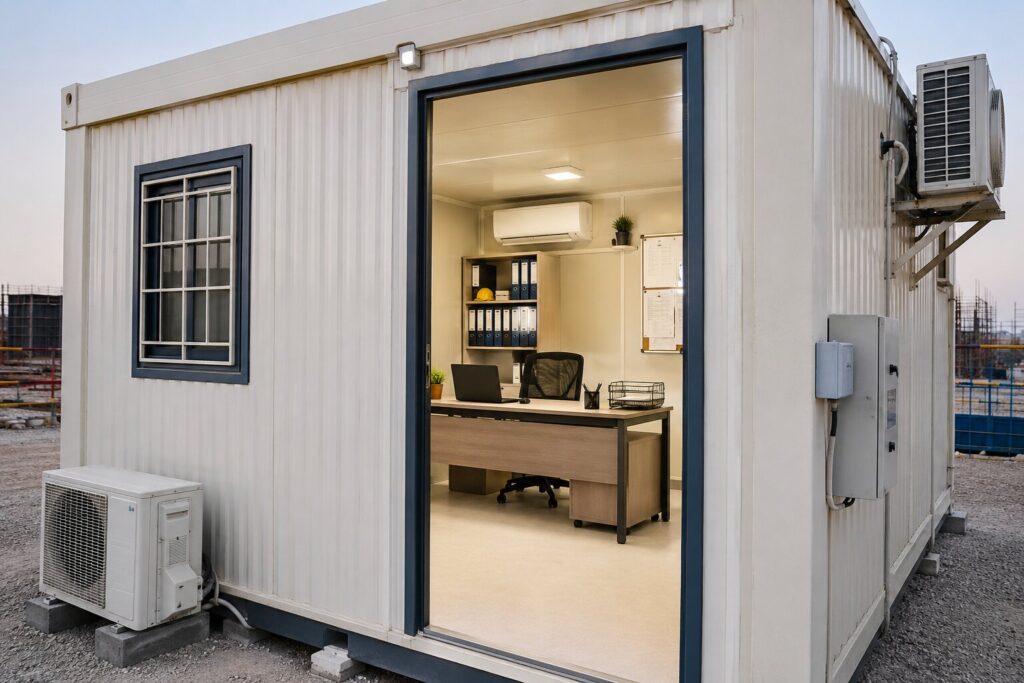
Good site office cabin interior design comes down to one idea: treat the cabin in zones rather than as one open room. A linear or corner desk along the longest wall handles daily engineering and admin work. A height-adjustable chair with lumbar support keeps the site manager comfortable through long shifts. A compact meeting corner handles contractor sign-offs. Wall-mounted storage keeps drawings, PPE, and paperwork off the floor. Every one of these choices has to answer to the cabin’s steel shell, its limited window space, and the fact that it may be lifted onto a truck and moved to the next project in a matter of hours. That last point is the one most articles on this topic skip past. Plenty of guides will tell you to buy an L-shaped desk and a mesh chair, and that advice is not wrong. It is just written for a fixed room in a permanent building. A site office cabin is a different animal. It is a prefabricated, insulated steel box that gets trucked to a construction site, connected to a generator or temporary power board, and used by people who spend half their day walking the site in boots and the other half reviewing drawings at a desk. Good interior design has to serve both realities at once, whether the cabin is sitting on a construction site in Dubai, a labour camp in Abu Dhabi, or a remote industrial project anywhere else in the region. This guide covers exactly that. It looks at how to lay out, furnish, light, ventilate, secure, and organise a site office cabin so it holds up to real site conditions while still giving your team a workspace they can actually concentrate in. Why Site Office Cabin Interior Design Needs a Different Approach A corporate office cabin sits inside a permanent building with stable HVAC, unlimited wall-mounting options, and a design lifespan measured in decades. A site office cabin, by contrast, is a self-contained module, usually a factory-built steel-panel structure between 20 and 40 feet long, that has to be functional from the day it is craned onto site until the day it is craned off again. That difference changes almost every design decision. Manufacturers who build these units for a living work with a narrower set of variables than a corporate fit-out designer does. Consider the constraints that shape every layout decision before a single piece of furniture is chosen. A fixed shell width and length. Unlike a corporate room, the footprint cannot be extended without adding an entirely new module. A defined number of window openings. These are set at the panel manufacturing stage and rarely changed afterward. A wall system that cannot take unlimited screw points. Sandwich panels have load limits that a plasterboard wall in a permanent building does not have to worry about. A floor built to survive site conditions. Boots, dust, dropped tools, and the occasional spilled coffee all happen far more often here than in a corporate setting. A structure that may be relocated multiple times. Furniture, fittings, and finishes all need to tolerate being loaded onto a truck more than once. A well-planned site office cabin typically has to serve three functions at once. A working office for the site manager, engineers, and administrative staff. A meeting space for contractors, consultants, and client visits. A storage hub for drawings, safety documentation, and PPE. That combination of a fixed structural shell, a compressed multi-purpose floor plan, and genuine mobility is what separates this category from anything written for a conventional office. This is exactly the kind of unit companies across Dubai and the wider UAE order through manufacturers such as Bait Al Maha for active construction and industrial projects, which makes getting the interior layout right from day one worth the extra thought. Planning the Layout: The Foundation of Site Office Cabin Interior Design Before any furniture gets chosen, the layout has to work with the dimensions the cabin actually has, not the dimensions a designer wishes it had. Most single-module portable office cabins fall in a fairly predictable size range, and that range should drive every layout decision that follows. Common site office cabin sizes and how they affect layout Cabin size (approx.) Typical use Recommended zoning approach 6m x 2.5m (20ft container-based) Single-person supervisor office or small admin unit One work zone along the long wall, compact wall storage, no separate meeting area. 6m x 3m Small team office for two to three people Work zone plus a fold-down or small round meeting table near the entrance. 12m x 3m (two modules joined) Site management office with meeting space Distinct work zone, meeting zone, and storage zone, divided by furniture placement or a half-height partition. Multi-cabin cluster (3+ modules) Full site management office with separate rooms for management, admin, and meetings Dedicated rooms per function, connected by a shared corridor module. A single-room cabin does not need drywall partitions to feel organised. Zoning can be done entirely with furniture, following a simple sequence. Anchor the work zone first. Place the primary desk against the longest uninterrupted wall, since this gives the most usable surface length without cutting into the room’s width. Position the meeting or visitor zone near the entrance. This keeps foot traffic away from the working desk and avoids visitors walking past confidential paperwork on their way in. Reserve the remaining wall for storage. Overhead cabinets and wall-mounted shelving along the opposite wall keep documents accessible without eating into the floor area. Leave the centre of the room as clear circulation space. This is the area that needs to stay open for movement between the three zones. This approach matters structurally too. Cutting into a sandwich-panel wall to add a stud partition after the cabin has already been fabricated is expensive, and it can affect the insulation and fire rating the panel was originally built with. Furniture-based zoning avoids that problem entirely, and it is also the easier layout to reconfigure if the cabin
Electrical & HVAC Setup for Site Office Cabins in Dubai: The Complete Guide
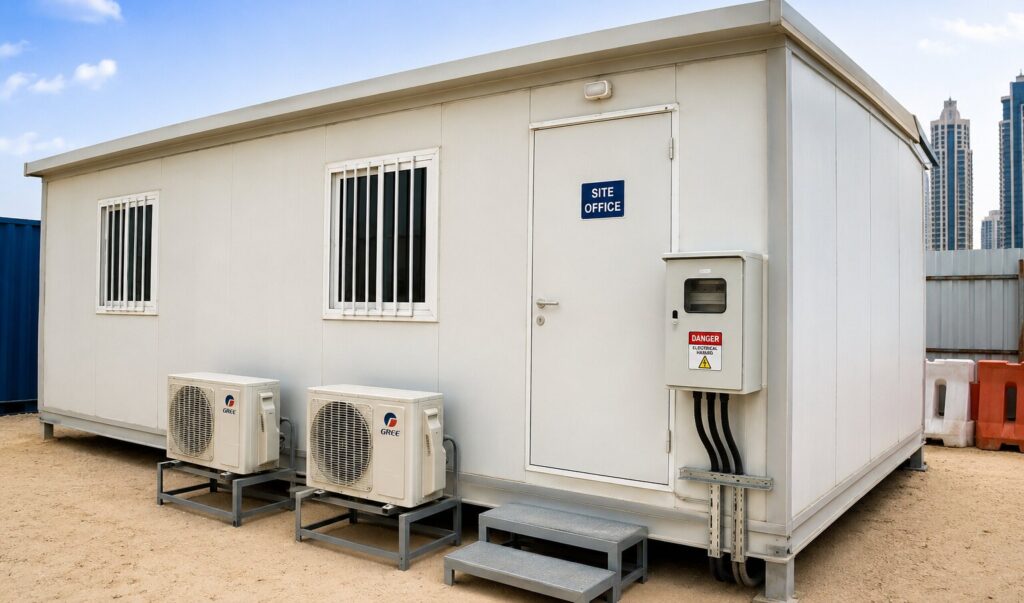
A correct electrical & HVAC setup for a site office cabin in Dubai means running power from DEWA mains or a generator into a weatherproof distribution board fitted with ELCB and MCB protection, earthing the cabin properly, and wiring it with fire-retardant, low-smoke cable that meets Dubai Civil Defence (DCD) standards. On the cooling side, a 20ft cabin generally needs 1.5 to 2 tons of refrigeration, and a 40ft cabin needs 3 tons or more, usually split across two units. Get the electrical & HVAC setup wrong, and the problem is not just discomfort in the heat. It becomes a failed inspection, a fire hazard, or a project delay that costs far more than doing it right the first time. This guide breaks the process down into every stage a project manager, facilities lead, or contractor in Dubai and across the wider UAE actually needs to plan for, with real sizing logic, cost ranges, compliance steps, and the mistakes that come up again and again on real portacabin and prefab office projects. For a broader look at portacabin types, sizing, and costs beyond electrical and HVAC alone, our complete guide to site offices in Dubai covers the full picture. Electrical & HVAC Setup Quick Reference: What a Compliant Setup Looks Like Before going into detail, here is the shorthand version most site managers want pinned to the cabin wall. Requirement Standard Practice for Dubai Site Office Cabins Power source DEWA mains where available, or a diesel generator for remote or interim phases. Distribution board Weatherproof, IP-rated, fitted with ELCB and MCB protection. Cabling Fire-retardant (FR) or low-smoke zero-halogen (LSZH), run through conduit. Earthing Mandatory on every cabin, tested and verified before handover. AC sizing – 20ft cabin (~15 sqm) 1.5–2 TR. AC sizing – 40ft cabin (~30 sqm) 3 TR, often split into two 1.5 TR units. Insulation PUF or EPS sandwich panel, 50–75mm thickness. Governing bodies DEWA, Dubai Civil Defence (DCD), and Dubai Municipality or Trakhees in free zones. Each row in this table gets a full explanation below, including why it is the standard and not just what the standard is. Why the Regulatory Side of Your Electrical & HVAC Setup Is Not Optional A site office cabin looks temporary, but Dubai treats the electrical and fire safety systems inside it with the same seriousness as a permanent building. Three separate authorities have a say in how the cabin gets powered and approved, and confusing their roles is one of the most common reasons a setup gets stuck in paperwork. The Three Authorities and What Each One Controls DEWA (Dubai Electricity and Water Authority) controls the power supply itself. This includes grid connections, temporary construction supply, and any request to increase load capacity mid-project. According to DEWA’s builder services documentation, a connection request needs a load schedule, a single-line diagram, and a site layout before an estimate is even issued. Dubai Civil Defence (DCD) governs what happens if something goes wrong. This covers fire-rated cabling, circuit protection, extinguisher placement, and emergency exit requirements. DCD’s fire and life safety code places heavy emphasis on electrical faults specifically, since they remain one of the most common causes of fire incidents on any site, temporary or permanent. Dubai Municipality or Trakhees (in free zones such as JAFZA) governs where the cabin physically sits. This includes its position relative to other structures and whether the plot itself is approved for temporary office use. Who Handles What, In Practice Your electrical contractor manages the DEWA-facing paperwork and connection application. Your fire safety contractor manages the DCD-facing cabling, extinguisher, and signage requirements. Your facilities or project team secures sign-off from whichever authority controls the plot itself. Skipping any one of these three steps is what turns a two-week cabin setup into a two-month one. Confirm all three approval paths at the very start of the project, not after the cabin has already arrived on site. Electrical Setup for Site Office Cabins: What Actually Goes Into the Cabin Choosing Your Power Source Most site offices in Dubai run on one of three setups. The right choice depends on where the project stands and how remote the site is. DEWA mains connection. The most stable, long-term option once the site has a confirmed supply point. Running costs are lower per month, there is no fuel logistics to manage, and this is generally the preferred option once it becomes available. Diesel generator. Necessary before DEWA supply is active, or on sites far from existing infrastructure. This option requires ongoing fuel delivery, routine servicing, and a plan for the noise and exhaust, since the cabin sits right next to the unit. Hybrid setup. DEWA as the primary source, with a generator kept as backup for critical loads such as server racks or security systems. This is more common on larger, longer-duration site offices where downtime is not acceptable. Option Best Suited For Advantages Trade-offs DEWA mains Sites with a confirmed connection. Stable supply, lower running cost, no fuel handling. Requires application lead time. Diesel generator Early-phase or remote sites. Immediate power, no waiting on approvals. Fuel cost, noise, and maintenance burden. Hybrid (DEWA + backup generator) Long-duration or critical-load offices. Redundancy, no single point of failure. Higher upfront setup cost. Working Out the Load You Actually Need This step is the one most articles skip, yet it is the step that determines the correct size for the distribution board and the cable. The method is simple: List every piece of equipment that will run in the cabin. Add up the wattage of each item. Convert the total to amps. Add a safety margin for future equipment. Example – a 20ft cabin. Lighting (LED, whole cabin): approximately 200W. Standard sockets (computers, printer, kettle, fridge): approximately 2,000W. 2 TR split AC unit: approximately 2,200W running load. Miscellaneous items (chargers, small appliances): approximately 500W. The total connected load comes to roughly 4,900W, or 4.9kW. On a standard single-phase 230V supply, that works out to around 21 amps
How Many Site Offices Do I Need for a Large Construction Project?
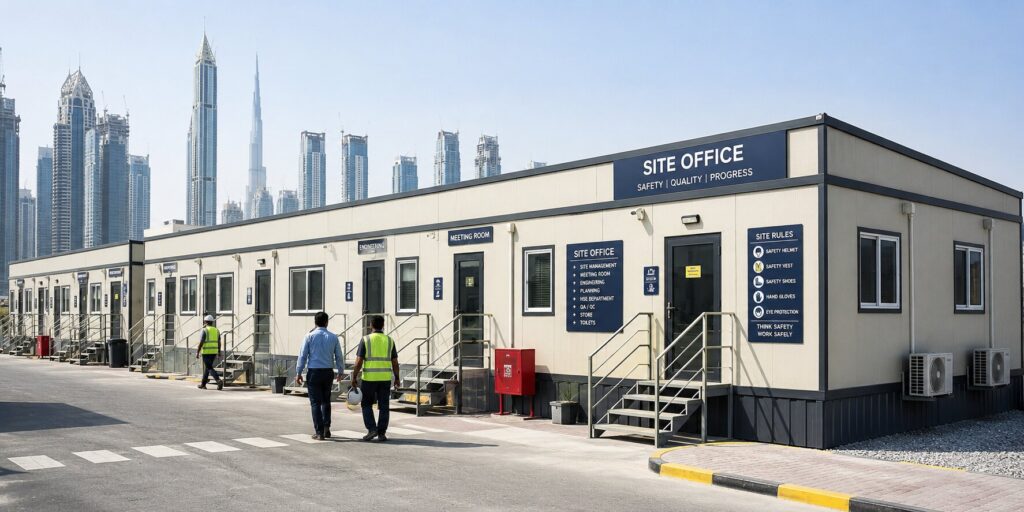
For a large construction project, instead of a single building, you often need one central command office complemented by smaller satellite units or welfare cabins. The exact number depends on your workforce size, site footprint, and trades. Most setups utilize multi-room configurations or modular complexes to separate administrative staff from operational teams Most large construction projects need a connected complex of 6 to 15 or more site offices, not one building. The exact number for your construction project comes from four things you can actually calculate: Your peak workforce headcount. How many distinct functions need their own space. How many subcontractors are active on site at once. The physical shape of your site. Get those four inputs right and the right number falls out almost on its own. Guess at them, and you will either run out of space in month four or pay for three empty cabins you never needed. I have spent years sourcing, configuring, and relocating site offices for contractors and developers across the UAE, on everything from a two-unit setup for a boutique villa project to a twelve-unit hub serving 30-plus engineers on a Business Bay tower. The question of how many site offices a construction project actually needs comes up on almost every single job, and almost nobody asks it correctly. They ask it as if there is one universal number. There is not. There is a formula instead, and that is what this guide walks through. How Many Site Offices a Construction Project Need? Before going further, it helps to define the thing we are actually counting. A site office is a connected group of modular or portable cabin units functioning as a temporary headquarters for a construction project. Rather than one freestanding building doing everything at once, it usually combines: Administration space for project management and engineering staff. Meeting rooms for coordination and client updates. Document control for plans, permits, and daily reports. Welfare facilities such as toilets and rest areas. A security or IT room for monitoring and server equipment. When this article refers to “units,” it means individual cabins, commonly 20-foot or 40-foot, that get connected, stacked, or distributed to form the complex. You can browse the actual range of site office cabins we configure these complexes from. If you want the fuller picture of how these units are built, sized, and permitted in the UAE, our complete guide to site offices covers the types, costs, and approvals in depth. That distinction matters because most generic advice on this topic answers a different question than the one people are actually asking. Articles that tell you to budget “15 to 20 square feet per person” are giving you a total area. They are not telling you: Whether that area should be one big cabin or nine small ones. Whether your subcontractors need their own desks. Whether your site’s shape means you need three separate clusters instead of one. Total square footage and unit count are related, but they are not the same decision. Unit count is usually the one that actually determines your budget, your permit applications, and your delivery schedule. Why “It Depends” Isn’t a Real Answer Ask five suppliers how many site offices a construction project needs and you will get five different vague answers, all true in their own way and useless in combination. The honest answer is that the right number comes from a calculation, not a lookup table. Here is the equation, in plain terms. Total units needed = (peak office headcount ÷ compliant occupancy per unit) + dedicated function units + subcontractor coordination units, adjusted for site layout. We call this the Four-Input Method, and it is the same sequence our team runs through with every client before quoting a single unit. Here is what each input means, in order: Peak office headcount. This is the busiest your administrative and engineering team will ever be. It is not your team size on day one, and it is not your average over the whole project. Compliant occupancy per unit. This is how many people can legally and comfortably work in a single cabin once local space regulations are applied. Dedicated function units. These are spaces that exist regardless of headcount, such as a meeting room, a document control room, an IT or server closet, and a first-aid station. You need these whether your team is 10 people or 80. Subcontractor coordination units. These account for the fact that subcontractor representatives need somewhere to sit and meet, even though they are not part of your core office headcount. Site layout. This is the adjustment factor. It can push your final number up or down by several units even when the headcount stays exactly the same. The rest of this guide walks through each of these five inputs one at a time, then puts the whole Four-Input Method together in two fully worked examples. Step 1: Size for Peak Headcount, Not Today’s Headcount The single biggest reason construction projects run out of office space midway through the build is that whoever ordered the units sized them for the team that existed at mobilization, often just five or six people setting up the site, rather than the team that will exist once the project hits full swing. Construction projects move through a predictable headcount curve, in three stages: Mobilization, roughly the first 1 to 3 months. A small core team, often just 3 to 5 people, including the project lead, a couple of engineers, and an admin assistant. Active construction, the bulk of the timeline. The full team mobilizes. Engineering, safety, quality control, and document control staff all come on board. Headcount often triples or quadruples from the mobilization phase. Finishing and handover. Headcount tapers off again as trades wind down, though snagging, inspection, and handover documentation can briefly bring specialist staff back in. If you order your site office complex based on the mobilization-phase headcount, you are sizing for the smallest team the project will
Porta Cabin Site Office for Government Projects in Dubai
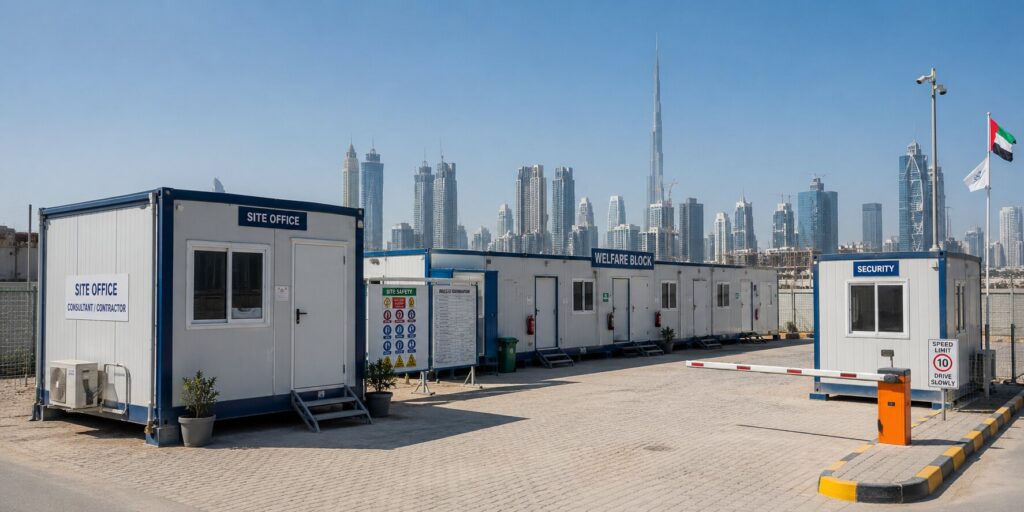
A porta cabin site office for government projects in Dubai requires a Temporary Building Permit (TBP) from Dubai Municipality before any structure is placed on site. The cabin must be built with fire-rated sandwich panels carrying a third-party Class A fire rating certificate, a hot-dip galvanised steel frame, inverter-type split AC units, and 220V/50Hz wiring with RCD protection, all of which are verified by UAE Civil Defense during a mandatory physical inspection. Welfare facilities must meet MOHRE standards, which require a minimum of one toilet for every 15 workers, a dedicated prayer room, and handwashing stations. If the project falls within a JAFZA or DP World territory, approvals must go through Trakhees EHS instead of, or in addition to, Dubai Municipality. The permit process takes between 25 and 55 working days depending on the project type and jurisdiction. Starting the approval process on the same day the cabin is ordered is the only way to avoid a stop-work notice on a Dubai government construction site. What Is a Porta Cabin Site Office for Government Project in Dubai? A porta cabin site office for government project is a prefabricated, relocatable modular structure that serves as the on-site administrative and operational headquarters for a construction project. It houses the project management team, site engineers, document controllers, QA/QC staff, and consultants. It is where permits are stored, where inspections begin, and where the day-to-day running of the project is coordinated. On a private development site in Dubai, a porta cabin is simply a practical convenience. On a UAE government project site, it is a regulated structure that must be engineered, documented, inspected, and approved by multiple authorities before a single worker can sit inside it. This distinction matters because many contractors treat the site office as an afterthought, something to sort out after the main contract is awarded. On a government construction site in Dubai, that approach routinely results in: Stop-work notices that halt the entire project, not just the site office. Re-inspection fees and mandatory remediation periods. Permit resubmissions that add weeks to the mobilisation timeline. Project delays that trigger contractual penalty clauses. Which Government Bodies Commission These Projects in Dubai? Government projects in Dubai are commissioned by public-sector entities, each with its own requirements for a compliant site office: Dubai Municipality (DM) for roads, drainage, public parks, and community infrastructure. Roads and Transport Authority (RTA) for highway expansions, Dubai Metro extensions, and bus depots. Dubai Electricity and Water Authority (DEWA) for power substations, water treatment plants, and pipeline works. Dubai South Authority for Expo City legacy infrastructure and Al Maktoum International Airport expansion. DP World and JAFZA entities for port, logistics corridor, and special economic zone infrastructure. Two Cabin Formats Used on Government Sites Across the UAE Sandwich panel modular cabins are the most common choice for contracts running up to three years, offering rapid fabrication and straightforward transport across Dubai and the wider UAE. ISO container conversions are increasingly preferred for long-duration infrastructure projects where structural permanence and resistance to impact damage outweigh the need for rapid mobilisation. Most contractors sourcing a compliant site office in Dubai end up comparing a handful of established UAE manufacturers, and the range of consultant cabins, contractor cabins, toilet blocks, security cabins, and container office conversions available locally gives a useful starting reference point for what a government-grade compound should include. Why Government Projects in Dubai Demand a Higher Standard of Site Office The easiest way to understand why a porta cabin site office for government projects is held to a different standard than a private-sector cabin is to look at what happens when that standard is not met. Contractors who have navigated government site inspections in Dubai know from experience that the site office is assessed before any structural work on the main contract is evaluated. Here is what typically happens when a site office fails to meet standard: An inspector from Dubai Municipality or UAE Civil Defense arrives and finds an uncleared cabin, one without a valid TBP displayed, or one built with non-fire-rated panels. The inspector does not move on to inspect the rest of the site. A stop-work notice is issued instead, halting every activity on the project, not just the site office. The contractor must resolve the non-compliance before any work can resume. On a contract with delay penalty clauses, the cost is disproportionate to what began as a simple procurement shortcut. It Is a Contractual Obligation, Not Just a Regulatory One Most Dubai government tender packages issued by DM, RTA, and DEWA include a site establishment clause within the contract documentation. This clause specifies: The minimum structural and material standards for all temporary structures. The welfare facility requirements that must be operational before work begins. The compliance documentation that must be available for inspection on demand. The permit sequence that must be completed before any cabin can be occupied. Failing to comply with this clause is not just a regulatory issue. It is a breach of the signed government contract. The Dubai Statistics Center reported that over 55,000 building permits were issued in 2024 alone, a 7.2% increase over the prior year, reflecting both the scale of construction activity and the increasingly competitive regulatory environment contractors now operate within. Multi-Authority Oversight Is the Norm on a Government Site Office in Dubai Private development sites typically deal with Dubai Municipality as their primary regulatory body. Government project sites simultaneously answer to several independent authorities: Dubai Municipality for building permits, site plan compliance, and structural standards. UAE Civil Defense for fire safety, panel ratings, detection systems, and evacuation provisions. MOHRE for worker welfare, toilet ratios, prayer facilities, and accommodation standards. Trakhees EHS for all of the above, independently, on sites within JAFZA and DP World zones. These bodies do not coordinate inspection schedules with one another. A pass from one authority offers no protection against a failure from another. Dubai’s Climate Turns Site Office Engineering Into a Genuine Safety Requirement Average temperatures on a Dubai
Why Dubai Construction Companies Choose Bait Al Maha for Prefab
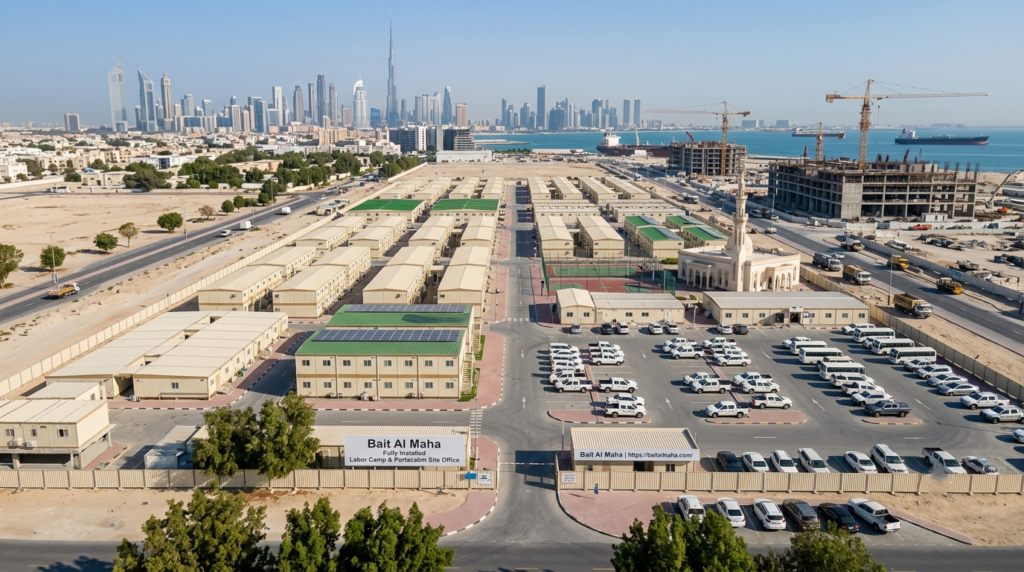
Dubai construction companies choose Bait Al Maha for prefabricated structures because they deliver cost-effective, turnkey solutions that accelerate project timelines. Operating across the Dubai, the manufacturer is highly trusted for supplying robust, custom-built modular units that endure harsh regional climates while meeting rigorous industry standards. The result? Mobilization timelines that are significantly shorter than traditional on-site builds. Based in Sharjah’s Sajja Industrial Area and serving all seven Emirates, Bait Al Maha supplies portacabins, labor camps, site offices, double-storey offices, and container conversions – every unit engineered to withstand UAE summer temperatures that regularly exceed 45°C and frequently reach 50°C. For contractors working under aggressive timelines and strict regulatory environments, that combination is not a luxury – it is a baseline requirement. The Problem Most Contractors Run Into Before They Call Bait Al Maha Picture a scenario that plays out more often than Dubai contractors would care to admit. A 200-worker labor camp is planned for an infrastructure project in Al Quoz. Groundbreaking is in six weeks. The procurement team sourced prefab units from a supplier that looked fine on paper – decent price, decent photos, and a reasonable lead time. Then the units arrive on site. The Dubai Municipality inspector visits. Three things are flagged immediately: Insufficient floor area per worker under UAE accommodation standards Non-compliant electrical earthing No documentation showing fire suppression compliance with Dubai Civil Defence codes The units cannot be occupied. Workers cannot mobilize. The project bleeds money in daily delay costs while the supplier scrambles to address issues they should have anticipated from the first drawing. This is not an exceptional story. It is a pattern – and it emerges directly from one decision: choosing a prefab supplier based on price rather than proven compliance. The contractors who consistently avoid this pattern share one quality: They work with suppliers who understand the UAE regulatory environment as fluently as they understand steel and insulation. Bait Al Maha has built its entire operation around that understanding. This article explains exactly why, with specifics that go well beyond the general claims found on most supplier websites. Why Dubai’s Construction Industry Demands a Different Kind of Prefab Supplier Before examining what Bait Al Maha does, it is worth understanding why Dubai creates prefab demands that simply do not exist in most other markets. The Sheer Pace and Scale of Dubai’s Construction Pipeline The UAE construction market reached USD 42.75 billion in 2025 and is projected to reach USD 52.66 billion by 2030, growing at a CAGR of 4.2% (Mordor Intelligence) Dubai accounts for roughly 41.6% of total UAE construction activity – the single most active emirate in the country Projects currently underway or in the pipeline include: USD 35 billion Al Maktoum Airport expansion – the largest airport project in the world by investment value USD 5.5 billion Dubai Metro Gold Line extension Continuous residential development under the Dubai 2040 Urban Master Plan A steady flow of hospitality, logistics, and industrial construction projects across all zones Every one of these projects needs temporary infrastructure – site offices, labor accommodation, dining facilities, and storage – before a single permanent structure is erected. The prefabricated construction market in the UAE has been growing faster than the broader construction sector: 9.4% CAGR between 2020 and 2024 6.8% annual growth forecast through 2029 Prefab is no longer an alternative approach in the UAE. It is becoming the default method for temporary and increasingly permanent structures where speed, compliance, and cost predictability matter. The Surge-and-Scale Problem What makes Dubai’s prefab market uniquely demanding is what procurement professionals call the surge-and-scale challenge. Projects in Dubai mobilize faster than almost anywhere else in the world. A contractor awarded a major infrastructure contract in January needs accommodation for 300 workers operational by February. There is no gentle ramp-up. There is a project start date, and everything before it is procurement. That urgency creates a very specific requirement – prefab units that are: Already manufactured and ready for dispatch Already compliant with UAE regulatory standards Already equipped with the MEP fittings needed to connect to site services on arrival Off-site manufacturing reduces project timelines by up to 50% compared to conventional builds (IMARC Group). That figure only holds true if the off-site manufacturing is genuinely complete – not simply a shell that requires on-site finishing work to pass an inspection. Worker Welfare Legislation Has Raised the Floor Permanently The UAE government has been progressively strengthening worker welfare regulations for over two decades. Key enforcement points include: The midday outdoor work ban – prohibiting outdoor work under direct sunlight between 12:30 pm and 3:00 pm from June 15 to September 15 – now in its 22nd consecutive year of enforcement Fines for violations: AED 5,000 per worker, up to a maximum of AED 50,000 Under Federal Decree-Law No. 33 of 2021, all companies with 50 or more workers earning below AED 1,500 per month must provide accommodation that meets specific government standards: Requirement Standard Personal space per worker Minimum 3–4 sq m Air conditioning Mandatory in all sleeping areas Room occupancy Maximum 10 workers per room Sanitation ratio 1 toilet + 1 shower per 8–10 workers Prayer facilities Dedicated room required Medical access Clinic within or near the camp These are not aspirational guidelines. They are inspectable, enforceable, and regularly checked by Dubai Municipality and MoHRE inspection teams who conduct field visits using smart digital monitoring systems. The Dual Challenge No One Warns You About The hardest aspect of sourcing prefab specifically for Dubai is that two requirements which rarely co-exist elsewhere must both be satisfied simultaneously: Units must be deployable within days Units must be engineered for one of the harshest climates on the planet Most prefab suppliers around the world can meet one of these requirements. Very few can meet both – with full regulatory compliance – from local stock. That is the gap Bait Al Maha fills. At a Glance: 8 Reasons Construction Companies Choose Bait Al Maha For contractors who need