

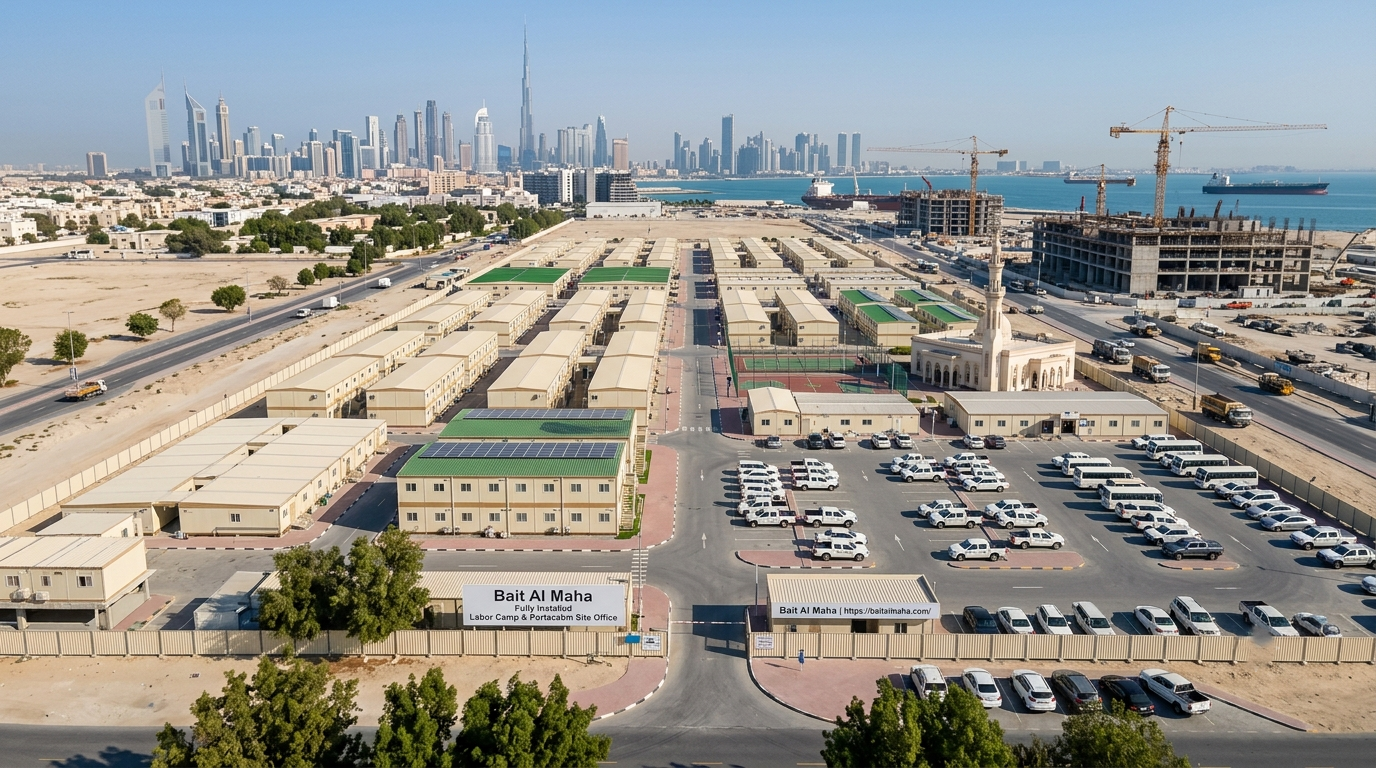
Dubai construction companies choose Bait Al Maha for prefabricated structures because they deliver cost-effective, turnkey solutions that accelerate project timelines. Operating across the Dubai, the manufacturer is highly trusted for supplying robust, custom-built modular units that endure harsh regional climates while meeting rigorous industry standards.
The result? Mobilization timelines that are significantly shorter than traditional on-site builds. Based in Sharjah’s Sajja Industrial Area and serving all seven Emirates, Bait Al Maha supplies portacabins, labor camps, site offices, double-storey offices, and container conversions – every unit engineered to withstand UAE summer temperatures that regularly exceed 45°C and frequently reach 50°C.
For contractors working under aggressive timelines and strict regulatory environments, that combination is not a luxury – it is a baseline requirement.
The Problem Most Contractors Run Into Before They Call Bait Al Maha
Picture a scenario that plays out more often than Dubai contractors would care to admit.
A 200-worker labor camp is planned for an infrastructure project in Al Quoz. Groundbreaking is in six weeks. The procurement team sourced prefab units from a supplier that looked fine on paper – decent price, decent photos, and a reasonable lead time.
Then the units arrive on site. The Dubai Municipality inspector visits. Three things are flagged immediately:
- Insufficient floor area per worker under UAE accommodation standards
- Non-compliant electrical earthing
- No documentation showing fire suppression compliance with Dubai Civil Defence codes
The units cannot be occupied. Workers cannot mobilize. The project bleeds money in daily delay costs while the supplier scrambles to address issues they should have anticipated from the first drawing.
This is not an exceptional story. It is a pattern – and it emerges directly from one decision: choosing a prefab supplier based on price rather than proven compliance.
The contractors who consistently avoid this pattern share one quality:
They work with suppliers who understand the UAE regulatory environment as fluently as they understand steel and insulation.
Bait Al Maha has built its entire operation around that understanding. This article explains exactly why, with specifics that go well beyond the general claims found on most supplier websites.
Why Dubai’s Construction Industry Demands a Different Kind of Prefab Supplier
Before examining what Bait Al Maha does, it is worth understanding why Dubai creates prefab demands that simply do not exist in most other markets.
The Sheer Pace and Scale of Dubai’s Construction Pipeline
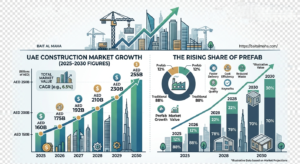
- The UAE construction market reached USD 42.75 billion in 2025 and is projected to reach USD 52.66 billion by 2030, growing at a CAGR of 4.2% (Mordor Intelligence)
- Dubai accounts for roughly 41.6% of total UAE construction activity – the single most active emirate in the country
Projects currently underway or in the pipeline include:
- USD 35 billion Al Maktoum Airport expansion – the largest airport project in the world by investment value
- USD 5.5 billion Dubai Metro Gold Line extension
- Continuous residential development under the Dubai 2040 Urban Master Plan
- A steady flow of hospitality, logistics, and industrial construction projects across all zones
Every one of these projects needs temporary infrastructure – site offices, labor accommodation, dining facilities, and storage – before a single permanent structure is erected.
The prefabricated construction market in the UAE has been growing faster than the broader construction sector:
- 9.4% CAGR between 2020 and 2024
- 6.8% annual growth forecast through 2029
Prefab is no longer an alternative approach in the UAE. It is becoming the default method for temporary and increasingly permanent structures where speed, compliance, and cost predictability matter.
The Surge-and-Scale Problem
What makes Dubai’s prefab market uniquely demanding is what procurement professionals call the surge-and-scale challenge. Projects in Dubai mobilize faster than almost anywhere else in the world.
A contractor awarded a major infrastructure contract in January needs accommodation for 300 workers operational by February. There is no gentle ramp-up. There is a project start date, and everything before it is procurement.
That urgency creates a very specific requirement – prefab units that are:
- Already manufactured and ready for dispatch
- Already compliant with UAE regulatory standards
- Already equipped with the MEP fittings needed to connect to site services on arrival
Off-site manufacturing reduces project timelines by up to 50% compared to conventional builds (IMARC Group). That figure only holds true if the off-site manufacturing is genuinely complete – not simply a shell that requires on-site finishing work to pass an inspection.
Worker Welfare Legislation Has Raised the Floor Permanently
The UAE government has been progressively strengthening worker welfare regulations for over two decades. Key enforcement points include:
- The midday outdoor work ban – prohibiting outdoor work under direct sunlight between 12:30 pm and 3:00 pm from June 15 to September 15 – now in its 22nd consecutive year of enforcement
- Fines for violations: AED 5,000 per worker, up to a maximum of AED 50,000
Under Federal Decree-Law No. 33 of 2021, all companies with 50 or more workers earning below AED 1,500 per month must provide accommodation that meets specific government standards:
| Requirement | Standard |
| Personal space per worker | Minimum 3–4 sq m |
| Air conditioning | Mandatory in all sleeping areas |
| Room occupancy | Maximum 10 workers per room |
| Sanitation ratio | 1 toilet + 1 shower per 8–10 workers |
| Prayer facilities | Dedicated room required |
| Medical access | Clinic within or near the camp |
These are not aspirational guidelines. They are inspectable, enforceable, and regularly checked by Dubai Municipality and MoHRE inspection teams who conduct field visits using smart digital monitoring systems.
The Dual Challenge No One Warns You About
The hardest aspect of sourcing prefab specifically for Dubai is that two requirements which rarely co-exist elsewhere must both be satisfied simultaneously:
- Units must be deployable within days
- Units must be engineered for one of the harshest climates on the planet
Most prefab suppliers around the world can meet one of these requirements. Very few can meet both – with full regulatory compliance – from local stock. That is the gap Bait Al Maha fills.
At a Glance: 8 Reasons Construction Companies Choose Bait Al Maha
For contractors who need the summary before the detail:
- Fast setup and reduced downtime – Delivery and installation within 48 to 72 hours for UAE sites, keeping mobilization timelines on track from day one
- Extreme climate durability – ACP cladding and sandwich panel insulation specifically engineered for UAE summer temperatures of 45–50°C and beyond
- Dubai Municipality compliance built in – Pre-engineered to meet DM safety standards, MEP codes, Dubai Civil Defence fire requirements, and UAE worker welfare regulations – not retrofitted after inspection
- Complete product ecosystem – From security cabins and site offices to full labor camps, prefab mosques, majlis units, dining halls, and container conversions – all from one supplier
- End-to-end customization – Fully adaptable layouts for every project phase, with integrated plumbing, MEP routing, internal partitioning, and septic tank options
- Three procurement models – Buy new, buy refurbished, or rent – with the same compliance standards applied across all three options
- Full lifecycle service – Delivery, crane installation, MEP connection, mid-project maintenance, and end-of-project relocation
- UAE-rooted manufacturing – Sharjah-based production eliminates customs delays, specification mismatches, and currency risk associated with imported prefab
Each point is expanded fully in the sections that follow.
Reason 1: Factory-First Manufacturing That Keeps Your Timeline Intact
How fast can Bait Al Maha deliver a prefab unit to a Dubai construction site?
Bait Al Maha can deliver and install most prefab units within 48 to 72 hours of order confirmation for sites within the UAE, subject to site access and unit specification.
Most contractors say the same thing when asked what they value most: certainty. Not the cheapest price – certainty that units will arrive when promised, meet agreed specifications, and not require rework before occupation.
What Parallel Manufacturing Actually Means for Your Programme
When a Bait Al Maha unit enters production, your site is likely still in groundwork. The two workstreams run simultaneously rather than sequentially:
- Foundation preparation happens on-site
- Fabrication happens at the Sajja Industrial Area factory
- MEP is pre-installed in the factory before delivery
- The limiting factor shifts from manufacturing to delivery logistics
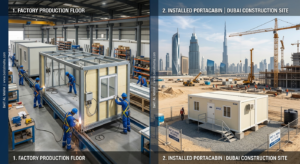
From Factory Floor to Occupied Unit: The 5-Stage Process
- Design and specification review – Layout check covering dimensions, MEP requirements, compliance specs, and site access constraints. Issues at this stage cost nothing to resolve; post-delivery issues cost significantly more.
- Controlled factory production – Steel structure fabrication, insulation panel fitting, electrical and mechanical pre-installation, and cladding application under cover, in consistent conditions, with quality control at each stage.
- Pre-delivery inspection – Units are checked against the agreed specification before leaving the facility. This is where deviations are caught – not at your Dubai Municipality inspection.
- Crane-ready delivery – Transported on flatbed trailers and positioned using mobile cranes. The delivery team includes certified riggers familiar with Dubai’s site access constraints.
- On-site connection and handover – MEP connections are completed on site. The unit is commissioned and inspected before worker handover.
Timeline Comparison: Traditional Build vs. Bait Al Maha Prefab (50-Person Site Camp)
| Stage | Traditional On-Site Build | Bait Al Maha Prefab |
| Design and specification | 2–3 weeks | 1–2 days |
| Material procurement | 3–5 weeks | Already in production or in stock |
| Foundation and groundwork | 1–2 weeks | 1–2 weeks (runs simultaneously with production) |
| Structure fabrication | 4–8 weeks on-site | 5–10 days in controlled factory |
| MEP installation | 2–3 weeks on-site | Pre-installed in factory |
| Finishing and fit-out | 2–3 weeks on-site | Factory-completed before delivery |
| Compliance inspection and approval | Variable – often requires rework | Documentation pre-prepared; first-pass approval standard |
| Total to occupation-ready | 14–24 weeks | 1–3 weeks from order |
The difference is structural, not incremental. Even accounting for real-world variables, the parallel production model reliably saves 2 to 4 weeks on a standard 50-person labor camp mobilization. For a project where every week of delay carries a financial consequence, that is often the difference between staying within programme and triggering a delay claim.
Reason 2: Engineered for 50°C – Not Adjusted for It
What insulation materials does Bait Al Maha use in its prefab units?
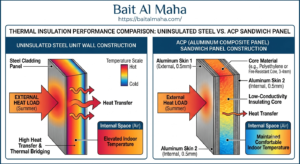
Bait Al Maha constructs its prefab units using aluminium composite panel (ACP) cladding combined with high-density insulation cores – typically polyurethane or rock wool sandwich panels – rated for UAE summer conditions.
The Steel Skin Problem
In a Dubai summer:
- Ambient air temperatures regularly exceed 45°C
- During the June 2024 heatwave, parts of the UAE recorded 49.4°C, with heat index values climbing above 60°C
- Steel cladding under direct desert sun can reach 65–70°C during peak afternoon hours
An uninsulated or inadequately insulated steel shell at those temperatures functions as a radiator inside the unit. The consequences:
- AC systems run continuously at maximum load and still struggle to maintain a liveable temperature
- Energy bills climb sharply and remain elevated throughout the summer months
- AC equipment lifespans are shortened by continuous overload operation
- Workers are not adequately protected from heat stress, regardless of the AC specification
How ACP Cladding and Sandwich Panel Construction Solve the Problem
ACP – aluminium composite panel – uses a polyethylene or mineral-fill core sandwiched between two aluminium sheets. When combined with a high-density insulation core in the wall panel construction:
- Dramatically reduces thermal conductivity compared to single-skin steel sheet
- Creates a building envelope with meaningful thermal resistance (R-value)
- Keeps interior temperatures within a manageable range even at peak solar load
The practical outcome: An ACP-insulated Bait Al Maha cabin with a correctly sized AC unit maintains a comfortable interior temperature during peak summer heat. An equivalent single-skin steel cabin does not – regardless of the AC specification.
This matters directly for UAE regulatory compliance. The MoHRE midday work ban requires workers to have access to shaded or climate-controlled indoor spaces during the 12:30 pm to 3:00 pm break period. A cabin that cannot maintain a habitable temperature in peak heat does not satisfy that requirement in any practical sense.
Insulation Performance Comparison: UAE Summer Conditions
| Performance Factor | Standard Single-Skin Steel | Bait Al Maha ACP-Insulated Unit |
| Exterior surface temperature (peak summer) | 65–70°C | 38–45°C (aluminium reflects solar radiation) |
| Interior temperature without AC (peak hours) | 50–55°C – uninhabitable | 32–38°C – warm but survivable |
| Interior temperature with correctly sized AC | 28–32°C (AC under severe load) | 22–26°C (AC operating efficiently) |
| AC energy consumption | High – continuous maximum load | Moderate – normal cycling |
| AC equipment lifespan impact | Shortened significantly | Normal operational life |
| DM welfare compliance | Borderline or non-compliant | Compliant |
Reason 3: Dubai Municipality Compliance Built In, Not Bolted On
What Dubai Municipality approvals are required for prefab labor accommodation?
Prefab labor accommodation in Dubai must be licensed by Dubai Municipality and comply with the Technical Guidelines for Labour Accommodation Compliance, alongside UAE federal standards under Federal Decree-Law No. 33 of 2021 and applicable MoHRE ministerial resolutions.
What Dubai Municipality Actually Checks
When a DM inspector visits a labor camp, they work through a checklist spanning multiple technical domains:
Structural requirements:
- Load ratings appropriate to the accommodation class
- Structural connection integrity throughout the unit
- Floor loading certification for the intended occupancy
- Foundation adequacy verified for specific site conditions
MEP (Mechanical, Electrical, and Plumbing) requirements:
- Electrical earthing and isolation compliance
- Cable routing and conduit standards throughout
- Plumbing connections and drainage verified
- HVAC performance measured relative to occupancy and room size
- Water heater specifications in line with UAE Standards (UAE.S / GSO / IEC 60335-2-21)
Sanitation requirements:
- 1 toilet + 1 shower per 8–10 workers
- Kitchen facilities properly ventilated, clean, and functional
- Dining areas sized appropriately for shift populations
- Gender separation of accommodation facilities – mandatory in Dubai
Fire safety requirements:
- Fire extinguisher placement per Dubai Civil Defence code
- Exit signage installed and clearly visible throughout
- Fire suppression systems in place for larger accommodation blocks
- Emergency egress route widths meeting minimum DCD specifications
Space allocation requirements:
- Minimum of 3–4 square meters of personal space per worker
- Room occupancy strictly limited to maximum 10 workers per room
- Overcrowding results in immediate enforcement action
What “Compliance Built In” Means in Practice
A Bait Al Maha unit leaves the Sajja facility pre-engineered to meet every item on that checklist. The compliance documentation package provided with each unit includes:
- Technical specifications for all structural and MEP components
- Material certificates from approved UAE testing sources
- Installation records confirming factory-stage completion of all regulated elements
- DM-format documentation required for the accommodation licensing process
The Liability Inversion Most Contractors Overlook
When a prefab supplier provides non-compliant units, the legal exposure sits with the contractor – not the supplier. Consider who carries the risk:
- The contractor is the licensee of the construction site
- The contractor is the employer of record for the workers in the accommodation
- The contractor is the party named in the stop-work notice
- The contractor absorbs the daily financial penalty while non-compliance is being resolved
Working with a supplier whose compliance credentials are verified and whose documentation is in order shifts a significant category of legal and financial risk off the contractor’s books entirely.
Dubai Municipality and MoHRE Compliance Requirements at a Glance
| Compliance Area | Requirement | Bait Al Maha Approach |
| Minimum personal space | 3–4 sq m per worker | Room dimensions designed to standard from factory stage |
| Room occupancy limit | Maximum 10 workers per room | Configuration specified at order; no overcrowding by design |
| Sanitation ratio | 1 toilet + 1 shower per 8–10 workers | Ablution block sizing calculated to project occupancy |
| Air conditioning | Mandatory for all accommodation | Pre-installed at factory; system sized to room volume |
| Prayer facilities | Required for camps of significant size | Prefab mosque units available as standard product |
| Gender separation | Mandatory in Dubai | Separate block allocation built into layout design |
| Electrical earthing | UAE Standards (UAE.S) compliant | Factory-wired to UAE code |
| Fire suppression | Dubai Civil Defence requirements | Fire extinguisher placement, exit signage per DCD code |
| Emergency egress | Minimum width routes, mandatory signage | Built to minimum egress standards; DCD documentation provided |
| Compliance documentation | Required for DM accommodation licensing | Full technical package provided with every unit |
Reason 4: A Complete Product Ecosystem Under One Roof
What prefab units does Bait Al Maha supply for construction sites?
Bait Al Maha supplies the full range of prefab and modular units required across a Dubai construction project lifecycle. The complete range includes:
Site management units:
- Site offices – single-storey and double-storey configurations
- Project manager and senior management cabins
- Security guard booths and gate structures
Worker accommodation and welfare:
- Labor camp bedroom blocks
- Mass halls and dining facilities
- Kitchen preparation units
- Ablution blocks and portable toilet units with integrated plumbing
- Prefab mosques and dedicated prayer facilities
- Recreation rooms and welfare facilities
- Medical and first aid rooms
Specialist and cultural units:
- Majlis units for formal reception and client-facing use
- Container conversions – 20-foot and 40-foot ISO formats
- Pump cabins and specialist industrial enclosures
- Maid rooms and driver accommodation for residential projects
- Caravan houses for mobile accommodation requirements
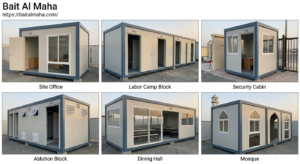
The Site Hierarchy from Entrance to Camp
Walking through a fully mobilized Dubai construction site makes the full product range meaningful:
- Site entrance and security – The security cabin is the first structure any visitor encounters. Needs to be climate controlled, DM compliant, and operational from day one.
- Site management and engineering – The project office: project director’s cabin, engineering team workspace, meeting room, and drawings storage. Double-storey configurations available for dense urban sites.
- Worker accommodation – The most regulated and most complex element. A labor camp for 300 workers involves sleeping blocks, dining halls, kitchens, ablution blocks, prayer facilities, and recreational space – all meeting DM and MoHRE standards simultaneously.
- Sanitation and welfare – Portable toilet units with integrated plumbing and septic tank connections address one of the most logistically complex aspects of early-stage or remote site welfare.
Products That Only Make Sense If You Actually Know the UAE Market
Two product lines stand out as clear markers of genuine UAE market expertise:
Prefabricated mosques – Not a generic multi-purpose room. A dedicated facility with:
- Proper ablution arrangements sized for shift-scale usage
- Correct directional orientation (Qibla)
- Interior configuration accommodating Jumu’ah Friday prayer for a large workforce
Majlis units – A formal reception and gathering space designed for Arabic cultural use. On projects where senior visitors are expected or where a dedicated cultural space is required for the workforce, the majlis unit provides something no generic portable office can substitute for.
The Procurement Math of Single-Vendor Sourcing
Managing prefab across 4–5 suppliers creates compound complexity:
- 4 separate purchase orders to raise, approve, and track
- 4 separate delivery schedules to coordinate simultaneously
- 4 separate compliance documentation sets to compile for the DM site file
- 4 separate warranty chains to manage when something goes wrong
Consolidating to Bait Al Maha reduces that to:
- One contract
- One DM documentation package
- One delivery coordination
- One ongoing relationship
Bait Al Maha Complete Product Range
| Unit Type | Typical Size Range | Primary Application | Key Compliance Considerations |
| Security cabin | 3m × 3m to 3m × 6m | Site entrance control | DM structure approval; electrical earthing |
| Site office (single-storey) | 3m × 6m to 6m × 12m | Project team workspace | MEP pre-installation; DM structural compliance |
| Double-storey office | 6m × 12m and above | Multi-team site management | Structural load rating; staircase and egress compliance |
| Labor camp bedroom block | 6m × 12m to 6m × 24m | Worker sleeping accommodation | Space per worker; occupancy limit; ventilation |
| Mass hall / dining hall | 6m × 12m to 12m × 24m | Worker dining, shift catering | Ventilation; food safety; capacity per shift |
| Kitchen unit | 3m × 9m to 6m × 12m | Food preparation | Health authority requirements; ventilation; fire suppression |
| Ablution block | 3m × 6m to 6m × 12m | Showers, toilets, wash facilities | Sanitation ratio compliance; plumbing connection |
| Prefab mosque | 6m × 9m to 12m × 18m | Dedicated prayer facility | Directional orientation (Qibla); ablution facilities adjacent |
| Majlis unit | 6m × 9m to 9m × 12m | Client reception, cultural gathering | High-quality interior finish; branded cladding option |
| Medical / first aid room | 3m × 6m to 6m × 9m | On-site medical facility | MoHRE camp health facility requirements |
| Container conversion (20ft) | 6m × 2.4m | Storage, tool room, specialist office | Container structural certification |
| Container conversion (40ft) | 12m × 2.4m | Larger storage, workshop, laboratory | Container structural certification |
| Pump cabin | 3m × 3m to 3m × 6m | Oil and gas pump station housing | Explosion-rated electrical specification |
| Maid room | 3m × 3m to 3m × 6m | Residential staff accommodation | Municipal guidelines for residential staff housing |
| Caravan house | Variable | Mobile residential accommodation | RTA road compliance if towed |
Reason 5: Customization That Adapts to How Construction Projects Actually Evolve
Can prefab buildings be customized for specific project requirements in Dubai?
Yes. Bait Al Maha offers full customization of prefab unit layouts, including MEP routing plans, internal partitioning, door and window placement, integrated plumbing configurations, septic tank sizing, exterior cladding finish, and colour options. Customization is a standard part of the order process, beginning with the initial design consultation.
Projects Do Not Mobilize and Stay Static
A construction project’s prefab requirements change dramatically over its lifecycle:
- Week 2: A project director’s cabin, a site engineer’s office, a security booth, and emergency sanitation. 15–20 units, deployed fast and functional.
- Week 26: Accommodation for 400 workers, a 500-person dining hall running three shifts, a mosque, a recreation room, a full medical facility, and ablution blocks sized for peak occupancy.
- Week 80: Workforce numbers are declining. Some blocks need to be consolidated, others decommissioned and relocated to the next project.
Standard catalogue prefab does not accommodate this lifecycle gracefully. Genuinely customizable prefab, built to be reconfigured and redeployed, does.
What End-to-End Customization Actually Involves
Bait Al Maha’s consultation-first process produces:
- MEP integration drawings – Define where electrical feeds, plumbing connections, drainage outlets, and HVAC connections must be positioned to match the site’s planned infrastructure. Getting this right in the factory means no on-site cutting, no field modifications, and no compliance risk.
- Internal layout configuration – Covers the number, size, and position of internal partitions; placement of doors and windows for natural light, ventilation, and privacy; furniture and fitting specifications.
- Sanitation engineering – Septic tank sizing is a technical calculation, not an add-on decision. Bait Al Maha sizes septic systems based on:
- Actual occupancy numbers
- Pump-out access logistics
- Expected duration of deployment
- Exterior specification – ACP cladding colour and finish for client-facing structures; branded cladding panels for site offices visible from the road; structural specifications for units near active site traffic routes.
How Prefab Requirements Change Across a Typical UAE Project Lifecycle
| Project Phase | Timeline | Workforce | Primary Prefab Requirements | Priority |
| Early mobilization | Weeks 1–4 | 10–30 | Security cabin, project office, emergency sanitation | Speed of deployment |
| Subcontractor mobilization | Weeks 4–12 | 50–150 | Extended offices, initial labor camp, ablution units, dining | DM compliance; space ratios |
| Peak workforce | Weeks 12 to midpoint | 200–500+ | Full labor camp village: sleeping blocks, mass hall, mosque, medical, recreation | Full welfare compliance |
| Project wind-down | Midpoint to completion | Declining to 30 | Progressive demobilization, office consolidation | Relocation logistics |
| Project close | Final 4 weeks | 10–20 | Final site office, security cabin | Full camp teardown and relocation |
Understanding this curve is what separates a prefab supplier who thinks in individual units from a partner who thinks in project programmes.
Reason 6: Three Ways to Pay – New, Refurbished, or Rental
What is the cost difference between buying and renting a portacabin in Dubai?
The right answer depends on the project’s duration, budget cycle, and workforce volume. Bait Al Maha operates across all three procurement models:
- Buy new – for long-duration projects where full specification and asset value are the priority
- Buy refurbished – for budget-conscious procurement where compliant infrastructure matters more than pristine cladding
- Rent – for short-duration, seasonal, or temporary requirements where capital commitment is not justified
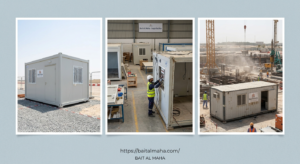
The New Build Case: When Full Specification Is the Right Investment
A new-build Bait Al Maha unit makes the most commercial sense for projects that are:
- Running for 18 months or longer, where accumulated rental costs would exceed the purchase price
- Serving client-visible functions, where site infrastructure reflects directly on the contractor’s brand
- Requiring specific MEP configurations or unusual dimensions difficult to achieve in the refurbished market
- Deploying to a site where the contractor will run multiple projects in sequence and can redeploy the asset
New units come with:
- Full factory warranty
- Fresh compliance documentation
- Freedom to specify every aspect of the fit-out from the initial order
- Strong residual value in the refurbished segment at project close
The Refurbished Case: The Most Misunderstood Option in the Market
A Bait Al Maha refurbished portacabin is a previously deployed structure that has been:
- Returned to the Sajja facility
- Stripped to the structural steel core
- Re-insulated where required
- Re-clad with fresh ACP or equivalent cladding
- Refitted with new MEP components throughout
- Certified to current DM standards before re-entering the supply chain
The structural steel frame – the element that determines safety and longevity – is typically the same quality in a properly refurbished unit as in a new one, because the steel frame outlasts everything else by a significant margin.
The price difference between new and refurbished can be substantial. For a contractor running a 300-person camp for six months with a competitive project margin, the refurbished option delivers fully compliant infrastructure at a price point that makes the project financially viable.
The Rental Case: Flexibility Without the Capital Commitment
Rental makes commercial sense in several specific scenarios Dubai contractors encounter regularly:
- Short-duration projects – anything under six months
- Event and activation uses – where a structure is needed for weeks rather than months
- Bridge situations – where a project has mobilized urgently and needs temporary accommodation while the permanent prefab solution is being specified
- Seasonal demand spikes – where a contractor’s project portfolio peaks at certain times of year
Bait Al Maha’s UAE-wide rental fleet covers all of these scenarios, with availability across Dubai, Sharjah, Abu Dhabi, and the Northern Emirates. Rental units meet the same compliance standards as new and refurbished stock – DM inspectors do not apply a different compliance standard to rented accommodation.
The Real Cost Comparison: Total Cost, Not Purchase Price
The most common mistake in prefab procurement is comparing quotes on purchase price alone. The correct comparison uses total cost of ownership:
True total cost = Quoted unit price
- + Estimated modification cost to reach DM compliance
- + Risk-weighted delay cost (daily project penalty rate × estimated approval delay)
- + Estimated after-sales service cost over the project life
- + End-of-project relocation or disposal cost
A unit priced AED 15,000 below the Bait Al Maha equivalent that requires AED 8,000 in on-site modifications, plus a two-week delay penalty worth AED 40,000, is not the cheaper option. None of that additional cost appears on the original purchase order.
The Three-Model Decision Matrix
| Decision Factor | Buy New | Buy Refurbished | Rent |
| Best suited project duration | 18 months+ | 8–18 months | Under 6 months |
| Capital requirement | High upfront | Moderate upfront | Low – periodic rental |
| Compliance documentation | Full factory certification | Full recertification to current standards | Same as new – inspected before dispatch |
| MEP customization scope | Unlimited | Moderate | Limited to fleet standard |
| Residual value at project close | High | Moderate | None – returned to fleet |
| Typical lead time | 5–15 days | 2–5 days from refurbished stock | 1–3 days from rental fleet |
Most experienced UAE construction procurement managers use all three models simultaneously – new units for the site office, refurbished units for labor camp bedroom blocks, and rental for the early mobilization phase.
Reason 7: Service That Does Not Stop at Installation
Do prefab suppliers in Dubai handle installation and after-sales support?
Bait Al Maha provides end-to-end service covering delivery logistics, crane-assisted installation, MEP connection, mid-project maintenance, and end-of-project relocation across all seven Emirates.
This is not a standard market offering. Most prefab suppliers in the UAE deliver units and consider their obligation fulfilled at the point of delivery. The lifecycle service model is a genuine differentiator.
The Transport and Installation Operation
Moving large prefab units through Dubai’s road network requires considerably more than a flatbed truck. Urban construction sites present specific challenges:
- Crane access restrictions in built-up areas
- Permit requirements for oversized loads, coordinated with Dubai Roads and Transport Authority
- Site access constraints demanding experienced logistics management
Bait Al Maha’s delivery operation includes:
- Certified riggers familiar with Dubai’s site access constraints
- Crane-equipped transport for larger units
- Full logistics coordination for permit requirements on oversized vehicle movements
What Mid-Project Maintenance Looks Like in Practice
A 300-worker labor camp running for 18 months is not a static asset. Issues that inevitably arise include:
- Air conditioning units reaching service intervals
- Panel cladding damaged by site vehicle movement or lifting equipment
- Plumbing fittings developing faults under high-occupancy use
- Fixtures and fittings wearing in ways that affect welfare standards and compliance
Bait Al Maha’s service scope during a project’s operational life covers:
- Scheduled AC servicing
- Structural checks at agreed intervals
- Panel replacement for damaged cladding
- Plumbing fault rectification
Relocation: The End-of-Project Value That Most Contractors Do Not Price In
A properly maintained Bait Al Maha unit at project close is not a disposal problem – it is a redeployable asset.
Bait Al Maha’s full relocation service covers:
- Complete teardown of the camp or site office configuration
- Transport to the next project site or back to the Sajja facility for reconditioning
- Reinstallation at the new location
For contractors with a pipeline of active projects, continuity of asset use dramatically improves the economics of prefab ownership over a multi-year period.
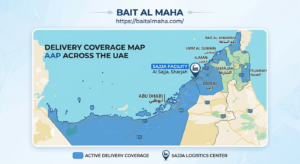
Dubai Wide Service Coverage
| Emirate | Coverage Status | Key Project Types | Delivery Lead Time from Sajja |
| Dubai | Full – primary market | Infrastructure, hospitality, residential, commercial | Same-day to 24 hours |
| Sharjah | Full – adjacent to facility | Industrial, commercial, residential | Same-day |
| Abu Dhabi | Full | Oil and gas, infrastructure, government projects | 1–2 hours transport; same-day delivery |
| Ajman | Full | Industrial, residential | Same-day |
| Umm Al Quwain | Full | Industrial, manufacturing, port projects | Same-day |
| Ras Al Khaimah | Full | Industrial, tourism, cement and quarrying | 1.5–2 hours transport; same-day |
| Fujairah | Full | Port, oil storage, industrial | 1.5–2.5 hours transport; next-day standard |
Reason 8: UAE-Made Means More Than You Think
Why does local UAE manufacturing matter for prefab procurement?
Local manufacturing – specifically Bait Al Maha’s production facility in Sharjah’s Sajja Industrial Area – eliminates three categories of risk that imported prefab consistently introduces:
- Customs clearance delays that can add 2–4 weeks to an already tight mobilization schedule
- Specification mismatches between international building standards and UAE codes that require expensive on-site correction
- Currency risk from foreign-denominated supplier contracts that expose UAE contractors to exchange rate movements
The Middle East and Africa modular construction market was valued at USD 5.98 billion in 2024 and is projected to reach USD 9.04 billion by 2030 at a 5.97% CAGR. As that market has grown, an increasing number of international prefab manufacturers have targeted UAE procurement – offering units manufactured in Turkey, China, or South Asia. These products are often attractively priced. They also carry risks that are not visible in the initial price comparison.
The Imported Prefab Problem
An international prefab unit built to European or South Asian building standards arrives in Dubai with specifications that may not align with UAE requirements in several critical areas:
- Electrical standards – UAE codes differ from both European (IEC) and North American (NEC) standards in earthing requirements, circuit protection, and cable rating conventions. Rewiring before UAE inspection is neither simple nor inexpensive.
- Climate engineering – A unit manufactured in a temperate climate is insulated for ambient temperatures in the range of −10°C to +30°C. That specification does not perform adequately in Dubai’s summer conditions. Retrofitting adequate insulation after delivery is expensive and structurally complicated.
- Documentation gaps – UAE compliance documentation requires specific formats and certifications from recognised UAE testing authorities. International manufacturer documentation does not come in these formats, creating a compliance paper trail inspectors find difficult to verify.
- Lead times – An international order typically requires 6–12 weeks from order to delivery, including manufacturing lead time, sea freight, and customs clearance.
Products That Only Exist Because They Were Designed Here
The cultural fit of Bait Al Maha’s product range is a concrete signal of genuine UAE market expertise:
- Prefabricated mosques as a standard product line demonstrate that the product development team has thought about what a UAE construction workforce actually needs – not what a generic international catalogue provides.
- Majlis units, maid rooms, and driver accommodation are products that only make sense if you understand the UAE residential market. These use cases simply do not exist in the home markets of international prefab manufacturers.
Local Dubai Manufacture vs. Imported Prefab: Head-to-Head
| Comparison Factor | Imported Prefab (Turkey, China, South Asia) | Bait Al Maha (UAE, Sharjah) |
| Order-to-delivery timeline | 6–14 weeks (manufacturing + shipping + customs) | 2–15 days depending on configuration |
| Customs clearance risk | Present – delays unpredictable; 2–4 weeks not unusual | None – domestic supply chain |
| Electrical specification | Wired to home-country standard; may require rewiring | Factory-wired to UAE Standards (UAE.S) |
| Insulation specification | Designed for exporting country’s climate range | Designed for UAE’s 45–50°C summer conditions |
| UAE compliance documentation | International formats; UAE conversion often required | UAE formats, UAE authority certifications, DM-ready |
| After-sales support | Offshore; local agent may lack technical capability | In-country team with full technical knowledge |
| Culturally specific products | Not available | Available as standard products |
| Currency of contract | Foreign currency (USD, EUR, CNY) – FX exposure | AED – no currency risk for UAE contractors |
| Supply chain resilience | Vulnerable to port congestion and geopolitical disruption | Local – insulated from global supply chain disruption |
When viewed across all these factors – not just the line-item unit price – the case for locally manufactured UAE prefab is not about preference. It is about risk reduction, lead time certainty, compliance confidence, and total cost of ownership.
How to Evaluate Any Prefab Supplier in Dubai: A Contractor’s 7-Point Checklist
Most contractors evaluate prefab suppliers the same way they evaluate any trade contractor: price, lead time, and a phone call with a sales representative. That process is not adequate for a procurement decision that carries as much compliance risk as prefab accommodation in Dubai.
Step 1: Verify Dubai Municipality Compliance Documentation Before Anything Else
Ask for the compliance documentation package for a comparable unit. It should include:
- Structural load certifications referenced to UAE Standards
- MEP installation specifications with UAE Standards document numbers
- DM inspection records from prior deployments of comparable units
- Fire safety compliance documentation from Dubai Civil Defence
A supplier who cannot produce this documentation on request – not after a delay, not with a promise to send it later – is a supplier who has not submitted their products for formal compliance review.
Step 2: Confirm the Climate-Rated Insulation Specification
Ask specifically:
- The insulation type (polyurethane, rock wool, mineral fill)
- The insulation core density in kg/m³
- The thermal resistance (R-value) of the panel assembly
- The maximum ambient temperature the system is rated for
A supplier who understands the UAE market will answer these questions with specifics and documentation.
Step 3: Check That the Full Product Range Matches Your Project Phases
Confirm whether this supplier can provide everything your project needs from a single contract:
- Security cabins, site offices, accommodation blocks, and sanitation units
- Dining facilities, prayer facilities, and welfare rooms
- All unit types with consistent compliance documentation covering the entire site
Step 4: Confirm UAE-Wide Service and Maintenance Coverage
Before committing to a supplier, clarify:
- Where is their service team physically based?
- What is the committed response time for a maintenance issue at your site location?
- Do they have documented experience with projects in your emirate and project type?
- What does their mid-project maintenance service include?
Step 5: Review Warranty Terms for Both New and Refurbished Units
For new units, confirm:
- What does the structural warranty cover, and for how long?
- What is the MEP warranty period and scope?
- What is the claims process and committed response time?
For refurbished units specifically, also confirm:
- What was the documented scope of the refurbishment on this specific unit?
- Which components were replaced and which were retained?
- What certification documentation exists for the reconditioning work?
Step 6: Assess the Relocation and End-of-Project Policy
Establish clearly before contract signature:
- Does the supplier manage the teardown and transport at project close?
- What is the additional charge for relocation, or is it included in contract terms?
- Can units be redeployed directly to your next project site?
Step 7: Confirm Single-Vendor Capability and Contract Simplicity
Ask directly: how many contracts, delivery schedules, and DM documentation packages will you be managing?
A supplier who can cover the entire site requirement under one contract removes administrative complexity from a procurement team already managing multiple workstreams.
Red Flags to Watch For
The following signals should prompt serious reconsideration of any prefab supplier in Dubai:
- No compliance documentation available on request
- Vague or non-specific answers to insulation specification questions
- No service team physically based in the UAE
- No documented experience with DM inspection processes
- Prices significantly below market (usually explained by a specification equally below market)
- International manufactured units presented without UAE adaptation and compliance documentation
- Inability to name the relevant UAE Standard (UAE.S) documents applicable to their products
What Makes Bait Al Maha a Trusted Name in UAE Construction
Why does trust matter so much in the Dubai prefab market?
In a market where:
- Compliance failures result in stop-work notices
- Project delays carry daily financial penalties
- A worker welfare incident can damage a contractor’s standing with Dubai Municipality permanently
…the choice of prefab supplier is not a minor commercial decision. It is a risk management decision.
Established Presence in the UAE Market
Bait Al Maha is not a newcomer to the UAE prefab sector. Operating from its Sajja Industrial Area facility in Sharjah, the company has navigated multiple cycles of regulatory change – including successive tightening of MoHRE worker welfare standards and the ongoing evolution of Dubai Municipality’s accommodation licensing framework.
That longevity means knowing:
- What inspectors look for beyond the documented checklist items
- What documentation needs to say to support a first-pass approval
- Where the most common failure points lie in UAE prefab accommodation
What Contractors Say About Working with Bait Al Maha
Contractors who return to Bait Al Maha for multiple projects consistently describe the same experience:
- Responsive communication when issues arise – not delayed responses routed through a call centre
- Technical knowledge that extends well beyond sales-level familiarity with the product range
- An after-sales posture that treats problems as their responsibility to resolve, not the contractor’s problem to manage alone
Procurement managers specifically highlight three qualities that distinguish Bait Al Maha from other suppliers:
- Compliance documentation accuracy – DM documentation packages consistently pass inspection review without the back-and-forth that other suppliers’ paperwork generates
- Thermal specification integrity – AC and insulation specification holds up through a UAE summer without requiring field modifications
- Delivery reliability – Units arrive when committed
Sectors Served and Project Types
Bait Al Maha’s client base spans the full range of Dubai and UAE construction activity:
- Infrastructure and civil engineering – Roads, bridges, utility corridor projects, metro and rail infrastructure where large-scale labor camps are required for 24–36-month programmes
- Oil, gas, and industrial – Pump station sites, pipeline projects, and refinery maintenance programmes requiring explosion-rated electrical specifications and specific setback distances
- Hospitality and tourism development – Hotel construction sites across Dubai’s coast and desert resort developments, where site infrastructure is visible to the developer’s client team throughout construction
- Residential and villa development – Across Dubai’s villa communities, townhouse developments, and high-rise residential towers; maid rooms, driver accommodation, and compact site offices
- Commercial and mixed-use – Downtown Dubai, Business Bay, DIFC, and Dubai South – where the prefab footprint is constrained and management accommodation needs to reflect project quality
- Government and public infrastructure – Large-scale public works with workforces of 500–2,000+ workers across 3–5-year project durations
Active Digital Presence and Verifiable Market Standing
Bait Al Maha’s standing in the UAE prefab market is verifiable through multiple independent channels:
- Google Business profile – carries reviews from verified clients across UAE construction sectors
- Instagram: @baitalmaha.prefab – documents regular product deliveries, project completions, and new unit types
- Facebook: facebook.com/baitalmaha.uae – an active, operational business with a consistent and documented posting history
For contractors conducting due diligence, these channels provide independent verification that a supplier comfortable with being evaluated publicly is itself a meaningful trust signal.
Frequently Asked Questions
What is the difference between a portacabin and a modular building?
A portacabin is a portable, self-contained prefabricated unit – typically a single structure on a chassis or base frame – that can be moved as a complete unit using a crane or flatbed transport. Best suited to single-function applications such as site offices, security booths, and individual accommodation rooms.
A modular building is an assembly of multiple prefabricated modules combined on-site to create a larger structure, often across two or more storeys. Used for larger, more complex structures such as full labor camps or multi-function site villages.
Both options are available from Bait Al Maha.
How much does a prefab labor camp cost in Dubai?
The cost depends on:
- Number of workers being accommodated
- Specification of the units
- Whether new or refurbished stock is selected
- Project duration or asset life being planned for
Bait Al Maha provides bespoke pricing based on your specific project brief. The most accurate route to a cost figure is a consultation with their team, supported by your floor plan, workforce numbers, and project duration.
Do prefab buildings in Dubai require Dubai Municipality approval?
Yes. All labor accommodation in Dubai must be licensed by Dubai Municipality. The licensing process involves inspection against:
- Technical Guidelines for Labour Accommodation Compliance
- UAE federal worker welfare standards
- Dubai Civil Defence fire safety requirements
- MEP codes applicable in Dubai
Bait Al Maha provides the compliance documentation package that supports this process with every unit supplied.
How long does it take to install a portacabin in Dubai?
- Single portacabin: Typically delivered and installed in a single working day, subject to site access, crane availability, and MEP connection preparation
- Larger configurations (full labor camp): Typically several days to position, connect, and commission
Can prefab cabins withstand Dubai summer temperatures?
Yes – when properly specified. Prefab units with ACP cladding and high-density insulation panels can maintain habitable interior temperatures in UAE summer conditions. Standard single-skin steel units without adequate insulation cannot.
All Bait Al Maha units are specified for UAE climate conditions as a standard product requirement – not as an optional upgrade.
Is it better to buy or rent a portacabin for a construction project in the UAE?
A practical framework:
- Projects longer than 12 months → Purchase (new or refurbished) typically delivers better total-cost economics
- Projects under 6 months → Rental provides appropriate flexibility without a capital commitment
- Bridge situations → Rent while the permanent prefab solution is being specified and produced
Bait Al Maha offers all three options, allowing the right model to be matched to each project phase individually.
What worker welfare standards apply to prefab labor camp accommodation in the UAE?
Under Federal Decree-Law No. 33 of 2021, minimum requirements include:
- Space: Minimum 3–4 sq m of personal space per worker
- Occupancy: Maximum 10 workers per room
- Cooling: Mandatory air conditioning in all sleeping areas
- Ventilation: Adequate natural ventilation and lighting throughout
- Sanitation: 1 toilet + 1 shower per 8–10 workers
- Facilities: Dedicated kitchen, dining area, and prayer room
- Medical: Access to a clinic within or near the camp
Companies with 50 or more workers earning AED 1,500 or below per month are required to provide accommodation meeting these standards.
Does Bait Al Maha supply prefab buildings outside Dubai?
Yes. Bait Al Maha supplies and services prefab units across all seven Emirates – Dubai, Abu Dhabi, Sharjah, Ajman, Umm Al Quwain, Ras Al Khaimah, and Fujairah – from their production facility in Sharjah’s Sajja Industrial Area. The company also serves project needs in wider GCC markets.

Your Next Prefab Project in Dubai: What to Do Before Mobilization Day
Bait Al Maha is a UAE-based prefab manufacturer and supplier that provides Dubai Municipality-compliant portacabins, modular labor camps, and site offices across all seven Emirates, with delivery achievable within 48 to 72 hours of order confirmation for standard unit configurations.
The one piece of advice that experienced UAE construction procurement managers consistently offer:
Do not start the supplier conversation at tender award. Start it at tender submission.
The contractor who talks to their prefab supplier during the tender phase already knows:
- Realistic delivery lead times for the configuration they need
- That a compliant documentation set will be ready for the DM site file
- That the mobilization plan is achievable – not just optimistic
The contractor who calls for the first time on the day of project award is immediately behind schedule on a mobilization clock that has already started.
Three Practical Next Steps for Your Team
- If you have a floor plan – Share it with Bait Al Maha directly. Floor plan + expected worker population + project duration + site location = an accurate layout proposal and cost estimate. Their response time on a properly specified brief is typically within 24 hours.
- If you are still in the tender phase – Request the compliance documentation package for the unit types you will need. Reviewing compliance documentation before winning a project means you enter the execution phase with a pre-vetted supplier who has already demonstrated regulatory readiness.
- If you have an existing supplier but want a comparison – Bait Al Maha will review your current specification against their equivalent offering, covering compliance documentation, MEP specification, insulation rating, and total cost of ownership across new, refurbished, and rental options.
The decision of which prefab supplier to work with is not one to be made on the morning of mobilization. It is a project infrastructure decision – and the best time to make it is well before the pressure begins.
Explore Bait Al Maha’s Product Range
- Porta Cabin Suppliers in Dubai – The complete portacabin range with sizes, specifications, and use cases for site office and accommodation applications
- Container Solutions Dubai – ISO container conversions for storage, specialist offices, and on-site industrial applications
- Affordable Refurbished Portacabin Dubai – The refurbished stock range with specifications, compliance details, and warranty information
- Caravan House – Mobile accommodation solutions for residential and project staff applications.


